Introduction
During studies of the genus Buellia s. lat. in the Iberian Peninsula (Giralt et al. Reference Giralt, Barbero and Elix2000a) we examined specimens of an interesting corticolous species, previously identified as Rinodina biloculata (Nyl.) Sheard. Because of its ecological requirements, we were convinced that further material would be located, either during subsequent fieldwork in similar habitats or in herbaria, probably included under other names, possibly as R. pyrina (Ach.) Arnold or R. biloculata. Up to now, no further collections have been found and the specimens are described here as a new species.
Material and Methods
This study was based on herbarium material from the private herbaria of the second author (P. P. G. van den Boom). The specimens were examined by standard techniques using stereoscopic and compound microscopes. Only free ascospores lying outside the asci have been measured and measurements were made at ×1000 magnification on material mounted in water. Mean value (M) and standard deviation (SD) were calculated and the results are given as (minimum value observed) M ± SD (maximum value observed). M, SD and n (the total number of ascospores measured) are given within parentheses. The terminology used for the proper excipulum follows Bungartz et al. (Reference Bungartz, Nordin, Grube, Nash, Ryan, Diederich, Gries and Bungartz2007), for the asci Rambold et al. (Reference Rambold, Mayrhofer and Matzer1994) and for the ascospore-type and their ontogeny Giralt (Reference Giralt2001).
Secondary chemistry was checked by high performance liquid chromatography (HPLC) (Elix et al. Reference Elix, Giralt and Wardlaw2003).
The Species
Amandinea myrticola Giralt, van den Boom & Elix sp. nov
MycoBank no. 518625
Thallus crustaceus, tenuis, griseus, sine substantia metabolica secundaria. Apothecia nigra, lecideina, epruinosa, 0·1–0·3 mm diametro, juvenilia cum margine pseudothallino tenuissimo. Ascosporae typo Physconiae, 11–15 × 4·5–6·5 µm [M = 12·4 × 5·6 µm; SD = 1·3 × 0·5 µm; n = 75], juveniles septo crasso (polariloculares), laeves. Conidia filiformia, ± 20 × 1 µm.
Typus: Portugal, Alentejo, SE of Alvito, S Side of Barragem Odivelas, E of campsite, SW slope with Quercus ilex, Cistus ladanifer, Myrtus communis and pebbles, on Myrtus communis, 100 m, 8°05.6W, 38°10.9′N, 11 July 1995, P. P. G. van den Boom 17189 (GZU—holotypus; BCN & hb. van den Boom—isotypi).
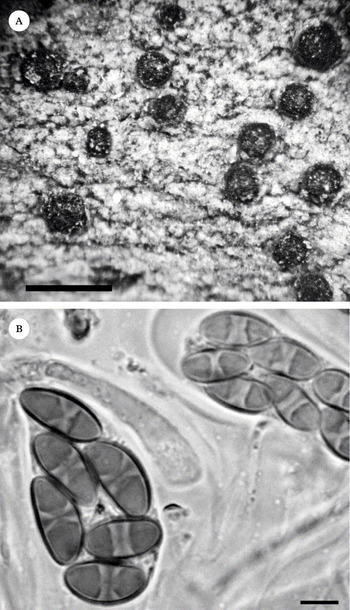
Amandinea myrticola (holotype). A, habitus; B, Physconia-type ascospores showing a thick septum and pronounced median wall thickenings [= polarilocular ascospores with long and narrow lumina canals]. Scales: A = 500 µm; B = 10 µm.

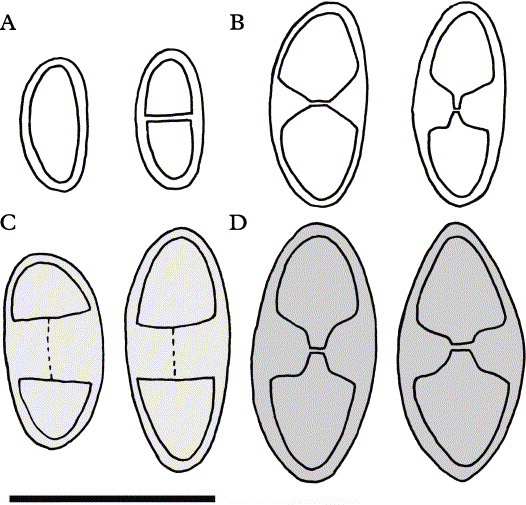
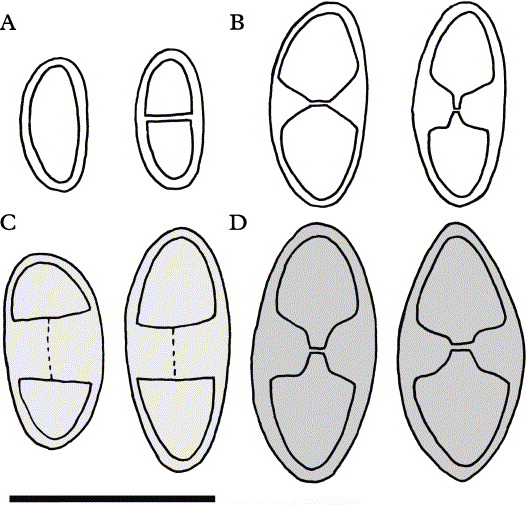
Amandinea myrticola, ascospore ontogeny and variability (holotype). A, Type-A ontogeny [the septum is inserted before any inner wall thickening has become distinct]; B, immature, hyaline Physconia-type ascospores with median wall thickenings becoming successively more pronounced during development; C, young, slightly pigmented Physconia-type ascospores typically polarilocular with nearly inconspicuous long, very narrow lumina canals; D, mature, brown pigmented, Physconia-type ascospores showing the shorter, thicker lumina canals and the septal pore. Scale = 10 µm.
Thallus corticolous, episubstratal, crustose, continuous, very thin (25–50 µm thick), smooth to minutely rugose, grey, covering large areas (Fig. 1A). Prothallus absent. Medulla not amyloid (I−), lacking calcium oxalate (H2SO4−). Photobiont chlorococcoid, up to 25 µm diam.
Apothecia initially apparently lecanorine, surrounded by a thin and entire pseudothalline margin concolorous with the thallus, becoming lecideine, adnate to sessile, scattered, 0·1–0·2(–3) mm diam. Disc dark brown to blackish, epruinose, plane to convex. Proper margin thin, not persistent. Proper excipulum poorly developed, ± aethalea-type, 20–30 µm wide, prosoplectenchymatous, inner cells elongate, hyaline, outermost cells short, swollen, brown. Hymenium colourless, 50–60 µm high, not inspersed with oil droplets. Hypothecium dark brown, (30–)50–70 µm deep. Paraphyses apical cells 3–5(–6) µm diam., with dark brown cap. Asci 8-spored, Bacidia-type. Ascospores Physconia-type (Figs 1B & 2B–D), (10–)11–13·5(–15) × (4·5–)5–6(–6·5) µm [M = 12·4 × 5·6 µm; SD = 1·3 × 0·5 µm; n = 75], ellipsoid, straight or slightly curved, not constricted at septum, torus absent or poorly developed, outer wall smooth at ×1000. Immature, hyaline ascospores with median wall thickenings becoming successively more pronounced during development (Fig. 2B); young, slightly pigmented ascospores with a thick septum and very pronounced median wall thickenings, typically polarilocular (or placodiomorphic) with nearly inconspicuous long, very narrow lumina canals (or isthmus) (Fig. 2C); mature ascospores with a thinner septum and less pronounced median wall thickenings, with shorter, thicker lumina canals (Fig. 2D). Ascospore-ontogeny of type A (Fig. 2A).
Pycnidia subimmersed, 0·01–0·02 mm diam.; conidiophores type III (Vobis Reference Vobis1980). Conidia filiform, mostly strongly curved, c. 20 × 1 µm.
Chemistry. Thalline and apothecial reactions all negative; no substances detected by HPLC.
Ecology and distribution. At present A. myrticola is known only from the type and one additional locality, both in Alentejo (Portugal). It grows on smooth bark of the twigs of Myrtus communis and Pinus sp., accompanied by typically pioneer, acidophilous species including Amandinea punctata s. lat., Lecanora strobilina (Spreng.) Kieff., L. conizella Nyl., Lecidella elaeochroma (Ach.) M. Choisy and Rinodina freyi H. Magn. Some other taxa present at these localities on another phorophyte (Quercus ilex) included Caloplaca cf. pyracea (Ach.) Th. Fr., C. obscurella (J. Lahm) Th. Fr., Parmotrema reticulatum (Taylor) M. Choisy, Rinodina capensis A. Massal. and Waynea stoechadiana (Abassi & Cl. Roux) P. Clerc & Cl. Roux. Additional species on Cistus ladanifer were Flavoparmelia soredians (Nyl.) Hale, Lecanora albella (Pers.) Ach., L. expallens Ach. and Parmotrema hypoleucinum (J. Steiner) Hale.
Observations. Amandinea myrticola is characterized by the thin, grey thallus lacking secondary metabolites, the small apothecia with a pseudothalline margin when immature and, in particular, by the small, smooth Physconia-type ascospores, which exhibit a thick septum and pronounced median wall thickenings (= typically polarilocular with long and narrow lumina canals) at all ontogenic stages.
Physconia-type ascospores are those that have inner wall thickenings ± pronounced only at the septum (Fig. 2D) and, also occasionally at the apices, although these are rather weak and are only observed briefly during the ascospore development (Giralt Reference Giralt2001). Physconia-type ascospores with a very thick septum and long and narrow lumina canals (= polarilocular, Figs 1B, 2C) have often been called Orcularia-type (e.g. Mayrhofer & Poelt Reference Mayrhofer and Poelt1979, Mayrhofer Reference Mayrhofer1984, Blaha Reference Blaha2002). However, in the strict sense, Orcularia-type ascospores follow a different ontogeny from the Physconia-type and, hitherto, have only been observed in taxa of section Orcularia Malme, for example Rinodina biloculata. Malme (Reference Malme1902) segregated these species from other sections of Rinodina because of their polarilocular ascospores and the brown hypothecium (cf. Sheard Reference Sheard1967). In ascospores with Physconia-type ontogeny, the septum is inserted before any inner wall thickening appears (Fig. 2A), whereas in Orcularia-type ascospores, the septum is inserted after lateral inner wall thickenings become distinct (compare the Orcularia-type ascospore-ontogeny of R. biloculata in Giralt & Matzer Reference Giralt and Matzer1994, fig. 2C: 322; Giavarini et al. Reference Giavarini, James, Purvis, Smith, Aptroot, Coppins, Fletcher, Gilbert, James and Wolseley2009, fig. 47: 814; and of Amandinea insperata (Nyl.) H. Mayrhofer & Ropin in Marbach Reference Marbach2000, Abb. 25: 79). Consequently, immature uniseptate ascospores with pronounced lateral thickenings (with a single lumina ± bone-shaped) are common and very characteristic in the Orcularia-type but absent in the Physconia-type.
Because of their polarilocular ascospores, the specimens of Amandinea myrticola were identified as Rinodina biloculata, with Orcularia-type ascospores. Apart from the different ascospore-type, R. biloculata can easily be separated from A. myrticola by the larger ascospores, of 12–18 × 7–10 µm, which are ± citriform in shape and, according to Giavarini et al. (Reference Giavarini, James, Purvis, Smith, Aptroot, Coppins, Fletcher, Gilbert, James and Wolseley2009), the bacilliform conidia.
Amandinea myrticola can also be mistaken for Rinodina pyrina but this species has larger and typically lecanorine apothecia, a colourless hypothecium, Lecanora-type asci and bacilliform conidia.
Other corticolous Amandinea species present in the area included the polymorphic A. punctata s. lat. and A. crassiuscula Giralt & Etayo. Both are distinguished from A. myrticola by the larger Buellia-type, ascospores (Scheidegger Reference Scheidegger1993; Bungartz et al. Reference Bungartz, Nordin, Grube, Nash, Ryan, Diederich, Gries and Bungartz2007). Further, A. crassiuscula has strongly ornamented ascospores and a thickly crustose to subsquamulose thallus (Giralt et al. Reference Giralt, Etayo and Gómez-Bolea2000b). According to Sheard & May (Reference Sheard and May1997), Marbach (Reference Marbach2000), Blaha (Reference Blaha2002), Hafellner (Reference Hafellner2004) and Bungartz et al. (Reference Bungartz, Nordin, Grube, Nash, Ryan, Diederich, Gries and Bungartz2007), there are no other species of Amandinea morphologically similar to A. myrticola.
Additional specimen examined. Portugal: Alentejo: SSW of Évora, SE of Alvito, S side of Barragem Odivelas; valley W of dam, various trees along small fen (young Fraxinus, Pinus, Salix), on Pinus twig, 75 m, 8°06.9′W, 38°11.0′N, 10 July 1995, P. P. G. van den Boom 17152 (hb. van den Boom).
The first author is grateful for funding of project CGL2007-66734-C03-02/BOS by the Spanish Government. We thank Harrie Sipman for assistance with the Latin diagnosis.