The roots of the political science discipline are intertwined with developing the skills required for democratic citizenship. Teaching and research efforts in this admirable tradition are still a prominent focal point of our academic tradition, as evidenced by the work of the APSA Task Force on Civic Education, reoccurring arguments about the most effective pedagogy for promoting participation, and works assessing the effects of civic education interventions. Moreover, this tradition has become increasingly relevant as political participation in the United States, especially among young people, continues to decline. Panel studies of college freshmen indicate that young people's participation in an array of political indicators—including thinking that keeping up with politics is important, discussing politics with friends, and acquiring political knowledge—have all declined by about half since the 1960s (Sax et al. 2003). Far more young people voted in 2004 than in the past, as turnout by 18–24 year-olds increased from 36% in 2000 to 42%, but younger citizens' appearance at the polls still lagged behind prior cohorts of young Americans, as well as their current elders (CIRCLE 2005). Educators and policy makers have come to the conclusion that intervention through formal civic education is necessary (Carnegie Corporation of New York and CIRCLE 2003; Galston 2003). Spurred on by works such as Educating Citizens (Colby, Ehrlich, Beaumont, and Stephens 2003) and Civic Responsibility in Higher Education (Ehrlich 2000), many colleges and universities have reinvigorated their mission of grooming students for civic leadership. Most of the skills identified as essential to such efforts could be labeled as deliberative communication skills. As the Colby et al. (2003) note:
Fully effective citizenship requires a well-developed capacity for effective communication including, moral and political discourse; skills in political participation; the capacity to work effectively with people, including those who are very different from oneself; and the ability to organize other people for action. (100)
Hence, research on deliberative communication skills may serve as an important resource for political scientists interested in youth participation and civic education.
The Need for Deliberative Civic Education
The argument that effective citizenship ought to be promoted by enhancing citizens' deliberative, communication skills is certainly not a new one in the United States (Barber 1984; Fishkin 1991; 1995; Gastil 2000; Gastil and Dillard 1999; Matthews 1994; McMillan and Harringer 2002; Ryfe 2005). Yet this approach should play an especially important role in higher education's efforts to produce civic leaders for two reasons. First, deliberative civic education addresses skills that are under-emphasized in other civic education traditions. Formal efforts to cultivate good citizenship have traditionally been dominated by liberal political theory, which focuses on knowledge of government institutions and individual rights (Boyte 2003). The emerging alternative to liberalism is communitarian political theory, which is based on the argument that “America suffers from excessive individualism” (Boyte 2003, 88). Hence, these civic education efforts encourage students to develop connections to their communities, often via service-learning experiences. Research documents the benefits of participating in formal learning experiences framed around both approaches (Cogan et al. 2001; Niemi and Junn 1998; Youniss and Yates 1997). Yet neither focuses on teaching the specific set of communication skills required for effective civic leadership. The first emphasizes individual means of and reasons for participation in politics, without stressing the role effective collective action plays in empowering citizens. The latter, meanwhile, emphasizes the collective nature of public life, but downplays the role of group-based activities to develop and pursue an explicitly political agenda.
The second reason for turning to deliberative civic education is that historical circumstances framing young generations' political socialization, as well as young citizens' own descriptions of their political experiences, suggest it addresses their specific needs. A variety of explanations have been provided for these generations' low levels of participation. Yet when asked to explain their lack of interest in politics, young people indicate that they do not believe their involvement will make any difference (National Commission on Civic Renewal 1988). Findings from large-scale focus groups conducted by the Kettering Foundation reveal that young people are pessimistic about their ability to promote solutions to problems that worry them (Matthews 2000). Moreover, even when the young people involved in this study imagined attempting to address a political issue, their responses revolved around individual political acts. In summarizing this data, Matthews concludes, “the perception that they [young people] were lone individuals up against an impregnable megalith, surely contributed to their sense of powerlessness” (152).
Average people, who lack influential connections or access to financial resources, must rely on the power of numbers in a democracy (Jacobs and Skocpol 2005). Even though the most effective way to make government more responsive to average citizens is to “nourish” grass-roots organizations (Putnam 2000b), many young people appear to be distrustful of group processes. They are afraid their own best interests will not be served by the “whims of collective decision-making,” and they do not want to be tied to decisions that “might restrict their individual progress and success” (McMillan and Harringer 2002, 244). These characteristics suggest young people may not have interacted in enough group settings while coming of age to develop the trust in others essential for effective collective political action efforts (Brehm and Rahn 1997).
These characteristics may well be the result of the historical circumstances framing younger citizens' political socialization. Some scholars conclude America's youngest cohorts have been socialized at a time of declining associational life (Putnam 2000a; Skocpol and Fiorina 1999), while those who question the claim of decline generally acknowledge that American associational life has been “churning” as older groups and community organizations are replaced with newer versions (Ladd 1999). Even if such replacement is occurring, the beneficial effects of participating in older youth organizations, such as 4-H, the Scouts, or YMCA, have been well-documented, while the impact of newer organizations, such as soccer clubs, has yet to be assessed (Youniss, McLellan, and Yates 1997). Anecdotal evidence, for example, indicates that some of today's young people have been overscheduled with individual lessons and tutoring sessions since childhood (Brooks 2001). Yet these activities teach skills that promote individualized professional advancement, not collective decision-making. Hence it is possible that young people have such low levels of efficacy because they have not learned how to participate effectively within groups—either for the purposes of identifying a common agenda or for pursuing it through collective means.
Regardless of the source of such youth characteristics, however, deliberative civic education efforts specifically address the self-described shortcomings of current young people's political socialization by formally teaching deliberative communication and collective action skills. Moreover, in addition to a lack of internal political efficacy, young people lack external political efficacy as they are distrustful of established political institutions and figures. They claim to prefer bottom up versions of leadership, which—despite their animosity toward group processes—are far more amenable to collective grassroots processes (Gibson 2001). Hence, deliberative civic education, when it is explicitly tied to collective action efforts, has the potential to provide young people with an attractive model for wielding political influence.
Implementing Deliberative Civic Education
Yet research on deliberative civic education provides mixed assessments. Hahn (1998) links in-class deliberation to attitudes indicative of future political participation, while others find that deliberative exercises can improve the capacity to act as informed citizens (Reeher and Cammarano 1997). Yet the results of more prominent, deliberative initiatives, aimed primarily at adult citizens, have had mixed results, suggesting that the development of more “sophisticated, tolerant and participative citizens” through such efforts may be quite rare (Ryfe 2005, 50). Many such encounters leave citizens more anxious and frustrated than they were prior to the intervention (Ryfe 2005). Gastil (as cited by Gastil and Dillard 1999), for example, not only failed to find a significant relationship between the National Issues Forum and future political activity, he also found that participation appeared to exacerbate cynicism about the effectiveness of group political action. Hence Gastil and Dillard (1999) call for research efforts that address “whether participation in political group discussion is often as discouraging as it is educational” (190).
Such outcomes may occur because most deliberative initiatives focus on process rather than practical outcomes, as they are dedicated to enhancing citizens' deliberative skills without the opportunity to wield real political influence (Warren 2001). In some cases, deliberative initiatives also serve a consultative function, as citizens offer their conclusions to policymakers. But policymakers are typically not required to follow citizens' advice (Ryfe 2005). In short, most deliberative initiatives are divorced from the traditional mechanism of citizen influence—collective action activities.
Divorcing opportunities for deliberative skill building from actual political influence is apt to have three negative effects on outcomes. First, deliberation requires hard work and almost certain social discomfort. Hence, people will lack the motivation to deliberate with one another unless their efforts are tied to an outcome that is important to them (Ryfe 2005). Second, while average people will decline to participate without proper motivation, those who like to argue or who have intense opinions will be apt to dominate the process. Under this scenario, “the goal of finding real common ground is subjugated to a false consensus imposed by those with greater oratory skills” (McMillan and Harringer 2002, 245). Such a dynamic can be difficult to prevent when people lack experience collaborating in groups. When it occurs, a decreased faith in the effectiveness of group political activities would be a likely outcome. After all, why would average participants place their faith in a process where they felt dominated by a “well-informed, articulate faction?” (McMillan and Harringer 2002, 243). Finally, even when all participants have been properly motivated to participate in a truly deliberative process, simply turning recommendations over to a public official—who may or may not take them seriously—is also not likely to convince citizens that their hard work has been worth the effort and may once again decrease participants' faith in the effectiveness of group activities.
Teaching deliberative skills as a preliminary step for successful collective action efforts, however, may be the key to preventing all three of these negative outcomes. Recognizing the potential to wield real political influence as opposed to learning beneficial, but purposeless skills, should help motivate participants to engage in a deliberative process. Focusing on the long-term goal of implementing group political activities should help participants realize that mobilization for collective action will not be stimulated simply by winning arguments. If people can be convinced that collective action is a prerequisite to their political power and that true collaboration is essential to such mobilization, they should be less inclined to engage in the types of interactions that damage the perceived effectiveness of group-based political action. Finally, collective action should help to restore the political efficacy that is inevitably diminished when final decisions are simply turned over to government officials.
Similar Successful Approaches in Political Science
Boyte's (2003) framework for civic education efforts, which he labels Democratic Populism, provides a similar emphasis on deliberative communication skills. His approach in projects such as Public Achievement emphasizes teaching the types of practical, participatory skills that enable citizens to engage in collective political efforts. Public Achievement organizes students into teams in order to work on a public issue over the course of a year. Along the way, they are mentored by adults who help them work toward their goals and learn political skills. Not only do such civic education approaches address this particular generation of young people's needs, they correspond to findings on enhancing efficacy and promoting behavioral change. One substantial barrier to processing persuasive messages is a lack of efficacy. Individuals' perceptions of competence affect whether they will be willing to attempt a particular activity. Hence, the factor most likely to impact an individual's sense of efficacy is personal accomplishment because such experiences most vividly demonstrate mastery (Bandura 1977; 1986).
Yet programs based on direct experience, while offering the potential for dramatic impact, require ample financial resources and time commitments. In addition, if participation is voluntary, they are more likely to attract atypical young people who are interested in learning about the political process. If similar types of lessons could be learned by developing a more traditional civic education curriculum, far more members of younger generations could be exposed to an intervention. Alternative sources of learning that enhance efficacy include both verbal persuasion and vicarious learning via simulations and role playing (Bandura 1986; 1977). This work therefore represents a preliminary attempt to develop a curriculum enhancing students' likelihood of participating in public life that could be more widely adopted in formal education settings.
The Curriculum
The opportunity to develop such a curriculum emerged when the University at Albany adopted an oral discourse requirement. To help students fulfill the requirement, several sections of a one-credit class, COM 399, were offered in the fall 2003 and spring 2004 semesters. Each section met for one hour of class time each week. The primary attraction, even for the small handful of political science majors in the class, was fulfilling the new graduation requirement. In short, those who enrolled in the course were not a self-selected group of students interested in civic affairs.
The first three weeks of class were dedicated to readings and discussions that enabled the instructor to incorporate Bandura's (1986; 1977) advice regarding verbal persuasion. Readings, lectures, and discussions were designed to persuade students that deliberative communication skills are worth learning, and, that when combined with collective action strategies, they can be the key to achieving political influence. Course materials addressed generational declines in political participation, as well as potential reasons why current generations of young people have been less inclined to participate in politics than their predecessors. While discussing potential remedies for this problem, the instructor provided examples of the ways that associational life, collective action efforts, and grassroots organizations can empower average people with the hope that students would appreciate the opportunity to develop and hone the deliberative communication skills required to successfully engage in such activities.
The next four weeks of class were dedicated to an assignment that followed Bandura's advice regarding simulations (1986; 1977). To enhance their deliberative communication skills in a simulated setting, students were assigned to small groups and instructed to select and research any public affairs issue. They were asked to develop a group position on the issue and to present this position in class. Students were not charged with developing a plan for implementing their solution, but were required to spend time outside of class developing a collective position acceptable to all members of the group. Unlike many public speaking assignments, the goal here was not to teach students how to argue for their own preferred position. Rather, by tying the outcome of students' interactions to the development of an inclusive, collaborative position, the process was intended to promote the skills of compromise and negotiation that are often required for successful collective action.
The remaining weeks were dedicated to a final assignment that followed Bandura's (1986; 1977) advice regarding role playing. Again, students were asked to select and research any public affairs issue, but were then asked to assume the role of a leader on this particular issue. They were instructed to adopt a position, to develop a plan for taking collective political action, and to deliver a speech persuading their fellow students to enact the desired political action. Grades on this assignment included standard public speaking criteria. However, identifying an appropriate and feasible collective action solution was also a component of the grade on this assignment. This component discouraged students from simply arguing for their own preferred position in a classroom environment entirely removed from political reality. Instead, they were required to consider the practical considerations that come along with efforts to mobilize other citizens for collective action.
Student reactions to the class were investigated via a pre- and post-semester questionnaire. In addition to measuring students' internal and external political efficacy, it explored their trust in others, their attitudes toward a variety of political activities, and their expectations for their future involvement in political and apolitical activities. While students who took the course clearly did not self-select based on their interest in politics, the inability to randomly assign students to the intervention is a clear limitation of this design. In addition, the university offered no comparable one-credit courses at the time, which prevented collection of data from control groups.
A total of 77 respondents completed the questionnaires. The sample reported here was 60% female. Close to 60% were seniors, and the modal age of the respondents was 21, at 41.9%. Students' academic major varied greatly. The mode was psychology, which comprised 23% of the sample. Political science majors represented 10% of the sample. The partisanship of the sample leaned Democratic, with 44.4% of the students self identified as Democrat, 26.4% as Republican, and 29.1% as Independent or Other. The sample was fairly diverse racially; 71.4% were White, 11.4% Latino, and 8.6% African-American.
Findings
Traditional Measures of Internal and External Efficacy
Internal and external efficacy was measured with three 5-point Likert scale questions. Students were asked to indicate their agreement with the claims that “My vote doesn't matter,” and “It is difficult for someone like me to make a difference.” The results of a two-tailed paired samples t test indicate students' internal efficacy in terms of the impact of their vote did not improve by the end of the semester. The degree of difficulty students believed they would have making a difference also failed to improve. Finally, external efficacy was consistent across the semester. Students maintained cynical attitudes about the government bodies, as they were inclined to agree with the statement that “Government is run by a few big interests” at both points in time.
In general, COM 399 students' attitudes were similar to their national counterparts: They were cynical about government institutions, had limited faith in the effect of voting, and believed it is difficult to influence political outcomes.
Attitudes toward Collective Participation
Students' orientations to collective political participation were also assessed using 5-point Likert scales. Contrary to expectations, there was little room to improve students' acceptance of collective action as an effective strategy. These attitudes did not improve across the semester, as students strongly agreed with the claim that “Working with others is the best way to get things done,” at both points in time.
In order to be willing to engage in group politics, however, citizens must trust each other to contribute fairly. Students were asked to indicate their agreement with the statement that “In general, most people can be trusted.” Working together in groups and considering past collective action successes did help improve students trust in others, as more students agreed with this claim by the end of the semester than at the beginning.
Students already accepted the claim that group participation was essential to effective participation. Yet their willingness to engage in collective acts was potentially enhanced by participating in COM 399 activities that required successful interaction with others.
Perceived Effectiveness of Collective Political Activities
COM 399 was also designed to convince students that activities other than voting could provide effective ways to influence political outcomes. To measure success in this endeavor, students were provided with a list of potential political activities and asked to assess their effectiveness on a 3-point Likert scale. The array of activities, which focused on group rather than individual participation, included: attend a meeting, speak out at a meeting, sign a petition, join a local group, and attend a demonstration. As Table 1 indicates, students were largely convinced that collective political activity was apt to be effective at the local level. This assessment left little room for improvement across the semester.
Effectiveness of Tactics at the Local Level

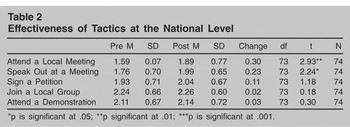
Yet Table 2 demonstrates that students were less convinced of collective tactics' effectiveness at the national level. In the pre-test, students ranked every single collective tactic as less effective at the national level than at the local level. Yet in the post-test, signing a petition, joining a local group, and attending a demonstration were all perceived to be just as effective at the national level as they were at the local level.
Effectiveness of Tactics at the National Level

The two most deliberative activities—attending a local meeting and speaking out at a meeting—were perceived to be the most effective local tactics both before and after the class. Interestingly, they were also perceived to be the least effective national tactics at the beginning and at the end of the class. Yet student assessments of these two tactics and their potential impact on national political issues improved significantly across the semester.
Anticipated Apolitical and Political Participation
COM 399 also attempted to make students feel more comfortable engaging in collective political activities. Given younger generations' tendencies to prefer apolitical volunteer activities, students were asked to report their likelihood of participating in a long list of both political and apolitical activities. Their intentions were measured on 5-point Likert scales.
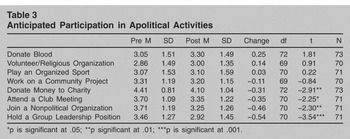
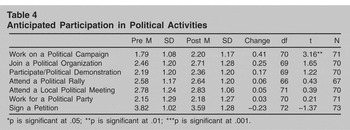
In general, many students expected to participate in a wide range of community and political activities. Consistent with other recent surveys of young people, however, Tables 3 and 4 indicate that COM 399 students intended to concentrate their efforts on local volunteer activities. In the pre-test, far more students claimed that they anticipated participating in an array of apolitical activities. The most popular apolitical activity was donating money to charity, while the least popular was volunteering at a religious organization. Aside from signing a petition, students were far less likely to claim that they expected to participate in any explicitly political activities.
Anticipated Participation in Apolitical Activities

Anticipated Participation in Political Activities

Despite some fluctuations, this gap in favor of apolitical activities still existed after students participated in COM 399. Once again, aside from signing a petition, none of the political activities achieved the popularity of apolitical activities.
An initial assessment of students' expectations of their participation in public life appears to contradict the desired influence of the course; ordering potential activities according to both pre- and post-test rankings places the most explicitly political activities at the bottom of the list. Yet comparing patterns across the semester in both categories provides a more optimistic conclusion. Students' preferences for future activities shifted, with support for some activities eroding and others increasing. In this broader context, the most notable pattern is the erosion of support for several apolitical activities. Students were less likely to anticipate donating money to charity, attending a club meeting, joining a nonpolitical organization, and holding a group leadership position.
Initially, this finding was troubling, as the intervention was not intended to decrease participation in apolitical activities likely to have positive influences on students' future involvement in community life. The reason for this decline remains unclear. Yet conversations with a small number of students at the close of the semester provide some opportunity for speculation. These students offered the explanation that the pre-test was administered at the beginning of the semester, at a time when they had more ample leisure time, while the post-test was administered during the last week of class when they were stressed for time and preoccupied with final exams.
In stark contrast to these apolitical activities, however, students' anticipated participation in every explicitly political activity aside from signing a petition was at least maintained. Furthermore, as Table 4 indicates, more students expected to work on a political campaign at some point in the future. While subtle, the patterns emerging for anticipated political participation appear more relevant when compared to the declines experienced in apolitical activities across the course of the semester. Hence, students appeared at least somewhat responsive to course messages that organized political activities are effective vehicles for change.
Discussion
The finding that students' political efficacy failed to improve significantly is a disappointing, although not surprising, outcome. Political efficacy is an attitude based on long-term socializing agents. A one-credit course simply cannot compete. Promoting collective action as an effective political strategy was a more realistic goal, and the course was more successful in this agenda. Contrary to concerns that have often plagued deliberative civic education efforts (Ryfe 2005), students' trust in others was enhanced, and they became more optimistic rather than more cynical about group political activities. Students either maintained or increased their appreciation for activities requiring collective participation, especially those with a deliberative component. Finally, students' projected likelihood of working on a political campaign, one of the most intensive means of political involvement, increased.
While students' anticipated future activities centered on volunteering in apolitical settings, these activities were typically less popular in the post-test. Yet students' consistent support for political activities is all the more striking in the face of this decline, and suggests the course helped to protect anticipated political participation from further erosion. Ideally, participating in classes like COM 399 could set the stage for the types of life experiences that will affect students' political efficacy. If they continue to hone their deliberative skills, the skills students learned in the classroom could help them to be more successful in these endeavors. As a result, their cynicism toward political participation could gradually be replaced as they become accustomed to wielding political influence. As Colby et al. (2003) suggest, the impact of college experiences may not take immediate effect. Rather, lessons learned in college may “shift graduates' trajectories just a bit and give them new ways of responding to later experiences … so that the shift in direction will be magnified over time and the long-term impact significant” (276).
Given this important potential, political scientists should consider emphasizing deliberative and collective action skill building in their courses. Many colleges and universities include public speaking in their liberal arts requirements, while others are moving to adopt one-credit oral discourse requirements. Political scientists should seek out opportunities to teach these requirements in collaboration with communication professors to ensure that the students learn how to apply communication skills for explicitly political purposes. By fulfilling general education requirements, political scientists would also reach a wider array of the most disengaged students who would otherwise avoid political science courses. Another way to magnify the impact of course work emphasizing deliberative skills required for collective action is to combine such efforts with traditional and emerging pedagogical approaches in political science. Even political science majors suffer from the political malaise characterizing their generation. If their coursework in the major emphasized not only the information of liberal theory, but also communitarian values and the practical skills of deliberative civic education, students would be exposed to the full array of classroom messages with the potential to enhance their political efficacy.
Author Bio
J. Cherie Strachan, author of High-Tech Grass Roots, is assistant professor at Central Michigan University. Her current research projects explore the effects of college experiences on youth political participation.