




No CrossRef data available.
Article contents
The prevalence of psychiatric disorder and the wish to hasten death among terminally ill cancer patients
Published online by Cambridge University Press: 04 April 2005
Abstract
Objective: This study assessed the prevalence of psychiatric disorder among a group of terminally ill cancer patients with or without a wish to hasten death (WTHD).
Methods: Consecutive patient referrals to a hospice inpatient unit, home palliative care service, and hospital palliative care-consulting service were recruited. A group of these patients (n = 56) consented to participate in a structured clinical interview (SCID) to identify the presence of psychiatric diagnoses. Patients were categorised into those with or without a wish to hasten death.
Results: Current major depressive episode and adjustment disorder were the most prevalent disorders in this group of patients. Patients with a high WTHD were significantly more likely to have a current major depressive episode compared to patients with no WTHD. Patients with a high WTHD were also significantly more likely to have a past major depressive episode compared to patients with no WTHD.
Significance of results: These results support the view that terminally ill patients with a high WTHD are significantly more likely to be suffering from a depressive disorder as assessed by a structured clinical interview. This has important clinical implications for those caring for dying patients who may make a request to hasten death.
Keywords
Information
- Type
- Research Article
- Information
- Copyright
- © 2004 Cambridge University Press
INTRODUCTION
Requests for euthanasia and physician-assisted suicide among terminally ill patients often cause great distress among the physicians and family members of those patients who may make such a request. Recent research indicates that such requests are due mainly to psychological and social factors rather than physical factors (Kissane et al., 1998; Chochinov et al., 1995; Breitbart et al., 2000). Kelly et al. (2003) found that among a large sample of terminally ill patients, higher levels of depressive symptoms, greater perception of being a burden, recent admission to an inpatient hospice unit, and poorer perceptions of social support were significant in discriminating patients with no wish to hasten death (WTHD) from those with a high WTHD. These findings supported previous studies that indicated that psychological (particularly depression) and social variables were key factors in a patient's end-of-life decision making when considering a WTHD.
Reports have demonstrated the link between the WTHD and interest in assisted suicide with the presence of depressive symptoms (Chochinov et al., 1995; Breitbart et al., 2000). There have been few studies conducted that have assessed the relationship between a WTHD or interest in assisted suicide and the presence of psychiatric disorder using reliable and standardized measures in clinical assessment. Those studies reported have indicated an association between the wish to die and the presence of major depression particularly (Chochinov et al., 1995; Wilson et al., 2000). Other clinical reports of case series support this link (Kissane et al., 1998). This link is an important clinical issue in palliative care, and one that has become the focus of legislation when laws have been passed that require exclusion of depression or other psychiatric disorder as part of an assessment prior to the provision of assisted suicide. Nevertheless the diagnosis of major depression is problematic in the context of advanced physical illness.
Depression is a common psychiatric illness in patients with advanced cancer (Lloyd-Williams, 2001) with prevalence rates ranging between 3.2% and 16% depending on the diagnostic criteria used (Derogatis et al., 1983; Minagawa et al., 1996; Durkin et al., 2003). However up to 80% of psychological and psychiatric morbidity that develops in cancer patients goes unrecognized and untreated (Maguire, 1985), with very few of the 30% of cancer patients believed to experience clinical depression ever receiving the necessary treatment (Chochinov, 2001).
Much has been written about the challenges of diagnosing depression in cancer and palliative patients (Lloyd-Williams et al., 2003). The main problem is determining the origin of physical symptoms associated with the diagnosis of depression (Chochinov, 2001). There are problems of selecting the most salient symptoms that measure a depressive mood when many of the depression symptoms could be related to the disease itself (e.g., appetite/weight changes, sleeping problems, loss of energy/fatigue, diminished concentration or slowed thinking) and how severe the symptoms need to be before they are considered clinically significant (Chochinov et al., 1994). Furthermore, physical symptoms of depression are not unique and may occur in other psychiatric illnesses (Lloyd-Williams, 2001).
Further barriers to identifying depression in palliative patients are that both patients and doctors frequently believe that psychological distress is a normal feature of the dying process and find it difficult to differentiate existential distress from clinical depression (Ganzini et al., 1996; Ganzini & Lee, 1997; Block, 2000). Furthermore, physicians may lack the clinical knowledge and skills to identify problems of depression, anxiety, and delirium, with both patients and doctors avoiding exploration of psychological issues because of time constraints and concerns that it may lead to further distress (Block, 2000). Doctors treating terminally ill patients may not be confident or skilled in eliciting psychological and psychiatric morbidity (Brugha, 1993). Patients may withhold their distress from doctors for fear of being a burden to them (Maguire & Howell, 1995).
Structured clinical interviews are the benchmark against which the validity of the screening instruments and rating scales used to measure patients' emotional symptoms are assessed. Structured clinical interviews vary in the degree of clinical interpretation required, in accordance with their design for use by clinicians (e.g., the structured clinical interview [SCID]) or lay interviewers (e.g., Diagnostic Interview Schedule (DIS)). The limitations of using a structured clinical interview with a terminally ill patient include (1) the amount of time that is required from the patient (Durkin et al., 2003), (2) physical symptoms that may overlap with psychological symptoms (e.g., fatigue), (3) any concomitant physical problems that might interfere with the interview (e.g., fatigue, pain), and (4) the amount of effort that is required from the patient to remain focused. Nevertheless, a structured clinical interview has advantages over rating scales in that the interviewer can adapt the wording of questions (without deviating too far from the expressed meaning of the question) to suit the particular patient's situation (e.g., education, ethnic background, age); can request elaboration of information; can formulate the patient's problems within the context of the patient's illness, environment, and life history; can assess current mood state; can incorporate clinical signs as well as symptoms and provide for clinical interpretations; and, perhaps most importantly, can allow for the development of a therapeutic relationship with the patient that may prove fruitful for eliciting concerns.
The current study aimed to assess the prevalence of psychiatric diagnoses, with a focus on depression, using a structured clinical interview based on Diagnostic and Statistical Manual of Mental Disorders, 4th edition (DSM-IV) criteria, among a group of terminally ill patients who participated as part of a research project investigating the clinical correlates of the WTHD. It was hypothesized that patients with the presence of a WTHD using a WTHD scale would be more likely to have a psychiatric diagnosis, especially a current major depressive episode, compared to patients with no WTHD.
METHODS
Participants
Consecutive patient referrals to a hospice inpatient unit, home palliative care service, and hospital palliative care-consulting service during 1999–2001 were recruited. A group of these patients (n = 56) consented to participate in a structured clinical interview to identify the presence of psychiatric diagnoses. Each of these patients had earlier completed an interviewer-administered questionnaire that assessed psychological symptoms using the Hospital Anxiety and Depression Scale (Zigmond & Snaith, 1983), social symptoms using the Social Support Scale (Saranson et al., 1983) and a measure of level of burden, physical symptoms using the Memorial Symptom Assessment Scale (Portenoy et al., 1994), and the level of WTHD using the WTHD scale (Kelly et al., 2003).
Materials
SCID-I/NP
The research version of the Structured Clinical Interview for DSM-IV Axis I Disorders–Non-Patient Version (SCID-I/NP; First et al., 1998) was used to assess the presence or absence of a selection of Axis I psychiatric disorders. The SCID-I/NP can be used as a research tool to structure the diagnostic interview and is based on the classification system of the DSM-IV (American Psychiatric Association, 1994). Based on the response from the patient, the interviewer assesses the symptom as being (1) absent or false, (2) met only at a subthreshold level, (3) met fully or at the threshold level, or (4) that there is inadequate information to reach a conclusion on the presence of the symptom. The following Axis I disorders were assessed: current major depressive episode, past major depressive episode, dysthymic disorder, posttraumatic stress disorder, panic disorder, generalized anxiety disorder, and adjustment disorder.
Wish to Hasten Death Scale
Each patient's level of his or her WTHD was obtained using the WTHD scale (Kelly et al., 2003). The six-item WTHD scale is a modification of a scale previously developed for use with palliative patients (Chochinov et al., 1995). This modified scale retained similar wording used in the original scale items except that one item, “Have you discussed with anyone that your desire is to hasten death?” was replaced with the following two items, “Have you ever discussed a wish to die with family or friends?” and “Have you ever discussed a wish to die with your doctor or nurse?” A sixth item, “Have you ever asked your doctor or nurse to do something that might help end your life?” was also included. The inclusion of the three new items increased the variability of scores obtained from this scale and broadened the level of the wish for death measured. The WTHD items are stem questions that were administered by a research assistant. The modified scale used a 5-point likert response format (no = 0, occasionally = 1, often = 2, almost always = 3, and constantly = 4). Scores across the six items were summed to give a composite score of the intensity of the WTHD for that patient. Scores could range between 0 and 24. The items, together with the frequency of that item being endorsed, are indicated in Table 1.
The WTHD scale items (modified after Chochinov et al., 1995) and frequency of endorsement (n = 256)

Patients were classified into groups based on the level of their WTHD score. Group membership was determined on the basis of the frequencies of scores (derived from a sample of 256 patients who previously completed the WTHD scale as part of the questionnaire) as follows: patients with no WTHD (score = 0; 59%), moderate WTHD (score between 1 and 4; 27%), and the high WTHD (score ≥ 5; 14%). These thresholds were determined using the distribution characteristics of the WTHD scores, where the majority of patients scored 0, a linear taper of scores between 1 and 4, and then a plateau from 5 to the highest total of 18. To investigate the most clinically distinct groups a decision was made to compare patients with no WTHD to those with a high WTHD. This decision was made in order to compare the two ends of the spectrum of WTHD scores as opposed to comparing three or even four groups based on arbitrary cutoffs where just a small change in score could mean the difference between being in one group or another. The characteristics of the distribution made the high–low grouping easy to distinguish.
Diagnosis of Psychiatric Disorder
A psychiatric diagnosis was deemed present if a patient met the criteria for the SCID-I/NP Axis I disorder based on the required number of items for that disorder being met at the threshold level. For example, a diagnosis of current major depressive episode was made if a patient indicated experiencing (at the threshold level) either “depressed mood” or “diminished interest or pleasure in almost all activities” most of the day, nearly every day, or during the last month, along with at least five of the following symptoms: “significant weight loss or gain,” “insomnia or hypersomnia,” “psychomotor retardation or agitation,” “fatigue/loss of energy,” “feelings of worthlessness or excessive/inappropriate guilt,” “diminished ability to think/concentrate or indecisiveness,” or “recurrent thoughts of death” (including “thoughts of own death,” “suicidal ideation,” “specific suicide plan,” and “having made a suicide attempt”). These symptoms must cause clinically significant distress or impairment in important areas of life and the symptoms should not be due to the direct physiological effects of a substance or general medical condition.
Study Procedure
A research assistant collected demographic, psychological, social, and physical symptom data from the questionnaire previously administered to each patient. Patients who consented to a psychiatric interview were administered the SCID-I/NP by one of two psychiatrists from the research team. Administration of the SCID-I/NP occurred in the patient's home or at the hospice/hospital bedside. The psychiatrists were blind to the level of the patient's WTHD.
Statistical Analysis
To ascertain the prevalence rates of patients with a psychiatric disorder, the frequency of patients from the high and no WTHD groups having a psychiatric disorder were reported. To investigate the association between a patient's WTHD and presence of psychiatric diagnoses, chi-square analyses were performed between the WTHD groups and (1) patient characteristics and (2) presence of psychiatric disorders as assessed by the SCID-I/NP. To more closely examine the relationship between a patient's WTHD and depression, a chi-square analysis was performed between the WTHD groups and endorsement of individual items making up the criteria for current major depressive episode from the SCID-I/NP. This study was cleared by the human research ethics committees from the University of Queensland, Princess Alexandra Hospital, and Mt. Olivet Hospital and conducted in accordance with the National Health and Medical Research Council of Australia guidelines.
RESULTS
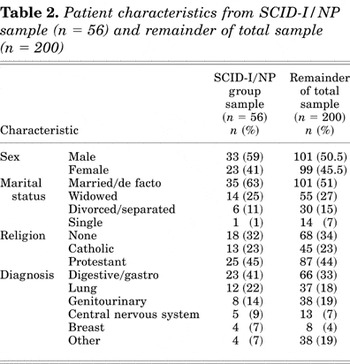
The group of patients who participated in this study were, on average, 67.14 years of age (SD= 12.67 years; range = 36–86 years) compared to patients from the total remaining sample of 200 who had an average age of 66.44 years (SD = 13.31; range = 20–94 years). Table 2 displays the characteristics of the patient sample (n = 56). No statistically significant differences were noted between the two groups.
Patient characteristics from SCID-I/NP sample (n = 56) and remainder of total sample (n = 200)

Prevalence of Psychiatric Diagnoses
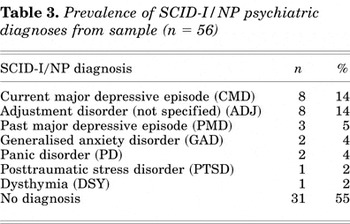
Table 3 displays the proportion of patients from the sample who met the criteria for a SCID-I/NP psychiatric diagnosis. Current major depressive episode and adjustment disorder were the most prevalent disorders in this sample of patients.
Prevalence of SCID-I/NP psychiatric diagnoses from sample (n = 56)

Four patients had comorbid SCID-I/NP diagnoses: current major depressive episode–generalized anxiety disorder; past major depressive episode–dysthymia; panic disorder–adjustment disorder; and current major depressive episode–past major depressive episode–posttraumatic stress disorder.
Sample Characteristics of the WTHD Groups
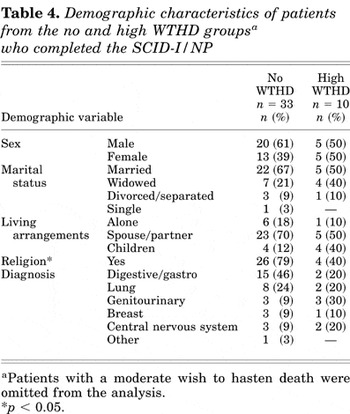
The demographic characteristics of the two WTHD groups (no and high) are presented in Table 4. It should be noted that 13 patients fell in the moderate group. The proportion of patients with a high WTHD from this group of 56 (18%) is comparable with the 14% found to have a high WTHD from the total sample of 256. Patients from the no WTHD group had an average age of 68.5 years (SD = 12.05) compared to those in the high WTHD group who had an average age of 66.0 years (SD = 14.40). The only significant difference between the groups was in religious affiliation, where patients with a high WTHD were significantly more likely to have reported having no religious affiliation compared to patients with no WTHD (chi-square = 5.47, df = 1, p < 0.05).
Demographic characteristics of patients from the no and high WTHD groupsa who completed the SCID-I/NP

Psychiatric Diagnoses and the Wish to Hasten Death
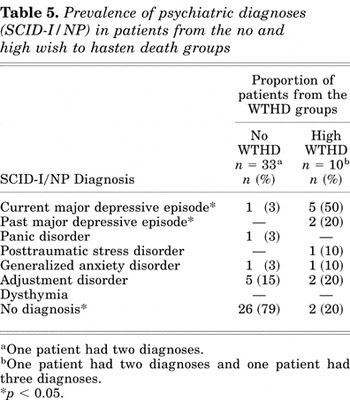
Table 5 displays the prevalence of psychiatric disorders as assessed by the SCID-I/NP in the no and high WTHD groups. Significantly more patients from the high WTHD group had a psychiatric diagnosis (80%) compared to the no WTHD group (20%) (chi-square = 11.68, df = 1, p < 0.01). There were significantly more patients from the high WTHD group who had a current major depressive episode (chi-square = 14.10, df = 1, p < 0.01) compared to the no WTHD group. The data revealed that 50% of patients with a high WTHD had a current major depressive episode whereas 83% of all the patients diagnosed as having a current major depressive episode had a high WTHD. Patients from the high WTHD group were also more likely to have a diagnosis of a past major depressive episode (chi-square = 6.92, df = 1, p < 0.01) compared to patients with no WTHD. Specifically, 20% of patients with a high WTHD had a diagnosis of past major depressive episode whereas all patients who had a past major depressive episode had a high WTHD.
Prevalence of psychiatric diagnoses (SCID-I/NP) in patients from the no and high wish to hasten death groups

When looking at current major depressive episode items from the SCID-I/NP, patients from the high WTHD group were significantly more likely to endorse having “depressed mood” (chi-square = 6.86, df = 1, p < 0.01), “diminished interest or pleasure” (chi-square = 12.19, df = 1, p < 0.01), “feelings of worthlessness” (chi-square = 4.93, df = 1, p < 0.05), “feelings of inappropriate guilt” (chi-square = 4.93, df = 1, p < 0.05), and “thinking of own death” (chi-square = 4.90, df = 1, p < 0.05) compared to patients with no WTHD.
DISCUSSION
This study sought to measure the prevalence of psychiatric disorders, with a focus on depression, among a group of terminally ill patients using a structured clinical interview. Patients with a high WTHD as assessed by the WTHD scale were more likely to have a diagnosis of current and past major depressive episode than patients with no WTHD. These results support the view that terminally ill patients with a high WTHD are more likely to be suffering from a depressive disorder.
Physical symptoms that made up the diagnosis of a current major depressive episode were less salient in patients with a high WTHD compared to the cognitive and affective symptoms. This supports the idea that less emphasis should be placed on neuro-vegetative symptoms when assessing depression in a terminally ill patient. This further highlights the importance of focusing discussion of a terminal patient's depression and WTHD on a patient's psychological concerns rather than on physical complaints.
A limitation of this study involves the small number of patients interviewed. Furthermore, not all of the SCID-I/NP Axis I disorders were assessed and therefore important information regarding comorbidity with other disorders is lacking. However given the time and effort required by the patient to undertake the interview, it was decided that only the main mood disorders should be examined.
Future investigation might look at conducting a more detailed assessment of the losses a patient has suffered as a result of the illness to determine the degree of relationship that these losses have on a patient's level of depression and WTHD. Previous research has shown that psychological and social factors are key discriminators in a patient's WTHD (Kelly et al., 2003) and with information gained from this study on the significant association between a psychiatric diagnosis of depressive episode and a WTHD, suggest that a thorough psychiatric assessment is warranted for patients with a terminal illness who report a high WTHD so that appropriate treatment can be implemented.
ACKNOWLEDGMENTS
We wish to thank all the patients who participated in this research, as well as staff from Mt. Olivet Palliative Care Services and Princess Alexandra Hospital Palliative Care Consulting Service. We wish to acknowledge funding from the Queensland Cancer Fund, National Medical Research Council, University of Queensland, Princess Alexandra Hospital Research and Development Fund, and British Red Cross Fund.
References
REFERENCES
American Psychiatric Association.
(1994).
Diagnostic and Statistical Manual of Mental Disorders,
4th ed.
(DSM-IV). Washington, DC:
American Psychiatric Association.
Block, S.
(2000).
Assessing and managing depression in the terminally ill
patient.
Annals of Internal Medicine,
132,
209–218.Google Scholar
Breitbart, W.,
Rosenfeld, B.,
Pessin, H.,
et al.
(2000).
Depression, hopelessness, and desire for hastened death in
terminally ill patients with cancer.
Journal of the American Medical Association,
284,
2907–2911.Google Scholar
Brugha, T.
(1993).
Depression in the terminally ill.
British Journal of Hospital Medicine,
50,
175–181.Google Scholar
Chochinov, H.,
Wilson, K.G.,
Enns, M.,
et al.
(1994).
Prevalence of depression in the terminally ill: Effects of
diagnostic criteria and symptom threshold judgments.
American Journal of Psychiatry,
151,
537–540.Google Scholar
Chochinov, H.,
Wilson, K.G.,
Enns, M.,
et al.
(1995).
Desire for death in the terminally ill.
American Journal of Psychiatry,
152,
1185–1191.Google Scholar
Derogatis, L.R.,
Morrow, G.R.,
Fetting, J.,
et al.
(1983).
The prevalence of psychiatric disorders among cancer
patients.
Journal of the American Medical Association,
249,
751–757.Google Scholar
Durkin, I.,
Kearney, M., &
O'Siorain, L.
(2003).
Psychiatric disorder in a palliative care unit.
Palliative Medicine,
17,
212–218.Google Scholar
First, M.,
Spitzer, R.,
Gibbon, M.,
et al.
(1998).
Structured Clinical Interview for DSM-IV-TR Axis I Disorders,
Research Version, Non-patient Edition (SCID-I/NP).
New York:
Biometrics Research, New York State Psychiatric Institute.
Ganzini, L.,
Fenn, D.,
Lee, M.,
et al.
(1996).
Attitudes of Oregon psychiatrists toward physician-assisted
suicide.
American Journal of Psychiatry,
153,
1469–1475.Google Scholar
Ganzini, L. &
Lee, M.
(1997).
Psychiatry and assisted suicide in the United States.
New England Journal of Medicine,
336,
1824–1826.Google Scholar
Kelly, B.,
Burnett, P.,
Pelusi, D.,
et al.
(2003).
Factors associated with the wish to hasten death: A study of
patients with terminal illness.
Psychological Medicine,
33,
75–81.Google Scholar
Kissane, D.,
Street, A., &
Nitschke, P.
(1998).
Seven deaths in Darwin: Case studies under the Rights of the
Terminally Ill Act, Northern Territory, Australia.
Lancet,
352,
1097–1102.Google Scholar
Lloyd-Williams, M.
(2001).
Screening for depression in palliative care patients: A
review.
European Journal of Cancer Care,
10,
31–35.Google Scholar
Lloyd-Williams, M.,
Spiller, J., &
Ward, J.
(2003).
Which depression screening tools should be used in palliative
care?
Palliative Medicine,
17,
40–43.Google Scholar
Maguire, P.
(1985).
Improving the detection of psychiatric problems in cancer
patients.
Social Science & Medicine,
20,
819–823.Google Scholar
Maguire, P. &
Howell, A.
(1995).
Improving the psychological care of cancer patients. In
Psychiatric Aspects of Physical Disease,
Houses, A. &
Mayou, R. (eds.), pp.
41–54.
London:
Royal College of Psychiatry.
Minagawa, H.,
Uchitomi, Y.,
Yamawaki, S.,
et al.
(1996).
Psychiatric morbidity in terminally ill cancer patients: A
prospective study.
Cancer,
78,
1131–1137.Google Scholar
Portenoy, R.,
Thaler, H.,
Kornblith, A.,
et al.
(1994).
The memorial symptom assessment scale: An instrument for the
evaluation of symptom prevalence, characteristics and distress.
European Journal of Cancer,
30A,
1326–1336.Google Scholar
Saranson, I.,
Levine, H.,
Basham, R.,
et al.
(1983).
Assessing social support: The social support questionnaire.
Journal of Personality and Social Psychology,
44,
127–139.Google Scholar
Wilson, K.G.,
Scott, J.F.,
Graham, I.D.,
et al.
(2000).
Attitudes of terminally ill patients toward euthanasia and
physician-assisted suicide.
Archives of Internal Medicine,
160,
2454–2460.Google Scholar
Zigmond, A. &
Snaith, R.
(1983).
The hospital anxiety and depression scale.
Acta Psychiatry Scandinavia,
67,
361–370.Google Scholar

The WTHD scale items (modified after Chochinov et al., 1995) and frequency of endorsement (n = 256)
Patient characteristics from SCID-I/NP sample (n = 56) and remainder of total sample (n = 200)
Prevalence of SCID-I/NP psychiatric diagnoses from sample (n = 56)
Demographic characteristics of patients from the no and high WTHD groupsa who completed the SCID-I/NP
Prevalence of psychiatric diagnoses (SCID-I/NP) in patients from the no and high wish to hasten death groups
 You have
Access
- 23
- Cited by