Introduction
Bilingual experience may bring about cognitive control changes. Bilinguals have been reported to have advantages over monolinguals in cognitive control tasks (e.g., Simon, Stroop, Flanker and Go/No-Go auditory tasks) (Bialystok, Reference Bialystok2011; Bialystok, Craik, Klein & Viswanathan, Reference Bialystok, Craik, Klein and Viswanathan2004; Bialystok, Craik, Green & Gollan, Reference Bialystok, Craik, Green and Gollan2009; Foy & Mann, Reference Foy and Mann2013; Hsu, Reference Hsu2013; Kroll & Bialystok, Reference Kroll and Bialystok2013), particularly among child bilinguals (Bialystok, Reference Bialystok2010; Bialystok, Barac, Blaye & Poulin-Dubois, Reference Bialystok, Barac, Blaye and Poulin-Dubois2010; Engel de Abreu, Cruz-Santos, Tourinho, Martin & Bialystok, Reference Engel de Abreu, Cruz-Santos, Tourinho, Martin and Bialystok2012; Foy & Mann, Reference Foy and Mann2013; Kuipers & Thierry, Reference Kuipers and Thierry2013) and older adult bilinguals (Bialystok, Craik & Freedman, Reference Bialystok, Craik and Freedman2007; Craik, Bialystok & Freedman, Reference Craik, Bialystok and Freedman2010; Gold, Kim, Johnson, Kryscio & Smith, Reference Gold, Kim, Johnson, Kryscio and Smith2013; Schweizer, Craik & Bialystok, Reference Schweizer, Craik and Bialystok2013). Even for young adult bilinguals, who are at the peak of cognitive control development, advantages have also been found at least in some behavioral measurements under certain circumstances (Bialystok, Reference Bialystok2009; Costa, Hernández, Costa-Faidella & Sebastián-Gallés, Reference Costa, Hernández, Costa-Faidella and Sebastián-Gallés2009; Prior & Gollan, Reference Prior and Gollan2011; Prior & Macwhinney, Reference Prior and Macwhinney2010). Such bilingual advantages have been assumed to come from the fact that bilinguals have to manage two non-selectively activated languages (Abutalebi, Annoni, Zimine, Pegna, Seghier, Lee-Jahnke, Lazeyras, Cappa & Khateb, Reference Abutalebi, Annoni, Zimine, Pegna, Seghier, Lee-Jahnke, Lazeyras, Cappa and Khateb2008; Costa & Caramazza, Reference Costa and Caramazza1999; Hoshino & Thierry, Reference Hoshino and Thierry2011; Kroll, Bobb, Misra & Guo, Reference Kroll, Bobb, Misra and Guo2008). The non-selective language activation poses interferences for bilinguals when they use the target language. In order to succeed in selecting the target language, bilinguals adopt a language control mechanism (Green, Reference Green1998) to deal with competition not only from within-language choices such as semantic neighbors but also from between-language choices such as words for the same concept. In language control, individuals must continuously monitor the context, maintain the task goal and resist interference from other competing actions that may be triggered by the situational context (Green & Abutalebi, Reference Green and Abutalebi2013). As a result, by continuously utilizing the language control mechanism, bilinguals exhibit advantages at general cognitive control, such as monitoring the target task, inhibiting distracting information or switching between different task sets. This kind of cognitive control advantage is also supported by studies of neural substrates. It was reported (Abutalebi, Della Rosa, Green, Hernandez, Scifo, Keim, Cappa & Costa, Reference Abutalebi, Della Rosa, Green, Hernandez, Scifo, Keim, Cappa and Costa2012), for example, that the dorsal anterior cingulate cortex (ACC), a structure tightly bound to domain-general cognitive control functions, is a common locus for language control and for resolving nonverbal conflict. The fact that language control and general cognitive control share the same neural locus makes it possible that language control advantages transfer to cognitive control in general domains.
However, quite a few studies have failed to capture a bilingual advantage, particularly for young adult bilinguals in behavioral measures (Hernández, Martin, Barceló & Costa, Reference Hernández, Martin, Barceló and Costa2013; Kousaie & Phillips, Reference Kousaie and Phillips2012; Luk, Anderson, Craik, Grady & Bialystok, Reference Luk, Anderson, Craik, Grady and Bialystok2010; Paap & Greenberg, Reference Paap and Greenberg2013; Paap & Liu, Reference Paap and Liu2014). A variety of reasons may be able to account for this incoherence in the presence or absence of bilingual advantages, such as differences in ageFootnote 1 , task difficulty, and bilinguals’ language backgrounds (Barac & Bialystok, Reference Barac and Bialystok2012; Bialystok, Martin & Viswanathan, Reference Bialystok, Martin and Viswanathan2005; Dong & Li, Reference Dong and Li2015; Tao, Marzecova, Taft, Asanowicz & Wodniecka, Reference Tao, Marzecova, Taft, Asanowicz and Wodniecka2011). However, the heterogeneity of participants’ cultural and L1 backgrounds and the inconsistency of measuring tasks used may be related to the incoherence. Although the question of bilingual advantage has been investigated in numerous studies, most of them tested immigrant bilinguals with heterogeneous L1 and cultural backgrounds and/or adopted only one behavioral task (Bialystok et al., Reference Bialystok, Craik, Klein and Viswanathan2004; Kousaie & Phillips, Reference Kousaie and Phillips2012; Paap & Greenberg, Reference Paap and Greenberg2013; Prior & Macwhinney, Reference Prior and Macwhinney2010). In Paap and Greenberg (Reference Paap and Greenberg2013), for example, no evidence was found for bilingual advantages in executive processing. However, the 122 bilinguals spoke 30 different languages altogether, with English as their L2, whereas the monolinguals were native English speakers. The bilinguals and monolinguals were therefore not comparable in their L1 and cultural bearings. The distance between the bilinguals’ first languages and second language may have modulated the interference between languages. In one such study (van Heuven, Conklin, Coderre, Guo & Dijkstra, Reference van Heuven, Conklin, Coderre, Guo and Dijkstra2011), it is revealed that for bilinguals with different language scripts (e.g., Arabic, Chinese, and alphabetic in Uyghur–Chinese–English trilinguals), the magnitude of within-language Stroop interference was similar, whereas between-language Stroop interference was modulated by cross-language similarity. Moreover, cultural bearings may be another confounding factor. If participants come from quite different cultures, such differences may contribute to the variations of cognitive control performance. A recent study of cultural differences in human brain activity (Han & Ma, Reference Han and Ma2014) shows that social cognitive processes are characterized by stronger activity in the dorsal medial prefrontal cortex, lateral frontal cortex and temporoparietal junction in East Asians (Chinese, Japanese, Korea) but stronger activity in the anterior cingulate, ventral medial prefrontal cortex and bilateral insula in Westerners (Americans and Europeans). Moreover, East Asian cultures are associated with increased neural activity in the brain regions related to inference of others' mind and emotion regulation whereas Western cultures are associated with enhanced neural activity in the brain areas related to self-relevance encoding and emotional responses during social cognitive/affective processes. If culture modulates cognitive processes, it potentially confounds previous findings with participants recruited from East Asian and Western populations in bilingualism studies. It may, therefore, produce cleaner results for the investigation of the bilingual effect if participants are recruited from more homogeneous language and cultural backgrounds.
In addition, most previous studies adopted only one single task that usually tested just one aspect of cognitive control (Antón, Duñabeitia, Estévez, Hernández, Castillo, Fuentes, Davidson, & Carreiras, Reference Antón, Duñabeitia, Estévez, Hernández, Castillo, Fuentes, Davidson and Carreiras2014; Bialystok et al., Reference Bialystok, Craik, Klein and Viswanathan2004; Bialystok, Craik & Ryan, Reference Bialystok, Craik and Ryan2006; Kirk, Fiala, Scott-Brown & Kempe, Reference Kirk, Fiala, Scott-Brown and Kempe2014; Kousaie & Phillips, Reference Kousaie and Phillips2012). As pointed out by Paap and Greenberg (Reference Paap and Greenberg2013), although previous studies have adopted different tasks, the same set of matched bilinguals and monolinguals typically participate in only a single task, and hence only a certain aspect of cognitive control is measured. For example, in Antón et al.’s (Reference Antón, Duñabeitia, Estévez, Hernández, Castillo, Fuentes, Davidson and Carreiras2014) study, the researchers had noticed the necessity of matching the cultural and social backgrounds of bilinguals and monolinguals. A group of 180 bilingual children and a group of 180 carefully matched monolinguals were compared, but only one single task (the Attention Network Test – ANT) was adopted to test cognitive control, and the results showed no bilingual advantage. However, testing cognitive control by only a single task (such as inhibition by the ANT) cannot tell us the full picture of bilingual advantage, as cognitive control can be decomposed into different aspects, such as inhibition, conflict monitoring, mental set shifting, working memory updating, etc., which are relevant but relatively independent to each other (Green & Abutalebi, Reference Green and Abutalebi2013; Miyake, Friedman, Emerson, Witzki, Howerter & Wager, Reference Miyake, Friedman, Emerson, Witzki, Howerter and Wager2000; Paap & Greenberg, Reference Paap and Greenberg2013). Therefore, both homogenous background and multiple tasks are preferred when examining bilingual advantages. The first purpose of the current study is thus to examine this issue among young adults who are homogeneous in their L1 and cultural backgrounds, through multiple behavioral tasks.
Furthermore, according to the rationale of bilingual advantage, certain intensive language training experiences, either in L1 or in L2, may enhance cognitive control in particular ways. Take public speaking training as an example. There may be a relation between stress regulation (a form of emotion regulation) in public speaking and cognitive control (Fineman, Reference Fineman2008). In public speaking, individuals experience anxious thoughts, dysfunctional beliefs, and excessive fears of negative evaluation (Harb, Eng, Zaider & Heimberg, Reference Harb, Eng, Zaider and Heimberg2003), and they need the ability to self-regulate attentional processes to focus on the current goal and exclude performance anxiety. Inferior performance of public speaking has been reported to be related to lower attentional control (Jones, Fazio & Vasey, Reference Jones, Fazio and Vasey2012). Attentional control plays as a protective buffer that helps to reduce performance anxiety (Jones et al., Reference Jones, Fazio and Vasey2012). In other words, to achieve a good performance in public speaking, speakers need to continuously adopt attentional control to regulate emotion (e.g., fear, stress, or anxiety), such as monitoring appropriate emotion, inhibiting irrelevant emotion (Schel & Crone, Reference Schel and Crone2013). Recent neurocognitive data showed that the brain area of ACC plays a crucial role in both emotion and cognitive control and in the interactions between them (Mueller, Reference Mueller2011). If so, the experience of public speaking may contribute to cognitive control enhancement in some significant ways. In the literature, public speaking (or in adapted forms) has been used as an effective way to induce, assess or treat social anxiety (Bergamaschi, Queiroz, Chagas, de Oliveira, De Martinis, Kapczinski, Quevedo, Roesler, Schroder, Nardi, Martin-Santos, Hallak, Zuardi & Crippa, Reference Bergamaschi, Queiroz, Chagas, de Oliveira, De Martinis, Kapczinski, Quevedo, Roesler, Schroder, Nardi, Martin-Santos, Hallak, Zuardi and Crippa2011; Pribyl, Keaten & Sakamoto, Reference Pribyl, Keaten and Sakamoto2001; Wallach, Safir & Bar-Zvi, Reference Wallach, Safir and Bar-Zvi2009), but few studies have directly examined how such experience may affect cognitive control in behavioral measures. Moreover, for bilinguals, compared to L1, L2 public speaking (the weaker language) may produce more significant changes of cognitive control; since, in L2 public speaking, speakers need to monitor the appropriate context and exclude interferences not only from the speaking anxiety facing a large audience but also from the stronger language (L1). The second purpose of the current study is thus to investigate how public speaking experience (particularly in L2) may contribute to cognitive control changes among young adults who are homogeneous in L1 and cultural backgrounds, through multiple tasks.
For these two purposes, the current study compared four groups of participants with an aim to examine the cognitive control differences among them. There was one monolingual group (monolingual Chinese) and three Chinese–English bilingual groups: general bilinguals, L1 public speaking bilinguals, and L2 public speaking bilinguals. All the participants were required to complete three behavioral tasks: the Flanker, the Number Stroop, and the Wisconsin Card Sorting Test (WCST). These tasks were selected based on previous definitions of cognitive control construct (Bialystok & Viswanathan, Reference Bialystok and Viswanathan2009; Costa et al., Reference Costa, Hernández, Costa-Faidella and Sebastián-Gallés2009; Green & Abutalebi, Reference Green and Abutalebi2013; Miyake & Friedman, Reference Miyake and Friedman2012; Miyake et al., Reference Miyake, Friedman, Emerson, Witzki, Howerter and Wager2000; Paap & Greenberg, Reference Paap and Greenberg2013). Cognitive control can be divided into related but relatively independent aspects, as mentioned earlier, including inhibiting (or inhibitory control), conflict monitoring, mental set shifting (or mental flexibility), and updating of working memory. The present study was intended to explore the three aspects that are considered most closely related to bilingualism. The first one is conflict monitoring, which is indicated by overall response times in each trial type in the Flanker and Number Stroop tasks, revealing the ability to handle tasks that involve mixing trials of different types (Costa et al., Reference Costa, Hernández, Costa-Faidella and Sebastián-Gallés2009; Dong & Li, Reference Dong and Li2015; Paap & Greenberg, Reference Paap and Greenberg2013). The second one is the ability of inhibition, which is indicated by the difference in the mean response times between trials that require conflict resolution compared to those that do not in the Flanker and Number Stroop tasks, revealing the ability to select goal-relevant information and suppressing competing and distracting information (Bialystok et al., Reference Bialystok, Craik, Green and Gollan2009; Green, Reference Green1998; Paap & Greenberg, Reference Paap and Greenberg2013). The third one is mental set shifting which is indicated by the performance in the WCST, revealing the ability to switch from one task to a completely different task (Dong & Xie, Reference Dong and Xie2014; Festman & Munte, Reference Festman and Munte2012; Yudes, Macizo & Bajo, Reference Yudes, Macizo and Bajo2011). The diversity of cognitive control components suggests that the enhancement of one aspect in cognitive control does not necessarily mean that other aspects will also be strengthened. Only some specific aspect(s) of cognitive control might be enhanced as a result of certain specific bilingual language use/training experience.
To sum up, the present study was intended to verify the hypothesis that not only bilingualism but also certain intense language training experiences such as public speaking, either in L1 or in L2, may enhance cognitive control abilities (but in different aspects perhaps) among young adults.
Method
Participants
Three groups of unbalanced Chinese–English young adult bilinguals and one group of monolinguals (42 males/84 females, mean age = 20.2 years, SD = 2.50) participated in this study. The bilingual groups were students from Jiangxi Normal University in China, and the monolingual group were middle school or vocational school graduates. All the participants were right-handed, reported normal or corrected-to-normal vision and had no speech or hearing disorders. They took part in the experiments either for monetary compensation or for course credits. Participants gave informed consent and their rights were protected in accord with the ethical standards of the university's Academic Board.
The L2 public speaking group and the bilingual group were English majors from the university, who had been learning English (as a foreign language) for about 11.45 years. In their university study, they took at least 16 hours of in-class English learning (according to their class schedule) each week during each semester (two semesters a year). The L2 public speaking group, 30 participants altogether, had received an extra time of L2 public speaking training for 2.8 years (SD = 0.9), with about 8 hours of such training each week, including both in and after class training. They had been trained in two skills: prepared L2 speech and impromptu L2 speech. The bilingual group, 33 participants in all, took normal English major classes for about three to four years but did not receive any formal training in L2 public speaking.
The L1 public speaking group, 30 participants in all, were second-year university students majoring in Chinese Broadcasting. They had received Chinese public speaking training for a mean time of 2.9 years (SD = 0.3). Their training tasks included news broadcasting, prepared speech, impromptu speech, and simulated TV show hosting, accumulating about 9 hours each week according to their class schedule. Their English learning was limited to around 3 hours of in-class learning each week (few reported extra learning and L2 speaking after class because they were not required to do so). The monolingual group, 33 participants altogether, graduated from junior middle school or vocational/high school 3–6 years ago and ceased learning English since then. The main reason for why they did not go to college was that they were low in academic achievement for the subjects they learned in school, including English. They reported extremely limited knowledge of English (L2)Footnote 2 and were not exposed to or able to speak/use English at all in their daily life. Furthermore, they did not receive any training in L1/L2 public speaking.
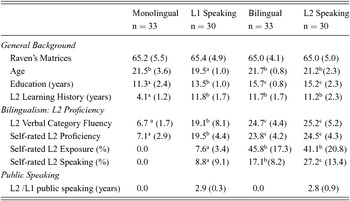
All the participants were required to complete a brief questionnaire concerning their demographic background, including age, years of education, and L2 learning history. Then the participants were required to self-rate their L2 proficiencyFootnote 3 , including relevant factors such as L2 exposure (%) and L2 speaking (%). The L2 proficiency – composed of listening, speaking, reading, and writing – was self-rated on a 10-point Likert scale, which is a widely recognized measurement in bilingual research and is considered highly correlated with objective measurements of language proficiency (Marian, Blumenfeld & Kaushanskaya, Reference Marian, Blumenfeld and Kaushanskaya2007; Prior & Gollan, Reference Prior and Gollan2011). As an objective measurement of L2 proficiency, an English (L2) verbal fluency test was adopted, in which all participants were required to produce as many words as possible within one minute according to the categories presented (jobs, sports, animals). Category fluency has been reported to be strongly indicative of vocabulary size (Bialystok et al., Reference Bialystok, Craik, Green and Gollan2009). For Intelligence scores, all the participants took Ravens Advanced Progressive Matrices (Raven, Court & Raven, Reference Raven, Court and Raven1977). The task consisted of 72 items, which were grouped in six types, and in each type there were 12 items. Each item was composed of a pattern with a missing part in the lower right. Participants were required to select the right one from a set of six or eight alternatives to complete the pattern within 40 minutes. Correct answers were counted as intelligence scores. Table 1 is a summary of the features for each group of participantsFootnote 4 .
Means (standard deviations) of participant characteristics in language history, language proficiency, and language experience etc. across groups.

Note: Means in the same row with different superscript letters differ from each other significantly at p < .05. The total language exposure and speaking percentage of L1 and L2 equals 100; the total score for L2 proficiency is 40.
There are three main characteristics for these participantsFootnote 5 . First, for their general backgrounds, all the groups exhibited equivalent intelligence, and all the bilingual groups were comparable in L2 history, but there were statistical differences between some groups in age and education (see Table 1 for more details). However, they were not considered important factors because all the groups were in their early twenties (19.5–21.7 years old, a period of the most efficient cognitive functioning) and all the bilingual groups were enrolled in college education. Second, for L2 proficiency (an indicator of bilingualism), participant groups differed as reflected in the verbal fluency test and the subjective self-ratings of factors relevant to L2 proficiency (see Table 1). However, the control bilingual group and L2 public speaking group reflected similar L2 proficiency and general background. Third, for public speaking experience, the two public speaking groups had received equal years of training, whereas the other two groups did not have any such training.
Materials and Procedures
The experiments lasted for approximately two hours. Participants completed two sets of tests. The first set was a composite questionnaire, an L2 verbal fluency test, and an intelligence test (as stated above). The second set was three computerized cognitive control tasks: the Flanker task, the Number Stroop task, and the Wisconsin Card Sorting Test (WCST).
Flanker Task
The Flanker task (Eriksen & Eriksen, Reference Eriksen and Eriksen1974) was used to assess one's ability to suppress responses that are inappropriate in a particular context (Festman & Munte, Reference Festman and Munte2012; Luk et al., Reference Luk, Anderson, Craik, Grady and Bialystok2010). In this test, participants were instructed to respond to the direction of a red target chevron that was flanked on two sides by other symbols. In one of the three conditions, the neutral condition, the flanking stimuli were black diamonds presenting no relevant information to the target chevron. In the congruent condition, the target chevron is flanked by four black chevrons pointing in the same direction as the target. In the incongruent condition, the four flanking chevrons point in the direction opposite to that indicated by the target, creating conflict and interference. The computerized task, programmed in E-prime (version 2.0), consisted of a practice block with 9 trials (with feedback), followed by the experimental block, which included 108 trials. The experimental block would not start for a participant until he or she had reached an accuracy rate of above 80% in the practice block. Each trial started with a fixation of “+” for 250ms. Then an experimental stimulus was randomly presented for 2000ms or until designated keys were pressed.
Number Stroop Task
The Stroop Interference Test (Stroop, Reference Stroop1935), similar to the Flanker task, was used to measure participants’ ability to inhibit an over-learned (i.e., dominant) response in favor of an unusual one (Spreen & Strauss, Reference Spreen and Strauss1998). The Number Stroop paradigm requires participants to decide whether the number of stimuli presented is odd or even (Bush, Whalen, Rosen, Jenike, McInerney & Rauch, Reference Bush, Whalen, Rosen, Jenike, McInerney and Rauch1998; Girelli, Sandrini, Cappaand & Butterworth, Reference Girelli, Sandrini, Cappaand and Butterworth2001; Tzelgov, Meyer & Henik, Reference Tzelgov, Meyer and Henik1992). In neutral trials, the stimuli are shapes of the hash sign “#”. For example, if it is “###”, the number of the stimulus is “3”, so it is odd. In both congruent and incongruent trials, the stimuli are digits. In congruent trials, the number of the digits coincides with the digit itself, such as in the case of “333”. In incongruent trials, the number of the digits causes interference when odd or even shall be decided, such as in the case of “3333”. The computerized Number Stroop task consisted of two blocks: the practice block and the experimental block. There were 9 practice trials in the practice block, in which feedbacks of accuracy and response times were presented, and there were 120 formal trials randomly presented in the experimental block, in which no feedback was given. Each stimulus was presented for a maximum time of 2000 ms or until participants responded by pressing designated keys. Participants were required to respond as quickly as possible without sacrificing accuracy.
Both the Flanker task and the Number Stroop task involve ignoring distracting and conflicting information and inhibiting irrelevant response (Costa et al., Reference Costa, Hernández, Costa-Faidella and Sebastián-Gallés2009; Miyake et al., Reference Miyake, Friedman, Emerson, Witzki, Howerter and Wager2000), but they differ in cognitive demand. They make use of similar, but not identical, cortical regions or cognitive resources (Fan, Flombaum, McCandliss, Thomas & Posner, Reference Fan, Flombaum, McCandliss, Thomas and Posner2003; Stins, Polderman, Boomsma & de Geus, Reference Stins, Polderman, Boomsma and de Geus2005). In the Flanker task, the stimuli are visually presented in spatial pattern (e.g., >>>>>), and participants only need to focus on the target information, excluding the interfering information in the same spatial dimension. But in the Number Stroop task, the stimuli are embedded in two dimensions (e.g., 3333), the digits themselves and the oddness/evenness of the number of the digits, which makes the task cognitively more demanding than the Flanker task. Participants may show differences in performing the same task or similar tasks differing in task difficulty (Costa et al., Reference Costa, Hernández, Costa-Faidella and Sebastián-Gallés2009; Dong & Li, Reference Dong and Li2015).
Wisconsin Card Sorting Test (WCST)
The WCST was used to detect participants’ ability to infer the implied rule in card sorting and to switch their mental sets. Following procedures from previous studies (Dong & Xie, Reference Dong and Xie2014; Festman & Munte, Reference Festman and Munte2012; Yudes et al., Reference Yudes, Macizo and Bajo2011), the test was composed of 128 response cards and 4 stimulus cards depicting three dimensions of geometric figures (number: one, two, three, or four; color: red, green, yellow, or blue; shape: triangle, star, cross, or circle). Each response card had a combination of the three dimensions, for example, a card with one green cross. Meanwhile, the 4 stimulus cards depicted one red triangle, two green stars, three yellow crosses, and four blue circles. Participants were required to sort each response card by pressing one of the four designated keys corresponding to the four stimulus cards. If the underlying rule for a certain response card is color, for example, the correct response for “one green cross” will be the key corresponding to the stimulus card “two green stars”. After each trial, participants received feedback on whether their responses were correct or not, but they were not informed of the exact rule. After a few trials (from 5 to 9), the sorting rule would change.
In the computerized version in the current study, there were 12 practice trials in the practice block and 128 formal trials in the experimental block. Participants would not go into the experimental block until they fully understood what to do. There was a fixation of 1000ms before a stimulus appeared. The stimulus lasted for no more than 3000ms, in which participants had to respond by pressing designated keys. Participants received feedback (1000ms) of ‘correct’ or ‘incorrect’ for their response.
Results
Data trimming
In the Flanker and Number Stroop tasks, data of erroneous and extreme responses were first excluded. Then trials that fell above 3 standard deviations (SDs) of the overall mean for each subject in each condition of all the tasks were eliminated, accounting for 2.16% of the total correct responses. In the WCST, completed categories, overall errors and types of errors were analyzed respectively.
Flanker Task
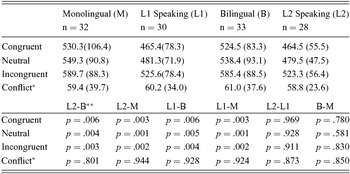
Table 2 presents the data for the Flanker task performance across groups. Three participants from the groups were excluded because of false operations, in which participants were not able to finish the task because of computer failure or not following the correct procedure. Two indexes were used to compare between-group performances. The first one is Flanker conflict, the difference in mean response times between trials that require conflict resolution (incongruent) and trials that do not (congruent). A smaller Flanker conflict implies superior ability in conflict resolution, thus stronger ability of inhibition (Bialystok et al., Reference Bialystok, Craik, Klein and Viswanathan2004; Bialystok, Craik & Luk, Reference Bialystok, Craik and Luk2008; Costa et al., Reference Costa, Hernández, Costa-Faidella and Sebastián-Gallés2009; Paap & Greenberg, Reference Paap and Greenberg2013). The second one is overall RTs in each condition, which reflects global goal-oriented maintenance and conflict monitoring. Faster RTs mean superior performance in conflict monitoring. The bilingual advantage in overall RTs may reveal bilinguals’ better ability to handle tasks that involve mixing trials of different types, i.e., the efficiency of the monitoring system (Costa et al., Reference Costa, Hernández, Costa-Faidella and Sebastián-Gallés2009; Costa, Hernández & Sebastián-Gallés, Reference Costa, Hernández and Sebastián-Gallés2008; Martin-Rhee & Bialystok, Reference Martin-Rhee and Bialystok2008).
Means (standard deviations) of reaction times in each Flanker condition, means (standard deviations) of Flanker conflict in each group, multiple comparisons (p value) of the groups in each Flanker condition.

Notes: *Conflict refers to the different response times between incongruent condition and congruent condition. **Abbreviations: “M” for monolingual group, “L1” for L1 public speaking group, “B” for bilingual group, “L2” for L2 public speaking group; “L2-B” for a comparison between the L2 public speaking group and the bilingual group.
We conducted a repeated-measures analysis of variance with Group (four participant groups) as between-subject variables and Condition (neutral, incongruent, congruent) as within-subject variables. This analysis revealed a significant main effect of Condition (F (2, 238) = 203.635, p < .001, η 2 = .631), but there was no Condition and Group interaction (F < 1), indicating that there were differences among the three conditions of the task but these differences were similar across the groups. Further analysis revealed the typical Flanker effect, differences among the three conditions of the task. To be more specific, planned comparisons showed that participants responded more quickly in the congruent condition (497.91ms) than in the neutral condition (513.90 ms), F (1, 119) = 34.858, p < .001, and than in the incongruent condition (557.76ms), F (1, 119) = 365.752, p < .001, more quickly in the neutral condition (513.90ms) than in the incongruent condition (557.76ms), F (1, 119) = 172.244, p < .001.
However, what's more critical to the present study is that the main effect of Group was significant, F (3, 119) = 6.621, p < .001, η 2 = .143. ANOVA analysis showed that there were no group differences on the Flanker conflict (F < 1), but there were group differences of global RTs in all the three conditions: congruent F (3,119) = 5.699, p = .001; neutral F (3,119) = 6.672, p < .001; incongruent F (3,119) = 6.408, p < .001. In order to find out which group was different from each other in each condition, post-hoc analyses were conducted. The results showed that the L1 and L2 public speaking groups were faster than the bilingual and monolingual groups in each of the three task conditions (ps < .05). However, there were no group differences between the two speaking groups (ps> = .911), and no group differences between the monolingual and bilingual groups (ps> = .581) (see Table 2 for more details). These results indicate that public speaking experience (in L1 or L2) significantly enhanced cognitive control in the aspect of conflict monitoring.
To be more cautious, in order to further confirm the role of public speaking training experience, we conducted multiple regression analyses by entering differing background variables (age, education, L2 history), L2 proficiency (objective test scores of verbal fluency), and public speaking experience (two continuous levels: 1 = public speaking; 0 = non-speaking) as independent variables in each of the three task conditions. The multiple regression models were significant for the congruent condition (adjusted R 2 = .124, F (5, 115) = 4.410, p = .001), the neutral condition (adjusted R 2 = .120, F (5, 115) = 4.282, p = .001), and the incongruent condition (adjusted R 2 = .153, F (5, 115) = 5.326, p < .001). More specifically, the results showed that age, education, L2 history, L2 proficiency did not contribute significantly to the effects in all the conditions (ps>.05), whereas public speaking experience contributed significantly to the effects in all the conditions (congruent: p < .001; neutral: p < .001; incongruent: p < .001).
To sum up, the general bilingual group, who did not have public speaking experience, did not outperform their counterpart monolingual group. Moreover, the two public speaking groups, matched in public speaking experience but differing in L2 proficiency, performed similarly in the Flanker task. These results are obviously not evidence for the bilingual advantage. However, the fact that both the two public speaking groups outperformed the other two groups in global RTs indicates that public speaking experience significantly enhanced conflict monitoring.
Number Stroop Task
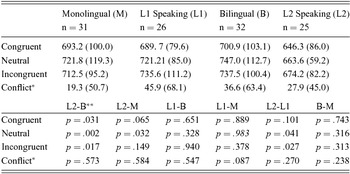
Two participants from the monolingual group, four from the L1 public speaking group, five from the L2 public speaking group, and one from the bilingual group were excluded because of false operations, in which participants were not able to finish the task because of computer failure or not following the correct procedure. Table 3 presents the detailed descriptive data for the Stroop performances of the remaining participants.
Means (standard deviations) of reaction times in each number Stroop condition, means (standard deviations) of Stroop conflict in each group, multiple comparisons (p value) of the groups in each Stroop condition.

Notes: * Conflict refers to the different response times between incongruent condition and congruent condition. ** Abbreviations: “M” for monolingual group, “L1” for L1 public speaking group, “B” for bilingual group, “L2” for L2 public speaking group; “L2-B” for a comparison between the L2 public speaking group and the bilingual group.
As in the Flanker task, similar indexes (global RTs and Stroop conflict) were analyzed. A repeated-measures analysis of variance was conducted, with Group (the four participant groups) as between-subject variables and Condition (neutral, incongruent, congruent) as within-subject variables. This analysis revealed a significant main effect of condition, F (2, 220) = 22.525, p < .001, η 2 = .170, but there was no condition and group interaction, F (6, 220) = 1.221, p = .296. The results of planned comparisons showed that participants responded more quickly in the congruent condition (684.29 ms) than in the neutral condition (715.96 ms), F (1, 110) = 33.392, p < .001, and the incongruent condition (716.39 ms), F (1, 110) = 35.636, p < .001, reflecting a significant Stroop effect. But the neutral condition (715.96 ms) and the incongruent condition (716.39ms) did not differ, F < 1, p = .780.
The main effect of participant group was significant, F (3, 110) = 2.754, p = .046, η 2 = .070, suggesting that there were differences across these groups. Post-hoc analyses showed that the L2 public speaking group outperformed the general bilingual group in all three conditions (p = .031, .002, .017), and the L1 public speaking group in two of the three conditions (p = .101, .041, .027), and the monolingual group in one or two of three conditions (p = .065, .032, .149). There was no significant difference among other comparisons. As for the index of Stroop conflict, ANOVA analysis did not show significant group differences (see Table 3 for more details).
As in the Flanker task, in order to further confirm the role of public speaking training experience in cognitive control differences, we conducted multiple regression analyses by entering as independent variables differing background variables (age, education, L2 history), L2 proficiency (objective test scores of verbal fluency), and public speaking experience (two continuous levels: 1 = public speaking; 0 = non-speaking) in each condition of the Number Stroop task. The results showed that the multiple regression model was neither significant for the congruent condition (adjusted R 2 = .026, F (5,105) = 1.590, p = .169) nor for the incongruent condition (adjusted R 2 = .030, F (5,105) = 1.674, p = .147), but significant for the neutral condition (adjusted R 2 = .069, F (5,105) = 2.672, p = .028). Specifically, age, education, L2 history, and L2 proficiency did not contribute significantly to the effects in all the conditions (ps>.05), whereas public speaking experience contributed significantly to the effects in the three conditions (the congruent condition p = .041; the neutral condition (p =.002), the incongruent condition, p = .029).
To summarize, the results are consistent with our predictions. The L2 public speaking group performed significantly faster than the other three groups in the more demanding task of Number Stroop (in one or more conditions) in terms of global RTs, but not in conflict resolution. These results suggest that the more demanding experience of L2 public speaking training significantly enhanced conflict monitoring in cognitive control.
WCST
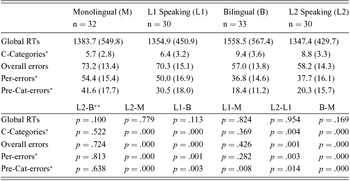
Unlike the Flanker and Number Stroop tasks, the WCST was used to detect the ability of mental set shifting (mental flexibility) in cognitive control. In this test, we report analyses on three indexes of global performance (global RTs, number of completed categories and overall errors) and two indexes of local performance (perseverative errors, previous category errors) to capture the group differences in mental flexibility (Barceló & Knight, Reference Barceló and Knight2002; Yudes et al., Reference Yudes, Macizo and Bajo2011). Table 4 presents the means and standard deviations of the five indexes for each group of participants, along with the p values of post-hoc multiple comparisons. One participant was excluded because of false operations.
Means (standard deviations) of global performance and types of errors in the WCST across groups, multiple comparisons (p value) of the groups in each index.

Notes: * “C-Categories” refers to completed categories, “Per-errors” perseverative errors; “Pre-Cat-errors” previous category errors. ** Abbreviations: “M” for monolingual group, “L1” for L1 public speaking group, “B” for bilingual group, “L2” for L2 public speaking group; “L2-B” for a comparison between the L2 public speaking group and the bilingual group.
Among the five indexes (global RTs, number of completed categories, overall errors, perseverative errors, previous category errors), four showed significant differences across the participant groups in ANOVA analyses, with the exception of the first index global RTs (F (3,121) = 1.248, p = .296). The second indicator of WCST performance was how many correct categories the participants had completed, ranging from 0 to 19. “0” means that the participant was not able to complete at least 5 consecutive correct responses to trials of any category, and “19” means that the participant had successfully completed trials of all the categories. ANOVA analysis on the number of completed categories indicated that there were significant differences across the groups, F (3, 121) = 9.841, p < .001, η 2 = .196. Similar results were found for the index of overall errors , F (3, 121) = 10.730, p < .001, η 2 = .212. Two subcategories of errors are generally taken into consideration when assessing WCST performances: perseverative errors and previous category errors. Perseverative errors are failures to change the mental rule after receiving negative feedback so that the person continues sorting the cards according to the previous-category dimension despite feedback indicating that the response was wrong (Yudes et al., Reference Yudes, Macizo and Bajo2011). Perseverative errors can be further categorized into perseverations to the immediately preceding category and perseverations to a different category (Hartman, Bolton & Fehnel, Reference Hartman, Bolton and Fehnel2001; Hartman, Steketee, Silva, Lanning & Andersson, Reference Hartman, Steketee, Silva, Lanning and Andersson2003; Yudes et al., Reference Yudes, Macizo and Bajo2011). Immediate previous category perseverations reflect lack of flexibility to change the mental set to a new rule, while different category perseverations reflect the understanding that the previous rule is no longer correct but there is an unsuccessful attempt to infer a new rule. ANOVA analysis produced significant differences across the groups on the number of perseverative errors, F (3, 121) = 9.806, p < .001, η 2 = .197, and on the number of immediate previous category errors, F (3, 121) = 13.776, p < .001, η 2 = .259.
For each of the four indexes for which ANOVA analyses had produced significant values, post-hoc multiple comparisons were conducted, and the results were summarized here (see Table 4 for more details). For any two groups of participants that differed in bilingualism (L2 proficiency), the group with higher L2 proficiency outperformed that with lower L2 proficiency in at least one index. More specifically, the L2 public speaking group and the general bilingual group that did not differ in bilingualism (L2 proficiency) did not differ in WCST performances either (ps> = .522), but both of them outperformed the other two groups (ps < .05). The L1 public speaking group outperformed the monolingual group in one of the indexes (previous category errors, p = .008).
To be more cautious, as in the Flanker and Number Stroop tasks, in order to further confirm the factor of L2 proficiency in the WCST performance, we conducted multiple regression analyses by entering differing background variables (age, education, L2 history), L2 proficiency (objective test scores of verbal fluency), and public speaking experience (two continuous levels: 1 = public speaking; 0 = non-speaking) as independent variables. The results showed that the multiple regression models were significant for “completed categories” (adjusted R 2 = .172, F (5,116) = 6.031, p < .001), “overall errors” (adjusted R 2 = .214, F (5,116) = 7.525, p < .001), “perseverative errors” (adjusted R 2 = .205, F (5,116) = 7.197, p < .001), and “previous category errors” (adjusted R 2 = .247, F (5,116) = 8.751, p < .001). More specifically, age, education, L2 history, and public speaking experience did not significantly contribute to the differences on all indexes (ps>.05). However, L2 proficiency (verbal fluency scores) significantly contributed to the group differences on all the indexes (“completed categories” p = .003; “overall errors” p < .001; “perseverative errors” p < .001; “previous category errors” p = .001). All these regression results are consistent with the ANOVA analyses. These results indicate that bilingualism (or L2 proficiency), rather than public speaking, has made major contributions to cognitive control enhancement in mental set shifting.
General Discussion
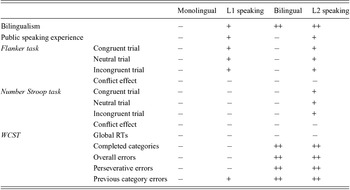
The current study was intended to compare the contributions of bilingualism and public speaking training to cognitive control differences among young adults, as we hypothesized that both general bilingualism and specific language training experience would lead to changes in general cognitive control. Four groups of young adult participants who were homogeneous in their native language and cultural backgrounds were tested in three tasks (the Flanker task, the Number Stroop task, and the WCST) that measured different aspects of cognitive control: inhibition, conflict monitoring, and mental set shifting. The results of ANOVA analyses are summarized in Table 5.
A general summary of the task results across the groups.

Note: “++” is significantly higher than “+”, which is significantly higher than “−” .
To sum up, there are two major findings. First, the two public speaking groups outperformed the other two groups in the Flanker task in terms of global RTs, and the L2 public speaking group outperformed the other three groups in the more demanding task of Number Stroop in terms of global RTs. This is evidence that intensive public speaking training (2.8/2.9 years) enhances the aspect of conflict monitoring in cognitive control, and that intensive L2 public speaking training is probably more powerful than L1 public speaking in such enhancement. Second, in the WCST that tested mental set shifting, all the three bilingual groups outperformed the monolingual group in one or more indicators, and the group with higher L2 proficiency performed significantly better than the group with lower L2 proficiency. This suggests that L2 proficiency (or more generally bilingualism) rather than public speaking experience mainly contributed to mental set shifting enhancement in cognitive control. All these findings obtained from ANOVA analyses were further confirmed in multiple regression analyses.
Therefore, from these results, we can reasonably conclude that a certain degree of public speaking training, particularly in the L2, contributes to conflict monitoring enhancement, whereas a certain degree of L2 proficiency contributes to mental set shifting enhancement. More importantly, these results indicate that bilingual advantages are closely associated with specific features of language use experience and that only certain specific aspect(s) of cognitive control that are related to language use experience can be significantly affected. These results are consistent with the proposal that “language control processes themselves adapt to the recurrent demands placed on them by the interactional context” (the adaptive control hypothesis) (Green & Abutalebi, Reference Green and Abutalebi2013). Similar ideas have also been discussed by Kroll and Bialystok (Reference Kroll and Bialystok2013) and Luk and Bialystok (Reference Luk and Bialystok2013) that the diversity of bilingual experience modulates the effect of bilingual advantage. These results are also consistent with the view put forward recently by Valian (Reference Valian2015), which states that bilingual benefits (in cognitive control) vary because individuals vary in the number and kinds of experiences they have that promote superior executive functioning.
As mentioned in the introduction, the reason why public speaking training experience enhances conflict monitoring in cognitive control is probably because such intensive language training requires speakers to monitor and focus attentively only on the target language and inhibit the interference from the other language and from public speaking anxiety facing a large audience. However, why didn't the public speaking groups outperform the control groups in the Flanker or Number Stroop conflict (inhibition)? A smaller conflict indicates a better ability of conflict resolution. Very likely, the reason lies in the specific and unique language use context in public speaking. Once the goal maintenance (speaking one language) has been achieved, the interfering information (the other language) is kept at a relatively stable but low activation level, thus offering no need of efficient conflict resolution. Previous study suggests that bilinguals outperform monolinguals in inhibitory control (inhibition) only when the task requires the participants to adjust continuously to the different demands associated with different types of trials (Costa et al., Reference Costa, Hernández, Costa-Faidella and Sebastián-Gallés2009). Obviously, keeping one goal (speaking one language) without continuously changing to a different one with different demands requires monitoring and maintaining the goal but not resolving conflict. This fact may also explain why public speaking training does not significantly contribute to cognitive control differences in the WCST (testing mental flexibility).
The effect of bilingualism (L2 proficiency) was manifested in the results of the WCST, that is, the two bilingual groups, matched in L2 proficiency (the bilingual group and the L2 public speaking group), outperformed the two groups of lower L2 proficiency (the L1 public speaking group and the monolingual group). In other words, higher L2 proficiency leads to better mental set shifting/flexibility. It is a well-known fact that bilinguals have a more intensive and practical need to switch between different language mental sets whereas monolinguals do not have such a need (Bialystok & Martin, Reference Bialystok and Martin2004; Bialystok & Viswanathan, Reference Bialystok and Viswanathan2009; Marzecová, Bukowski, Correa, Boros, Lupiáñez & Wodniecka, Reference Marzecová, Bukowski, Correa, Boros, Lupiáñez and Wodniecka2013; Yudes et al., Reference Yudes, Macizo and Bajo2011). Similarly, bilinguals of higher L2 proficiency may switch more often than bilinguals of lower L2 proficiency. What is worth mentioning is that bilingualism in the current study did not lead to an enhancement in the aspects of monitoring or inhibition as tested in the Flanker or Number Stroop tasks. Although the absence of bilingual advantages among young adult bilinguals has been frequently reported in the literature, the contrast between the presence of bilingual advantages as tested in the WCST and the absence of bilingual advantages as tested in the Flanker and Number Stroop tasks is new. The reason is probably that bilingual advantages are closely associated with specific language experiences and that the WCST is a more sensitive tool for testing bilingual advantages in mental set shifting.
The results in the current study provide implications for the heated discussion of bilingual cognitive control advantages. As for the absence or presence of bilingual advantages, the lack of coherence in previous studies (Paap & Greenberg, Reference Paap and Greenberg2013) may be related to the heterogeneity of bilingual language use experiences in different bilingual contexts and to the complexity of cognitive control construct. Previous studies have ignored the fact that specific language training, like public speaking training in the current study, may confound the results. Although there are many papers formulating the nature of bilingual advantages (see Dong & Li, Reference Dong and Li2015 for a brief review), comparing different groups of bilinguals with differing language use experiences as we did in the current study may reveal more insights. Future studies are therefore encouraged to specify the exact aspect of cognitive control related to specific bilingual language use experience.
Conclusion
Based on the results of the present study, we may conclude that bilingualism contributes to cognitive control enhancement in the aspect of mental set shifting, and that higher L2 proficiency (of bilingualism) is associated with better mental set shifting. Public speaking training, whether in L1 or L2, contributes to conflict monitoring enhancement in cognitive control, and L2 public speaking training has a greater contribution probably because general bilingualism and public speaking experience can work together to affect cognitive control. Therefore, both general bilingualism and public speaking training may contribute to cognitive control differences, but in different aspects. This conclusion does not exclude the roles of other modulating factors that may also contribute to cognitive control, but it does suggest a strong relationship between bilinguals’ specific language experiences and specific aspects of cognitive control advantage. Specifically, L2 proficiency is closely associated with mental set shifting whereas public speaking (particularly in L2) is closely associated with conflict monitoring. Future follow-up studies are encouraged to identify the specificity of bilingual language experience and its possible effect on specific aspect(s) of cognitive control (Paap, Reference Paap2014).
Supplementary Material
For supplementary material accompanying this paper, visit http://dx.doi.org/10.1017/S1366728915000474