A country’s involvement in militarized disputes between countries has largely been explained by impersonal forces, institutional and structural factors. However, much is yet to be learned about how the backgrounds of decision-makers may influence the way nations behave. Just as for ordinary citizens, early-life experiences and major life events are likely to leave a long-lasting imprint on leaders’ future personality traits, attitudes and behavioral tendencies, and thereby shape the decisions they make. Among these experiences, international mobility is a prevalent life event that especially affects university students. In particular, an international educational experience exposes sojourners to an internationally diverse social environment and, in most cases, to a completely new system of values and beliefs. Thus, the large number of non-Western would-be national leaders studying in Western democratic countries should make us wonder about the impact of this experience on their future foreign policy-making. This article begins to answer this broader question by looking at a specific aspect of leaders’ background: are Western-educated leaders less likely to initiate militarized interstate disputes?
Anecdotal evidence yields mixed results. On the one hand, Gandhi represents a paradigmatic case of a non-Western leading figure who received his academic training in the West and then transformed his country by applying the values of freedom, democracy, and non-violence. Another noteworthy case is Aung San Suu Kyi who, after graduating from Oxford, returned to Burma to begin an active political career advocating for human rights and peace. On the other hand, Pol Pot’s first involvements with Communism occurred in Paris where he joined the French Communist Party while studying at the Engineering School of Information and Digital Technologies. After four years of Western education, Pol Pot returned to his country to become the leading figure of the Khmer Rouge in the genocide of up to one-quarter of Cambodia’s population.Footnote 1
There has not been any systematic attempt to examine whether Western-educated leaders are more or less likely to initiate militarized interstate disputes. This neglect is largely caused by a broader scholarly reluctance to incorporate leaders’ characteristics into models of political and economic outcomes.Footnote 2 In reaction to the standard pure institutionalist approach, some scholars have begun to look into leaders’ characteristics when evaluating how institutions affect leaders, and how leaders affect outcomes. For example, Horowitz, Stam and Ellis empirically tested whether leaders’ education influenced a country’s likelihood to engage in interstate military disputes and found no effect.Footnote 3 Further, Gift and Krcmaric argue that education alone is not sufficient for instilling the values of freedom and democracy to a leader, but that Western education is.Footnote 4 They find that countries whose national leaders have a Western educational background are more likely to democratize. Therefore, the lack of evidence for the education effect reported by Horowitz, Stam and Ellis, might be because the values that foster international peace are brought about not by any education, but specifically Western democratic education.Footnote 5
This study theorizes that leaders educated in Western democracies are more likely to have been exposed to values of tolerance and conciliation, which, in turn, leads them to look for non-conflict resolution of disagreements in their foreign policy. The argument is tested with data that combine events of interstate disputes with the background information of 902 national leaders from 147 non-Western countries for the period 1947–2001. I find that Western-educated leaders are indeed less likely to go to war compared to non-Western-educated leaders from similar countries. Results are robust to the inclusion of control variables, year fixed-effects and country-fixed effects. In addition, I implement various strategies to address threats to the causal validity of the main relationship, including checking the validity across different definitions of the West, sub-sampling on random transitions, adjusting for the impact of education alone, with a proxy variable of intelligence and socio-economic status of the leader, and for another proxy that captures a leader’s transnational networks and transnational empathy. Finally, I also test whether endogenous beliefs could drive the main finding.
The results of this study contribute to the emerging literature showing that elites with different background characteristics tend to have different views and pursue different policies with respect to a wide range of domestic issues, such as gender-related policy outcomesFootnote 6 or economic policies,Footnote 7 by extending it to the area of foreign policy. While some scholars had already shown the effect of prior military or combat experience on foreign policy,Footnote 8 this study examines the effect of non-military prior experience on foreign policy. In addition, this article adds new evidence to the recent debate about whether educated leaders are better leadersFootnote 9 by using a more nuanced measure of education that is closer to the theoretical mechanism.Footnote 10 Furthermore, this article provides an original answer to the long-standing question of why states decide to resort to the use of force in international relations, by showing that these decisions are partly shaped by leaders’ prior experiences in life. Whether Western-educated leaders are linked to less aggressive military policy has direct implications for countries’ national security. In particular, Western democratic countries might be more effective in achieving their political aims by wielding their non-military power, such as attracting prospective international leaders to their universities, as part of their national security strategy.
THE POLITICS OF WESTERN-EDUCATED LEADERS
The idea that leaders are essential to explaining political events is not a modern one. In fact, historians have long embraced that political leaders are responsible for shaping the history of politics. The nineteenth-century idea of history is probably best expressed by Thomas Carlyle’s famous dictum that ‘the history of the world is but the biography of great men’.Footnote 11 However, the ‘great men hypothesis’ largely overlooks the role of institutions in shaping leaders’ incentives, and it fast lost traction with social scientists. Since the advent of modern quantitative social sciences, the exploration of the sources of interstate disputes has centered on impersonal forces. This practice derives from two phenomena: institutionalist dominance and hopelessly unsystematic subjects.Footnote 12 One the one hand, there was the belief that individuals do not matter, or matter little, in explaining major political outcomes.Footnote 13 Instead, scholars stressed the importance of incentives and constraints, including institutional dynamics, domestic politics, ethnic divisions, and major international events, to explain leaders’ decisions.Footnote 14 On the other hand, although some admit that leaders may have played a role on some occasions, individuals’ decisions are believed to be too rooted in individualistic causes. In other words, leaders’ characteristics, so the argument goes, are too unique to lend themselves to broad generalizations and manageable theories.Footnote 15
Though institutions surely exert powerful effects on the actors within them, individual leaders may have, at a minimum, some degree of leeway in their decision-making process. Reasonably, leaders have autonomy to shape their symbolic, legislative and executive functions, influencing the content and timing of enacted legislation, policies implemented, the statements made to their citizens and the like. In reaction to the traditional institutionalist perspective, the study of political leaders is re-emerging at a fast pace. While the ‘great men’ hypothesis is no longer part of the scholarly discussion, the long-lasting idea that variation in personal traits of influential individuals may impact political outcomes is increasingly seen as deserving of more systematic empirical examination.
The growing interest in leaders moves in two directions. On the one hand, some scholars emphasize how structural conditions influence leaders’ preferences.Footnote 16 On the other hand, and most relevant for this research, scholars have recently shown that leaders’ background characteristics influence policy-making and political outcomes in both domestic and foreign policy. Recent work on domestic policies has found that legislators’ class background accurately predicts their policy preferences and legislative behavior.Footnote 17 In addition, national leaders’ education is related to economic growth,Footnote 18 and pro-democratic institutional reforms.Footnote 19 Similarly, researchers have also linked the prior backgrounds of political leaders to political outcomes. Revolutionary leaders with prior non-combat military experience are more likely to engage in military interstate disputes,Footnote 20 and those with rebel experience are more prone to nuclear proliferation.Footnote 21 Contributing to this small but emerging literature, I argue that Western-educated leaders are less likely to initiate interstate warfare. In the remainder of this section, I develop the rationale for my hypothesis by explicitly stating the what – Western democratic values – and the how – the channels of elite socialization in the West.
WESTERN VALUES AND NON-VIOLENT CONFLICT RESOLUTION
At the forefront of the studies on war and peace stands the democratic peace theory – the absence of wars between democracies. This empirical regularity has been linked to both an institutional and a normative causal logic. While the institutional mechanism contends that political leaders are re-election seekers who are beholden to internal interest groups and citizens,Footnote 22 the normative approach focuses on the role of the within-system dissemination of values.Footnote 23
Central to the normative mechanism of the democratic peace proposition is that democratic systems socialize their political elites in values and norms in order to have them act according to its norms of behavior. The components of this value system include: the non-violent resolution of disputes, conflicts and disagreements; learning to tolerate, negotiate and accommodate diverse views; and, the belief in the norms of ‘live and let live’ as quintessential in a democratic political realm.Footnote 24 The values learned and applied domestically within democratic systems are externalized in norms of behavior toward other societies, which lead to more peaceful international relations, especially with other equally democratic societies.
An important aspect to consider is the geographic limits of the normative channel. There are three reasons to believe that the normative channel of the democratic peace thesis is plausible mostly within the boundaries of Western countries. First, although the normative mechanism blends all democratic countries into the same system of values, whether Western or not, the democratic peace thesis is not a universal empirical regularity. Henderson tested the main prediction of the thesis by splitting the sample into five world regions.Footnote 25 Revealingly, he found that while democracy is negatively linked to war in the sub-sample of Western countries, the effect of democracy is either non-significant or positive in every single region outside the West.Footnote 26 Moreover, Dafoe also shows that the thesis is empirically supported only if regional dummies are excluded.Footnote 27 Therefore, the democratic peace proposition may be best characterized as Western democratic peace, or simply as the Western peace proposition.
Consistent with this view, Inglehart, Welzel, and their colleagues have an important number of contributions in which they depict a two-dimensional structure of world values.Footnote 28 In one of these dimensions, world societies are distinguished for their self-expression values – or emancipative values – as opposed to survival values. Emancipative values ‘give societies a more humanitarian, civic, democratic, and ecological outlook’,Footnote 29 and people who live in these societies are characterized by, among other things, a greater acceptance of individual differences in nationality or sexual orientations, the value of tolerance, and participation in public life. Importantly for the aim of this article, Welzel and Deutsch argue that societies with a high level of emancipative values, which involve stronger humanitarian ideals, are less likely to engage in activities that may risk humans’ physical integrity.Footnote 30 Because militarized disputes involve an obvious risk for the integrity of human beings, and especially their most extreme case of engagement in interstate war, individuals and societies with these values should strive for the non-violent resolution of disputes.
While any society around the world could, in theory, have high levels of self-expression or emancipative values, an empirical regularity is associated with Inglehart and Welzel’s value map of the world: the system of values and beliefs that characterizes the English-speaking world and Western European countries lies significantly above the world’s average in the emancipative dimension of societal values.Footnote 31 The nearly perfect empirical collinearity between Western societies and societies with long-lasting democratic political institutions does not allow researchers to disentangle the Western component from the democratic component of societies’ system of values.Footnote 32 As a consequence, I argue that Western societies, which tend to have well-established democratic systems, are likely to socialize their political elites through their institutions and social environments in values and norms that include the non-violent resolution of disputes, conflicts and disagreements; learning to tolerate, negotiate and accommodate diverse views; and, the belief in the norms of ‘live and let live’, which are quintessential in Western long-lasting democratic political realms.
The next section explains how a Western democratic system of values is more likely to be acquired through socialization processes by national leaders who have attended a Western democratic academic institution.
CHANNELS OF ELITE SOCIALIZATION IN THE WEST
There are two major types of socialization mechanisms: strategic calculation and normative persuasion. The former stems from a rational-choice perspective, whereby actors are motivated by a logic of anticipated consequences rather than values or norms. In this regard, Waltz referred to the socialization effects of the structures in the international system as a process that ‘limits and molds behavior’, but not beliefs.Footnote 33 In this view, contexts and organizations constrain the behavior of the agents but do not change their internal characteristics. In contrast, I use a normative persuasion conceptualization, which defines socialization as a process of ‘inducting actors into the norms and rules of a given community’.Footnote 34 Thus, institutions and social environments are causal variables with transformative effects on the basic characteristics of actors on how they see themselves, how they see their environment and even what they think their interests are. In fact, the socialization mechanism that explains the relationship between Western-based education and foreign policy preferences can work only through the normative channel given the nature of the relationship between variables. When national leaders make decisions, they are no longer constrained by their country or institution of education and, thereby the logic of the mechanism cannot be explained by behavioral constraints, but by internalized policy preferences.
The idea that social communities such as countries or institutions socialize citizens, bureaucrats, workers or students with the internalization of norms, values, ideas and even identities has a long tradition in the social sciences. At a basic level, values, norms and ideas can spread through interpersonal contact,Footnote 35 or through personal and online social networks.Footnote 36 Besides peer contact, institutions can also exert a direct effect oo mass-level political values, attitudes and behaviors,Footnote 37 which may be then diffused through international mobility or migration.Footnote 38 At the level of elites’ socialization, a number of scholars have also shown how national representatives working in the European Commission and agencies of the European Union internalize a set of norm-guided rules and principled beliefs in collectively legitimating arguments, making decisions that reflect the views of their new organization, and expand their self-concept to include their organizational identity.Footnote 39
Socialization within a well-functioning Western democracy may cause many foreigners to learn and adopt the values, competences, and allegiances of Western democratic citizenship.Footnote 40 While there are multiple channels that may socialize foreign leaders, one of the most important ones is through the soft power of the schooling and university systems. The term ‘soft power’ was coined to define the ability to impact the predilections of others through appeals generated by a process of admiration and emulation, rather than coercion.Footnote 41 In this regard, one of the most effective tools to exercise a country’s soft power is by hosting foreign students in university institutions. In the case of international students, Atkinson shows not only that those international students who go abroad to acquire university education in a Western democratic country are more exposed to the liberal norms of their host institutions, but they also get a first-hand experience about the way of life in a Western country and its institutional functioning, which would likely influence the values that these students bring home after their educational experiences.Footnote 42 In this regard, Spilimbergo reports that countries who have a greater proportion of students who have attended a university in a democratic country – the vast majority located in a Western country – are more likely to democratize.Footnote 43
Altogether, educational institutions seem to have an important effect on socializing their students in the values of the host country. The precise channels of these transformational effects can be found both inside and outside the academic institution. Inside the university, non-Western international students are exposed to distinct curricula and teaching styles. It is generally assumed that academic institutions reflect the societal values in their organization and management, and that students are exposed to curriculum experiences that develop in them a respect for country ideals. Thus, Western countries – with a stronger historical tendency for democratic regimes – and non-Western countries – historically more prone to authoritarian regimes – are not only different in their institutional and value systems, but also in the content of the curricula in the classes and the institutional organization of schools and universities.Footnote 44 In addition, Western universities regularly have a multitude of highly active organizations, including newspapers and magazines run by students, and extra-curricular activities, which, altogether, may bolster civic participation. In short, university institutions, by themselves, might impact would-be leaders’ preferences by introducing them to the Western democratic emancipative values characterized by a humanitarian view in which the non-conflict resolution of conflicts is thought to be a core component.Footnote 45
In addition to the impact of the in-class and on-campus life, the cultural impact for some non-Western international students of the off-campus lifestyle can also influence their long-term preferences. Living abroad infuses foreigners with the values of the place.Footnote 46 In a Western democratic society, this means infusing their emancipative values and humanitarian worldview,Footnote 47 having a first-hand experience of an institutional and value system in which citizens’ participation is not only allowed but encouraged (e.g. uncensored political information, political activities, electoral campaigns or politically oriented social organizations), and domestic conflicts are solved peacefully. Therefore, we should expect leaders’ preferences to be shaped by their on-campus and off-campus experience in a Western democratic country.
One of the primary reasons why university education is a significant transformative life experience is because it tends to occur at a crucial formative period for would-be leaders and citizens. The impressionable-years hypothesis maintains that core political attitudes, beliefs and values crystallize during a period of attitudinal malleability at a relatively young age as individuals enter adulthood – 15 to 30-year-old period – and remain fundamentally unaltered thereafter.Footnote 48 Therefore, experiences during this period, during which individuals’ window for attitudinal changes is open, have long-lasting effects on individuals’ beliefs throughout the rest of their lifetimes. This period coincides with an individual’s formative years in their last stage of secondary school and tertiary education – college and graduate school. Perhaps because it occurs at a crucial formative period of one’s personality, value and political orientations and attitudes, international mobility has been found to have deep and long-term personal and social consequences among students, with changes in even the most stable attributes like their core personality traits, for example.Footnote 49 In conjunction with the time period in which it usually occurs, international mobility is characterized by a transition in one’s social relationships, which is arguably the first and foremost attribute of life transitioning events.Footnote 50
Even though I acknowledge that the theory of value transmission from Western institutions to visitors is applicable to broader experiences in the West during leaders’ formative years, there are five reasons to focus on university education in the West. First, the major reason of international mobility to the West among non-Western young individuals is international education. Second, career-oriented goals such as the reputation of academic qualifications and degrees from Western academic institutions, and not learning the history, the values or enjoying the political freedoms of Western countries, are the major force in the decision of non-Western students to attend a Western university (IIE/ACA).Footnote 51Footnote 52 Third, university education is easily detectable, leading to a measure of a strong international experience that is more reliable than other possible international experiences, such as work experience or private trips. Fourth, foreign education ensures a minimum amount of time of life in a Western country, compared to personal trips that can be as short as a few days. And, finally, education not only allows an individual to participate in the life in the host country, but also first-hand contact with the organizational characteristics of universities, a salient social institution.
Figure 1 summarizes the theoretical framework used in this article by depicting the theorized processes that go from the life experience of Western democratic-based education to foreign policy. In short, the steps are the following: (1) non-Western individuals travel abroad to acquire skills; (2) once abroad, they are exposed to distinct life experiences, both on-campus and off-campus; (3) their experiences set in motion a process of socialization that induces them to acquire the values of host country, hence, a Western democratic value system that is characterized by emancipative values – a humanitarian worldview that incorporates a non-violent resolution of conflicts; (4) this process shapes leaders’ preferences; and, finally, (5) conditional on domestic institutions, non-violent leaders’ preferences decrease the likelihood to implement aggressive foreign policies. Even though I acknowledge the relevance of domestic institutions in shaping foreign policy, this article focuses on the average treatment effect of changes in national leaders’ preferences on their foreign policy. Even if domestic institutions impose constraints on leaders’ decision-making, the expectation is that socialization in the West increases the likelihood of non-violent leaders’ preferences and, in turn, makes war involvement less likely, all else equal. Thus, the details of the interaction between leaders’ preferences and domestic institutions are beyond the scope of this article. All together, the transformational effects of living in a Western democratic society as international students among non-Western would-be national leaders gives rise to the following empirical expectation:
Hypothesis: Non-Western countries whose national leader was educated in a Western university leader are less likely to be involved in militarized interstate disputes.
The theoretical relationship between life experience as a foreign university student in a western democratic country and leaders’ foreign policies Note: This diagram shows the theoretical relationships between leaders’ background and policy outcomes. For a more general conceptualization, see Horowitz and Stam Reference Horowitz and Stam2014, 530.

RESEARCH DESIGN
This section surveys some relevant characteristics of the dataset, the measurement of the dependent, independent and control variables, and the empirical strategy for the identification of a causal effect.
Sample of Cases and Unit of Analysis
My data rely on the Archigos dataset to identify the universe of political leaders from 1875 to 2001, and the dates of entering and exiting of office along with the reason for leaving office.Footnote 53 In countries where there is more than one leader, Archigos uses what Gleditsch and Ward identified as the effective leader of each independent state.Footnote 54 In general terms, Archigos follows the simple rule of using the prime minister for parliamentarian systems, and the president for presidential, mixed systems and non-democratic countries. Since the measure of Western education, as well as most covariates, is only available for the postwar period, I restrict my analysis to the period 1947–2001. The final sample consists of 902 leaders from 147 non-Western countries.Footnote 55
There are several options available for selecting the unit of analysis. Some studies looking at the relationship between leaders’ characteristics and democratization chose the leader-country as their unit of analysis.Footnote 56 Given that political institutions are very stable, this allows capturing the changes a leader has created throughout their term rather than changes in specific years. However, it artificially inflates the weight of short leader spells by counting all leaders equally, regardless of the duration governed. Other studies looking at the effect of leaders on interstate disputes have used leader-year as the unit of analysis because a dispute is a year-specific political event.Footnote 57 Thus, I employed monadic tests that use leader-year as my basic unit of analysis with two exceptions. First, I add as many observations as active wars during the year if a country is involved in multiple militarized disputes in the same year. And, second, I follow a country year observation dataset – rather than leader-year – in those country years in which there are not militarized disputes. The implementation of these changes in the dataset are fully consistent with the decisions made in prior literature (for the exact same procedures, see Horowitz and Stam).Footnote 58
Dependent Variable
My main dependent variable of interest is the initiation of militarized dispute by a country’s government. To build the variable, I employ data from the Militarized Inter-State Disputes (MID, version 4.1) provided by the Correlates of War (COW) dataset.Footnote 59 This dataset collects information for every conflict, defined as an instance in which one or several independent countries threaten, display or use force against one or more states from 1816 to 2013. Thus, the main dependent variable measures whether a country is immersed in an interstate dispute initiated by the same country. Thus, each country i either is immersed in a militarized dispute in year t or not.Footnote 60 Accordingly, the dependent variable MID i,t has the following form:
 $$MID_{{i,t}} \,{\equals}\,\left\{ {\matrix{ 0 & {{\rm if \,country\,{\it i}\,is\,not\,involved\,in\,an\,interstate\,war\,initiated\,by\,country}\,i\,{\rm in\,year\,{\it t}}} \cr 1 & \!\!\!\!\!\!\!\!\!{{\rm if\,country\,{\it i}\,is\,involved\,in\,aninterstate\,war\,in\,itiated\,by\,country}\,i\,{\rm in\,year\,{\it t}}} \cr } } \right.$$
Independent Variable
To construct the key independent variable reflecting the educational experiences of world leaders, including whether a leader has had university education in a Western country, I expand upon Gift and Krcmaric’s dataset by collecting biographical information of world leaders from a variety of sources, including encyclopedias.Footnote 61 In particular, I focus on coding whether a leader has university-level education and, if so, whether any of the institutions the leader attended for undergraduate or graduate studies was located in a Western country. While any definition of the West is disputable, I define a Western-educated leader as a leader who attended any university institution located in one of the following two sets of countries. First, Western European countries that did not belong to the Soviet bloc during the Cold War: Austria, Belgium, Denmark, Finland, France, Germany, Greece, Ireland, Italy, the Netherlands, Norway, Portugal, Spain, Sweden, Switzerland and the United Kingdom. Second, the block of countries that due to their shared cultural background with Western countries share similar emancipative values: Australia, Canada, New Zealand, and the United States. This latter set of countries is characterized by being both English-speaking countries and former British settlement colonies in which the British Empire replicated their home institutions to them; they also called Neo-Europes.Footnote 62
Figure 2 displays the variation over time in non-Western national leaders with Western tertiary education. The time trend in leaders with a Western tertiary education seems to have moved slightly upward, but the shift is not substantively significant and the percentage of Western-educated leaders is quite stable. The plot also shows that most non-Western leaders do not have a Western educational background. As for Western democratic educated leaders, the years with the greatest percentage were 2000 and 2001, with 29 per cent of the non-Western worldwide leaders having been educated in the West. On average, the percentage of non-Western national leaders with Western-based tertiary education is 15.7 per cent throughout the entire period.
Percentage of non-western national leaders educated in a western democratic country per year

More generally, the percentage of non-Western national leaders with a university education has clearly been increasing over the second half of the twentieth century. While about only one quarter of the national leaders during the period 1947–89 had attended a university, with some variation within the range of 20–40 per cent of the sample, there is an important increase of about 10–20 per cent in leaders with university education during the period 1989–2001, ranging between 30 and 40 per cent of the sample each year. This is the consequence of the entrance to the sample of those countries that originated after the collapse of the USSR and Yugoslavia. However, while many leaders in these new countries were educated, most of them had not been educated in the West. Therefore, the increase in the proportion of educated leaders outside the West does not translate into an increase in the proportion of non-Western Western-educated leaders.
Another interesting piece of information is to observe where most non-Western national leaders go to the university conditional on going to a Western democratic country. Figure 3 shows the distribution of leader-year observations with an educational experience in a Western democratic at the level of a university with respect to their host country. As we can observe, most leaders that go to the West attend a university in the United Kingdom (37.5 per cent), the United States (27.4 per cent) and France (22.4 per cent), compared to any other Western country (12.7 per cent).
The distribution of non-western national leaders educated in a western democratic educated by country of reception

Control Variables
In this section, I list the control variables that might confound the basic bivariate association between a leader’s educational background and involvement in a militarized dispute. For this, I included several national-level control variables that are standard in the field of interstate disputes. For most of the variables, I take data from the year before the leader enters office to ensure controls are only included if they cannot be a consequence of the leader itself.Footnote 63 To minimize the issue of omitted variable bias, I include a number of leader-level control variables as well.
Regime Type
A country’s regime type is regarded as a major determinant of the likelihood of being involved in an interstate war.Footnote 64 In addition, democratic countries are more likely to select more educated leaders.Footnote 65 Therefore, regime type is a major control of the empirical tests.
Economic Development
One of the most robust determinants of international conflict is economic development. To the same extent that upper middle and high-income countries rarely engage in any form of civil war,Footnote 66 higher income countries are unlikely to engage in interstate disputes.Footnote 67 Additionally, high-income countries might be more likely to send their leaders to study abroad. Therefore, this is also an important confounding variable that the empirical models should take into account. Thus, I include the country-year GDP per capita in the models.
National Material Capabilities
National material capabilities, or military power, can affect the likelihood of getting involved in interstate wars by increasing the likelihood of a war victory. This argument can go in two directions: a stronger country has more incentives to initiate an international military dispute due to the higher likelihood of success, but a country’s strength can also decrease the likelihood of conflict due to the deterrence effect of its military power. Even though I don’t have strong directional expectations about its association with the selection of Western-educated leaders, I follow similar prior work and include it to make the main findings robust to this variable.Footnote 68 To measure a country’s national material capabilities, I rely on the widely used Composite Index of National Capability (CINC) from the National Material Capabilities dataset (version 4.0) collected by the Correlates of War Project.Footnote 69 The CINC is a composite score based on six indicators: military expenditure, military personnel, energy consumption, iron and steel production, urban population and total population.
Past War Experience
Similar to the national material capabilities, a defeat or a victory in a country’s past war experience may impact the likelihood that a country engages in an interstate dispute in the future. Furthermore, the effect from a past defeat or victory can also trigger instability that may fuel internal tensions leading to an increased likelihood of civil war, with potential for its trans-nationalization. At the same time, the legacy of past wars can also affect the decision of potential leaders to study abroad or to stay in the country by means of limiting the available resources or changing potential leaders’ need to strengthen their educational skills. Therefore, I include two controls in the model that are related to past war experience. First, a variable indicating the number of years since the last militarized interstate dispute. Secondly, two control dummy variables that capture whether the past war experience ended up in victory or defeat: the excluded category is if the last war ended in a draw.
National Student Flows
The number of a country’s young population studying abroad may affect both the likelihood that any Western-educated individual seized power in that country and popular support for militarized interstate disputes. Therefore, the models are adjusted for a measure of a country’s total number of students (in thousands) studying in the United States, using data from the Institute of International Education.Footnote 70
Distance to the West
The distance to a Western country may be a determinant of Western-based education. In addition, proximity to Western countries, whose level of regime stability might be greater than non-Western countries, can also reduce the likelihood of engaging in conflicts. Therefore, I add a control that takes the minimum value of the distance between the centroid of the country and the centroid of the following countries: Australia, Austria, Finland, Germany, Greece, Italy, New Zealand, Spain, and the United States. These countries are selected because they represent, broadly speaking, the perimeter of the West. Distance is computed in kilometers using the C-shapes data in 2001.Footnote 71 Thus, the value for Argentina is 8,965, which corresponds to the distance to the United States, the closest of the above countries to Argentina; but the value for Iraq is 2,026, which is the distance to Greece, the closest of the above countries.
Ethnic Fractionalization
More ethnically or religiously diverse countries are more prone to conflict.Footnote 72 At the same time, ethnic fractionalization can dampen development through a reduction of investment, which might indirectly influence investment in human capital, and also so the likelihood of potential leaders to get education abroad.Footnote 73 Even though this is perhaps a more influential factor for intra-state disputes rather than interstate disputes, I still control for it.
Colonial Legacy
Many leaders from postcolonial countries experienced their formative years during the colonial time. If the leader lived in a colony with a Western metropolis, this may have eased their way to Western academic institutions. If, instead, the leader had her formative years in an independent postcolonial country, this may still increase her likelihood to go to the West due to the colonial legacy that may facilitate the entire process (e.g. language proficiency, fellowships). In addition, the status of being a former colony surely affects the position of the independent country in the international arena. Using data from the Quality of Government dataset,Footnote 74 models are adjusted for the colonial legacy of the country with a dummy that captures whether the country was a former colony or not.
Prior Occupation
Leaders with a high socio-economic status may be less likely to go to war because they have more to lose. And, also, they may be more likely to study abroad because their families can afford more costly education. Even though there are no data available on the socio-economic background of leaders, their occupation before entering in politics is a reasonably good proxy variable for their prior social class experiences, and widely used in comparative politics for similar purposes.Footnote 75 Using the LEAD dataset,Footnote 76 I classify the prior occupations of national leaders into nine categories: business people, blue-collar workers, career politicians and activists, lawyers, military personnel and police officers, religious figures, scientists and engineers, gentry and nobility (e.g. landowner, aristocrats, royalty), and service-based professionals (e.g. teachers, journalists, doctors, interpreters). Thus, I adjust the main relationship for leaders’ occupations prior to their political career. I include these categories as a set of dummies in the model.
Level of Educational Attainment
Beyond Western education, education alone can also instill values that are relevant for a leader’s future policy preferences. Even though this has already been tested by Horowitz, Stam and Ellis,Footnote 77 who found a null effect, I ensure that my results are not affected by the effect of education alone by adjusting my models for the level of educational attainment of the leader. To be clear, I do not expect that education does not matter, but that Western education provides an added effect for reducing war-proneness among leaders. Using the LEAD dataset, I add an ordinal variable that takes the following values: primary education (1), secondary education (2), a bachelor’s university degree or equivalent (3) and a doctoral degree (4).
Non-Western Foreign Education
Besides values, Western education also brings other attributes such as transnational empathy or broader social networks.Footnote 78 On the one hand, studying abroad forces contact with new people and their new ways of life. Generally speaking, this may lead sojourners to humanize citizens from other places, develop empathy and reduce animosity against people from other countries.Footnote 79 On the other hand, leaders with a foreign education may enjoy broader networks, which allows them to reap the benefits from these networks to solve confrontations through negotiation rather than conflict. Notice that these mechanisms are at work regardless of the country of study as long as the leader studies abroad. Therefore, I ensure that the main coefficient is not affected by these processes by adjusting for a dummy that captures whether a leader had attended a non-Western foreign university.
Education in a Top University
Compared to non-Western-educated leaders, Western-educated leaders may be better trained, have higher capabilities, competencies or just more intelligence. This can be the case because either intelligent or highly competent leaders self-select into these institutions or Western universities provide a higher education quality to their students. Regardless of either of the mechanisms, I tackle both by constructing a control variable that captures whether the leader attended an elite university based on a Western democracy. While there is not a widely accepted measure of high quality in academic universities, I code the dummy as 1 if the university is included among the top-ten universities from the US News Report on university rankings in 1983.Footnote 80 Added to the US academic institutions, I also include as elite schools the University of Oxford and Cambridge University from the United Kingdom. Controlling for top university generates a problem of lack of common support with the main independent variable. In short, this variable can only take a value of 1 if Western education also takes the value of 1. To avoid this issue, Western education is coded as 1 only if the university of attendance is not a top academic institution.Footnote 81
ESTIMATING LEADER EFFECTS
The aim of this project is to estimate the contribution of a leader to a country’s involvement to a militarized interstate dispute and how this relates to the leaders’ Western democratic-based education. My model specifications follow a two-stage process. I estimate the effects of leaders from the following regression:
 $$Pr(MID_{{itl}} \,{\equals}\,1)\,{\equals}\,logit^{{{\minus}1}} (\beta _{1} E_{{itl}} {\plus}\iota _{l} {\plus}\lambda _{t} {\plus}\theta _{i} {\plus}X_{{it}} \beta {\plus}Z_{{it}} \beta )$$
where MID itl is the involvement in a militarized international dispute in country i at year t when leader l is in office. On the right-hand side of the equation, E itl is a dummy that captures whether in country i at year t the national leader l who is in office has a Western democratic educational background, l t are leader-fixed effects, λ t are year fixed-effects, θ i are country-fixed effects, X it stands for other time varying controls, and Z itl stands for leader-level controls. The key variable in the model is E itl. In a first step, testing the null hypothesis that leaders do not matter in MID is equivalent to testing whether l l=0 in a null model with fixed-effects only model, that is, a model without leader, country and year-level controls.Footnote 82 If the null hypothesis cannot be rejected, then further discussion on the effect of leader-level characteristics becomes meaningless. If there is evidence of a significant cross-leader variation in MID, then I apply equation 1 to test my hypothesis. Briefly, testing the null hypothesis that leaders’ Western-based education does not matter in MID involvement is equivalent to testing whether β 1=0.
THREATS TO THE IDENTIFICATION OF A CAUSAL EFFECT
There are some issues that arise when claiming causality on the basis of this model specification. The first issue has been mentioned above and has to do with the possible presence of time-variant confounders. If there are country-time specific effects that may correlate with the Western nature of the educational attainment of the leader and a country’s MID, then the causal effect cannot be identified. To strengthen my claims of causality, the main model includes X it, a plausible set of country-year factors that might confound the main relationship, and which is detailed above.
The second source of concern is endogeneity due to unobservable characteristics of the leader that are correlated both with their experience of going to the West and with a peaceful foreign policy. While I admit this is an intractable concern, I employ two strategies to address this issue. First, I have provided some quantitative and qualitative suggestive evidence showing that leaders study abroad to acquire skills and a prestigious degree, rather than because of their democratic values. Further, the main model also includes X it, a plausible set of a leader’s characteristics that might confound the main relationship.Footnote 83
The third source of concern is endogeneity due to either endogenous transition timing or endogenous leader selection. On the one hand, leadership transitions are not random shocks, but they may be determined by the advent of conflict. Adding to this, leaders are selected as a function of a context. Altogether, there is potential that countries may transition their leadership to select non-Western-educated leaders when they face the expectation of war in the near future. Even though this is plausible, it is also very unlikely. In most cases, leaders are selected for domestic rather than international reasons. While accounting for these endogeneity issues is surely fundamental in studies of leader effects on domestic outcomes, such as economic growth or change in political institutions, it is less central in studies of international outcomes.
However, if leaders are selected in anticipation of the near future, then a significant relationship between Western-educated leaders and MID from the main model specification may be the result of two distinct processes: (a) Western-educated leaders are less likely to take their countries to MID, or (b) countries that are likely to face MID in the near future undertake leader transition toward non-Western-educated leaders in anticipation of the conflict-prone scenario. Even though we would like to know what is the specific mechanism, whether the effect of the leader while in office or the selection of the leader by a country’s selectorate, both pathways are in line with my basic theoretical postulate, that is, that Western-educated leaders are less likely to go to MID.
To systematically investigate this alternative mechanism, I address the timing of the leadership transition by employing a technique that was first developed in the economic literature by Jones and Olken,Footnote 84 and more recently applied to the studies of leader effects in both economics and political science.Footnote 85 This technique exploits the source of exogeneity that comes from transitions caused by leader deaths from natural causes. Thus, I empirically analyze my main finding only on the sample of leaders that arrive in the office after a natural death. In this manner, I can now be confident that the date of the leadership transition is unrelated to pre-existing circumstances or anticipation of conflict in the near future. Thus, this strategy ensures that transitions are randomly determined with respect to MID, attenuating the concerns of endogeneity in the leader selection process with regards to the prospect of MID.
However, analyzing those leaders that achieve office after a random transition is not sufficient if the new leader is imposed by a foreign power or seizes power in an irregular manner. In this case, while the transition is random, the selection of the next leader is not. To alleviate this additional concern, I implement the main empirical specification on the subsample of leaders that, besides replacing a naturally deceased leader, achieve office through regular channels, doing so according to the provisions, rules and norms of a country (e.g. the second in line replaces the President or prime minister).Footnote 86 This explicitly excludes those remaining leaders that entered into office through an irregular manner, such as a coup, or through direct imposition by another state.
THE LINK BETWEEN WESTERN EDUCATION AND INVOLVEMENT IN MILITARIZED INTERSTATE DISPUTES
This article estimates the relationship between the Western educational background of a country’s national leader and that country’s engagement in a militarized interstate dispute. Specifically, I test the hypothesis that countries with Western-educated leaders are less likely to initiate militarized disputes against other countries.
DO LEADERS MATTER FOR MILITARIZED INTERSTATE DISPUTES?
A first stage of the analysis should test whether there is significant cross-leader variation in war involvement in a model where country and period effects are taken into account. In a null model of a mixed effects logistic regression with random intercepts by leaders, year and country (not shown), the variance of the intercepts indicates that variation across leaders within countries is substantial. In particular, leader intercepts have a standard deviation of 1.21, compared to the variance of the year intercepts, whose standard deviation is 0.30, about one quarter of the standard deviation of leaders. Unsurprisingly, the cross-national differences are larger than the within-country cross-leader effects on bellicose disputes. In other words, knowing about a leader’s country is more informative concerning the likelihood of conflict than knowing the leader itself, yet both of them are far more informative than just knowing the year the leader governed. Even though the country-level variance is greater than the leader-level variance, a great share of the within-country variance is attributed to the differences across leaders. Consequently, the task of understanding what leader-level characteristics may influence the likelihood of the country initiating militarized international disputes is worth pursuing.
MAIN FINDINGS
Before presenting the results from the multivariate regressions, Figure 4 shows the percentage of observations in the data set that were involved in a MID during our period of analysis by the type of leaders’ education. The plot shows that 24.1 per cent of the leader-year observations whose national leader was not Western educated were involved in a MID. By contrast, the percentage of observations with a MID decreases to 9.1 per cent if the country has a national leader with Western-based education. Though the difference is substantial, I now proceed to implement the appropriate statistical analysis to improve the credibility for a causal claim between the type of leaders’ education and countries’ military foreign policy.
Percentage of observations involved in a MID conditional on the type of leaders’ education

To begin with, Table 1 reports the results from a set of mixed effects logistic regression models that test the hypothesized relationship between Western-based education and war initiation across different model specifications, including leader, country and year random and fixed effects, as well as the introduction of country and leader controls. Because the data have a multilevel structure with leaders nested into countries, I implement a set of mixed effects models with random intercepts by leader to estimate the higher-level parameter of interest, whether a leader has had university education in a Western country.
Regressions of War Initiation and Western Education

Note: *p<0.05; **p<0.01; ***p<0.001. Models are mixed effects logistic regression models with random intercepts by leaders, and random or fixed effects by year and country, depending on the specification. GPDpc, ethnic fractionalization and student flow are included in their logarithmic scale since this is the most appropriate functional form in the relationship between these variables and the outcome variable.
The effect of Western education on involvement in a war is negative and statistically reliable at a 99 per cent confidence level across all models. Model 1 reports the significantly negative bivariate relationship between Western education and war involvement, after incorporating a mixed effects models with random intercepts by leader, country and year. Models 2 through 6 minimize the issue of omitted variable bias. Model 2 reports the main relationship after entirely removing any year-level variance, as well as partially pooling the between-country variance. Model 3 adds adjustments to deal with endogeneity due to characteristics of the leader that may be correlated both with their experience of going to the West and with a peaceful foreign policy. This includes the level of studies of the leader and prior occupation of the leader before becoming involved in politics. In addition, Model 3 shows that leaders from top universities are not different from other Western-educated leaders in their propensity for war involvement, and that the simple experience of a foreign education (non-Western) does not suffice to reduce the likelihood of war involvement. By contrast, the effect of Western education on war involvement is largely unaltered after incorporating these adjustments. Models 4 and 5 estimate the country-level variance by adding country-level controls with and without leader-level controls. The main effects remain quite similar across these specifications.
Model 6 in Table 1 further deals with the omitted variable bias by entirely removing all country- and year-level heterogeneity. In other words, the model keeps the within-country and the within-year variance alone. Moreover, the leader-level controls, included in Models 3 and 5, and the country-level time-variant controls, included in Models 4 and 5, are maintained in this specification. This model requires the exclusion of countries that only have one leader, leaders that only govern for one year, as well as time-invariant country-level controls (ethnic fractionalization, colonial legacy and distance to the West), which explains the reduction in the number of observations. Overall, while controlling for time-variant and time-invariant covariates reduces the effect of a leader’s Western education, it remains significantly negative.
In order to illustrate the substantive significance of the effect of having a Western-educated leader, Figure 5 plots the simulation of the predicted probabilities as suggested by King, Tomz and Wittenberg.Footnote 87 The simulated predicted probability of a country being involved in an interstate dispute that that country initiated in a particular year is expected to be 11.1 per cent (from Model 5, Table 1) or 8.6 per cent (from Model 6, Table 1) if a leader is not Western-educated.Footnote 88 This figure drastically shrinks if the leader has been Western-educated, with an associated probability of 6.5 per cent (from Model 5, Table 1) or 4.5 per cent (from Model 6, Table 1). In other words, the likelihood of being involved in an interstate dispute is reduced by about one-half as a function of whether the leader is Western-educated or not. The predicted probabilities are simulated at the mean values of the democracy score, the GDP per capita, student flow, national material capabilities, ethnic fractionalization (time-invariant variable, so not included in the FE model) and distance to the West (time-invariant variable, so not included in the FE model); they also assume that a country either had never faced a war or the last war ended up in a draw, does not have a colonial legacy (time-invariant variable, so not included in the FE model), the leader holds a university degree, has not attended a top university nor a non-Western academic institution outside her home country, and she has had a lifelong political career.Footnote 89
The predicted probability of international disputes at different type of leaders’ education (95 per cent CI). coefficients from Table 1, models 5 and 6

The controls in the models have the expected signs. Across all the models, an important predictor of interstate disputes is economic development. As expected, more economically developed countries are less likely to be involved in interstate disputes initiated by the same country. Since this variable does show substantive within-country variation over time, it remains statistically reliable even after including all other controls and adjusting for time-invariant characteristics of the country. In other words, variation across countries, as well as variation in the same country, affect the likelihood of involvement in disputes against other countries. Another important variable is democracy. Democratic countries are less likely to initiate interstate disputes, yet even though the coefficient of democracy is consistently negative, they are only statistically significant at the 90 per cent confidence level.
Beyond economic development and political institutions, the model confirms some of the security-specific confounders that are generally correlated with the initiation of interstate disputes in the prior literature, such as the outcome of the last war and material national capabilities. To begin with, we should take into account that the excluded category conflates countries that engaged in a war in the past that ended up in a draw with countries that have never engaged in a war. Thus, we should expect that the dummies for the outcomes in the last war capture the fact that a country engaged in a conflict, as well as the outcome of that conflict. As expected due to this coding procedure, countries that engaged in a dispute, regardless of the outcome of that dispute, are more likely to initiate another interstate dispute in the future. Similarly, results confirm the role of national material capabilities. More powerful states or, in other words, states with a greater capacity to exercise influence and resist external influence attempts, are more likely to initiate interstate disputes. The effect of the composite index of national material capabilities exerts a strong influence in boosting the likelihood of engaging in a dispute against another state. Variation across nations is particularly strong in this regard, with a confidence level of 99 per cent even after adjusting for year-specific attributes. In the country fixed-effects model, however, the effect of national material capabilities becomes close to no-effect. The last time-variant control in the model is a confounder specific for my model since it specifically deals with the confounding effect of outbound internationally mobile students to the West. Even though there is no literature suggesting any expectation on its effect on interstate disputes, changes in the number of students going to Western countries is associated with more interstate disputes, although this effect is confounded by time-invariant characteristics of nations because we can see that it becomes insignificant once we focus on within-country difference in international student flows over time.
Finally, there are three time-invariant characteristics of the country that may affect the likelihood of engaging in a dispute against other states: ethnic fractionalization, colonial legacy and distance to the West. Of the three, colonial legacy is the predictor that consistently exerts a stronger effect on reducing the likelihood of engaging in a conflict – yet it is only significant at the 90 per cent confidence level, but not at the standard level of 95 per cent level. As expected, the effect of ethnic fractionalization is positive, with more fractionalized countries engaging in more international disputes, and the effect of the distance to the West is positive, although both effects are close to zero and do not reach any standard level of statistical significance.
Not only could the relationship between Western-based education of the leader and militarized disputes be spurious due to country-level characteristics, but it could also be a product of leader-level characteristics. Table 1 also reports models based on a number of leader-level adjustments. This set of models shows that those countries with leaders with no educational attainment are less likely to become involved in an interstate conflict compared to countries with leaders of higher educational background, although these differences are not significant. The lack of significant differences across levels of educational attainment is consistent with similar empirical findings in previous work.Footnote 90
As expected from this article’s theoretical framework, the results also show that non-Western foreign education and Western education in a top university do not explain additional variance beyond the effect of studying in the West. Furthermore, the model also adjusts for a leaders’ pre-office characteristics such as their occupational background before entering politics. Yet, these coefficients do not yield consistent results across the model specifications.
ROBUSTNESS CHECKS
In this section, I check the robustness of the finding by re-estimating the models with different coding decisions of the independent and the dependent variables, an alternative matching procedure in which leader-year observations are matched according to observable characteristics and, finally, I deal with the endogeneity of leader selection by examining the deaths-in-office sub-sample.
Sensitivity to Coding Decisions
To ensure that results are not sensitive to some coding decisions, I have re-estimated the models using alternative definitions of the main independent and dependent variables. On the one hand, I have included in the definition of the West, all countries that, according to a Polity IV score of 8 or above, are democracies for the most part of the years in the sample (Costa Rica, Jamaica, Japan, and Trinidad and Tobago). I have also excluded those countries that have not been democracies in one year or more during this period (France, Greece, Spain and Portugal). In addition, I have re-estimated the model after recoding the dependent variable to take the value of 1 if a leader becomes involved in an international dispute in that year and it was initiated by that leader, so excluding inherited conflicts, and 0 if otherwise. In both cases, the results remain substantively unchanged (see the online Appendix B and C, respectively).
Selection Bias: A Matching Approach
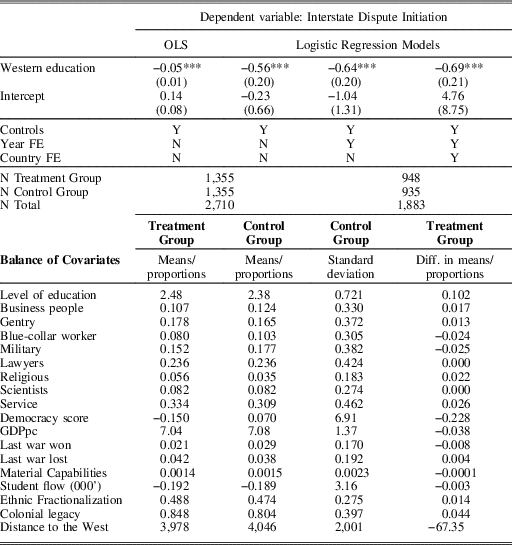
The research design establishes the effect of international education in countries’ foreign policies whose leaders have been educated in a Western democracy (‘the treatment group’) and countries whose leaders have not been educated in a Western democracy (‘the control group’), yet both groups of leaders are drawn from the same country, period and adjusted values in the other controls. A common issue with this type of regression-adjustments analysis is the lack common support. To check the robustness of the above model, I implement a matching technique based on leader- and country-level observables to increase the confidence that I am effectively comparing only comparable observations. In practice, I use a matching procedure to discard some data – unmatched data points – so that regression models fit better. To do so, I first match observations on all covariates used in Models 1–5 in Table 1 using the nearest neighbor matching technique. Then, I trim the dataset to include only matched observations (1,355 treated and 1,355 control observations).Footnote 91
The bottom panel in Table 2 reports the balance of covariates between the treatment and the control groups ensured with the matching technique, except for the year dummies, which are included in the online Appendix due to space limitations. The differences in the means across all covariates are relatively small compared to the standard deviation of the variables in the control group. This indicates that the treated and the control units are effectively comparable across all observables. A difference in means between the two groups shows that the proportion of observations with a militarized interstate dispute among non-Western-educated leaders is 13.8 per cent, which is significantly higher than the proportion of 8.7 per cent among Western-educated leaders.Footnote 92
The effect of western education on war initiation: a matching approach

Note: *p<0.05; **p<0.01; ***p<0.001. Models report cluster-robust standard error by leader to correct for the within-leader correlation of observations. The matching procedure is nearest neighbor. See the online Appendix for a full report of the balance of the covariates in the unmatched dataset compared to the balance of the covariates in the matched dataset. Just as for all the models in Table 1, only non-Western leaders are used for the analysis. Controls ‘Y’ means that all controls that are shown in the list of Balance of Covariates are also included in the regression models. Because the matching is not exact, the inclusion of the controls in the post-matching analysis adjusts for the remaining differences in the value of the covariates between the treated and the control units. Yet, the decision to include the set of controls in the post-matching analysis does not change any of the results presented here. Year FE and Country FE are year and country fixed effects. The last column drops observations that appear only once within a country.
To further test the robustness of this effect, Table 2 reports a set of regression models after adjusting for the small imbalances in the covariates and including cluster-robust standard error by leader to correct for the within-leader correlation of observations. The OLS estimate reported in Model 1 shows that the adjusted difference in means is 5 per cent, which is consistent with its unadjusted value of 5.1 per cent. While Model 1 has the advantage of providing easily interpretable coefficients, Model 2 appropriately models the relationship by using a logit link. As expected, the effect remains statistically significant and negative. To provide a further robustness test for the relationship, Models 3 and 4 add year and country fixed effects, respectively. The estimated relationship remains negative and statistically significant at a 99 per cent confidence level. Overall, the matching procedure provides further validity to the causal effect of leaders’ Western-based tertiary education on the reduction of their countries’ war involvement.
A Further Test of the Mechanism: US Versus Non-US Western Education
One of the empirical challenges to test the proposed theoretical reasoning is the lack of observable implications that would allow us to directly test the value-driven mechanism. In a recent review paper, Dafoe, Renshon and HuthFootnote 93 argue that leaders often invoke the need to protect national honor, reputation for resolve, respect and the like, a so-called culture of honor, as a motive for war involvement. Following this line of inquiry, Dafoe and CaugheyFootnote 94 exploit the within-country variation in culture between northern and southern United States to estimate whether culture of honor affects war involvement. In particular, the authors argue that white southerner presidents should be more likely to go to war because their cultural background is rooted in the culture of honor, compared to northern presidents. This inter-regional variation within the United States suggests that US cultural values are a combination of peace-prone northerner culture, similar to those found in non-US Western countries, and a war-prone southerner culture. Consequently, the peace-prone emancipative values should be less effective in this particular country due to this mixture of values.Footnote 95 If the mechanism of the finding is through change in values, we should then expect that the main relationship is weaker if a leader studied in the United States compared to other non-US Western countries.
To test this proposition, I construct two dummy variables. The first dummy variable takes the value of 1 if the leader has US-based Western education, and 0 otherwise. The second dummy variable takes the value of 1 if the leader has non-US-based Western education, and 0 otherwise. Therefore, those leaders that have non-Western-based education are in the excluded category. Table 3 consistently shows that the effect of studying in the US is negative, although not statistically distinguishable from non-Western education. By contrast, the effect of non-US-based Western education is also negative, but it is reliably estimated.
The Effect of US Education and Non-US Western Education on the Initiation of Militarized Disputes

Note: *p<0.05; **p<0.01; ***p<0.001. Models are mixed effects logistic regression models with random intercepts by leaders, and random or fixed effects by year and country, depending on the specification. Controls are the same as those included in Table 1 GPDpc, ethnic fractionalization and student flow are included in their logarithmic scale since this is the most appropriate functional form in the relationship between these variables and the outcome variable.
Testing the Endogeneity of Leader Selection
I now return to the issue of endogenous leader transitions that I referred to in the methods section. A potential challenge to the results presented in Table 1 has to do with the leader selection process being endogenous to the international security environment. Thus, if a country’s powerful actors believe the country is likely to face a military challenge in the near future, they could decide to change their country leader on the basis of whether the leader was educated in a Western democracy or not. Although it is implausible that leaders are selected during times of turmoil as a consequence of whether their educational background was in the West or not, I show here that the main finding is robust to this possibility by estimating a model that includes only those leaders who entered office in a regular manner immediately after the natural death of their predecessor. Given that there are only a few deaths-in-office transitions, I expand the time range of the sample back to 1875, by analyzing all leader transitions included in Archigos from 1875 to 2001. Even though control variables are not available for such a period of time, confounding factors are partly captured by the inclusion of country and year fixed effects. In any case, leaving only the fixed effects in place here is a worthwhile trade-off for alleviating the concern of endogenous transitions.
Table 4 estimates the main relationship for the deaths-in-office sample without random effects, with year and country random effects, and year, country and leader random effects (columns 1–3).Footnote 96 Regardless of the specification, the results show a strong relationship between Western democratic education and war involvement. The magnitude of the coefficient parallels the general models shown in Table 1. Notwithstanding this, leadership transitions may be random only during some years and, as time goes by, staying in office or not after a period of time can no longer be assumed to be random. To further alleviate this concern, I limit the analysis to the five years after the transition of the leader. Even though the number of observations drastically shrunk, the main association in this deaths-in-office sample restricted to the first five years after the leader transition is substantively unaltered, showing a significant negative association between a country leader’s Western education and war involvement. Therefore, leaders seem to play an important role in a country’s war involvement, and not as a consequence of the factors that let leaders rise to power.
Logit Regressions of War Initiation and Western Education (Random Leader Transitions)

Note: *p<0.1; **p<0.05; ***p<0.01. Models 1 and 4 are logistic regression estimates, and Models 2-3 and 5-6 are multilevel logistic regression models with varying intercepts. Constants are omitted from the output.
CONCLUSION
Following earlier requests for further studies on how the backgrounds of leaders may affect the way nations behave,Footnote 97 this article has explored the impact of prior background of national leaders and a country’s likelihood of engaging in interstate disputes against other countries. The first attempt to connect national leaders’ education and their country’s initiation of interstate disputes found null results.Footnote 98 This article generally argues that it is not the values, the skills or the networks that education alone provides to leaders, but that the kind of education is what matters in bringing the values, the skills or the networks that are associated with particular foreign policies. In particular, this article puts forward that Western education provides the values, the skills, or the networks to Western-educated non-Western leaders that influence them toward a more peaceful foreign policy.
The results have shown that leaders who have a university degree from a Western democratic country have a probability of being involved in a militarized interstate dispute that was initiated by the leader’s country of 7.3 per cent, compared to the 12.3 per cent probability of an otherwise similar leader who obtained her degree from a non-Western democratic country. The effect of Western education is significant across a number of different specifications. Mainly, the main effect remains after adjusting for a number of time-variant characteristics of the country – for example, democracy of political institutions, economic development, number of outbound international students, conflict history, and military capabilities – and year fixed effects or country-specific time trends, as well as after adjusting for time-invariant observable factors – for example, ethnic fractionalization, colonial legacy and distance to the West – and time-invariant unobservable characteristics with country fixed effects. In addition, the effects are also largely unchanged after matching the observations on observable characteristics, or after changing my definition of the West to include either only Western countries that have been permanently democracies between the period 1946–2001 or only long-lived Western and non-Western democracies, or both.
The study has also made additional efforts to alleviate reasonable concerns about the causal validity of the main findings of the article by controlling for a number of country characteristics, for pre-treatment characteristics of the leaders, accounting for country and year fixed effects, excluding Western non-democratic countries from the sample, including non-Western democratic countries from the sample, recoding war involvement to account only for those wars begun by the leader in power, and testing for the possibility of endogeneity related to leader transitions. Regardless of how the empirical models are specified, leader educational background in the West is associated with the likelihood of a country to become involved in an interstate dispute.
A caveat to the current analysis is that leaders’ experiences in the West are not homogeneous. First, contact alone may just be a necessary condition for socialization, and the quality of contact, an important component for socialization, depends on the visiting students.Footnote 99 While it may be the case that students’ self-selected social contact is limited to other foreign students with a similar socialization background,Footnote 100 it is also true that socialization in the culture and the social structure of a Western democratic country is more likely if an individual lives in a Western democratic country than if the student stays in her home country. Yet, understanding how the leader-specific experiences in the West shape their shift in preferences remains as a puzzle for further research. Secondly, this research effort has not been able to compare the experience of international education with other types of experiences that may also shift leaders’ preferences, such as the involvement in cross-national activities or exposure to foreign media broadcasting.Footnote 101 Finally, another component that this piece has not been able to address is the extent to which the change in foreign policy is due to the Western or the democratic nature of the host countries. With the spread of democratic political institutions around the world, an exploration of national leaders who studied after the third wave of democratization in non-Western democratic countries would allow us to disentangle the Western and the democratic component.
I acknowledge that claiming causality between a leader’s educational background and the way a nation behaves from an observational study is a challenging endeavor. However, the analysis and the robustness checks presented here strongly suggest that the link between a leader’s educational background in a Western democracy and a country’s war involvement is not simply a function of which countries select Western-educated leaders, the temporal evolution of worldwide educational trends and interstate disputes, or the way leaders rise to power. Consistent with the theory presented here, a Western democratic educational background of leaders shapes the likelihood of leaders to initiate militarized international disputes.