One surprising fact in the history of written languages in Mesoamerica is that the pictographic writing of the Mexica (also known as the Aztecs) and their neighbors was extant after the Mayan development of hieroglyphic writing, indeed flourishing for several hundred years in a highly culturally interconnected region. This historical movement from the hieroglyph (that is, image-based syllable writing) to picture writing troubles the standard narrative of the development of writing. That standard narrative assumes that humans begin with pictures that serve as icons of things, then gradually elaborate that iconology into more abstract forms of written representation, first ideographic then partially logographic (i.e., the hieroglyph) and then, in cascades of increased abstraction, tending toward the fully phonetic (i.e., the alphabet). Yet in Mesoamerica there appears to be an eddying movement backward, as it were, from hieroglyphic pools to a pictographic welling. Why is that?
Scholars have posited that the abundant linguistic variety of the region (Central Mexico) necessitated such a transition. Where there was intense spoken multilingualism what was needed was a monolingual image. As the archaeologist and anthropologist Stephen Houston explains, “A similar pattern occurs in Central Mexican writing, which, as an ‘open’ writing system, bridges areas of relative linguistic diversity and cultural homogeneity … since a heavily pictorial quality may actually facilitate the direct comprehension of meaning” (34). “As for purely ideographic writing,” he goes on, “I agree with A. Leroi-Gourhan that ‘true pictography is recent, mostly dating from after the period of contact with literate societies’”—that is, Maya societies from Southern Mesoamerica (38). “In regard to reading,” Houston writes, “I agree with Thompson and Kubler that the pictorial features of writing were maintained [i.e., in Central Mexican writing]—that is, prevented from achieving the abstraction that characterizes Chinese logographs—by the need to preserve superficial reading ability among a larger group of people” (40). Houston's notion that Mesoamerican pictography is a recent invention, a dialectical response to hieroglyphic writing, upends facile evolutionary conceptions of the development of writing. Here, rather than a Darwinian emergence of letters from pictures, you have pictures constellated into language amid a historical crisis of condensed polyglotism and proliferating intercultural interactions. The anthropologist and scholar of Mexica writing Gordon Whittaker thus notes that in Mesoamerica in the first millennium CE the idea of writing circulated unhitched to any normative sense of developmental abstraction, and thus was enabled to grow pictorially:
Intensive contact between the Teotihua and Maya elites around this time is likely to have given impetus to the development of writing in Central Mexico in a process called stimulus diffusion—it was not a system of writing that diffused to the Teotihua from the Maya and other peoples in Southern Mesoamerica, such as the nearby Zapotecs of Monte Albán, but the idea of writing. The product of this influence was a writing system with a much more flexible structure than the Maya had: syllable signs were not bound to a strict V (that is, a vowel, like a) and CV (consonant+vowel, like mi) structure but could also take the shapes VC (like ac) and CVC (like pan), and even be disyllabic (like acol). The occasional occurrence in Mid-Late Classic Maya writing of VC and CVC syllabograms would seem to derive from this new Central American practice, one that continued on down to the Aztec period and beyond—a case of the student influencing the teacher, just as Rome, after conquering Greece, absorbed elements of Greek culture, only for Greece to return the compliment at a later point. (188–89)
Whittaker reminds readers that the pictographic writing of Central Mexico did not lose the ability to signify syllables. It is not a degradation from a more advanced Maya way of writing; rather, it continued to enable an author in Central Mexico circa 1400 CE to write anything that an author in Central America circa 400 CE would have been able to write, except that for the later author the pictorial quality of the writing system had been intensified. Whittaker also points out that such pictorial intensification made circular geographic movements, inspiring Maya writers in the Late Classical Period of Maya civilization (550–830 CE) to take a cue from their northern neighbors and intensify the pictorial aspect of their writing system. The wells of picture writing in Mesoamerica indeed rose in this time, just as one of those cenotes considered sacred there might do in a heavy historical rain.
These considerations came to me as I noticed a proliferation of this style of Mesoamerican pictorial writing in contemporary graphic novels and animated films, prompting me to ask: How is the monolingual character of pictographic writing related to these highly globalized contemporary mediations? It is clear that anime and its attendant modes (e.g., manga) have what Aby Warburg would have characterized as a genealogical constellation, a “pathosformel”—that is, a form of pictorial feeling and thinking—in this case one that is interconnected with nineteenth-century Japanese woodblock images (qtd. in Didi-Huberman 81). For instance, one can readily appreciate how the mountainous wave of Katsushika Hokusai's “Great Wave off Kanagawa” (1831) or even “Kajikazawa in Kai Province” (1830) is reiterated in Hayao Miyazaki's film Ponyo (2008), particularly in the scene in which the mermaid Ponyo runs over a titanic wave to her new home on land. Likewise, you can see the massive, looming arcs of trees in Utagawa Hiroshige's “View of the Saruhashi Bridge in Kai Province” (1842) revisited in Miyazaki's monumental camphor tree in My Neighbor Totoro (1988), or notice how the entranced perspectives of Hiroshige's “Foxfire on New Year's Night under the Enoki Tree near Oji” (1857) or “Ushimachi in Takanawa” (1857) seem as if they take place in an animated film, without even having to cite their reiteration in such films as Miyazaki's Nausicaä of the Valley of the Wind (1984), Hiroyuki Morita's The Cat Returns (2002), or Hiromasa Yonebayashi's Secret World of Arietty (2010). In its visual repertoire anime enacts a rich inheritance from the Japanese woodblock, perhaps prompting a continued material sensibility of wood, wet ink, and the animating quality of their interrelation. But what about the anime that doesn't look to Japan for its visual inheritance, and instead looks to the Americas? What happens to a film's pathosformel when it derives its visual repertoire from the picture writing of Mesoamerica? And, conversely, how does this new life in animation cast new light on picture writing?
I should emphasize that, while I am concerned here with how the formal repertoire of pictography affects its contemporary adaptation in anime, there are many animated works that deploy a Mesoamerican look that is superficial at best. I am not concerned with such infelicitous appearances of Mesoamerica in contemporary animation as the Olmec head in The Simpsons, the cursed mask in JoJo's Bizarre Adventure, or Maya's sword in Maya and the Three. These representations lack a Mesoamerican pathosformel insofar as they lack engagement with the formal specificity of Mesoamerican picture writing and the world of ideas and feelings it enables. In such works the image of Mesoamerica is content for narratives uninterested in the mechanics of picture writing.
What then are the mechanics of Mesoamerican picture writing? As Enrique Escalona demonstrates in his stunning animated film explanation of Mexica pictography, Tlacuilo (1987), pictographs are mnemonic devices for oral recitation and, in their connection to an oral mode, endow a text's reader with the ability to creatively rework and elaborate its contents. Still, in Mesoamerican pictography, such performative open-endedness is tempered by specific ideographic, logographic, and syllabic cues. In reading a pictographic work such as the Codex Mendoza (the codex featured in Escalona's film), you might be able to give a narrative sequence your own special flair, but you'd know as well that you were telling a story about the founding of Tenochtitlan and the conquests of such specific Tenochca rulers as Chimalpopoca, Itzcoatl, Axayacatl, and Ahuitzotl. More critical to my emphasis here, however, is that there is something about pictographic writing that is well demonstrated by Escalona's filmic animation—that is, the way in which the animated pictures of the film teach viewers something about the animacy of Mesoamerican pictography. Magnified in Patricia Amlin's animated retelling of the K'iche’ Maya story of creation the Popol Vuh (1989), in which she transformed the figures from classical Maya ceramics into puppets for the screen, the film's visual language given motion resonates with a writing system whose entire reason for being is to give legibility to languages in motion, crisscrossing over a written page that is itself a compressed expression of sight, sound, text, and context.
In short, the contemporary remediation of pictography in animation is a kind of reanimation of texts whose symbols always had an animated sensibility. These texts are made in a world where—as I've elaborated in my own work (drawing on another work by Houston, The Life Within)—language itself, written and spoken, is understood to be animate, alive, autonomous, and even unruly (Garcia 136). The picture serves to ground some of that unruliness—but, as Escalona's and Amlin's animated films suggest—the picture also moves. Other recent works that have given Mesoamerican pictography a sense of reanimation are two comics series: Daniel Parada's Zotz: Serpent and Shield (2011– ) and Paul Guinan, Anina Bennett, and David Hahn's Aztec Empire (2018– ). And the practice is certainly not strictly recent. As Whittaker notes, in the sixteenth-century Florentine Codex (the Franciscan friar Bernardino de Sahagún's monumental work of ethnography and encyclopedic assemblage) pictographic cues can still be seen in the more naturalistic, European-style illustrations that his Nahua students provided for the colonial-era alphabetic text (48). That said, to make my final points here about the vitalism of pictography in its contemporary remediation, I turn to a recent achievement of pictography in film, an online, internationally produced animated series named Onyx Equinox (2020– ), created by the Mexican animator Sofia Alexander.
Onyx Equinox is an anime series that takes place in a multiethnic, intercultural milieu of precolonial Mesoamerica, involving Mexica, Zapotec, Maya, and Totonac history and myth. The show forgoes a strict historical representation of these groups in order to picture their interaction. The Mexica god of the lowest underworld, Mictlantecuhtli, brings about the show's crisis: hungry for human sacrifice, the underworld god has been stealing blood intended for the other gods. These other gods convene to discuss what should be done. While this group includes the core deities of the Mexica pantheon—Xipe Totec, Huitzilopochtli, Tezcatlipoca, and Quetzalcoatl—only the latter two proceed with a plan. Or, rather, they proceed with a wager: Tezcatlipoca is ready to destroy the world (as he has done several times), but Quetzalcoatl bets him that one hero, drawn from the lowliest of the lowest humans (a slave in fact), will defeat Mictlantecuhtli. Tezcatlipoca accepts the wager under the condition that, should this hero fail, Tezcatlipoca will destroy humanity and take all future blood offerings from Quetzalcoatl, dooming the sun god to starvation. The boy they select, a Mexica named Izel who is enslaved in the Maya city of Uxmal, is given the daunting task of closing the five gates of the underworld. To do this, he must travel across Mesoamerica to various Zapotec, Maya, Totonac, and Mexica cities (i.e., Dani Baán/Monte Alban, Calakmul, Lakamha/Palenque, and Tajín/Papantla), while also enlisting the help of other young heroes in those diverse locales and the help of Mictlantecuhtli's consort, Mictecacihuatl, goddess of death and the night.
The iconography of the show is derived from Mesoamerican codices. In particular, the divinatory almanac called the Codex Borgia (circa 1480–1520 CE) appears to be a primary source for the show's depiction of the gods. And visual tribute lists (i.e., pictographic records of the Mexica Empire's tribute collected from its subsidiary states) such as the Matrícula de Tributos (circa 1525) help the show depict the varied fashion and styles of the different kinds of people of Mesoamerica. The tribute roll is of interest here because it not only serves to substantiate the depiction of various Mesoamerican fashions, it also appears in the last episode of the show's first season held in the hands of a Tenochca tribute collector in the background of the scene (episode 12, 22:34). The tribute collector is thus depicted by way of the very thing he holds in his hands, a pictorial account of contemporaneous clothing owed in tribute to Tenochtitlan. Such mirrored relations between the pictographic archive and its visual reanimation are frequent in the show: hero twins are shown beneath murals of the famous hero twins of the Popol Vuh; animals that will be important to the plot are prefigured in tapestry, painting, or stele, as if to suggest that they emerge from their picture; and Izel's weapon is a living flint knife or tecpatl that is visually self-same with the glyph for the eighteenth day of the Mexica calendar, suggesting again the emergence of a living object from the picture writing of Mesoamerica. When pictures appear inside themselves in this way, when they appear to reflect on themselves and on the work of picture-making, they are what my colleague the image theorist W. J. T. Mitchell has called “metapictures,” or pictures that reflect on the act of picture making—a moment when the work of pathosformel sees itself in a mirror (35). And in the world of Onyx Equinox, the metapictures do not so much open up a space for dialectical self-reflection as constitute the language itself, a reflexive dialectic positioned amid multiple streams of linguistic difference (the indigenous languages of Mesoamerica alongside the other languages involved in the show's production—English, Spanish, Japanese, and Korean—and the languages besides English and Spanish into which the show is dubbed—e.g., Portuguese, French, German, and Russian). As such, the show's metapictures negotiate an awareness of contradiction and change, enabling knowledge and feeling across spoken languages while also embodying some sense of the anxiety and pride elicited in organizing such heterogeneity. The show reminds its viewers (as do the pictographs of Mesoamerica) that the monolingual image hides its multilingual origins. While such images seek to regulate the fact of other languages, their very appearance reflects linguistic change, difference, precarity, and contingency. The globalized contemporary remediation of these pictographs was prefigured by the linguistic multiplicity of Mesoamerica that gave rise to the pictographs.
It is perhaps a platitude to note that monolingualism is only a possible desire in a multilingual environment; there is no horizon of the singular without first some sense of its fragmentation to precipitate a movement in the direction of the one. In elaborating Warburg's concept of the pathosformel, the philosopher and art historian Georges Didi-Huberman points out that the picture standing amid multiple languages and cultural formations, trying in turn to constellate that heterogeneity into a singular form, often has a sense of tremendous intellectual ambivalence, an anxiety about assemblage, or what Didi-Huberman provocatively calls:
an anxious gay science: knowledge of the heterogenous, inasmuch as it “elects” its home in its affinity with the other, object or subject. Knowledge of the heterogenous, inasmuch as it makes us “elect” the dissimilar as an object of knowing … or as a love object (to love beyond boundaries, “cosmopolitically”). … The elective affinity would thus be, before anything else, to love one's dissimilar and to want to know it through “constellations,” montages, or atlases interposed. (141)
Didi-Huberman's point here, it seems to me, is that such monolingual images as we find in first-millennium CE Mesoamerica have historical anxiety behind them. They are positioned against linguistic heterogeneity while they try also to regulate that which they cannot control—that is, the fact of other tongues. The anxiety of the assemblage is always behind the monolingual image, seen in the background when such images catch sight of themselves in a reflecting instrument like the Mesoamerican pictograph. Didi-Huberman invokes the Benjaminian figure of the constellation, which is appropriate for considering anime and pictographs together, since these media—like constellations—seek to arrange things that will never meet: languages, film sequences, social locations, historical orientations, and stars.
In a moment of revealing self-awareness in the fourth episode of Onyx Equinox, the reanimated form of Quetzalcoatl reflects on his role not just as Creator god but as a creator with a lowercase c—that is, as an artist amid widespread fragmentation, destruction, and change—here, speaking to the jaguar Yaotl:
Do you see them, Yaotl? They [the monkeys in the trees] are the children of our great second Sun, the second age, the second time we attempted the creation of a people to venerate us. We cursed them to this form when they lost their nobility and gave in to baser traits. They were the second—Tezcatlipoca sent jaguars like yourself to devour the first attempt. The third and fourth Suns we drowned and set ablaze. I always mix up which is which. Tlaloc's wife cried blood for fifty years, drowned those humans; but he turned them into fish, I think. Humanity is in their fifth incarnation. Billions came before them—now burned, drowned, banished, cursed. If the humans cease to sate us, the sun will darken and the earth will be shattered. And everything and everyone that has ever been loved will be destroyed, and remade. (episode 4, 11:22–12:18)
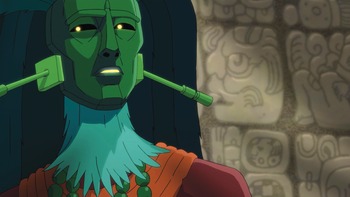
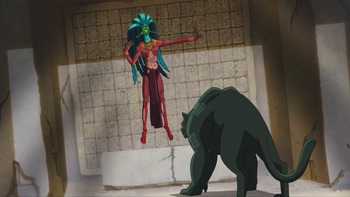
Quetzalcoatl here refers to the myth of the Five Suns in Mexica cosmology, a Mesoamerican creation story in which the gods fail on several occasions to make the right kind of people—a story depicted in another film by Amlin, in which she uses the Mexica codices for her animated pictographic puppetry, The Five Suns: A Sacred History of Mexico (1996). Indeed, these gods only succeed when they finally make people who, like these gods, are beings of fracture, difference, frustration, and critical self-reflection, the kinds of gods who, as Quetzalcoatl does here, forget which attempt came first, what happened when, or what the takeaway from such world-historical transformations was supposed to be. In seeking to make humans that are a kind of metapicture of the gods—that is, neither omnipotent nor omniscient, but very much vulnerable, anxious, and aspirational beings—Quetzalcoatl floats in front of a tablet of glyphs in Palenque that includes a picture of himself (fig. 1). To his left are two Mayan glyphs identifiable as the MAT glyph and the CHAN/KAN glyph. The MAT glyph to which Quetzalcoatl's hand is raised in one shot is a bird glyph associated with Quetzalcoatl, either in the guise of a cormorant, merganser, harpy eagle, heron, or crow (Stuart 21–22). And the CHAN/KAN glyph, which is shown in profile alongside a close-up of Quetzalcoatl's face (fig. 2), is a glyph for the cardinal number 4 that is homophonous in the Yucatec Mayan language with the words for sky and snake (Montgomery). Combining these two glyphs then we get a visual translation of Quetzalcoatl's name, which in the Nahuatl language means “feathered serpent” or “bird snake.” In Mexica philosophy (and more broadly throughout Mesoamerica), such a composite name indicates a sense of irreconcilable pairs, a nonsynthesizing dialectic, by which the world's constant transformations are thrown into their ineluctable movement. Here, that world-historical movement is coordinated by the pictographic aspect of a hieroglyphic relation across two film shots, two Mesoamerican cultural formations (Mexica and Maya), multiple spoken languages, millennia of time, and the diversity of media integrated into the single scene (a hieroglyphic stela that has the approximate aspect ratio of a television screen through which I find myself watching the show). But most dramatic is Quetzalcoatl's visage here, his face, both as glyph and animated character. The two faces mirror each other: the rays that stream on the glyph from its facial temples and cheek are reiterated in the feathers streaming from the animated figure's temples and neck, while the eyes on both arc upward and to the left, just above the sagging eye-bags of a world-weary god. Likewise, the jutted tooth on the glyph's face is mirrored in the golden shine of the animated god's grimace. In most respects, it is clear that the pictorial idea here is reflection, or metapicturing.
Quetzalcoatl's face is shown in a close-up alongside the CHAN/KAN glyph, in a still from the animated series Onyx Equinox. © 2020 Crunchy Onigiri, LLC.

Quetzalcoatl floats in front of a tablet of glyphs in Palenque, in a still from the animated series Onyx Equinox. © 2020 Crunchy Onigiri, LLC.

Yet in one significant respect the faces are different: the reanimated Quetzalcoatl's face is bisected by analog antennae that seem as alien to the Mesoamerican glyph as they do familiar to its anime remediation. In those antennae are connoted the global, televisual networks that bring this program into existence, made by a collection of Mexican, Latin American, Latinx, and Indigenous animators, writers, and voice actors (the anime of the Americas) in collaboration with Korean and Japanese production teams (the anime of the Americas in its trans-Pacific networks). Each still of the animated, global program is in effect pictographic, condensing languages and distant geographic contexts into an image of translatability. Quetzalcoatl himself is a metapicture of such linguistic transit, embodying the irresolvable, yet nonetheless animating, dialectic by which he appears in a glyphic representation in front of which he floats, like the flying serpent he is, coursing through earth and air, stela and streaming digital platform. If this is a picture in a scene of revealing self-awareness, its transit through both the vitalism of Mesoamerican pictography and the montages of the cinematic medium conditions its picture consciousness, its pathosformel, as a historical consciousness sensitive to its present changes and, as Quetzalcoatl himself notes, its immanent revisability. It is not just the case that the pictograph gives this anime reanimation a sense of historical self-awareness (which it does); the anime also reveals how the pictograph organizes changes in sight, sound, text, and context, as well as the emotional resonances and difficulties that come with trying to capture such change.
If the pathosformel of the monolingual Mesoamerican pictograph connotes an anxiety about linguistic difference, then its pathos is nowhere better described than by Izel, when reckoning with the gods’ obsession with blood (and bloodlines and even racial lineages), who says, “[W]e are complex and imperfect creations because we were created by imperfect beings” (episode 12, 14:46–14:52). The obsession of those struggling gods with blood leaves them incapable of seeing when the human struggle for monolingual horizons is precisely what should resonate with their (the gods’) own fractured lines of communication. This is not to say the gods are wrong in their insights, broken though they are—only that it takes them so long to see past blood and racial horizons, to see (as Izel does) that there is no insight without a precipitating problematization, no breakthroughs without breakdowns, no summoning the monolingual image without knowing first how the fact of other languages affects, and thus prompts, the self-reflection of the people in its midst. Such multilingualism in the monolingual image can be seen when, in looking at the screen of moving pictures, whether anime or Mesoamerican, you catch sight of yourself watching, and everything behind and around you is like a crowded chattering suddenly visible.