





Impact statement
This paper offers biodesign educators a conceptual framework for articulating the pedagogical significance of eco material libraries – not as supplementary resources but as foundational learning infrastructures. By demonstrating that transversal competences associated with sustainability transitions depend on organised material conditions rather than instructional methods alone, it provides theoretical grounding for the strategic positioning of biodesign education within challenge-based and sustainability-oriented higher education programmes.
Introduction
Biodesign education is increasingly positioned as a response to ecological crisis, material scarcity and the need to rethink dominant paradigms of extraction and production (Ramsgard-Thomsen, Reference Ramsgard Thomsen2025). As design programmes integrate biomaterials, microbial processes and laboratory-based experimentation into their curricula, pedagogical practices are necessarily evolving (Vijayakumar et al., Reference Vijayakumar, Cogdell, Correa, Dade-Robertson, Danies, Edens and Walker2024; Sauerwein and Mooij, Reference Sauerwein and Mooij2025; Zhou et al., Reference Zhou, Rognoli and Pedgley2025). Designers are no longer framed solely as selectors of industrially stabilised materials, but as participants in material formation, cultivation and transformation. When materials are living, temporally unfolding and sensitive to environmental conditions, they resist being treated as fixed substrates with predefined properties (Karana, Reference Karana2020). Instead, they demand sustained engagement with processes of growth, decay, contamination and instability. Under such conditions, material production and material learning become inseparable: cultivating a biomaterial is simultaneously an act of design and an act of inquiry (Nachtigall et al., Reference Nachtigall, Tomico, Wakkary and Dongen2019).
Within this evolving landscape, eco material libraries have emerged in several institutions as structured environments for working with biomaterial samples (Wilkes and Miodownik, Reference Wilkes and Miodownik2018). While no universal definition exists and configurations vary across contexts (Waag Futurelab, 2025; Fab Textiles, 2025), eco material libraries can be understood as curated and evolving collections of samples, recipes, protocols and documentation systems that preserve iterative experimentation over time. The term eco material library is used deliberately to signal that materials are understood not as isolated substances but as ecological entities – a category that encompasses biobased, living, biofabricated and bio-derived materials alongside the processes, interdependencies and inquiries through which they come into being (Ferguson et al., Reference Ferguson, Edens, Lazaro Vasquez, Simeone, Gray, Verhoeven, de Götzen, Bakırlıoğlu, Zohar, Stead and Buwert2026). Understood this way, an eco material library constitutes an ongoing constituency of humans and nonhumans – students, educators, samples, microbes, recipes and environmental conditions – continuously reconfigured through acts of making, curation and collective inquiry (Tomico et al., Reference Tomico, Oogjes and Wakkary2025). Building on the broader tradition of material libraries as reference resources, eco material libraries extend the traditional model by foregrounding ecological awareness, hands-on experimentation and the documentation of process alongside outcome (Romani et al., Reference Romani, Rognoli and Levi2023). In doing so, they cultivate forms of material literacy grounded in embodied practice and collective comparison.
Despite their growing presence in design education, the pedagogical role of eco material libraries remains under-theorised. Unlike conventional material collections oriented towards comparison of properties and applications, eco material libraries preserve iterations, breakdowns and traces of temporal transformation. Samples within these environments therefore function not merely as references or experimental outcomes, but as mediating artefacts that externalise otherwise invisible biological, chemical and technical processes (Ayala Garcia and Rognoli, Reference Ayala Garcia and Rognoli2018; Wilkes, Reference Wilkes2011; Lázaro-Vasquez et al., Reference Lázaro Vasquez, Arduini, Sandry, Houser, Golla and Alistar2026; Duarte Poblete et al., Reference Duarte Poblete, Romani and Rognoli2024). Their materiality makes ecological interdependence tangible, inviting students to interpret, negotiate and respond to material behaviour across disciplinary perspectives.
To grasp the significance of such environments, it is productive to shift from viewing eco material libraries as repositories towards conceptualising them as pedagogical infrastructures. Drawing on infrastructural theory in science and technology studies, infrastructure can be understood as the relational arrangements that organise practice, distribute agency and stabilise activity over time (Star, Reference Star1999; Edwards, Reference Edwards, Misa, Brey and Feenberg2003). Infrastructure often recedes into the background of attention, becoming visible primarily when it fails, yet it continuously shapes what forms of action and knowledge are possible. Applied to biodesign education, this perspective directs attention to the organised configurations of samples, documentation systems, curatorial decisions and spatial arrangements that structure how learners encounter material systems. Rather than isolating teaching methods from their material context, an infrastructural lens foregrounds the conditions under which epistemic practice unfolds.
The relevance of such an approach becomes particularly salient within challenge-based learning (CBL) environments, where learners collaboratively address complex sociotechnical challenges that exceed disciplinary boundaries (Cator and Torres, Reference Cator and Torres2016). CBL has gained significant traction in higher education over recent decades, particularly within STEM and design-oriented programmes, as institutions seek to prepare students for the kinds of open-ended, interdisciplinary challenges that sustainability transitions demand – bringing together students, researchers and industry or community partners around shared real-world problems (Gallagher and Savage, Reference Gallagher and Savage2023; Galdames-Calderón et al., Reference Galdames-Calderón, Stavnskær Pedersen and Rodriguez-Gomez2024).
CBL is often associated with the cultivation of transversal competences such as collaboration, systems thinking and critical reflection (Gallagher and Savage, Reference Gallagher and Savage2023). Yet educational research suggests that exposure to complex challenges alone does not guarantee the development of such competences (Georgiou et al., Reference Georgiou, Gallagher and Chmielewska2025; Galdames-Calderón et al., Reference Galdames-Calderón, Stavnskær Pedersen and Rodriguez-Gomez2024). The question then becomes: what material and organisational conditions make such competences not merely desirable but practically necessary? If learning is embodied, situated and mediated by artefacts, competences cannot be treated as transferable skills detached from context; they emerge within specific material and social arrangements (Lave and Wenger, Reference Lave and Wenger1991). This points towards the infrastructures that structure participation – the organised environments in which learners encounter uncertainty, negotiate across disciplines and develop adaptive reasoning through sustained material engagement. Eco material libraries, situated at the intersection of laboratory experimentation and studio practice, stabilise material inquiry across time and organise encounters that require explanation, negotiation and reinterpretation.
Drawing on sustained pedagogical engagement with two eco material libraries embedded in biodesign programmes at different universities, this paper develops a conceptual account of how such libraries operate as pedagogical infrastructures. Through reflective analysis of sample-making processes, documentation practices and student engagement, it articulates the mechanisms through which biomaterial samples mediate cross-disciplinary reasoning and recalibrate design epistemologies. Rather than evaluating predefined learning outcomes, the paper examines how infrastructural configurations shape epistemic practice and scaffold embodied, situated and reflexive forms of learning. By reframing eco material libraries as infrastructures that organise material inquiry over time, this paper contributes to ongoing discussions in biodesign pedagogy and material literacy (Nicenboim et al., Reference Nicenboim, Karana, McQuillan, Devendorf, Kakehi, Bell, Speed, Oogjes, Yao, Søndergaard, Helms and Withers2025; Karana et al., Reference Karana, Barati, Rognoli and Zeeuw van der Laan2015; Bak-Andersen, Reference Bak-Andersen2021; Zhou et al., Reference Zhou, Rognoli and Pedgley2025). Specifically, it advances an infrastructural framing – attending to the organised material conditions that stabilise practice rather than to instructional methods alone – and argues that this framing carries epistemic implications: what designers can know and do with living materials depends not only on curriculum design but on the durability of the environments in which material inquiry unfolds. In doing so, it offers a conceptual vocabulary for understanding how material engagement reshapes learning within challenge-oriented educational contexts and positions eco material libraries as a condition of possibility for the transversal competences CBL frameworks presuppose but rarely explain.
Theoretical framing
The argument developed here draws on five interconnected theoretical threads, each contributing a distinct analytical layer that builds towards the central claim of this paper. The threads follow an argumentative sequence: biodesign education is first situated as a form of material inquiry to establish what kind of learning is at stake. Challenge-based learning then introduces the educational context that demands this learning. Theories of embodied and situated learning provide the theoretical grounding for why both work the way they do. The concept of boundary objects zooms in on how samples specifically operate pedagogically. These four threads converge in the final section, which synthesises them into the central claim of this paper: that eco material libraries function as pedagogical infrastructures that organise the conditions under which cross-disciplinary material inquiry becomes cumulative, reflexive, and educationally generative. Together, these threads construct the conceptual model presented in Figures 1 and 2: Figure 1 maps the relationships between institutional demand, educational context, pedagogical infrastructure, epistemic foundations and competence development, while Figure 2 instantiates these relationships within the specific context of eco material libraries and challenge-based learning.
Conceptual model showing the relationship between institutional demand, educational context, pedagogical infrastructure, epistemic foundations, competence development and epistemic recalibration.

Figure 1. Long description
A conceptual model diagram illustrating the relationship between institutional demand, educational context, pedagogical infrastructure, epistemic foundations, competence development, and epistemic recalibration. The diagram is divided into two main sections: Institutional Demand and Epistemic Foundations. The Institutional Demand section includes Educational context, Competences, and Pedagogical infrastructure. Educational context is described as the learning environment and program. Competences are demanded and enacted, and Pedagogical infrastructure organizes the conditions under which competences become necessary. The Epistemic Foundations section includes Knowledge generation, Situated learning, and Material mediation. Knowledge generation is produced through engagement, Situated learning involves competence enacted in context, and Material mediation involves knowledge distributed through objects. The diagram shows that Pedagogical infrastructure depends on Epistemic Foundations and organizes Competences. Epistemic Foundations produce Epistemic recalibration, which is a redesigned relationship to knowledge and practice.
The conceptual model instantiated: eco material libraries as pedagogical infrastructures within challenge-based learning, showing the gap between educational context and competence development and how infrastructural organisation fills it.

Figure 1 presents a conceptual model for understanding how pedagogical infrastructure mediates between institutional demand and competence development. Institutional demand refers to the external pressure from society and institutions – the need for graduates equipped to navigate complex challenges such as sustainability transitions. Educational context is how education responds to this demand, through learning environments and programmes designed to cultivate relevant competences. However, educational context alone cannot guarantee competence development. Pedagogical infrastructure occupies the central organising role: it structures the conditions under which competences become not merely desirable but necessary. This infrastructure is grounded in three epistemic foundations – knowledge generation through engagement, situated learning and material mediation – which together explain why organised material environments carry pedagogical weight. The bidirectional relationship between competences and infrastructure reflects a core claim: competences depend on infrastructure to become practicable, while infrastructure is designed in response to the competences that educational contexts demand. When all layers align, the system produces epistemic recalibration – a redesigned relationship to knowledge and practice.
Figure 2 instantiates this model within the specific context of this paper. The abstract layers of Figure 1 are here populated with their concrete equivalents: challenge-based learning as the educational context, with its associated demand for transversal competences such as collaboration, systems thinking and critical reflection. Eco material libraries function as the pedagogical infrastructure — providing the specific conditions under which these competences become necessary rather than merely desirable. This infrastructure is grounded in three epistemic foundations: biodesign as material inquiry, embodied and situated learning, and boundary objects. Together, these explain why eco material libraries carry pedagogical weight and how sustained engagement within them produces epistemic recalibration — a shift from designers as selectors of stable materials toward situated participants within material-ecological systems. The sections that follow develop each of these theoretical threads, building toward the infrastructural claim at the model’s centre.
Biodesign education as material inquiry
Biodesign education is first situated as a form of material inquiry – the foundational epistemic layer of the conceptual model (Figure 2) – in which knowledge is generated through engagement with living systems rather than applied from existing repertoires. The ecological implications of material production have increasingly reshaped both design discourse and design education (Bak-Andersen, Reference Bak-Andersen2021) Designers are no longer positioned solely as selectors of industrially stabilised materials, but as actors implicated in extraction, processing and environmental consequence (Antonelli, Reference Antonelli2024; Crawford, Reference Crawford2023; Ayala Garcia and Rognoli, Reference Ayala Garcia and Rognoli2018; Wakkary et al., Reference Wakkary, Oogjes, Tomico, Sakib and Kökel2025). In response, biodesign education integrates living systems, biomaterials and laboratory-based experimentation into design curricula, shifting attention from material selection towards material formation. This shift entails an epistemic reorientation: material knowledge is not simply applied but generated through engagement with dynamic systems.
Unlike conventional studio models in which materials are treated as stable and predictable substrates, biodesign requires direct involvement with biological processes such as growth, fermentation, decay and microbial activity. Materials are encountered as temporally unfolding processes shaped by environmental conditions, infrastructural constraints and practices of care (Zhou and Rognoli, Reference Zhou, Rognoli, Börekçi, Koçyıldırım, Korkut and Jones2019; Ihls and Pollini, Reference Ihls and Pollini2025; Tomico et al., Reference Tomico, Oogjes and Wakkary2025). Their properties are neither fully predictable nor permanently stabilised; they emerge through iterative experimentation. Production and learning thus become co-constitutive: to cultivate a biomaterial is simultaneously to test hypotheses, confront uncertainty and interpret material behaviour.
Material literacy in this context extends beyond identifying properties or performance criteria. It involves understanding how materials come into being, under which conditions they persist, how they depend on ecological and technical systems and how they participate in broader environmental relations (Parisi et al., Reference Parisi, Rognoli and Sonneveld2017; Zhou et al., Reference Zhou, Rognoli and Pedgley2025). This material literacy is not acquired through description or classification alone – it develops through direct engagement with materials that behave unexpectedly, resist intention and change over time. Students negotiate between biological constraints and design intention, situating their decisions within living processes that resist full control – learning to read materials not as fixed substrates but as dynamic participants in an ongoing ecological exchange.
This orientation aligns with design research approaches that frame making as epistemic practice, including Material Driven Design and DIY-Materials methodologies (Karana et al., Reference Karana, Barati, Rognoli and Zeeuw van der Laan2015; Rognoli et al., Reference Rognoli, Bianchini, Maffei and Karana2015). Within sustainability discourse, growing attention to material lifecycles and relational ecologies further underscores the need for such processual engagement (Pierce, Reference Pierce2009; Karana et al., Reference Karana, Nimkulrat, Giaccardi, Niedderer and Fan2019; Malafouris, Reference Malafouris2019; Barrios-O’Neill et al., Reference Barrios-O’Neill, Ribul, Tommencioni Pisapia, Yan, Rungta, Selby, Ren, Quintana, Morrow, Lanot, McQueen-Mason and Baurley2025). Material inquiry in biodesign is therefore characterised by processes that unfold unpredictably, resist full control and exceed disciplinary boundaries – conditions that educational environments must be equipped to sustain rather than resolve.
Challenge-based learning and the question of scaffolding
CBL has gained prominence within interdisciplinary higher education as an approach designed to engage students with complex, real-world sociotechnical issues (Gallagher and Savage, Reference Gallagher and Savage2023). Rather than structuring learning around predefined disciplinary problems, CBL environments invite students to collaboratively frame and address open-ended challenges that cut across technological, ecological and social domains. Particularly within STEM and design-oriented programmes, CBL is valued for its capacity to situate learning within contexts of uncertainty and societal relevance – taking forms such as hackathons, interdisciplinary project teams and collaborative learning environments that bring together students, researchers and industry or community partners around shared sustainability challenges.
CBL is frequently associated with the cultivation of transversal competences such as collaboration, systems thinking, and critical reflection (Gallagher a Savage, Reference Gallagher and Savage2023). These competences are often described as essential for navigating sustainability transitions and complex innovation processes. Yet the assumption that such capacities will emerge organically from exposure to complexity has been repeatedly questioned. Constructivist and sociocultural theories of learning emphasise that knowledge and skill develop through structured participation in situated practices rather than through abstract problem exposure alone (Vygotsky, in Wersch, Reference Wertsch1985; Lave and Wenger, Reference Lave and Wenger1991). Simply placing students within open-ended challenges does not guarantee the development of collaborative reasoning or reflexive judgement (Georgiou et al., Reference Georgiou, Gallagher and Chmielewska2025; Galdames-Calderón et al., Reference Galdames-Calderón, Stavnskær Pedersen and Rodriguez-Gomez2024). Competence is enacted within specific material and social arrangements; it is not transmitted as an independent cognitive attribute.
From this perspective, the pedagogical question shifts from which competences are desirable to how educational environments organise the conditions under which such competences become necessary and practicable. Collaboration, for instance, is not merely an attitude but a requirement that emerges when tasks exceed individual expertise. Systems thinking is not an abstract mental capacity but a mode of reasoning prompted when interdependencies become materially visible. Critical reflection does not arise from instruction alone but from encounters that destabilise prior assumptions and demand reinterpretation.
This is, at its core, a scaffolding problem: how to organise the conditions of learning so that transversal competences are not merely hoped for but structurally required. Biodesign education, particularly when integrated into challenge-oriented contexts, makes this problem more acute. Working with living, biofabricated, and bio-derived materials introduces layers of uncertainty and ecological interdependence that complicate linear problem–solution reasoning (Benabdallah et al., Reference Benabdallah, Lázaro Vasquez, Devendorf and Alistar2025). Materials do not behave as intended: growth unfolds according to its own temporality, contamination or failure can invalidate initial design intentions, and outcomes resist the kind of control that linear reasoning assumes. Under such conditions, reflexivity, negotiation and adaptive reasoning are not optional virtues but practical necessities. The development of transversal competences thus becomes inseparable from the organisation of material practice – and it is precisely this organisation that an infrastructural perspective brings into focus.
Learning as embodied, situated and multidimensional
Experiential learning theories emphasise that knowledge emerges through cycles of action and reflection rather than through abstract transmission (Dewey, Reference Dewey1934; Kolb, Reference Kolb1984). In materially oriented disciplines, these cycles are mediated through direct engagement with substances and processes. Making functions not as execution but as inquiry: learners manipulate materials, observe responses, interpret outcomes and adapt their approach (Schön, Reference Schön1983). Phenomenological and embodied cognition traditions further situate knowledge in bodily engagement with the world (Merleau-Ponty, Reference Merleau-Ponty1962; Ingold, Reference Ingold2013). Cognition unfolds through interaction with material resistance and environmental conditions, a perspective that has informed design and Human-Computer Interaction scholarship on thinking-through-doing and distributed agency (Malafouris, Reference Malafouris2013; Dourish, Reference Dourish2001).
Biodesign intensifies this embodied dimension. Working with biomaterials requires attunement to viscosity, temperature, contamination and growth over time. Interpretation is inseparable from sensory coordination and procedural adjustment. At the same time, such practices introduce epistemic friction by challenging familiar assumptions about what design knowledge is and how it is acquired. For students accustomed to controlled studio environments, laboratory engagement with living systems destabilises familiar modes of mastery. Growth cannot be accelerated at will; contamination cannot be rhetorically resolved. Outcomes resist aesthetic correction and demand sustained presence. This vulnerability interrupts instrumental problem–solution reasoning and repositions the learner within networks of ecological and technical dependency.
Beyond individual embodied engagement, learning in biodesign is fundamentally situated – shaped by participation in shared practices organised around artefacts, routines and interpretive frameworks (Lave and Wenger, Reference Lave and Wenger1991). A contaminated batch of bacterial cellulose or a brittle sheet of alginate foil becomes a focal point for collective reasoning rather than an isolated failure. Rather than an individual setback, material failure becomes a shared epistemic event that anchors collective reasoning within the social and material arrangements that situated learning theory describes.
This situated engagement is also multidimensional: working with biomaterials activates cognitive, psychomotor and affective dimensions of learning simultaneously — and crucially, these domains are not discrete but entangled within material practice. Cognitive reasoning is required to interpret growth patterns and ecological implications, psychomotor fluency develops through handling and fabrication, and affective dimensions emerge as students confront uncertainty, responsibility and care. Research in distributed cognition similarly demonstrates how artefacts externalise processes and scaffold shared reasoning (Hutchins, Reference Hutchins1995; Dourish, Reference Dourish2001). In biodesign, temporally unfolding samples render microbial and chemical processes materially visible, transforming sustainability from abstract value into lived negotiation.
Boundary objects and cross-domain mediation
Biomaterial samples occupy an unusual position in biodesign education: the same physical object means something different to a microbiologist, a materials scientist, a technologist and a designer while holding yet it holds their conversation together. The concept of boundary objects, developed by Star and Griesemer (Reference Star and Griesemer1989), offers a useful theoretical lens for understanding how precise theoretical account of how this is possible. Boundary objects are artefacts that inhabit multiple social worlds simultaneously while maintaining sufficient coherence to enable coordination across them. Their interpretive flexibility allows different communities to engage with the same object according to distinct epistemic frameworks without requiring full consensus. It is precisely this quality that makes biomaterial samples sites of lived negotiation rather than mere experimental outcomes – objects through which disciplinary perspectives meet, clash and are mutually recalibrated.
A mycelium composite may be understood by a microbiologist as a fungal growth system, by a materials scientist as a fibre-reinforced structure, by a technologist as a fabrication process and by a designer as a speculative application (Haghighi et al., Reference Haghighi, Yu, Landay and Rosner2025). The sample remains materially constant, yet its epistemic significance – what it means as an object of knowledge, what questions it raises, what expertise it calls upon, what claims it supports – shifts across perspectives. When a batch contaminates, cracks or behaves unpredictably, the breakdown does not belong to a single domain but prompts questions that traverse microbiology, materials science, production techniques and design intention. This resistance of materials against expectations and disciplinary assumptions is what we term ontological friction. Rather than collapsing disciplinary differences, it anchors negotiation between them, functioning as an epistemic catalyst that demands movement across boundaries.
Yet the sample’s capacity to anchor negotiation across disciplinary perspectives does not reside in the object alone. It depends on how samples are preserved, documented and made accessible over time – on the infrastructures that organise their circulation and keep their history legible. The pedagogical significance of biomaterial samples therefore cannot be understood solely at the level of individual artefacts. It must be situated within the environments that stabilise and sustain them.
Eco material libraries as pedagogical infrastructures
Infrastructure theory, developed within science and technology studies, offers the most precise account of what makes eco material libraries pedagogically distinctive by attending to the relational arrangements that organise practice, distribute agency and stabilise activity across time (Star, Reference Star1999; Edwards, Reference Edwards, Misa, Brey and Feenberg2003). Crucially, infrastructures shape what forms of action and knowledge are possible while receding into the background of attention by becoming visible primarily when they fail. They do so by structuring access, comparison, circulation and maintenance: the conditions under which practice unfolds rather than the content of practice itself. Applied to educational contexts, this perspective shifts attention from isolated teaching techniques to the organised material configurations that sustain epistemic practice over time.
Eco material libraries are precisely such infrastructures. They curate evolving collections of biofabricated samples alongside documentation of recipes, growth conditions, fabrication parameters and iterative outcomes – preserving not only successful results but also failed experiments, contaminations and transformations (Lerma et al., Reference Lerma, De Giogi and Allione2013; Wilkes and Miodownik, Reference Wilkes and Miodownik2018). In doing so, they stabilise what would otherwise remain ephemeral moments of experimentation, rendering the temporal unfolding of material processes durable and legible.
Organised within these libraries, biomaterial samples shift in epistemic role – from transient artefacts to cumulative reference points within a distributed learning ecology. Iterations become comparable across time and cohorts: breakdowns are retained as instructive traces and documentation renders procedural decisions legible. The library thereby extends the mediating capacity of boundary objects by embedding them within a durable framework of preservation and circulation. Temporality, uncertainty and interdependence – central characteristics of biodesign material inquiry – are not merely experienced but structurally sustained.
Eco material libraries thus reorganise the conditions under which material knowledge is produced and shared. When samples are collectively maintained and interpreted, collaboration becomes not merely encouraged but structurally required. As material behaviour is traced across ingredients, processes and environmental conditions, systems thinking develops as a practical necessity. When failures are preserved rather than erased, critical reflection emerges — not from instruction but from sustained encounter with material consequence. The transversal competences often associated with CBL are therefore not externally imposed objectives but capacities enacted within these infrastructural arrangements – suggesting that rather than centring pedagogy solely in curriculum or instruction, biodesign education must foreground the organised material environments that shape epistemic practice over time.
Methodological position
Situated reflective inquiry
This paper develops an exploratory conceptual analysis grounded in sustained pedagogical practice in biodesign education since 2018, and on eco material libraries developed since 2019 and 2020, respectively, at two universities. The first two authors occupy dual roles as design educators and eco material librarians, positioning the study within a reflective practitioner tradition that recognises practice itself as a site of inquiry (Schön, Reference Schön1983; Gaver and Bowers, Reference Gaver and Bowers2012). Rather than treating teaching as an object external to analysis, this approach acknowledges that pedagogical environments are continuously shaped, interpreted and reconfigured through situated engagement.
The study does not aim to measure predefined learning outcomes or capture student experience directly; rather, it attends to the organised material conditions that structure epistemic practice – foregrounding pedagogical structuring over learner perception. It articulates recurring infrastructural mechanisms observed through sustained interaction with biomaterial experimentation, documentation practices and student engagement within challenge-oriented learning environments. Insights are derived from iterative course design, classroom and laboratory observations, student-produced samples and portfolios and reflective documentation accumulated across multiple course cycles.
To complement this ongoing engagement, two semi-structured interviews (approximately 60 minutes each, conducted September–October 2025) were carried out with the faculty curators responsible for the respective eco material libraries. Although both libraries developed independently across different institutional contexts, sustained engagement revealed striking structural and pedagogical similarities. The interviews were therefore designed not as primary data collection but as a method of co-reflection – making explicit the patterns and mechanisms that had accumulated across years of parallel practice. The interviews addressed the development of the libraries, curatorial decisions, pedagogical integration, maintenance practices, student engagement and cross-departmental interactions.
The first two authors’ insider positions provided situated insight into daily operations and student interactions, while the third and fourth authors – affiliated but no longer working directly with the eco material libraries – contributed analytic distance that supported critical interpretation. Interview transcripts were coded by the third author using an inductive thematic analysis approach (Braun and Clarke, Reference Braun and Clarke2006), identifying themes related to library development, curation, pedagogical strategies and institutional conditions. Because the third author conducted the analysis without being embedded in the current operation of either library, this distance was intended to reduce the influence of daily familiarity on the interpretation of curator perspectives. The broader analytical process drew on iterative course design, classroom and laboratory observations, student-produced samples and portfolios and reflective documentation accumulated across multiple course cycles – with mechanisms identified inductively and refined through collective discussion across all authors.
The resulting account is therefore not a comparative evaluation of two programmes but a situated articulation of how eco material libraries function as pedagogical infrastructures within distinct yet structurally comparable settings. The emphasis lies on identifying mechanisms through which material arrangements recalibrate epistemic practice rather than on assessing educational performance.
Several limitations of this study warrant acknowledgement. The study foregrounds the educator perspective, attending to pedagogical structuring rather than learner perception – a deliberate choice that necessarily leaves student voice largely absent. Student engagement is therefore inferred through observed behaviour, produced artefacts and portfolios rather than direct account, leaving questions of student experience open for future investigation. Additionally, both contexts examined are located within Western European and North American academic institutions, which shapes the material cultures, institutional infrastructures and pedagogical traditions within which these libraries operate. The conceptual framework developed here may require adaptation when applied to different cultural, institutional or economic settings.
Two infrastructural configurations
Eco material libraries do not exist as neutral repositories but as evolving configurations shaped by coursework, staffing, spatial constraints and material availability. Across the two universities examined here, the libraries function less as archives of finished artefacts and more as cumulative records of material experimentation. While differing in rhythm and organisation, both stabilise iterative processes and preserve material temporality.
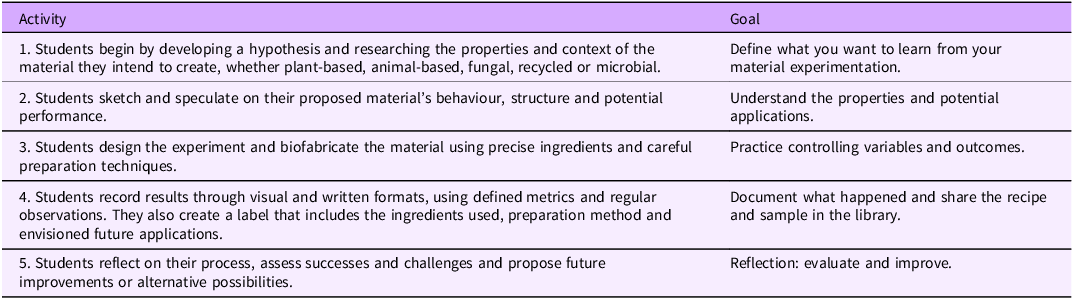
At UC Davis California, the eco material library develops incrementally through coursework. Students contribute samples generated through a structured workflow that includes hypothesis formulation, fabrication, documentation and reflection (Table 1). Over time, the collection becomes an evolving prompt: an infrastructural scaffold that situates new experimentation within a visible history of material becoming (Figure 3A). Each sample is labelled with ingredients, preparation methods and intended applications, ensuring procedural legibility for future cohorts (Figure 3B). Curation focuses on comparability and accessibility through documenting recipes, variables and observed outcomes in ways that allow subsequent students to reuse, modify or critically assess prior experiments. Space limitations and maintenance demands introduce selective pressures that shape what is preserved, reinforcing the library’s pedagogical relevance.
UC Davis course workflow contributing to eco material library 1

Table 1. Long description
A table with two columns and five rows detailing the activities and goals of a course workflow for developing an eco material library. The columns are labeled ‘Activity’ and ‘Goal’. Row 1: Activity 1. Students begin by developing a hypothesis and researching the properties and context of the material they intend to create, whether plant-based, animal-based, fungal, recycled or microbial. Goal 1. Define what you want to learn from your material experimentation. Row 2: Activity 2. Students sketch and speculate on their proposed material’s behaviour, structure and potential performance. Goal 2. Understand the properties and potential applications. Row 3: Activity 3. Students design the experiment and biofabricate the material using precise ingredients and careful preparation techniques. Goal 3. Practice controlling variables and outcomes. Row 4: Activity 4. Students record results through visual and written formats, using defined metrics and regular observations. They also create a label that includes the ingredients used, preparation method and envisioned future applications. Goal 4. Document what happened and share the recipe and sample in the library. Row 5: Activity 5. Students reflect on their process, assess successes and challenges and propose future improvements or alternative possibilities. Goal 5. Reflection: evaluate and improve.
(A) A student exploring the eco material library at UC Davis – the open, browsable organisation of samples invites comparison and inquiry across iterations; (B) Samples made by students and faculty with an open source label system, illustrating how documentation renders process decisions legible and reproducible across cohorts.

Figure 3. Long description
Panel A: A student is exploring an eco material library at UC Davis. The library is organized with various shelves displaying different materials and samples. The student is holding a sample and examining it closely. The shelves are labeled with categories such as ‘Natural Dyes’ and ‘Animal-Based’. Various containers and samples are visible on the shelves, inviting comparison and inquiry across different iterations. Panel B: A collection of samples made by students and faculty is displayed on a board. Each sample is labeled with an open-source label system. The labels include names such as ‘Banana Fiber Mesh’, ‘Digital Ikat (Agave)’, ‘Charcoal Bioplastic’, ‘Tumeric Bioplastic’, ‘Pitochea Zea Biocomposite’, ‘Horsehair Bioplastic’, ‘Cactus Leather’, ‘Cochineal Bioplastic’, ‘Kombucha Leather’, ‘Mycelium Skin’, ‘Made With Reshi’, and ‘Recycled Paper’. The samples are arranged in a grid format, illustrating how documentation renders process decisions legible and reproducible across cohorts.
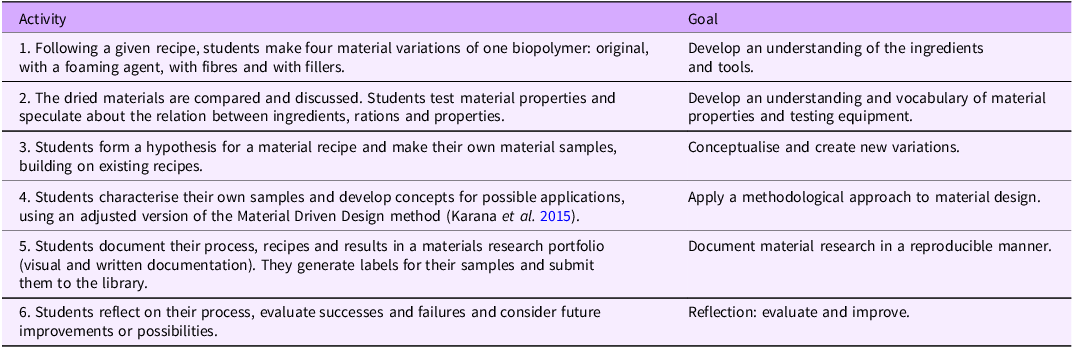
At the Amsterdam University of Applied Sciences (AUAS), by contrast, the library is cyclically reconstructed as part of the curriculum. Each cohort evaluates existing samples, determines which to retain and reorganises the display according to thematic or methodological criteria. Curation itself becomes a pedagogical activity, foregrounding classification, comparison and interpretive framing. Students begin by producing controlled variations of a shared biomaterial recipe before developing their own formulations (Table 2). Through the structured workflow documented in Table 2, students learn to treat material experiments and process iterations as objects of inquiry in their own right rather than mere steps towards a final outcome – a disposition that becomes visible in the samples themselves (Figure 4B). Because the collection is publicly visible within a hallway space, it invites informal interaction from other departments, extending its infrastructural reach beyond the immediate course (Figure 4A).
AUAS course workflow contributing to eco material library 2

Table 2. Long description
A table with six rows and two columns detailing activities and goals in a course workflow. The columns are labeled Activity and Goal. Row 1: Activity 1, Goal 1. Row 2: Activity 2, Goal 2. Row 3: Activity 3, Goal 3. Row 4: Activity 4, Goal 4. Row 5: Activity 5, Goal 5. Row 6: Activity 6, Goal 6.
(A) Samples of the eco material library at AUAS are displayed on a wall in a publicly accessible hallway, extending the infrastructural reach of the library beyond the immediate course; (B) Material experiments and process iterations displayed as samples in their own right – transforming intermediary research steps into legible objects within a shared material lexicon, rather than mere means towards a final product (Image: Loes Bogers).

Figure 4. Long description
Panel A: The image shows a wall with multiple samples of biomaterials displayed in a publicly accessible hallway. Each sample is mounted on a white card with a label, showcasing different textures and materials. Panel B: The image features two specific samples, one labeled ‘Mango Leather’ and the other ‘Alginate Net Plastic Composite’. The ‘Mango Leather’ sample is a piece of orange-brown material with visible spots, while the ‘Alginate Net Plastic Composite’ sample is a white, net-like structure.
The four infrastructural mechanisms through which eco material libraries recalibrate epistemic practice, showing how each manifests in observed student behaviour and which CBL transversal competence it activates.

Despite these differences in rhythm and organisation — incremental accumulation at UC Davis versus cyclical reinvention at AUAS — both configurations converge on a set of shared characteristics that underpin their pedagogical function. Samples are preserved as records of experimentation rather than as polished artefacts. Documentation foregrounds ingredients, process variables and observed behaviour. Iteration and comparison are structurally embedded. Material temporality – drying, shrinking, contamination, decay – shapes workflow and interpretation. In both settings, the library stabilises what would otherwise remain fleeting encounters with dynamic material systems.
Infrastructural mechanisms and epistemic recalibration in eco material libraries
The following analysis identifies four recurring mechanisms through which eco material libraries recalibrate design reasoning and scaffold cross-disciplinary engagement. These mechanisms emerge not from instructional directives alone but from the organised material conditions that structure participation.
Concentration: samples as integrative nodes of inquiry
A single biomaterial sample is never just one thing – it concentrates biological, chemical, technical and aesthetic processes into a single tangible object, embodying ingredient ratios, environmental conditions, fabrication techniques and temporal development. When preserved and documented within the library, the sample becomes more than the residue of an isolated experiment: it serves as an integrative node through which different forms of expertise intersect.
Students encountering existing samples rarely approach them through a single disciplinary lens. In practice, students were observed consistently reaching for samples before consulting labels or recipes – tactile engagement preceding conceptual interpretation, as if the object itself initiated the inquiry. A brittle sheet of bioplastic may prompt questions about polymer composition, drying time, humidity, structural performance or potential application. A contaminated mycelium block may lead to speculation about sterility protocols, microbial competition, substrate quality or environmental fluctuation. The sample does not merely illustrate prior knowledge; it generates inquiry that traverses microbiology, materials science and design intention.
What transforms a sample from an isolated experiment into an integrative node is its position within the library’s infrastructure. Because iterations are preserved, labelled and made comparable, students are able to trace relations between ingredients, processes and outcomes across multiple experiments. The object anchors cross-disciplinary reasoning not through abstraction but through material specificity. Concentration as a mechanism therefore does not arise from instructional design alone — it emerges from the organised material conditions of the library itself, which structure participation by making cross-disciplinary inquiry not merely possible but unavoidable.
Ontological friction: destabilising mastery through material resistance
Ontological friction – the moment when a material refuses to behave as expected, disrupting not just the design plan but the assumptions the designer brought to the encounter – constitutes a second mechanism through which eco material libraries recalibrate design reasoning. Many students initially approach biomaterials with product-oriented expectations or instrumental assumptions about sustainability. Some envision specific artefacts (such as lamps, garments, packaging or else) into which biomaterials might be incorporated. Others assume that biomaterials are inherently sustainable and can be optimised for high performance with sufficient technical refinement.
Sustained engagement with biomaterial experimentation disrupts these assumptions. Materials shrink, warp, contaminate, dissolve or behave inconsistently across batches. Recipes that appear straightforward produce divergent outcomes under slight environmental variation. Attempts to scale up from small samples to larger formats reveal structural instability or energy-intensive processes. Such encounters expose the limits of design control and the complexity of ecological claims. A recurring shift in student language was observable across both contexts: where early-stage students describe materials in terms of intended outcomes, sustained engagement with failure and instability produces more conditional formulations — ‘under these conditions,’ ‘given this substrate,’ ‘depending on humidity.’ Such encounters expose the limits of design control and the complexity of ecological claims.
The eco material library amplifies this friction by preserving failed and unstable samples alongside successful ones. Rather than allowing breakdowns to disappear at the end of a course, the infrastructure renders them durable and visible. Students are confronted not only with their own experiments but with accumulated traces of prior attempts. This continuity interrupts narratives of seamless innovation and situates material development within histories of trial, adjustment and constraint.
Through these encounters, design reasoning shifts from solution-oriented projection towards conditional and systemic articulation. Sustainability becomes a situated evaluation rather than a declarative attribute, suggesting a genuine reorientation of epistemic stance rather than rhetorical adjustment. Ontological friction as a mechanism therefore does not arise from instructional design alone — it is stabilised and amplified by the organised material conditions of the library, which preserve evidence of friction across time and render it available for collective reinterpretation.
Iteration and documentation: stabilising temporality
A third mechanism concerns the temporal dimension of biodesign practice. Biomaterial processes unfold over time. Growth, curing, drying and contamination rarely align neatly with semester schedules or rapid prototyping cycles. Without infrastructural support, such temporality risks being experienced as frustration or inefficiency. Within eco material libraries, however, documentation practices transform temporal unfolding into cumulative knowledge.
Structured workflows require students to record ingredients, ratios, environmental conditions and observed behaviour. Labels and portfolios make procedural decisions legible to others. Iterations are preserved for comparison, allowing relationships between variables and outcomes to be traced retrospectively. Over time, the library becomes a material archive of process rather than a display of finished artefacts.
This stabilisation of temporality has epistemic consequences. Students learn to interpret variability not as error but as data. Variability becomes interpretable rather than merely frustrating: documented alongside environmental conditions and process decisions, unexpected shrinkage across humidity levels yields evidence about drying behaviour, while colour shifts in natural dye batches reveal the sensitivity of biological processes to temperature and substrate. Documentation externalises reasoning, enabling shared analysis across cohorts. The infrastructure thus distributes cognition across artefacts and records, reinforcing the mediating role of samples as boundary objects.
Students who returned to compare their own samples against prior cohorts’ documentation were observed reframing earlier ‘failures’ as informative data points – a shift that occurred not through instruction but through the comparative structure the library made available. Iteration and documentation as a mechanism therefore does not emerge from instructional directives alone — it is the organised material conditions of the library, its structured workflows, preserved iterations and shared documentation systems, that transform temporal unfolding from a source of uncertainty into a collective epistemic resource.
Reflexive repositioning: the designer as situated participant
Across the first three mechanisms, a broader shift becomes visible that is less concerned with the samples, the encounters, or the temporal process, but more with the designer themself. Sustained engagement with biomaterials within an eco material library shifts the designer’s position from detached problem-solver towards situated participant within material–ecological systems. This repositioning is not imposed through ethical instruction alone, but emerges from the accumulated experience of concentration, ontological friction, and iteration — from embodied encounters with materials that resist simplification and from infrastructural arrangements that preserve evidence of process over time.
Students articulate increased awareness of their own role in shaping environmental conditions, ingredient sourcing and energy input. They question whether a single-use biomaterial justifies the resources invested in its production; they reconsider scale, durability and afterlife scenarios. A shift in how students discussed material choices across the course of a semester was consistently observable – moving from questions of performance and application early on towards questions of sourcing, energy input and afterlife later, without these having been explicitly posed as design criteria. This change in conversational orientation is itself illustrative of the repositioning the infrastructure makes possible.
Reflexive repositioning as a mechanism therefore cannot be separated from the three mechanisms that precede it, but becomes possible when concentration, ontological friction, and iteration and documentation have done their work. Rather than an instructional outcome it is an experiential one, emerging from sustained, embodied participation in the organised material conditions of the library
From mechanisms to epistemic recalibration
Taken together, these mechanisms of concentration, ontological friction, iteration and documentation, and reflexive repositioning illustrate how eco material libraries function as pedagogical infrastructures that recalibrate epistemic practice. Each operates on a distinct dimension: the object, the encounter, the temporal process, and the designer themself. Yet these mechanisms are not independent — they reinforce and depend on one another, and it is their combined effect, sustained across time and cohorts, that produces epistemic recalibration.
Epistemic recalibration, as the outcome of this sustained engagement, describes a fundamental shift in how designers relate to knowledge and practice: moving from the assumption that materials are stable substrates to be selected and controlled, toward an understanding of materials as dynamic, ecological participants that demand conditional reasoning, collaborative interpretation, and ongoing care. This shift does not arise from instruction or curriculum design alone but is depending on the organised material environments that structure participation — environments that render uncertainty durable, preserve consequence, and make cross-disciplinary reasoning not merely possible but unavoidable.
In doing so, eco material libraries reorganise how participation unfolds in biodesign education: the designer is repositioned not through instruction but through the infrastructural arrangements that structure encounter, comparison and consequence.
Infrastructural implications for biodesign pedagogy and CBL
This infrastructural perspective offers a nuanced way of reconsidering the relationship between biodesign education and CBL. As discussed earlier, CBL frameworks are frequently associated with the development of transversal competences, yet such competences cannot be assumed to emerge automatically from exposure to complex challenges (Gallagher and Savage, Reference Gallagher and Savage2023). They depend on the material and social arrangements through which participation is structured.
Eco material libraries provide one such arrangement. By preserving iterations and failures, they render uncertainty durable rather than incidental. By documenting recipes, conditions and outcomes, they externalise decision-making and invite shared reasoning. By situating samples within cumulative collections, they embed individual experimentation within collective trajectories.
These infrastructural characteristics make certain modes of participation necessary rather than merely desirable. Negotiation across disciplinary perspectives becomes indispensable when samples require microbiological, material and design interpretation; reflexive judgement becomes unavoidable when sustainability claims are confronted with energy input, ingredient sourcing and material afterlife; adaptive reasoning emerges as a practical response to material variability rather than as an abstract competence.
From this vantage point, transversal competences appear less as externally defined educational objectives and more as enacted responses to infrastructurally organised material engagement. Collaboration becomes structurally required, systems thinking emerges through tracing material interdependencies and critical reflection arises through ontological friction – not as outcomes to be assessed but as practical necessities of participation. What the infrastructure provides, in other words, is not a context for learning these competences but the conditions under which they become unavoidable.
Therein, eco material libraries do not replace or redefine CBL, but, as this analysis indicates, the efficacy of challenge-based approaches may depend in part on the infrastructural environments within which challenges are situated. When material inquiry is scaffolded through cumulative, documented and comparably organised experimentation, students are afforded sustained engagement with uncertainty and consequence – suggesting that the design of learning environments deserves as much attention as the design of learning challenges.
Beyond its relevance for CBL, this infrastructural framing invites a broader reconsideration of biodesign pedagogy. Biodesign is often characterised by the introduction of living systems and biofabrication techniques into design curricula. Yet the analysis presented here suggests that its pedagogical significance lies equally in how it reorganises the material conditions of learning. By foregrounding temporality, preserving breakdown and embedding material processes within collective infrastructures, eco material libraries recalibrate not only what designers know but how they come to know it – shifting the ground of design epistemology from stable properties to ecological processes.
This perspective opens avenues for further inquiry. If infrastructures shape epistemic practice, then variations in infrastructural configuration—accumulative versus cyclical growth, open versus restricted access, visible versus internal display—may influence how design reasoning develops. Comparative investigations across institutions could examine how different material arrangements foster distinct orientations towards sustainability, agency and responsibility. Such research would deepen understanding of how biodesign education not only introduces new materials, but also transforms design epistemologies – and with them, the orientations towards ecological responsibility and material agency that sustainability transitions require.
Conclusion: material conditions as generative foundations for learning
This paper has argued that eco material libraries function as pedagogical infrastructures – organised material environments that stabilise inquiry, mediate across disciplinary perspectives and render ecological interdependence tangible within biodesign education. Rather than treating biomaterial samples as isolated teaching tools, it has positioned them within infrastructural arrangements through which samples operate simultaneously as question, evidence and provocation. In doing so, it contributes an exploratory framework for examining how material environments organise learning in emerging biodesign contexts – and offers a conceptual vocabulary for understanding why embodied material engagement becomes a foundational condition for competence development within challenge-oriented learning environments.
More broadly, this paper proposes that biodesign education – and eco material libraries specifically – offers a lens through which to recalibrate how learning itself is understood. The pedagogical significance of these environments lies not only in the materials they introduce but equally in how they reorganise the material conditions of learning. These conditions matter: the transversal competences that education systems increasingly associate with sustainability transitions – systems thinking, adaptive reasoning, ecological responsibility – do not emerge from instruction or exposure to complexity alone. They depend on infrastructures that sustain uncertainty, preserve consequence and render interdependence tangible. Eco material libraries are precisely such infrastructures – and biodesign education, in building and maintaining them, makes a contribution to learning that extends well beyond its own disciplinary boundaries.
Data availability statement
The interview data that support the findings of this study are not publicly available as they contain information that could compromise participant privacy, but are available from the corresponding author upon reasonable request.
Acknowledgements
The authors would like to thank the two anonymous reviewers for their careful and constructive feedback, which substantially strengthened this paper. A special thanks goes out to Loes Bogers, founder of the eco materials library at Amsterdam University of Applied Sciences. Although she no longer works here, her work and efforts form the basis for the pedagogical approach to biodesign in the university, including its eco materials library. A big thanks goes out to all faculty members and students who have engaged with both the eco materials libraries in the past eight years.
Author contributions
The research article was developed collaboratively by all authors. However it is attributed to: Sam Edens: Conceptualisation, Investigation, Methodology, Formal Analysis, Validation, Writing - original draft, Writing - review and editing. Beth Ferguson: Conceptualisation, Investigation, Validation, Writing - review and editing. Eldy Lázaro Vasquez: Conceptualisation, Investigation, Methodology, Validation, Writing - review and editing. Troy Nachtigall: Conceptualisation, Validation, Writing - review and editing. All authors approved the final submitted draft.
Financial support
This research received no specific grant from any funding agency, commercial or not-for-profit sectors.
Competing interests
The authors have no conflicts of interest to declare for this publication.
Ethical standards
This study involved semi-structured interviews with faculty participants who provided informed consent. All interview transcripts were stored securely with access limited to the authors. Verbal informed consent was obtained for any student work or images published in this article. Ethical approval was not required for this study type.
Use of AI
Authors used ChatGPT-5 (first version) and Claude (camera-ready version) as a writing assistant during the revision process. The Polisher method was employed for prose refinement and structural editing across all sections; the Rephraser method was used for restructuring and rewording the Abstract, Introduction and Conclusion; and the Chunk Stylist method supported argumentation development in the Theoretical Framework and Discussion sections. These practices follow the methods outlined by Buruk (Reference Buruk2023). The final content was thoroughly reviewed and approved by all authors, who assume full responsibility for the ideas, concepts and articulation in the manuscript.





 Open access

