Introduction
The Mexican bean weevil, Zabrotes subfasciatus Boheman (Coleoptera: Chrysomelidae), is one of the most important pests of stored beans (Phaseolus vulgaris L.) in Africa, especially under small-scale subsistence farming (Dendy and Credland, Reference Dendy and Credland1991; Abate and Ampofo, Reference Abate and Ampofo1996). The pest causes significant yield losses reaching up to 38% (Negasi, Reference Negasi1994; Abate and Ampofo, Reference Abate and Ampofo1996). The degree of damage caused by the pest may be even higher, depending on the storage period and conditions. For example, Getu et al. (Reference Getu, Ibrahim, Iticha, Ali, Kenneni, Ahmed, Malhotra, Beniwal, Makkouk and Halila2003) reported an average grain loss of 60% within 3–6 months of storage. The bean weevil Z. subfasciatus destroys not only the quantity but also the quality and viability of bean grain and seeds (Schoonhoven and Cardona, Reference Schoonhoven and Cardona1986; Abate and Ampofo, Reference Abate and Ampofo1996). To safeguard against poor germination resulting from the bean weevil damage, farmers plant up to six seeds/hole, which limits the amount of grain available for consumption (Kabeere et al., Reference Kabeere, Mutyaba, Agona, Komurembe, Muyinza and Nahdy2002). Moreover, damage by weevils affects the odour and palatability of beans, reduces nutritional quality, and results in loss of weight and market value (Dendy and Credland, Reference Dendy and Credland1991; Abate and Ampofo, Reference Abate and Ampofo1996).
Conventional storage pest control using synthetic insecticides and fumigation is not only expensive for smallholder African farmers but also result in several undesirable consequences. These include, the development of resistance by the pest, widespread environmental hazards, and health risks in handling and application (Williams and Hammitt, Reference Williams and Hammitt2001; Isman, Reference Isman2008; Bruce, Reference Bruce2010). These obstacles highlight the need to develop alternative control options, such as botanical pesticides (Songa and Rono, Reference Songa and Rono1998; Tapondjou et al., Reference Tapondjou, Adler, Bouda and Fontem2002; Isman, Reference Isman2008). Besides providing ecologically sound and effective control against crop pests, plant extracts constitute a rich source of bioactive chemicals that act synergistically to inhibit pest growth and development of resistance (Kim et al., Reference Kim, Roh, Kim, Lee and Ahn2003; Oparaeke et al., Reference Oparaeke, Dike and Amatobi2005; Wei et al., Reference Wei, Hua, Li, Huang, Li, He and Shen2014). Furthermore, plant-derived materials break down readily in the soil, and do not accumulate in the plant or animal tissues; hence, they constitute low health risks to consumers (Williams and Hammitt, Reference Williams and Hammitt2001; Kim et al., Reference Kim, Roh, Kim, Lee and Ahn2003; Isman, Reference Isman2008).
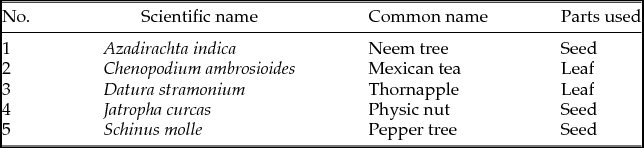
Although researchers had made commendable attempts in the last two to three decades to identify and test botanicals with better insecticidal potential for bean weevil management (Abate and Ampofo, Reference Abate and Ampofo1996; Tapondjou et al., Reference Tapondjou, Adler, Bouda and Fontem2002), available information is limited on the potency of these botanical mixtures, their toxicology, and optimal application rates. Also, recommended proportions are often high and cause inconvenience for practical application of botanical pesticides. Hence, the current study was designed and undertaken to determine the potential of different botanical products and their combinations against Z. subfaciatus to enhance the effectiveness of constituent botanicals and reduce application rates. Agona and Muyinza (Reference Agona and Muyinza2003), Oparaeke et al. (Reference Oparaeke, Dike and Amatobi2005), and Vayias et al. (Reference Vayias, Athanassiou and Buchelos2009) have demonstrated a possible way to improve the insecticidal efficacy of individual components, for better grain protection and yield increase, by combining different botanicals. We chose four botanical plants, namely Jatropha curcas (L.), Datura stramonium (L.), Chenopodium ambrosioides (L.), Schinus molle (L.), and Azadirachta indica (A. Juss) (Table 1) as they are locally available and have potential to control the bean weevil (Su, Reference Su1991; Negasi, Reference Negasi1994; G/selase and Getu, Reference G/selase and Getu2009). The chemical constituents of leaf and seed extracts of the selected botanical plants were previously described (Friedman and Levin, Reference Friedman and Levin1989; Adebowale and Adedire, Reference Adebowale and Adedire2006; Atangwho et al., Reference Atangwho, Ebong, Eyong, Williams, Eteng and Egbung2009; Abdel-Sattar et al., Reference Abdel-Sattar, Zaitoun, Farag, Gayed and Harraz2010; Gbolade et al., Reference Gbolade, Tira-Picos and Nogueria2010).
Botanical plants and parts used against Zabrotes subfasciatus in the study

Materials and methods
Insect rearing
Adult Z. subfasciatus were obtained from laboratory culture at Melkassa Agricultural Research Center (MARC) (8°24′N; 39°21′E) and reared on common bean variety Awash-1. The experimental insects were maintained under laboratory condition (27 ± 2 °C, 60 ± 5% RH, 12L: 12D photoperiod). The food media (bean seeds) used for insect rearing were first disinfected by being kept in the oven at 40 °C for 4 h and allowed to cool for 2 h before use (Bekele, Reference Bekele2002). Infestation was done by introducing 100 parental adults (1:1 sex ratio) in 1 L volume of glass jars containing 250 g of beans. The parental adults were sieved off 13 days after the oviposition period and the beans were kept under laboratory conditions until the emergence of F 1 progeny. New generations of adult Z. subfasciatus obtained from this culture were used in the experiments.
Plant materials and treatment combinations
Botanical plant species and parts used in this study are shown in Table 1. Fresh leaves and seeds of J. curcas, S. molle, and D. stramonium were collected from MARC and surroundings. Plant materials for C. ambrosioides were collected from natural habitats in Addis Ababa (9°1′48″N, 38°44′24″E) and for A. indica from Worer Agricultural Research Center (9°20′27″N, 40°10′53″E). The plant parts were air-dried, separately crushed into fine powders using a pestle and mortar, and sieved through a 0.25-mm mesh to obtain fine particles. The particles were weighed into 0.5 and 1 g samples and mixed appropriately to constitute binary formulation at either 1% or 2% w/w admixture on 100 g bean samples. For unitary formulations, 1 and 2 g of each plant material were weighed and admixed with 100 g bean samples to represent dosage rates of 1% and 2% w/w.
Effect on adult mortality
Healthy disinfected common bean seeds (100 g) treated with unitary and binary formulations of test botanical powders were placed in 1 L volume glass jars. The positive control was synthetic insecticide pirimiphos-methyl (a.i. 50 mg/kg) at the rate of 0.1/100 g grain and the negative control was untreated grain. Eight pairs of Z. subfaciatus 2–4 days old were obtained from laboratory culture and introduced into each glass jar. To allow aeration, the jar tops were covered with nylon mesh held in place with rubber bands. Percentage insect mortality was calculated using Abbott's formula (Abbott, Reference Abbott1925) by counting the numbers of dead insects in each jar at 24, 48, 72, 96, and 120 h after treatment application/adult introduction. Adults were considered dead when no response was observed after repeated probing with forceps. At the end of each assessment, dead insects were removed. The experiment was arranged in a completely randomized design (CRD) with three replications:
 $$\begin{equation*}
{\rm{Abbot\text{'}s}}\;{\rm{formula:}}\;{P_t} = \displaystyle\frac {\textstyle{{{P_o} - {P_c}}}} {\textstyle{{100 - {P_c}}}} \times 100
\end{equation*}$$
where Pt is the percentage mortality, Po is the observed mortality, and Pc is the control mortality effect on F 1 progeny.
After mortality assessment, Z. subfasciatus adults in treated and untreated jars were kept for an additional 10 days for oviposition and both live and dead insects were discarded afterwards. The infested jars were further maintained under laboratory conditions (27 ± 2 °C, 60 ± 5% RH, 12L: 12D) until F 1 progeny emerged. To avoid overlapping generations, the number of F 1 progeny was counted upon emergence for a period of 45 days after the initial date of adult introduction. The percentage reduction in adult emergence or inhibition rate (% IR) was calculated using the following formula (G/selase and Getu, Reference G/selase and Getu2009):
 $$\begin{equation*}
\% \;{\rm{IR}} = \displaystyle\frac{(\textstyle{C_n} - \textstyle{T_n})} {\textstyle{C_n}} \times 100
\end{equation*}$$
where Cn is the number of newly emerged insects in the untreated (control) jar and Tn is the number of insects in the treated jar.
Grain damage assessment
To determine grain damage level, samples of 100 seeds were randomly taken from the treated and control jars. Both treated and untreated seeds were assessed for the extent of bean weevil damage using exit holes as a measure. The numbers of damaged (with characteristic holes) and undamaged seeds were counted and weighed. Percentage grain weight loss was calculated using the FAO (1985) formula:
 $$\begin{equation*}
{\bf{Weight}}\,\,{\bf{Loss}}\left( \% \right) = \frac{(UNd)\, -\, (DNu)}{U(Nd + Nu)} \times {\bf 100}
\end{equation*}$$
where U is the weight of undamaged seeds, Nd is the number of damaged seeds, D is the weight of damaged seeds, and Nu is the number of undamaged seeds.
Seeds that were riddled with exit holes were counted and the percentage damage (PD) and weevil perforation index (WPI) were calculated according to methods provided in Fatope et al. (Reference Fatope, Nuhu, Mann and Takeda1995):
 $$\begin{eqnarray*}
{\rm PD} &=& {\rm (Total\; number\; of\; treated\; seeds\; perforated/}\\
&&{\rm Total\; number\; of\; seeds)\; \times\; 100}\\
{\rm WPI} &=& {\rm (\%\; of\; treated\; seeds\; perforated/\;\%\; of\; control}\\
&&{\rm seeds\; perforated\; +\; \%\; of\; treated\; seeds}\\
&&{\rm perforated)\; \times\; 100}
\end{eqnarray*}$$
Germination test
A germination test was carried out by randomly picking 80 undamaged seeds from each treatment jar. Then, 20 seeds from each treated and control group were placed separately on a moistened filter paper (Whatman No.1) in Petri dishes and kept at room temperature. Each treatment was replicated four times where healthy seeds without botanical powder application were used as a control. Numbers of germinated seeds were recorded starting from the first date of germination. Percentage germination was computed using the following formula (G/selase and Getu, Reference G/selase and Getu2009):
 $$\begin{equation*}
{\rm{Viability}}\;{\rm{index}}\left( \% \right) = \frac{{{\rm{NG}}}}{{{\rm{TG}}}} \times 100
\end{equation*}$$
where NG is the number of seeds germinated and TG is the total number of seeds tested in each Petri dish.
Data analysis
All data were checked for normality and analysed in SAS software (SAS Institute, 2008). Percentage data were subjected to arcsine transformation and analysed with analysis of variance (ANOVA) using the general linear model (GLM) (Tamiru et al., Reference Tamiru, Getu, Jembere and Bruce2012). Means (±SE) of untransformed data were reported. Significant means were separated using the Student–Newman–Keuls (SNK) test with α set at 0.05.
Results
Effects on adult mortality
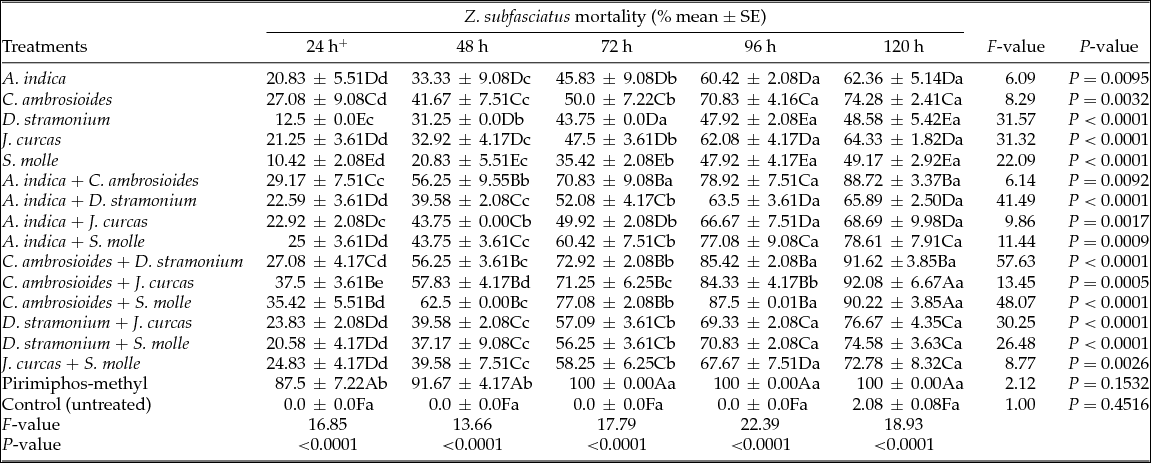
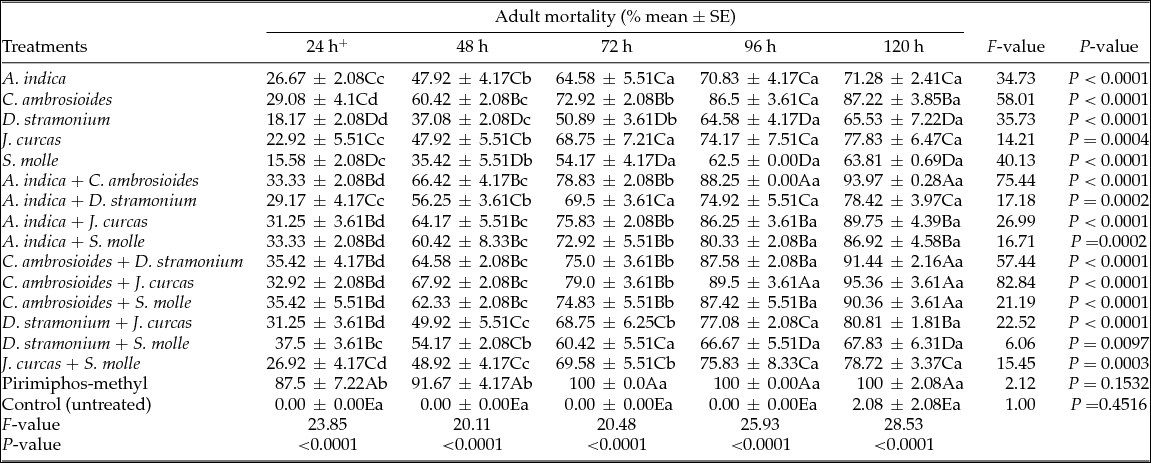
Adult mortality varied significantly (P < 0.001) among different treatments. All botanical products resulted in a significantly higher death rate of adult Z. subfasciatus compared with the untreated control (Tables 2 and 3). Comparison between the individual botanical plants showed that C. ambrosioides had the highest toxicity effect at both dosage rates (1% and 2% w/w). Among botanical admixtures, C. ambrosioides + J. curcas, A. indica + C. ambrosioides, C. ambrosioides + D. stramonium, and C. ambrosioides + S. molle resulted in significantly higher mortality of Z. subfasciatus. Even at the lower test dose (1% w/w), these binary combinations resulted in an efficacy greater than the individual achievement by each component.
Mortality (% mean ± SE) of adult Zabrotes subfasciatus on common bean seeds admixed with unitary and binary combinations (1% w/w) of different botanical powders

+Hours after treatment application.
Means (± SE) of untransformed data are reported. Means followed by the same upper case letters within a column and the same lower case letter within a row are not significantly different using Student–Newman–Keuls (SNK) test (P < 0.05). Effectiveness of botanical formulations was determined by computing percentage insect mortality (Abbott, Reference Abbott1925) and comparing the arcsine transformed mortality data by ANOVA using GLM procedure. The experiment was arranged in a completely randomized design (CRD) with three replications.
Mortality (% mean ± SE) of adult Zabrotes subfasciatus on common bean seeds admixed with unitary and binary combinations (2% w/w) of different botanical powders

* Hours after treatment application
Means (±SE) of untransformed data are reported. Means followed by the same upper case letters within a column and the same lower case letter within a row are not significantly different using Student–Newman–Keuls (SNK) test (P < 0.05). Effectiveness of botanical formulations was determined by computing percentage insect mortality (Abbott, Reference Abbott1925) and comparing the arcsine transformed mortality data by ANOVA using GLM procedure. The experiment was arranged in a completely randomized design (CRD) with three replications.
Mortality rate in adult Z. subfaciatus due to botanical insecticide application was directly related to exposure period. Longer duration after treatment application resulted in significantly higher adult mortality and vice versa for both unitary and binary botanical combinations at both dosage rates (P < 0.05). Lowest Z. subfaciatus mortality was recorded 24 h after botanical application, whereas the highest rate was achieved 5 days after treatment application. An increased Z. subfaciatus mortality rate was observed at the higher dose for unitary formulation, whereas no notable difference in toxicity was observed between dosage levels among the binary botanical combinations (Tables 2 and 3).
Effects on F1 progeny production and percent inhibition
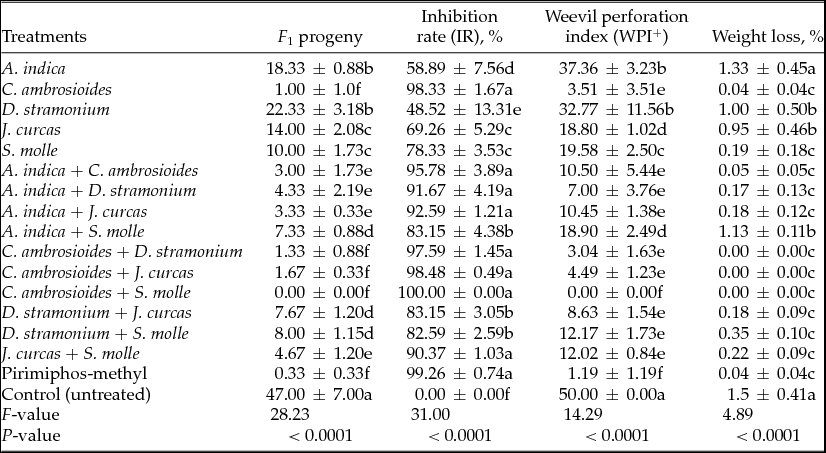
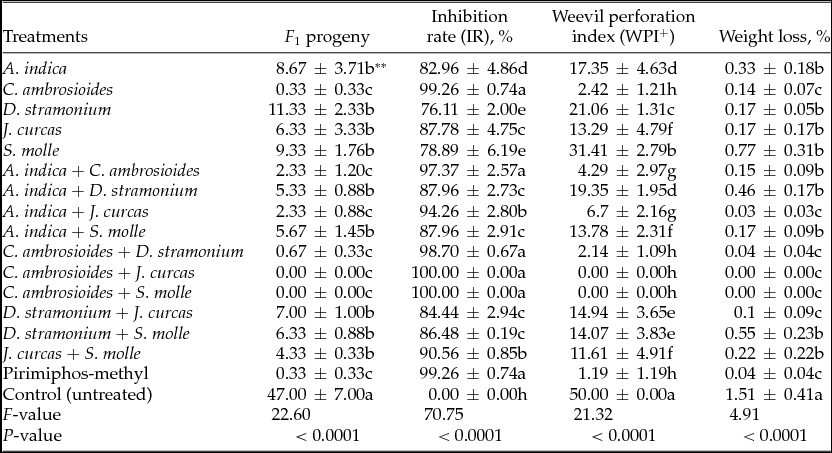
There was significant variation among the different botanical products in their efficacy to inhibit progeny production, though all reduced F 1 progeny were compared to the untreated control (P < 0.001). Treatment with C. ambrosioides resulted in the highest progeny reduction out of all unitary botanical products at both test doses. Among binary botanical combinations, C. ambrosioides + S. molle at 1% dosage rate showed the highest inhibition rate followed by C. ambrosioides + D. stramonium and C. ambrosioides + J. curcas with their inhibition effects similar to that of synthetic insecticide. Under 2% dosage level, binary formulations in which C. ambrosioides was a constituent had a progeny reduction rate on a par with that of synthetic insecticides. F 1 progeny reduction rate was found to increase with dosage rate for botanicals used in the unitary formulations. However, an increased dosage failed to bring a significant difference in the reduction of F 1 progeny under all types of binary botanical combinations (Tables 4 and 5).
Mean number of F 1 progeny produced (mean ± SE), percentage inhibition rate (IR), weevil perforation index (WPI), and percentage grain weight loss caused by Zabrotes subfasciatus on common bean seeds admixed with different unitary and binary botanical powder combinations at 1% w/w dosage rate

+ WPI value above 50 indicates negative protectant ability.
Means (± SE) of untransformed data are reported. Means followed by the same letter within a column are not significantly different using Student-Newman-Keuls (SNK) test (P < 0.05). The data were analysed by ANOVA using GLM procedure. The experiment was arranged in a completely randomized design (CRD) with three replications.
Mean number of F 1 progeny produced (mean ± SE), percentage inhibition rate (IR), weevil perforation index (WPI), and percentage weight loss caused by Zabrotes subfasciatus on common bean grain admixed with different unitary and binary botanical powder combinations at 2% w/w dosage rate

+ WPI value above 50 indicates negative protectant ability.
Means (±SE) of untransformed data are reported. Means followed by the same letter within a column are not significantly different using Student–Newman–Keuls (SNK) test (P < 0.05). The data were analysed by ANOVA using GLM procedure. The experiment was arranged in a completely randomized design (CRD) with three replications.
Effects on weevil perforation index (WPI) and grain weight loss
When compared with the untreated control, WPI and grain weight loss were significantly reduced owing to seed treatment with the test botanical products and their admixture at both dosage rates (P < 0.001). Moreover, there was significant difference between the different botanical types in their efficacy to protect grain from damage and weight loss. In unitary formulations, C. ambrosioides showed the highest efficacy for both parameters. Among the binary botanical combinations, C. ambrosioides + S. molle at 1% dosage rate showed the least grain damage and weight loss followed by C. ambrosioides + D. stramonium and C. ambrosioides + J. curcas. At 2% dosage level, binary formulations in which C. ambrosioides was a constituent had a reduction in WPI and grain weight loss similar to that of synthetic insecticides. Grain damage appeared to be less under 2% dosage rate compared with 1% for unitary botanical products (Tables 4 and 5).
Effects on seed germination
We saw no significant difference in percentage germination between untreated seeds and seeds treated with the different botanicals and their combinations at both dosage rates (F = 2.03 and P = 0.53 for 1% dosage; F = 0.69 and P = 0.79 for 2% dosage). Percentage germination rate for untreated control seeds was 97.92 ± 0.96%, whereas for seeds treated with different botanical products it ranged from 93.33 ± 1.8% to 98.75 ± 0.65%.
Discussion
Our toxicity tests demonstrate that all the tested botanical plants have insecticidal effects against Z. subfasciatus when compared with untreated control. However, the bioefficacy varied between plant species. For unitary formulations, the cumulative adult toxicity effects of the tested plants were in the order of C. ambrosioides > A. indica > J. curcas > S. molle > D. stramonium at both dosage rates (1% and 2% w/w). Insecticidal properties of these plant species have been previously reported on other insect pest species (Tapondjou et al., Reference Tapondjou, Adler, Bouda and Fontem2002; Rahman and Talukder, Reference Rahman and Talukder2006; Asmanizar et al., Reference Asmanizar, Djamin and Indris2012). Contrary to most previous studies that tested the efficacy of individual botanicals, often at higher dosages and longer exposure times (Omotoso, Reference Omotoso2005; G/selase and Getu, Reference G/selase and Getu2009), our study examined the insecticidal activities of binary admixtures of these botanicals. The results reveal the enhancement of insecticidal effects of individual botanical products, with relatively lower efficacy, when combined as binary admixtures even at a lower dosage. For instance, Z. subfasciatus adult mortality, which ranged from 44.58% to 53.33% owing to application of unitary formulations of D. stramonium, J. curcas, and S. molle, was increased to over 90% when combined with C. ambrosioides. These findings agree with the previous report by Agona and Muyinza (Reference Agona and Muyinza2003). The study showed improved biological activities of the botanicals, tobacco (Nicotiana tabacum), Mexican marigold (Tagetes minuta), tephrosia (Tephrosia vogelii), and A. indica, in their binary formulations against common bean weevil Acanthoscelides obtectus Say (Coleoptera: Bruchidae).
Among botanical admixtures, binary combinations of C. ambrosioides with D. stramonium, J. curcas, and S. molle were the most potent, as they resulted in highest Z. subfasciatus mortality at the lowest test dosage rate (1% w/w). Correspondingly, these binary admixtures provided the most effective protection of stored beans against Z. subfasciatus damage, as judged by a low WPI and grain weight loss or none. The outcome was on a par with the mortality recorded and protection provided by synthetic insecticide pirimiphos-methyl. The results are consistent with earlier observations where combinations of different grain protectants (including botanicals) offered exceptional efficacy than each component can achieve individually and at relatively lower doses (Vayias et al., Reference Vayias, Athanassiou and Buchelos2009; Yang et al., Reference Yang, Liang, Xu, Lu and Zeng2010; Islam et al., Reference Islam, Hasan, Lei, Mucha-Pelzer, Mewis and Ulrichs2010). Besides optimizing the potency of constituent botanicals, combining botanicals has an advantage of hindering resistance development by pests as different bioactive chemicals inside the admixtures may act synergistically (Kim et al., Reference Kim, Roh, Kim, Lee and Ahn2003; Oparaeke et al., Reference Oparaeke, Dike and Amatobi2005; Isman, Reference Isman2008). Furthermore, botanical formulations discussed here have favourable toxicological properties, such as rapid degradation, low residues, and safety for the consumers, which make them preferred biopesticides for ecologically sustainable storage pest control (El Atta and Ahmed, Reference El Atta and Ahmed2002; Isman, Reference Isman2008).
The efficacy of unitary botanical applications improved with increasing dosage. However, doubling the dosage rate of botanical admixtures failed to result in pronounced differences in insecticidal activities. For example, binary formulations at 1% and 2% dosages resulted in similar percentage mortality. Researchers have not previously studied the efficacy of binary formations of these botanicals. However, the dosage-dependent insecticidal effect of some of these botanicals in their unitary formulations was reported previously (G/selase and Getu, Reference G/selase and Getu2009). The similarity in efficacy between low and high doses of binary formations demonstrates the potential of mixing botanical products to enhance control and reduce wastage of plant materials to control the insect pest. Apart from resource conservation, the application of botanicals at lower dosage poses less pressure on the ecosystem and non-target organisms (Williams and Hammitt, Reference Williams and Hammitt2001). Furthermore, our study revealed the insecticidal effects of botanical application are exposure time dependent. We recorded the highest Z. subfasciatus mortality at the most prolonged periods of exposure to botanical treatments and vice versa. On the other hand, the absence of any significant difference in adult mortality between 96 and 120 h after botanical admixture application indicated strong mortality effects of binary formulations within 4 days of seed treatment.
Bean grain treatment with binary formulations of C. ambrosioides + A. indica, D. stramonium + C. ambrosioides, C. ambrosioides + J. curcas, S. molle + C. ambrosioides, and A. indica + J. curcas significantly reduced F 1 progeny production compared to unitary formulations. Moreover, F 1 progeny reduction between synthetic chemical insecticide and the binary formulations was not significantly different, which further confirms the enhanced potency of binary botanical combinations. Suppressing F 1 progeny could be due to combined factors, such as increased adult mortality, ovicidal and larvicidal properties of botanical formulations, and the presence of chemicals that interfere with insect feeding (Ofuya, Reference Ofuya1990; Omotoso, Reference Omotoso2005). Ileke and Oni (Reference Ileke and Oni2011) demonstrated that the botanical powders of A. indica and A. boonei (which cause high mortality of adult insects, disrupt mating and sexual communication, deter females from laying eggs, and affect the developmental stages of insects) suppressed the F 1 generation of maize weevil (Sitophilus zeamais) on wheat. In related studies, botanical powders have been shown to prevent and inhibit oviposition, weaken female insects into laying fewer eggs, and kill the hatched larvae afterwards (Ofuya, Reference Ofuya1990; Mulatu and Gebremedhin, Reference Mulatu and Gebremedhin2000; Rahman and Talukder, Reference Rahman and Talukder2006). El Atta and Ahmed (Reference El Atta and Ahmed2002) reported neem seed kernel admixed with groundnut at the rate of 5% reduced the adult emergence of groundnut seed beetle, Caryedon serratus Olivier (Coleoptera: Bruchidae).
Results from the germination test demonstrate that all botanical powders and their binary combinations used to treat bean seeds against Z. subfasciatus do not have adverse effects on seed germination at both dosage rates. Therefore, bean seeds for planting can be protected and kept viable from storage pests such as Z. subfasciatus by treating them with these or similar botanical formulations. Our study is the first to consider effects of binary botanical synergists on seed germination. However, previous studies with individual botanical insecticides, which provided protection against storage pests, showed similar results where botanical treatment did not affect seed quality and viability (Kéita et al., Reference Kéita, Vincent, Schmit, Arnason and Bélanger2001; Rahman and Talukder, Reference Rahman and Talukder2006; G/selase and Getu, Reference G/selase and Getu2009).
Conclusion
The findings from this study indicate that combining different botanical formulations could enhance potency constituent components and reduce the application rates. Among the various botanical admixtures, combinations of C. ambrosioides with D. stramonium, J. curcas, and S. molle were the most potent as small quantities of constituent botanicals provided effective control of Z. subfasciatus within a reasonably short period. Toxicity effects of the binary botanical combinations against Z. subfasciatus were better than their constituent components and on a par with the standard chemical insecticide pirimiphos-methyl. The use of botanicals may also have several comparative advantages over synthetic pesticides such as low cost and availability to the majority of smallholder bean farmers, reduced environmental pollution, and minimal toxicity to humans and livestock (Elhag, Reference Elhag2000; Isman, Reference Isman2008; Kareru et al., Reference Kareru, Rotich, Maina and Trdan2013). Thus, the scientific rationale for incorporating binary botanical formulations as an alternative biorational control option against Z. subfasciatus in stored beans (especially for resource-limited small-scale farmers in Africa) exists.
Acknowledgements
The authors are grateful to Melkassa Research Center of the Ethiopian Institute of Agricultural Research (EIAR) for providing laboratory facilities for undertaking the research. Technical assistance by Weinshet Belay in insect rearing is appreciated. Financial support was from Ethiopian Ministry of Education, Hawassa University, and EIAR. The funders had no role in the study design, data collection, data analysis, and write-up of the manuscript.