In 1960, three years after Jack Kerouac's novel On the Road “sold a trillion Levis and … sent countless kids on the road,”Footnote 1 Senator Robert F. Kennedy defined America's “national purpose” as an ongoing “pursuit of happiness,” a “constant, restless, confident questing” that had been set in motion centuries before by Thomas Jefferson's Declaration of Independence. Kennedy stated,
Quest has always been the dominant note of our history, whether a quest for national independence; a quest for personal liberty and economic opportunity on a new continent from which the rest of mankind could take heart and hope; a quest for more land, more knowledge, more dignity.Footnote 2
In using this metaphor, Kennedy was echoing the views of many commentators on this facet of American national character. For example, in 1840 French writer and historian Alexis de Tocqueville devoted a chapter of his respected work Democracy in America, to explain the “causes of the restless spirit of the Americans in the midst of their prosperity.”Footnote 3 In 1893, historian Frederick Jackson Turner addressed a special meeting of the American Historical Association at the World's Columbian Exposition, to argue that “movement has been [the] dominant fact” of American history and American national character.Footnote 4 And in the “Roaring Twenties,” journalist H. L. Mencken pronounced that Americans were marked by a “character of restlessness”, which he attributed to “their inheritance of the immigrant experience.”Footnote 5 It is clear, therefore, that the road has always been a significant and persistent feature of American culture.
Many such reasons have been put forward for the restlessness of the American character. In the colonial period the abundance of supposed “virgin land” made westward movement inevitable, especially when prompted by the semi-religious doctrine of Manifest Destiny. Furthermore, the geography of the United States lends itself to wanderlust: the West in particular was seen by many as a blank slate on which they could write their American dreams. There is also a certain romantic appeal in John Steinbeck's hypothesis, which he articulated in Travels with Charley in Search of America:
Could it be that Americans are a restless people, a mobile people, never satisfied with where they are as a matter of selection? The pioneers, the immigrants who people the continent, were the restless ones in Europe. The steady rooted ones stayed home and are still there … every one of us … are descended from the restless ones, the wayward ones, who were not content to stay at home. Wouldn't it be unusual if we had not inherited this tendency?Footnote 6
One of America's most famous adventurers, Meriwether Lewis, wondered about his “passion for rambling” and concluded that “this Quixottic disposition of mine [was] inherited [from] the Meriwether Family.”Footnote 7
Is it possible, as Steinbeck and Lewis suggest, that there is some sort of “nomadic gene” that is more prevalent in the United States than elsewhere? Taken literally, this is a somewhat fanciful notion. However, as a metaphor, the idea is hard to resist. How else can one explain, for example, the abundance of road stories in the United States and the popularity of such artistic wanderers as Robert Johnson, Woody Guthrie, Jack Kerouac and Bob Dylan? The first Americans were travellers: it is widely believed that the ancestors of Native Americans crossed a land bridge from Asia approximately 12,000 years ago to populate the Americas; European settlers would later make their own epic journeys across the Atlantic to the New World.Footnote 8 The friction and interaction of the two groups from the fifteenth century to the nineteenth set in motion a process of mythogenesis – recurring and evolving ideas, symbols, narratives and metaphors that appear repeatedly in American literature and performing arts, and in US political discourse.Footnote 9 While not unique to the United States, the frontier experience has therefore left an enduring imprint on American culture and this is reflected in the road genre. The continuing popularity of the frontier outlaw is perhaps the most obvious example of this. Although access to motor vehicles assisted the real-life escapades of antiheroes such as Pretty Boy Floyd, Bonnie Parker and Clyde Barrow, and the Hell's Angels, their fame and celebrity depends also on their ability to evoke the long-gone American frontier – what Kitses calls “America's defining myth.”Footnote 10
Through close textual analysis of the epic British comic book story The Cursed Earth, this paper reveals how certain thematic elements of the road genre are linked to significant themes in American history and culture. These images and themes constitute the road not only as a distinct genre, but also as a distinctly American genre. Janis P. Stout contends, for example, that “since American history has been so pervasively concerned with journeys and so forcefully enunciated as myth, there is an overwhelming tendency for American writers who utilize journey narratives to perceive them after the patterns of history.”Footnote 11 Likewise, Jack Sargeant and Stephanie Watson assert that road cinema “emerged from America, where notions of the open road and travel form part of a potent cultural myth far more powerful than in Europe.”Footnote 12 Although these recurring themes often appear in non-American road narratives, they usually have a different meaning that is mediated by the history and culture of the country in which they are set, as well as by the individual experiences of the protagonists.Footnote 13 However, when non-Americans create road stories located in the United States they tend to employ symbols and narratives that are often considered intrinsically American. These storytellers appear to have absorbed aspects of American national identity, and this is reflected in their work. Due to the dominance of American popular culture in the global media market it is, perhaps, inevitable that many non-Americans will envisage the United States through the distorted lens of American film and television programmes. British novelist Alex Garland acknowledged as much in his road novel The Beach,Footnote 14 where an English backpacker destroys an uneasy truce between beach dwellers and locals because he has been conditioned by Hollywood's Vietnam War movies to see the Thais as “gooks,” like modern-day Viet Cong.
In his authoritative study of western films, John Cawelti has cautioned that a thematic analysis such as this risks isolating elements of the story from their context.Footnote 15 However, as Sargeant and Watson have demonstrated, the recurring genre conventions of the travel narrative or road genre, such as the all-male cast of characters, the theme of rebirth or regeneration, the tension between urban and rural life, the enduring mythology of the American frontier experience, and the story of the picaresque hero whose adventures offer a critique of the society in which he operates, provide an opportunity here to address questions about the genre's dialogic relationship with the society, culture, and politics of the United States.Footnote 16 In addition, a useful aspect of road stories is that they often reflect the time period in which they are made. Steven Cohan and Ina Rae Hark assert, for example, that a cinematic road story provides “a ready space for exploration of the tensions and crises of the historical movement during which it is produced.”Footnote 17 Road narratives can, therefore, offer insight into the social context in which the stories were read or watched – in this case, the increasingly conservative mood in both Britain and America, which led to election victories for Margaret Thatcher and Ronald Reagan.
The Cursed Earth, written by British writer Pat Mills, with contributions from “T.B. Grover” (John Wagner) and “Jack Adrian” (Chris Lowder), presents a valuable opportunity to discuss these themes. The Cursed Earth is a futuristic road trip set in a postapocalyptic United States. It first appeared in the pages of 2000AD, a British weekly comic that began in 1977 and is still ongoing. 2000AD was a product of a new wave of British comics that challenged traditional comic book storytelling by pushing, and sometimes overstepping, the boundaries of conventional comics. Mills and Wagner had previously worked on the comics Battle (1975–88) and Action (1976–77), both of which offered new and innovative stories with a hard edge. In fact, Action had to be withdrawn from publication for seven weeks in 1976 due to media criticism of its violent content.Footnote 18 When Action was reissued in December 1976, it proved to be a tamer version of the comic that had shocked parents across Britain. Mills, Wagner and Lowder abandoned the watered-down comic to work on what was to become Britain's most successful weekly comic book. In 1975 Mills had been asked by IPC Magazines to create a science fiction comic to cash in on the wave of science fiction movies being released at that time. Mills therefore became the first editor of 2000AD and Wagner one of its first script writers.Footnote 19 One of the new characters they created would become the most popular and most recognizable icon of British comics for the next thirty years. That character was Judge Dredd.
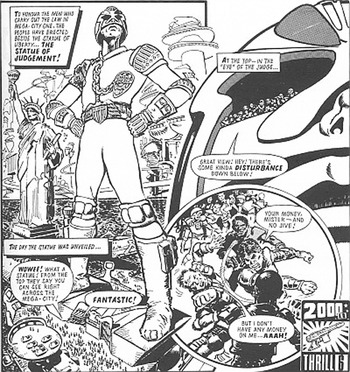
In the dystopian future that spawned Dredd, America has been decimated by a nuclear exchange with the “Sov-Blok” in 2070, and then by a civil war which ended with the Battle of Armaggedon in 2071. The survivors have built a vast “Mega-City,” which covers the whole of the Eastern Atlantic states. As most of the United States is irradiated and usable land is at a premium, the survivors build upwards rather than outwards. As a result, the city's massive structures tower above the remains of old New York like a new “city upon a hill.” However, this new society is anything but puritanical: with crime raging and unemployment levels close to ninety-five percent, all stages of government and law enforcement are run by an elite group of “Judges” – men and women recruited from childhood to protect the city from internal and external threats to order. As their name suggests, Judges were part lawman and part judge. There are no trials in this society because Judges have the power to impose instant sentences on lawbreakers. As Martin Barker notes, Judges “combine the roles of law-maker, policeman, jury, jailer and (frequently) executioner.”Footnote 20 Mega-City One is a fascist city state in which democracy has been consigned to the history books as a failed political experiment. As if to illustrate this point, a huge statue of a Judge towers over the increasingly irrelevant Statue of Liberty (see Figure 1). The toughest and most respected lawman in the city is Judge Dredd. So when a plague infects Mega-City Two (rebuilt from the ruins of Los Angeles), driving its citizens insane and closing all communications between the two cities, Dredd is chosen to lead a trek across the irradiated wasteland known as the “Cursed Earth” to deliver a vaccine to the plague-infected city.
The Statue of Judgement towers over the increasingly irrelevant Statue of Liberty. Judge Dredd Copyright © 2007 Rebellion A/S. All rights reserved. www.2000adonline.com.

The Cursed Earth was inspired by Roger Zelazny's 1969 novel Damnation Alley. Mills states, “It was a conscious decision on our part not to use the essence of Damnation Alley but to use that kind of generic road-movie concept as a framework to give us direction.”Footnote 21 Consciously or not, this framework meant that the story consequently would feature many of the genre conventions that are typical of road narratives. According to Ronald Primeau, these “predictable patterns” give the reader or viewer
assurances about what has worked so far and … clues on how conventions can be further exploited, developed, or modified within a range of what will still be accessible. At the same time, readers are likely to … bring to their reading expectations based on what they understand to be the genre's appeal.Footnote 22
These familiar genre conventions or formulas act, therefore, as “an instrument of seeing” beyond the deceptively simple comic book format of The Cursed Earth, to reveal recurring themes, symbols and imagery of American history and culture, in this instance seen from a British perspective.
Like other science fiction stories that feature a journey narrative, such as Harry Harrison's Wheelworld, Stephen King's The Stand, and movies such as The Road Warrior (1982) and The Postman (1997), The Cursed Earth story is positioned in a devastated landscape. This serves a number of purposes that have their specific origins in the American frontier experience. For example, the apocalypse – whether it is nuclear, biological or environmental in nature – denudes the landscape of people and creates an Arcadian landscape similar to that facing America's original European settlers. This wilderness is part of the American national consciousness and has been celebrated in literature and film. For example, James Fenimore Cooper's character Natty Bumppo felt he had to move on when settlers began to encroach on the wilderness.Footnote 23 Similarly, Arthur Guiterman's 1926 poem tells the apocryphal tale of Daniel Boone, and his preference for Arcadian solitude:
In films such as Stagecoach (1939) and many other John Ford westerns, the epic landscape ennobles the travellers; their petty concerns are nothing compared to the majesty of Monument Valley.Footnote 25 Here, too, the wilderness works to elevate Dredd and his companions, their task made more heroic and grand when viewed against such a hostile, imposing environment.
The vast size of the United States is a factor in these stories. Unlike western Europe, the United States' geographical landscape is a vast blank slate on which artists can paint their visions. The American Southwest in particular is a favourite of road writers, not only because of its vast open spaces but also because of its history of frontier conflict, and the traumas of slavery and the Civil War.Footnote 26 Dredd co-creator John Wagner remembers, “I never thought of setting it [Dredd] anywhere but the US – Britain somehow seemed too small-scale for the things we wanted to happen. America with a vast nuclear desolation outside the city provided ample scope for everything we want to do.” Martin Barker and Kate Brooks argue,
It was … crucial to the success of Dredd that he is within the epic frame of “America”. The dream-land of dreams has so long provided us with scenarios for futurity: land of freedom, home of the brave, refuge of the oppressed, world of technology, nightmare of crime, cityscapes of misery.Footnote 27
Setting the story in a devastated landscape restores the danger that was once present on the frontier. In the Cursed Earth, beyond the relative calm of the city, bands of hostile mutants replace “Indians” as protagonists. This, in turn, allows Dredd to dispense some old-fashioned “frontier justice” – another major staple of American mythology. Wagner has admitted that Dredd was inspired by fictional lawmen like “Dirty” Harry Callaghan. He recalls, “Pat Mills and I came up with the idea for Judge Dredd in 1977 … This was back in the days of Dirty Harry, and with [Margaret] Thatcher on the rise there was a right-wing current in British politics which helped inspire Judge Dredd.” He elaborates further: “Dredd came from an idea I had done in Valiant – ‘One-Eyed Jack’, which had some roots in the Dirty Harry movies.”Footnote 28 Like Harry Callaghan, Wagner envisaged Dredd as “Judge, Jury and Executioner.” Critic Pauline Kael argues, “Harry doesn't bring anyone to court; the audience understands that Harry is the court.”Footnote 29 According to Barker and Brooks, Dredd was to be the “‘Dirty Harry’ of the next millennium.”Footnote 30 The appeal of such a character is that his mythology derives from the western rather than from the detective genre. These archetypical figures offer simple explanations to complex problems and they deliver justice immediately, rather than arbitrated through an often frustrating legal system. Michael Wood notes, for example, that Eastwood's “spaghetti western” characters “cannot be judged by a code which has not yet come to their world, or which exists only in lame or fumbling forms.” “In the west of the movies”, asserts Wood, “the law is in abeyance or in the wings.”Footnote 31
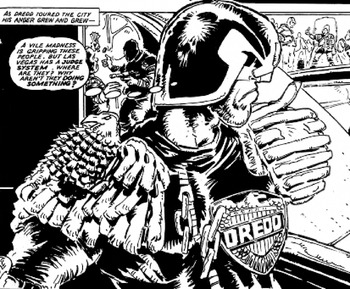
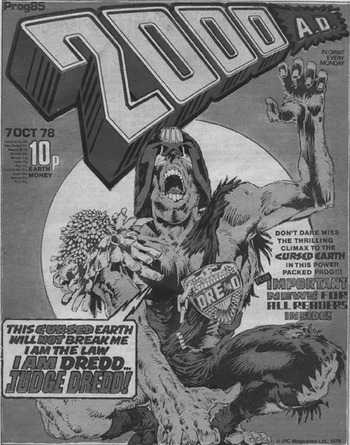
Dredd's origins therefore go back further than Dirty Harry, to the Eastwood character “The Man With No Name.” Kitses describes him as a “laconic, mask-like, minimalist character,”Footnote 32 and comparisons can be drawn with the “machine-like … [h]umorless … grim” and misanthropic Dredd of the pre-Cursed Earth era.Footnote 33 Dredd is, in fact, “The Man With No Face”, a lawman whose features are forever covered up by his helmet (see Figure 2).Footnote 34 Reminiscent of a sheriff's “tin star,” Dredd wears a silver badge in the shape of a shield. He does not use the oversized weaponry typical of cinema action heroes. Instead, Dredd carries a modest sidearm called a Lawgiver, which is analogous to the infamous Colt peacemaker. His futuristic rifle is holstered on his motorcycle and is therefore evocative of a sheriff's Winchester rifle. One critic claims the first Dredd story planned for 2000AD was “nothing more than a futuristic variation of a Wild West sheriff, with his faithful horse, badge and shining six-gun, cleaning up Dodge City.”Footnote 35
‘The Man with No Face.’ Judge Dredd Copyright © 2007 Rebellion A/S. All rights reserved. www.2000adonline.com.

Wagner and Mills gave Dredd a futuristic motorcycle to ride rather than a car, which gives the character a harder edge due to the obvious associations with high-profile outlaw motorcycle gangs such as the Hell's Angels. The Angels themselves were often compared with America's western icons. According to John Wood, “Bikers were seen … as throwbacks to the individualist and frontier spirit … The image of the cowboy on the open plains, the epitome of American rugged individualism, had been replaced by the Hell's Angel of the open road.”Footnote 36 According to George Christie, current president of the Ventura chapter of the Hell's Angels, part of the attraction of their organization is that it evokes the imagery of western outlaws such as “Jesse James, Billy the Kid, and Doc Holiday.”Footnote 37
Dredd's bike has extended handlebars, similar to the bikes in the road movie Easy Rider (1969). Given Dredd's western antecedents, his bike is his modern-day “iron horse.” David Laderman notes, for example, that sequences in Easy Rider “recall the Wild West imagery of The Searchers, with the motorcycle substituted for the horse.”Footnote 38 This metaphor has been in constant use in American popular culture since mechanical transport began to compete with the horse as a mode of travel. Railroads were the “iron horse” of the nineteenth century, and motorcycles the iron or steel “horse” of the twentieth century. Timothy Corrigan notes,
If a friendly horse became the way a person would gallop through the Wild West, a train the way to cross nineteenth-century industrial landscapes, and a silly jalopy the way to get through the newly risen urban jungles of the first quarter of this century, the car of the fifties and sixties becomes a consumer tank.Footnote 39
The difference between a motorcycle and a car is, however, the difference between a horse and a covered wagon: the latter is entirely functional whereas the former serves as an icon of freedom often associated with the “charismatic cowboy or dashing cavalryman.”Footnote 40 When one recalls that Dredd lives in an apartment block named after Eastwood's Rawhide character Rowdy Yates, it is evident that the character's creators were drawing from western iconography.Footnote 41 This was part of a wider trend of association between gunfighters and modern-day lawmen, as Robert Berner astutely notes: “the modern cops-and-crooks genre is modeled, consciously or not, on the classic Western and all manifestations of it, to one degree or another, resemble the models.”Footnote 42
In Dredd's world, the frontier begins at the walls of Mega-City One. Like a besieged fort, the city walls repel a daily assault from mutants, some of whom are enraged at being abandoned by the city dwellers and some driven by the lure of a better life in the city. This is a familiar theme of the road genre, which often features plot elements that invite contrast between the urban and the rural. Often the city is portrayed as something to escape from, its confusion and alienation in marked contrast to the calm of America's “deserts.” Walter J. Matherly claims, “The city differs from the country. The city moves swiftly; the country moves slowly. The city is characterized by feverishness; the country is characterized by placidness. The city is a place of confusion; the country is a place of composure.”Footnote 43 To conservative, rural America the city traditionally has been a place where the permissive society has run amok. In The Decline of Western Civilization Oswald Spengler lamented “the victory of the city over the country whereby it freed itself from the grip of the ground but to its own ultimate ruin.”Footnote 44 Spengler's ideas would influence Beat Generation writers like Allen Ginsberg and Jack Kerouac.Footnote 45 Kerouac, in particular, was fearful of the American city: in On the Road he spoke of “millions hustling for a buck in awful cemetery cities.”Footnote 46 In this particular future, however, the American Dream exists only in the cities, and even there the mass of citizens live lives of drudgery and boredom, often punctuated by bursts of extreme violence.
The theme of sacrifice is a recurring feature of both the action-hero genre and the road genre. The outsiders and antiheroes of the road are frequently punished for their behavioUr by a society that perhaps does not deserve them. The deaths of the main female protagonists in Ridley Scott's 1991 road film Thelma and Louise is perhaps the most obvious example of this, although the murder of Billy and Wyatt in Easy Rider, and the executions of the outlaw folk heroes in Bonnie and Clyde set the trend in the 1960s. Eric Lichtenfeld points out that in the action-hero genre the masculine hero is frequently an outsider who suffers for the society that has rejected him. He argues that these protagonists play the role of “sacrificial hero – a martyr stained on our behalf.” According to Lichtenfeld, the prototype of this hero is the Christ figure.Footnote 47 This is evident in a number of Eastwood films, particularly A Fistful of Dollars (1964), in which “No Name” endures “Christ-like suffering” as he is beaten to a bloody pulp by Rojo thugs,Footnote 48 or in Dirty Harry, when he suffers a similar beating at the hands of a crazed kidnapper.Footnote 49 This trait is not limited to Eastwood characters: for many male action heroes “the evocation of an heroic masculinity … principles of absolute individuation, solitude, probity, and personal resourcefulness … demand the social marginality of the principal figure, much as their Western antecedents did.”Footnote 50 Dredd very much fits this pattern: he is a loner by choice, whose only love is for the law. This has a negative effect on his relationship with women – a trend typical also of many western heroes. Gregory states, for example, “From Natty Bumpo to John Wayne our western heroes … define themselves through killing, contempt for all authority except their own, and their mistrust of women and the social structure they represent.”Footnote 51 This trait is also present in modern-day action heroes such as Harry Callaghan, who seldom seeks out female company, preferring instead the company of other men, or more usually solitude. Richard Combs argues that for Inspector Callaghan, “sexual denial is part of the work ethic.”Footnote 52 Similarly, there are no females in Dredd's life. In fact, this trait is taken to the extreme: not only does he not have a girlfriend, wife or sister, he even lacks a mother due to having been cloned from the DNA of another Judge.Footnote 53 Dredd's usual companion is a robot, the feminized, lisping “Walter the Wobot,” which Dredd bullies at every opportunity.
In The Cursed Earth,Footnote 54 Dredd's travelling companions are two male Judges, a number of armed robots, and Spikes Harvey Rotten, a violent convict recruited by Dredd to add firepower to his group. There is no obvious diegetic reason why Dredd would need to include Spikes on the journey. However, in nondiegetic terms, the plot requires someone to act as a comic foil for its main protagonist. One of the dangers in creating such a minimalist character as Dredd, whose world view is often a simple dichotomy of right and wrong, is that the novelty quickly wears thin. If there is no character maturity, plots can become predictable and stale. This can be avoided by adding a supporting character to allow plot exposition or, as is usually the case in the road genre, to have the traveller meet a variety of interesting or opposing characters on the journey. Both approaches are apparent here. Spikes is Dredd's opposite, an irreverent criminal and reluctant hero whose inclusion follows the conventions of the “buddy” movie, in which two different and conflicting personalities are forced to work together for a common purpose. As Kitses notes, this allows a balance between “one immovable character against which a more interesting ‘split’ character can be placed.”Footnote 55 As shall be illustrated, Dredd's interactions with all of these figures allow for significant character development.Footnote 56
Like many other road tales, The Cursed Earth is notably lacking in femininity. In this genre women are typically mistreated at every opportunity and regarded by males as interlopers who threaten male bonding. David Laderman argues that in road movies “female characters ultimately become distractions from [the] freedom on the road.”Footnote 57 In Bonnie and Clyde (1967), for example, the lead female character complains, “We used to be goin' somewhere, now it seems like we're just goin'.” She doesn't get it: for many males in this genre “just going” is the whole point of the journey. As Michael Atkinson states, “The journey's the thing, and anyone who thinks differently is just wasting gas.”Footnote 58 The dominance of men in this genre is, undoubtedly, a reflection of traditional gender roles, especially outdated views about the nature of reproduction. In this lexicon the female egg is stationary while the male sperm undertakes an incredible journey. As Tim Cresswell notes, the “mobility of the sperm [is] equated with agency, [t]he sperm does things and the egg has things done to it.”Footnote 59 These terms of reference code mobility as masculine and exciting, and immobility as feminine and passive. These foundational attitudes are reflected in society as a whole, and are catered to in much of the road genre.
While Dredd is a loner, he is nevertheless prepared to sacrifice himself for a society he often disparages. “Sometimes the human race makes me sick!” he pronounces (in “Requiem for an Alien”). Matthew T. Althouse states, “seemingly, half of the population is criminal … [t]he other half of Mega-City One's population lives in terror of city judges, who are authorised to assess crime situations and to issue on-the-spot fines, jail terms, and death sentences.”Footnote 60 According to Martin Barker and Kate Brooks “Megacity [sic] One is a claustrophobic, teeming, urban nightmare, where all citizens are potential perpetrators, where the line between guilt and innocence is determined only by the Judges, and where Dredd judges without mercy.”Footnote 61 According to Althouse, Dredd “believes that all inhabitants in Mega-City One hide some kind of misdeed.”Footnote 62 Dredd's attitude towards the citizens is therefore ambivalent in the extreme. Despite this, he undergoes a near-suicidal journey to save those he often judges unworthy. “My life doesn't matter – as long as the vaccine gets through to Mega-City Two” he declares (“Dredd's Last Stand”). In this respect, Dredd is the reluctant antihero typical of both the road and action-hero genres.
Dredd's attitude towards the inhabitants of the wastelands is also ambivalent. At one point he states that they “deserve pity … not vengeance,” but he also refers to them as “the damned.” In “Night of the Vampire” Dredd states, “These simple hillbillies barely scratch a living from the soil – yet they welcome us with open arms. They are good people.” These ragged survivors of ruinous nuclear exchanges cannot seek refuge in Mega-City One because of their mutations. The city therefore represents normality and civilization, and those excluded are deemed to be uncivilized and threatening. This particular stigma has its origins in ancient Greece. Anthony Pagden points out, for example, that “those who chose, or were compelled, to leave their native cities were looked upon both as potentially degenerate and as potentially dangerous. Exile in the ancient world was a punishment comparable to death.”Footnote 63 This image continued through feudal times, when the mass of European peasantry existed in tight-knit, stationary communities. Tim Cresswell explains, “To be mobile was to exist on the margins. Wandering minstrels, troubadours, crusaders, pilgrims, and some peripatetic monks existed, for periods of time, outside of the obligations of place and roots.” Not all of these groups or individuals were mistrusted, but a mobile lifestyle could cause suspicion and result in persecution for some. Cresswell notes, for example, the “[s]o-called wandering Jews [who] lived outside the web of obligations and duties that marked feudalism. For this reason they were looked down upon and distrusted.”Footnote 64 The threat of exile continued in the supposed “new” world of America. For example, the punishment for miscegenation in Virginia in 1691 was banishment from the colony.Footnote 65
The inhabitants of the Cursed Earth form two major groups: the first are criminal gangs, usually distinguishable by their somewhat extravagant mutations. In the second group are the innocent victims of these mutants, usually distinguishable because they appear “normal.” The story therefore follows familiar plotlines of horror, science fiction and James Bond movies in which disfigured people are unfairly stereotyped as evil. In this respect, The Cursed Earth departs from what is a notable and unusual facet of the modern American road genre, namely that the road can be a haven for what society considers abnormal or uncivilized. For example, in Easy Rider the “freaks” of a hippy commune in Arizona are much more welcome and tolerant than the racist townsfolk and hostile lawmen of small-town America. This departure from the norm may be attributed to the fantastic properties of the story, but it is more likely that Dredd's character type drives the plot in this direction. The forces of law and order are, by their very nature, conservative, and anyone outside the norms of society is automatically suspicious.
A further area of the Cursed Earth story that does not follow the traditional road-genre convention is Dredd's politics. Frequently in this genre those who set out on the road tend to express liberal views and lead countercultural lifestyles. Althouse states bluntly, however, “Dredd is a fascist.”Footnote 66 He may be an antihero, as are many of the road genre's protagonists, but he is a right-wing, authoritarian antihero in the Dirty Harry mould, rather than the drop-out antiheroes of Easy Rider or work-shy car fanatics of Two-Lane Blacktop (1971). Despite this, the story features satirical and picaresque themes. These are evident in two storylines that have never been reprinted. In issues 71 (1 July 1978) and 72 (8 July 1978) Wagner's “Battle of the Burger Barons” and “Burger Law” satirized the giant American corporations Burger King and McDonalds (spelt “MacDonalds” in the comic). In issues 78 (12 August 1978) and 79 (19 August 1978), Chris Lowder's stories “Giants Aren't Gentlemen” and “Soul Food” featured copyrighted images such as the jolly green giant of Green Giant sweet corn, the Michelin tyre mascot, and a mad scientist who bore an uncanny resemblance to Harland “Colonel” Sanders, the Kentucky Fried Chicken magnate.Footnote 67 These tales were not part of Mills's original plans: he found that he could not keep meeting 2000AD's weekly deadlines, and both Wagner and Lowder were therefore asked by editor Nick Landau to contribute some “fill-in stories.”Footnote 68 In “Battle of the Burger Barons,” the suspicious, heavily armed townsfolk of In Between, Kansas explain to Dredd that competition between two hamburger chains, MacDonalds and Burger King, has turned violent. Citizens must choose between one or the other, or face death. In Between is the only burger-free, neutral town left in the area. When it is attacked and overrun by an armed gang whose leader dresses as Ronald MacDonald, Dredd is captured and taken to MacDonald's City. He quickly organizes his escape but is captured by Burger King vigilantes. Mistaken for a MacDonald's employee, Dredd is quickly lynched. Before he is completely throttled, however, he is rescued by Judge Jack. In typical road-genre fashion, this plot is not resolved: Dredd orders the Burger King lynch mob released, and he then presses on for Mega-City Two.Footnote 69
The “Burger Wars” narrative features a number of familiar plot themes from the American western genre. The title of the first part of the story, “Battle of the Burger Barons,” is suggestive of the cattle barons and range wars of the frontier era, a theme reinforced by the inclusion of a cattle stampede in the storyline. In addition, Dredd is subjected to the supposed “frontier justice” of a hangman's noose. There is also a suggestion that the burger wars are a distorted version of a family feud. Ronald MacDonald states, “That wasn't the real Burger King – just like ah ain't the real Ronald MacDonald. See, back ‘fore th’ atom war, my pappy ran MacDonald's in these parts. Me, ah'm jus' carryin' on th' family tradition. ‘Cept we're at war now!” The senseless violence and exaggerated southern aristocratic accents are suggestive of the Grangerfords and Shepherdsons, the feuding families of Mark Twain's canonical road novel The Adventures of Huckleberry Finn.
There is here perhaps also an allusion to the fake aristocratic fried chicken mogul Harland “Colonel” Sanders, whose likeness also appears in “Giants Aren't Gentlemen” and “Soul Food.” Wagner used the “Burger Wars” story to critique the abusive power of giant corporations like Burger King and Kentucky Fried Chicken. Dredd states, “After the war, with the government gone, there was nothing to stop the big burger chains lust for complete control. They grew more and more powerful, until their hamburger war turned violent.” Dredd's authoritarian nature leads him to the conclusion that lack of government regulation is the problem. However, he also criticizes the consumers of fast food and the apparent apotheosis of Ronald MacDonald. For example, in MacDonald's City he witnesses the execution of a fast-food employee who failed to wipe a table quickly enough. MacDonald declares, “Everythin’ in MacDonald's is disposable – includin' th' staff.” Dredd comments, “The hamburger chains have grown so powerful they've taken over. The people worship them!” Wagner may also be critiquing the so-called “McDonaldization” of British society. Although McDonald's had opened its restaurant in the United Kingdom only four years before, the franchise had already achieved market dominance. George Ritzer, author of The McDonaldization of Society, writes,
the fundamental problem with McDonaldised systems is that it's other people in the system structuring our lives for us, rather than us structuring our lives for ourselves. I mean, that's really what McDonald's is all about. You don't want a creative person clerk at the counter – that's why they are scripted. You don't want a creative hamburger cook – you want somebody who simply follows routines or follows scripts. So you take all creativity out of all activities and turn them into a series of routinised kinds of procedures that are imposed by some external force. So that's the reason why it is dehumanising … The idea is to turn humans into human robots.Footnote 70
However, in using the deeply conservative Dredd to criticize lack of government control over giant corporations, Wagner sends a mixed message. Utilizing Dredd as a vehicle for freedom is particularly problematic. Dredd's appeal is due mostly to the straightforward, good-versus-evil nature of the character. However, for a large section of his audience his attractiveness is his straitlaced conservatism. For Dredd, no level of government control is too much, and every transgression of the law, no matter how trivial, must be punished severely. If electoral politics is any indication of the mood of the nation, the dominance of Thatcherite conservatism in the late 1970s and the appeal of Judge Dredd to a section of 2000AD's readership go hand in hand. However, Dredd also appealed to those readers who found his behaviour indicative of the new conservatism of British society and who saw in Dredd a dire warning of things to come. Many of those on the receiving end of Dredd's unforgiving punishments were, after all, guilty only of not conforming to Dredd's harsh laws. A few of these characters struck such a chord with readers that they became popular in their own right. For example, in the non-Cursed Earth story “Unamerican Graffiti,” Marlon Shakespeare (“Chopper”) was a graffiti artist whose artistic talents could not be expressed in a society with ninety-five percent unemployment rates. Originally planned as a one-off story, Chopper was quickly captured and jailed by Dredd. However, his popularity with readers was such that he featured in future stories where he was the main character and Dredd an incidental part of the story.Footnote 71 This demonstrates that while many readers admired Dredd for his authoritarian and uncompromising approach, many others were more attracted to Dredd's rebellious victims.Footnote 72
“Giants Aren't Gentlemen” and “Soul Food” offer an opportunity for Lowder to further explore the theme of big business exploitation that Wagner had begun in “Burger Wars.” Dredd stumbles upon a government agricultural research station, which dates to the pre-atomic war era. It is run by Doctor Gribbon, a Colonel Sanders look-alike, who uses genetic engineering to give life to vegetable matter. Obviously insane – a protégé of the Frankenstein, “mad scientist” school of scientific research – Gribbon uses advertisements from old magazines for inspiration. Hence Dredd is menaced by thirty-foot tall “green giant” sweet corn monsters and by Bibendum, the gun-wielding Michelin tire mascot. Gribbon dies in an explosion caused by one of his mutinous creations. Dredd passes judgment on the affair: “Gribbon learned too late that man cannot play at being God! His creations had feelings … emotions! He created life – but in the end it was the death of him!” These stories appear to be influenced by well-known science fiction or horror literature, such as Mary Shelley's Frankenstein and H. G. Wells's The Island of Doctor Moreau. Although Mills feels that the fill-in stories of Wagner and Lowder were “a big mistake” because of their abuse of copyrighted figures,Footnote 73 they remain the most memorable individual chapters of The Cursed Earth. This may be because of their notoriety, but it is also undoubtedly due to their satirical, picaresque nature, which is a recurring feature of many road stories.
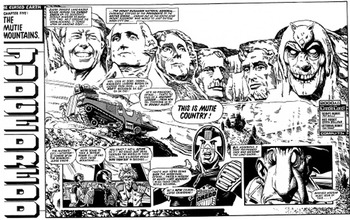
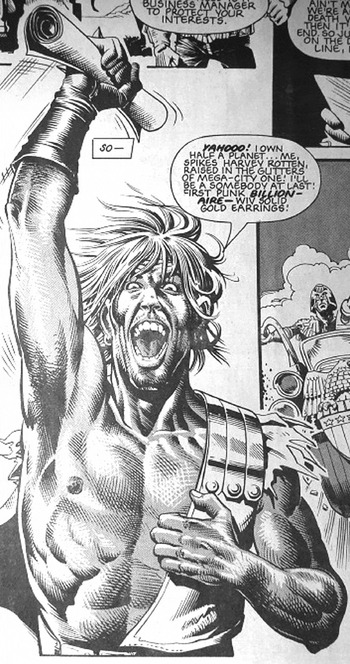
The artwork in The Cursed Earth is primarily the work of Mike McMahon and Brian Bolland. Despite their undoubted skills, neither artist fully captures the feeling of movement associated with a road trip. However, both draw dramatic and dynamic scenes that were particularly appealing to the young audiences that were the mainstay of 2000AD. Many chapters in the story feature, for example, an introductory double page spread of a single image – usually an eye-catching and exciting action scene (see Figure 3). McMahon states modestly, “what I regard myself really as is someone who can string a sequence of pictures together you can follow quite easily.”Footnote 74 The artwork of The Cursed Earth therefore follows in the tradition of the road genre in its appeal to youth culture. The artists were given plots and characters that appealed to late 1970s youth. For example, Dredd's “reluctant companion,”Footnote 75 Spikes Harvey Rotten, a spiky-haired rebel with hand grenade ear-rings, was no doubt inspired by that era's punk rock movement (see Figure 4).Footnote 76
Mount Rushmore in the year 2100. Judge Dredd Copyright © 2007 Rebellion A/S. All rights reserved. www.2000adonline.com.

Punk rocker, Spikes Harvey Rotten. Judge Dredd Copyright © 2007 Rebellion A/S. All rights reserved. www.2000adonline.com.

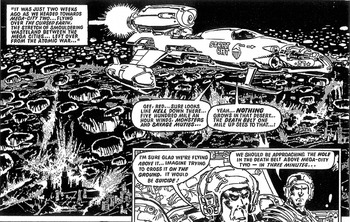
Another aspect of the art in The Cursed Earth is what Leo Marx has referred to as “The Machine in the Garden.” Marx demonstrates how industrialization and technology (the machine) threatened idea of America as a new Eden (the garden). Marx explains how writers such as Nathaniel Hawthorne and Mark Twain incorporated such ideas into their work. In Huckleberry Finn, for example, the tranquility and peaceful nature of life on a raft is suddenly disrupted by the appearance of a “monstrous steamboat.” For Hawthorne it was the “startling shriek” of a locomotive that disrupted their meditation in the woods. Marx concludes, “it is difficult to think of a major American writer upon whom the image of the machine's sudden appearance in the landscape has not exercised its fascination.”Footnote 77 Aside from the motorcycle that Dredd rides, the bulk of the journey is made in an armored vehicle known as “The Land Raider.” The vehicle is introduced to readers in a dynamic two-page spread in “Into the Darkness.” McMahon draws the image without a frame, which conveys both space and action. This scene is replicated throughout The Cursed Earth, particularly in “The Coming of Satanus” and “Loser's Leap.” When Dredd is depicted on his motorcycle McMahon either draws the image without a frame, or he uses a “splash panel” – a panel bigger than those around it (see Figure 5). This has the effect of emphasizing the panel.Footnote 78 These intrusions of machinery into the wastelands are symbolic of the city's influence on the rural. Here it is benevolent, but in American history it has often been seen as malevolent. Like so much of this story, then, the writers (and artists) send mixed messages of intent.
Flying over the Death Belt: “splash panel.” Judge Dredd Copyright © 2007 Rebellion A/S. All rights reserved. www.2000adonline.com.

Jack Sargeant and Stephanie Watson argue, “Historically the desert is a space in which protagonists are tested and emerge as transformed, in narratives that go back to the Bible and Jesus' forty days and nights spent in the wilderness.”Footnote 79The Cursed Earth incorporates a “rite of passage” ordeal like this, in what has become a familiar road convention. For example, in The Grapes of Wrath the Joads must traverse the great “American desert,” face physical and spiritual trials, and lose a family member along the way, before they reach the supposed “Eden” of California. In “Death Crawl!” Dredd is the sole survivor of the original group that left Mega-City One. In a scene reminiscent of the suffering of Eastwood characters in both A Fistful of Dollars and High Plains Drifter (1973), Dredd, wounded, exhausted and dehydrated, is haunted by hallucinations of the mutants, villains and monsters that he has faced in the Cursed Earth (see Figure 6). Dredd, however, endures, eventually crawling to Mega-City Two with the vaccine that will save the city. A grateful official of the city declares, “Only a Judge could've made it – and this guy Dredd … he must be special, even for a Judge.”
Death Crawl! Dredd's rite of passage. Judge Dredd Copyright © 2007 Rebellion A/S. All rights reserved. www.2000adonline.com.

Passage through the wilderness can either ennoble the travellers or reduce them to insignificance when pitted against the forces of nature. At the beginning of the story Dredd's group overcome natural obstacles such as a mountain and wild beasts.Footnote 80 At the end, however, it seemed for a moment that the Cursed Earth had won. Dredd's companions are dead or missing, his motorcycle destroyed, and the clothes ripped from his back. His pain is, however, the price of being cleansed, reborn and transformed into a fairer, less inflexible, character. As noted previously, the theme of sacrifice is apparent in both the “action-hero” genre and the road genre, but Dredd's test here is also typical of the road journey as a modern-day quest. Primeau notes, for example, that a typical formula is “the hero who sets out on a quest, experiences ordeals, and ultimately returns triumphant.”Footnote 81 Closely connected to the rite-of-passage theme is that of transformation. In the road genre, characters or protagonists often face an ordeal and emerge, butterfly-like, transformed. Timothy Corrigan argues that this is related to the quest motif, in which the confrontations and obstacles faced “generally lead, in most cases, to a wiser individual and often a more stable spiritual or social state.”Footnote 82 To an extent, this happens to Dredd. The draft of the first ever Dredd story sees him execute in cold blood three alleged bank robbers. Although this scene was eventually edited from the story, it is much closer to Wagner's vision of the character as “judge, jury and executioner” than the post-Cursed Earth era Dredd.Footnote 83 Landau states,Footnote 84
During the journey, Dredd underwent a complete character change – from a relentless, macho cop, who could cope with the insanity of Mega-City One by being tougher and more ruthless than its inhabitants, to a fairer, more compassionate lawman whose treatment of the Cursed Earth mutants was both sympathetic and just.
Mills calculates that “the cold, merciless Dredd of the Mega-City streets couldn't have made that journey. The city was about control, The Cursed Earth was about lack of control – it brought out the different halves of Dredd's psyche.”Footnote 85 The search for identity is characteristic of road tales. In Paul Auster's Moon Palace, for example, Marco Fogg undergoes a similar transformation. He states, “I felt like someone about to be reborn, like someone on the brink of discovering a new continent.”Footnote 86 In a sense, Dredd is also “reborn” as a more rounded figure than the cold-blooded killer of earlier stories. Just as Huckleberry Finn learned the dignity of human life by virtue of being on the road – that is, by realizing that the slave Jim was more than a piece of property – Dredd becomes aware that “instant justice” (killing) is not the answer to every problem.
Not every road story has a destination and not every traveller arrives at their goal. In fact, those that do are often disappointed with the result.Footnote 87 However, when the story takes the form of a quest, as in The Cursed Earth, achieving the goal is important if the story is to reach a satisfactory conclusion. Dredd's objective is, of course, Mega-City Two, a huge metropolis that has been built from the ruins of Los Angeles. Journalist Mike Davis notes that science fiction writers have destroyed Los Angeles more often in their imagination than any other American city. Davis states,
No other city seems to excite such dark rapture … The destruction of London – the metropolis most persecuted in fiction between 1885 and 1940 – was imagined as a horrifying spectacle. The obliteration of Los Angeles, by contrast, is often depicted as, or at least secretly experienced as, a victory for civilization.Footnote 88
Davis's explanation for this – “racial anxiety”Footnote 89 – does not, however, apply to The Cursed Earth saga. Mills states,Footnote 90 for example, “I had become very passionate about what was basically a story of oppression, touching a lot of areas where Western civilization has oppressed other races. It made me feel very angry.” Here, again, the authoritarian character of Dredd came into conflict with the natural tendency of the road story towards rebelliousness and support for the underdog. Dredd is, after all, very much the oppressor and bully. Mills dealt with this conflict by introducing the character “Tweak,” an intelligent alien with paranormal powers. The alien and his family are abducted from their home planet to be exhibited in an “alien nature reserve.”Footnote 91 In the aftermath of the nuclear exchange that created the Cursed Earth, locals bought the aliens to use as slaves. Dredd avows, “The use of slave labour is evil,” and swears to put an end to the practice when his mission is accomplished. However, events overtake his plan: when Tweak escapes, Dredd offers the alien sanctuary and kills the pursuing slave-traders. In very poignant scenes that are, perhaps, unexpected in a comic book aimed at seven- to eleven-year-olds,Footnote 92 readers discover that Tweak escaped because he had been separated from his family, which had been sold to work on a plantation. Tweak is too late, however: his wife and kids have already been murdered by their master.
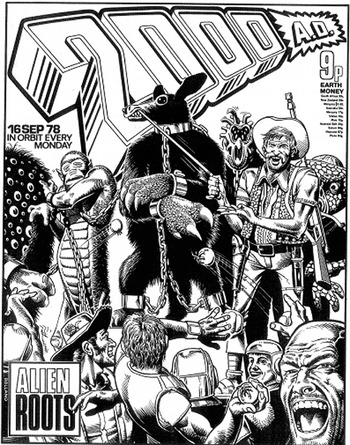
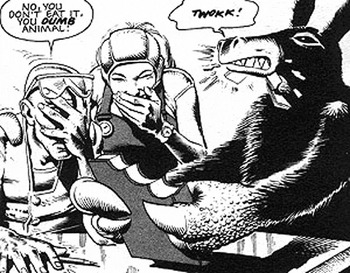
Comparisons with the American slave trade are obvious here. The cover of issue 82 of 2000AD depicts Tweak on an auction block, having his teeth examined by an overseer. The image is entitled “Alien Roots” (see Figure 7), an obvious reference to the television series based on Alex Haley's novel, which was first broadcast in the United States in January 1977, and in Britain soon after. The forced-labour plotline, references to the “Big House,” the auction, and the slave-traders' use of whips are all evocative of America's “peculiar institution.” While it would be a mistake to attribute too many historical parallels to the story – hanging too much weight on what may be simply an insubstantial narrative hook – the portrayal of a slave escaping to be with his family is, nevertheless, a surprisingly accurate retelling of historical events. For example, until the 1943 publication of Herbert Aptheker's America Negro Slave Revolts,Footnote 93 the generally accepted image of slavery was that portrayed by southern historian Ulrich Bonnell Phillips, namely that slaves were passive, happy and obedient. Their destiny, Phillips argued, “was affected only so far as the master race determined.” Lacking in agency, these “Negroes” were an “inert and backward” people for whom “it was a satisfaction to work sturdily for a hard boss.”Footnote 94 Despite Aptheker's work (Aptheker was a communist, and much of his research was therefore unfairly discredited), it was not until the publication of Kenneth Stampp's book The Peculiar Institution in 1956 that the racist image of the docile male slave was put to rest.Footnote 95 In “Tweak's Story,”the slave is described as “stupid,” “vicious” and a “thick brute” – a lexicon of dehumanization very familiar to scholars of the slave system. On the surface, Tweak resembles the “Sambo” personality type – “docile but irresponsible, loyal but lazy, humble but chronically given to lying and stealing: his behavior was full of infantile silliness”Footnote 96 – but it is a masquerade. Mills states, “Tweak suffered all the horrible tests without revealing he was intelligent.” He would “pretend to be a dumb animal” because that's what humans and slaveholders expected (see Figure 8). This has remarkable parallels to Aptheker's description of individual slave resistance wherein slaves would pretend to be “dumb animals,” while striking back at their masters through such tactics as “carelessness” and “pretending illness.”Footnote 97
Alien roots. Judge Dredd Copyright © 2007 Rebellion A/S. All rights reserved. www.2000adonline.com.

Tweak suffered all the tests without revealing he was intelligent. Judge Dredd Copyright © 2007 Rebellion A/S. All rights reserved. www.2000adonline.com.

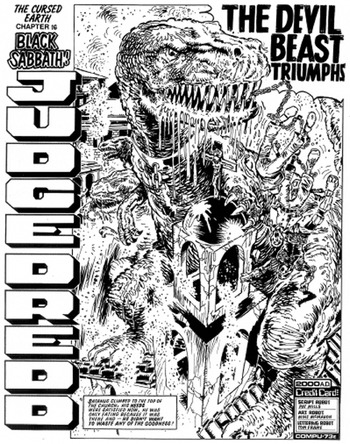
In keeping with the typical liberal inclination of road tales – at its core, the genre is about exploring the limits of freedom when its characters run up against, and sometimes transgress, social, cultural and political boundaries – and perhaps therefore also to add balance to stories usually dominated by the ultra-conservative Dredd, Tweak also makes a wider point about “Western oppression.” For example, when humans arrive on his planet for the first time they insist “We come in peace for all mankind.” However, Tweak's mind probe reveals thoughts of war and brutality that belie these words. One image reveals the persecution of a Native American, a theme that Mills returns to in “For Whom the Bell Tolls,” “Picnic at Black Rock” and “Black Sabbath.” These stories feature dinosaurs re-created from fossilized DNA. Locals follow a bizarre religious ritual that entails sacrificing individuals in order to save their town (aptly named “Repentance”). In these stories, Mills creates a satire not just of organized religion, but of the Catholic missions that did so much to destroy Native American culture. Mills reflects,Footnote 98 “The scene where Satanus (the Devil beast) is perched atop a Mexican church was, for me, deeply symbolic, referring to the forces of evil triumphing over good” (see Figure 9).
Satanus the devil beast. Judge Dredd Copyright © 2007 Rebellion A/S. All rights reserved. www.2000adonline.com.

Mills and Wagner are consumers of American culture. The authors draw from many different aspects of Americana, and the result is an exciting tale containing jumbled, polyglot images of America. Leo Marx argues, for example, that there are two competing versions of the New World. The first is the idea of the “virgin land,” an Eden-like garden where life could begin anew. The second is that of an American wilderness. Marx notes the differences between the two:
To depict America as a garden is to express aspirations still considered utopian – aspirations, that is, toward abundance, leisure, freedom, and a greater harmony of existence. To describe America as a hideous wilderness, however, is to envisage it as another field for the exercise of power. This violent image expresses a need to mobilize energy, postpone immediate pleasures, and rehearse the perils and purposes of the community. Life in a garden is relaxed, quiet and sweet … but survival in a howling desert demands action, the unceasing manipulation and mastery of the forces of nature, including, of course, human nature. Colonies established in the desert require aggressive, intellectual, controlled and well-disciplined people.Footnote 99
In The Cursed Earth, the writers cannot decide which version of postapocalypse America they subscribe to. “The Devil's Lapdogs” features, for example, imagery similar to what William Bradford saw from the Mayflower, “a hideous and desolate wilderness, full of wild beasts and wild men.”Footnote 100 However, “Giants Aren't Gentlemen” features “a gigantic sea of grass” that is reminiscent of the “garden” metaphor or America as a land of plenty. Similarly, “Dark Autumn” and “Night of the Vampire” depict the kind of idyllic Arcadian society of small farmers advocated by Thomas Jefferson. Jefferson's rural idyll is, however, not usually reflected in the road genre. Often, small towns are depicted as violent and repressive, and the townsfolk ignorant, ultra-conservative, and dangerous. For example, in a review of Easy Rider, Chris Hugo notes the film's depiction of small-town America as “brutal and corrupt.”Footnote 101
After Dredd leaves Kentucky, his journey follows roughly the direction of Route 66, “America's Main Street.” From Mega-City One, Dredd travels through Kentucky, Kansas, Utah, Colorado, Las Vegas and Death Valley, to Mega-City Two. Route 66 was, of course, the road taken by thousands of migrants especially during the Great Depression. The road was decommissioned in 1985, mainly due to lack of use following the growth of the US interstate highway system. However, the myth and icons of Route 66 remain alive due to a well-organized “nostalgia industry” that has helped replace tourist traffic lost to the interstates.Footnote 102 This nostalgia for times past can be found in many road narratives and an element of it exists in The Cursed Earth. “Night of the Vampire” and “The Sleeper Awakes” tell the story of the last President of the United States and the origins of the Judge system. Primeau argues that the road genre “often takes on the tone of pilgrimage to search for origins.”Footnote 103 Usually this takes the form of a New World/Old World dichotomy in which comparisons are invited between the United States and Europe, particularly the supposed “parent” country of Great Britain. Occasionally, it also takes the form of a contrast between pre- and post-Columbian America. In this section of The Cursed Earth, however, Mills explores the origins of the judicial system by comparing the two men who represent the old democratic society of the United States and the police state that replaced it – President Booth and Judge Dredd.
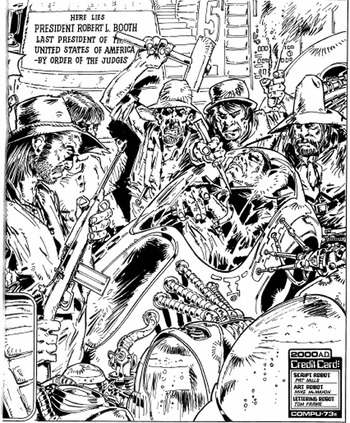
In “Night of the Vampire,” Dredd is enjoying the hospitality of some Kentucky locals, when he is interrupted by a posse in search of a supposed vampire. The vampire is, in fact, a robot which has been programmed to search for and collect blood samples. Dredd follows the posse to a “ruined castle,” which turns out to be the remains of Fort Knox. Inside, Dredd discovers that the “head vampire” is, in fact, “Bad” Bob Booth, the last President of the United States. Booth had initiated the atomic wars, which created the wastelands, led to the establishment of city states like Mega-City One and Mega-City Two, and allowed the Judges to take control of the executive, judiciary and legislature. Rather than execute Booth, the Judges sentenced him to 100 years of suspended animation. When blood supplies began to run low, the robots assigned to provide medical care to Booth began to prey on the locals, and the legend of the vampire began (see Figure 10). When Booth is awakened from suspended animation by the posse, Dredd convinces the angry mob that the robots can be reprogrammed to work for them in the fields, and that Booth should join them, “getting your lily-white hands dirty – bringing life back to the Cursed Earth.”
The legend of the vampire. Judge Dredd Copyright © 2007 Rebellion A/S. All rights reserved. www.2000adonline.com.

Mills states,Footnote 104 “I always have to know the history of everything, which is why I wrote the story about President Booth. I just had to know how the Judges came to be.” Mills fills this lacuna in Dredd's origin story with the tale of Booth, the symbolic “lost parent” (and motivation for many characters in this genre to go on the road). Booth is the female-coded progenitor who gave birth to Dredd's world. He is weak and indecisive, having been assigned the feminine role of “staying home” while his robotic children go shopping for blood – a simulacra of Dredd, the man of action, who is mobile, decisive, prepared and able to use violence to enforce his will. The message this sends is a mixed one. In the context of the mid-1970s, when conservative values were replacing the liberalism of the turbulent 1960s, democracy seemed to be threatened by corrupt politicians like Richard Nixon and Spiro Agnew. However, while Mills may have intended this story to act as a grim warning of the possible results of such political corruption, Dredd's masculine actions and decisive judgment also offered 2000AD's young male readers a positive hero figure, especially when compared to the weaker figure of Booth.Footnote 105 That Dredd actually represents an antidemocratic, illiberal police state, in which dissent is ruthlessly crushed, is lost in the penumbra of mixed messages and morals created by the arc of the story.
The Cursed Earth is very much a product of its time. The punk-era influences are evident with the inclusion of Spikes Harvey Rotten, “the greatest punk of all time.” Punk fashions also influenced Dredd's uniform, which is adorned with chains (although artist Carlos Ezquerra claims otherwise).Footnote 106 In addition, a relocated and redesigned Mount Rushmore monument features then-President Jimmy Carter. According to Mills,Footnote 107 this was his attempt to show “American kitsch culture at its most vulgar.” Combined with dynamic artwork and compelling stories, adding contemporary punk and political imagery added to the story's attraction. However, The Cursed Earth is not without its faults: there are, for example, occasional continuity and artistic errors. Furthermore, some elements of the plot appear contrived.Footnote 108 Overall though, The Cursed Earth is a success. This can be attributed to innovative editorial decisions, inventive storylines and exciting artwork. The radical decision to run the story over twenty-five weeks was unheard-of for a weekly British comic book. The artwork, featuring, for the first time, coloured double-page introductory panels, ranks among the best British comic art of the period. The plot expanded Dredd's narrow, “one-joke” character and “defined the Judge Dredd of today.”Footnote 109 Choosing the road genre characteristics of Damnation Alley as a framework meant incorporating recurring images and themes such as myths and symbols of the West, transformation of identity, an appeal to youth culture, the antihero or villain as hero (in this case, Spikes Harvey Rotten), the city-versus-frontier comparison, the heroic quest, same-sex relationships (the “buddy” theme, in which women are excluded), and a contrast between Old World and New World values, which, in this case, manifested itself in a story about a search for origins. In addition, The Cursed Earth demonstrates that the road genre can encompass a great variety of plots and situations as long as the aforementioned basic conventions are retained. Beyond this, however, the story includes themes articulated by Marx in The Machine in the Garden, such as the intrusion of modern technology into the untouched land beyond the cities, and the contrasting images of this land as either a new Eden or a howling wilderness.
Beginning in the 1950s with Henry Nash Smith,Footnote 110 the “myth and symbol” school of American studies posited that Americans had a common and unique cultural tradition, and that influential American archetypes can be found both in the canon of American literature and in works of popular culture. Americans, therefore, have a common “origins story,” featuring archetypal images, ideas and themes, to which they can all refer (and in the case of writers and artists, draw inspiration from). Marx's aforementioned Machine in the Garden is a product of the “myth and symbol” school. How is it, then, that non-Americans such as Mills can access this supposed “origins story”? Either the archetypes are also present in non-American cultures or the “myth and symbol” explanation is incomplete or incorrect. The former explanation is entirely plausible given the widespread exposure of American culture through various media. Furthermore, the myth–symbol mode of analysis has serious shortcomings: Bruce Kuklick is among its most prominent detractors: he has criticized its methodological deficiencies, in particular, calling the whole form of scholarship “suspect.”Footnote 111 In addition, any attempt to assign common characteristics to a national group, or to identify a shared popular consciousness, is fraught with difficulties. This is especially problematic when discussing hybrid, protean cultures such as the United States.
It may, then, be possible to say that the narrative framework of this story – the road trip – is responsible for the presence of themes which are supposed to be inherently American in nature. The recurring road-genre themes mentioned above are not necessarily innately American, but the dominance of American culture in the areas of film, television and literature has resulted in widespread dissemination of peculiarly American road stories. These stories may – consciously or otherwise – act as a template for non-Americans. In the “twisted road movie”Footnote 112Taxi Driver (1976) a character named The Wizard states, “You get a job, you become the job.” This is the classic existentialist position that humans define their own reality, taken to the extreme in another road movie, Two-Lane Blacktop, where the obsessive driver and his mechanic reject every human emotion as they attempt to meld machine and man into the perfect driving experience. While those characters welcomed the fusion, it is unlikely Dredd's writers would feel the same way about the fusion of American and British culture. Many of the stories featured in 2000AD are about aspects of American culture and one could argue that, in this respect, the comic reflects a wider national view of the United States. Concurrent with the so-called “special relationship” between Britain and the United States – the supposed common tradition and common culture – there is also ambiguity of feeling. This is usually articulated by reference to the changing roles of the two countries in the post-Second World War period; that is, British resentment at the rise of the global American superpower and, conversely, American unease about Britain's colonial past and class-based social system.
However, while the British may often express resentment at the pervasive influence of American culture, they are, at the same time, also fascinated and attracted by it.Footnote 113 Thus, in Dredd's world, we are introduced to the peculiarity of the League of Fatties, a civil rights group for the grossly overweight, whose members are so obese they require a wheel underneath their belly to move around; or we can visit Otto Sump's Ugly Clinic, where those too pretty for future standards of beauty can pay plastic surgeons to make themselves less attractive. 2000AD readers were invited both to laugh at the eccentricities of Americans and also to admire Dredd's stern response to their odd behaviour. Yet, for every time Dredd is depicted as the straitlaced enforcer of “normality,” his writers also ensured that readers could identify occasionally with Dredd's victims, such as the aforementioned “Chopper.” Dredd's unflinching belief in enforcing the letter of the law meant that he was sometimes in on the joke, and at other times the butt of the joke, as, unlike many readers, his rigid nature excluded him from identifying with the attractive absurdity and random lunacy of both this future world and, by extension, the United States of the late 1970s.
In The Cursed Earth Dredd's British writers satirize American culture using Dredd to expose the flaws of contemporary society. In this respect, one could argue that Dredd is, then, in the best tradition of sociological science fiction, “extrapolate[ing] the future consequences of present circumstance” to encourage constructive activism in the present.Footnote 114 However, while writers may set out with one goal in mind, their creations sometimes evoke surprising audience reactions. Dredd fans were both attracted to and repulsed by his fascist tendencies. Given that Dredd was created, in part, as a response to some of the more reactionary aspects of American culture – to hold Dredd's fascist tendencies up to ridicule, for example – Dredd is, in fact, a polysemic figure who can be viewed variously as a figure of fear and loathing, as an antihero, or as a hero/superhero. The unintended irony of The Cursed Earth is that in addressing the contradictory nature of Britain's relationship with the United States using the “generic road-movie concept,” the writers appear themselves to have internalized many myths and symbols usually considered intrinsically American.