Introduction
There are only a few groups of organisms with triradial symmetry known in the late Ediacaran and early Cambrian fossil record. In the Ediacaran, there were enigmatic soft-bodied tribrachiomorphs (sensu Grazhdankin, Reference Grazhdankin2014)/triradialomorphs (sensu Laflamme et al., Reference Laflamme, Darroch, Tweedt, Peterson and Erwin2013) (e.g., Tribrachidium, Anfesta, Albumares). In the early Cambrian, triradial symmetry is typical for anabaritids (Kouchinsky et al., Reference Kouchinsky, Bengtson, Feng, Kutygin and Val'kov2009). They compose a group of extinct minute (mostly of millimeter scale) benthic cnidarians that occur in the fossil record mostly as tubular calcareous shells (usually no more than 5–6 mm long) and inner casts. Besides anabaritids, the triradial symmetry also occurs among orthothecid hyoliths (Missarzhevsky, Reference Missarzhevsky1989; Malinky, Reference Malinky2009), carinachitids (Qian et al., Reference Qian, Van Iten, Cox, Zhu and Zhuo1997), and some earliest conulariids (Ivantsov and Fedonkin, Reference Ivantsov and Fedonkin2002).
Conulariids are extinct benthic scyphozoans cnidarians (Van Iten et al., Reference Van Iten, De Moraes Leme, Simões, Marques and Collins2006) ranging from the late Ediacaran to the Late Triassic (Leme et al., Reference Leme, Simões and Van Iten2010; Lucas, Reference Lucas2012). They reached their maximum diversity by the Ordovician Period (Van Iten and Vylhasova, Reference Van Iten, Vhylasova, Webby, Droser and Paris2004), but only a few occurrences of conulariids are known from the older strata (Hughes et al., Reference Hughes, Gunderson and Weedon2000; Ivantsov and Fedonkin, Reference Ivantsov and Fedonkin2002; Van Iten et al., Reference Van Iten, Leme, Pacheco, Simões, Fairchild, Rodrigues, Galante, Boggiani, Marques, Goffredo and Dubinsky2016). In the fossil record, conulariids appear as steeply pyramidal ornamented organo-phosphatic, generally tetraradial thecae (Brood, Reference Brood1995; Leme et al., Reference Leme, Simões and Van Iten2010). The oldest conulariids (late Ediacaran) have nonmineralized theca and exhibit both tetraradial (Van Iten et al., Reference Van Iten, Leme, Pacheco, Simões, Fairchild, Rodrigues, Galante, Boggiani, Marques, Goffredo and Dubinsky2016) and triradial (Ivantsov and Fedonkin, Reference Ivantsov and Fedonkin2002) symmetry. In the Phanerozoic, triradial conulariids are extremely rare (e.g., Conularina triangulate (Raymond, Reference Raymond1905); Van Iten et al., Reference Van Iten, Cournoyer and Coyne2020) and in most cases compose intraspecific variations caused by growth anomalies (Babcock et al., Reference Babcock, Feldman and Wilson1987; Sendino et al., Reference Sendino, Zágoršek and Taylor2012). Because of the triradial symmetry of Vendoconularia from the upper Ediacaran of the White Sea region, phylogenetic affinity of anabaritids and conulariids was earlier suggested (Ivantsov et al., Reference Ivantsov, Vickers-Rich, Zakrevskaya and Hall2019). However, independent origin of the triradial symmetry in different groups in the late Ediacaran and Cambrian shall not be excluded.
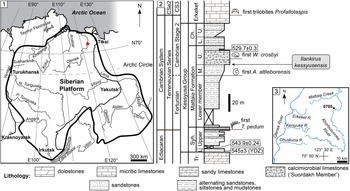
Here we describe a new taxon, Ilankirus kessyusensis new genus new species, from the base of the Cambrian Stage 2 of the Olenek Uplift (northeastern Siberian Platform; Fig. 1). The fossils have a pyramidal shape and carry surface ornamentation reminiscent of the Phanerozoic conulariids. But they appear as steinkerns with no relics of surface mineralization and have a prominent triradial symmetry. Drawing on Ilankirus and Ediacaran Vendoconularia, we attempt to estimate whether the triradial symmetry of some earliest conulariids indicates phylogenetic affinity of this group with the anabaritids.
Locality maps and stratigraphic position of the studied specimens in the Kessyusa Group. (1) A simplified map of the Siberian Platform with the study area (3) marked with a red dot. (2) A composite stratigraphic column of the Kessyusa Group (after Grazhdankin et al., Reference Grazhdankin2020) showing the fossil locality. (3) A sketch map of the Olenek Uplift with the studied section (0705). U–Pb ages: 545 ± 3 Ma, youngest detrital zircons (YDZ) (Vishnevskaya et al., Reference Vishnevskaya, Letnikova, Vetrova, Kochnev and Dril2017); 543.9 ± 0.24 Ma, zircons from the Tas-Yurakh volcanic complex (Bowring et al., Reference Bowring, Grotzinger, Isachsen, Knoll, Pelechaty and Kolosov1993); 529.7 ± 0.3 Ma, zircons from tuff interbed (Kaufman et al., Reference Kaufman, Peek, Martin, Cui, Grazhdankin, Rogov, Xiao, Buchwaldt and Bowring2012). CSe2 = Cambrian Series 2; CS3 = Cambrian Stage 3; Tr. = Turkut; Syh. = Syhargalakh; Ch. = Chuskuna; L. = lower; M. = middle; U. = upper.

Geological setting
The fossils originate from the Terreneuvian Kessyusa Group of the Olenek Uplift (northeastern Siberian Platform) (Fig. 1). It comprises a 146-meter-thick siliciclastic-carbonate succession including Syhargalakh, Mattaia, and Chuskuna formations in ascending order (Fig. 1.2; Nagovitsin et al., Reference Nagovitsin, Rogov, Marusin, Karlova, Kolesnikov, Bykova and Grazhdankin2015). The studied fossils were found in the upper Mattaia Formation (Fig. 1.2).
The Mattaia Formation (92 m) is a single depositional succession of gradual transition from alternating siltstones and mudstones with scarce fine-grained sandstone interbeds in its lower member to alternating siltstones and planar-laminated and hummocky cross-stratified fine-grained calcareous sandstones (middle member) and further upward to peloidal, ooidal, and calcimicrobial limestones (Nagovitsin et al., Reference Nagovitsin, Rogov, Marusin, Karlova, Kolesnikov, Bykova and Grazhdankin2015; Grazhdankin et al., Reference Grazhdankin2020). The upper member has a contrast lateral facies variability (Grazhdankin et al., Reference Grazhdankin2020). In the central part of the Olenek Uplift, this unit is composed of calcimicrobial limestones (Renalcis, Girvanella, Botomaella) forming a laterally persistent package that has been referred to as the Suordakh Member (Meshkova et al., Reference Meshkova, Zhuravleva, Luchinina and Zhuravleva1973). The sections in the northeast, including the one where the studied fossils were found (section 0705; left bank of the Khorbusuonka River; 71°17′30″N, 123°46′30″E; Fig. 1.3), are composed mainly of cross-bedded and hummocky cross-stratified calcareous sandstones and ooidal and sandy limestones (Grazhdankin et al., Reference Grazhdankin2020). The Mattaia Formation is interpreted as a transition from open shelf to shoreface conditions (Grazhdankin et al., Reference Grazhdankin2020). The Terreneuvian age of the Kessyusa Group is constrained by biostratigraphic (small skeletal fossils, trace fossils) (Khomentovsky and Karlova, Reference Khomentovsky and Karlova1993; Nagovitsin et al., Reference Nagovitsin, Rogov, Marusin, Karlova, Kolesnikov, Bykova and Grazhdankin2015), chemostratigraphic (Grazhdankin et al., Reference Grazhdankin2020), and U–Pb zircon age data (Bowring et al., Reference Bowring, Grotzinger, Isachsen, Knoll, Pelechaty and Kolosov1993; Kaufman et al., Reference Kaufman, Peek, Martin, Cui, Grazhdankin, Rogov, Xiao, Buchwaldt and Bowring2012; Vishnevskaya et al., Reference Vishnevskaya, Letnikova, Vetrova, Kochnev and Dril2017) (Fig. 1.2).
The studied fossils are localized in parallel-laminated and hummocky cross-stratified sandy limestones (grainstones). The grainstones are composed of rounded to poorly rounded fine sand and silt grains (60–100 μm) of calcite, quartz, ilmenite, and rutile with sporadic ooids (Ivanovskaya et al., Reference Ivanovskaya, Geptner, Savichev, Zaitseva, Gor'kova and Pokrovskaya2019; Fig. 1.1). The grains are cemented with fine sparitic calcite. The previously proposed correlation suggests this level corresponds to the base and lower part of the Suordakh Member in the central Olenek Uplift. Considering the biostratigraphic, geochronological, and carbon isotope age constraints, the fossils occur near the base of the Cambrian Stage 2 (Grazhdankin et al., Reference Grazhdankin2020; Fig. 1.2).
Materials and methods
The collection includes 74 specimens from the section 0705 (left bank of the Khorbusuonka River; 71°17′30″N, 123°46′30″E; Fig. 1.3). The specimens were collected during fieldwork at the Olenek Uplift in 2007, 2009, and 2018. Initial morphological description of these fossils without taxonomical and taphonomic analysis was conducted by Goy and Grazhdankin, Reference Goy and Grazhdankin2010. The fossil-bearing strata also host millimeter-sized anabaritids and circothecid hyoliths with calcite shells (Fig. 2.1).
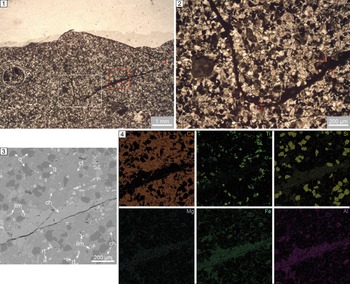
(1) Transverse section of the specimen CSGM 2028-80 in thin section (plane-polarized light). Note section of tubular calcite shell on the left-hand side. White and red rectangles delineate areas shown in detail in (2) and (3), respectively. Red arrows show areas where chlorite crust varies in thickness most. (2) Plastic deformations (white arrows) and variations of thickness of chlorite patina encrusting the fossil (red arrows). (3) Back-scattered electron (BSE) image of Ilankirus kessyusensis n. gen. n. sp. and host rock. (4) Elemental mapping of the thin section of CSGM 2028-80. q = quartz; ct = calcite; ch = Fe-rich chlorite (chamosite); ilm = ilmenite; rt = rutile.

Thin sections of the fossil-bearing rocks were studied using a Carl Zeiss Axio Scope.A1 optical microscope. The general macroscopic morphology of the fossils was studied and measured both visually and with a Leica M205 C stereomicroscope. Images were shot with digital and Leica M205 C cameras. Elemental analysis and imaging of the carbon-coated thin sections were performed with a Tescan MIRA 3LMU scanning electron microscope (SEM) coupled with energy-dispersive microanalysis system Aztec Energy and spectrometer Oxford Instruments X-Max 50+ at the Analytical Center for multi-elemental and isotope research (IGM SB RAS, Novosibirsk).
Repository and institutional abbreviation
The studied specimens are stored in the Shared-Use Center ‘Collection GEOCHRON’ of the Trofimuk Institute of Petroleum Geology and Geophysics (IPGG SB RAS), Novosibirsk, Russia. The collection carries the catalogue number 2028 followed by the individual specimen number.
Systematic paleontology
Phylum Cnidaria Verrill, Reference Verrill1865
Subphylum Medusozoa Peterson, Reference Peterson, Larwood and Rosen1979
Class Scyphozoa Götte, Reference Götte1887
Order Conulariida Miller and Gurley, Reference Miller and Gurley1896
Genus Ilankirus new genus
Type species
Ilankirus kessyusensis n. gen. n. sp. by monotypy. The base of the Cambrian Stage 2, upper Mattaia Formation of the Kessyusa Group (Olenek Uplift, NE Siberian Platform).
Diagnosis
As for type species by monotypy.
Occurrence
Cambrian Olenek Uplift (NE Siberian Platform).
Etymology
After Evenkian (a federal subject of Russia in Siberia) ilan meaning three, kiru meaning face/plane, mirroring general morphology of the fossils (trilateral pyramids).
Comparison
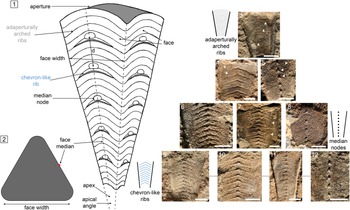
Triradial symmetry (Fig. 3.3, 3.5) is the main morphological feature differing Ilankirus from most conulariid genera. As mentioned, the fossil record includes only two conulariid genera with the triradial symmetry: late Ediacaran Vendoconularia (Ivantsov and Fedonkin, Reference Ivantsov and Fedonkin2002) and Ordovician Conularina triangulata (e.g., Van Iten et al., Reference Van Iten, Cournoyer and Coyne2020). It was recently suggested that, together with Vendoconularia, enigmatic casts of Protechiurus from the terminal Ediacaran of Namibia comprise triradial (hexaradial?) ancestors of Phanerozoic conulariids (Ivantsov et al., Reference Ivantsov, Vickers-Rich, Zakrevskaya and Hall2019). However, a detailed analysis of the type material of Protechiurus is necessary for the phylogenetic affinity of this taxon. Ilankirus differs from Vendoconularia in the number of lateral faces (three rather than six), the lack of longitudinal rods or invaginations (sulci) between the pairs of the faces, and the diverse surface ornamentation (parabolic and chevron-like ribs, median nodes; Fig. 4.1) (Ivantsov and Fedonkin, Reference Ivantsov and Fedonkin2002; Van Iten et al., Reference Van Iten, De Moraes Leme, Rodrigues and Simões2005). From Conularina triangulata (Sinclair, Reference Sinclair1942; Van Iten et al., Reference Van Iten, Cournoyer and Coyne2020), Ilankirus differs by the nonmineralized periderm, specific surface ornamentation (chevron-shaped ribs, median nodes), and lack of the midline ridges. In all other conulariid genera, the trilateral symmetry occurs only as the intraspecific variations (e.g., Metaconularia anomala (Barrande, Reference Barrande1867); Sendino et al., Reference Sendino, Zágoršek and Taylor2012). From tetraradial Baccaconularia, the new taxon differs in expression of the median-aligned isolated structures. They appear as invaginations on Baccaconularia (Hughes et al., Reference Hughes, Gunderson and Weedon2000), whereas the nodes on Ilankirus appear in positive relief on the casts (Figs. 3, 4) and in negative relief (pits) on the external molds. From minute Microconularia Percival, Reference Percival2009, Ilankirus differs in the greater apical angle and more diverse surface ornamentation, including the fine arched ribs and median nodes.
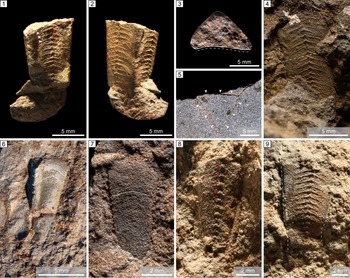
Morphology and sculptural elements of Ilankirus kessyusensis n. gen. n. sp. (1–3) Holotype (CSGM 2028-50) sculptured with median nodes (red arrows) and chevron-shaped transverse ribs (white arrows): (1, 2) lateral view; (3) apertural view. Note plastic deformation of the face (white dashed line) and scalene triangle-shaped cross section. (4, 5) Specimen CSGM 2028-236 lying face upward in the bed: (4) lateral view with chevron-like ribs and low-relief median nodes (white dashed line shows transverse section (5)); (5) equal triangle-shaped (undeformed) cross section of I. kessyusensis (white arrows). (6) Specimen CSGM 2028-16 with a fractured face (red arrows) and ornamented only with fine adaperturally arched ribs (white lines) reaching and extending through the corners. (7) Specimen CSGM 2028-6 with smooth surface and poorly preserved relics of fine arched ribs (white line). (8) Lateral face of the specimen CSGM 2028-24 sculptured only with median nodes (red arrows). (9) Plastic deformation (white dashed lines) of the face ornamented with the ribs and low-relief nodes (CSGM 2028-75).

(1, 2) Sketch reconstruction of morphology and sculpture of casts of Ilankirus kessyusensis n. gen. n. sp.: (1) lateral view; (2) apertural view. (3–12) Diagram showing morphological variations of sculpture of I. kessyusensis: (3) CSGM 2028-67; (4) CSGM 2028-69; (5) CSGM 2028-65; (6) CSGM 2028-75; (7) CSGM 2028-50; (8) CSGM 2028-41; (9) CSGM 2028-1; (10) CSGM 2028-66; (11) CSGM 2028-70; (12) CSGM 2028-62. White arrows point to thin parabolic ribs variously preserved on the specimens. Scale bars = 2 mm.

Remarks
The fossils comprise steinkerns in a shape of elongated (height considerably exceeds the cross section) pyramids with triradial symmetry. With conulariids ranging from the terminal Ediacaran to Triassic (e.g., Leme et al., Reference Leme, Simões and Van Iten2010), these fossils share pyramidal shape and flat faces of the theca and surface ornamentation: fine aperturally arched transverse ribs (e.g., Archaeoconularia; Van Iten et al., Reference Van Iten, Gutiérrez-Marco, Muir, Simões, Leme, Hunter, Álvaro, Lefebvre, van Roy and Zamora2018), transverse chevron-shaped ribs (e.g., Microconularia; Percival, Reference Percival2009), and a median-aligned row of isolated nodes (Baccaconularia; Hughes et al., Reference Hughes, Gunderson and Weedon2000). Like Microconularia, the studied fossils lack prominent midlines and corner sulci (Percival, Reference Percival2009). Although the fossil record of conulariids includes triradial, pentaradial, and hexaradial forms (Babcock et al., Reference Babcock, Feldman and Wilson1987; Ivantsov and Fedonkin, Reference Ivantsov and Fedonkin2002; Sendino et al., Reference Sendino, Zágoršek and Taylor2012), most of the species are tetraradial (Leme et al., Reference Leme, Simões, Marques and Van Iten2008). With a few exceptions (Conularina triangulata Sinclair, Reference Sinclair1942; Vendoconularia triradiata Ivantsov and Fedonkin, Reference Ivantsov and Fedonkin2002), trilateral symmetry among the conulariids occurs as an intraspecific variation caused by growth anomalies (Babcock et al., Reference Babcock, Feldman and Wilson1987; Sendino et al., Reference Sendino, Zágoršek and Taylor2012). Cladistic analysis demonstrates that conulariids as a monophyletic group are united by two autapomorphies: presence of semi-mineralized (organo-phosphatic) periderm and the quadrate transverse section of the apertural region of the periderm (Leme et al., Reference Leme, Simões, Marques and Van Iten2008). Neither the studied fossils from the Mattaia Formation nor the Ediacaran Vendoconularia (the oldest fossils assigned to conulariids) have these characteristics (Ivantsov and Fedonkin, Reference Ivantsov and Fedonkin2002; Ivantsov et al., Reference Ivantsov, Vickers-Rich, Zakrevskaya and Hall2019). By contrast, the terminal Ediacaran Paraconularia from the Tamengo Formation (Brazil) is clearly tetraradial though also lacking mineralized periderm (Van Iten et al., Reference Van Iten, Leme, Pacheco, Simões, Fairchild, Rodrigues, Galante, Boggiani, Marques, Goffredo and Dubinsky2016). We assume that these two autapomorphies characterize the crown-group conulariids, whereas the late Ediacaran and Terreneuvian triradial conulariids (Vendoconularia and Ilankirus, respectively) characterize the stem forms.
Among the early Cambrian thecate organisms, anabaritids (family Anabaritidae Missarzhevsky, Reference Missarzhevsky, Zhuravleva and Rozanov1974) were those with the triradial symmetry as a diagnostic feature. The anabaritids are an extinct group of minute benthic organisms (putatively cnidarians; Kouchinsky et al., Reference Kouchinsky, Bengtson, Feng, Kutygin and Val'kov2009) abundant in the Terreneuvian and ranging from the terminal Ediacaran? (Nagovitsin et al., Reference Nagovitsin, Rogov, Marusin, Karlova, Kolesnikov, Bykova and Grazhdankin2015) to the Cambrian Epoch 2 (Bengtson et al., Reference Bengtson, Conway Morris, Cooper, Jell and Runnegar1990; Kouchinsky et al., Reference Kouchinsky, Bengtson, Clausem and Verdasco2015). In the fossil record, the anabaritids occur mostly as 5–6 mm long calcareous conical/tubular shells and their casts with a distinct triradial symmetry (e.g., Missarzhevsky, Reference Missarzhevsky1989; Kouchinsky et al., Reference Kouchinsky, Bengtson, Feng, Kutygin and Val'kov2009). Ilankirus differs from anabaritids by the pyramidal shape of the steinkerns and by the orientation of the sculptural elements: transverse ribs encrusting the anabaritid shells are either normal to the apex–aperture axis or adapically arched near the aperture (Kouchinsky et al., Reference Kouchinsky, Bengtson, Feng, Kutygin and Val'kov2009, fig. 29C). In contrast to the pyramidal shape of Ilankirus and conulariids, the symmetry of the anabaritids originates from longitudinal invagination of the tube and/or development of radial elements (keels, rows of outgrowths, and so on; Missarzhevsky, Reference Missarzhevsky, Zhuravleva and Rozanov1974; Kouchinsky et al., Reference Kouchinsky, Bengtson, Feng, Kutygin and Val'kov2009). The Ilankirus theca has an apical angle of ~15°–20°, whereas most of the anabaritid tubes are extremely elongated and have a smaller apical angle (Kouchinsky et al., Reference Kouchinsky, Bengtson, Feng, Kutygin and Val'kov2009). Among the anabaritids, Aculeochrea ornata Val'kov and Sysoev, Reference Val'kov, Sysoev and Bobrov1970 reveal certain morphological elements similar to Ilankirus (row of isolated tubercles along the apex–aperture axis) (Kouchinsky et al., Reference Kouchinsky, Bengtson, Feng, Kutygin and Val'kov2009, fig. 49). However, Ilankirus lacks prominent broad depressions subdividing the cast onto three lobes (Figs. 3, 4.1). In addition, the transverse ornamentation of A. ornata (besides thin growth lines) comprises deep folds, in contrast to the positive-relief ribs covering Ilankirus. Conulariids and anabaritids also differ in the theca mineralization type (Van Iten, Reference Van Iten1992; Kouchinsky and Bengtson, Reference Kouchinsky and Bengtson2002; Ford et al., Reference Ford, Van Iten and Clark2016; see details in the Discussion). However, the lack of the periderm mineralization does not allow the classification of Ilankirus based on this criterion.
In the Ediacaran, triradial symmetry is typical for tribrachiomorphs (sensu Grazhdankin, Reference Grazhdankin2014)/triradialomorphs (sensu Laflamme et al., Reference Laflamme, Darroch, Tweedt, Peterson and Erwin2013) (e.g., Tribrachidium, Anfesta, Albumares), one of the groups of the enigmatic soft-bodied Ediacaran biota. In contrast to Ilankirus (see description of the species in the following), tribrachiomorphs comprise low-relief (to hemispheric) casts with circular outlines preserved in negative hyporelief (Grazhdankin, Reference Grazhdankin2014).
The lower Cambrian fossil record of triradial organisms includes some carinachitids (e.g., Emeiconularia; Qian et al., 1997; Han et al., Reference Han, Li, Wang, Yang, Guo, Sasaki and Komiya2017). In contrast to the latter, Ilankirus has the greater apical angle and lacks deep longitudinal grooves separating the faces, and carries specific surface sculpture (Conway Morris and Chen, Reference Conway Morris and Chen1992; Qian et al., Reference Qian, Van Iten, Cox, Zhu and Zhuo1997; Han et al., Reference Han, Li, Wang, Yang, Guo, Sasaki and Komiya2017). Some of the Cambrian orthothecid hyoliths also had pyramidal elongated shells with a triangle-shaped cross section (Missarzhevsky, Reference Missarzhevsky1989; Malinky, Reference Malinky2009). Hyoliths with the triangular cross section possess bilateral symmetry, rather than triradial, and are sculptured only with thin growth lines. There were no helens and/or operculums characteristic for hyoliths (Missarzhevsky, Reference Missarzhevsky1989; Malinky and Berg-Madsen, Reference Malinky and Berg-Madsen1999) documented in association with Ilankirus in the upper Mattaia Formation.
Ilankirus kessyusensis new species
Figures 3–6
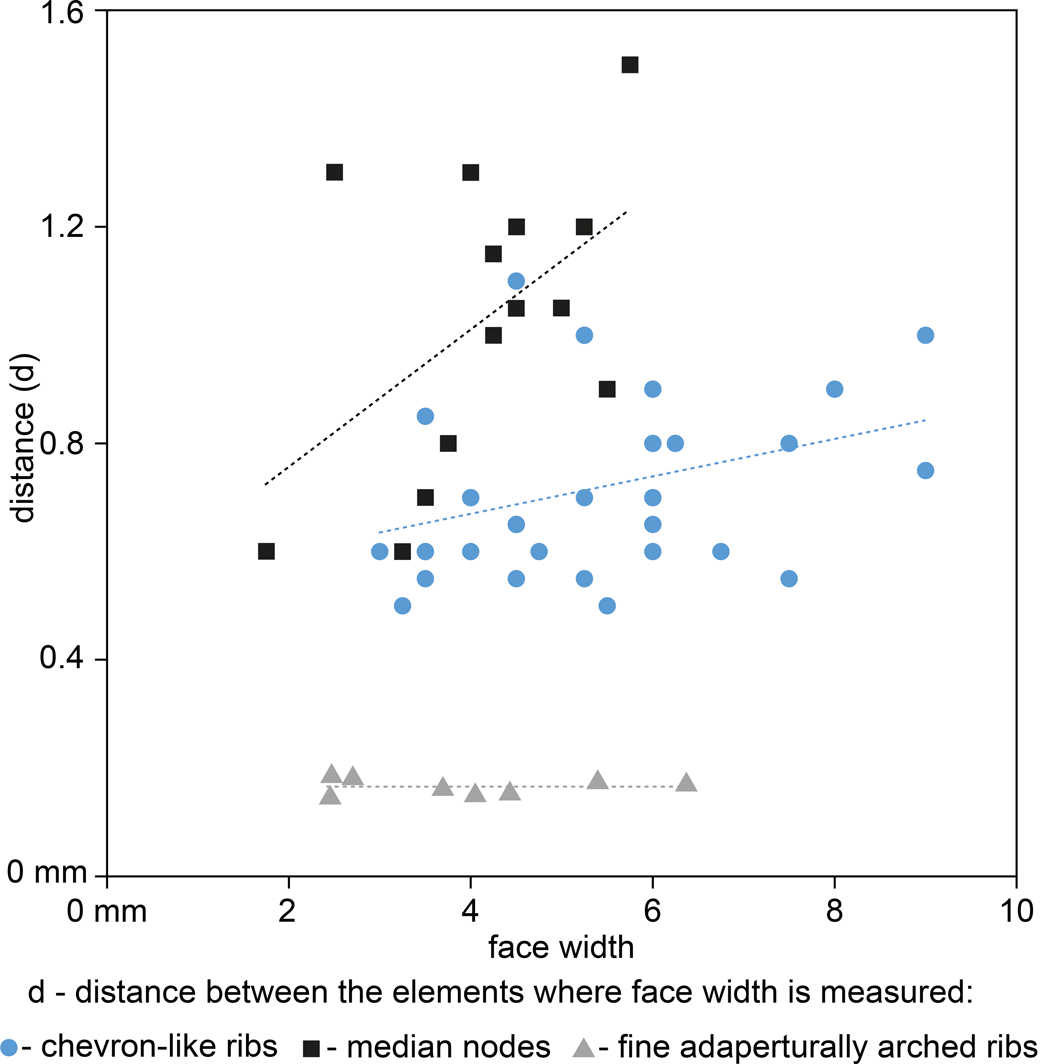
Scatter diagram showing variations of the distance between the sculpture elements (chevron-like ribs/median nodes/fine arched ribs) as related to the face width. Dashed lines comprise linear trends for corresponding elements (see legend). The distances between the elements are measured for the specimens with only one type of the sculpture preserved.

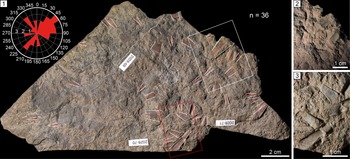
(1) The slab of grainstone hosting 36 specimens of Ilankirus kessyusensis of various preservation, all lying subhorizontally but with no clear spatial orientation. White lines highlight the fossil contours; red arrows point toward the apertural end of the specimen. Red and white rectangles delineate areas with specimens CSGM 2028-64, CSGM 2028-72, CSGM 2028-85, CSGM 2028-86, and CSGM 2028-71, CSGM 2028-83, CSGM 2028-84, CSGM 2028-87 shown in detail in (2) and (3), respectively.

Holotype
Specimen CSGM 2028-50, Shared-Use Center “Collection GEOCHRON,” IPGG SB RAS, Novosibirsk, Russia. Upper Mattaia Formation of the Kessyusa Group (Olenek Uplift, NE Siberian Platform), the base of the Cambrian Stage 2.
Diagnosis
Steeply pyramidal triradial tests with an apical angle of ~15°–20°. The faces are flat and smooth or ornamented with thin transverse adaperturally arched ribs, prominent widely spaced transverse chevron-like ribs (convex toward the aperture), and/or row of hemispherical nodes arranged along the median of the face. Prominent midlines, septa, and/or corner sulci are lacking. The tests are nonmineralized.
Occurrence
Cambrian, Olenek Uplift (NE Siberian Platform).
Description
The fossils comprise elongated the trilateral pyramids with an apical angle of ~15°–20° (Figs. 3, 4.1). The apical and apertural ends are not preserved on the studied material (Fig. 3). The length of incomplete specimens ranges between 4 mm and 20.5 mm. The width of the faces varies between 1 mm and 10.5 mm. The cross section of the fossils comprises an equal triangle with slightly rounded corners (Figs. 3.5, 4.2). The fossils are occasionally deformed (folded or fractured faces; Figs. 2.2, 3.3, 3.6, 3.9) with the cross section becoming scalene triangle-shaped (Figs. 2.1, 3.3).
The fossils appear both as casts and outer molds. The casts are filled with sediment similar to the host rock (steinkerns; Fig. 2.1) and covered with thin (100–200 μm) brownish-gray crust (Figs. 2, 3.4, 3.5, 3.9). The steinkerns lack relics of the theca mineralization. Elemental analysis reveals the crust is composed of iron-rich chlorite (chamosite) (Fig. 2.3, 2.4). In the host rock, chamosite also occurs as thin crust covering grains (Fig. 2.3) and as laminae alternating with calcite in ooids.
The faces are covered with thin parabolic adaperturally arched ribs, prominent transverse chevron-like ribs (convex toward the aperture), and/or row of hemispherical nodes arranged along the median line of the faces (Figs. 3, 4). Distance between the fine arched ribs is at 0.15–0.2 mm and does not change as the face expands (Figs. 3.6, 4.3, 5). By contrast, the distance between the median nodes and chevron-like ribs is bigger (0.5–1.5 mm) and increases as the face expands (Fig. 5). The nodes and ribs likely compose the outer sculpture of the periderm because they appear in positive relief on the casts and as pits and chevron-like grooves on the outer molds, respectively. Most of the studied specimens are covered with these sculptural elements, but some fossils are poorly, if at all, ornamented (Figs. 3.7, 6.3). The presence/absence of the sculptural elements does not depend on the size of the specimen (face width) (Fig. 6.3). The studied material includes specimens with all possible combinations of the sculptural elements variously preserved (Fig. 4.3–4.12). If the chevron-like ribs and nodes are preserved together, the latter occur exclusively at the chevron apexes (Fig. 4.1, 4.7, 4.10, 4.11). The fine arched ribs cover the whole surface of the face, reaching the corners (Fig. 3.6). The chevron-shaped transverse ribs are sharp edged, lack nodes, and gradually become fine and disappear toward the corners (Fig. 3.4, 3.9). The interspace between the sculptural elements is smooth and shows no evidence of bars or tubercles (Leme et al., Reference Leme, Simões and Van Iten2010). The Ilankirus faces lack a definite midline (longitudinal ridge or groove at the median of the face; sensu Babcock and Feldman, Reference Babcock, Feldman, Hoffman and Nitecki1986) as none of the transverse sculptural elements or nodes are connected (Figs. 3, 4).
In the bed, casts of Ilankirus kessyusensis n. gen. n. sp. lay subhorizontally, parallel to the bedding planes. Within the horizontal plane, the fossils lay both face/edge upward (Fig. 3.5, 3.6) and randomly aligned (Fig. 6.1).
Etymology
The species name comes from the name of the Kessyusa Group where the type material originates from.
Materials
Seventy-three specimens (CSGM 2028-1, 2, 4–6, 8–14, 20, 21, 23, 25, 28, 29, 31–34, 36, 38–51, 53–55, 57–61, 63, 65, 67–69, 71, 73, 74, 76–82, 88–90, 92, 94–96, 194, 199, 200, 203, 205, 236).
Remarks
As mentioned, the studied material lacks theca mineralization. As do large-sized (fragments up to 92 mm in length) straight conical casts of similar preservation, previously documented in the upper Mattaia Formation 2 m below the Ilankirus-bearing bed and provisionally assigned to circothecid hyoliths (Marusin and Grazhdankin, Reference Marusin and Grazhdankin2018). By contrast, millimeter-sized tubular fossils occurring together with Ilankirus (Fig. 2.1) do have calcite shells. Because the studied material does not include completely preserved specimens of Ilankirus, it remains enigmatic what early ontogenetic stages of these fossils look like (apical end is pointed or ends with a schott) and whether they were mineralized. Abundant deformations (variations in the shape of edges of the single specimen [Figs. 2.1, 3.3], folding of faces) observed on the specimens suggest that at least adult organisms were likely covered with a plastic organic nonmineralized exoskeleton.
The role of the chevron-like ribs and median nodes is debatable. Although some authors suggested a free-swimming lifestyle for conulariids (Kiderlen, Reference Kiderlen1937; Moore and Harrington, Reference Moore, Harrington and Moore1956), it is now generally accepted that these organisms were either sessile or recumbent (most probable for large-sized forms) benthic polyps (Leme et al., Reference Leme, Simões and Van Iten2010). Erect sessile forms were either attached to or partially buried in a substrate (Harland and Pickerill, Reference Harland and Pickerill1987; Simões et al., Reference Simões, Mello, Rodrigues, Leme and Marques2000; Van Iten et al., Reference Van Iten, Tollerton, ver Straeten, Leme, Simões and Rodrigues2013). There is no evidence of any attachment organs documented in the studied material. Considering sedentary, partially embedded in sediment, mode of life, the prominent sculptural elements of Ilankirus may have served to confer stability. The casts ornamented only with ribs or median nodes and the difference in distances between the sculptural elements documented for these specimens may be a criterion for different species within Ilankirus. But gradual transitions between the sculptural elements observed on the studied material (Fig. 4.3) suggest that the variations in ornamentation likely mirror intraspecific variability.
Discussion
As noted, nonmineralized triradial Ilankirus lack both autapomorphies of the Phanerozoic conulariids. Hence, phylogenetic affinity of the studied material to conulariids requires both precise analysis of the specific environmental conditions that provided fossilization of the nonmineralized theca and a review of phylogenetic affinities of the Ediacaran–Cambrian thecate cnidarians with triradial symmetry.
Taphonomy of Ilankirus
As noted, conulariids are thought to be either vertical-standing sessile or recumbent (Leme et al., Reference Leme, Simões, Marques and Van Iten2008). Preservation of Ilankirus kessyusensis n. gen. n. sp. in the upper Mattaia Formation does not mirror living orientation of the organisms. It is supported by the observation that the fossils lay subhorizontally both face and edge upward. Among the agents of redeposition, fair-weather waves are unlikely because the fossils are randomly aligned in the horizontal planes (Fig. 6.1) and there is no evidence of wave agitation (wave ripple marks, wavy bedding) in the fossil-bearing bed. Currents also barely affected the host sediment as evidenced by similar lithological composition of the steinkerns and host rock (Fig. 2) and by lack of lithological features of current activity (cross bedding, current lineation, and so on). Because Ilankirus occur in the hummocky cross-stratified limestones, we assume that the fossils were redeposited by storms. The plastic deformations observed on the specimens suggest that the tests had been already filled with the sediment and partially lithified before redeposition.
As mentioned, the steinkerns are covered with a thin crust of iron-rich chlorite (chamosite) (Fig. 2). Chlorite is a phyllosilicate mineral common in all kinds of sediments and sedimentary rocks (Hillier, Reference Hillier, Middleton, Church, Coniglio, Hardie and Longstaffe2003). Iron-rich chlorite in marine sedimentary rocks can be detrital (derived from a continent), can originate as a product of diagenesis of iron-rich clastic minerals (mainly igneous) at temperature >150°C or clay minerals (berthierine and glauconite), or can result from low-temperature metamorphism of sedimentary rocks (Hillier, Reference Hillier, Middleton, Church, Coniglio, Hardie and Longstaffe2003; Worden and Morad, Reference Worden and Morad2003; Beaufort et al., Reference Beaufort, Rigault, Billon, Billault, Inoue, Inoue and Patrier2015; Tang et al., Reference Tang, Shi, Jiang, Zhou and Shi2017). In the Mattaia Formation, the detrital origin of the chlorite is unlikely because this mineral is easily weathered and hence accumulates in immature sediments close to the chlorite-rich parent rocks. By contrast, the fossil-bearing strata include mainly very resistant to weathering clastic grains (quartz, ilmenite, rutile) with only scarce feldspar (Ivanovskaya et al., Reference Ivanovskaya, Geptner, Savichev, Zaitseva, Gor'kova and Pokrovskaya2019; Fig. 2). Origin of the chlorite under greenschist facies metamorphism is also highly improbable because the Mesoproterozoic, Neoproterozoic, and Phanerozoic sedimentary formations of the Olenek Uplift did not undergo regional metamorphism (e.g., Shpunt et al., Reference Shpunt, Shapovalova, Shamshina, Lazebnik, Savvinov, Permyakov, Kelle and Yankovsky1979; Nagovitsin et al., Reference Nagovitsin, Rogov, Marusin, Karlova, Kolesnikov, Bykova and Grazhdankin2015; Ivanovskaya et al., Reference Ivanovskaya, Geptner, Savichev, Zaitseva, Gor'kova and Pokrovskaya2019). Previous reports suggested that the iron-rich chlorite in the upper Mattaia Formation diagenetically replaced glauconite abundant in the upper part of the Kessyusa Group (Ivanovskaya et al., Reference Ivanovskaya, Geptner, Savichev, Zaitseva, Gor'kova and Pokrovskaya2019) but not documented in the fossil-bearing bed (Fig. 2). Glauconite in the upper Mattaia Formation occurs as both authigenic globules and allothigenic grains. The latter resulted from the redeposition of authigenic globules by storm events (Ivanovskaya et al., Reference Ivanovskaya, Geptner, Savichev, Zaitseva, Gor'kova and Pokrovskaya2019). In the Mattaia Formation, the authigenic glauconite is iron rich (>20%) (Ivanovskaya et al., Reference Ivanovskaya, Geptner, Savichev, Zaitseva, Gor'kova and Pokrovskaya2019), which indicates reducing environments of its formation (Banerjee et al., Reference Banerjee, Bansal and Thorat2016). Considering shallow shelf (shoreface) environments reconstructed for the upper Mattaia Formation (Grazhdankin et al., Reference Grazhdankin2020), the reducing conditions were likely caused by depauperate oxygen concentration on sea- and porewaters.
Diagenetic transformation of glauconite to chamosite requires a significant amount of Fe2+ and Mg2+, a lesser amount of Al3+, and paralleled release of Si and K (Tang et al., Reference Tang, Shi, Jiang, Zhou and Shi2017). Freshwater, hydrothermal fluids, iron-rich clastic minerals (biotite, hematite, and so on), or anoxic Fe2+-rich seawater are the main sources of Fe2+ (Tang et al., Reference Tang, Shi, Jiang, Zhou and Shi2017). Glauconite–chamosite transformation can go either directly without intermediate phases under high temperature (>175°C) or with an intermediate phase (berthierine) (Drits et al., Reference Drits, Ivanovskaya, Sakharov, Gor'kova, Karpova and Pokrovskaya2001). The first scenario is unlikely for the Mattaia Formation because the upper Precambrian and Phanerozoic sedimentary complexes of the Olenek Uplift did not undergo deep burial as evidenced by excellent preservation of authigenic organic matter in the Ediacaran strata (Duda et al., Reference Duda, Love, Rogov, Melnik, Blumberg and Grazhdankin2020; Melnik et al., Reference Melnik, Parfenova and Rogov2020). Because the fossil-bearing strata do not reveal any effect of hydrothermal fluids (Nagovitsin et al., Reference Nagovitsin, Rogov, Marusin, Karlova, Kolesnikov, Bykova and Grazhdankin2015) and do not contain significant amount of easily weathering iron-rich minerals (Fig. 2; Ivanovskaya et al., Reference Ivanovskaya, Geptner, Savichev, Zaitseva, Gor'kova and Pokrovskaya2019), oxygen-depauperate seawater is thought to be the main source of reducing iron. This suggestion is supported by evidence of mainly low oxygen amount in seawater during the late Ediacaran and early Cambrian, with short episodes of oxygenation and anoxia in the ocean (Dahl et al., Reference Dahl, Connelly, Li, Kouchinsky, Gill, Porter, Maloof and Bizzarro2019; Wood et al., Reference Wood, Liu, Bowyer, Wilby, Dunn, Kenchington, Hoyal Cuthill, Mitchell and Penny2019). One of the ocean anoxic events happened at ~530 Ma and is interpreted as a result of global perturbations in marine ecosystems (increasing bioproductivity and development of deep-tier bioturbation) (Dahl et al., Reference Dahl, Connelly, Li, Kouchinsky, Gill, Porter, Maloof and Bizzarro2019; Wood et al., Reference Wood, Liu, Bowyer, Wilby, Dunn, Kenchington, Hoyal Cuthill, Mitchell and Penny2019).
As mentioned, preservation of Ilankirus in the upper Mattaia Formation is caused by incrustation of nonmineralized outer surfaces with clay minerals. This fossilization mechanism is one of the few providing preservation of soft-bodied organisms in Lagerstätten (Kenchington and Wilby, Reference Kenchington, Wilby, Laflamme, Schiffbauer and Darroch2014; Hall et al., Reference Hall, Smith, Tamura, Fakra and Bosak2020). Taphonomic experiments reveal that iron-rich phyllosilicates provide a lower degree of preservation compared with those from kaolinite and montmorillonite (Naimark et al., Reference Naimark, Kalinina, Shokurov, Boeva, Markov and Zaytseva2016, Reference Naimark, Kalinina, Shokurov, Markov, Zaytseva and Boeva2018). In the upper Mattaia Formation, the clay minerals are accessory (Ivanovskaya et al., Reference Ivanovskaya, Geptner, Savichev, Zaitseva, Gor'kova and Pokrovskaya2019) and hence could not completely isolate and protect buried organisms from decay. It is assumed that the authigenic glauconite formed in the sediment under reducing conditions providing Fe2+ source for phyllosilicates rather than oxides and hydroxides. Complete diagenetic transformation of the glauconite to berthierine in the fossil-bearing strata was stimulated by local increase of alkalinity and more intense reducing environments around the decaying organisms (Fernández-Landero and Fernández-Caliani, Reference Fernández-Landero and Fernández-Caliani2021). Because chloritization highlights only the faces of tests, we assume that the organisms were covered with a comparatively decomposition-resistant organic exoskeleton. Its slower degradation compared with soft tissues of the organism allowed formation of a thin patina composed of clay minerals.
Triradial symmetry of the Ediacaran–Cambrian thecate cnidarians
As mentioned, anabaritids, putatively cnidarians, were the most abundant organisms with the triradial theca in the Terreneuvian (Kouchinsky et al., Reference Kouchinsky, Bengtson, Feng, Kutygin and Val'kov2009). In the fossil record, the anabaritids occur as elongated conical/tubular calcareous shells and their inner casts, mostly not exceeding 5–6 mm in length (Rozanov et al., Reference Rozanov1969; Missarzhevsky, Reference Missarzhevsky1989; Kouchinsky et al., Reference Kouchinsky, Bengtson, Feng, Kutygin and Val'kov2009). Rare large-sized (up to 35 mm long) anabaritids, morphologically similar to small forms of some species, are also known from the early Cambrian (Rozanov et al., Reference Rozanov1969; Sarsembaev and Marusin, Reference Sarsembaev and Marusin2019). The triradial symmetry of anabaritids develops at the adult stages, whereas apical parts of the shells are usually circular or oval in the cross section with no evidence of the trilobate shape (Kouchinsky et al., Reference Kouchinsky, Bengtson, Feng, Kutygin and Val'kov2009). The oldest microscopic anabaritids Cambrotubulus from the terminal Ediacaran (Nagovitsin et al., Reference Nagovitsin, Rogov, Marusin, Karlova, Kolesnikov, Bykova and Grazhdankin2015) also lack the triradial symmetry. It was previously suggested that anabaritids had triradial symmetry at the adult stage but were tetraradial at the embryonal stage (Kouchinsky et al., Reference Kouchinsky, Bengtson and Gershwin1999).
The anabaritids were previously interpreted as scyphozoans because of the overall morphological similarities to polyps of the latter and the presence of serial constrictions on the anabaritid shells, interpreted as evidence of strobilation (Val'kov, Reference Val'kov1982). Further discoveries of the late Ediacaran triradial Vendoconularia (Ivantsov and Fedonkin, Reference Ivantsov and Fedonkin2002; Van Iten et al., Reference Van Iten, De Moraes Leme, Rodrigues and Simões2005) have resulted in the interpretation of the anabaritids as a sister group to conulariids and suggested Vendoconularia as a common ancestor for these two groups (Ivantsov et al., Reference Ivantsov, Vickers-Rich, Zakrevskaya and Hall2019). In this scenario, the remarkable size difference between Vendoconularia and first anabaritids may be attributed to the ecological specialization of the anabaritids and associated dramatic reduction of their body size. Alternatively, the terminal Ediacaran and Fortunian anabaritids could be of macroscopic (centimeter scale) size and were biomineralized only at initial (juvenile) stages. If so, macroscopic soft-bodied anabaritids are expected, though still lacking, in the fossil record of the terminal Ediacaran and Fortunian.
However, the suggestion of close phylogenetic affinity of anabaritids and conulariids via Vendoconularia as the common ancestor faces principal differences in morphology of these two Phanerozoic groups: types of the theca ornamentation; shape of the theca; dominant symmetry; lack of apertural closures in the anabaritid shells. These two groups also differ in mineral composition of the theca (organo-phosphatic for conulariids, calcareous for anabaritids) (Kouchinsky et al., Reference Kouchinsky, Bengtson, Feng, Kutygin and Val'kov2009; Leme et al., Reference Leme, Simões and Van Iten2010); however, diagenetically phosphatized anabaritids are also known from the fossil record (Kouchinsky et al., Reference Kouchinsky, Bengtson, Feng, Kutygin and Val'kov2009). Thecae of the conulariids and anabaritids also have a different microstructure and orientation of the lamellae: the anabaritid exoskeleton growths via accretionary biomineralization of epithelially secreted tissue at the aperture (Kouchinsky and Bengtson, Reference Kouchinsky and Bengtson2002); theca of conulariids exhibits gradual thickening associated with the centripetal accretion and/or extension of the periderm along the apertural margin (e.g., Babcock et al., Reference Babcock, Feldman, Hoffman and Nitecki1986; Van Iten, Reference Van Iten1992; Ford et al., Reference Ford, Van Iten and Clark2016).
The early Cambrian carinachitids, interpreted as a sister group of conulariids within scyphozoans (Van Iten et al., Reference Van Iten, Leme, Pacheco, Simões, Fairchild, Rodrigues, Galante, Boggiani, Marques, Goffredo and Dubinsky2016; Guo et al., Reference Guo, Han, Van Iten, Song, Qiang, Wang, Zhang and Li2021), share some morphological features with the anabaritids: minute size and elongated (nearly tubular) shape; development of the radial symmetry by sharp and deep invagination of longitudinal furrows at the corners (e.g., Conway Morris and Chen, Reference Conway Morris and Chen1992; Qian et al., Reference Qian, Van Iten, Cox, Zhu and Zhuo1997; Han et al., Reference Han, Li, Wang, Yang, Guo, Sasaki and Komiya2017). Although most carinachitids are tetraradial, triradial taxa are also known (Emeiconularia) (Qian et al., Reference Qian, Van Iten, Cox, Zhu and Zhuo1997). Theca mineralization of the carinachitids is similar, on the one hand, to that of the anabaritids (periodic accretion at the aperture), but on the other hand, to the mineralization type of the conulariids (two-layered theca composition including a granular layer) (Han et al., Reference Han, Li, Wang, Yang, Guo, Sasaki and Komiya2017). However, first, in contrast to the carinachitids, the anabaritids lack inwardly curved apertural lobes. The growth lines of the anabaritid shells are usually adapically arched at the lobes near the aperture (Kouchinsky et al., Reference Kouchinsky, Bengtson, Feng, Kutygin and Val'kov2009). Second, the wall/inner-cavity thickness ratio of the anabaritids is much lower than that of the carinachitids (Kouchinsky et al., Reference Kouchinsky, Bengtson, Feng, Kutygin and Val'kov2009; Han et al., Reference Han, Li, Wang, Yang, Guo, Sasaki and Komiya2017).
An alternative hypothesis suggests anabaritids were descendants of cloudinids abundant in the terminal Ediacaran (Markov et al., Reference Markov, Rogov, Karlova and Grazhdankin2019). This suggestion is based on documented clusters of telescoped conical tests of anabaritids (Cambrotubulus and Anabarites) in the Kessyusa Group. In addition, some anabaritids (e.g., Mariochrea sinuosa Val'kov, Reference Val'kov1982 and Anabarites licis [Missarzhevsky in Rozanov et al., Reference Rozanov1969]) carry a series of circular flanges (Kouchinsky et al., Reference Kouchinsky, Bengtson, Feng, Kutygin and Val'kov2009, figs. 39E, 51C–E) vaguely reminiscent of a stacked-cones morphology of cloudinids (e.g., Yang et al., Reference Yang, Warren, Steiner, Smith and Liu2021). However, this suggestion faces the following challenges. First, all the documented telescoped anabaritids in the Kessyusa Group are allochthonous (Markov et al., Reference Markov, Rogov, Karlova and Grazhdankin2019). Hence, the origin of these fossil aggregates as a result of mechanical stacking cannot be excluded. Second, if anabaritids are descendants of cloudinids (bilaterians; Schiffbauer et al., Reference Schiffbauer, Selly, Jacquet, Merz, Nelson, Strange, Cai and Smith2020), these organisms were also definitive bilaterians (not cnidarians) and developed highly unusual triradial symmetry (secondary in this case) during the Ediacaran–Cambrian transition.
As mentioned, besides an unusual triradial symmetry, Ilankirus from the Mattaia Formation is morphologically closer to the conulariids than to any other group known in the late Ediacaran and Cambrian. The oldest representatives of the conulariids are known from the late Ediacaran and include triradial Vendoconularia (Ivantsov and Fedonkin, Reference Ivantsov and Fedonkin2002) and tetraradial Paraconularia (Van Iten et al., Reference Van Iten, Leme, Pacheco, Simões, Fairchild, Rodrigues, Galante, Boggiani, Marques, Goffredo and Dubinsky2016), both with nonmineralized theca. Because the conulariids as a monophyletic group share two major autapomorphies (organo-phosphatic periderm, quadrate cross section of the theca at the oral end) (Leme et al., Reference Leme, Simões and Van Iten2010), we interpret the triradial Vendoconularia and Ilankirus (and probably Protechiurus from the terminal Ediacaran of Namibia) as stem-group conulariids. It is still equivocal whether the oldest nonmineralized tetramerous Paraconularia from the Tamengo Formation of Brazil (Van Iten et al., Reference Van Iten, Leme, Pacheco, Simões, Fairchild, Rodrigues, Galante, Boggiani, Marques, Goffredo and Dubinsky2016) represents the crown-group conulariid. If so, this fossil elucidates the late Ediacaran origin of the crown-group conulariids.
As briefly shown, all the late Ediacaran and Cambrian thecate benthic cnidarians that at least sporadically showed the triradial symmetry (conulariids, carinachitids, anabaritids), if pairwise compared, share some morphological features but are remarkably different in others. Hence, independent origin of the triradial symmetry among different lineages of the cnidarians shall not be completely excluded. Phylogenetic affinity of the anabaritids and other early Cambrian scyphozoan cnidarians (conulariids, hexangulaconulariids, carinachitids, olivooids) requires a detailed cladistic analysis of these groups.
Conclusions
Macroscopic trilateral pyramid-shaped steinkerns Ilankirus kessyusensis n. gen. n. sp. from the upper Mattaia Formation of the Kessyusa Group (base of the Cambrian Stage 2 in the Olenek Uplift) are most reminiscent of the Phanerozoic conulariids. The fossils lack relics of mineralized shells and are covered with a thin patina of iron-rich chlorite (chamosite). Chamosite formed because of diagenetic replacement of authigenic glauconite with berthierine and its further transformation to iron-rich chlorite under reducing environments in the sediment. The reducing environments were caused by oxygen-depauperate conditions in seawater and local increase of alkalinity and reducing potential in the sediment around the decaying soft tissues. Abundant plastic deformations suggest the organisms (at least, adult forms) had an organic periderm rather than organo-phosphatic theca. Both lacking two major autapomorphies of the crown-group conulariids (mineralized periderm and quadrate cross section of the oral region of the periderm), the late Ediacaran triradial Vendoconularia and Terreneuvian Ilankirus represent stem-group conulariids.
Acknowledgments
This research was supported by the Russian Foundation for Basic Research (grant number 20-35-70016; paleontology, SEM-study) and by the Russian Science Foundation (grant number 21-17-00052; paleontology, manuscript preparation). Fieldworks at the Olenek Uplift were financially supported by the National Geographic Committee for Research and Exploration (grants 8227-07, 8637-09, NGS-372R-18). We thank D.V. Grazhdankin, N.V. Bykova, V.I. Rogov, K.E. Nagovitsin, and B.B. Kochnev (IPGG SB RAS, Novosibirsk) for their help during the fieldwork. Insightful comments of D.V. Grazhdankin and T.A. Ivanovskaya on the early draft of the manuscript are warmly appreciated. The authors are grateful to M.V. Khlestov (IGM SB RAS, Novosibirsk) for guidance during the SEM study and to N.V. Bykova for linguistic improvements of the manuscript. We also thank the reviewers, H. Van Iten (Hanover College, USA) and A. Kouchinsky (Swedish Museum of Natural History), who provided the in-depth critical analysis of our work and hence developed it considerably. The authors declare no conflict of interest.