Introduction
Regulation of seed dormancy by the environment ensures that germination occurs at a favourable time for seedling establishment. The annual temperature cycle is one of the main environmental factors regulating dormancy of seeds in the soil bank (Baskin and Baskin, Reference Baskin and Baskin1980; Bouwmeester and Karssen, Reference Bouwmeester and Karssen1992, Reference Bouwmeester and Karssen1993; Batlla and Benech-Arnold, Reference Batlla and Benech-Arnold2005). Nevertheless, other factors, such as the gaseous environment of the soil, may influence the dormancy of seeds, particularly in flooded habitats (Baskin and Baskin, Reference Baskin and Baskin1998; Baskin et al., Reference Baskin, Baskin and Chester2000). Among the gaseous components of the soil, oxygen is one of the most important factors for altering seed dormancy. The effect of hypoxia on seed dormancy varies among species; some enter secondary dormancy in the absence of oxygen in the soil, whereas the dormancy level in others is attenuated or not changed (Insausti et al., Reference Insausti, Soriano and Sánchez1995; Baskin and Baskin, Reference Baskin and Baskin1998; Crawford, Reference Crawford2003). Once the dormancy level is sufficiently low, it can be terminated by different types of environmental signals that induce germination (Benech-Arnold et al., Reference Benech-Arnold, Sánchez, Forcella, Kruk and Ghersa2000). In seeds of many species from natural grasslands, germination is promoted by fluctuating temperature or light, signals related to vegetation gaps (Thompson and Grime, Reference Thompson and Grime1983; Insausti et al., Reference Insausti, Soriano and Sánchez1995). On the other hand, fluctuating temperature promotes germination of seeds of many aquatic and wetland habitats, a response that is associated with decreased water depth and the consequent exposure of wet soil (Thompson and Grime, Reference Thompson and Grime1983; Pons and Schroder, Reference Pons and Schroder1986; Baskin and Baskin, Reference Baskin and Baskin1998).
Changes in dormancy alter seed sensitivity to the factors that can promote germination (Benech-Arnold et al., Reference Benech-Arnold, Sánchez, Forcella, Kruk and Ghersa2000; Batlla and Benech-Arnold, Reference Batlla and Benech-Arnold2005). Thus, the different soil conditions experienced by seeds modify their dormancy level and change their response to environmental signals (Probert et al., Reference Probert, Smith and Birch1985; Noronha et al., Reference Noronha, Andersson and Milberg1997; Steadman, Reference Steadman2004). In Ambrosia tenuifolia, immersion in water provokes an increase in sensitivity to light (Insausti et al., Reference Insausti, Soriano and Sánchez1995), and the occurrence of flooding may generate the loss of a light requirement for germination in seeds of Schoenoplectus purshianus (Baskin et al., Reference Baskin, Baskin and Chester2000).
The seeds of several species of the genus Setaria L. have dormancy mechanisms related to the oxygen and water availability of the soil (Dekker, Reference Dekker, Black, Bradford and Vásquez-Ramos2000; Dekker and Hargrove, Reference Dekker and Hargrove2002). In addition, they have requirements for low temperatures that alleviate dormancy during winter, thus permitting the synchronization of germination with the arrival of spring, and show a positive germination response to alternating temperatures (Dekker, Reference Dekker, Black, Bradford and Vásquez-Ramos2000).
Setaria parviflora (Poir.) Kerguélen is a perennial grass species, megathermic and with a broad geographical and ecological distribution, growing in different ecosystems that are subjected to frequent disturbances (Dekker, Reference Dekker, Black, Bradford and Vásquez-Ramos2000). In the natural grasslands of the Flooding Pampa (Province of Buenos Aires, Argentina), it has a considerable cover in communities situated in landscapes of flat relief, with gentle slopes, subjected to frequent floods and also in communities situated in higher topographical positions with better-drained soils, where flooding does not occur (Burkart et al., Reference Burkart, León and Movia1990; Insausti et al., Reference Insausti, Chaneton and Soriano1999). The seeds are dispersed in summer and form large seed banks (D'Angela et al., Reference D'Angela, Facelli and Jacobo1988). Germination takes place in late spring, after the flooding period that occurs during winter or early spring.
The objective of this study was to evaluate the effects of winter–spring floods on the dormancy of S. parviflora seeds from two communities in the Flooding Pampa grasslands, and how this modulates their capacity to perceive signals associated with canopy gaps. Specifically, we addressed the following questions: (1) Can flooding affect the dormancy level of S. parviflora seeds? (2) Are there differences in the dormancy response to floods between upland and lowland seed populations?
Materials and methods
In March 2003, ripe seeds of S. parviflora were harvested from two populations situated in two communities of the Las Chilcas landscape in Flooding Pampa grasslands, Province of Buenos Aires, Argentina (Burkart et al., Reference Burkart, León and Movia1990): (1) a non-flooded community (upland community) of Melica brasiliana, Diodia dasycephala and Echium plantagineum, associated with well-drained soils, free from floods and situated in relatively high areas of the landscape; and (2) a flooded community (lowland community) of Piptochaetium montevidense, Ambrosia tenuifolia, Eclipta bellidioides and Mentha pulegium, situated in a lower topographic position with respect to the previous community. Seeds were kept in paper bags in the laboratory (20 ± 2°C). Germination was evaluated immediately after harvest and after 3 months of dry storage, prior to the beginning of experiments.
Seed pre-treatments
Field pre-treatments
A reciprocal burial experiment was performed with S. parviflora seeds. On 5 June 2003, two groups of 800 seeds per population were placed in fine-mesh polyester bags (10 × 8 cm) and buried at a 3-cm depth in the upland and lowland communities. During the burial period, soil temperature was registered hourly with thermistors, and soil volumetric hydric content monitored with ECHO Probes EC-10 sensors (Decagon Devices, Pullman, USA) installed in Campbell 21-X dataloggers (Campbell Scientific, Logan, USA).
One bag per population and site was exhumed in darkness on 27 November 2003 (spring) after 6 months of burial and on 23 January 2004 (summer) after 8 months of burial.
Laboratory pre-treatments
Seeds were incubated in groups of 800 each in plastic boxes (15 × 10 × 6 cm) on cotton covered with absorbent white paper saturated with distilled water. Other groups of seeds were immersed under 5 cm of distilled water in similar boxes. All boxes were wrapped in black polyethylene and were kept in an incubator at 5°C for 3 months.
Germination treatments
Fresh seeds, dry-stored seeds and seeds subjected to pre-treatments were germinated in clear polystyrene boxes (6 × 7 × 1 cm) containing cotton and absorbent white paper saturated with water. Four replications of the following treatments, each one with 25 seeds, were performed: (1) red light pulses for 20 min d− 1 (R/FR ratio = 4.09; irradiance = 18.0 μmol m− 2s − 1), provided by two fluorescent tubes (Philips TL 40W/15) covered with red acetate (λmax = 610 nm) (La Casa del Acetato, Buenos Aires, Argentina); (2) far red light pulses for 20 min d− 1 (R/FR ratio = 0.002; irradiance = 6.3 μmol m− 2 s− 1), provided by a 150 W Osram incandescent quartz bulb, filtered with 10 cm of water and Schott RG9 filters (2 mm width; λmax = 760 nm) (Schott, Mainz, Germany); and (3) darkness. These treatments were combined with two others: (1) fluctuating temperatures (20/30°C, 9/15 h d− 1), simulating the average maximum and minimum temperatures occurring in canopy gaps of the grasslands, with the light treatments provided during the high temperature phase; and (2) a constant temperature of 25°C.
Seeds were distributed in boxes under very low intensity green light (Burkart and Sánchez, Reference Burkart and Sánchez1969), and boxes were covered with black polyethylene. Then they were exposed to the light treatments for 5 d, followed by 5 d in the dark. After 10 d, the number of germinated seeds was counted. In the calculation of average germination, dead seeds were discounted from the total number of seeds per box (Herron et al., Reference Herron, Clemens, Greer and Greer2000). The distinction between live and dead seeds was made in each repetition based on the hardness of seeds, determined by holding them with histological tweezers (Steadman, Reference Steadman2004). At the same time, for another group of seeds subject to the same pre-treatments, tetrazolium tests were performed [2, 3, 5-triphenyltetrazolium chloride (1%, w/v) for 24 h in the dark at 25°C] to determine their viability. The germination averages were transformed to proportions, and transformed again according to an arc sine formula, √x (Sokal and Rohlf, Reference Sokal and Rohlf1969). For the study of the effect of flooding upon the dormancy level of S. parviflora seeds, the transformed data were analysed using a two-way analysis of variance. Multiple comparisons were performed with the Tukey test (P < 0.05). Differences in behaviour between the upland and lowland seed populations were tested by studying the triple interaction, population × temperature × light, using a three-way analysis of variance (Sokal and Rohlf, Reference Sokal and Rohlf1969).
Results
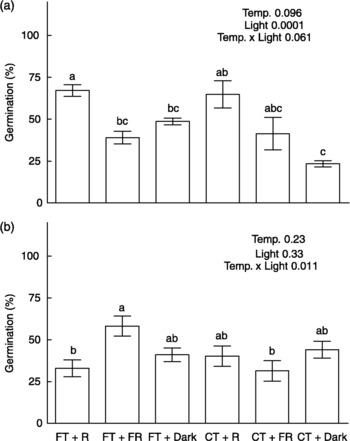
Immediately after harvest, none of the seeds from either population germinated, regardless of test conditions. After 3 months of dry storage, the seeds from the upland site germinated >70% when exposed to red light; this was significantly more germination than in darkness. Germination at constant or fluctuating temperatures did not exhibit significant differences (Fig. 1a). The seeds from the lowland community also had considerable germination, but there were no large differences between the seeds exposed to the different treatments (Fig. 1b). This was the condition of the seeds immediately before starting the experiments described below.
Germination (%) under different temperature and light treatments for Setaria parviflora seeds before the start of pre-treatments. Seeds were harvested from the upland (a) or the lowland (b), and dry-stored for 3 months at 20°C. FT, fluctuating temperatures (20–30°C); CT, continuous temperature (25°C); R, light with a high R/FR ratio; FR, light with a low R/FR ratio; Dark, darkness. Values are means ± SE. The significance of the two-way ANOVA (dfError = 18) appears inside each panel. Different letters indicate significant differences (P < 0.05). Differences in germination behaviour were detected between populations with a three-way ANOVA (population × temperature × light: P = 0.0036). The viability of seeds was 92% in (a) and 96% in (b).

Field reciprocal burial experiments
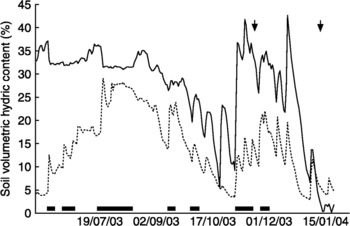
During the time the seeds were buried, soil in the lowland site was flooded several times during the winter and spring, whereas no flooding occurred in the upland site (Fig. 2). When the first exhumation was made in late spring (November 2003), the lowland was flooded, but when the second exhumation was made in mid-summer (January 2003), both sites were under a drought (Fig. 2).
Soil volumetric hydric content of the upland (discontinuous line) and lowland (continuous line) communities during the field reciprocal burial experiments. The horizontal line above the x-axis shows flooding periods in the lowland community. Arrows show the exhumation dates of seeds.

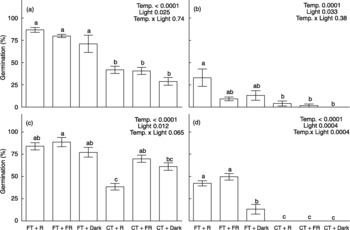
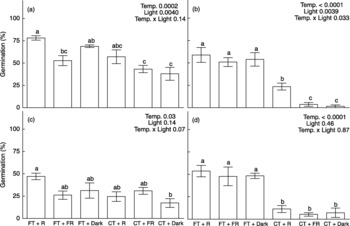
The differences in soil environment had a large influence on the dormancy of seeds of both communities, but affected them in a similar way. After exhumation following 6 months of burial, the seeds buried in the upland site (Fig. 3a, c) germinated to higher percentages than those buried in the lowland site (Fig. 3b, d). Whereas seeds buried in the upland germinated to higher percentages than before burial (Fig. 3a, c), those buried in the lowland germinated to lower percentages than before burial, and only showed significant germination at fluctuating temperatures (Fig. 3b, d). There were no significant differences between the seeds from the upland and lowland communities in their behaviour after being buried in the upland soil (population × temperature × light: P = 0.289). On the other hand, seeds from the upland community buried in the lowland were more affected by burial than seeds harvested in the lowland (population × temperature × light: P = 0.023).
Germination (%) under different temperature and light treatments of Setaria parviflora seeds from a reciprocal burial experiment between seeds harvested in an upland community (a, b), or harvested in a lowland community (c, d). Seeds were buried in the upland community (a, c) or in the lowland community (b, d). Seeds remained buried in the field for 6 months and were exhumed in spring during flooding in the lowland. FT, fluctuating temperatures (20–30°C); CT, continuous temperature (25°C); R, light with high R/FR; FR, light with low R/FR; Dark, darkness. Values are means ± SE. The significance of the two-way ANOVA (dfError = 18) appears inside the panels. Different letters indicate significant differences (P < 0.05). Viability of seeds was 84% in (a), 92% in (b), 80% in (c) and 84% in (d).

Germination of the seeds exhumed during the summer drought, after 8 months of burial, was higher than in the previous exhumation date, particularly under the most stimulating conditions: light plus fluctuating temperatures (Fig. 4). Moreover, the lowest values of germination were observed at constant temperature in the absence of red light, especially in seeds buried in the lowland community (Fig. 4b, d). There were no differences in germination between seed populations buried in the upland and exhumed in summer (population × temperature × light; P = 0.680). However, at the same exhumation time, the seeds from the lowland community were less dormant than those from the upland community when both were buried in the lowland (population × temperature × light; P = 0.018).
Germination (%) under different temperature and light treatments of Setaria parviflora seeds from a reciprocal burial experiment between seeds harvested in an upland community (a, b), or harvested in a lowland community (c, d). Seeds were buried in the upland community (a, c) or in the lowland community (b, d). Seeds remained buried in the field for 8 months and were exhumed in summer. FT, fluctuating temperatures (20–30°C); CT, continuous temperature (25°C); R, light with high R/FR; FR, light with low R/FR; Dark, darkness. Values are means ± SE. The significance of the two-way ANOVA (dfError = 18) appears inside each panel. Different letters indicate significant differences (P < 0.05). Viability of seeds was 88% in (a), 72% in (b), 76% in (c) and 80% in (d).

The effect of immersion in water under controlled conditions
The soil conditions in the burial experiment suggested that immersion in water was the predominant factor modulating the secondary dormancy of S. parviflora seeds. To test this possibility, the effect of immersion in water was assayed with seeds from both communities under controlled conditions.
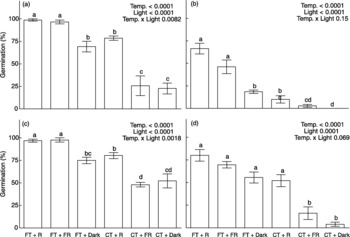
After exposure to an immersion pre-treatment, the seeds of both populations of S. parviflora showed a reduced capacity to germinate at constant temperature (Fig. 5b, d). The decrease of the germination percentage at constant temperature was nearly 45% in the seeds from the upland community (Fig. 5b) and 42% in those from the lowland (Fig. 5d), compared with germination at fluctuating temperatures. This temperature effect on the control seeds incubated on water-saturated white paper was much less noticeable; the seeds from the upland community germinated, on average, 20% less at continuous temperatures than at fluctuating temperatures (Fig. 5a), while in the lowland community seeds, this difference was only 10% (Fig. 5c). Seed populations did not differ after immersion in water (Fig. 5b, d) (population × temperature × light, P = 0.354). The seeds harvested in the upland were less dormant than seeds from the lowland after incubation on water-saturated filter paper (Fig. 5a, c). However, there were no differences between seed populations in the response to germination treatments (population × temperature × light; P = 0.486).
Germination (%) under different temperature and light treatments of Setaria parviflora seeds, previously incubated on saturated white paper (a, c) or immersed in water (b, d) for 90 d at 5°C. Seeds were harvested in the upland (a, b) or in the lowland (c, d). FT, fluctuating temperatures (20–30°C); CT, continuous temperature (25°C); R, light with high R/FR; FR, light with low R/FR; Dark, darkness. Values are means ± SE. The significance of the two-way ANOVA (dfError = 18) appears inside each panel. Different letters indicate significant differences (P < 0.05). The viability of the seeds was 92% in (a, c, d) and 88% in (b).

Discussion
Non-dormant seeds may enter secondary dormancy in response to environmental conditions that are not favourable for seedling establishment (Bouwmeester and Karssen, Reference Bouwmeester and Karssen1992; Hilhorst, Reference Hilhorst1998). Floods, among other environmental unfavourable conditions, have a major role in many habitats because of their consequences for seedling survival (Crawford, Reference Crawford2003). Our results show that a significant proportion of Setaria parviflora seeds enter secondary dormancy in the soil during flooding, in contrast to seeds in nearby non-flooded areas that continue to lose primary dormancy.
As a signal that promotes germination of seeds, fluctuating temperature is part of a mechanism allowing the seeds to perceive particular environmental conditions (Thompson et al., Reference Thompson, Grime and Mason1977; Benech-Arnold et al., Reference Benech Arnold, Ghersa, Sánchez and García Fernández1988). In seeds of many wetland species, temperature fluctuations can promote germination (Thompson and Grime, Reference Thompson and Grime1983). Sensitivity to fluctuating temperatures is a mechanism that would allow seeds to detect a decrease in water depth, i.e. temperature fluctuations increase as water depth decreases (Thompson and Grime, Reference Thompson and Grime1983; Pons and Schroder, Reference Pons and Schroder1986; Ekstam and Forseby, Reference Ekstam and Forseby1999). In addition, alternating temperature permits the detection of vegetation gaps, as do other mechanisms, such as the R/FR ratio of light acting through phytochrome (Casal and Sánchez, Reference Casal and Sánchez1998). In Flooding Pampa grasslands, seeds of Ambrosia tenuifolia germinate after perceiving light with high R/FR reaching the soil in vegetation gaps created by plant death during previous waterlogged conditions (Insausti et al., Reference Insausti, Soriano and Sánchez1995). Our data show that, in the studied populations of S. parviflora, entrance into secondary dormancy during immersion was expressed by a decrease in the germination capacity and by an increase in the dependence on fluctuating temperatures for germination. Moreover, this fluctuating temperature requirement was accompanied by a light requirement to reach maximum germination. Induction of secondary dormancy in flooded S. parviflora seeds will prevent not only germination when the area is flooded (Pons and Schroder, Reference Pons and Schroder1986; Ekstam and Forseby, Reference Ekstam and Forseby1999), but will also delay seedling emergence until well after flooding ceases. So, seeds exhumed from flooded soils do not germinate immediately, even when incubated in the laboratory under fluctuating temperatures and light. Secondary dormancy is lost slowly after the end of the flooding season, and is still detected 2 months after the end of flooding (Fig. 4). Thus, germination cannot occur until well after the risk of flooding subsides.
Within a species, habitat is a prevailing factor in the natural selection of the regulatory mechanisms of germination (Meyer et al., Reference Meyer, Allen and Beckstead1997; Donohue et al., Reference Donohue, Dorn, Griffith, Kim, Aguilera, Polisetty and Schmitt2005). Remarkably, in S. parviflora seeds harvested from the non-flooded upland, we observed essentially the same requirements after flooding as in seeds harvested in the lowland. The lack of a substantial difference between the two populations may be due to the proximity of the flooded and non-flooded areas. Nevertheless, some relatively small differences were detected in the degree of secondary dormancy induced in each population by flooding. These dissimilarities were perceived only in the field experiment and not after immersion in water in the laboratory. A proper assessment of the relevance of these differences requires additional exploration.
Acknowledgements
We specially thank Gustavo Striker for assistance and comments about manuscript. This study was supported by a grant of ANPCyT Foncyt PICT 08-09934.