


1 Introduction
Let
 $(X,\|\cdot \|)$
be a normed space of dimension at least two, and let
 $B_X$
and
 $S_X$
be its closed unit ball and unit sphere, respectively. Several different notions of rotundity of the unit ball
 $B_X$
have been introduced and widely studied in the literature. The most common ones are rotundity (or strict convexity) (R), uniform rotundity (UR), and local UR (LUR). Let us recall how these properties can be characterized by means of the corresponding moduli of rotundity. Given
 $x\in S_X$
, the modulus of local uniform rotundity at x is defined as
 $$ \begin{align*}\textstyle\delta_{\|\cdot\|}(x,\varepsilon)=\inf\left\{1-\|\frac{x+y}2\|:\, y\in S_X,\;\|x-y\|\ge\varepsilon\right\},\qquad\varepsilon\in[0,2].\end{align*} $$
Then x is an LUR point for
 $B_X$
if and only if
 $\delta _{\|\cdot \|}(x,\varepsilon )>0$
, whenever
 $\varepsilon>0$
. If, for
 $\varepsilon \in [0,2]$
, the modulus of (global) uniform rotundity is defined as
 $$ \begin{align*}\textstyle\delta_{\|\cdot\|}(\varepsilon)=\inf\left\{1-\|\frac{x+y}2\|:\, x,y\in S_X,\;\|x-y\|\ge\varepsilon\right\}=\inf_{x\in S_X} \delta_{\|\cdot\|}(x,\varepsilon),\end{align*} $$
then
 $B_X$
is UR if and only if
 $\delta _{\|\cdot \|}(\varepsilon )>0$
, whenever
 $\varepsilon>0$
. Moreover,
 $B_X$
is R if and only if
 $\delta _{\|\cdot \|}(2)=1$
.
It is a well-known result due to M.M. Day [Reference Day6, Lemma 5.1] (see also [Reference Lindenstrauss and Tzafriri16, p. 70]) that in the definition of
 $\delta _{\|\cdot \|}(\varepsilon )$
one can equivalently consider
 $x,y\in B_X$
and/or
 $\|x-y\|=\varepsilon $
. The natural question whether a similar result holds also for the modulus of local uniform rotundity
 $\delta _{\|\cdot \|}(x,\varepsilon )$
was considered in the paper [Reference Daneš5], in which J. Daneš proved that in the definition of
 $\delta _{\|\cdot \|}(x,\varepsilon )$
one can equivalently consider
 $y\in B_X$
and/or
 $\|x-y\|=\varepsilon $
. Let us point out that the same statement had already been provided by Buĭ Min Či and Gurariĭ in [Reference Buĭ-Min and Gurariĭ4] but, as observed in [Reference Daneš5], their proof contained an inaccuracy. The main difficulty in the proof of the result contained in [Reference Daneš5] consists in the fact that, for the modulus of local uniform rotundity, one of the two points involved in the definition is fixed and hence the basic argument used in the proof of the result by M.M Day mentioned above is not available.
The notions of rotundity, UR, and LUR can be easily generalized to convex bodies (i.e., proper closed convex subsets with nonempty interior), see Definition 2.1 below for the details. These notions appear quite often in the literature (see, e.g., [Reference Balashov and Repovš1–Reference Balashov and Repovš3, Reference De Bernardi and Veselý7, Reference De Bernardi and Veselý8, Reference De Bernardi and Veselý10–Reference De Bernardi, Somaglia and Veselý12, Reference Klee, Maluta and Zanco14, Reference Klee, Maluta and Zanco15]) and moreover, also the definition of moduli of local/global UR can be extended to convex bodies in an obvious way as follows. Let C be a convex body,
 $x\in \partial C$
, and let us denote
 $$ \begin{align*} \Delta_x(C):=\sup_{y\in C}\|x-y\|=\sup_{y\in\partial C}\|x-y\| \end{align*} $$
(this is a kind of “diameter of C from x”). If we define the local modulus of uniform rotundity of C at x as
 $$ \begin{align*}\textstyle\delta_{C}(x,\varepsilon)=\inf\{d(\frac{x+y}2,\partial C):\; y\in \partial C,\;\|x-y\|\ge\varepsilon\},\qquad \varepsilon\in\bigl[0,\Delta_x(C)\bigr),\end{align*} $$
then x is an LUR point for C if and only if
 $\delta _{C}(x,\varepsilon )>0$
whenever
 $\varepsilon \in \bigl (0,\Delta _x(C)\bigr )$
(or equivalently, for each sufficiently small
 $\varepsilon>0$
). If, we define the modulus of uniform rotundity of C as
 $$ \begin{align*}\textstyle\delta_{C}(\varepsilon)=\inf\{d(\frac{x+y}2,\partial C):\; x,y\in \partial C,\;\|x-y\|\ge\varepsilon\},\qquad \varepsilon\in\bigl[0,\mathrm{diam}(C)\bigr),\end{align*} $$
then C is UR if and only if
 $\delta _{C}(\varepsilon )>0$
whenever
 $\varepsilon \in \bigl (0,\mathrm {diam} (C)\bigr )$
(or equivalently, for each sufficiently small
 $\varepsilon>0$
). For a different approach to the definition of moduli of uniform rotundity for convex bodies see the paper [Reference Zanco and Zucchi17], in which roughly speaking the distance from the boundary of a convex bounded “rooted body” is measured by the Minkowski gauge of the body itself.
In a recent paper [Reference De Bernardi and Veselý9], we showed that in the definition of
 $\delta _{C}(\varepsilon )$
one can equivalently consider
 $x,y\in C$
and/or
 $\|x-y\|=\varepsilon $
, extending to bodies the result of M.M. Day mentioned above. The aim of the present article is to go further in this direction, generalizing the result of J. Daneš contained in [Reference Daneš5], by showing that in the definition of
 $\delta _{C}(x,\varepsilon )$
one can equivalently consider
 $y\in C$
and/or
 $\|x-y\|=\varepsilon $
. Let us notice that the proof contained in [Reference Daneš5] strongly depends on the fact that the modulus of local uniform rotundity refers to the unit ball, and a plain adaptation of that proof to the general case seems to be not available.
Let us briefly describe the structure of the article. In Section 2, after introducing some notation and preliminaries, we define the four moduli of local uniform rotundity associated with a convex body C at a given point
 $x\in \partial C$
. Then we present a result, namely Proposition 2.3, ensuring that the four moduli of local uniform rotundity are “equivalent.” Even though this last result is weaker than our main result contained in Section 3, we decided to include its proof since it is much simpler than the proof of Theorem 3.3, asserting that the four local moduli of rotundity actually coincide. The equality between the four local moduli is proved via a quite technical 2-dimensional proposition, namely Proposition 3.1, that is based on a geometrical argument in which we consider suitable cones supporting the convex body. Finally, we observe that Theorem 3.3 easily implies the result from [Reference De Bernardi and Veselý9] concerning moduli of (global) UR of a convex body.
2 Notation and preliminaries
In what follows, X is a real normed space of dimension at least
 $2$
, with unit ball
 $B_X$
and unit sphere
 $S_X$
. Let us denote
 $\mathbb {R}^+=[0,\infty )$
. For
 $x,y\in X$
,
 $[x,y]$
denotes the closed segment in X with endpoints x and y, and
 $[x,y):=[x,y]\setminus \{y\}$
; meanings of
 $(x,y]$
and
 $(x,y)$
are analogous. The distance between two sets
 $B,C\subset X$
is defined as
 $$ \begin{align*}d(B,C):=\inf\{\|b-c\|: \, b\in B,\, c\in C\} \end{align*} $$
with the usual convention that
 $\inf \emptyset :=\infty $
. We also put
 $d(x,B):=d(\{x\},B)$
,
 $x\in X$
.
Given a nonempty set
 $C\subset X$
, we define the cone generated by C as the set
 $$ \begin{align*}\mathrm{cone}(C):=\{\lambda c: \lambda>0, c\in C\},\end{align*} $$
and we denote by
 $\overline {\mathrm {cone}}(C)$
its closure. We say that
 $v\in X\setminus \{0\}$
is a recession direction for C if
 $C+\mathbb {R}^+v=C$
. The next two facts, the proof of which is left to the reader, can be easily proved taking into account the following well-known result about convex sets (cf. [Reference Klee13]): if C is convex,
 $x\in \mathrm {int}(C)$
and
 $y\in \overline {C}$
then
 $[x,y)\subset \mathrm {int}(C)$
.
Fact 2.1 Let
 $B\subset X$
be a convex set. If
 $y_0\in \partial B$
and
 $\emptyset \neq J\subset \mathrm {int}(B)$
then
 $$ \begin{align*}[y_0-\overline{\mathrm{cone}}(J-y_0)]\cap\mathrm{int} (B)=\emptyset\qquad \text{and}\qquad [y_0-\mathrm{cone}(J-y_0)]\cap B=\emptyset.\end{align*} $$
Fact 2.2 Let
 $C\subset X$
be a nonempty closed convex set and
 $v\in X\setminus \{0\}$
. Then:
-
(i) v is a recession direction for C if and only if there exists
 $c_0\in C$
such that the half-line
$c_0+\mathbb {R}^+v$
is contained in C;
-
(ii) if v is a recession direction for C and there exist
$c_0\in C$
and
$\lambda>0$
such that
$c_0+\lambda v\in \partial C$
, then the half-line
$c_0+\mathbb {R}^+v$
is contained in
$\partial C$
.


By a convex body in X we mean a proper closed convex subset of X whose interior is nonempty. A convex body C is rotund (R) if
 $\frac {x+y}2\in \mathrm {int}\,C$
whenever
 $x,y\in \partial C$
and
 $x\ne y$
. Let us recall the notion of LUR point and the notion of UR for a convex body.
Definition 2.1 Let C be a convex body in X. We say that:
-
•
$x_0\in \partial C$
is a LUR point of C if for each
$\varepsilon>0$
there exists
$\delta>0$
such that if
$y\in \partial C$
and
$d\bigl (\frac {x_0+y}2,\partial C\bigr )<\delta $
then
$\|x_0-y\|<\varepsilon $
; -
• C is UR if for each
$\varepsilon>0$
there exists
$\delta>0$
such that if
$x,y\in \partial C$
and
$d\bigl (\frac {x+y}2,\partial C\bigr )<\delta $
then
$\|x-y\|<\varepsilon $
.


If
 $C=B_X$
, the previous definitions coincide with the standard definition of LUR of the norm at x and UR of the norm, respectively. Moreover, it is clear that if C is a convex body the following implications hold:
 $$ \begin{align*} [C\text{ is UR}]\Rightarrow [\forall x\in \partial C, x \text{ is an LUR point of } C]\Rightarrow [C \text{ is R}]. \end{align*} $$
2.1 Definition of four moduli of local uniform rotundity
Let us now introduce four different notions of modulus of local uniform rotundity that can be obtained by considering in the definition of
 $\delta _{C}(x,\varepsilon )$
:
 $y\in \partial C$
or
 $y\in C$
, and
 $\|x-y\|\geq \varepsilon $
or
 ${\|x-y\|=\varepsilon }$
. Let C be a convex body in X and
 $x\in \partial C$
. Then we denote
 $$ \begin{align*}\Delta_x(C):=\sup_{y\in C}\|x-y\|=\sup_{y\in\partial C}\|x-y\|.\end{align*} $$
It is clear that if C contains a ball of radius
 $r>0$
then
 $\Delta _x(C)\ge 2r$
for every
 $x\in \partial C$
.
Definition 2.2 Let C be a convex body in X and
 $x\in \partial C$
. Given
 $0\le \varepsilon <\Delta _x(C)$
, let us define:
 $$ \begin{align*} \delta_C(x,\varepsilon)&=\textstyle\inf\{d(\frac{x+y}2,\partial C):\; y\in \partial C,\;\|x-y\|\ge\varepsilon\}, \\ \delta^{\prime}_C(x,\varepsilon)&=\textstyle\inf\{d(\frac{x+y}2,\partial C):\; y\in \partial C,\;\|x-y\|=\varepsilon\}, \\ \widetilde{\delta}_C(x,\varepsilon)&=\textstyle\inf\{d(\frac{x+y}2,\partial C):\; y\in C,\;\|x-y\|\ge\varepsilon\}, \\ \widetilde{\delta}^{\prime}_C(x,\varepsilon)&=\textstyle\inf\{d(\frac{x+y}2,\partial C):\; y\in C,\;\|x-y\|=\varepsilon\}.\end{align*} $$
The definitions immediately imply that, for
 $0\le \varepsilon <\Delta _x(C)$
, the following inequalities hold:

(To see the last inequality, notice that if
 $x,y\in \partial C$
and
 $\|x-y\|=\varepsilon $
then
 $d(\frac {x+y}2,\partial C)\le \|\frac {x+y}2-x\|=\frac \varepsilon 2$
.)
Now, let us state a simple proposition which implies that the four moduli are mutually “equivalent” in the following sense: if
 $\delta _1$
and
 $\delta _2$
are any two of them such that
 $\delta _1(x,\varepsilon )\le \delta _2(x,\varepsilon )$
for each
 $\varepsilon \in [0,\Delta _x(C))$
then
 $\delta _1(x,\varepsilon )\ge \frac 12 \delta _2(x,\frac 25\varepsilon )$
for each such
 $\varepsilon $
. In the proof, we use the following simplified notation: for
 $f\in X^*$
and
 $\alpha \in \mathbb {R}$
, we define
 $[f<\alpha ]:=\{x\in X: f(x)<\alpha \}$
, and analogously are defined the sets
 $[f>\alpha ]$
and
 $[f\le \alpha ]$
.
Proposition 2.3 Let C be a convex body in X. For every
 $0\le \varepsilon <\Delta _x(C)$
,
 $$ \begin{align*}\widetilde{\delta}_C(x,\varepsilon) \ge \frac12\,\delta^{\prime}_C(x,{\textstyle\frac25}\varepsilon)\,. \end{align*} $$
Proof Proceeding by contradiction, assume that there exists
 $\varepsilon \in (0,\Delta _x(C))$
such that
 $\widetilde {\delta }_C(x,\varepsilon ) < \frac 12\delta ^{\prime }_C(x,\frac 25\varepsilon )$
. Fix a real number t (necessarily strictly positive) such that
 $$ \begin{align*}\textstyle \widetilde{\delta}_C(x,\varepsilon) < t < \frac12\delta^{\prime}_C(x,\frac25\varepsilon). \end{align*} $$
There exists
 $y\in C$
such that
 $\|x-y\|\ge \varepsilon $
and
 $d(z,\partial C)<t$
for
 $z=\frac {x+y}2$
. Fix
 $z'\in \partial C$
such that
 $\|z-z'\|<t$
. Since C has nonempty interior, there exists
 $f\in S_{X^*}$
such that
 ${f(z')=s:=\sup f(C)}$
.
Since
 $s\ge f(z)=f(z')-f(z'-z)\ge s-\|z'-z\|>s-t$
and
 $x,y\in [f\le s]$
, it easily follows that
 $x,y\in [f>s-2t]$
. Moreover,
 $$ \begin{align*} \|x-z'\|&\textstyle\ge\|x-z\|-\|z-z'\|>\frac{\varepsilon}2 -t> \frac12\left(\varepsilon-\delta^{\prime}_C(x,\frac25\varepsilon)\right) \ge \frac12\left(\varepsilon-\frac15\varepsilon\right)=\frac25\varepsilon. \end{align*} $$
Let
 $\gamma $
be a continuous arc of
 $\partial C$
between x and
 $z'$
, contained in
 $[f>s-2t]$
. By continuity, there exists
 $v\in \gamma $
such that
 $\|x-v\|=\frac 25\varepsilon $
. Denoting
 $w:=\frac {x+v}2$
, we clearly have
 $w+\delta ^{\prime }_C(x,\frac 25\varepsilon )B_X\subset C$
, and
 $v,w\subset [f>s-2t]$
. Then
 $$ \begin{align*}\textstyle s\ge f(w)+\delta^{\prime}_C(x,\frac25\varepsilon)>s-2t + \delta^{\prime}_C(x,\frac25\varepsilon). \end{align*} $$
It follows that
 $\delta ^{\prime }_C(x,\frac 25\varepsilon )<2t$
, but this contradicts our choice of t. The proof is complete.
3 Main results
The main aim of this section is to show that the four moduli of local uniform rotundity, introduced in Definition 2.2, actually coincide. The next two-dimensional proposition constitutes the core of our proof.
Proposition 3.1 Let X be a 2-dimensional normed space and suppose that
 $C\subset X$
is a convex body such that
 $0\in \partial C$
. Suppose that
 $x_0\in C$
is such that
 $$ \begin{align} \textstyle \delta:=d\left(\frac12x_0,\partial C\right)<\frac12\|x_0\|. \end{align} $$
Then, for each
 $\varepsilon \in (0,\|x_0\|]$
, there exists
 $x\in \partial C$
such that
 $\|x\|=\varepsilon $
and
 $d\left (\frac 12x,\partial C\right )\leq \delta $
.
Proof If
 $[0,x_0]\subset \partial C$
then
 $\delta =0$
and the statement is quite clear. So let us assume that
 $[0,x_0]$
is not contained in
 $\partial C$
, and hence
 $(0,x_0)\subset \mathrm {int}(C)$
and
 $\delta>0$
. Let
 $z_0\in \partial C$
be such that
 $\|\frac 12x_0-z_0\|=\delta $
. Then (3.1) easily implies that
 $x_0$
and
 $z_0$
are linearly independent. Hence, via an appropriate linear homeomorphism, we can (and do) assume that X coincides with
 $\mathbb {R}^2$
, equipped with a certain norm
 $\|\cdot \|$
, and
 $$ \begin{align*}x_0=(2,0),\qquad \qquad z_0=(1,1).\end{align*} $$
Let us define
 $$ \begin{align*}v_0=z_0-\frac12x_0=(0,1),\qquad w_0=z_0-x_0=(-1,1),\end{align*} $$
 $$ \begin{align*}H=\{(u,v)\in X:\, v\geq |u|\},\qquad K=\{(u,v)\in X:\, u\geq |v|\},\end{align*} $$
 $$ \begin{align*}H^\circ=\{(u,v)\in X:\, v> |u|\},\qquad K^\circ=\{(u,v)\in X:\, u> |v|\}.\end{align*} $$
We claim that:
-
(i)
$(-K^\circ )\cap C=\emptyset $
and
$(-K)\cap \mathrm {int}(C)=\emptyset $
; -
(ii)
$(z_0+H^\circ )\cap C=\emptyset $
and
$(z_0+H)\cap \mathrm {int} (C)=\emptyset $
.


Let us show (i). By (3.1), we have
 $\frac 12x_0+\delta B_X\subset C$
. In particular, the segment
 ${J=(z_0,x_0-z_0)}$
is contained in
 $\mathrm {int} (C)$
(indeed,
 $\frac 12 x_0$
is its midpoint). Since clearly
 ${K^\circ =\mathrm {cone}(J) }$
, (i) follows by Fact 2.1. The proof of (ii) follows similarly, taking into account that
 $z_0\in \partial C$
and that the segment
 $(0,x_0)$
is contained in
 $\mathrm {int} (C)$
.
Some simple cases. If
 $\partial C$
contains a half-line from
 $0$
, we are immediately done by picking x from that half-line. Now, if
 $w_0$
is a recession direction for C then the half-line
 $\mathbb {R}^+w_0$
is contained in
 $(-K)\cap C$
, and hence in
 $\partial C$
by (i) above. If
 $z_0$
is a recession direction for C, the half-line
 $\mathbb {R}^+ z_0$
contains
 $z_0\in \partial C$
, and hence
 $\mathbb {R}^+ z_0\subset \partial C$
by Fact 2.2,(ii). So, in both these cases we are done.
The main case. Assume now that
 $w_0$
and
 $z_0$
are not recession directions for C.
Observation 3.2 The following facts are quite straightforward.
-
(i) For each t in the segment
$(0,z_0)$
, there exists a unique point
$\gamma _t$
belonging to
${\partial C\cap (t+\mathbb {R}^+w_0)}$
. Moreover, we clearly have
$$ \begin{align*}C\cap (\gamma_t+\mathbb{R}^+w_0)=\{\gamma_t\},\qquad\qquad \forall t\in(0,z_0).\end{align*} $$
-
(ii) For each t in the interval
$(z_0,x_0)$
, there exists a unique point
$\gamma _t$
belonging to
$\partial C\cap (t+\mathbb {R}^+z_0)$
. -
(iii) There exists a unique point
$q_0$
in the set
$ \partial C \cap (x_0+\mathbb {R}^+z_0)$
such that
$ C \cap (q_0+\mathbb {R}^+z_0)=\{q_0\}$
.


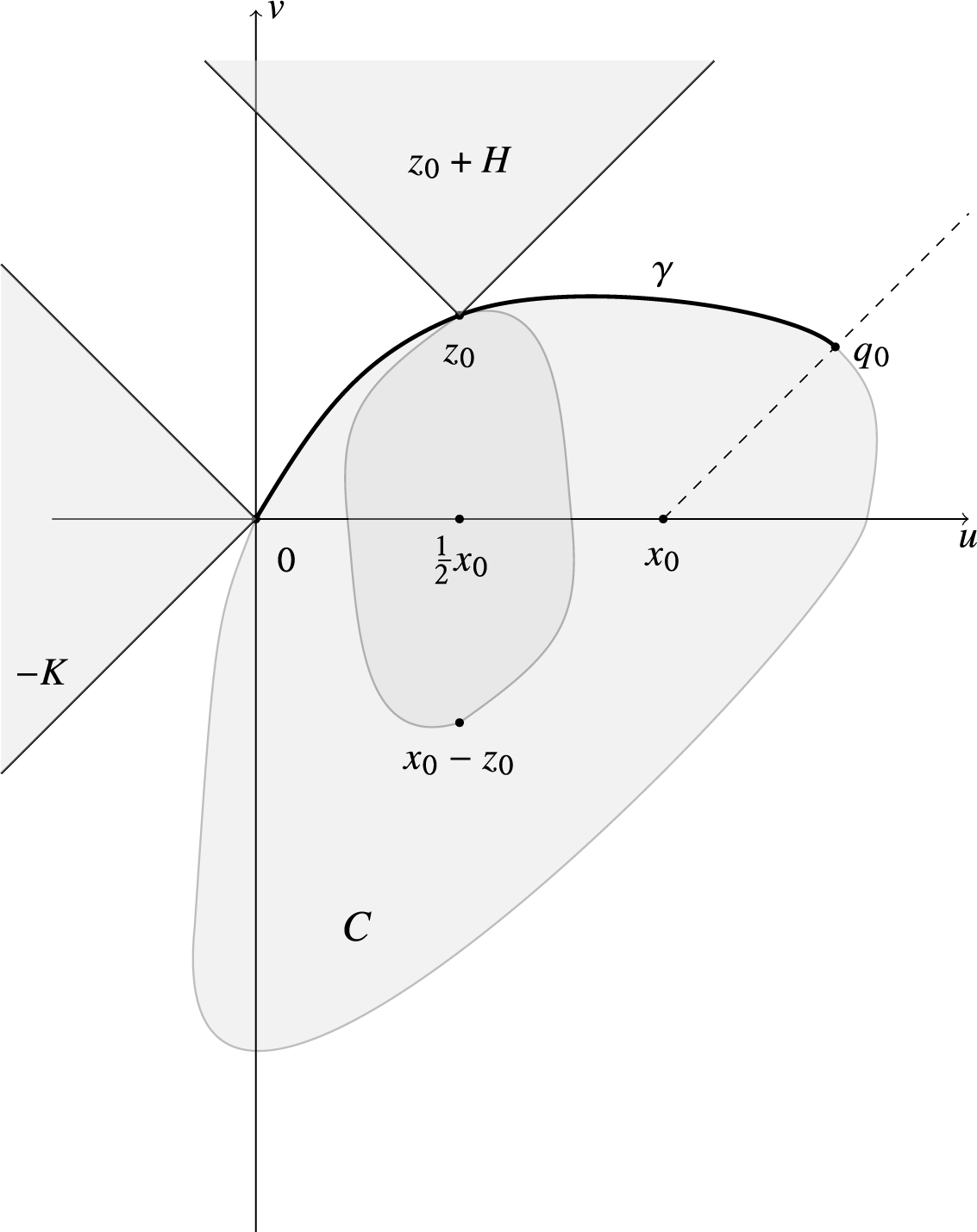
Let us denote
 $W=\{(u,v)\in X:\, v\geq 0\}$
and notice that, by our previous observations, we can consider the simple curve
 $\gamma $
describing the part of
 $\partial C$
contained in
 $W\setminus (x_0+ K^\circ )$
, with endpoints
 $0$
and
 $q_0$
(see Figure 1).
The curve
 $\gamma$
.

We claim that
 $\|q_0\|\geq \|x_0\|$
. Indeed, if we consider
 $B=\|x_0\|B_X$
, we clearly have
 ${x_0\in \partial B}$
; moreover, since by (3.1) we have
 $$ \begin{align*} \|2z_0-x_0\|=\|x_0-2z_0\|=2\delta<\|x_0\|, \end{align*} $$
the interval
 $I=(2z_0-x_0, x_0-2z_0)$
is contained in
 $\mathrm {int}(B)$
. Now, by Fact 2.1, we have that the set
 $$ \begin{align*} [x_0-\overline{\mathrm{cone}}(I-x_0)]=x_0+K \end{align*} $$
does not intersect
 $\mathrm {int} (B)$
. Since
 $$ \begin{align*} q_0\in x_0+\mathbb{R}^+z_0\subset x_0+K, \end{align*} $$
 $q_0\notin \mathrm {int}(B)$
and the claim is proved.
Now, by continuity, if
 $\varepsilon \in \left (0,\|x_0\|\right ]$
then there exists
 $x\in \gamma $
such that
 $\|x\|=\varepsilon $
. To conclude the proof it is sufficient to show that
 $d\left (\frac 12x,\partial C\right )\leq \delta $
. Since the image of
 $\gamma $
is contained in
 $\partial C\cap [W\setminus (x_0+ K^\circ )]$
and since
 $(-K^\circ )\cap C=\emptyset $
, we have that
 $$ \begin{align*} \textstyle \frac12x\in W\setminus[(\frac12x_0+ K^\circ)\cup(-K^\circ)]=\{(u,v)\in X:\, v\geq 0,\, v\geq u-1,\, v\geq-u\}. \end{align*} $$
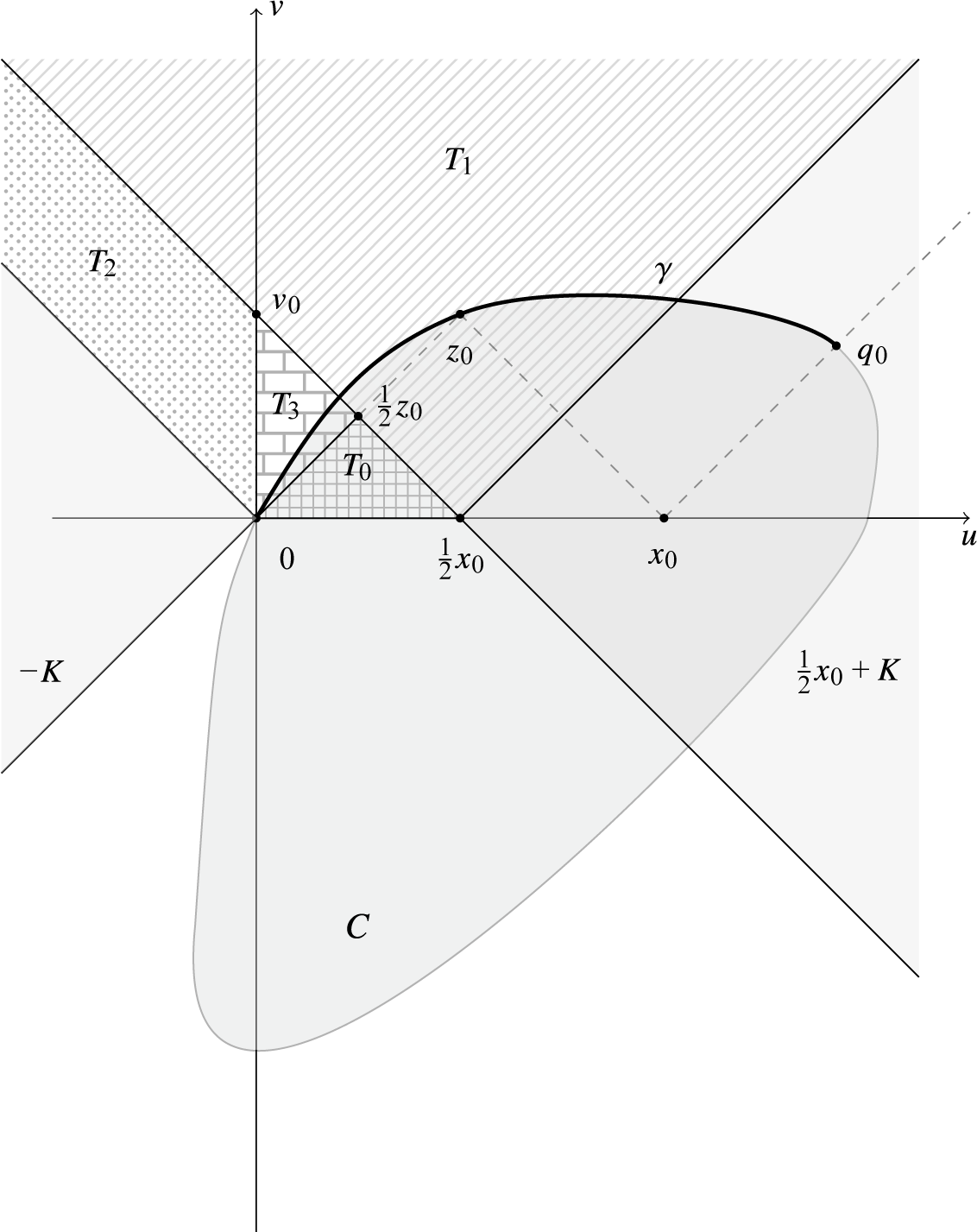
Notice that the set
 $W\setminus [(\frac 12x_0+ K^\circ )\cup (-K^\circ )]$
is the union of the following sets (see Figure 2):
-
•
$T_0=\{\frac \alpha 2x_0+\frac \beta 2z_0:\, \alpha>0,\, \beta \geq 0,\, \alpha +\beta <1\} $
; -
•
$T_1= \frac 12x_0+ H$
; -
•
$T_2=\{(u,v)\in X:\, -u\leq v< -u+1,\, u<0\}$
; -
•
$T_3=\{\frac \alpha 2z_0+\beta v_0:\, \alpha \geq 0,\, \beta \geq 0,\, \alpha +\beta <1\}$
.


Proof of Proposition 3.1.

Let us observe that, since the segment
 $(0,x_0)$
is contained in
 $\mathrm {int}(C)$
, we have that
 $$ \begin{align*}2T_0=\mathrm{conv}\bigl((0,x_0)\cup\{z_0\}\bigr)\setminus\{z_0\}\subset \mathrm{int}(C).\end{align*} $$
Since
 $x\in \partial C$
, it follows that
 $x\not \in 2T_0$
and hence that
 $\frac 12x\not \in T_0$
.
Now, consider the case in which
 $\frac 12 x\in T_1$
. Then necessarily
 $$ \begin{align*}\textstyle \frac12x+v_0\in z_0+H\subset X\setminus\mathrm{int}(C),\end{align*} $$
and hence
 $$ \begin{align*}\textstyle d\left(\frac12x,\partial C\right)\leq\|v_0\|=\|\frac12x_0-z_0\|=\delta.\end{align*} $$
Similarly, if
 $\frac 12 x\in T_2$
, then necessarily the segment
 $[\frac 12x,\frac 12x-v_0]$
intersects
 $-K$
, and hence we get
 $d\left (\frac 12x,\partial C\right )\leq \|\frac 12x-(\frac 12x-v_0)\|=\|v_0\| =\delta .$
It remains to consider the case in which
 $\frac 12x\in T_3$
. In that case, by Observation 3.2,(i) the ray
 $x+\mathbb {R}^+w_0$
does not intersect
 $\mathrm {int}(C)$
. Let us denote
 $\frac 12x=(\overline {u},\overline {v})$
and define
 $$ \begin{align*}z=x+(-\overline{u},\overline{u})=x+\overline{u} w_0\in x+\mathbb{R}^+w_0\in X\setminus\mathrm{int}(C).\end{align*} $$
Observe that
 $$ \begin{align*}\textstyle \|z-\frac12x\|=\|\frac12x+\overline{u} w_0\|=\| (0, \overline{v}+\overline{u})\|\leq\|(0,1)\|=\|v_0\|=\delta,\end{align*} $$
where the inequality holds since
 $0\leq \overline {v}+\overline {u}\leq 1$
. This clearly implies that
 ${d\left (\frac 12x,\partial C\right )\leq \delta }$
. The proof of Proposition 3.1 is complete.
With Proposition 3.1 in our hands, we are ready to state and prove the main result of our article.
Theorem 3.3 Let C be a convex body in X and
 $x\in \partial C$
. Then for every
 $0\le \varepsilon <\Delta _x(C)$
we have
 $$ \begin{align*}\delta^{\prime}_C(x,\varepsilon) = \widetilde{\delta}_C(x,\varepsilon). \end{align*} $$
Consequently, the four moduli of local uniform rotundity introduced in Definition 2.2 all coincide.
Proof By (2.1), it is sufficient to prove that
 $\delta ^{\prime }_C(x,\varepsilon ) \leq \widetilde {\delta }_C(x,\varepsilon )$
, whenever
 $0\le \varepsilon <\Delta _x(C)$
. If
 $\widetilde {\delta }_C(x,\varepsilon )=\frac {\varepsilon }2$
or
 $\delta ^{\prime }_C(x,\varepsilon )=0$
there is nothing to prove, hence we can suppose that
 $\widetilde {\delta }_C(x,\varepsilon )<\frac {\varepsilon }2$
and
 $\delta ^{\prime }_C(x,\varepsilon )>0$
. Moreover, without any loss of generality, we can (and do) suppose that
 $x=0$
.
Let us consider a real number
 $\eta $
such that
 $ \widetilde {\delta }_C(x,\varepsilon )<\eta <\frac {\varepsilon }2 $
. Then there exist
 $x_0\in C$
and
 $w_0\in \partial C$
such that
 $\|x_0\|\geq \varepsilon $
and
 $\|\frac {x_0}2-w_0\|<\eta $
. It is easy to see that, since
 $\delta ^{\prime }_C(x,\varepsilon )>0$
, one must have
 $(0,x_0)\subset \mathrm {int}(C)$
. Hence, since
 $\eta <\frac {\varepsilon }{2}\leq \frac {\|x_0\|}{2}$
, the vectors
 $x_0,w_0$
are linearly independent. Let Y be the two-dimensional subspace of X defined as
 $Y=\mathrm {span}\{x_0,w_0\}$
. By compactness, there exists
 $z_0\in Y\cap \partial C$
such that:
 $$ \begin{align*}\textstyle \delta:=\|\frac{x_0}2-z_0\|=d\left(\frac{x_0}{2},Y\cap\partial C\right)\leq \|\frac{x_0}2-w_0\|<\eta<\frac{\varepsilon}2\leq\frac{\|x_0\|}2.\end{align*} $$
By Proposition 3.1, there exists
 $x'\in Y\cap \partial C$
such that
 $$ \begin{align*}\textstyle\|x'\|=\varepsilon\qquad \text{ and}\qquad d\left(\frac12 x',Y\cap \partial C\right)\leq\delta.\end{align*} $$
In particular, we have
 $$ \begin{align*}\textstyle \delta^{\prime}_C(x,\varepsilon)\leq d\left(\frac{x+x'}2 , \partial C\right)\leq d\left(\frac{x+x'}2,Y\cap \partial C\right)\leq\delta<\eta.\end{align*} $$
By the arbitrariness of
 $\eta \in \left ( \widetilde {\delta }_C(x,\varepsilon ),\frac {\varepsilon }2\right )$
, we get
 $\delta ^{\prime }_C(x,\varepsilon ) \leq \widetilde {\delta }_C(x,\varepsilon )$
and the proof is done.
Let us conclude the present section by showing that the result from [Reference De Bernardi and Veselý9] about equality of four moduli of uniform rotundity can be now easily deduced from Theorem 3.3. (Nevertheless, the original proof from [Reference De Bernardi and Veselý9] is quite simpler.)
Definition 3.1 (see [Reference De Bernardi and Veselý9, Definition 3.1])
Let C be a convex body in a normed space X. Let us consider the following four moduli of uniform rotundity of C defined for any
 $0\le \varepsilon <\mathrm {diam}(C)$
by:
 $$ \begin{align*} \delta_C(\varepsilon)&\textstyle:=\inf\Bigl\{ d(\frac{x+y}2,\partial C):\;x,y\in\partial C,\;\|x-y\|\ge\varepsilon \Bigr\} ,\\ \delta^{\prime}_C(\varepsilon)&\textstyle:=\inf\Bigl\{ d(\frac{x+y}2,\partial C):\;x,y\in\partial C,\;\|x-y\|=\varepsilon \Bigr\} ,\\ \widetilde{\delta}_C(\varepsilon)&\textstyle:=\inf\Bigl\{ d(\frac{x+y}2,\partial C):\;x,y\in\overline{C},\;\|x-y\|\ge\varepsilon \Bigr\} ,\\ \widetilde{\delta}^{\prime}_C(\varepsilon)&\textstyle:=\inf\Bigl\{ d(\frac{x+y}2,\partial C):\;x,y\in\overline{C},\;\|x-y\|=\varepsilon \Bigr\}. \end{align*} $$
We start by borrowing from [Reference De Bernardi and Veselý9] the following observation. It describes some basic facts about convex bodies and the corresponding moduli of uniform rotundity introduced above.
Observation 3.4 (see [Reference De Bernardi and Veselý9, Observations 2.1 and 3.3])
Let
 $C\subset X$
be a convex body.
-
(i) If
$\partial C$
contains no line, then
${C}$
contains no line either. -
(ii) The distance-function
$d(\cdot ,\partial C)$
is concave on
${C}$
. -
(iii)
$\widetilde {\delta }^{\prime }_C(\varepsilon )=\widetilde {\delta }_C(\varepsilon )\le \delta _C(\varepsilon )\le \delta ^{\prime }_C(\varepsilon )\le \varepsilon /2$
for each
$\varepsilon \in [0,\mathrm {diam}(C))$
. -
(iv) At
$\varepsilon =0$
, all four moduli are null and right-continuous. -
(v) If
$\partial C$
contains a segment of length
$0<\ell <\mathrm {diam}(C)$
then
$\delta ^{\prime }_C(\varepsilon )=0$
for each
$\varepsilon \in [0,\ell ]$
.


Corollary 3.5 Let C be a convex body in a normed space X. Then
 $$ \begin{align*}\delta_C(\varepsilon) = \delta^{\prime}_C(\varepsilon) = \widetilde{\delta}_C(\varepsilon) = \widetilde{\delta}^{\prime}_C(\varepsilon) \quad\text{for each } 0\le\varepsilon<\mathrm{diam}(C). \end{align*} $$
Proof First, we proceed as at the beginning of the proof of [Reference De Bernardi and Veselý9, Theorem 3.6]. By Observation 3.4(c),(d), it suffices to show that
 $\delta ^{\prime }_C(\varepsilon )\le \widetilde {\delta }^{\prime }_C(\varepsilon )$
whenever
 $0< \varepsilon <\mathrm {diam}\,C$
. Without any loss of generality, we can assume that
 $$ \begin{align*}0< \varepsilon<\mathrm{diam}\,C \,, \quad \delta^{\prime}_C(\varepsilon)>0\,, \quad \widetilde{\delta}^{\prime}_C(\varepsilon)<\varepsilon/2\, \end{align*} $$
and hence, by Observation 3.4(a),(e), that C does not contain lines.
Fix an arbitrary
 $0<\eta <(\varepsilon /2) - \widetilde {\delta }^{\prime }_C(\varepsilon )$
, the proof is concluded if we prove that
 $\delta ^{\prime }_C(x)\leq \widetilde \delta ^{\prime }_C(\varepsilon )+\eta $
. By the definition of
 $\delta ^{\prime }_C(\varepsilon )$
, there exist points
 $x,y\in C$
such that
 $\|x-y\|=\varepsilon $
and
 $d(\frac {x+y}2,\partial C)<\widetilde {\delta }^{\prime }_C(\varepsilon ) + \eta $
. By Observation 3.4(b) and since C does not contain lines, we can shift the segment
 $[x,y]$
along the line
 $\mathrm {aff}\{x,y\}$
in one of the two directions till the boundary in such a way that the new segment
 $[\hat {x},\hat {y}]$
satisfies
 $d(\frac {\hat {x}+\hat {y}}2,\partial C) \le d(\frac {x+y}2,\partial C)$
. Hence we can (and do) assume that
 $x\in \partial C$
. If also
 $y\in \partial C$
then we immediately get that
 $\delta ^{\prime }_C(\varepsilon )\le \widetilde {\delta }^{\prime }_C(\varepsilon ) + \eta $
; so let us assume that
 $y\in \mathrm {int}\,C$
. Notice that, in particular,
 $\Delta _x(C)>\varepsilon $
and
 $\widetilde \delta ^{\prime }_C(x,\varepsilon )<\widetilde \delta ^{\prime }_C(\varepsilon )+\eta $
. Now, an application of Theorem 3.3 yields
 $$ \begin{align*}\delta^{\prime}_C(\varepsilon)\leq\delta^{\prime}_C(x,\varepsilon)=\widetilde\delta^{\prime}_C(x,\varepsilon)<\widetilde\delta^{\prime}_C(\varepsilon)+\eta,\end{align*} $$
and the proof is done since
 $\eta $
can be arbitrarily small.