One of the least acknowledged aspects of twentieth-century American land art is that it arose as the nation's nineteenth-century landscape was being rediscovered.Footnote 1 Against the backdrop of an environment in which megalopolis, suburbanization, and the interstate highway system seemed little more than a form of “planned deterioration,” many historians in the 1950s and 1960s began to revive the idea of landscape as a key to the nation's identity and character – singling out the nineteenth-century landscape as both a point of origin and a possible site of reclamation.Footnote 2 Among the most influential books to appear during this period were such classics as Henry Nash Smith's Virgin Land (1950), Perry Miller's Errand into the Wilderness (1956), R. W. B. Lewis's The American Adam (1958), Leo Marx's The Machine in the Garden (1964), and Roderick Nash's Wilderness and the American Mind (1967). Not surprisingly, there was a new appreciation for artists like Thomas Cole, Frederic Church, and Albert Bierstadt; for photographers like Timothy O'Sullivan, Andrew J. Russell, and Carleton E. Watkins, and especially for the landscape designer Frederick Law Olmsted. With the growth of the Sierra Club, the publication of Rachel Carson's Silent Spring (1962), and a new environmental agenda advanced by the Kennedy and Johnson administrations, land art also intersected the beginning of the modern environmental movement.Footnote 3
Unfortunately, much of this revival emerged as a profoundly nostalgic – or what David Noble has called “elegiac” – enterprise, harking back to the isolationist, agrarian tradition of Andrew Jackson and Frederick Jackson Turner. According to Noble, the most notable feature of this tradition was that it “defined the United States as a unique state of nature whose cultural virginity needed to be kept isolated from the rest of the world” because it “was not in harmony with nature” and thus “dwelled in darkness.”Footnote 4 During the eighteenth and nineteenth centuries this generally meant that Americans sought to derive their national identity from a landscape whose parameters had been determined by the laws and peculiarity of nature itself. In the 1950s and 1960s, however, this tradition was resuscitated mainly to advance the view that a truly sacred and organic national landscape had “lasted no more than a generation” – that is, from about 1835 to 1860.
A basic premise of this approach was that the idyllic nature of the nation's landscape had been subverted by a trajectory of industrialization that began with the Civil War and accelerated as the frontier “withered and lost its redemptive power.” “By 1890,” Noble explains, “the story of an exceptional nation based on nature was replaced by the story of the United States as one of many nations sharing an international industrial landscape” whose “law was constant progress.”Footnote 5 Seeing how entropic things had become by the 1950s and 1960s, many commentators sought to counter the “planned deterioration” that surrounded them by comparing it to a national landscape that had supposedly been lost. But if the redemptive power of that landscape had come to seem imaginary, it was mainly because they were yearning for something that had never existed in the first place. To anyone not enamored of a pastoral ideal, the entropic nature of progress looked less like a disruption or betrayal of the nation's landscape than like a continuation of contradictions that had been present all along. After all, even in the 1820s the visible landscape included the surveyor, the logger, the water-powered mill, and the railroad. Indeed, it could be said that the 640-acre section and the raised railroad embankment were the first mass-produced features of the national landscape – not just in the landscape but symptomatic of landscape itself as a form of mass production. All of this suggests that the antebellum period was not so much a paean to agrarianism as a prolegomenon to the entropic, fully engineered landscape of today – a fact confirmed by Nick Yablon, who has shown that a “distinctive urban imaginary of dereliction and decay” emerged at exactly the same moment that American pastoralism supposedly reached its peak.Footnote 6
If anyone chose to resist the nostalgic tenor of the 1950s and 1960s, it was the land artist Robert Smithson. Of course he was not alone – much the same thing could be said of Robert Frank, Edward Ruscha, Robert Adams, John Brinckerhoff Jackson, Robert Venturi, Denise Scott Brown, Nancy Holt, and others. But Smithson favored a far more drastic approach than anyone else at the time, creating an entropic, contradictory aesthetic that radically reconfigured the modern landscape of sameness by treating the quarry, the suburb, and the desert as mirror images of each other. Each of these distinctive landforms became a site of effacement for Smithson; each became a site “disrupted by industry, reckless urbanization, or nature's own devastation”; and each activated his desire to at once displace and reclaim the nineteenth-century landscape within the sphere of a “toxic discourse” that Lawrence Buell has identified with “the fear of a poisoned world” but that Smithson himself employed as an antidote to romantic nostrums of history and environmentalism.Footnote 7
To be sure, Smithson often ridiculed or distanced himself from the nineteenth-century landscape – noting in an interview, for instance, that “there is no going back to Paradise or 19th century landscape which is basically what the conservationist attitude is” (237). Yet it was mainly because he objected to any simplistic notion that the nineteenth-century landscape was somehow more organic or “natural” than the modern landscape. More than once he warned that people who grew up “in industrial blight” often sought refuge in “a picture-book sentimental, very trite romanticism of what the balance of nature is” (230); he also noted that
a kind of “virgin” beauty was established in the early days of this country and most people who don't look too hard tend to see the world through postcards and calendars, so that affects their idea of what they think nature should be rather than what it is. (298)
Though he never referred to works such as Virgin Land, Wilderness and the American Mind, or The Machine in the Garden, Smithson was implicitly rebelling against their nostalgic view of landscape.Footnote 8
That the nineteenth-century landscape remained a constant in Smithson's work, no matter how much he disavowed it at times, is undoubtedly the reason Olmsted became such a defining figure for him. Just before his death (in a plane crash, at the age of thirty-five), Smithson published an article in which he bluntly declared Olmsted to be America's first earthwork artist. Since Central Park was the prototype for a fully engineered landscape combining artifice and nature – something that Smithson himself, alert to the writings of Max Horkheimer and Theodore Adorno, termed a “dialectical landscape” (157) – it suggests that he had been creating a self-canceling mirror image of the nineteenth-century landscape all along. Where this landscape was not a direct influence, it acted indirectly as part of the environment he encountered every day. “A rusty sign glared in the sharp atmosphere, making it hard to read,” he noted of a bridge that marks the first monument in “A Tour of the Monuments of Passaic, New Jersey,” (1967). “A date flashed in the sunshine … 1899 … No … 1896 … maybe” (70).
“A Tour of the Monuments of Passaic, New Jersey” can be seen as the first fully formed expression of Smithson's toxic discourse. Smithson had begun to develop the rudiments of this discourse after being hired as an art consultant by the engineering firm commissioned to design the Dallas/Fort Worth airport. The collaboration exposed him to what he called the “large-scale” systems (210) of aerial photographs, surveyor's maps, and axes of infrastructure, and the ideas that were bandied about resulted in “Towards the Development of an Air Terminal Site” (1967) – an essay in which Smithson suggested for the first time that “remote places such as the Pine Barrens of New Jersey and the frozen wastes of the North and South Poles could be coordinated by art forms that would use the actual land as a medium” (56). Six months later, after a short bus ride and an Instamatic-aided walk, Smithson published his entropic essay on Passaic – at which point his toxic discourse had become firmly anchored in the nineteenth century.
The opening words of “Passaic” could not be more familiar:
On Saturday, September 30, 1967, I went to the Port Authority Building on 41st Street and 8th Avenue. I bought a copy of the New York Times and a Signet paperback called Earthworks by Brian W. Aldiss. Next I went to ticket booth 21 and purchased a one-way ticket to Passaic. After that I went up to the upper bus level (platform 173) and boarded the number 30 bus of the Inter-City Transportation Co. (68)
Although this deadpan, straightforward style may bring to mind the prose of Jim Thompson or James M. Cain, it rings even truer as an echo of many nineteenth-century travel narratives. For instance, Sarah Royce's diary of the California trail was one of hundreds, maybe thousands, of emigrant diaries which started in exactly the same way:
On the last day of April, 1849 we began our journey to California. Our out-fit consisted of a covered wagon, well loaded with provisions, and such preparations for sleeping, cooking, etc., as we had been able to furnish, guided only by the light of Fremont's Travels, and the suggestions, often conflicting, of the many who, like ourselves, utter strangers to camping life, were setting out for the “Golden Gate.”Footnote 9
In a similar vein, one of Henry David Thoreau's most often quoted essays, “Ktaadn” (1848), began,
On the 31st of August, 1846, I left Concord in Massachusetts for Bangor and the backwoods of Maine, by way of the railroad and steamboat, intending to accompany a relative of mine engaged in the lumber-trade in Bangor, as far as a dam on the west branch of the Penobscot, in which property he was interested.Footnote 10
Other examples included the journals of Lewis and Clark, the expedition reports of John Frémont that Royce carried with her, Edgar Allan Poe's The Narrative of Arthur Gordon Pym of Nantucket (1838), and Herman Melville's Typee (1846) – all a variety of what Jonathan Arac has designated “personal narratives.”Footnote 11
This alone is enough to alert us that Smithson is setting out not just in the footsteps of such picturesque travelers as William Gilpin or Uvedale Price but along a highway that had been blazed by Americans trying to adapt the conventions of picturesque travel to a far rougher and more dissonant landscape than the English Lake District or the ruins of Tintern Abbey. Doubtless that is why Smithson's eye is drawn to a “blurry reproduction” of Samuel F. B. Morse's Allegorical Landscape of New York University (1836) once he sits down on the bus and opens the Times. The painting is discussed in a column by John Canaday on “Themes and the Usual Variations” – where Canaday refers to the work as “standing confidently along with other allegorical representatives of the arts, science, and high ideals that universities foster” (quoted at 69). Smithson's own remarks are a bit less elevated. “The sky was a subtle newsprint grey,” he observes, “and the clouds resembled sensitive stains of sweat reminiscent of a famous Yugoslav watercolorist whose name I have forgotten” (69). Still, the fact that he, too, includes a copy of the painting – one of just seven photographs in “Passaic,” and the only one not taken by himself – suggests that Smithson is subtly evoking the somewhat “blurry” tradition of translatio studii that was so important to nineteenth-century America. This famous doctrine had postulated that knowledge and culture (studium) advanced to greater and greater heights as it moved (or was “translated”) from East to West. Americans had eagerly adopted the doctrine, modifying and transforming it “until it became part of the myth that America was the most glorious nation and empire because it was located in the west and was, therefore, closer to the original state of nature, to the terrestrial paradise, natural goodness and simplicity, and predestined to play the leading role in history as the vanguard of progress.”Footnote 12
According to Elisa Tamarkin, the prophetically allegorical setting of Morse's painting – which seems to depict a sturdy English Collegiate-style building next to one of the seven hills of Rome – was meant to be understood precisely in these “archaic terms”:
Athena stands on the near side of the lagoon and heralds the dawn of the institution as a recovery and translation of traditionary forms. It is a scene of illumination that works visually and ideologically from the perspective of a ‘west’ defined through the inheritance that it accepts by looking east.Footnote 13
If Smithson was not aware of each and every aspect of translatio studii – something that can never be assumed, given his curiosity and voracious reading habits – he clearly understood that Morse's painting represented the given landscape of America and hoped that “Passaic” would be enough of a “counter friction” (in Thoreau's apposite phrase) to disrupt or disturb it. Singling out the painting was a perfect way to introduce an essay that despondently wonders whether the “unimaginative suburb” of Passaic is merely “a cheap copy of The City of the Immortals” (73).
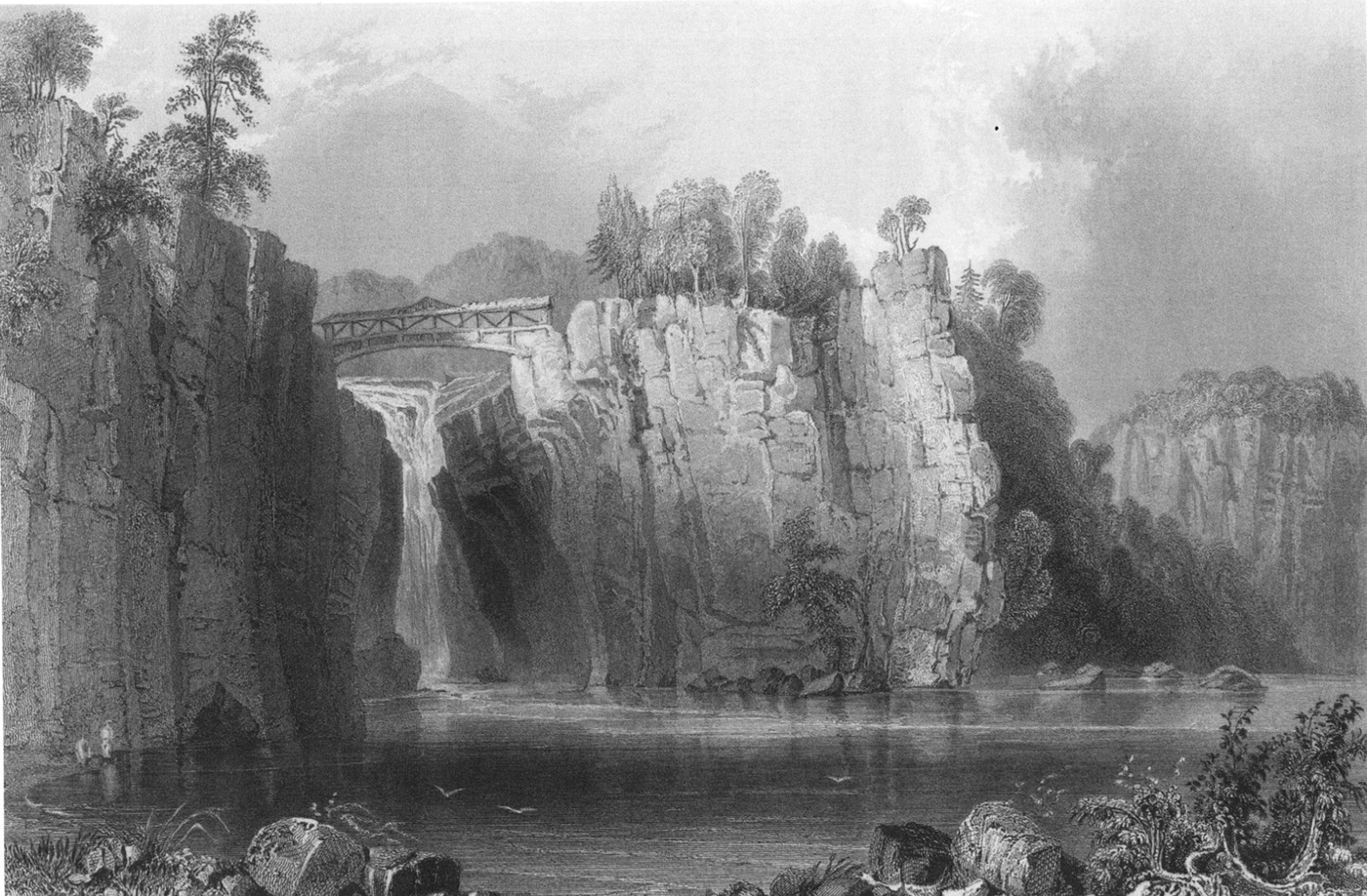
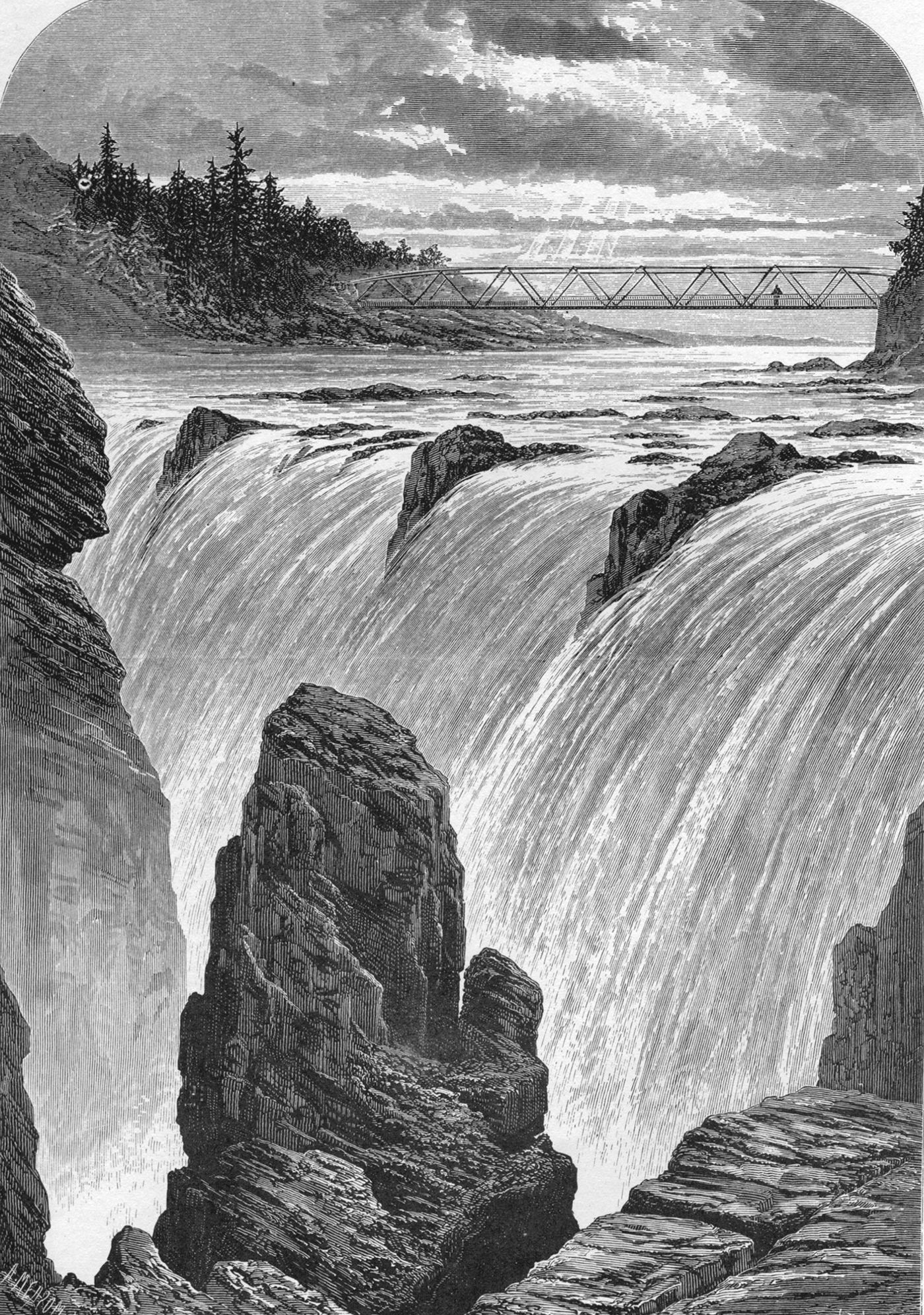
Of course, choosing Passaic as his destination was itself a dead giveaway – indicative of the disruption Smithson had in mind. Among other things, the Passaic Falls (now known as Paterson Falls, since they are actually located in the town adjoining Passaic) were one of the most celebrated scenic sites in nineteenth-century America. The site was referred to as early as 1800 in Charles Brockden Brown's essay “On a Taste for the Picturesque” and it had been commemorated by etchings that appeared in everything from Nathaniel Willis's American Scenery (1840) to William Cullen Bryant's Picturesque America (1872–4; Figures 1 and 2). On the other hand, the peculiar nature of the site was hinted at by the wood or iron bridge that appeared in the background of both the Willis and Bryant etchings. For the Passaic Falls were simply the most scenic section of a river that had powered the thriving textile industries of Paterson and Passaic since the 1790s.
William H. Bartlett, View of the Passaic Falls, 1840. Engraving in Nathaniel P. Willis, American Scenery; or, Land, Lake, and River: Illustrations of Transatlantic Nature, 2 vols. (London: George Virtue, 1840). Collection: the author.

Jules Tavernier, Passaic Falls, 1872–4. Engraving in William Cullen Bryant, ed., Picturesque America; or, The Land We Live In, 2 vols. (New York: D. Appleton and Co., 1872–74). Collection: the author.
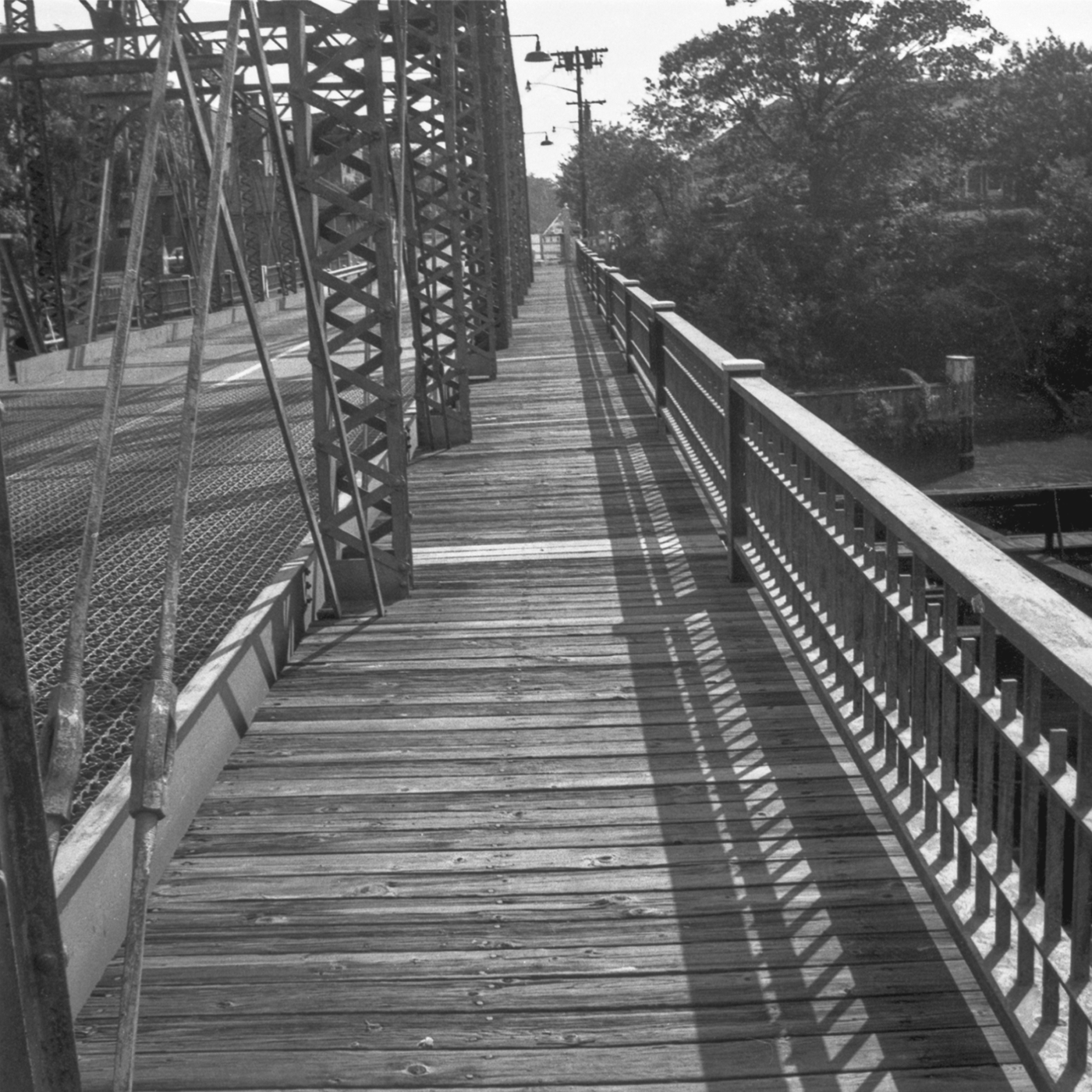
One of the more intriguing aspects of “Passaic” is that Smithson never even mentions the Falls. But in a kind of return of the repressed, the first monument he comes to, a rotating bridge he terms the “Monument of Dislocated Directions,” is both identified with the nineteenth-century landscape (“A date flashed in the sunshine …”) and presented as a secondhand image of that landscape. “The monument was a bridge over the Passaic River that connected Bergen County with Passaic County. Noon-day sunshine cinema-ized the site, turning the bridge and the river into an over-exposed picture. Photographing it with my Instamatic 400 was like photographing a photograph” (70). Such a vehement assertion of the picturesque reminds us that, as Rosalind Krauss has noted, the very notion of picturesque landscape “is constructed as a second term of which the first is a representation.” Since photography is strictly a secondhand medium in “Passaic” – neither an example of Gary Winogrand's practice of photographing something to see what it looks like photographed nor an example of the more conceptual use of photography as a “document” devoid of style or aesthetics – it confirms that Smithson's “over-exposed” picture “is simply felt to be repeating another work – a ‘landscape’ – that already exists elsewhere.”Footnote 14 And yet Smithson is not just pointing to the missing “elsewhere” of Willis and Bryant's scenic etchings but to the “continuous blank” (70) of a far less scenic landscape. For a structure that was little more than a background element in earlier images of the Falls has now morphed into the bleached, over-exposed close-up of “an open grating flanked by wooden sidewalks, held up by a heavy set of beams.”
An interesting feature of the “Monument of Dislocated Directions” is that “the Passaic (West) end of the bridge” literally “rotated south, while the Rutherford (East) end of the bridge rotated north” (70). These slow, lugubrious rotations parody the instantaneous mechanism of a camera shutter, but also suggest “the limited movements of an outmoded world” (70) and offer a material contrast to Morse's allegorical evocation of East and West. Indeed, one of the most important themes to emerge in “Passaic” is Smithson's implicit repudiation of translatio studii as either a spatial or a temporal culmination of some sort. Later in the essay, after walking along the riverbank and “what was left of River Drive” (71), he introduces the idea of “ruins in reverse”:
Actually, the landscape was no landscape, but … a kind of self-destroying postcard world of failed immortality and oppressive grandeur. I had been wandering in a moving picture that I couldn't quite picture, but just as I became perplexed, I saw a green sign that explained everything:

That zero panorama seemed to contain ruins in reverse, that is – all the new construction that would eventually be built. This is the opposite of the “romantic ruin” because the buildings don't fall into ruin after they are built but rather rise into ruin before they are built. This anti-romantic mise-en-scene suggested the discredited idea of time and many other “out of date” things … A Utopia minus a bottom, a place where the machines are idle … an abandoned set of futures. (72)
Nothing could be more opposed to the providential future evinced by Morse's Allegorical Landscape. Smithson often invoked the idea of entropy – citing the second law of thermodynamics to explain that “in the ultimate future the whole universe will burn out and be transformed into an all-encompassing sameness” (11) – and “Passaic” is where he begins to elaborate a landscape of sameness. The essay pointedly culminates in a “jejune experiment” in which Smithson asks us to imagine a sandbox (“also called The Desert”) “divided in half with black sand on one side and white sand on the other.” Playing on the ideal of suburbia as a family haven (a bubble he has already burst by describing a group of children “throwing rocks at each other near a ditch” (71)), he proposes that “we take a child and have him run hundreds of times clockwise in the box until the sand gets mixed and begins to turn grey; after that we have him run anti-clockwise, but the result will not be a restoration of the original division but a greater degree of greyness and an increase of entropy” (74).
While the essay as a whole posits a wary juxtaposition between East and West, Europe and America, the “jejune experiment” specifically forecloses any possibility of progressing from one to the other. Improvement is not an option in “Passaic.” Smithson denies the improvement that Gilpin and Price had found in razing old buildings and he denies the improvement that is supposed to result from raising new buildings – meaning that the past cannot improve the future and the future cannot improve the past. Since the rhetorical thrust of Morse's painting was that English landscape and culture would become ever more perfect in the United States, “Passaic” represents a completely different horizon. Near the end of the essay, in a passage that eerily anticipates Italo Calvino's Invisible Cities, Smithson boldly asks,
Has Passaic replaced Rome as The Eternal City? If certain cities of the world were placed end to end in a straight line according to size, starting with Rome, where would Passaic be in that impossible progression? Each city would be a three-dimensional mirror that would reflect the next city into existence. The limits of eternity seem to contain such nefarious ideas. (74)
What Smithson appears to be reacting to, paradoxically, is the extent to which the twentieth-century landscape – poisoned by the ill effects of progress and often criticized as ugly and soulless – had implicitly been understood as a violation or betrayal of translatio studii. Certainly his attack on the kind of “picture-book sentimentalism” that derived from nostalgic images of the past was a way of saying that the nation's future was still being idealized, in Sacvan Bercovitch's words, as a “new end-time Eden” meant to fulfill the promise of nineteenth-century agrarianism.Footnote 15 Thus Smithson's “impossible progression,” his deliberately “indifferent horizon” (119, emphasis added), was a reminder that even those nineteenth-century Americans who looked most assiduously to the landscape for their identity as Americans were aware that it existed as a juxtaposition of artifice and nature, wilderness and cultivation, progress and despoliation. “Readers of poetry see the factory-village, and the railway, and fancy that the poetry of the landscape is broken up by these,” Emerson had observed, “for these works of art are not yet consecrated in their readings; but the poet sees them fall within the great Order not less than the bee-hive, or the spider's geometrical web.”Footnote 16 Smithson himself once observed that Niagara Falls looked “like a great open pit quarry” – explaining that the cliffs “suggest excavation and mining,” but are “just the work of nature” (308).
“Passaic” reframes the juxtaposition of artifice and nature as a double view of nineteenth- and twentieth-century landscape. Commencing with the first monument – a “ramshackle,” antiquated bridge, its open-grated steel road “flanked by wooden sidewalks” (70) – Smithson's ironic “Odyssey” unfolds as a picturesque walking tour of the highway and the car. And since he experiences this and every other monument as a photograph of a photograph, it also emerges as a series of Kodak Instamatic pictures he takes along the way.
Smithson triggers his secondhand view by heading north on River Drive – scenic by name, perhaps, but of a sort that more or less erases the distinction between artifice and nature and ignores all picturesque prospects and landmarks.
Along the Passaic River banks were many minor monuments such as concrete abutments that supported the shoulders of a new highway in the process of being built. River Drive was in part bulldozed and in part intact. It was hard to tell the new highway from the old road; they were both confounded into a unitary chaos. (70–71)
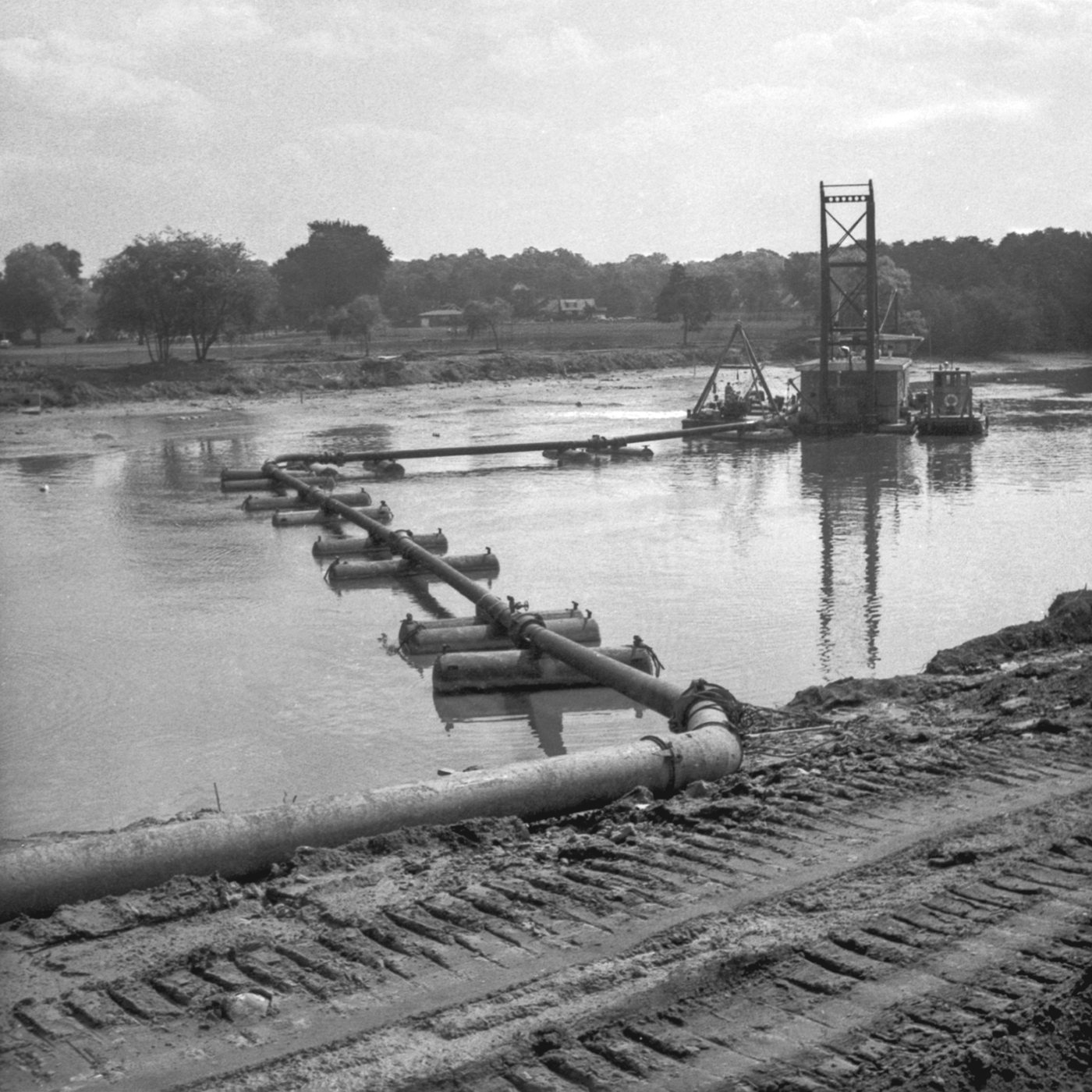
Working his way further north – past the feral children throwing rocks at each other – he comes upon three major monuments. The first and second are “a pumping derrick,” in the middle of the river, “with a long pipe attached to it. The pipe was supported in part by a set of pontoons, while the rest of it extended about three blocks along the river bank till it disappeared into the earth” (71). The third monument is equally industrial:
Nearby, on the river bank, was an artificial crater that contained a pale limpid pond of water, and from the side of the crater protruded six large pipes that gushed the water of the pond into the river. This constituted a monumental fountain that suggested six horizontal smokestacks that seemed to be flooding the river with liquid smoke. (71)
Unfortunately, Smithson suddenly finds himself bewildered by the “self-destroying postcard” landscape of the monuments. So at this point he turns away from the river and heads toward the city center, descending into “a set of used car lots” and “a chain of adjectives disguised as stores,” only to discover that “Passaic center was no center” – that it was in fact “full of ‘holes’” (72). “Those holes,” Smithson reflects, “are the monumental vacancies that define, without trying, the memory-traces of an abandoned set of futures. Such futures are found in grade B Utopian films, and then imitated by the suburbanite” (72).
Here, as elsewhere, “Passaic” brings to mind an aphorism that Smithson took from Vladimir Nabokov: “The future is but the obsolete in reverse” (11). Certainly the trajectory of progress that had begun so auspiciously with the Passaic River textile industry appears to reach a nadir among the used-car lots of the town's centerless center. This seems especially true if we see the essay as an artful, automotive rejoinder to “the old railroad tracks which at one time ran through the middle of Passaic” (73) – tracks that have now been asphalted over by a parking lot. Nothing was more emblematic of progress in the nineteenth century than the railroad. Emerson believed that “railroad iron” was “a magician's rod in its power to evoke the sleeping energies of land and water” and he seconded Thoreau's claim that the railroad had become such a “well conducted institution” that it was able to “regulate” both the daily habits of Americans and their more poetic habits of perception.Footnote 17
If anything seems to contradict this railroaded point of view, it is the “indifferent horizon” that appears “after what is left of River Drive.” Obviously the road was an important figure for Smithson. Virtually all his major articles and works invoke the road in one way or another. But eventually he used the material of the road, dirt and asphalt in particular, to suggest that it might simply sink or erode back into the landscape, assuming a new form, or no form at all. And this is exactly what we find in “Passaic.” Not only has the cindered embankment of the railroad given way to the “STONE, BITUMINOUS, SAND, AND CEMENT” (72) of the super highway, but both the car and the railroad have come to a halt in the parking lot that seems to represent the centerless center of town. “That monumental parking lot divided the city in half, turning it into a mirror and a reflection – but the mirror kept changing places with the reflection” (73). Of course, it is really the nineteenth-century landscape that keeps changing places with that of the twentieth in “Passaic,” and it is almost as if the railroad and the highway have been turned face-to-face, like two mirrors, creating “a kind of cliché idea of infinity” (73) in which the future seems “‘out of date’ and ‘old fashioned’” (73).
So it is that Smithson's “suburban Odyssey” (72) becomes an infinite regression from the railroad to the parking lot. Turning away from the banks of a river originally identified with both beauty and progress, Smithson has slowly made his way from one century to the next by denying the possibility of either beauty or progress, except as a form of obsolescence. Now it is not simply artifice and nature that have been reduced to “different types of sameness” (115) but time and space itself. Smithson makes it clear that the parking lot is neither a destination, a culmination, nor a turning point – merely a “lower stage” of the “futurity” (72) which has shaped his scenic tour from the beginning. Indeed, “Passaic” is nothing more than a series of inconsequential monuments to the nineteenth-century landscape, each as unremarkable as the next. And part of the reason they seem so unremarkable is that they are as deadpan and familiar, as secondhand, as Smithson's opening sentences.
Naturally the force of this secondhand view is conveyed as much by Smithson's photographs as by what he has to say. For along with everything else, “Passaic” can be seen as an evocative tour of American landscape photography. And yet it is a tour that begins to chisel away at one of the foundations of nineteenth-century nostalgia by harking back to the Civil War period. Recall that those who interpreted the period between 1835 and 1860 as a lost paradise invariably pinpointed the Civil War as the moment when the fleeting national landscape they had identified began to morph into the “international industrial landscape.” Henry Nash Smith expressed a widely held belief when he said that “the larger forces at work in American society after the Civil War – the machine, the devices of corporation finance, and the power of big business over Congress” – signified a landscape ruled by the influence and example of English industrialism.Footnote 18 “Passaic,” on the other hand, is clearly intended to be a counterargument to this retrograde point of view – a reminder that many years before the Civil War the Passaic was just one of many rivers, including the almighty Hudson, known as much for their industry as for their scenery.
By the 1960s, photography had long been used to glorify the American landscape as either a “jejune Eden,” a lost Eden, or a distorted example of “what the balance of nature is.” Smithson's own photographs – simple, straightforward images of everyday industrial objects – come across as offhand or banal mostly because they appear to flaunt a tradition so illustriously represented at the time by the photographs of Ansel Adams and Eliot Porter. Beginning with his image of the rotating bridge, and gaining momentum with each additional image, Smithson shrewdly utilizes this feigned banality to indicate an entirely different tradition of landscape photography – or more accurately, a more dialectical understanding of it. For in many ways, American landscape photography actually came of age on the battlefields of the Civil War. And “Passaic” itself is a monument to that visual history.
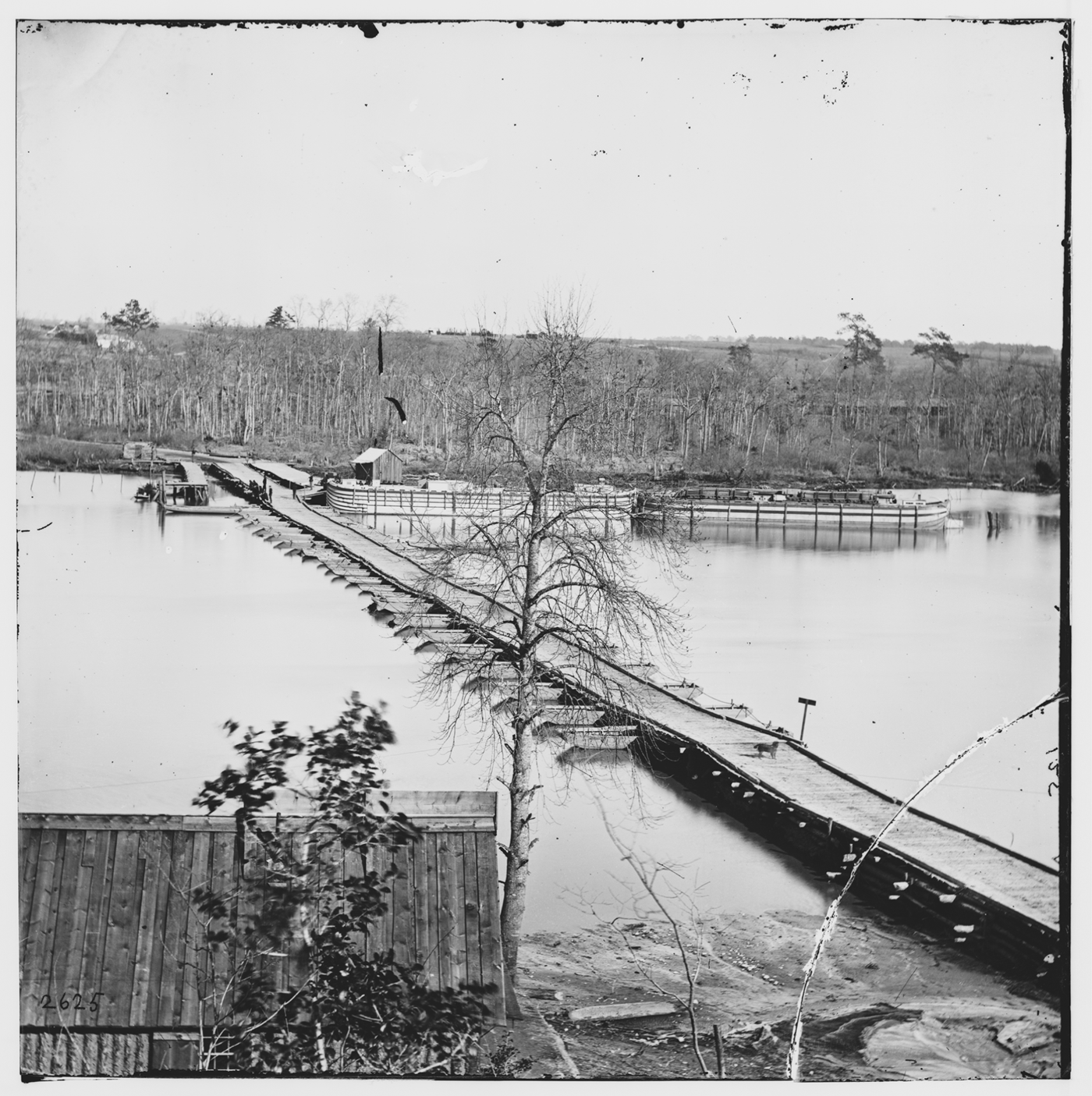
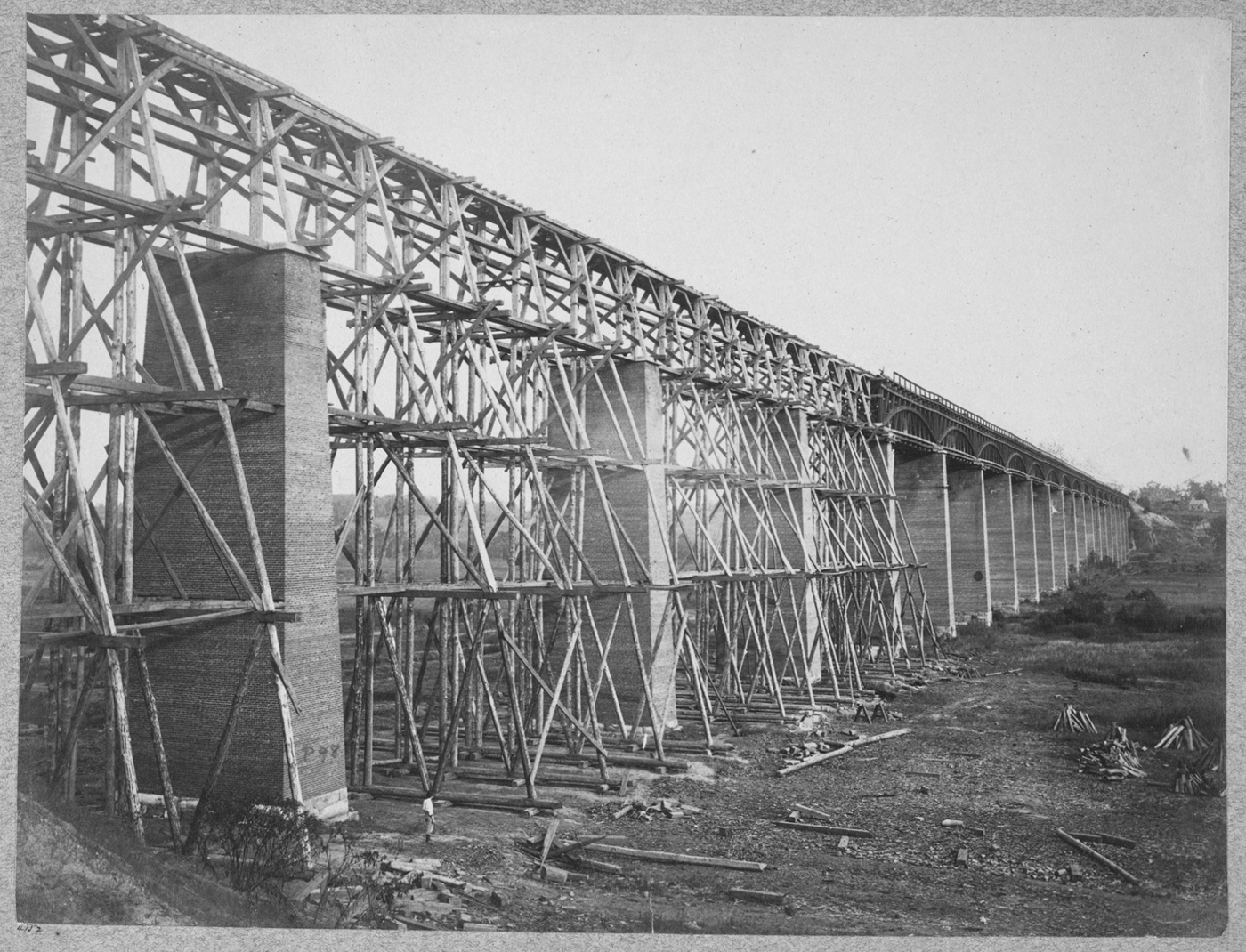
Prior to the Civil War, both a primitive, unwieldy technology and the nature of public demand had generally confined photography to studio portraiture. Only after Confederate soldiers fired on Fort Sumter and the glass plate negative replaced the daguerreotype did photographers begin working extensively in the field. As it happened, this included two of the nation's earliest and greatest landscape photographers – Andrew J. Russell and Timothy O'Sullivan – both of whom learned how to work out of doors during the war. Not surprisingly, it is their melancholy shots of bodies left splayed in shallow trenches or lying legion in grassy meadows that have received the most attention in books on the Civil War. But the two photographers actually spent most of their time documenting a landscape that was on the verge of being fully engineered. Indeed, photography itself was part of this development. As Keith Davis has observed, the technological innovations that allowed photographers to cover the war were an important element of “the first ‘modern’ conflict to combine mass armies, industrial technology, factory production, engineering skills, and mechanical invention.”Footnote 19 Evidence of this convergence can be seen in picture after picture of tent cities set regimentally among crumbling stone walls; of hastily assembled pontoon bridges spanning lugubrious, muddy rivers; of somewhat more permanent bridges standing spindly and half-finished; of crudely graded railroad embankments, haphazard breastworks, and makeshift artillery batteries; of behind-the-lines shots of factories, prisons, armories, hospitals, supply depots, and shelled buildings. Nor would this emphasis change all that much once these photographers journeyed west to document the construction of the transcontinental railroad and illustrate the Army and United States Geological Survey expeditions – which was also how William H. Jackson, another of the early landscape photographers, learned to work out of doors.
In both the Civil War and the West, the purely “scenic” aspect of these photographers' work was either incidental or absent. Clearly they were familiar with the conventions of European and American landscape painting and occasionally utilized these conventions in their work. But the emphasis was always on objectivity, reportage. To quote one historian, the photographs were deliberately designed “to reassure the audience that there had been no narrative of authorial intervention” – resulting in “an uncanny sameness to the look of most of the photographs” that also implied an empirical truth.Footnote 20 We know now that this “sameness” was anything but trustworthy, since photographers would sometimes take a picture of body-strewn fields from one angle and call it the Union dead and then take a picture of the same bodies from a different angle and call it the Confederate dead. Still, the effort to document the Civil War, at a time when landscape was generally the measure of national identity, forced photographers and artists alike to more openly depict an emerging (or demolished) infrastructure as well as the dead. In her splendid catalogue essay for The Civil War and American Art, Eleanor Jones Harvey makes it clear that “the vocabulary of landscape provided the structure for comprehending” both “the emotional toll” of the war and the way in which it was waged.Footnote 21 Yet the very confrontation between art and war led to a far more toxic and understated understanding of landscape itself. Coincidentally or not, this confrontation also created an aesthetic equivalence between the landscape of the Civil War and that of the topographic surveys and the transcontinental railroad. For what was now considered worthy of being “a landscape” no longer had any intrinsic connection to the scenic conventions of the day.
Obviously a very different view emerged in Carleton Watkins's and Eadweard Muybridge's stunning, deliberately scenic pictures of Yosemite, taken around the same time. Here it was not “railroad iron” or topographic geology that mattered but the sheer wonder of the landscape – epitomized by their use of a “mammoth camera” employing large, and therefore very sharp, glass plate negatives. Karen Current has written that Watkins was “a master of the ‘Grand View.’ He knew what the large format could express and he exploited its potential fully. He did not seek the part that characterized the whole; he attempted to capture the whole itself.”Footnote 22 It wasn't long before the grandeur of Yosemite began to represent the grandeur of America, and in the long run these “mammoth” pictures – in concert with Albert Bierstadt's paintings of Yosemite Valley and John Muir's writings about the region – were one of the principal reasons “a kind of ‘virgin’ beauty” eventually defined both the balance of nature and the nineteenth-century landscape itself as a “picture-book sentimental” ideal. As early as 1867 an English review of Watkins's photographs observed, “In none of these pictures do we see the least signs of man; not a log hut nor an axe-felled tree to indicate his presence; all seems wild, primitive nature, which gives great charm to these very excellent photographs.”Footnote 23
Yet even the pristine state of Yosemite seemed more significant because of the Civil War. Harvey points out that in both Watkins's photographs and Bierstadt's paintings “Yosemite held out the promise of a New Eden, a place in which all Americans could slough off the trauma of war and sectarian strife, a place of renewal and healing.”Footnote 24 Bierstadt only made it to Yosemite because the War Department provided a military escort, and it was during the latter years of the war that Lincoln set aside the valley and the surrounding region as the nation's first federally recognized park – a symbol of its commitment to “a New Eden.” Asked to prepare a report on how to manage the new park, Frederick Law Olmsted essentially framed his approach as a response to this aesthetic imperative. The report began,
It is a fact of much significance with reference to the temper and spirit which ruled the loyal people of the United States during the war of the great rebellion, that a livelier susceptibility to the influence of art was apparent, and greater progress in the manifestations of artistic talent was made, than in any similar period before in the history of the country.
Anticipating Harvey's comments, he made it clear that “the paintings of Bierstadt and the photographs of Watkins, both productions of the War time, had given to the people on the Atlantic some idea of the sublimity of Yo Semite”; he also claimed that “the union of the deepest sublimity with the deepest beauty of nature” rendered “the Yo Semite the greatest glory of nature.”Footnote 25
To combat this scenic ideal – affirmed every day as tourists avidly, without irony, seek the views made famous by Watkins and Muybridge's photographs to take their own snapshots of Yosemite – Smithson wrenches our attention back to the aesthetic prototype pioneered by O'Sullivan and Russell. Significantly, all but one of the photographs in “Passaic” comes across as a landscape rather than something related to urban or street photography. The photographs include urban or industrial elements, but they focus on the “scenery” along the Passaic River. Even their square format does not stop them from being read more horizontally than vertically – an aspect that Robert Adams, photographing the suburbs of Colorado Springs around the same time, would also feature in his seminal book, The New West: Landscapes along the Colorado Front Range (1974).
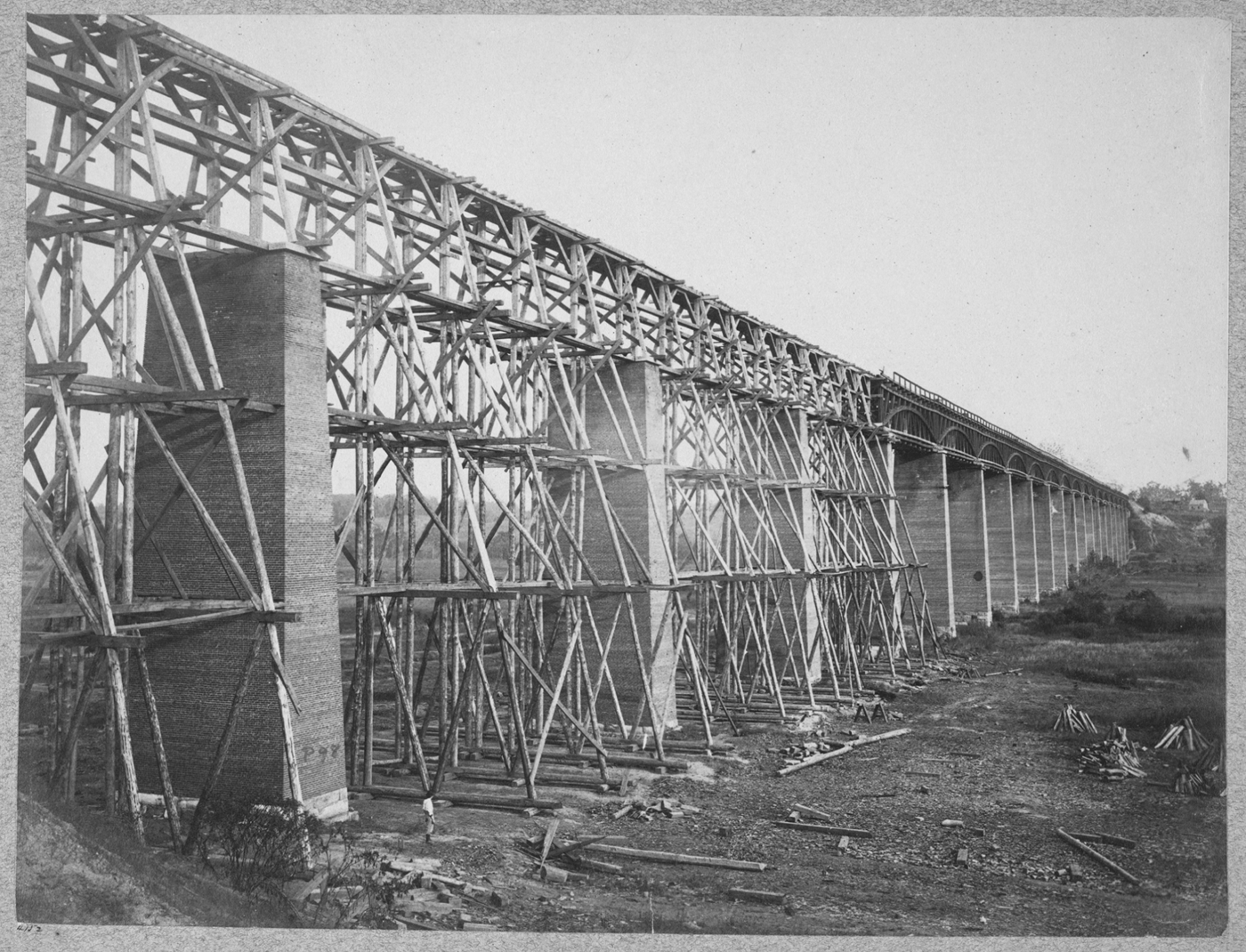
Again, it is the rotating bridge – the “Monument of Dislocated Directions” – which really sets the tone for everything that follows. Plainly, the photograph of the bridge is not an image of virgin beauty, both because of the scene it depicts and because it is so self-consciously secondhand, a photograph of a photograph. On the other hand, it is not a secondhand view of the illustrations that had appeared in Picturesque America and American Scenery. Instead it implicitly calls to mind the images to be seen in any illustrated book on the Civil War or the postbellum West – of which O'Sullivan's High Bridge, Appomattox, Va. and Jackson's Dale Creek Bridge, No. 198 can be seen as both representative and particularly iconic (Figures 3 and 4). There is no reason to believe that Smithson wished to evoke the Civil War itself, but he does seem eager to remind us of both the landscape, and the landscape photography, that it helped to inaugurate. Certainly this association is provoked by the Monument with Pontoons: The Pumping Derrick and The Great Pipe Monument, since pontoon bridges were widely used in the Civil War, and the prototypes for these monuments appear over and over again in such photographs as Broadway Landing, Va., Pontoon Bridge across the Appomattox (Figures 5 and 6). Even The Sandbox Monument (also called The Desert), so prosaic and suburban on its face, has the bereft, trampled look of an abandoned camp or battlefield and its foreground of sparse clumps of grass might just as well have been photographed by O'Sullivan in Utah or Nevada.
Robert Smithson, Monuments of Passaic – The Bridge Monument Showing Wooden Side-Walks, New Jersey, 1967. Six photographs and one cut photostat map. Collection: Nasjonalmuseet, Oslo, Norway. © Estate of Robert Smithson/licensed by VAGA, New York. Courtesy James Cohan Gallery, New York/Shanghai.
Timothy O'Sullivan, High Bridge, Appomattox, Va., 1865. Photograph. Courtesy Library of Congress Prints and Photographs Division, Washington, DC.
Robert Smithson, Monuments of Passaic – Monument with Pontoons: The Pumping Derrick, New Jersey, 1967. Six photographs and one cut photostat map. Collection: Nasjonalmuseet, Oslo, Norway. © Estate of Robert Smithson/licensed by VAGA, New York. Courtesy James Cohan Gallery, New York/Shanghai.
Anonymous, Broadway Landing, Va., Pontoon Bridge across the Appomattox, between 1860 and 1865. Photograph. Courtesy Library of Congress Prints and Photographs Division, Washington, DC.
By the time Smithson reaches The Sandbox Monument, then, it is apparent that his understated allusions to this tradition of nineteenth-century photography are mainly designed to highlight the sort of “low profile” (293), fully engineered landscape it represented. By indicating that even landscape photography made little distinction between “a kind of ‘virgin’ beauty” and the ubiquity of “industrial blight,” “Passaic” more broadly suggested that there was little distinction between the natural and the artificial aspects of landscape itself. One did not exclude the other, one did not replace the other, one did not exist as a higher or lower stage than the other. Instead they represented the opposing terms of a dialectic that had defined the Anglo-American landscape from the first landfalls in Virginia and New England.
In the end, it could be said that Smithson steadily sought to reclaim the landscape of the 1960s and 1970s by reclaiming the nineteenth-century landscape as something other than a once-and-future Eden. Some of his most fundamental notions, including those of entropy and rising into ruin, were at least partially directed to this end. Rather than lamenting the loss of an old Eden and pointing to a new one, Smithson made it clear that Eden had never existed. As far as he was concerned, the twentieth-century landscape was merely a different type of the sameness that had shaped the nineteenth-century landscape all along – implying a landscape that needed to be prolonged but not perfected. What made this approach so crucial was that the modern American landscape ceased to be a debased and disappointing version of a landscape that had shown such providential promise a century before. Instead, it could be seen as a landscape where nature and culture constantly displaced each other, constantly remained out of balance, while continually expanding the need for both. Ultimately that is what Smithson meant by a dialectical landscape – not just “an orchid garden in a steel mill, or a factory where palm trees would be lit by the fire of blast furnaces” (158), but an endless and transparent negotiation between nature and culture in which each became a reflection of the other. Because of this approach, he was able to treat the nineteenth and twentieth centuries as equally unstable mirror images of each other. “Olmsted's parks exist before they are finished,” Smithson declared, “which means in fact they are never finished; they remain carriers of the unexpected and of contradiction on all levels of human activity, be it social, political, or natural” (160).
As much as anyone during the 1960s and 1970s, Smithson set out to destroy the sort of historical idealism that signified both a nostalgic attachment to the nineteenth century and a lingering belief in American exceptionalism. Above all, his indifferent horizon embodied a sameness in which the American landscape ceased to be the end-all or be-all of history. “To think ‘environmentally’ or ‘ecologically,’” Lawrence Buell has observed, “requires thinking ‘against’ or ‘beyond’ nationness even more self-evidently than thinking ‘culturally’ does. Seldom do jurisdictional borders correspond to ecological borders.”Footnote 26 At a time when many others looked to an outmoded or nonexistent environment to define the sovereignty of the nation, Smithson avoided this wistful, insulated historicism by thinking truly environmentally. Indeed, his was one of the earliest and most corrosive challenges to a point of view that has largely been discredited within the spheres of both environmentalism and American studies. In the words of one curator, environmentally conscious artists these days “tread a dichotomous line” – “showing both the aesthetics of decline” and “a renewable belief in beauty, while at the same time thinking about possible solutions for ecological sustainability.”Footnote 27 All in all, nothing comes closer to being the prototype for this anxious ascent into ruin than the toxic, astringent aesthetic of Robert Smithson.