The way in which Greek places of worship feature in the current popular imagination is much influenced by the remnants of a few surviving temples, such as Athena's Parthenon or Poseidon's temple at Sounion. Yet these aesthetically pleasing but ruined and empty buildings give little insight into their former functions or furnishings.Footnote 1 Moreover, a (perhaps unconscious) comparison with modern religious buildings, such as churches, mosques, and synagogues, might lead us to think of an ancient sanctuary as normally consisting of just the temple – which would be a real mistake.Footnote 2 So let us first look at sanctuaries proper (§1), then their locations (§2), and, finally, their secular and religious functions (§3).Footnote 3
1. Buildings, statues, and personnel
In our oldest literary source, Homer, sanctuaries with a temple, statue, and priest(ess) are already well established. Hector's mother, Hecuba, went to the temple of Athena on the Acropolis of Troy, where the priestess Theano opened the doors, put Hecuba's valuable gift of an embroidered robe on the knees of Athena's statue, and pronounced a prayer (Il. 6.286–311), and Zeus went to Cretan Ida, the site of ‘his temenos and…altar’ (Il. 8.48). As archaeology has shown, this combination of temenos (a piece of land set aside for gods or heroes) and altar was already emerging in the Dark Age,Footnote 4 but it was not until the eighth century that the first temples appeared on the scene, gradually being distanced from the dwellings of rulers;Footnote 5 this late arrival of the temple precluded a standard form, and some temples always remained roofless.Footnote 6 Typical features of a sanctuary were water (for ritual use), a tree or grove, and a stone (to mark the place as special),Footnote 7 but only the altar was indispensable.Footnote 8 Sanctuaries differed greatly in size and complexity, ranging from large supra-local ones, such as Delphi and Olympia, via urban sanctuaries, to very simple rural shrines and caves;Footnote 9 in fact, even some larger sanctuaries never acquired a temple.Footnote 10 There was no sharp distinction between gods and heroes in these respects. Admittedly, a sanctuary of heroes (herôon) was normally smaller than that of major divinities or often wholly absent, but some herôa were large enough to allow the squatting of Attic refugees during the Peloponnesian War (Thuc. 2.17.1).Footnote 11
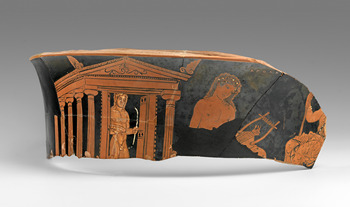
The Greeks had a rich vocabulary for what we nowadays call a ‘cult image’,Footnote 12 depending on the size, nature, and material of the images, as well as on the literary genre in which they were mentioned.Footnote 13 The earliest statues were probably of wood: a sitting one, such as Athena's in Troy, was normal for goddesses in archaic Greece, whereas male gods preferred the more manly attitude of standing (Figure 6).Footnote 14 Other divinities, however, could have aniconic statues: Apollo Agyieus regularly appears on coins as a conic column, and the famous image of Eros in Thespiae was only a rough stone.Footnote 15 Such statues coexisted with the more ‘normal’ figurative ones, which were much more decorated and colourful than the surviving examples suggest,Footnote 16 but in the course of the classical age aniconism started to sometimes evoke a certain ‘abnormality’ of the statue.Footnote 17 And indeed, strange statues of Artemis and Hera, but also of Dionysos, were regularly associated with festivals of reversal (Chapter IV, §3); sometimes these statues were considered so dangerous that they were tied up and only released once a year.Footnote 18 Heroes also had a statue and were often portrayed in armour, as many were believed to have been great warriors,Footnote 19 unlike, of course, healing heroes such as Asclepius. And, unlike images of Jesus or Mary in Christian churches, cult images were often shielded from the worshipers by a barrier, thus highlighting the distance between mortals and immortals.Footnote 20
Gilded bronze statue of Apollo in temple with adjacent picture of the god himself with his lyre. Fragment of south Italian (Taranto) red-figure calyx krater, c. 390 bc.

As with cult images, the Greeks also had a wide-ranging vocabulary for those officiating in sanctuaries, whom we usually range under the umbrella term ‘priest’; in addition, the terms used even varied from city to city.Footnote 21 In fact, the modern term covers a motley of functions, such as ritual experts, sacrificers, preservers of sacrificial knowledge, representatives of divinities, mediators between mortals and immortals – albeit not all of them all of the time.Footnote 22 Unlike their Roman Catholic counterparts, Greek priests could inherit their function and, unlike priesthoods in all modern mainstream religions, priesthoods could be bought in Asia Minor and the islands off its coast.Footnote 23 Priests distinguished themselves through their white or purple clothing, and on vases they are pictured with sacrificial knives, whereas priestesses are often pictured with metal keys, some of which have been excavated.Footnote 24 In fact, temples were usually closed to worshippers and only opened on fixed or festive days.
Male priests usually served for gods, and priestesses (Chapter VI, §2) for goddesses, but, as with sacrificial victims (Chapter IV, §2), there was no iron rule: Athena regularly had a priest. Priests performed sacrifices and guarded the treasures of the sanctuary. In larger sanctuaries special personnel did the more menial jobs, such as preventing birds from fouling statues, whereas in smaller, rural sanctuaries priests were not always present and worshippers themselves could sacrifice after having called for the priest in vain.Footnote 25 Rather strikingly, male and female adolescents sometimes occupied a priestly function in initiatory cults. This shows how different Greek priests could be from ours. The occasional appearance in the outfit of their divinities is another illustration of this difference; on Attic vases Athena's priestess is sometimes difficult to distinguish from the goddess. Was this identification perhaps a priestly strategy to increase status because Greek priests were always subject to the authority of the people and never managed to develop into a ruling class, as they did in India or ancient Israel?Footnote 26
In the end, though, it was the altar, not the temple or the statue, which was the real centre of a sanctuary, even though the temple itself may have been more important in rituals than is suggested by the literary tradition.Footnote 27 Several authors, who are all later than the fourth century bc, distinguish between a divine (bômos) and heroic (eschara) altar, the first being rectangular, monumental, and with a projecting step or stepped base, whereas the latter would be low, hollow, circular, and standing directly on the ground. As with the distinction between Olympian and Chthonic gods (Chapter II, §2), reality was more diverse, and various heroes had a divine altar.Footnote 28
2. Locations
Major sanctuaries outside the walls or situated at remote places played important roles in political federations and the birth of the polis. Delphi and Olympia developed in an especially spectacular way in the ninth and eighth centuries because here the aristocracies of the surrounding areas could meet and compete in games and conspicuous offerings, thus fostering a feeling of common Greek identity. Other sanctuaries away from major cities developed into centres of political federations, such as Poseidon's at Boeotian Onchestos and on the isle of Kalaureia, off Troizen. Finally, sanctuaries could mark the borders of a city's territory, such as those of Hera Lacinia and Apollo Aleos, respectively south and north of Croton in south Italy. They could even be used to strengthen ties with border areas, as the Peisistratids did by connecting Athens with the outlying sanctuaries of Brauron and Eleutherae. In short, the location of the sanctuary contributed to determining its social and political roles.
But why were some divine sanctuaries located in the polis and others not?Footnote 29 Some scattered settlements had kept their most important cults at the original places before constituting poleis and federations.Footnote 30 Yet there is also a more interesting aspect to location. If a sanctuary important for the religious life of the community is not situated in the heart of that community or at such a distance that citizens have to leave their familiar surroundings in order to worship, it is also possible that these cults are in some ways in opposition to those which occupied a more central location. As cults co-determine the character of gods (Chapter II, §1), an extramural cult may therefore point to an ‘eccentric’ or less central divinity.Footnote 31 Is this supposition true?
In the heart of the city we naturally find Zeus and Athena, who as polis gods par excellence had sanctuaries in the agora and on the acropolis, respectively, although Zeus's origin as weather god remained visible in his sanctuaries on mountaintops.Footnote 32 Apollo and Demeter were more ambivalent cases. Apollo's sanctuary was often located in the agora, as in Peloponnesian Argos, Cretan Dreros, and Crimean Olbia, but he was also worshipped away from the centre at the seaside, especially with the epithet Delphinios, or in the ‘suburbs’, as in the Athenian Lykeion. The differing locations probably reflect his own ambivalent position between adolescence and adulthood (Chapter II, §3).Footnote 33 When inside the city, Demeter's sanctuaries were nearly always away from inhabited areas and the agora, as in Corinth and Priene, except for Athens, where the Eleusinion was in the agora. As a general rule, they were situated in front of or somewhat outside the city, often on the slope of a hill, which fits Demeter's ‘eccentricity’ (Chapter II, §3).Footnote 34 Finally, sanctuaries of the birth goddess Eileithyia could be found near the city gate, except in Sparta (Paus. 3.14.6): there was no place in the heart of the city for a goddess closely connected with pollution.Footnote 35
Outside the polis we usually find sanctuaries of Poseidon,Footnote 36 Dionysos,Footnote 37 Hera, and Artemis. The Heraion was about 6–10 kilometres away from the city centre in Argos, Croton, and Paestum, and on Samos; on Paros it was situated in a hilly area. Hera's sanctuaries were connected with initiation and festivals of reversal; moreover, the rituals were often performed by women but concluded by men. Clearly, the Homeric picture of the quarrelsome wife of Zeus overlaid a much older, more complex cult.Footnote 38 Artemis’ sanctuaries could also be found in mountainous regions, but their distinctive feature was the closeness of rivers and swampy places – witness her epithet Limnatis (‘of the marshes’). This ‘watery’ environment was typical of Artemis, and the second-century rhetor Maximus of Tyre noted that ‘fountains of water, hollow thickets and flowery meadows are sacred to Artemis’ (8.1). Given Greece's aridity, these areas connected with Artemis must have been conspicuous for their moist, luxuriant lushness. As places of eternal spring they were particularly suited to girls in the full bloom of youth – a striking confirmation of Artemis’ initiatory function.Footnote 39
The location of hero shrines does not seem to have been very different from temples, although the former were usually simpler than the latter. They could be sited on prominent hills, in the midst of mountains (such as the temenos of Telephos on the Arcadian Mount Parthenion), or near springs (like the one at Attica where Makaria was worshipped). Heroes (never heroines) who had founded a city were often buried in the agora and clearly closely connected with the life of the polis;Footnote 40 in some cities, as in Athens and Thebes, there was even a secret heroic grave on which the safety of the city depended.Footnote 41 Some heroes’ shrines were situated near the city gates because they were the most vulnerable parts of the city, which therefore needed support from supernatural warriors: Apollo was also often invoked as defender of the gates.Footnote 42
Our analysis of the location of sanctuaries, then, has confirmed our discussion of the gods and heroes: those connected most with the political and social order also occupied central places in the Greek poleis. For a complete picture of Greek gods and heroes, the location of their sanctuaries cannot be neglected.
Finally, familiarity breeds contempt, as the proverb says, but does it also promote intimacy? In other words, was it religiously important to live close to a sanctuary? For the Greeks, of all the good relationships between humans, that between neighbours was considered to be best. It would hardly be surprising, therefore, if they also developed a special relationship with those gods and heroes whose shrines and sanctuaries were in their neighbourhood or even adjacent to their houses. In fact, many examples in ancient literature show that ‘a hero whose shrine was near an individual house might be “domesticated” and receive regular greetings and offerings from his mortal neighbours; in return, the hero was expected to influence the fortunes of “his” family’. If, indeed, our literary evidence mainly concerns heroes, this does not mean that the closeness of a divine shrine was considered to be insignificant. On the contrary: many Greek parents gave their children names that were expressive of the fact that a god was their neighbour (geitôn), such as Athanogiton (Athena), Damatrogiton (Demeter), Diogeiton (Zeus), Pythogeiton (Apollo), or just Theogeiton, ‘God's neighbour’. One may even wonder whether these names were not suggestive of a more personal devotion to a specific god.Footnote 43
3. Social, economic, and religious functions
Greek sanctuaries functioned in a much more varied way in society than modern churches or mosques do, as some examples of their social, economic, and political roles may illustrate.Footnote 44 Excavations as well as epigraphic and literary testimonia show that many sanctuaries contained temporary and permanent buildings which were used for dining; in some cases, as in Corinth, the cooking pots and drinking cups could still be recovered. In coastal or island sanctuaries, there is evidence for abundant consumption of fish. The small Greek houses offered little possibilities for larger groups to convene and a sanctuary was a secure place to meet, since it was divine property.Footnote 45 That is also why slaves, criminals, and political victims frequently sought refuge in temples through the ritual of supplication. As today, the number of suppliants could be considerable: Herodotus mentions the presence of 300 boys in a Samian sanctuary of Artemis (3.48). Not surprisingly, some sanctuaries had to set aside large tracts of land on which to house these ‘permanent pilgrims’.Footnote 46
Like many medieval Christian churches, major sanctuaries owned large estates to pay for their upkeep, personnel, and construction of new buildings, though the precise nature of their property remains a subject of debate, and the relationship of polis and sanctuary in this respect is often rather complicated.Footnote 47 Yet these estates also had a wider economic function. The land was leased and on Delos, for instance, we hear of farms, trees, barley, and vineyards.Footnote 48 And like the medieval Church – witness the dissolution of the monasteries by Henry VIII – rich estates stimulated greed. Many a sanctuary issued a sacred law to prohibit the grazing of its meadows and the cutting of its trees.Footnote 49 The land could even be so valuable that various wars were fought over the uncultivated land of the Cirrhaean plain below Delphi; comparable wars took place in Crete well up to the end of the second century bc.Footnote 50
Temples also functioned as reserve banks. According to Thucydides (6.20.4), in the debate before the second Athenian expedition to Sicily (415 bc) Nicias warned the Athenians that the Sicilians had not only considerable private means but also great wealth in the sanctuary of Selinus, where, as in other temples, objects of precious metal were safeguarded by countersigning them with names of gods. Indeed, the inventories of Greek sanctuaries, in which temple officials recorded the treasures and dedications (see below) of the temples at the end of their service, demonstrate the sanctuaries’ considerable wealth, the lure of which some people clearly could not resist.Footnote 51 Inventories also show that in times of need cities and their inhabitants happily borrowed from their gods but were not always as forthcoming in paying back. The gods were lenient creditors.Footnote 52
In addition to their economic function, temples played a role in political life. The first written laws in Greece were deposited in a sanctuary or actually inscribed on the more visible walls of the major temple of the city, such as the famous laws of Cretan Gortyn on the walls of the sanctuary of Apollo Pythios. Indeed, it was usually a sanctuary of Apollo that contained the laws, decrees, and treaties of a city, although the Athenians used the sanctuary of the Mother of the Gods, the Metroon, as their city archive. At least initially, the choice of a temple for ‘publication’ and preservation must have suggested inviolability and a binding character. When the Ephesian philosopher Heraclitus (c. 500 bc) deposited his work in the temple of Artemis (Diog. Laert. 9.6), his gesture may have been a continuance of this tradition.Footnote 53
But what about worship? Did all sanctuaries fulfil the same functions? That was not the case. Some of them were specialized, such as those for mysteries and healing cults (Chapter VII, §§1–2) or those that provided oracles. Divination has to uphold a certain amount of objectivity to remain credible and, consequently, major oracular shrines were situated at a fair distance from the territories of influential city-states: Homer knew of the wealth of Delphi (Il. 9.404–5) and far-away Dodona with ‘the Helloi, your interpreters, with unwashed feet, sleepers on the ground’ (16.234–5, trans. Janko 1992); Olympia, too, started as an oracular shrine before giving us the Olympic Games.Footnote 54 But some oracles were nearer home, such as those of Amphiaraos in Oropos, not far from Athens, Trophonios, not very far from Thebes, Didyma near Miletos, and Klaros on the edge of the territories of Notion and Colophon.Footnote 55 There is a certain difference between these faraway and near-to-home oracles. The former flourished especially in the archaic period and were consulted in such matters as colonization and land distribution, the great problems in the period of Greek state formation. The latter were more often consulted in matters of potential civic troubles. But in all cases ancient oracles assisted in making choices and setting the seal on collective decisions, rather than in predicting the future.Footnote 56 The crystal ball is a recent invention.
The main purpose of most sanctuaries, however, was to enable worshippers to sacrifice (Chapter IV, §2) and to make votive offerings, through which they could also express personal devotion.Footnote 57 Whenever the Greeks wanted to thank the gods and/or tried to obtain a favour, they could dedicate a votive offering, which would be a more lasting testimony than a sacrifice. Even though the extremes in value (poor painted wooden panels and rich gold and silver objects) have all but disappeared, just as the textiles that were once dedicated,Footnote 58 many inscriptions and votive reliefs have been preserved which allow us a unique glimpse into Greek religious practice. Through them we see who thought of the gods and why, where, and what offerings were thought suitable.Footnote 59
Thanks to the possibility of using very cheap material, all sections of society could make votive offerings, even though, of course, not only poor people dedicated modest votives.Footnote 60 Men, women, families – the gods were most hospitable. Sometimes, foreigners too made dedications to Greek gods. Herodotus mentions the many votives in gold and silver that Croesus offered (1.50–2, 90),Footnote 61 but he was not the only one to do so. In archaic times especially, many traders, in particular Phoenicians but also the occasional Etruscan, Lydian, and Egyptian, enriched Greek sanctuaries.Footnote 62
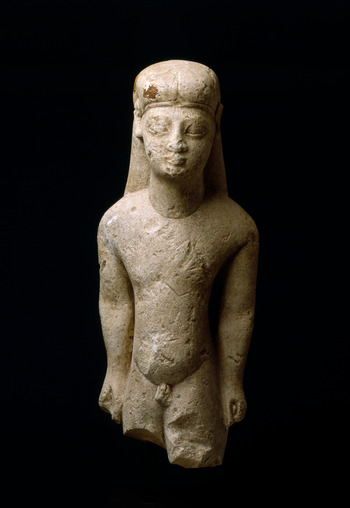
The ‘why’ of offerings is sometimes explained by the ‘what’ (and vice versa). After a victory, part of the booty could be consecrated, or soldiers dedicated their own weapons.Footnote 63 As here was a story to tell,Footnote 64 local sanctuaries thus served as a kind of museum, helping to keep collective memories alive, and, in a way, as lieux de mémoire.Footnote 65 A girl could dedicate her toys to Artemis on the eve of her wedding and a boy his statue (one of the famous kouroi) to Apollo on the occasion of his initiation, even if these were sometimes extremely small (Figure 7).Footnote 66 Healing gods received replicas of the limbs they had cured and so their sanctuaries were filled with arms and legs, vulvae and penises.Footnote 67 In other cases, worshippers dedicated figurines of divinities in their specific sanctuaries but also in those of other gods; once again, the gods were most hospitable.Footnote 68
A kouros could be small: this one from eastern Greece, c. 580 bc, is only 28 cm high.

Finally, there were costly gifts whose purpose was clearly not only to please gods but also to impress humans, such as those by Croesus; the gift of golden tripods to Delphi by Sicilian tyrants at the beginning of the fifth century was in the same vein.Footnote 69 Several states even had treasure houses, which were specially prominent at Delos, Delphi, and Olympia and served to store the valuable dedications of their citizens, but also to glorify the relevant poleis.Footnote 70 And people dedicated curiosities. In the Heraion of Samos, a jaw of a crocodile, teeth of a hippopotamus, antlers of an antelope, and eggs of an ostrich have been found. In the same sanctuary even living curiosities, peacocks, walked about.Footnote 71 In other words, some major sanctuaries must have looked like a kind of ‘curiosity shop’ or museum.Footnote 72 And what about the inside of popular temples?Footnote 73 An inventory of the Athenian temple of Asclepius describes in great detail where the dedications were located: a gold crown, iron finger-ring, and gold chain ‘at the ridge beam’, and a woman's face and ten silver reliefs ‘on the left as one enters. First rafter’. The inventory thus allows us to reconstruct the whole interior of the temple, which ‘must have closely resembled not the bare rooms of our drawings but the most jumbled and crowded antique store or museum store-room that most of us can imagine’.Footnote 74
Finally, dedications have a history, too. In the course of the archaic age, striking changes took place in the major Greek sanctuaries. A good example is the dedication of bronze jewellery in Olympia. An older investigation, the results of which still seem to reflect the chronological development, even if the precise numbers are out of date, noted only 49 finds from the period c. 1050–750 bc, but 948 finds from c. 750–450 and, again, only 77 finds from c. 450–150. These changes, which can be paralleled in other objects such as weapons, are not easy to explain.Footnote 75 They probably reflect the changing status of the aristocracy at the end of the archaic age, but other factors may also have played a role. The absence of informative texts prevents a clearer view in this respect.Footnote 76