In fish, peaceful associations between species such as cleaning (Francini-Filho & Sazima, Reference Francini-Filho and Sazima2008; Gasparini et al., Reference Gasparini, Luiz and Sazima2008) or following (Sazima et al., Reference Sazima, Krajewski, Bonaldo and Sazima2007; Félix & Hackradt, Reference Félix and Hackradt2008) are well known but others remain elusive due to their transient nature. As with crypsis, camouflage, schooling (e.g. Steele & Anderson, Reference Steele, Anderson, Allen, Pondella and Horn2006) or mimicry (Caley & Schluter, Reference Caley and Schluter2003), the association of one species to another for protection is one of many behavioural adaptations related to the avoidance of predation. Predation is a strong selective pressure that is considered important for the development of several morphological and behavioural characteristics of animals during both evolutionary and ecological times. Thus, decision making by prey appears to reflect an adaptative equilibrium between predation avoidance costs and vital needs (e.g. feeding and reproduction; Lima & Dill, Reference Lima and Dill1990). Here, we describe how a prey, the mackerel scad Decapterus macarellus (Cuvier, 1833), uses a potential predator, the Goliath grouper Epinephelus itajara (Lichtenstein, 1822), for protection during predation attacks by still another species, the horse-eye jack Caranx latus Agassiz, 1831.
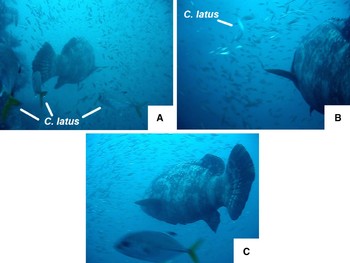
The observation was made during SCUBA fieldwork at the artificial reef Victory 8B, Guarapari, south-eastern Brazil (20°40′S 40°21′W), at 25 m depth. About 10 horse-eye jacks (30 cm total length (TL)) approximated and tried to attack a 300-individual mackerel scad school (~10 cm TL). The school assumed a denser formation and tightly surrounded one large (170 cm TL) Goliath grouper. Thereafter, the school followed the grouper into the water column away from the vessel until the whole group got out of view (Figure 1).
Sequence of anti-predatory behaviour: (A) Caranx latus approximating the Decapterus macarellus school; (B) C. latus attacking the D. macarellus school and the school assumes a denser formation while enclosing Epinephelus itajara; (C) E. itajara being followed by the D. macarellus school after the attack.

The Goliath grouper is a carnivorous teleost whose diet includes about 13% fish (Randall, Reference Randall1967) and is, thus, a potential predator of both scads and jacks. Risk assessment by the mackerel scad school obviously led to the decision that the grouper offered a lower danger of predation than the jacks while offering some protection against them. However, there is no evidence that the grouper actually presents a risk to either jack or scad. Even so, the present observation suggests that one behavioural decision made by a prey under risk of predation can be to seek shelter near another predator that offers a lesser danger.
ACKNOWLEDGEMENTS
We thank M. Hostim-Silva for his insights and corrections, Meros do Brasil project and Atlantes Dive Center (Guarapari, Brazil) for their help in fieldwork and Fundação de Apoio à Ciência e Tecnologia do Espírito Santo (FAPES) for financial support to the dives.