

1. Introduction
What were the effects of European colonialism on the economic fortunes of its colonies? A large literature continues to debate the answer to this question. One school of thought argues that European colonizers introduced extractive institutions benefiting the colonizers at the expense of native populations. In a widely cited article, Acemoglu, Johnson and Robinson (Reference Acemoglu, Johnson and Robinson2001) argue that Europeans were less likely to settle in large numbers in colonies with an unfavorable disease environment and hence high settler mortality. In such places, they argue that Europeans introduced policies to extract income and wealth from natives to benefit a colonial governing elite or the mother country. Over the long run, extractive institutions led to poor outcomes through weak property rights enforcement, low provision of public goods, and a small elite franchise (Acemoglu and Robinson, Reference Acemoglu and Robinson2012).
Such broad arguments yield insights, but in many colonies, it is unclear whether colonial institutions were effective in extracting income. Take British India for example. The argument that colonial institutions were extractive is based largely on nationalist histories emphasizing the “drain” of resources from India to Britain (Bagchi, Reference Bagchi1982; Chandra, Reference Chandra1991). In the nationalist view, the drain came largely from so-called Home charges (debt service, pensions, and railway subsidies) and private outflows (repatriated profits and remittances by employees of British firms).
But as argued by Roy (Reference Roy2002, Reference Roy2016) there are many conceptual and empirical problems with the drain argument. In particular, payments to British debt holders and foreign employees could be interpreted as fair compensation for services rendered or skills absent in India. The debate over colonial extraction and drain is, thus, far from resolved (Mukherjee, Reference Mukherjee2010; Satya, Reference Satya2008).
Our paper contributes to these debates by studying investor returns to Indian railway securities from 1869 to 1929. Railways figure prominently in critiques of colonial rule on account of guaranteed payments made to British investors.Footnote 1 Beginning in the 1850s, private British companies built the first Indian railways using London capital markets. To encourage investment, colonial regulations gave private investors a 5% guarantee on railway capital invested at a fixed exchange rate. If net earnings as a share of capital fell below 5%, the colonial government of India (henceforth GOI) used its own tax revenues to pay private railway investors the difference up to 5%. As it turned out, some early railway companies did not earn 5% and Indian taxpayers paid for the guarantees.
Beginning in the 1880s this model of privately owned and operated railways with 5% guarantees was phased out in favor of state ownership. First, the original guaranteed railways were effectively nationalized between 1879 and 1908. In a few cases the GOI took over ownership and operations from the original guaranteed company. In other cases, the GOI took ownership while operations were managed by a reconstituted private company with a minority ownership stake. Second, new railway companies were set up in a similar manner with a minority ownership stake and the GOI as the majority owner. These second-generation companies issued equities but received lower guarantees ranging from 3 to 4% for shorter duration. This was followed by a move to complete GOI ownership and operations in the 1920s.
Indian railways were thus financed in London using different securities: the 5% guaranteed securities of the original railway companies, equities from second-generation companies with lower guarantees, and finally bonds, mostly long term and at rates below 5%. These different securities offer a useful setting to examine whether colonial institutions were extractive in India.
The original 5% guarantees would appear to have been an ideal extractive policy for the British, and are described in the literature as a case of ‘private enterprise at public risk’ (Bhattacharya, Reference Bhattacharya2005). If guarantees were a vehicle for extraction, we would expect a higher financial return from investing in 5% guarantees compared to other Indian railway securities with less generous guarantees. More broadly, if colonialism led to extractive railway policies, we would also expect higher financial returns to Indian railway securities compared to other countries, especially those not under colonial rule.
We test these hypotheses using data from the Investors Monthly Manual (IMM). Our analysis builds on a new IMM database digitized by the International Center for Finance (ICF) at the Yale School of Management. The database has information on most securities trading on the London Stock Exchange between 1869 and 1929. Using these data, we construct annual returns for the main Indian railway securities. Our calculations show the average annual total return on guaranteed securities was only 3.7% between 1880 and 1908 when guaranteed securities were traded. By comparison, bonds had an average return of 4.6% up to 1908. Equities did even better, earning 7% up to 1929. Moreover, the Sharp ratio suggests guarantee portfolios had lower returns per unit of risk than portfolios with bonds or equities. In short, there is no evidence that guaranteed railway securities offered excessive returns to British investors when compared to other Indian railway securities.
We also undertake an event study of the GOI takeover of the guaranteed railway companies to explore another channel of extraction. The takeover procedure followed terms of the original contracts. Investors were paid the average share price in the three years prior to the takeover date. One might expect high investor returns leading up to takeover if institutions were generally extractive. For example, one could imagine a ‘gaming’ of share prices to increase the GOI purchase price, which would also increase the compensation of British investors. In our event study, we find no evidence on average of significant cumulative abnormal returns in the three-year window before takeovers.
In the final section, we show that the modest financial returns on Indian guaranteed securities stand in sharp contrast to those in other parts of the world. Using the IMM, we construct comparable annual returns to railway bonds in other countries. We find the return per unit of risk on a portfolio of Indian guaranteed securities was lower than railway bonds in Asia, Latin America, North America, Europe, and Britain. What explains the weak performance of Indian guaranteed securities? We argue that the 5% dividend guarantees bear some blame. Indeed, they contributed to higher operating costs and ultimately weaker financial performance.
Our paper contributes to three literatures. First, our results speak to the large literature on institutions dating to the seminal work of North (Reference North1991). Here, the recent focus has been on the effects of institutions on post-colonial outcomes (Acemoglu et al., Reference Acemoglu, Johnson and Robinson2001; Banerjee and Iyer, Reference Banerjee and Iyer2005; Green, Reference Green2018). Unlike these studies, we study the effects of colonial policies on colonial outcomes, like Juif and Frankema (Reference Juif and Frankema2018).
In the Indian literature, railway guarantees are an example of a colonial policy largely supporting British investors (Dubey, Reference Dubey and Singh1965; Sanyal, Reference Sanyal1930; Satya, Reference Satya2008; Thorner, Reference Thorner1951). But we show that guarantees did not generate large financial returns. Apart from guarantees, Sweeney (Reference Sweeney2009) argues that insiders, like the Rothschilds, made large profits underwriting Indian railways. Sunderland (Reference Sunderland2013) argues the relationship between London financiers and the colonial GOI was built on trust, favors, and a recycling of resources. Our findings of general investors earning modest returns are not inconsistent with these studies. Moreover, insider profiteering and reciprocal political and financial relations were common in early railroad investments. They were not unique to colonial India.Footnote 2
Second, our paper relates to the literature on the economic effects of Empire in India. To be clear, we are not arguing that all colonial institutions were benign. Income per capita in colonial India was very low. Famines were common. And other social indicators such as life expectancy and literacy remained low and stagnant for much of the colonial era. But our study of railways suggests that not all British colonial institutions were extractive. Is this argument true more generally? Others have pointed out that Indian firms did not fear British expropriation and were not subject to trade barriers within the Empire (Roy Reference Roy2016, Reference Roy2019). Also, capital flows from Britain to India were large and helped develop infrastructure.Footnote 3 Indeed, scholars highlighting extraction perhaps give too much agency to colonial rule. As Roy (Reference Roy2011) argues, the colonial state had limited ability to affect large positive or negative change because tax revenues were low. We think a comprehensive assessment of colonial rule first requires an assessment of individual colonial policies in key sectors. Our contribution is to highlight that guarantees in the railway sector, often cited as a source of drain, did not offer excessive returns to British investors.
Third and finally, we add to the literature on historical UK and overseas equity indices. This literature shows that securities for firms operating outside Britain yielded higher returns on average than securities for firms operating in Britain (Edelstein, Reference Edelstein1976; Goetzmann and Ukhov, Reference Goetzmann and Ukhov2006; Grossman, Reference Grossman2002). Our findings show that Indian railways were an exception to the general pattern of high overseas returns in London. We find the average return on Indian railway bonds was low and relatively stable, even though India was one of the least developed economies on the London exchange.
The rest of the paper is organized as follows. Section 2 provides a brief background on Indian railways. We describe the data in section 3. Section 4 discusses the returns to Indian securities. Section 5 assess the performance of Indian securities in the context of extraction theories. Section 6 discusses the event study. Section 7 compares Indian returns to other parts of the world, and section 8 concludes.
2. Background on Indian railway companies
Four phases mark the construction of colonial Indian railways. In the first phase from 1850 to 1869, private British companies constructed and managed trunk lines under a public guarantee. In the second phase, the GOI constructed railways in the 1870s. Beginning in the 1880s, the third phase, new public–private partnerships emerged between the GOI as majority owner and new private British companies serving as operators and minority owners. And in the fourth and final phase, the GOI began a takeover of rail operations leading to complete nationalization over time (Sanyal, Reference Sanyal1930). We summarize key issues in the first three phases that are relevant to our study.
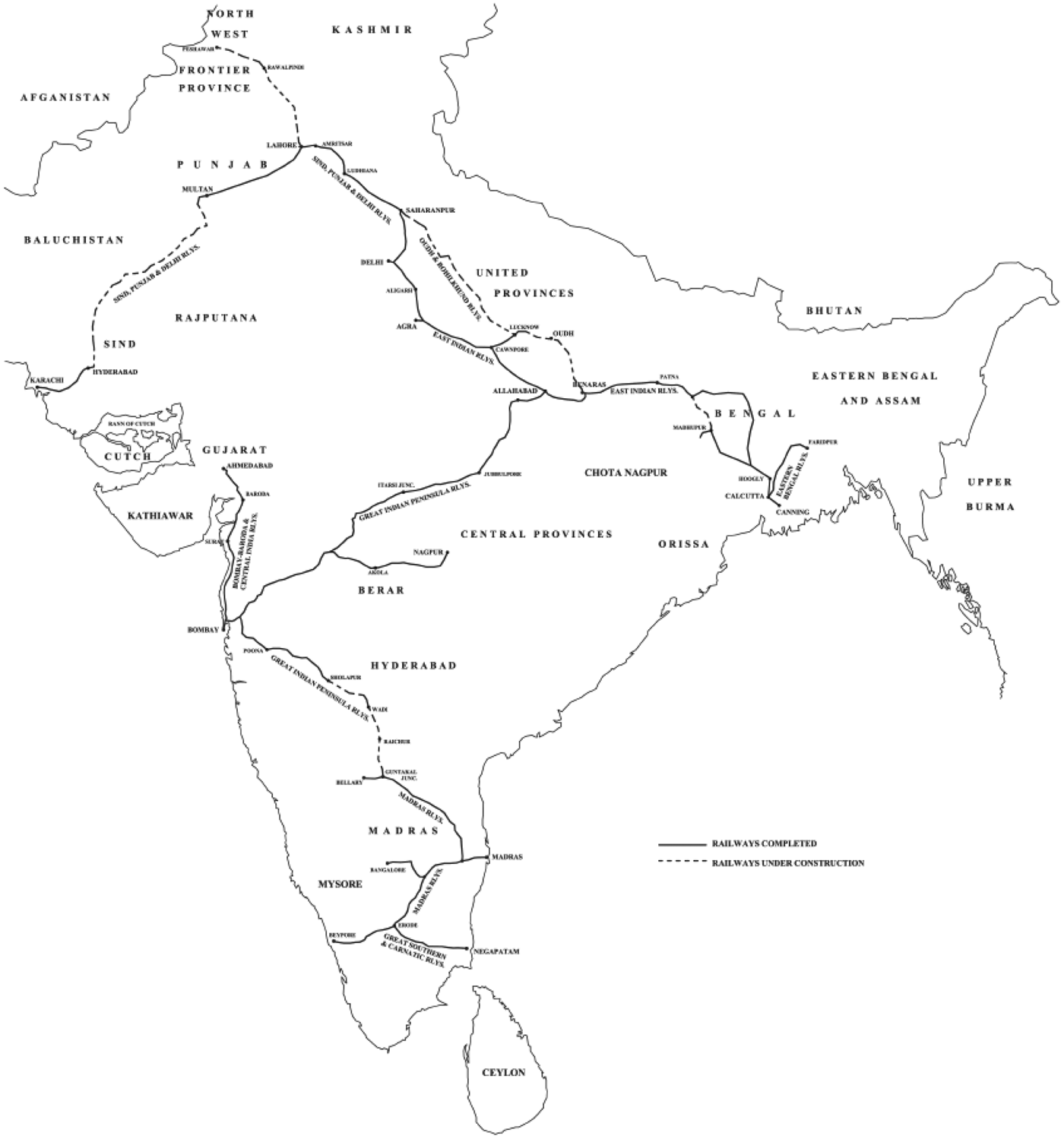
Two private British companies, the East Indian and Great Indian Peninsula, built the first Indian railways in the 1850s. Appendix Figure A1 shows an 1870 map of Indian railways. Such early companies were set up as joint stock companies under the oversight of both the Secretary of State for India in Britain and the GOI. While the GOI retained authority on route placement and gauge, the companies made other construction decisions (Kerr, Reference Kerr2007). They were given free land and received dividend guarantees. The GOI guaranteed a 5% return on the share capital at a fixed exchange rate for the entire duration of the 99-year contract. Such guarantee payments were treated as debt. When annual net earnings exceeded 5%, the company had to repay any past guarantee payments by transferring half of their surplus profits over 5% to the GOI. The company received the entire surplus profits, only after past guarantee payments were paid off.
Apart from guarantees, the companies could return the railways to the GOI with six months’ notice, while the GOI could buy the railways on the 25th or 50th anniversary of their original contract. If the GOI chose to buy the railways, they paid the shareholders the average market value of the shares trading in London over the past three years. Companies could also float debentures (i.e. bonds) to finance extensions. Some but not all of the debentures could be converted into shares.
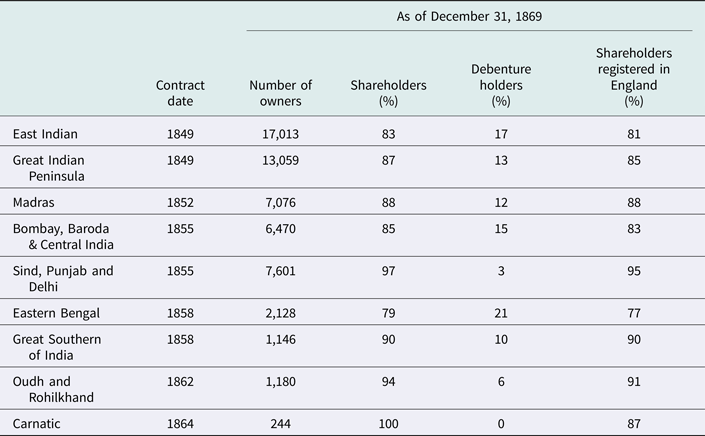
With contracts in hand, these guaranteed companies, as they came to be known, floated multiple securities on the London Stock Exchange. Most of the capital was raised through shares backed with the dividend guarantee. Table 1 lists the contract dates of the original guaranteed companies with a snapshot of their security holders as of 1869. Shareholders accounted for 89% with debenture holders accounting for 11%. Almost all the shareholders (97% on average) were registered in England. Even among the small number of shareholders registered in India, 44% were Europeans.
Guaranteed Indian railway companies, ownership

Notes: Great Southern of India was merged with Carnatic in 1874. The new company was named South Indian Railways. Table 1 is constructed from the Report to the Secretary of State for India in Council on Railways in India, 1868–1869, Statement No. 1.
Many early companies did not earn 5% and the GOI paid the difference using Indian tax revenues. Hurd (Reference Hurd, Raychaudhuri, Kumar, Desai and Habib1983) reports that all guarantee payments between 1849 and 1900 equaled to 568 million rupees. While sizable, Hurd points out that guarantee payments never exceeded 0.3% of national income in a single year. On account of their less than stellar performance, the GOI began to take over guaranteed companies as their contracts came due in the late 19th century. Other than three companies taken over on their 50th anniversary, the rest were taken over on their 25th anniversary.Footnote 4 The takeover dates ranged from 1879 to 1908. In five cases, the GOI signed new contracts with directors of the former companies to operate their railways after takeovers. Here, the GOI purchased three-quarters to four-fifths of the shares of the original company. On purchase, the former shareholders were paid in the form of annuities that also traded on the London Stock Exchange.Footnote 5 A minority of shareholders deferred their annuities and formed a reconstituted company, which managed operations under a new 25-year contract. The five companies split profits with the GOI in proportion to their capital share. They also received lower guarantees on their share capital ranging from 3.5% to 4.5%. In the case of the three remaining guaranteed companies, the GOI took over ownership and operation at purchase.
Government takeovers marked a significant ownership change in Indian railways. The major railway systems went from universal private ownership with 5% government guarantees to majority GOI ownership, albeit with private operations in many cases. Perhaps surprisingly, this transition led to an improvement in operating performance. For example, Bogart and Chaudhary (Reference Bogart and Chaudhary2012) find that working expenses within the same railway system fell by 13%.
Apart from taking over the original guaranteed companies, the GOI also experimented with state-owned and -operated railways in the 1870s. But this second phase was short-lived and gave way to new second-generation railway companies in the third phase. Here, the GOI owned a majority of the capital, often up to 75%, with a private British company owning the rest. The company managed railway operations and split profits with the GOI in proportion to their capital share. These companies also raised capital in London using a combination of equity and debt. Unlike the original guaranteed companies, their share capital was backed by lower guarantees ranging from 3 to 4%. Other terms of these contracts were also less generous than those of the original guarantee companies.
The public–private partnership model was common up to the 1920s when the GOI began taking over the operating companies leading to the eventual takeover of all railway operations. The changes during the 1920s reflect a new policy regime where Indians had greater control over railways.Footnote 6 We focus on financial returns to railway securities in the period when British control was at its peak.
3. Data
Our data come from the IMM as digitized by ICF at Yale. We use their database referencing the hard copies when necessary. IMM reports monthly data on securities that traded on the London Stock Exchange from 1869 to 1929.
While scholars such as Grossman (Reference Grossman2015) have used these data to construct returns to British and overseas equities, Hannah (Reference Hannah2018) notes problems with Grossman's (Reference Grossman2015) figures on UK equity using these data. We address Hannah's concerns by comparing Indian railway securities listed in the IMM with other administrative sources. We cannot speak to the UK-specific issues, but in the Indian case we find the IMM includes all the Indian railways securities trading on the London Stock Exchange. Moreover, their capital information matches other reported sources.Footnote 7
The Yale–ICF database includes all the published IMM series. It also adds new variables such as country code and security type. But ICF does not share the instructions given to the coders, which makes it hard to interpret some series. We describe these issues below. We first use the country code to select securities from India, Bangladesh, and Pakistan. Colonial Indian railways crossed the borders of these countries. We exclude Burma because it was a separate colony from 1937 up to its independence in 1948. We then select railways using the industry code.Footnote 8 Indian railway companies were often British companies operating in India. Our understanding is that ICF uses the primary place of business to code the country.
ICF codes the type of security as follows: (1) government bond, (2) common equity, (3) corporate bond, and (4) preferred stock. ICF does not explain how they code security types. Based on our analysis of Indian security names, we believe they used the following rules. A corporate bond is any security with an interest rate or the word “debenture” in its name. A preferred stock is any security with the word “preferred” in its name. The remaining securities are common equity. As described in section 2, guaranteed railway companies floated shares backed by a GOI dividend guarantee. ICF codes three guaranteed securities as common stock. But the remaining securities are coded as bonds. In the IMM hard copies, these securities are listed as company name followed by “guaranteed 5 percent by Indian Gov.”
We create a new coding for Indian railway securities. First, we code the guaranteed securities of the original railway companies.Footnote 9 Second, we code any security with the word “debenture” or “bond” as a corporate bond. Bonds were issued by original guaranteed and second-generation companies. Third, we code the remaining securities as equity, including preferred shares. This group includes securities associated with the second-generation railway companies. None of these companies were floating pure ordinary shares. Most received guaranteed interest for at least a few years. But their terms were less generous than those of the original guaranteed securities. Hence, we bin them with preferred shares. The label “equity” separates them from guaranteed securities and corporate bonds.
We construct the annual market capitalization of railway securities using the end of January price. If it is missing, we use the monthly open price. We exclude securities with stock splits, identifying them using changes in the par value of a security. Since par value is missing for some securities, we also drop securities if their price ever changes by more than three times over the previous January. Such large swings are stock splits or data entry errors.
Market capitalization of a security is the number of shares multiplied by their market price. To calculate market capitalization, we use the series on capital subscribed and capital amount per share. The number of shares is capital subscribed divided by the capital amount per share. But in many cases, the capital subscribed is reported as market capitalization of the security at par, often 100 for Indian railways. Such securities are identified as “stock” in the capital amount per share series, or in their name. In this case, we calculate the number of shares as capital subscribed divided by 100. For example, Bengal Nagpur had a fully subscribed capital of 3,000,000 in January 1913. The closing price was 114, which implied that it traded at 14% above par. Therefore, its market capitalization was 1.14 * 3,000,000 = 3,420,000.
IMM changed the reporting of dividends in this period. On account of ambiguities in reported dividends in the 1870s, we use the series “last two dividends at latest price per cent.” This series is reported from 1879 to 1929. So we report dividend yields for this period, and capital gains from 1869 to1929.
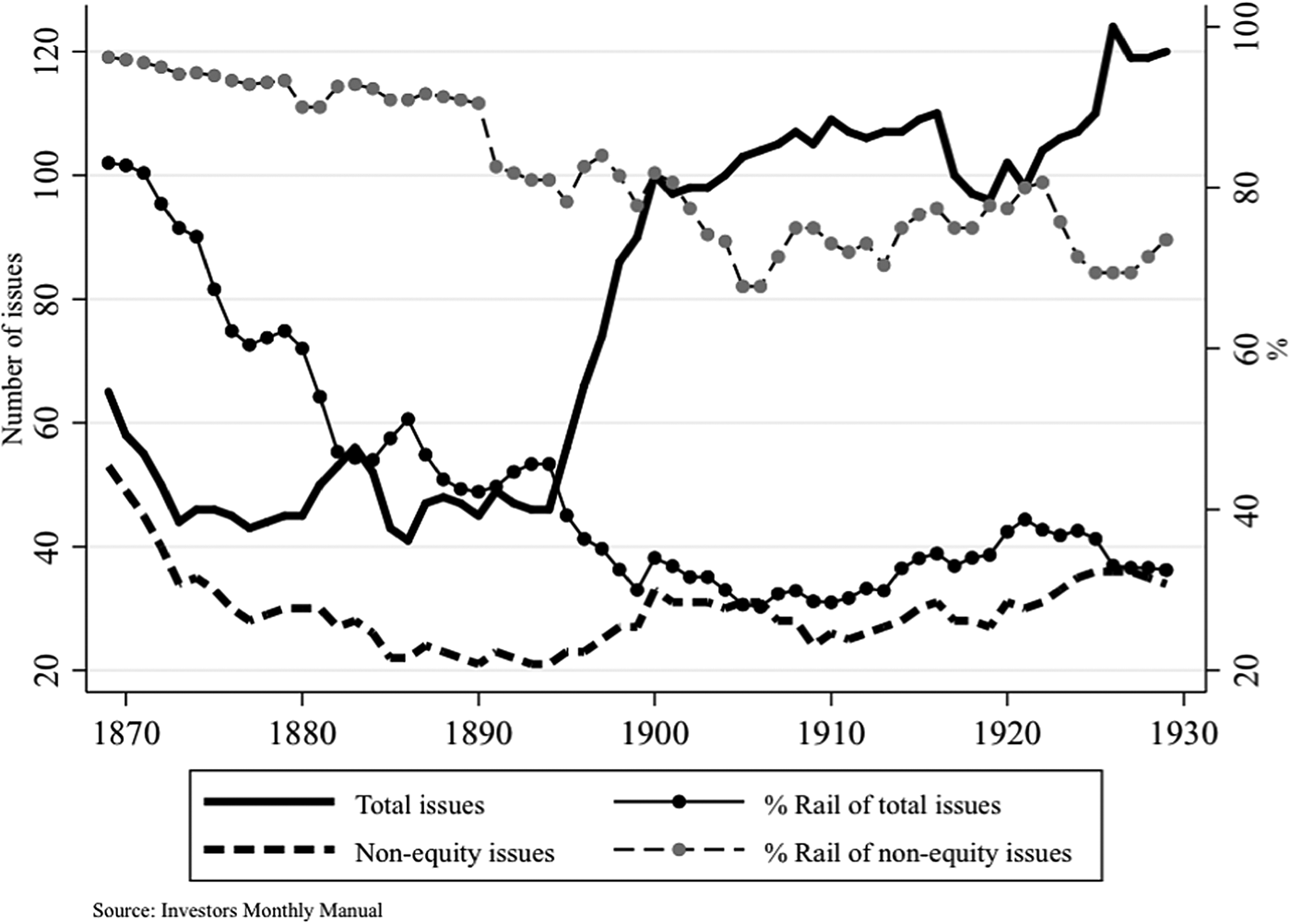
Figure 1 shows the total number of Indian securities trading on the London Stock Exchange. The y-axis to the left shows the number of issues, while the y-axis to the right shows the percentage of rail issues to total issues and the percentage of rail non-equity issues to total non-equity issues. The total number of Indian securities increased from 65 in 1869 to 120 in 1929. While railways dominated Indian issues early, accounting for 80% of issues in 1869, they declined to just under 40% by 1929.
Indian issues, London Stock Exchange, 1869–1929

Most early issues were the guaranteed securities and railway corporate bonds. These two groups accounted for 54 issues in 1869. The picture began to change in the 1890s. More equity-financed non-rail companies raised money in London. Within railways there was a shift away from bonds and guaranteed securities. Non-equity rail issues as a percentage of total non-equity issues decreased from close to 100% in 1869 to around 70% in 1929.
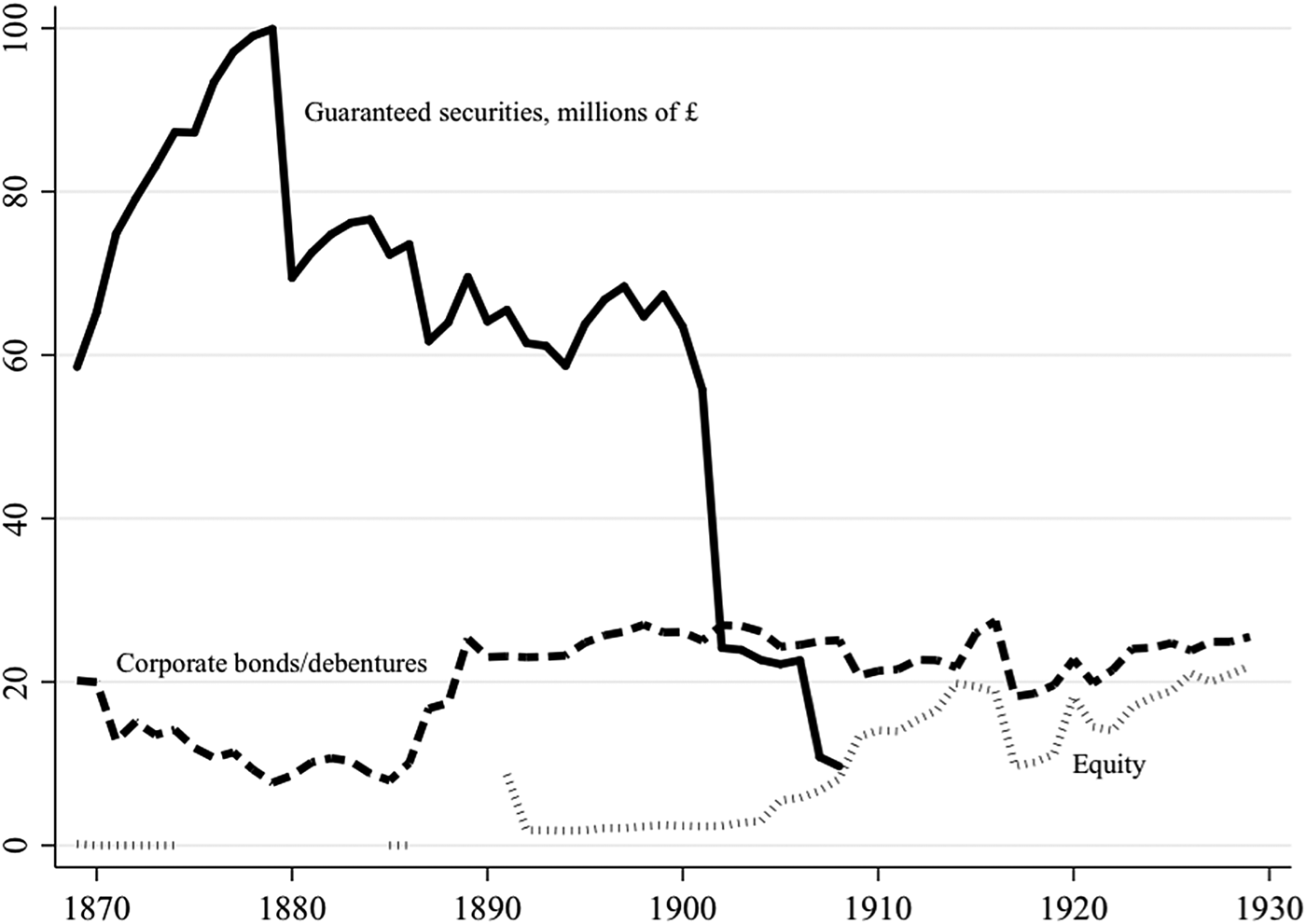
Figure 2 shows the market capitalization of Indian railways by security. The original guaranteed companies were the big players in the 1860s and 1870s, reaching almost £100 million in the late-1870s. Their sharp declines match the GOI takeovers of these companies. Bonds became the main source of financing extensions in the 1900s accounting for around £25 million in market capitalization as of 1929. Equities were small early on, but they caught up with bonds by 1929.
Indian railways market capitalization, millions of £, 1869–1929

4. Returns to Indian railway securities
We construct the total returns to any security as the sum of capital gains and dividend yield. In any year t, the capital gain is the increase in the value of the security in January compared to the previous January as shown below:
 $$(P_{t\; } - P_{t - 1})/P_{t - 1.}$$
Here, P t is the price of the security in year, t. The dividend yield is calculated as D t /(P t−1 ), where D t is the annual dividend paid to shareholders. In our estimates, we use the reported dividend yield series that begins in 1879. As a result, we construct capital gain indices from 1870 to 1929, but total returns from 1880 to 1929. Some securities ‘exit’ the data. We assume investors were paid the market value on the last January the security was traded.
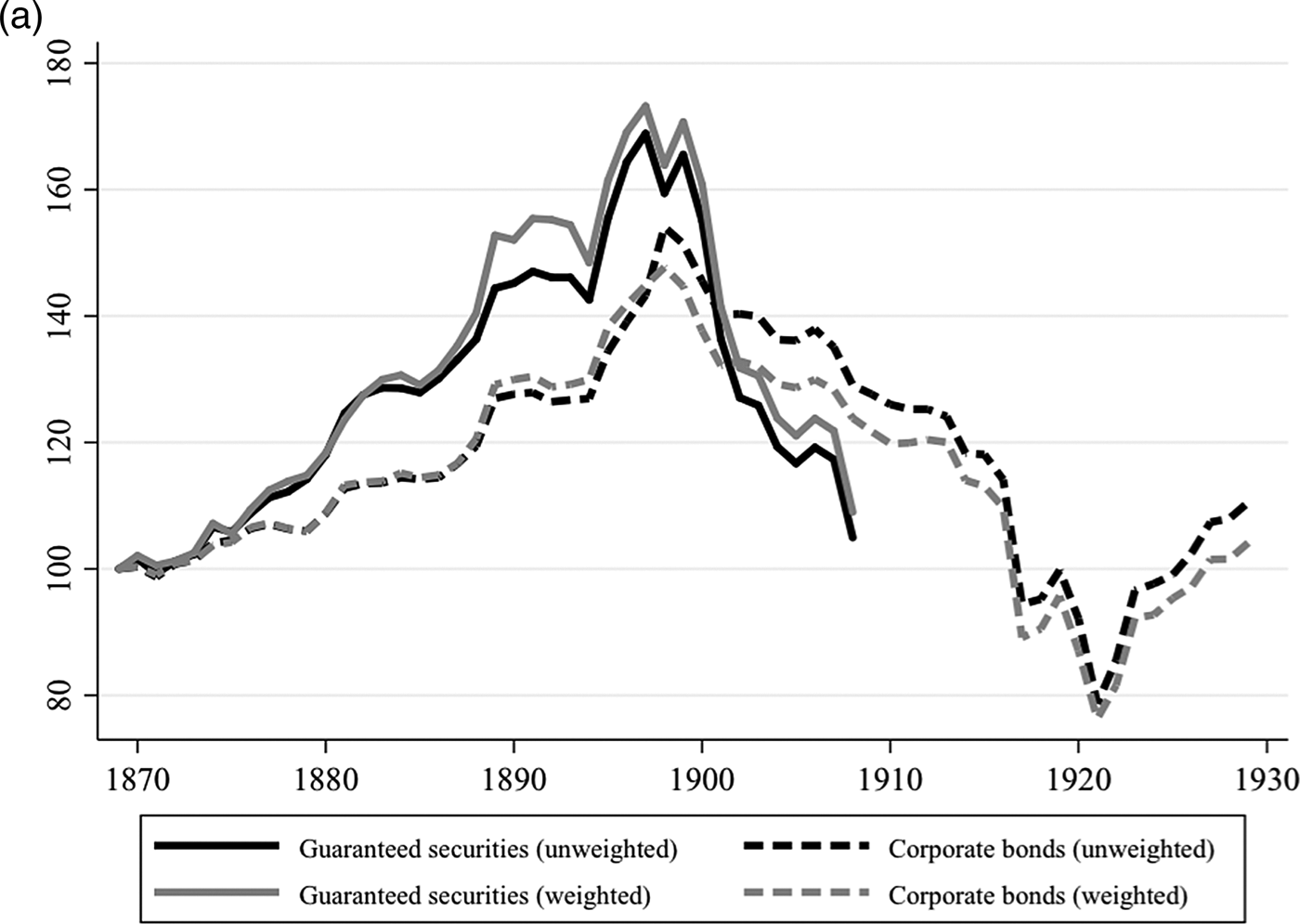
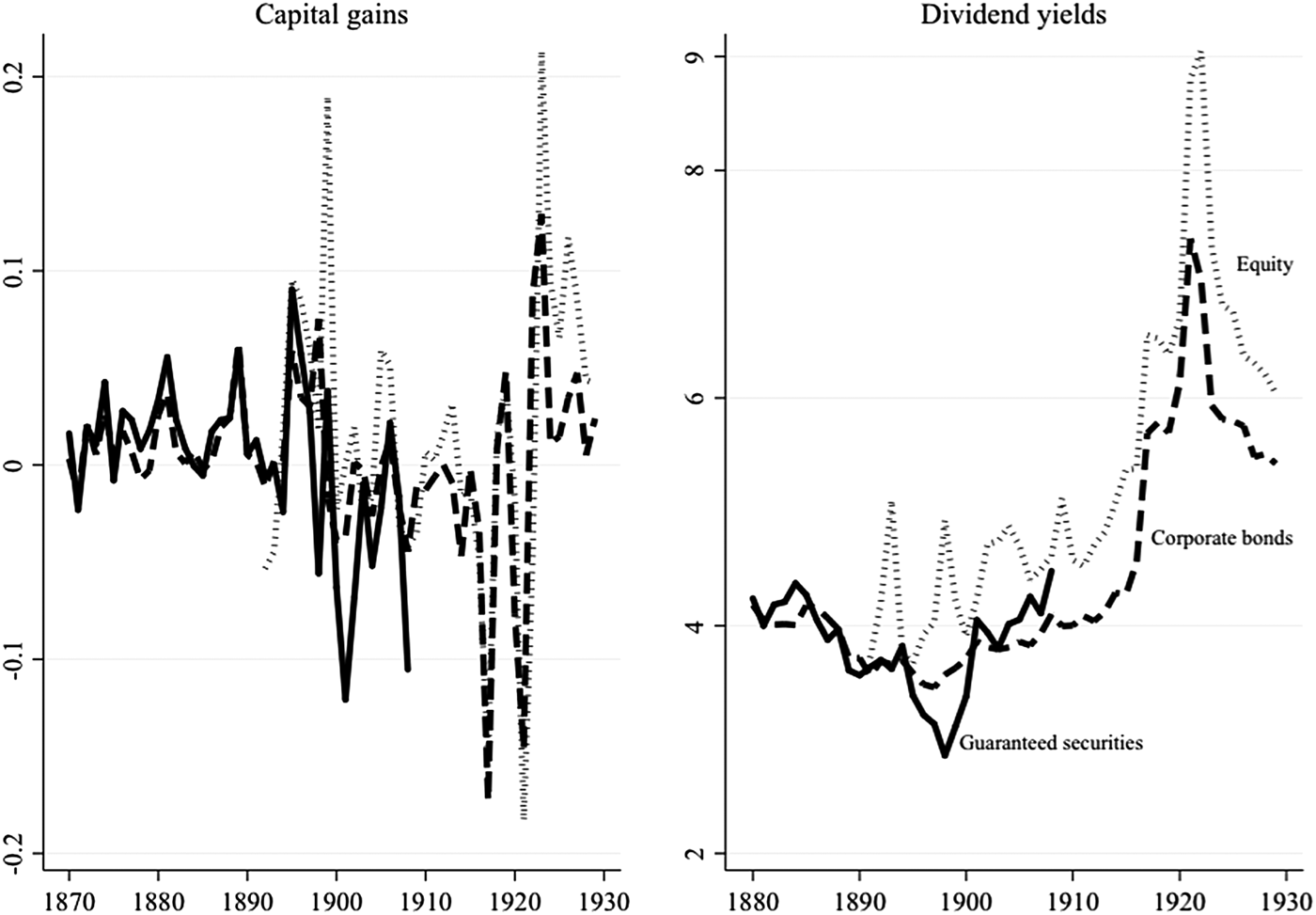
Figure 3a shows the unweighted and market capitalization weighted capital gain indices for bonds and guaranteed securities. Several important patterns stand out. First, the capital gains to guaranteed securities and bonds were both positive in the 1870s and 1880s. Second, the capital gains to holding guaranteed securities were higher than bonds up to the late 1890s. Third, the capital gains on guaranteed securities turned negative after 1899, reducing the index of capital appreciation. In 1899, there were three remaining guaranteed railway companies. Their share price saw significant declines over the next few years before they were taken over. Apparently, investors were more pessimistic about their potential at this point. The pessimism was less significant for railway bonds as that index fell less in the early 1900s. Fourth, World War I was associated with a decline in the capital value of Indian railways, followed by a partial recovery in the 1920s.
Indian railways capital gain indices (1869 = 100)

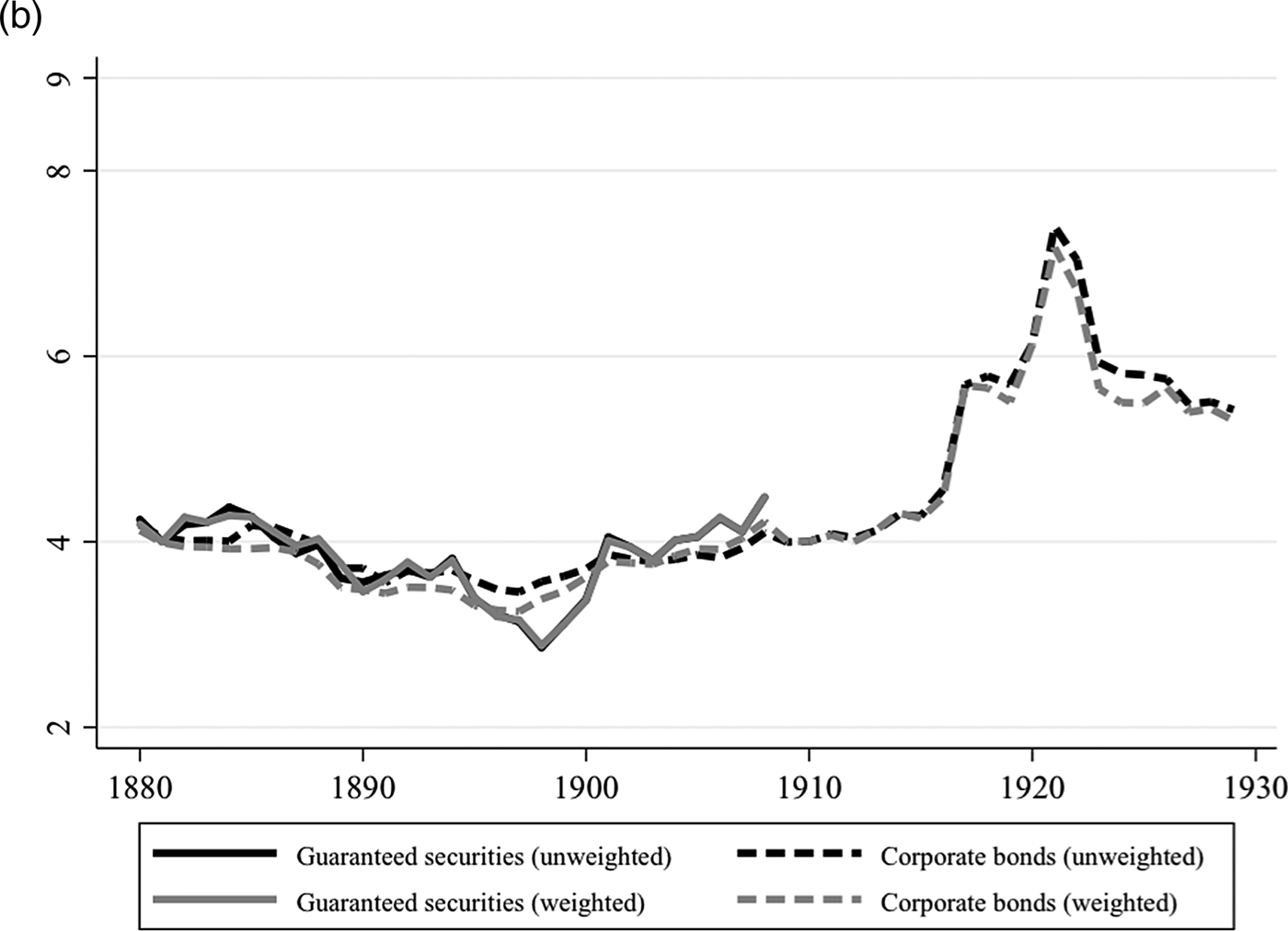
In Figure 3b, we show the dividend yields for the guaranteed securities and bonds. Similar to the capital gain series, weighting does not change the picture. Dividends were stable, averaging around 4% up to 1913. World War I contributed to the increase in the 1910s. The higher yields reflected the lower prices of railway bonds, not the higher dividends. Figure 3c compares capital gains and dividend yields for common equity to the non-equity securities. Since there are no railway equities in the 1870s, we show capital gains in Figure 3c, not capital gain indices. Railway equities experienced bigger highs and lows. Equities also paid higher dividends than bonds averaging 5.4% from 1892 to 1929. Bonds averaged 4.5% for the same period.
Indian railways dividend yields

Non-equity and equity Indian railways, unweighted

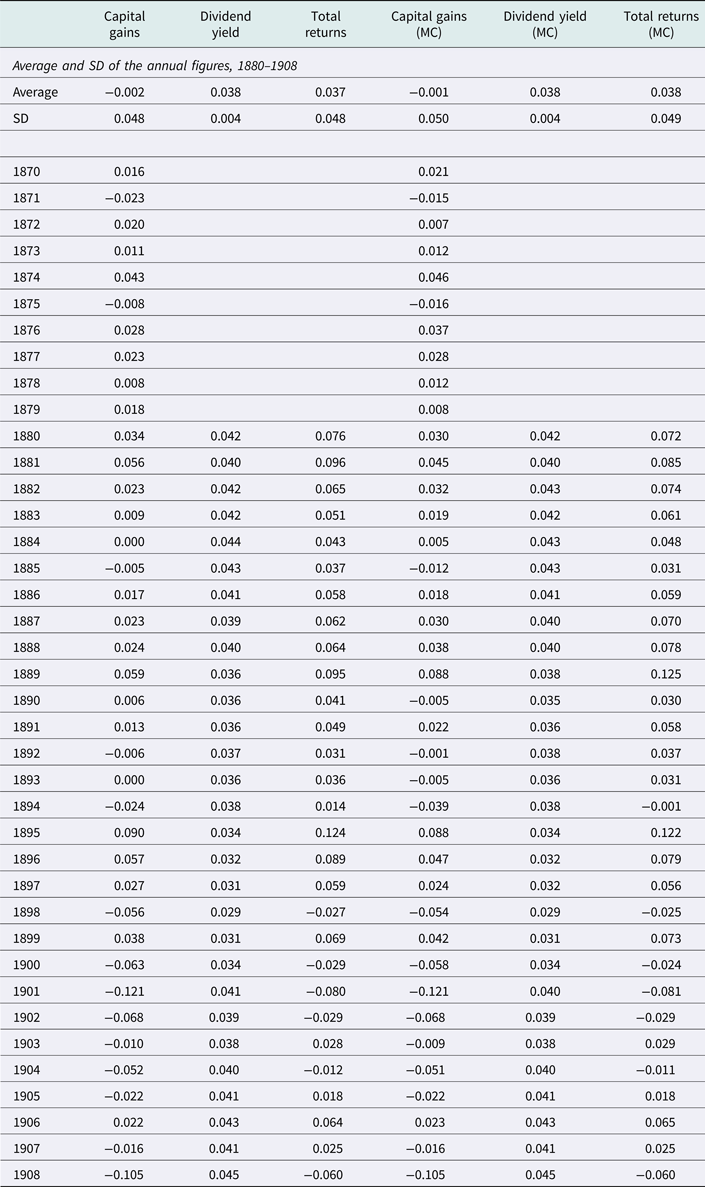
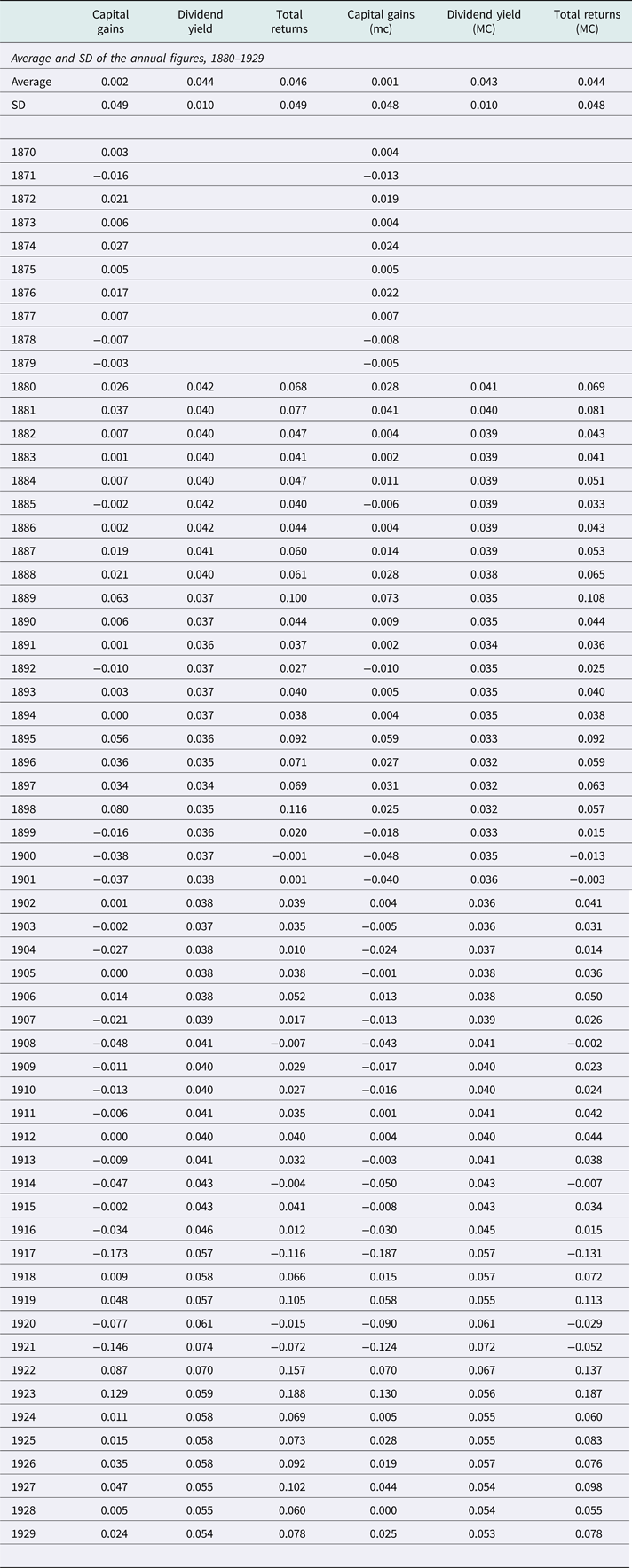
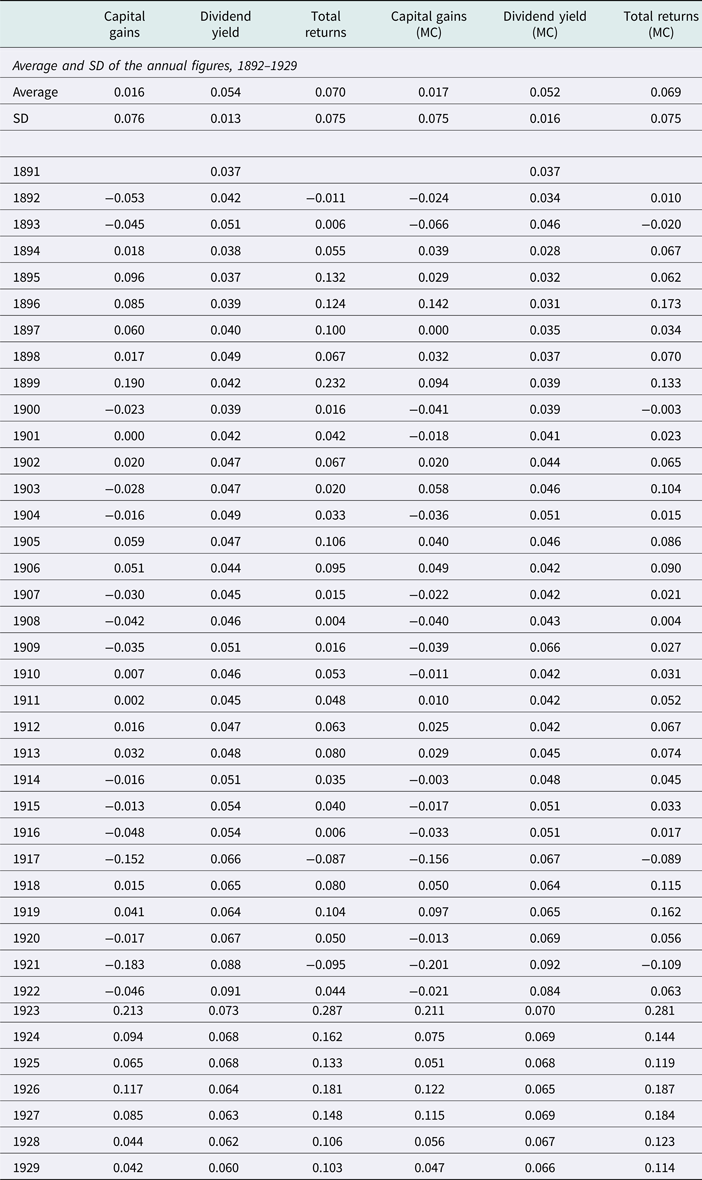
Tables 2a–c summarize the total returns by security type. The summary statistics apply to the period in which each security was observed (up to 1908 for guaranteed and after 1892 for equities). The next section discusses the implications of these series for debates surrounding extractive policies.
Capital gains, dividend yields and total returns, guaranteed securities

Note: MC refers to market capitalization weighted series. SD is standard deviation.
Capital Gains, Dividend Yields and Total Returns, Corporate Bonds

Note: MC refers to market capitalization weighted series. SD is standard deviation.
Capital Gains, Dividend Yields and Total Returns, Equity

Note: MC refers to market capitalization weighted series. SD is standard deviation.
5. Guaranteed securities and extraction
The guaranteed railway securities offer a useful context for studying the extractive nature of colonial policies in India. While the stated aim of guarantees was to promote investment they had a side benefit, namely generating a minimum return on British capital invested in Indian railways. Equities usually carry an upside potential and a downside risk. But in the case of guaranteed securities, the GOI eliminated the downside risk. The shareholder would never miss a dividend and had the potential to earn exceptional dividends in some cases. Of course, someone had to pay for the guarantees if companies failed to earn a 5% return. That burden fell on Indian taxpayers. Since they bore the downside risk, guarantees were potentially an extractive policy transferring money from Indian taxpayers to British investors.
Such an argument suggests that the total return on guaranteed securities should be higher than securities without guarantees. We do not observe railway securities with no guarantees in India. But we do observe returns on securities with lower guarantees. For example, railway bonds paid 3 to 4.5% interest, whereas the original guaranteed securities paid a 5% guarantee. Our analysis therefore compares the returns on the 5% guaranteed securities to railway bonds in the years when both securities are observed. We also compare guaranteed securities to equities. As noted in section 3, equities include the securities associated with the second-generation railway companies and preferred shares. They had lower guarantees, usually between 3 and 4%.
We do not find strong evidence in favor of extraction. As shown in Table 2a, the average total return on the unweighted portfolio of guaranteed securities was 3.7% from 1880 to 1908. The total return on the unweighted portfolio of railway bonds was 4.6% for the same period. A closer inspection shows that guaranteed securities yielded similar total returns to bonds from 1880 to 1899. But investors soured on the original guaranteed securities after 1899 when there were only three guaranteed companies remaining. Their share price saw declines over the next few years before they were taken over.
We also find the original guaranteed securities had lower returns than equities. The average total return on the unweighted portfolio of railway equities was 6.5% from 1892 to 1908. In the same years, the guaranteed portfolio earned an average total return of 1.9%. Strikingly, the securities with the highest guaranteed return on invested capital yielded the lowest average total return in the market. Their upside potential was not realized and over the longer term they fared worse.
Investors care about risks and returns. Perhaps the main benefit of guarantees was to reduce risk. If so, we would expect the standard deviation (SD) to be lower for guaranteed securities compared to equities and perhaps even to bonds. The SD turned out to be higher for the portfolio of guaranteed securities between 1880 and 1908 (0.048 unweighted guaranteed securities versus 0.029 for bonds). The SD is slightly higher for equities compared to guaranteed securities and equities between 1892 and 1908 (0.054 guaranteed securities versus 0.062 MC equities). As Table 2c reveals, equities also had a higher SD up to 1929, but much of that was due to the volatility of World War I. In short, guaranteed securities did not offer any lower risks to investors ex post.
Calculations of the returns per unit of risk further show that guarantee securities were inferior. The Sharpe ratio characterizes the returns per unit of risk for a portfolio. It equals the average total return minus the risk-free rate divided by the SD. We use the interest rate on UK government debt from 1880 to 1913 (2.85%) as the risk-free rate. We believe it provides a good comparison for Indian railway securities traded in London before World War I. Our calculations show that the Sharpe ratio for a portfolio of guaranteed securities was much lower than for railway bonds between 1880 and 1908 (0.17 guaranteed compared to 0.59 bonds). The Sharpe ratio also strongly favors equities between 1892 and 1908 (0.51).
6. Guaranteed railways, takeovers and abnormal returns?
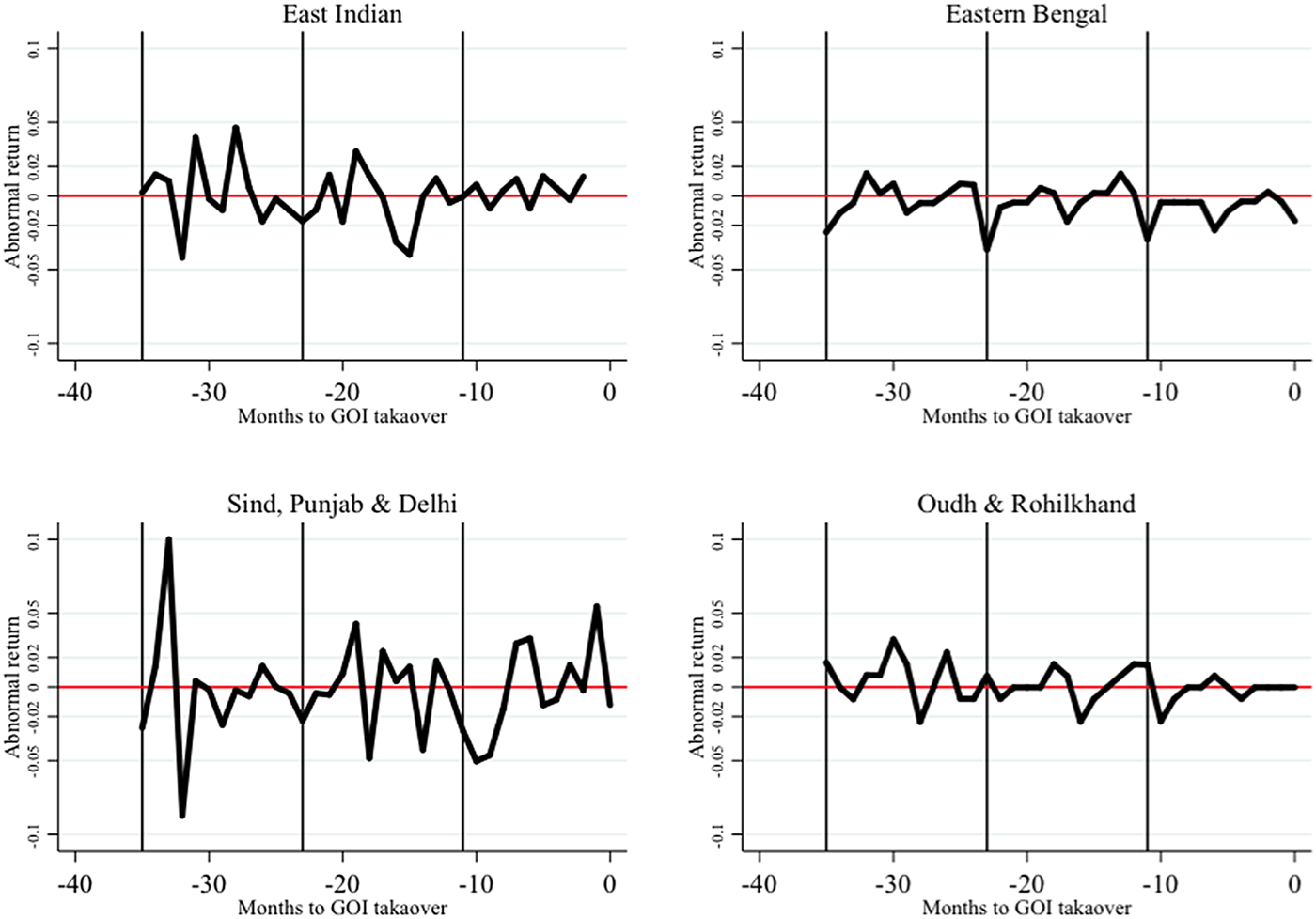
Next, we examine whether the takeover of the guaranteed companies significantly benefited British investors. As discussed earlier, the original guaranteed railways were partially or completely nationalized between 1879 and 1908. Investors were paid the average stock price in the three years prior to the takeover date. One might expect high investor returns leading up to takeover if such policies were designed to be extractive. For example, one might imagine a “gaming” of stock prices to increase the GOI purchase price. We use an event study to test for such abnormal returns in the three years leading to takeover of the original guaranteed companies.
Event studies are used to test how investors respond to firm-specific or macro events using daily data. In our case, we do not have daily data on stock prices. Rather, we adapt the event study methodology to our monthly returns. In particular, we define the event as the GOI takeover and the event window as the three-year window before takeover. Here, the sample includes only guaranteed securities for companies that were taken over. We define the estimation window as the three-year window up to four years before takeover. For example, the Great Indian Peninsula Company was taken over in June 1900. Its event window extends from July 1897 to June 1900, while the estimation window runs from July 1893 to June 1896. We drop the year immediately before the three-year window because it could be contaminated by discussions of takeover.
We estimate firm-specific abnormal returns, Average Abnormal Returns (AARs), across firms, Cumulative Abnormal Returns (CAR), which involves adding the abnormal returns for each month within the event window or a subset thereof, and Cumulative Average Abnormal Returns (CAAR), which involves averaging the CAR across firms.
In a standard market model, the individual return of a firm is regressed on a market return in the estimation window. But the choice of market return is unclear in our context. Although these guaranteed securities traded in London, they appear to be uncorrelated with a British domestic equity index. To get around this problem, we use the Comparison Period Mean adjusted model.
Here, the abnormal return is defined as:
 $$AR_{it\;} = \; R_{it\;} - \; \overline {R_{i\;}} $$
where  $\overline {R_{i\;}} $ is the mean return of the security in the estimation window. Using the individual abnormal return, we construct the cumulative return for each guaranteed security as follows:
 $$CAR\lpar {t_{1\;}, t_{2\;}} \rpar =\mathop \sum \nolimits_{t = t{1}} ^{t_{2}} \;AR_{it}$$
Here, we define t 1 and t 2 as the beginning and end dates of our event window. We also present CAR results for windows 1 year, 6 months, and 3 months leading to takeover; and the CAAR for GOI takeovers as the average of the CARs across all guaranteed securities:
 $$CAAR = {1 / N} {\mathop \sum \nolimits_{i = 1}^{n} CAR(t_1,\; t_2)}$$
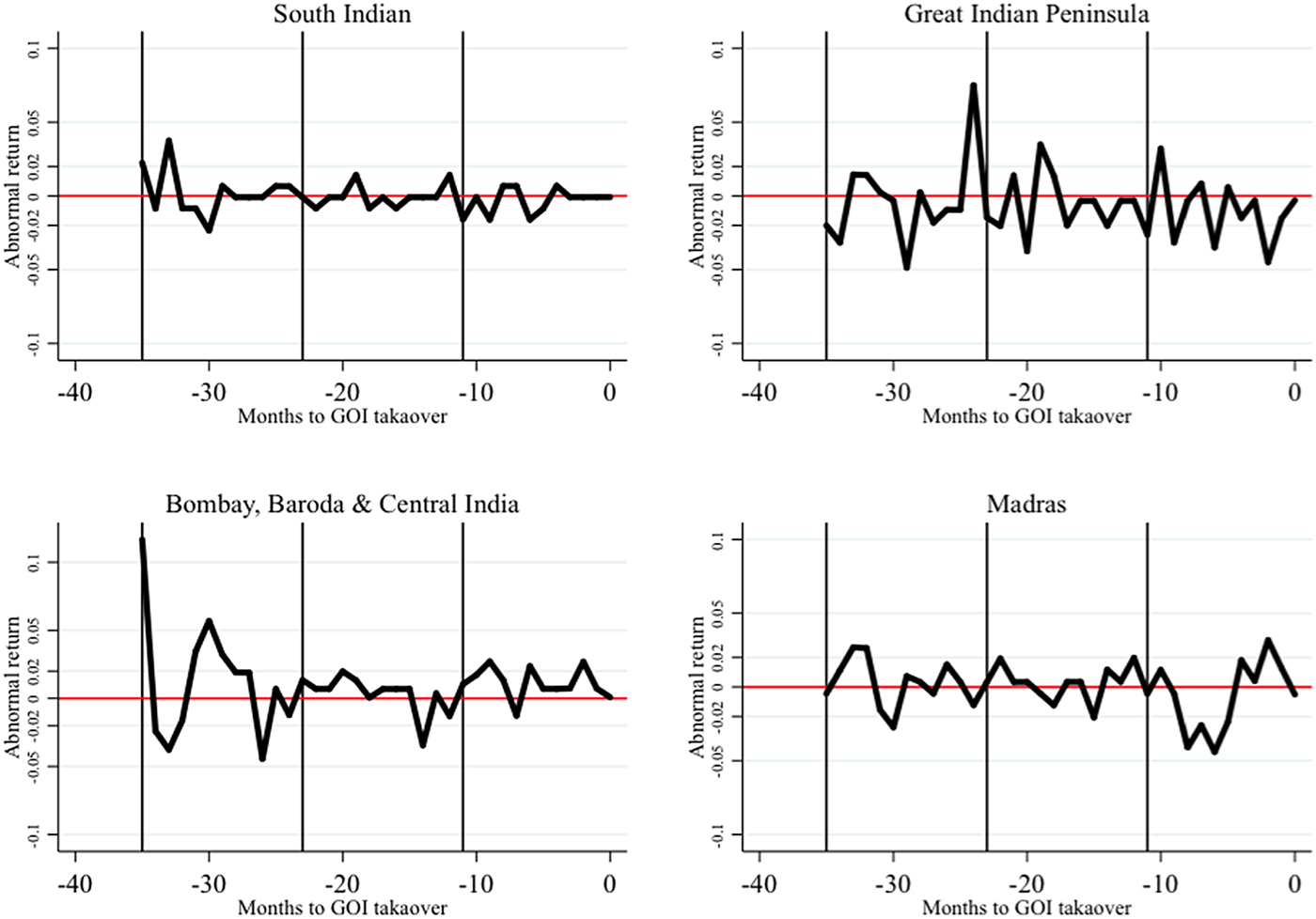
Figures 4a and 4b plot the abnormal returns for the eight guaranteed securities in their three-year window before takeover (i.e. the event window). We plot the railways in order of takeover. No clear patterns of excess returns jump out. Abnormal returns trend mildly positive for the East Indian company in the year leading to its takeover, but the effect size is economically small. In comparison, abnormal returns of the Eastern Bengal Railways trend mildly negative immediately before takeover. Companies like the South Indian and Oudh and Rohilkhand are flat in the year before takeover.
Abnormal returns by original guaranteed railways I
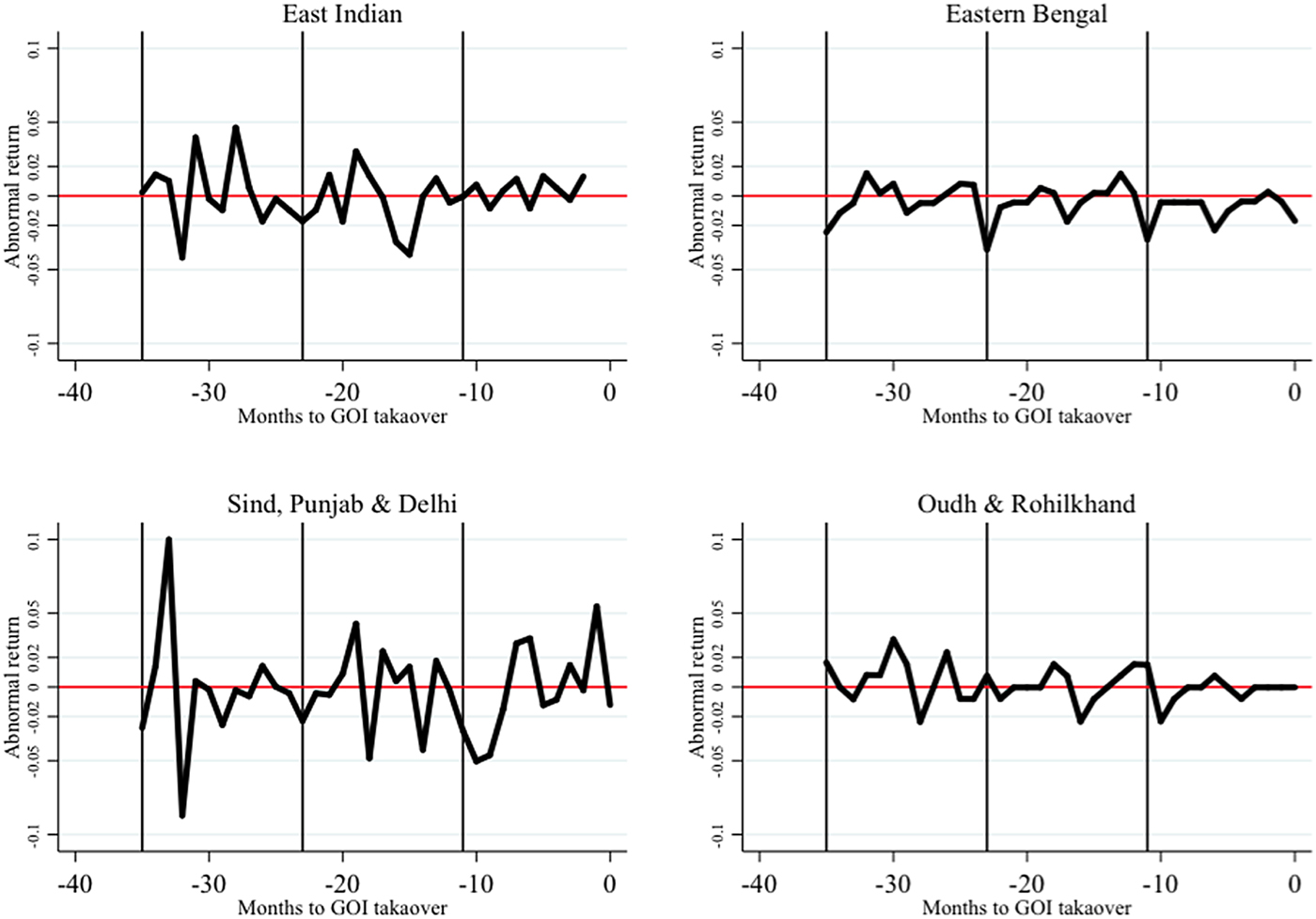
Abnormal returns by original guaranteed railways II
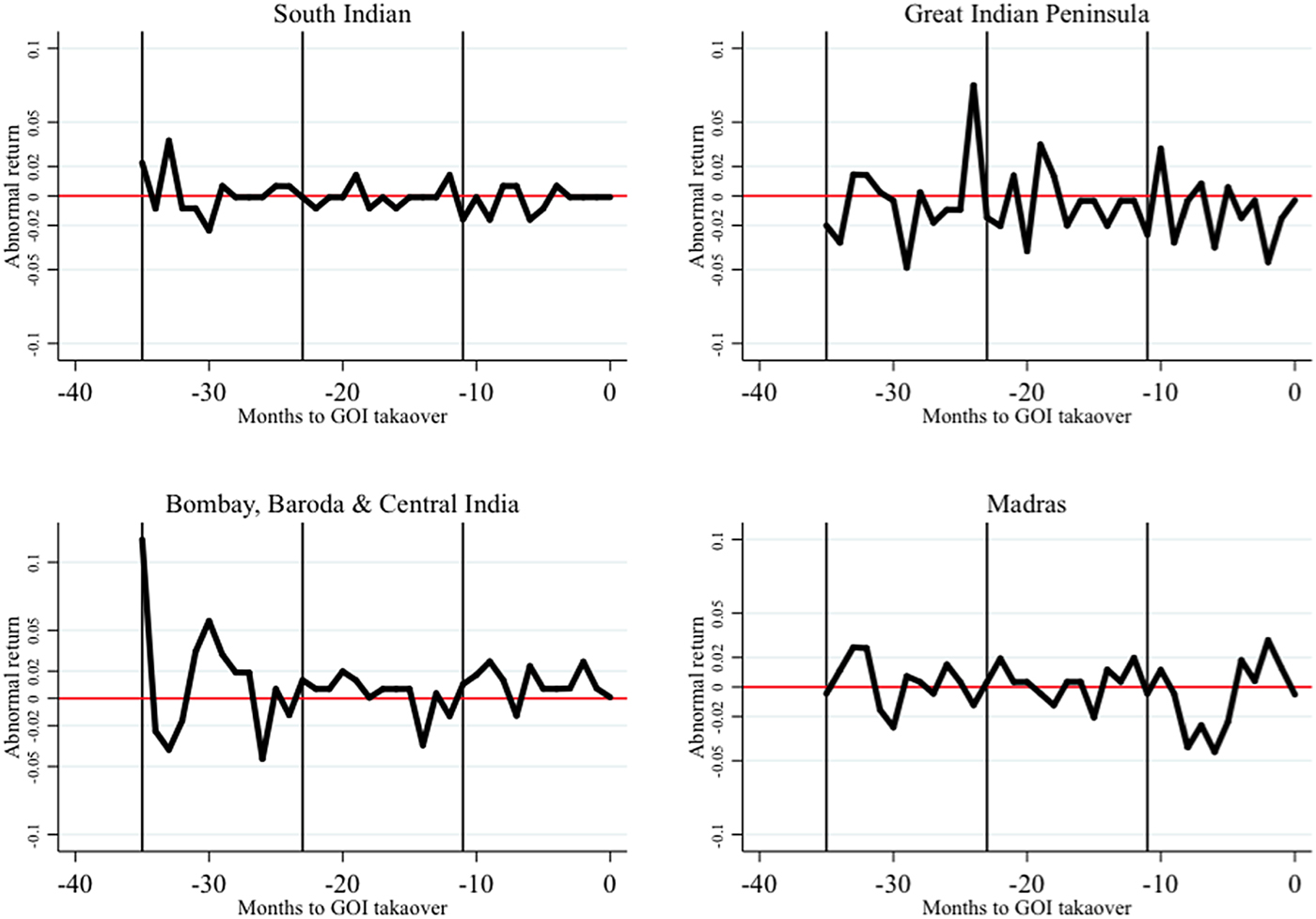
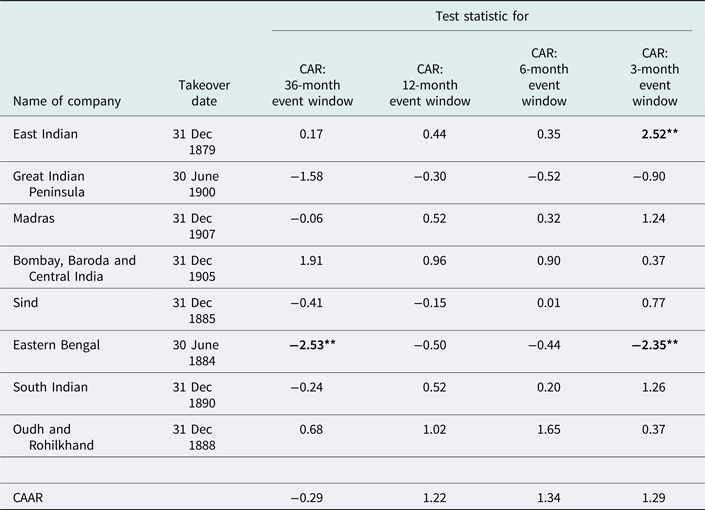
Table 3 shows the formal tests of significance, which confirm the visual patterns. Cumulative abnormal returns are insignificant for majority of the railways and event windows. Moreover, the CAAR is also insignificant. East Indian and Eastern Bengal are the two exceptions. Leading to the first GOI takeover in 1879, we find evidence of positive CARs for the East Indian in its three-month window before takeover and negative cumulative returns for the Eastern Bengal company in both its three-month and its three-year window before takeover. The East Indian company was the first railway purchased and thus it may have been different. After the East Indian, the Eastern Bengal was next in line with its 25th anniversary on June 30, 1884. This was the first railway to be transferred to GOI ownership and operation. If anything, investors feared the terms of impending takeover. In summary, the event study shows no evidence that takeovers led to large transfers to British investors.
Event study: three years leading to GOI takeover

Notes: CAR is Cumulative Abnormal Returns. East Indian is excluded in the Cumulative Average Abnormal Returns (CAAR) calculation because we entered their data from the published IMM, and constructed their dividend yield. Since we used the dividend yield as reported in the IMM after 1879 for the other railways, we did not want to combine their data for the CAAR if the published dividend yield series is constructed differently from our construction.
*** p < 0.01, ** p < 0.05, * p < 0.1.
7. Returns to global railway securities
In this section, we compare the financial performance of Indian railways to other railways around the world. A global comparison offers insight on India's relative performance. Moreover, if colonialism led to extractive railway policies, then financial returns in India should be higher than in other countries, especially those not under colonialism.
An important caveat is in order first. Even though the IMM data provide an important snapshot of foreign railway securities, we cannot speak to railways financed on other exchanges. This is more likely to bias the comparison to Europe and North America, compared with other regions. Most Asian, African, and Latin American railways were financed in London, the global financial center.
In the comparison, we exclude all non-rail securities using the IMM industry classification. We also exclude securities trading in currencies other than the British pound. We then bin securities into seven regions: Africa, Asia (excluding India), Australia (including New Zealand), Europe, Latin America, North America and Great Britain. Using Yale's coding of security type, we group securities as corporate bonds and common stock or preferred shares. We bin common stock with preferred shares to match the coding of Indian securities. Ordinary shares of Indian railway companies often enjoyed temporary guarantees. These and other privileges suggest that common stock was like preferred shares. We drop securities with stock splits and code prices in the same manner as described in section 3.
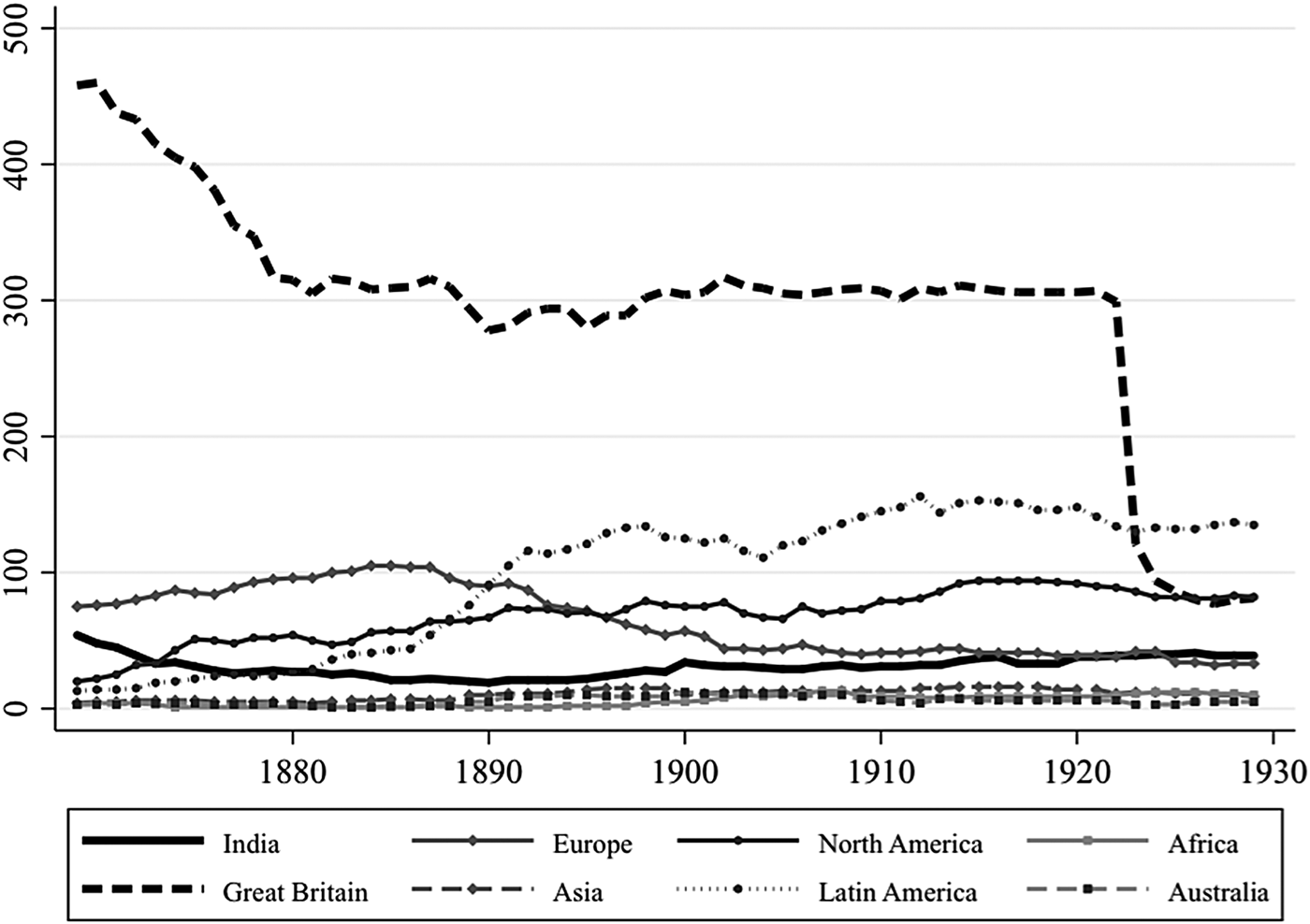
Figure 5 shows the number of railway issues by region from 1869 to 1929. British securities, the biggest group early on, account for 458 issues in 1869 but this declines to 81 in 1929. Their big decline in 1922 is because the 1921 Railways Act merged many railways into the Big Four. After Britain, Latin America is next with 135 securities by 1929. Indian railways account for 5% of securities on average. They begin with 54 in 1869 and end with 33 securities in 1929. Europe ends the period with the same number of securities as India because the number of European issues in the IMM are small. Unlike India, the rest of Asia, Africa and Australia have fewer rail issues. Africa and Australia trade fewer than ten issues on average in this period. Asia averages ten issues. While Africa had few railways, Asia and Australia had many state-owned railways.
Number of railway issues by region (London Stock Exchange, 1869–1929)

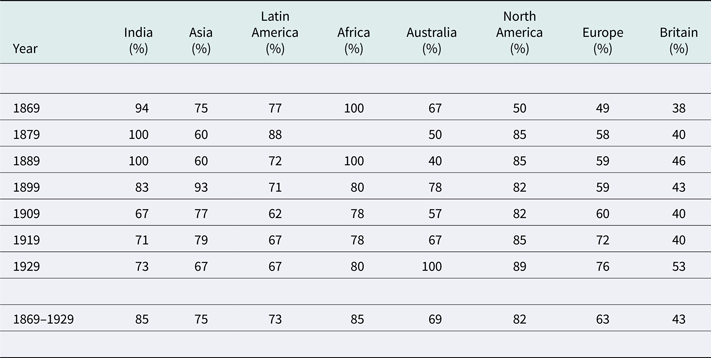
Table 4 shows the proportion of non-equity issues by region. India's reliance on debt financing was not unique. Non-equities account for 85% of issues in India. Here, the non-equities are corporate bonds and the guaranteed securities. Africa and Asia also use debt with non-equities averaging 85% and 75% of issues. Other than Britain, non-equities account for the majority of the issues trading in London. Hence, we focus on returns to non-equities, i.e. corporate bonds, in the comparison below.
India and the world: proportion of non-equity issues, 1869–1929

Notes: ‘Non-equity issues’ refers to corporate bonds, debentures and the guaranteed securities in the case of India.
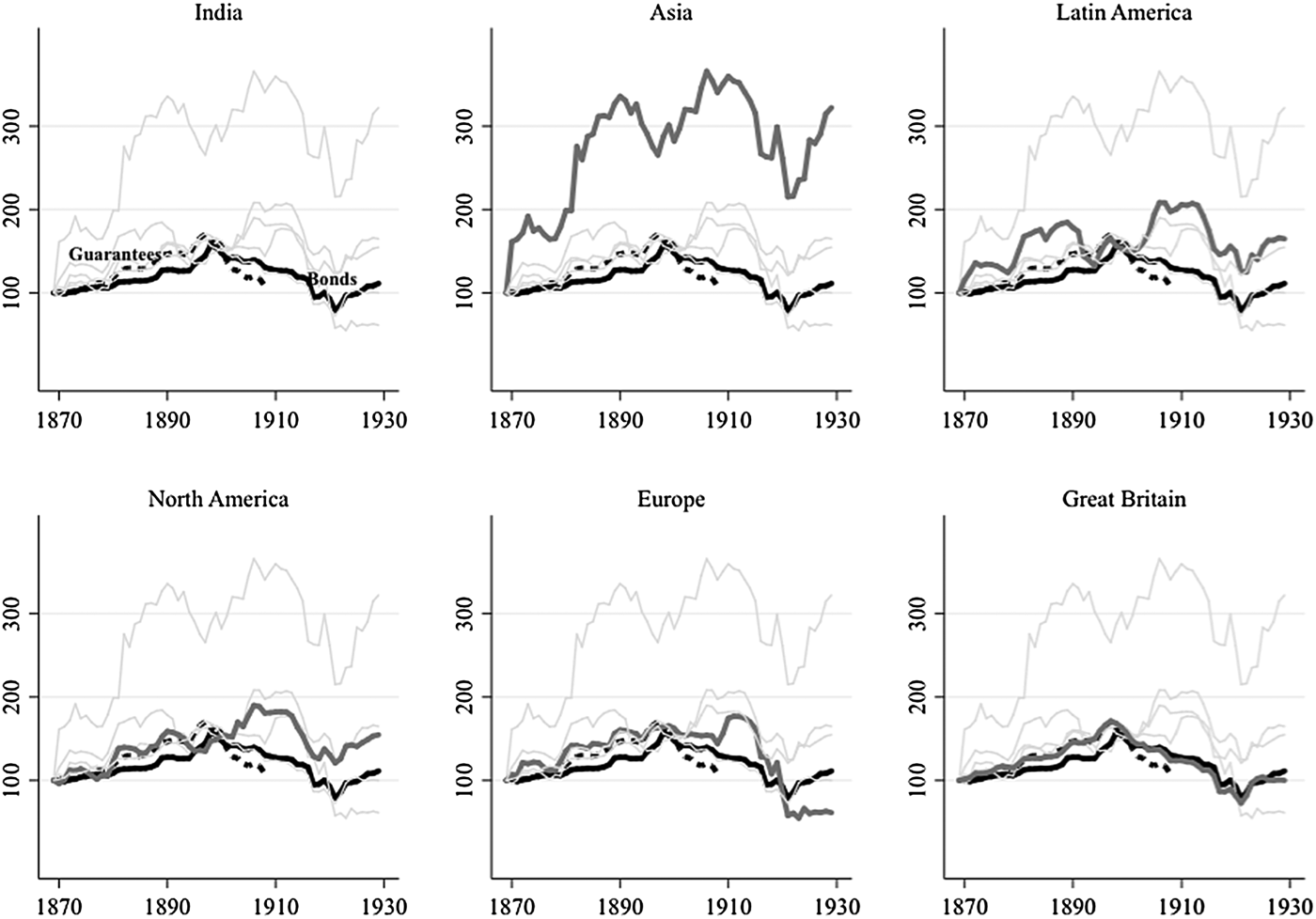
Figure 6 shows six graphs of unweighted capital appreciation indices by region with the exception of Africa and Australia because they have few bonds trading in the early years. In the first graph, Indian guaranteed securities are shown as a dashed line and bonds as a solid line. In the next graphs, we compare India in black to each region in gray noted in the subtitle. As seen in the first row, capital appreciation for Indian bonds and guaranteed securities trailed Asia and Latin America. Indeed, the capital appreciation for Latin American bonds was three times as high as for those of India. Capital appreciation in Europe and North America was also higher than in India, at least up to World War I. Indian railway capital appreciation was strikingly similar to Britain.
Capital appreciation index – railway corporate bonds (1869 = 100)

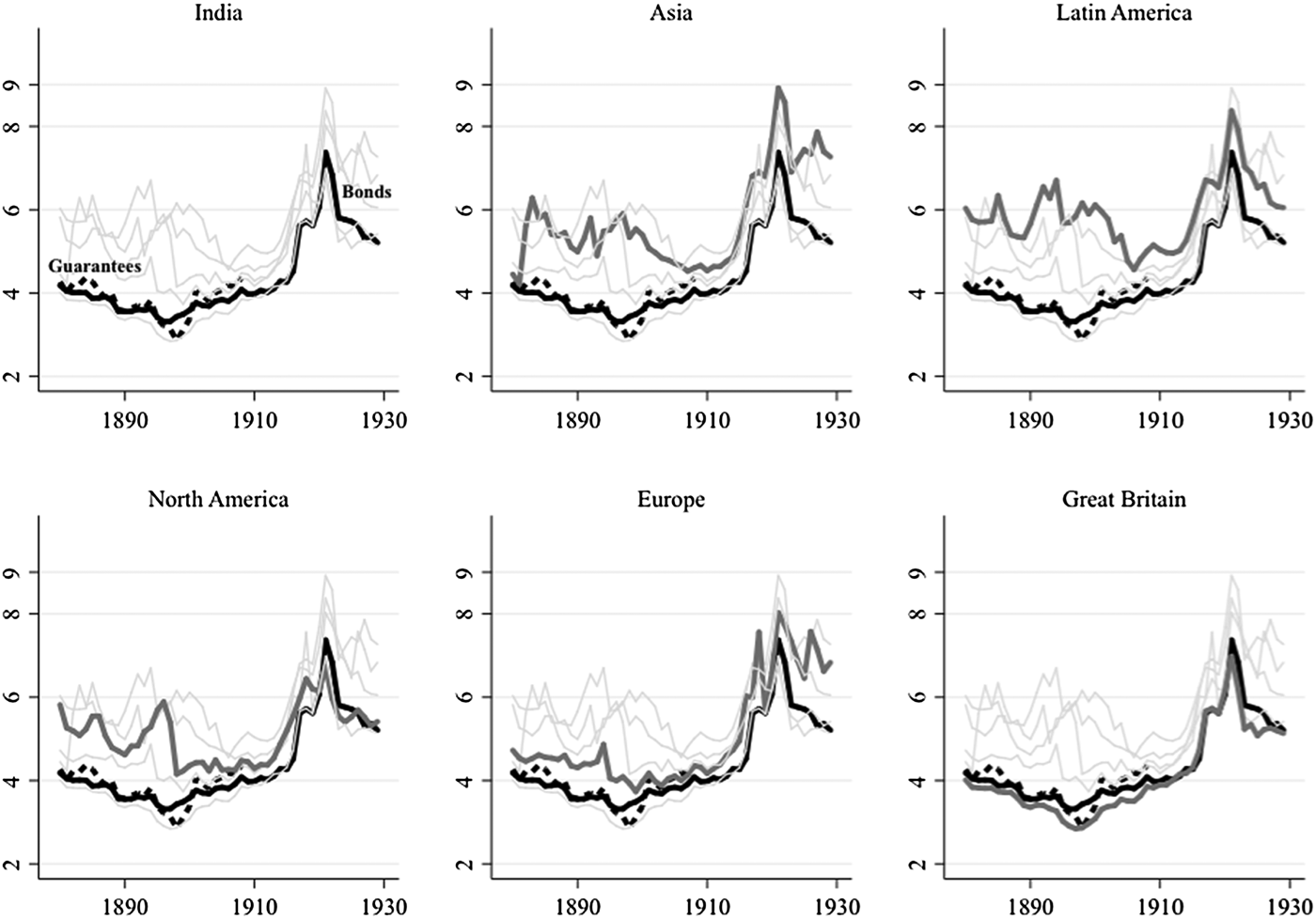
Dividend yields show similar patterns in Figure 7. Indian bond yields averaged 4.4% from 1879 to 1929. They trailed Asia (5.8%), Latin America (6%), North America (5.1%), and Europe (5%). Britain was the only country with lower yields at 4.1%. We have a complete series on dividend yields for Africa and Australia only from 1889 to 1929. In this period, Indian bond yields averaged 4.4% compared to 6% for Africa and 5% for Australia. Again, Indian yields were not excessive.
Dividend yields – railway corporate bonds

Looking at the guaranteed securities does not change the conclusion. We summarize the comparative patterns for 1879–1908. Dividend yields to Indian guaranteed securities average 3.8% compared to 5.2% for Asia and 5.7% for Latin America. Indian yields again trail those in Europe (4.3%) and North America (4.9%). Across the board, Indian yields and capital returns to non-equities resembled those of Britain.
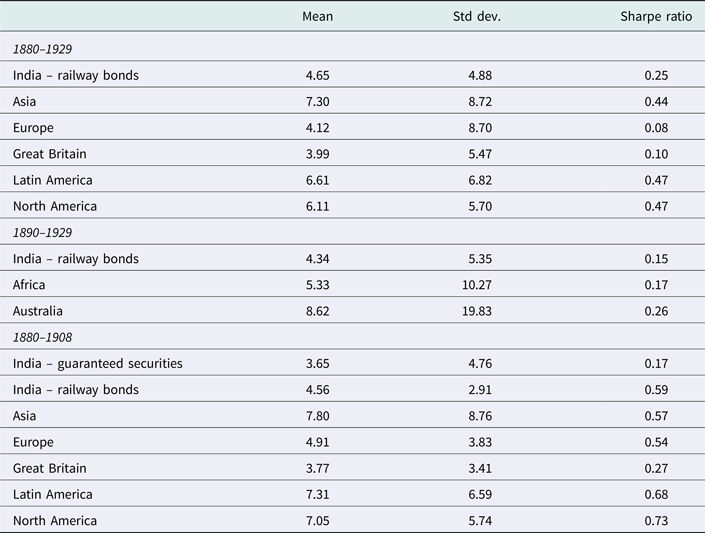
Table 5 summarizes the total returns on bonds. It reports average annual total returns, SDs, and the Sharpe ratio for portfolios of railway bonds in each region of the world. The yield on the UK government bonds in each period is used as the risk-free return. Indian railway bonds and guaranteed securities did not enjoy exceptional performance. The comparison with Britain suggests there was some gain from colonialism, since British investors earned more on Indian railway bonds than on British railway bonds. However, the returns in India were lower than in non-colonial North America and Latin America. Moreover, the returns per unit of risk on Indian guaranteed securities were worse than British railway bonds.
Total returns to railway corporate bonds, 1879–1929

Notes: Average and standard deviation of the annual figures, unweighted.
Why did guaranteed securities in India generate such poor financial returns? We think poor incentives are partly to blame. Indian guarantees are similar to minimum income guarantees in the theoretical literature on optimal infrastructure contracts (Engel et al., Reference Engel, Fischer and Galetovic2013). Although necessary when returns are uncertain, minimum income guarantees can also lead to moral hazard problems among private companies. Moral hazard is consistent with accounts of British railway companies in India having weak incentives to cut operating costs because they received a 5% guarantee regardless of operating profits (Kerr, Reference Kerr2007; Thorner, Reference Thorner1950). They are also consistent with Bogart and Chaudhary (Reference Bogart and Chaudhary2012), who show that the transition from private ownership under guarantees to majority GOI ownership reduced working expenses by 13% on average. Working expenses are one of the key factors affecting railway profitability, since net earnings are revenues minus expenses. Private ownership under guarantees thus worked against higher profitability, which ultimately lowered investor expectations about dividends.
British policy makers created guarantees in India in part to deliver a high return at low risk. But the guarantees ultimately did not pay off. They undermined incentives to reduce costs, which in part contributed to their demise with takeovers. Guarantees ended up being an ineffective extractive policy.
8. Conclusion
Using detailed annual data on Indian securities trading in London over the late 19th and early 20th centuries, we document the financial returns from investing in Indian railways comparing them to each other and to railways in other parts of the world. There are several main conclusions. First, Indian securities offered modest financial returns to investors. Guaranteed railways and railway bonds were the largest in market value and their annual total returns equaled 3.7% and 4.6% on average. Second, Indian railway securities had lower returns per unit of risk compared to railway securities in other parts of the world. Indian railways were low risk, low return, even though India was one of the least developed economies with securities on the London Stock Exchange. Third, there is no evidence that colonial railway policy led to extraction via investor returns.
Our study raises general questions about whether colonial institutions in India resulted in extraction and a significant drain of resources from India. We do not answer that larger question. Rather, we believe that scholars need to look at key sectors of the economy to first assess the nature and effects of individual policies. Only then can we begin to draw any general conclusion on the nature of institutions in colonial India.
Railway map of India, 1870