The dairy industry is one of the most polluting of industries, not only in terms of the volume of effluent generated but also in terms of wastewater characteristics (Sarkar et al. Reference Sarkar, Chakrabarti, Vijaykumar and Kale2006). This discharge from the dairy industry results in water eutrophication and is dangerous to soil and aquatic life, causing potential environmental problems when it is discharged without treatment (Healy et al. Reference Healy, Rodgers and Mulqueen2007).
Nano-zeolite refers to nano-crystalline zeolites, namely zeolites with crystal sizes less than 100 nm, which results in increased surface area and decreased diffusion path lengths, enhancing ion exchange properties and giving a high potential for environmental decontamination (Camblor et al. Reference Camblor, Corma and Valencia1998). Their physicochemical characteristics such as high mechanical and chemical resistance in addition to their high surface area have formed the basis for their widespread use in catalysis, separation, and ion-exchange (Song et al. Reference Song, Li, Grassian and Larsen2005). Only a few studies have shown the possibility of using nano-zeolites for simultaneous sequestration of ammonium and phosphate from wastewater (Chen et al. Reference Chen, Wendell, Zhu, Li, Yu and Zhang2012; Gan et al. Reference Gan, Zuo, Xie, Li and Huang2012). In this research, it is hypothesized that nano-zeolite could be synthesized using coal fly ash and the synthesized nanomaterial could then be a candidate absorbent for ammonium and phosphate adsorption in dairy wastewater.
Material and methods
Coal fly ash (FA) was obtained from the Moneypoint thermoelectric power plant located in Co. Clare, Ireland. Nano-zeolite was synthesized from FA via alkaline hydrothermal treatment. The detailed synthesis method was as follows: 40 g of FA and 240 ml of 2·0 mol/l NaOH solution were added into a 500 ml nickel autoclave at the solid–liquid ratio of 1 g/6 ml. This mixture was heated for 24 h at a constant temperature of 130 °C. The mixture was then rinsed with deionized water 3 times until no NaOH was detected, further washed with 0·5 mol/l CaCl2 solution and again rinsed with distilled water until no chlorine ion was detected. The nano-zeolite (NZ) product was dried in an oven at 90 °C for 24 h.
The phosphorous sorption index (PSI) of solids (FA and NZ) was determined as follows: 1 g of FA/NZ was added to 50 ml of 1000 mg/l solution prepared by dissolving KH2PO4 in 0·01 M KCl, and then equilibrated for 24 h. The difference in the concentrations of dissolved P in solution before and after equilibrium was considered as adsorbed by the solids. Scanning electron microscopy (sem) was performed on the samples. Chemical composition of the raw FA and NZ was analysed by energy-dispersive X-ray fluorescence (XRF). Cation exchange capacity (CEC) of the samples was measured using neutral NH4OAc and 10% NaCl as saturating and replacing solutions, respectively.
Batch studies were conducted to study the effect of sorption time of NZ on ammonium and phosphate removal efficiency. Synthesized wastewater (SW) was prepared by mixing KH2PO4 and NH4Cl with deionized water. The concentration of ammonium and phosphate were 100 and 50 mg/l in synthesized wastewater 1 (SW1), while they were 150 and 100 mg/l in synthesized wastewater 2 (SW2).
To determine the optimum sorption time, 50 ml of SW and 0·5 g of NZ particle were added into centrifuge tubes, at the NZ dosage of 1 g/100 ml. These slurries were shaken for 5–60 min at a fixed temperature (20 °C) at 250 rpm. At specific sorption times, the suspensions were centrifuged at 5000 rpm for 10 min. Ammonium and phosphate remaining in the supernatants were directly determined by Konelab (Thermo Fisher Scientific, Waltham MA, USA). To determine the pH values on the ammonium and phosphate removal efficiency, the NZ was combined with SWs at the NZ dosage of 1 g/100 ml. The pH values of the mixed solutions were adjusted with 1 mol/l HCl solution to specific values. These slurries were shaken for 5–60 min at a fixed temperature (20 °C) at 250 rpm. The amounts of ammonium and phosphate immobilized by absorbents were then calculated from the difference between initial and final concentrations of SWs. All experiments were performed in triplicate.
Results
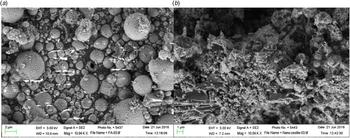
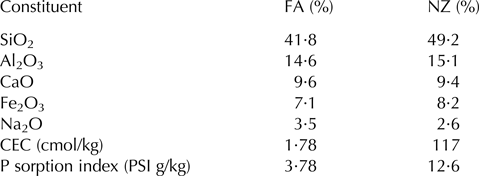
NZ was synthesized via alkaline hydrothermal treatment with a yield of 0·25 g NZ per FA. The chemical composition of the samples is shown in Table 1. Field emission scanning electron microscope (sem) images of the FA and synthesized NZ are shown in Fig. 1. sem observation of the FA indicates the presence of micro-particles in the shape of smooth balls (microspheres; Fig. 1a). NaOH solution affected the FA by deforming the ball-like shape and changing the smooth surface into various irregularly shaped crystals, mainly plates and rods (Fig. 1b). The particle surface of NZ showed the formation of zeolites.
sem images of (A): raw coal fly ash (FA) and (B): nano-zeolite synthesized from fly ash (NZ).

Chemical composition, cation exchange capacity and P sorption index of raw fly ash (FA) and nano-zeolite synthesized from fly ash (NZ)

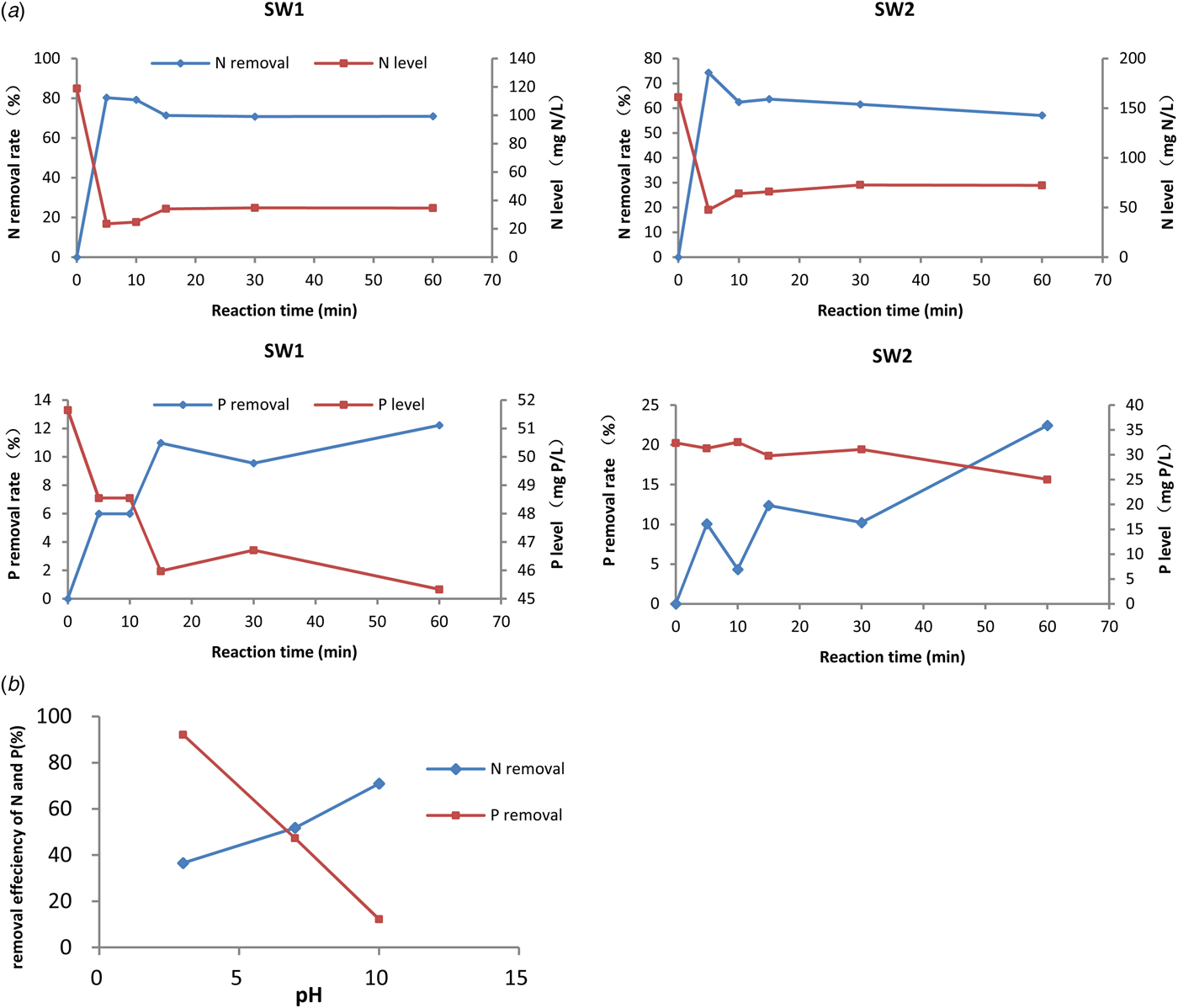
The removal efficiencies of N and P in SW over time at the NZ dosage of 1 g/50 ml can be seen in Fig. 2a. For SW1, both N and P levels decreased rapidly during the first 5 min due to the sorption. After that, N level increased slightly between 5 and 15 min while P level increased slightly at 30 min. Within 60 min, the concentration of ammonium decreased from 118 to 35 mg/l while the concentration of phosphate reduced only slightly, from 52 to 45 mg/l. For SW2, the N and P removal efficiencies follow a similar pattern to SW1 in that both N and P levels decreased rapidly during the first 5 min and fluctuated after that. Within 60 min, the concentration of N-NH4 decreased from 160 to 96 mg/l while the concentration of PO4-P decreased from 32 to 25 mg/l.
(a): The effect of time on removal efficiency of NZ for ammonia (N) and phosphorus (P) in simulated wastewaters containing 100 mg/l N and 50 mg/l P (SW1) or 150 mg/l N and 100 mg/l P (SW2). (b): Removal efficiencies at different wastewater pH levels.

The removal efficiencies of N and P in SW at different pH level by NZ are shown in Fig. 2b. The removal efficiency of ammonium was positively influenced by increasing pH, being 36·6, 51·8 and 70·9% at pH 3, 7 and 10, respectively. The removal efficiency of phosphate, however, decreased dramatically with increasing pH, showing removal rates of 92·1, 47·3 and 12·3% at pH 3, 7 and 10, respectively.
Discussion
The significant components of all fly ashes were oxides of Si, Al and various others. The untreated FA and NZ had similar compositions. The distribution of the electric charge between the Al–O and Si–O bonds of FA changed after the chemical treatment which led to the formation of NZ (Querol et al. Reference Querol, Moreno, Umana, Alastuey, Hernandez, Lopez-Soler and Plana2002; Larsen, Reference Larsen2007). The CEC of NZ was more than 104 and 40 times the values obtained for the raw fly ash (Fig. 1c). In addition, the PSI of NZ also increased from 3·78 to 12·6 g/kg which was four times greater than the PSI for raw FA. These data confirm that the synthesis method in this study could successfully produce NZ, which could be a suitable candidate for nutrient immobilization from synthesized wastewater.
For the batch experiments, both N and P levels decreased rapidly within the first 5 min. After that, N level increased slightly between 5 and 15 min while P level increased slightly at 30 min. The equilibrium appears to be reached within 60 min. It was inferred that more than one-step might be involved between adsorbent and adsorbate. The increasing trend on pollutant sequestration over time (mainly within the first 5 min) is primarily related to the increased specific surface area and the exchangeable ion on the zeolite surface (Chen et al. Reference Chen, Kong, Wu, Hu, Wang and Wang2006). Huang et al. (Reference Huang, Xiao, Yan and Yang2010) suggested that the bivalent cation ions in NZ may compete with ammonium in liquid and reduce the amount of ammonium adsorption, causing in this case ammonium desorption from NZ to liquid after 5 min and P desorption at 30 min in both SW1 and SW2 (Fig. 2). In addition, phosphate may be removed by adsorption and by precipitation, forming several calcium and aluminium phosphates (Lu et al. Reference Lu, Bai, Zhu and Shan2009).
With the increase of pH level, the increased OH− anions competed with phosphate, which led to the low removal efficiency of phosphate. For ammonium, zeolitic material synthesized from fly ash showed potential as cationic exchanger since elevated cation exchange capacity and affinity for ammonium contributed to the higher sorption rate at pH level of 10 (Ghan et al. Reference Ghan, Bakshi and Bhoskar2005). The electrostatic interaction with the Al–O surface groups also contributed to the result (Pengthamkeerati et al. Reference Pengthamkeerati, Satapanajaru and Singchan2008). On other hand, the removal efficiency decreased from pH 10 to 3. The existence of positive charges on the NZ surface at lower pH levels might be responsible for the reduction of the ammonium removal.
In conclusion, chemical treatment of coal fly ash caused beneficial changes in properties. Samples treated by NaOH had an increased cation exchange capacity and P sorption index relative to the initial fly ash due to particle modification from smooth surface to plate- and rod-shape crystals. Modified fly ash demonstrated a high removal rate of ammonium, but not of phosphate. Removal efficiencies were reciprocally altered by pH, emphasizing the difficulty of removal ammonium and phosphate simultaneously.