Introduction
The mulberry tree, Morus Linnaeus (Moraceae), is a cultural symbol in China due to its more than 5000-year cultivation history. The genus consists of 16 species that are distributed across Asia and the Americas (Gardner et al. Reference Gardner, Garner, Cowan, Dodsworth, Epitawalage and Arifiani2021). Its leaves play a pivotal role in supporting the sericulture industry by providing essential nourishment for silkworms, Bombyx mori Linnaeus (He et al. Reference He, Zhang, Qi, Zhao, Tao and Yang2013). In recent years, the edible, medicinal, and ecological value of mulberry has been widely recognised as well (Yuan et al. Reference Yuan, Xie, Wang, Yan, Ye, Jabbar and Zeng2015; Yuan and Zhao Reference Yuan and Zhao2017; Ou et al. Reference Ou, Gao, Jiang, Yu, Zhao and Liu2022). According to a report by Sánchez (Reference Sánchez and Sánchez2000), the mulberry cultivation areas in China and India are approximately 626 000 ha and 280 000 ha, respectively. The genus’s extensive historical cultivation and inherent value also significantly contribute to the abundance and diversity of mulberry cultivar breeding, as evidenced by the existence of more than 1000 documented cultivars (Nepal and Ferguson Reference Nepal and Ferguson2012).
Glyphodes pyloalis Walker (Lepidoptera: Pyralidae) is reported as a highly destructive pest to mulberry leaves in China, India, Japan, and other Asian countries (Oftadeh et al. Reference Oftadeh, Jalali Sendi and Khosravi2015; Poltavsky and Ilyina Reference Poltavsky and Ilyina2017). Feeding by larvae of G. pyloalis is the primary cause of reduced production and quality of mulberry leaves. Additionally, the short reproductive cycle of G. pyloalis, particularly with a larval stage lasting 12–17 days (Zhao et al. Reference Zhao, Bai and Shi2013), and frequent generations (ranging from 3 to 10 in China; Zhang et al. Reference Zhang, Chen, He, Du, Li and Jiang2022) significantly contribute to the severity of the insect’s impact (Cao et al. Reference Cao, Hu, Du, Shi, Hu, Deng and Zheng2020, Reference Cao, Hu, Shi, Wang, Cai, Hu and Wang2023). In addition, G. pyloalis can indirectly affect the health of silkworms by transmitting densonucleosis viruses DNV-1 and DNV-2 (Parvoviridae), as well as the infectious flacherie virus (Iflaviridae, Parvoviridae, or Reoviridae; Watanabe et al. Reference Watanabe, Kurihara, Wang and Shimizu1988). Recently, G. pyloalis has become a substantial threat to the sericulture industry (Chu et al. Reference Chu, Jiang, Yan, Li, Wang, Wu and Sheng2020).
The exploration of effective and environmentally friendly methods for controlling G. pyloalis is becoming increasingly important. Normally, chemical pesticides, such as organophosphorus and halogenated pyrrole insecticides, are employed in mulberry fields (Liu et al. Reference Liu, Xing, Liang, Ding, Li and Shao2022). However, the overreliance on pesticides has led to a number of resistance, residue, and resurgence problems (Shao et al. Reference Shao, Li, Zhang, Chu, Ma and Liu2020; Su et al. Reference Su, Gao, Liu, Li, Liang and Dai2020). As one of the most sustainable insect pest management strategies, host plant resistance is considered the backbone of pest management in agro-ecosystems (Sharma Reference Sharma2007; Horgan et al. Reference Horgan, Garcia, Haverkort, de Jong and Ferrater2020). For example, Abel et al. (Reference Abel, Wilson, Wiseman, White and Davis2000) found that resistant maize cultivars can reduce numbers of corn earworm, Helicoverpa zea (Boddie) (Lepidoptera: Noctuidae), fall armyworm, Spodoptera frugiperda (J.E. Smith) (Lepidoptera: Noctuidae), southwestern corn borer, Diatraea grandiosella Dyar (Lepidoptera: Crambidae), and sugarcane borer, Diatraea saccharalis (Fabricius) (Lepidoptera: Crambidae), within crops. Indeed, since the first report of a wheat cultivar that is resistant to Hessian fly (Diptera: Cecidomyiidae) in 1782 (Kumari et al. Reference Kumari, Jasrotia, Kumar, Kashyap, Kumar and Mishra2022), screening for existing pest-resistant species and cultivars has received increased attention as a pest management strategy. For instance, da Silva et al. (Reference da Silva, dos Santos, da Silva, da Silva, Lopes, da Silva Paes and Picanço2020) evaluated the resistance level of Tetranychus mexicanus (Sarcoptiformes: Tetranychidae) against different genotypes of passion fruit and identified one genotype that showed potential as a viable source for mite resistance. The difference may be attributed to the feeding preferences of pests on different cultivars, which have been reported to be a result of the long-term coevolution between insects and plants (Zaffaroni et al. Reference Zaffaroni, Cunniffe and Bevacqua2020; Sharma et al. Reference Sharma, Malthankar, Mathur and Reddy2021). The main mechanisms of host plant resistance include antibiosis, antixenosis (nonpreference), and tolerance (Smith Reference Smith2005). Hence, it is essential to understand the morphological, biochemical, and molecular characteristics of plants as crucial foundations for defensive traits (Leybourne and Aradottir Reference Leybourne and Aradottir2022). In the case of Morus spp., selecting cultivars resistant to G. pyloalis from the existing abundant mulberry cultivar resources could be a promising approach for pest control; however, limited research has been conducted on the identification and characterisation of available cultivars.
Life table measurements have been used widely in entomological studies to understand population mortality, survivorship, and life expectancy. Oftadeh et al. (Reference Oftadeh, Jalali Sendi and Khosravi2015) used life table analysis to compare the developmental times of G. pyloalis on four mulberry cultivars and found one cultivar to be highly susceptible to the pest. Therefore, it is also important to compare direct damage, such as leaf feeding by G. pyloalis, as this was found to vary between cultivars but, to our knowledge, has not been widely reported in screening studies. Here, we report the results of a comprehensive study to evaluate the cultivar preferences of G. pyloalis in mulberry. We examined field-observed damage on 12 mulberry cultivars across seven species, determined the life history and reproductive success of G. pyloalis using laboratory studies, and evaluated larval performance in a field study.
Materials and methods
Field experiment description
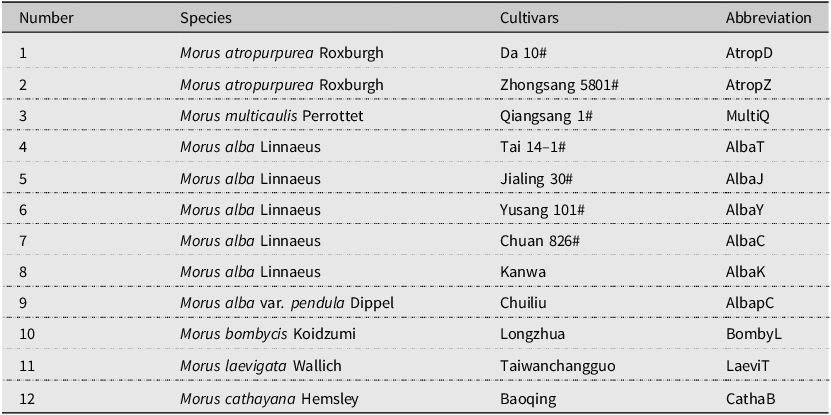
The field experiment was conducted at the mulberry orchard in Chongqing Sericulture Science and Technology Research Institute (29° 49′ N, 106° 27′ E; Chongqing, China). The orchard’s management adhered to the standard protocols established by the research institute. The orchard was divided into two distinct sections. The first orchard section, covering an area of 0.4 ha, was established in 2012–2014 to assemble a diverse collection of mulberry cultivars sourced from both within China and overseas. More than 200 mulberry cultivars were planted in this field and managed until 2022. At least five plants represented each cultivar, and each cultivar was randomly distributed in the field, with a planting density of 1.7 × 1.3 m. In the present study, the selection of 12 mulberry cultivars (Table 1) for further experimentation was based on observation of G. pyloalis feeding on mulberry leaves in the field over three years, as reported by experienced technicians. Annual winter pruning maintained these cultivars at a height of 80 cm above the ground.
Mulberry species, cultivars, and associated abbreviations used in Glyphodes pyloalis studies

A second section of the orchard was 7.2 × 10⁻³ ha in size and comprised the same 12 mulberry cultivars as the first section did, but these plants were grafted in May 2022 to create a garden plot experiment. One-year-old trees (cultivar Bei01) with stem diameters of 2–3 cm were chosen as rootstocks in the nursery and then transplanted to this section. Each cultivar was represented by four plants, which were placed randomly with a planting density of 0.9 × 0.7 m.
Observed damage of Glyphodes pyloalis on mulberry leaves in the field
In the first orchard section, the 12 cultivars of interest were observed for G. pyloalis damage in June 2021. Within each cultivar, three trees were randomly selected and examined. One branch (1.2–1.5 m long) positioned 80 cm above the ground was randomly selected per tree, and a total of three branches were chosen as replicates to represent one cultivar. Once evidence of larval feeding on leaf tissue was observed, the leaf was classified as damaged. The number of damaged leaves and the total number of leaves on each branch were recorded, and their ratio to each other was calculated to represent the percentage of observed damage.
Rearing of Glyphodes pyloalis for in vitro testing
Larvae of G. pyloalis were randomly collected in April 2022 when observed on the 12 mulberry cultivars in the first orchard section and were used to establish a lab colony. The larvae were reared on fresh mulberry leaves from the MultiQ cultivar, which is the main cultivar used in silkworm cultivation, in the laboratory at 25 ± 1 °C and 70 ± 5% relative humidity, with a 14:10–hour light:dark photoperiod in transparent plastic boxes (0.25 × 0.16 × 0.08 m). The boxes were covered by lids that had small holes for ventilation. When adults emerged, they were provided with demineralised water for nourishment and fresh mulberry leaves as a substrate for egg-laying. After a period of 5–6 days, the larvae successfully hatched. Approximately 15 days later, pupation commenced. Subsequently, the newly hatched larvae (within 24 hours) and developed (3-day-old) pupae were collected and tested separately as distinct life stages of G. pyloalis for subsequent experiments.
Glyphodes pyloalis life table and fertility studies
A sufficient amount of fresh mulberry leaves from each of the 12 cultivars was collected from the first orchard section, and the leaves were pooled within each cultivar. Twenty newly hatched G. pyloalis larvae were transferred into a plastic box with one mulberry leaf, each box serving as a replicate for a cultivar. Three replicates for each cultivar were created, resulting in 36 boxes. The petioles of the mulberry leaves were wrapped in damp cotton to provide water. The leaves were replaced with the same cultivar every two days for first- to third-instar larvae and daily for fourth- to fifth-instar larvae.
In each box, developmental stages from larvae through to adult were observed, and life stages were recorded daily. Pupae were recorded in each box and used to calculate the pupation rate per cultivar (percentage of larvae that pupated). To ensure a sufficient number of male and female pupae for each cultivar, the collected pupae from each cultivar were pooled, and the number of emerged adults was recorded to calculate the emergence rate (percentage of pupae that successfully produced an adult) and the mortality rate (percentage of larvae that failed to develop into an adult). Pupae were weighed individually on day 3 of pupation and then sexed (Song et al. Reference Song, Song, Zhao, Huang and Luo2023). One pair of female and male pupae was transferred to a plastic box for the purpose of mating and oviposition. Three to five pairs were evaluated for each cultivar. The total number of eggs laid by females and the oviposition period for each box were recorded once both the female and the male parents were dead. The ratio of eggs per day (daily oviposition) was then calculated.
Garden plot experiment
In the second orchard section, larval performance of G. pyloalis on each cultivar – the same 12 cultivars as were studied in the first orchard section – was observed. We assumed that, if a cultivar was less suitable for development, there would be low numbers of larvae on the leaves. First, in mid-May 2022, a 12-m-long × 6-m-wide × 2-m-high nylon net (0.18-mm mesh size) was applied in the field to cover all 48 plants after grafting in order to prevent the escape of released G. pyloalis and prevent G. pyloalis damage in neighbouring fields. At the end of September, 30 female and 30 male pupae were placed within the enclosed area, where they were allowed to freely mate and oviposit upon emergence. Twenty days after adding the pupae, G. pyloalis larvae had successfully hatched and were at the second- to third-instar stages. From 20 to 40 leaves grew on each tree. The number of second- to third-instar larvae on each leaf was recorded, and the total number of larvae per leaf was calculated across all leaves on each of the four trees within each cultivar.
Morphology and physiology of the cultivars
Four cultivars – BombyL, LaeviT, CathaB, and MultiQ – were selected for morphological and physiological analyses based on their observed levels of resistance to G. pyloalis in field and laboratory studies. Cultivars BombyL, LaeviT, and CathaB were deemed more resistant, whereas the MultiQ cultivar was deemed less resistant (or more susceptible to G. pyloalis). Mature leaves between the sixth to ninth positions on a branch were randomly collected and pooled within each cultivar (approximately 150 leaves/cultivar in total) early in the morning (09:00–09:30, local time) in the first orchard section. Those leaves were divided into four subsamples for the measurements of (1) leaf water, (2) thickness, surface waxes, and trichome density, (3) soluble-glucose content, and (4) soluble-protein content.
The first subsample included 12–20 leaves randomly selected from the pool of each cultivar and was used to measure leaf water content, following the method described by Jin et al. (Reference Jin, Shi, Yu, Yamada and Sacks2017). Four replicates were conducted for each cultivar, with every 3–5 leaves/cultivar tested as one replicate. The second subsample included 10 leaves/cultivar. These leaves were initially holed using a 2-cm-diameter hole punch (six holes/leaf) to measure leaf thickness and surface waxes. Then a subset of these punched samples (Φ = 2 cm) was redrilled with a 3-mm-diameter hole punch to measure trichome density. Leaf thickness was measured with an electronic Vernier caliper (Ningbo Deli Co., Ltd., Ninghai, Ningbo, Zhejiang, China), and a total of 60-holed samples (Φ = 2 cm) were examined for each cultivar. Leaf surface waxes were extracted and quantified using a colorimetric method (Sajeevan et al. Reference Sajeevan, Nataraja, Shivashankara, Pallavi, Gurumurthy and Shivanna2017), with 50 samples (Φ = 2 cm) from each cultivar randomly selected out of the 60-holed samples used to measure leaf thickness. Every 10 samples were measured as one replicate for the leaf surface–waxes detection. Subsequently, eight-holed samples (Φ = 3 mm) of each cultivar were randomly collected and recorded for leaf trichome density using an anatomical mirror (ZSA0850T; Chongqing Opu Photoelectric Technology Co., Ltd., Beibei District, Chongqing, China). The third and fourth subsamples included 30 leaves/cultivar each, which were used to measure the soluble-glucose and soluble-protein contents, respectively. Briefly, the soluble-glucose analysis was conducted using the anthrone–sulfuric acid method described by Leng et al. (Reference Leng, Sun, Jing, Wang, Wei, Wang and Zhu2016), with 10 leaves serving as one replicate for each cultivar. The soluble-protein analysis was conducted using the Coomassie Brilliant Blue G250 method described by Grintzalis et al. (Reference Grintzalis, Georgiou and Schneider2015), with 10 leaves serving as one replicate for each cultivar. Additionally, the leaves of cultivars MultiQ and CathaB were observed for leaf trichome structures using a scanning electron microscope (SU3500; Hitachi, Chiyoda City, Tokyo, Japan) as described by Zhao et al. (Reference Zhao, Zhuang, Chen, Lou and Li2023), with four leaves from the pool for each cultivar.
Statistical analysis
Percentage of leaves damaged by G. pyloalis, development time, pupal weight, pupation rate, fecundity, and average number of larvae per leaf were assessed for differences between the cultivars using one-way analysis of variance, followed by post hoc Tukey’s honestly significant difference test when significance was observed, using SPSS statistical software, version 17.0. We also conducted correlation analyses between parameters obtained from the laboratory study (larval-, pupal-, and adult-stage durations, pupation, adult emergence, adult mortality rates, pupal weight, and number of eggs) with observed damage from the field trial and larval performance from the garden plot experiment. The leaf morphology and physiology of the selected cultivars were determined in order to correlate resistance with physical plant traits. Correlation tests were performed in R, version 4.1.3 (https://cran.r-project.org/), with the function cor.test, and generated P-values were corrected with the “FDR” adjustment method using the function p.adjust in the stats package. All the figures were generated by GraphPad Prism, version 8.0.1 (https://www.graphpad.com/).
Results
Damage of mulberry cultivars by Glyphodes pyloalis in the field
Twelve cultivars, representing seven mulberry species, were surveyed in the field for G. pyloalis damage (Fig. 1). Cultivars AtropD, AtropZ, MultiQ, and AlbaT experienced damage on more than 50% of their leaves, and leaf damage by G. pyloalis on cultivars AlbaJ, AlbaY, AlbaC, and AlbaK ranged between 24.5% and 52.4%. Notably, the percentage of damage to each of the cultivars AlbapC, BombyL, LaeviT, and CathaB was below 10.0%, and no damage was observed on cultivar CathaB.
Observed percentage of damaged leaves (mean +/– standard error) by Glyphodes pyloalis across 12 mulberry cultivars planted in a field. Letters above the bars represent significant differences across cultivar (P < 0.05). Bars are colour-coded to show the associated mulberry species.

Performance of Glyphodes pyloalis
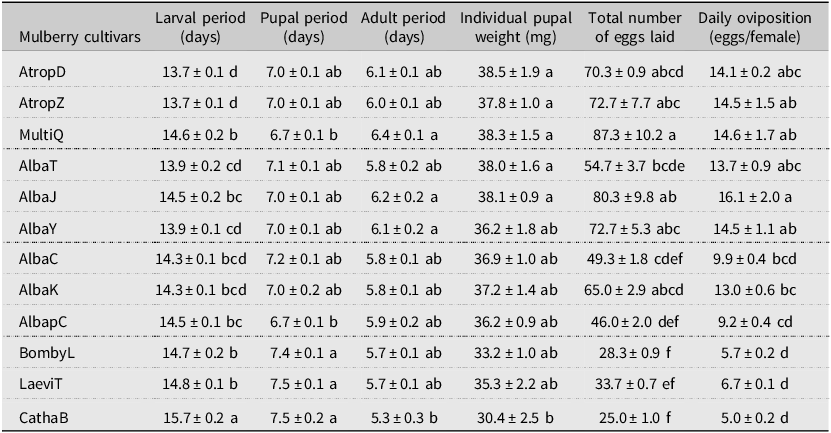
Cultivar significantly influenced the development of G. pyloalis (Table 2). The combined duration of the larval and pupal stages on CathaB was the longest (23.2 days in total), followed by LaeviT (22.3 days in total) and BombyL (22.1 days in total). Conversely, adult G. pyloalis had shorter lifespans (5.3–5.7 days) when their larvae fed upon cultivars CathaB, LaeviT, and BombyL, compared to the other cultivars, where adult lifespans ranged from 5.8 to 6.4 days. Moreover, CathaB exhibited the lowest rates of both pupation (55.0%) and adult emergence (69.7%), whereas G. pyloalis reared on AlbaC had the highest pupation rate (95.0%) and AlbaY had the highest adult emergence rate (93.9%; Fig. 2A and B). The overall mortality rate of G. pyloalis on CathaB (61.7%) was three times greater than that on AtropZ (16.7%) and MultiQ (20.0%; Fig. 2C). In addition, the average weight of pupae obtained from CathaB (30.4 mg) was significantly lower than the average weights of larvae obtained from AtropD, AtropZ, MultiQ, AlbaT, and AlbaJ (37.8–38.5 mg; Table 2). Total average fertility varied from 25.0 to 87.3 eggs. The maximum daily oviposition was observed for the AlbaJ cultivar (16.1 eggs/female/day), which was three times greater than that observed on the CathaB cultivar (5.0 eggs/female/day; Table 2).
Duration of larval, pupal, and adult life stages, pupal weight, and fecundity of Glyphodes pyloalis when feeding on 12 mulberry cultivars in laboratory studies. Mean +/– standard error. Letters within each column denote significant differences between cultivars, P < 0.05

A, Mean (+/– standard error) pupation rate; B, percent adult emergence; and C, percent overall mortality of Glyphodes pyloalis fed on different mulberry cultivars in the life history study. Letters above the bars denote significant differences across cultivar, P < 0.05. Bars are colour-coded to show the associated mulberry species.

Larval performance of Glyphodes pyloalis across mulberry cultivars
The garden plot experiment was employed to study larval performance of G. pyloalis on cultivars of mulberry (Fig. 3). Similar to damage observed in the first orchard section and field experiment, eight cultivars (AtropD, AtropZ, MultiQ, AlbaT, AlbaJ, AlbaY, AlbaC, and AlbaK) had a high density of larvae, ranging from 0.7 to 1.4 individuals/leaf. Moreover, the average numbers of G. pyloalis larvae on the leaves of cultivars CathaB and BombyL were significantly lower than on the leaves of AtropD, AtropZ, MultiQ, AlbaJ, AlbaY, AlbaC, and AlbaK. Notably, fewer than 0.1 G. pyloalis larvae were observed on each leaf of the CathaB cultivar.
Mean (+/– standard error) number of Glyphodes pyloalis larvae observed per leaf across 12 different mulberry cultivars in a protected garden experiment. Different letters above the bars denote significant differences between cultivars (P < 0.05). Bars are colour-coded to show the associated mulberry species.

Correlation analysis
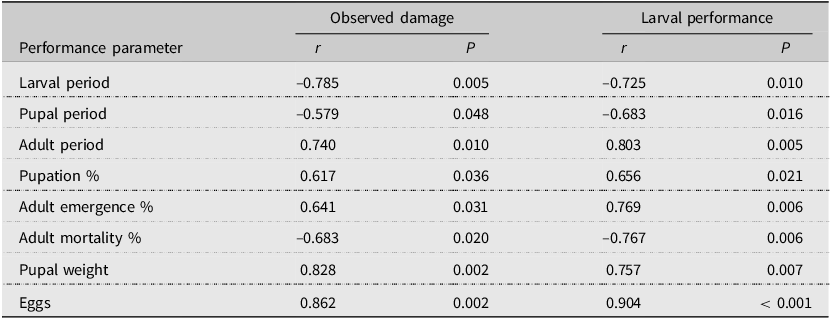
The correlation analysis results showed significant correlations between all performance parameters of G. pyloalis feeding on different mulberry cultivars against observed damage in the field and the larval performance in the garden plot (Table 3). Among these performance parameters, larval and pupal development times and adult mortality were negatively correlated with observed damage and larval performance, whereas the other parameters were positively correlated. The highest positive correlation was found between the number of eggs (r = 0.904) and larval performance. Additionally, correlation coefficients showed high positive correlations between the number of eggs (r = 0.862) and pupal weight (r = 0.828) with observed damage.
Correlation coefficients and P-values showing relationships between life history parameters (laboratory study) and observed damage (field trial) or larval performance (garden plot experiment) by Glyphodes pyloalis across 12 mulberry cultivars

Morphological and physiological characterisation of leaves from different mulberry cultivars
Generally, variations in leaf morphological and physiological characteristics were observed among different mulberry cultivars; however, the wax content was the only tested index for which MultiQ cultivar showed significantly lower values than all the other three cultivars (Fig. 4A–F). Specially, the surface wax content of cultivar MultiQ (395.1 ug dm–2) was less than half that of cultivar CathaB (812.5 ug dm–2; Fig. 4C). The leaf water content and thickness of cultivar MultiQ were significantly higher than those of cultivar BombyL (Fig. 4A and B). Cultivar CathaB had significantly higher values for leaf trichome density and soluble-glucose and soluble-protein content than the other three cultivars tested did (Fig. 4D–F). Notably, the primary type of trichomes, long macro hairs, were observed in cultivar CathaB (Fig. 4H), with a density of 1237.2/cm–2 (Fig. 4D), whereas no trichomes were observed in cultivar MultiQ (Figs. 4D and 5).
Morphological characteristics of four mulberry cultivars showing A, leaf water content; B, leaf thickness; C, surface wax content; D, trichome density; E, soluble-glucose content; and F, soluble-protein content. Within each panel, letters above the bars denote significant differences across cultivars, P < 0.05. MultiQ, Morus multicaulis Perrottet; BombyL, Morus bombycis Koidzumi; LaeviT, Morus laevigata Wallich; CathaB, Morus cathayana Hemsley.

Scanning electron microscopy images of leave from A, MultiQ (susceptible; Morus multicaulis) and B, CathaB (resistant; Morus cathayana) mulberry cultivars. The red arrows point to macro hairs.

Discussion
In the present study, G. pyloalis caused a wide range of damage to 12 mulberry cultivars across seven species. We demonstrated that G. pyloalis exhibited higher fecundity on and caused more damage to cultivar MultiQ, which indicates this cultivar should be considered susceptible to G. pyloalis.
When insects feeding upon plants demonstrate reduced survival and reproduction, this is referred to as antibiosis, a form of host plant resistance (Kumari et al. Reference Kumari, Jasrotia, Kumar, Kashyap, Kumar and Mishra2022). In the present study, cultivars CathaB, BombyL, and LaeviT showed evidence of resistance because G. pyloalis took longer to develop and had fewer eggs on these cultivars than on the nine other cultivars that we evaluated. These findings are similar to those obtained for the cotton bollworm, Helicoverpa armigera (Hubner) (Lepidoptera: Noctuidae), feeding on tomato (Solanaceae) (Hemati et al. Reference Hemati, Naseri and Razmjou2013; Razmjou et al. Reference Razmjou, Naseri and Hemati2013). Consequently, these effects lead to a decline in pest population size and subsequent reduction of damage, as we observed in the cultivars CathaB, BombyL, and LaeviT.
Oftadeh et al. (Reference Oftadeh, Jalali Sendi and Khosravi2015) found that a longer developmental period and lower reproduction of G. pyloalis on a host plant indicate reduced suitability for successfully completing their life cycle. Extended duration of the larval and pupal stages can increase the risk of predation, thereby increasing survival costs (Razmjou et al. Reference Razmjou, Naseri and Hemati2013). We observed that female G. pyloalis adults laid an average of 5.0–6.7 eggs per day on cultivars CathaB, BombyL, and LaeviT, with 41.7–61.7% of the subsequent larvae failing to survive to adulthood. In contrast, on cultivar MultiQ, females laid an average of 14.6 eggs per day, and 80.0% of the larvae that hatched from these eggs survived to adulthood. Our correlation analysis further confirmed a largely positive correlation between fecundity and larval performance of G. pyloalis. These results suggest that the preference of female insects plays a pivotal role in selecting cultivars for feeding (Carrasco et al. Reference Carrasco, Larsson and Anderson2015). As a consequence, we selected fecundity and larval performance as the primary factors for classifying resistance and identified three cultivars (BombyL, LaeviT, and CathaB) with the fewest number of eggs laid per day and the highest mortality rates as more resistant cultivars.
Damage can also be avoided if there is nonpreference for the host, which can be referred to as antixenosis, another form of host plant resistance (Kumari et al. Reference Kumari, Jasrotia, Kumar, Kashyap, Kumar and Mishra2022). Our comparison of morphological and physiological characteristics of four cultivars across the range of susceptibility showed that cultivars that were more susceptible to G. pyloalis had less leaf wax content and trichome density. The morphological, biochemical, and molecular characteristics, such as the presence of surface protective structures (e.g. wax, trichomes) or the synthesis of defensive compounds (e.g. terpenoids, alkaloids; Hanley et al. Reference Hanley, Lamont, Fairbanks and Rafferty2007), may serve as plants’ direct defensive traits against herbivore attacks (War et al. Reference War, Paulraj, Ahmad, Buhroo, Hussain, Ignacimuthu and Sharma2012). Leaf surface wax and the presence of trichomes constitute a primary physical barrier to herbivore feeding, serving as crucial defense mechanisms (Punithavalli et al. Reference Punithavalli, Muthukrishnan and Rajkumar2013; Cardona et al. Reference Cardona, Grover, Bowman, Busta, Kundu and Koch2023). Furthermore, it has been reported that the nutritional composition of plants can affect pest populations and thus impact plant damage severity (Wetzel et al. Reference Wetzel, Kharouba, Robinson, Holyoak and Karban2016). For instance, Rousselin et al. (Reference Rousselin, Sauge, Jordan, Vercambre, Lescourret and Bevacqua2016) found that different nitrogen and water levels can affect the nutrition of peach tree shoots and ultimately affect the abundance of the aphid, Myzus persicae (Hemiptera: Aphididae). However, in this study, the most resistant cultivar, CathaB, exhibited higher levels of soluble-glucose and soluble-protein content than cultivar MultiQ did. This suggests that these nutrients may not be key diet components for G. pyloalis; however, it is worth noting that soluble-glucose and soluble-protein contents have been reported as crucial indicators for nutrient availability for silkworms (Dong et al. Reference Dong, Zhang, Tao, Chen, Li and Qiu2017).
Additionally, we observed a species-dependent consistency in the damage to those cultivars from Morus atropurpurea Roxburgh and Morus multicaulis Perrottet, which had an average percentage of observed damage of more than 50.0%. However, due to the limited number of cultivars examined in this study, further species-specific observations should be conducted in future studies.
In conclusion, the present study documents and describes the first field-observed damage of 12 mulberry cultivars by G. pyloalis. The cultivar CathaB was found to exhibit the greatest potential for natural resistance to G. pyloalis. Furthermore, our in vitro assessment of life history parameters and our garden plot experiment on larval performance provide further evidence to support our observation that CathaB exhibits resistance to G. pyloalis. Our results are limited by a single year of study: whether CathaB persists in its resistance to G. pyloalis across years and in varying environments requires further study. Overall, our findings provide a basis for future cultivar selection in the mulberry tree industry.
Data availability
The datasets generated or analysed during the current study are available from the corresponding author upon reasonable request.
Acknowledgements
The authors thank Jiajia Xie and Xueqin Liu from Southwest University, Chongqing, China, for collecting mulberry tree leaves and feeding Glyphodes pyloalis. They also thank Dr. Xiaojiao Liu from Southwest University for her critical reading of the manuscript and helpful suggestions. This study was supported by the Special Project of Performance Incentives and Guidance for Scientific Research Institutions in Chongqing (cstc2021jxjl80002, cstc2022jxjl80010) and the Technical Innovation team at Xinyang Agriculture and Forestry University (KJCXTD-202001).
Competing interests
The authors declare that they have no conflicts of interest.