The interconnective tissue of the body politic—news reports on national leaders, the messages between community activists, the symbolic assertions of power, the expressions of ideology, and the protests of the counter-culture—all rest on the telecom infrastructure, television networks, and Internet. Yet, it is economists who dominate debates about communications services regulation and the infrastructure on which these services depend. More political scientists should engage in this work. As the world moves from the industrial to the information age, governing the communications market will become more important. In the next five to ten years, countries all over the world will solidify the institutions responsible for policy and rules for communications services—telecommunications, Internet, and media—and define such institutions' relationships with other parts of government, industry, and consumers. This change is occurring now because of two major shifts, one conceptual and one technological.
First, governments accepted and implemented the idea that a competitive paradigm for communications markets was more economically beneficial than a monopoly model. With multiple players in the markets, more debates and conflicts occur that need to be resolved. One way to frame this challenge is to distinguish between policy and regulation. The policy maker is expected to broker agreement on broad objectives, and every brokered agreement could be unique from the next depending on political circumstances. The regulator that is independent from direct political pressure is expected in similar cases to reach similar conclusions. The challenge, however, becomes how to design a regulatory institution insulated from the vagaries of politics that is still consistent with democratic notions of accountability and majority rule.
Second, the shift from analog to digital technologies makes services that were once discrete—television programming and print publishing, for example—all physically reducible to data that can be sent over Internet protocol (IP) networks, sparking a redefinition of these services and the institutions that govern them. Regulators decide how such services are defined, who can offer them, who can use them, and assign any scarce resources such as radio spectrum that may be necessary to make the services available. This is a transformative moment in communications policy; researchers have an opportunity not only to contribute to the literature, but also to influence concrete institutional arrangements that govern telephones, televisions, radios, and Internet service worldwide.
The Advent of This Study
Until recently, I worked at the Federal Communications Commission (FCC), the U.S. regulatory agency for communications services, which includes telephones, media services such as television and radio, and, to a certain extent, Internet services. In the spring of 2003, my colleague Patrick Boateng, who covered work with our government counterparts in Africa, started asking me questions. Was there a notional, “ideal design” for an independent communications regulator? What general characteristics or specific functions should regulatory institutions have? He was working with government officials in several countries who were creating communications services regulators and was confronted with finding answers to their very practical, concrete questions. The key goal that countries with new regulators aim for is an “independent” regulator, which reflects the current policy literature's suggestion that such regulators, insulated from political interference and pressure from industry players, are more likely to make good decisions that reflect the public interest. Many countries must establish independent regulators in order to fulfill World Trade Organization commitments.
Boateng's questions reflect an international trend. In 1990 there were only 14 communications regulatory agencies in the world. Since then, the number has roughly doubled every four to five years. As of 2007, there were no less than 148 such authorities.Footnote 1

Globally, there has been a rise of regulatory agencies in a range of countries across a range of sectors—finance, electricity, water, gas, general competition policy. Jordana and Levi-Faur track the establishment of regulatory agencies in 36 Latin American and European countries from 1979 to 2002. Their work in Latin America and Europe reveals that national communications regulatory agencies are exceeded in number only by central bank authorities.Footnote 2
In order to answer the questions of Boateng and other colleagues, I organized a survey of regulators for 18-countries chosen because they recently had significant improvement in their communications network development and FCC staff corresponded with them regularly. Where markets have separate regulators for telecommunications and broadcast, efforts were made to include both, although responses were not received in all cases. This survey was combined with a previous four-country study by Cathleen Hsu and me on ethics and decision-making processes, which drew on information collected in correspondence, materials, and interviews with regulatory officials.Footnote 3 The working strategy that shaped the construction of the survey was that among this group of good regulators, it might be possible to identify a useful set of characteristics, which could then be the basis of recommendations to other countries in the process of organizing their regulators. The survey questions reflected a mix of issues based on concerns raised in the literature and on practical regulatory experience.
The 18-country survey had three sets of questions related to regulatory independence, reflected in figure 2. The first related to the relationship between regulator and industry. The consensus among scholars and practitioners is if communications operators—telecommunications companies, television broadcasters, and Internet service providers—are still owned by the government, then the regulator is likely to be hostage to their concerns. The second set was on the relationship between regulator and other parts of government, such as the communications ministry, competition authority, and legislature. Unlike with privatization, among practicing regulators there is no consensus that separating regulation and policymaking enhances regulatory independence. The survey results suggest that among good regulators, this distinction is commonplace. A third set of questions related to regulator and consumers. The scholarly research focuses on what regulators should be independent from; there is very little work on what regulators should be independent for and accountable to. However, many of the most admired regulators are advocates of the long-term benefit of the consumer.
The regulator in context

In an earlier survey, Cathleen Hsu and I had described the decision-making procedures and ethics rules of four regulators. Corruption, whether institutional or individual, undermines the independence of a regulator, although it is rarely so bluntly stated. The literature on regulators and independence elides the issue. The inclusion of this second survey in this study is an effort to bring the research on ethics and transparent decision-making to bear directly on the question of regulatory independence.
Why Is It Important to Have an “Independent” Communications Regulator? What Makes a Regulatory Agency Independent?
Historically, communication services are run by monopolies, whether state-owned telecommunications operators or state-owned public broadcasters. As governments privatized and competitors entered these markets, regulators were established to set technical standards, settle disputes, allocate scarce resources, and other tasks. Theory suggests that governments establish independent regulators to make commitment to reforms easier and reduce investor risk, which should boost market growth.Footnote 4 Researchers have focused on whether the regulator is independent from industry players, usually the historic incumbent monopolist. For example, in a study of 15 European states, Edwards and Waverman identify whether the incumbent telecom operator is privatized and measure its effect on regulation. They find that when incumbent operators are state-owned, regulatory pricing decisions tend to favor them. However, if there is an independent national regulatory authority, the regulator can counter the systemic bias in favor of the state-owned operator.Footnote 5 This literature combined with the practical observation that the markets with the most flourishing communications services often have them,Footnote 6 has persuaded the officials of many nations to take seriously the idea of establishing an independent regulator.Footnote 7
There is less international consensus around additional characteristics that may improve a regulator's independence; this study participates in building a clearer and richer view of independence.Footnote 8 Research emphasizes the need to protect the regulator from political pressure from other state institutions.Footnote 9 For example, in an ideal world, a regulator faced with license applications from a number of different firms will use the same criteria to evaluate each application and not be influenced by the number of politicians calling in favors from the head of the regulatory agency. Won-ki Min's paper for the Organisation of Economic Cooperation and Development (OECD) includes separation of regulator from the communications ministry as an indicator of regulatory independence.Footnote 10 While this principle is accepted among the 30 OECD member countries, it is not worldwide. In the 18-county survey included in this study, questions that explore the degree to which regulator and policymaking ministry are separate may contribute to a more nuanced view of regulatory independence.
Stern and Holder's Reference Stern and Holder1999 study identifies effective participation by interested parties in decisions and transparency in the regime to reduce the likelihood of unfairness and incompetence.Footnote 11 Not discussed in the literature, however, is the practical challenge of making transparent decision-making procedures work. The problem is not in the mechanics; publicizing notices and information is made easier every day with the Internet. Instead, the challenge is in transforming the culture of participation among firms and consumers who are affected by regulation. When regulators first begin asking comments from the public on proposed rule changes, frequently, parties are reluctant to participate. Why they are reluctant is fertile ground for further work—is it fear of retaliation, lack of resources, reluctance to share information, or lack of confidence in the process? This study includes a survey of four markets' decision-making process that can serve as a foundation for future comparative work.
Both Min and Stern and Holder identify the contestability of a regulator's decision as a characteristic of an independent regulator. In general many scholars argue that if a regulator's decision can be contested successfully, that is a demonstration of the independence of the regulatory regime. This makes sense because frequently regulators, thought of as “captured” by the industry they regulate, make decisions considered inordinately in favor of the incumbent operator. Therefore, the opportunity for small, innovative, or foreign operators to contest the decision successfully is considered a mark of a regulatory regime independent of the incumbent. However, if a regulatory decision were favorable to the competing operator and an incumbent operator were able to successfully contest such a decision, contestability appears no longer a mark of the regulator's independence, but instead a reflection of regulatory capture. For this reason, this study focuses on identifying whether the regulator has procedures in the decision-making process to enhance fairness and transparency as a basis for accountability, rather than the process of afterward contesting decisions.
What Is the Regulator's Relationship with Other State Organizations?
The 18-country survey shows that while many countries separate the policy-making organization from the regulatory organization, many do not. Three aspects of the survey are relevant to examining the regulatory relationship with other state institutions: the terms and conditions of the leadership, the scope of the regulatory authority to issue licenses; and the source of the regulator's budget. The first indicator of the relationship between the regulatory and other state institutions is how the leader of the regulatory organization is selected and dismissed (table 1). The regulatory organization has greater independence if the leader's position is protected, by custom or by law, for a specified period of time or for life, no matter what decisions are taken. However, in some instances the leader can be dismissed if others in the state are dissatisfied with the decisions of the organization. Half of the countries surveyed have regulatory agencies with an independent leader. In these countries, having a predetermined term of office of between three and seven years often serves as a clear time frame that insulates the leader from pressures on day to day decisions. The one exception is Hong Kong, where a custom may be developing that the leader serves until he or she retires from civil service. If this custom is preserved, it serves as even greater source of independence than the common pre-set term of office.Footnote 12
Leadership of the regulatory organization

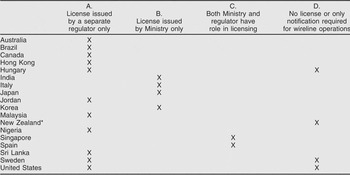
A second indicator is the clarity of the regulator's authority (table 2). For example, one area where regulators typically have great influence is in issuing licenses for market entry. For wireline telecommunications licenses, where scarce resources are not usually at stake, many independent regulators have exclusive authority to issue licenses, whereas in other countries, the ministry that reports directly to the political leadership has an exclusive or partial control in the issuing of licenses. In 11 of the 18 countries examined, the regulator has the exclusive right to issue wireline licenses. Only in six countries did the ministry retain the whole or partial right to govern entry into the wireline market. The one exception in this set is New Zealand, since no licenses are required for firms to provide wireline service; neither regulator nor ministry is involved. Licensing of wireline telecommunications service is only one of many areas of possible authority for regulatory organizations. If other areas were examined, a different range of responses on the relationship between the regulator and ministry's relationship might be uncovered.
Telecommunications wireline licensing

* In New Zealand, no license is required; therefore the regulator is not dependent on the Ministry's decision in this regard.
A third indicator of the regulator's independence is the source of its budget (table 3). Greater independence is possible if the regulatory organization has nearly complete control over how fees and funds are raised for its own operations. In other instances, the organization's budget is allocated and approved by institutions that may seek to use the budget process to influence regulatory decisions. Some organizations are funded both by their own fees and by a politically allocated budget. Seven of the surveyed bodies raise their entire budget from regulatory fees. In four countries, substantial funds are raised through fees, but also some portion of the budget must be allocated through the national budget process, which subjects them to political review. In Korea, the broadcast regulator's entire budget is raised from fees, but the telecom ministry has its funds allocated through the national budget.
Independent funding for regulator

Note: X = raise own funding; O = rely on state budget allocation.
At least based on these three indicators, four countries' regulators have very robust independence from other state institutions (in Brazil;, Canada; Hong Kong, China; and Nigeria). Brazil, Canada, and Hong Kong do indeed have regulators with strong reputations for independence. Brazil and Hong Kong are especially known for their exceptionally vigorous regulatory efforts to break up and erode the market power of their respective incumbent telecommunications monopolist in the 1990s.Footnote 13 Nigeria's regulator is more recently established. Successful license auctions conducted in 2003 have established its reputation as independent and resourceful.Footnote 14
What Is the Regulator's Relationship with Industry?
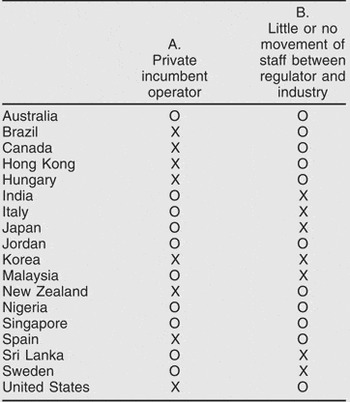
In the survey of eighteen countries, two sets of data were relevant to the regulator's relationship with industry: privatization of operators and regulator staff relationship with industry. The first indicator of the regulator's relationship with industry is if any state-owned incumbent operators were privatized. Greater independence is possible if the state responsibility is first to the consumer without any interest in the profitability of a state-owned operator. A second indicator is whether there is a revolving door for the staff to move between the regulator and the industry. Greater independence is possible if staff serve their entire careers in the regulatory organization; they are less likely to be influenced by other interests. In other instances, staff move frequently between the regulatory organization and industry or other parts of the state. However, a tradeoff is that regulators benefit from the market and technical knowledge of staff drawn from the industry. Frequent interchange of staff between industry and regulatory agency has its benefits, therefore, but it may have a dampening effect on the regulator's independence.
Based on these indicators, Korea has both a fully privatized incumbent operator and a regulator staff that customarily does not move in and out of industry positions. To characterize the Korean regulatory institution as independent from industry may be surprising as Korea has often been considered a prime example among East Asian economies of industrial policy—using state policy to promote its own country's firms at the expense of others.Footnote 15 Whether a state treats foreign firms differently from domestic firms, however, is outside the scope of this article. These results suggest that in Korea the framework of the relationship between regulatory organization and industry maximizes the regulator's independence from industry. Another notable set of facts is that for some of the surveyed countries, privatization is recent. This is true of Korea, which privatized Korea Telecom only in 2002. In other markets, such as Hong Kong, Spain, and the United States, the incumbent operators have been private for a long time. On the other hand, many countries listed as not having private incumbent operators have partially privatized. This is true, for example, for Australia, India, and Sweden.
Regulator's relationship with telecom industry

Note: X = yes; O = no.
Regulator's Relationship with Consumers
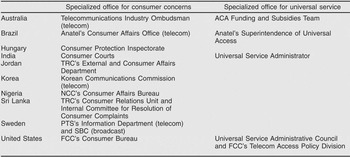
If a regulator is independent from industry interests and insulated from political vagaries, what is it for? One answer is that an independent regulator is an advocate for the long-term interests of the consumer, and the first step to acknowledging this objective is to have consumer interests represented within the regulatory agency. How this occurs varies widely among different states and the survey results reflect this diversity. In telecommunications, there are two major areas of consumer interest: handling of consumer complaints and concerns and universal service or universal access to services. These two areas are not equally important in all countries. Table 5 reflects those surveys with responses for this section, not all returned surveys had responses for consumer issues.
Dispute resolution, consumer concerns, and universal service functions

In Brazil and the United States, overseers for universal service policy are organized inside the regulatory institution. In other instances, institutions other than the regulator are responsible. For example, in Australia, Hungary, and India, bodies other than the regulator handle consumer complaints.
The idea that an independent regulator should be for consumers, in addition to being independent from policymakers and industry is a new contribution of this study. One critique of independent regulatory agencies is that they are too unaccountable to the public; this criticism is especially cogent in newly democratic states still in the midst of building political institutions responsive to the broader public rather than a privileged elite. If researchers investigate whether regulators that take long-term consumer welfare as their primary goal are more effective, some progress can be made in answering this critique.
In politics, representation is valuable. While in many countries there may be hundreds or even thousands of companies under the purview of a regulator, often there are easily millions of consumers. As a practical matter, customer-oriented interpersonal skills, a body of specially tailored information, and other expert techniques are necessary to handle direct interaction with consumers. The presence of these offices and representatives for consumer interests in these governments, therefore, reflects official recognition that consumers have interests distinct from other constituencies. If the political goal of regulating an industry is not to maximize its growth, but rather to improve the long-term quality of life of the citizens, then having an office devoted to their concerns—whether represented by a consumer office, a universal service office, or some other form—may serve as a useful indicator of whether its organizational resources are aligned with its objectives.
Transparency in Decision-Making Procedures
Beyond the organizational arrangements discussed here, the regulator's independence and credibility can be affected by the rules that govern its everyday interaction with others, whether state institutions, firms, or consumers. Transparent decision-making rules can increase confidence in a regulator's fairness. Clear ethics guidelines for regulatory staff can enhance the organization's integrity. In 2002, Cathleen Hsu and I undertook a study of the decision-making process and ethics rules in the communications regulators for Canada, Hong Kong, United Kingdom; and our own institution, the FCC in the U.S., regulators which all have strong reputations for integrity.Footnote 16 While these four markets have quite different styles of government, their communications regulator's decision-making procedures and ethics rules share remarkable similarities. Further research could explore whether these common frameworks can be useful in other countries.
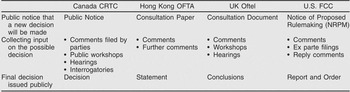
All four regulators follow a basic three-stage rulemaking framework.Footnote 17 In the first stage, the regulator releases a consultation paper which identifies a problem, proposes new rules, and asks the public for opinions. In the second stage, the regulator receives comments on the consultation paper. While there is always at least one round of comments, often it is followed by additional rounds known as “reply comments,” to allow the public to critique the initial comments. In the third stage, the regulator releases the final decision paper, which includes the new rules, a discussion of how they serve the public interest, and responses to public comments. For all four regulators, the consultation paper, comments and reply comments, and the final decision paper are available to the public at each stage, unless there are special arrangements requested to keep information confidential. This three-stage process guarantees basic transparency by ensuring the public are aware of possible regulatory changes, are given an opportunity to voice their views, and informed of the final decision and the reasoning behind it.
Decision-making processes

Initial Consultation Paper
The initial consultation paper clearly defines all relevant issues that need addressing, provides background, and describes the regulator's preliminary solutions. Consultation papers can address a single problem or bring together a group of related problems. A close look at the actual practice of these four regulators shows that putting together a consultation paper in itself may require consultation. For example, before issuing a formal consultation paper on creating an ombudsman, UK's Oftel hosted working group meetings of telecommunications providers and consumer groups to discuss its feasibility.Footnote 18 Similarly, Hong Kong's OFTA, in a particularly complex case when incumbent operator PCCW-HKT (Pacific Century CyberWorks-Hong Kong Telecom) requested changes to interconnection rules, wrote to all the local fixed network operators inviting them to identify their interconnection concerns. Consequently, OFTA was better informed about the universe of possible regulatory changes before issuing a formal consultation paper and was able to resolve more efficiently a range of interconnection problems in one proceeding.Footnote 19 When regulators are required to release a consultation paper to the public, they have an incentive to consider thoroughly a variety of views from the beginning of the decision-making process.
Collecting Input from the Public
For all four regulators, anyone can file comments on a consultation paper, and these comments are made public. For example, in the U.S., other government agencies can file comments on a FCC consultation paper. Except for Hong Kong, all these regulators have a formal reply comment period when the public can file critiques of the first round of comments. The regulators' information gathering is not limited to comments and reply comments. UK's Oftel and Canada's CRTC often hold workshops and hearings. The CRTC will issue specific interrogatories to people who participate. The FCC will receive presentations of views from interested parties; other interested parties are notified that such presentations have taken place through ex parte letters and then have the opportunity to present their own views before the FCC. Overall, the formal second stage of collecting comments from the public, especially since the comments are circulated publicly, creates a period of substantial public debate where all parties have access to much of the relevant information.
Final Decision Paper
The regulator's final decision paper usually states the rule changes, addresses the concerns raised during the comment period, and explains the decision in light of public interest goals. Such a decision paper gives the regulator the opportunity not only to publicize the new rules, but also to explain the reasoning behind the decision, a process that not only increases transparency, but also may enhance compliance. In all four of these markets, if the parties do not agree with the regulatory decision, they can either appeal directly to the regulator to reconsider or appeal through the courts. Canada is the only country with a regulatory appeals process that ultimately rises to the federal cabinet. However, the cabinet usually defers to the regulator.
Ethics Rules for Integrity
An agency's transparency and impartiality in decision making could be jeopardized if its employees are influenced or are perceived to be influenced by gifts from outside sources, financial and personal conflict of interest, or post-employment prospects. Generally, there are four approaches to ensure ethical standards: (1) avoidance of activity, (2) disclosure of activities, and (3) divestment or resignation from positions that pose conflicts, or (4) recusal, or quarantine, from an area of the regulator's work.
Ethics rules

Gifts
All four countries prohibit regulatory staff from receiving gifts that are improper or appear improper; in addition they all have criminal codes on bribery. The challenge in ethics rules related to gifts is in what exceptions can be made. Here, among the four countries, there are variations. In Canada, government employees may accept gifts of incidental value and customary hospitality that do not give rise to appearance of conflict of interest or compromise the integrity of the state. In Hong Kong's OFTA, employees may accept gifts from a close relative or on occasions such as their wedding anniversary, when it is the customary tradition to give gifts. The Hong Kong codes are quite explicit in identifying family relationships that apply: spouse, parents, grandparents, children, grandchildren, and to a specified degree, aunts, uncles, nieces, and nephews.Footnote 20 In the U.S.'s FCC staff may receive from regulated entities gifts of US$20 or less in each instance, and cumulatively less than U.S.$50 in a year; meals are considered gifts. In the U.S., there is an exception for gifts from those with a preexisting, close, personal relationship with a staff person.
Often there are support systems or specified procedures for staff who find themselves in a situation where a potential conflict or appearance of impropriety might arise. For example, if an employee is unsure about the appropriateness of a gift, he can decline it, or if that is not possible, accept the gift and report it immediately to his supervisor. In the U.S.'s FCC, for example, there is an ethics office where staff routinely can ask for advice on potential ethical problems. In Canada, in circumstances where it is impossible to decline the gift, the employee must report it to the supervisor immediately.Footnote 21 In Hong Kong, other than in excepted circumstances, employees must obtain special permission to accept gifts.Footnote 22 In the UK, under certain circumstances, the employee is required to report offers of gifts, hospitality, awards, decorations and other benefits before accepting them.Footnote 23
Conflict of Interest
The three main types of conflict of interest arise from pecuniary, personal affiliations, and family interests. Ethics rules come into effect when a regulatory employee participates in proceedings that involve close associates or family members, companies in which the employee holds stock, or companies about which the employee has gained confidential information through personal affiliations. The primary approach to prevent conflicts of interest is to require regulatory staff to disclose financial and personal interests in categories that could give rise to conflict. Often this leads to a requirement to divest of these interests if there is or appears to be a conflict. In the case of Hong Kong, however, although OFTA requires mandatory disclosure of direct telecommunications investments, the divestment of these investments is voluntary. Sometimes required disclosures extend beyond the staff person in question; for example, in the U.S., disclosure of the spouse and children's financial holdings is also required.
Post-Employment
Post-employment guidelines aim to prevent any suspicion that an official might be influenced by the hope or expectation of future employment with outside firms and the risk that a particular firm might gain an improper advantage over its competitors by employing someone who had access to information on the competitor through official capacities. In Canada, a CRTC official is prohibited from accepting employment from companies with which he had significant dealings with for a period of one year after leaving office. In the UK, for a senior level employee, in the first two years after service, she must file an application and obtain approval from the Advisory Committee on Business Appointments prior to taking a new appointment.
While there is a broad range of work on the importance of integrity and fair-dealing by government officials, this study seeks to link this directly with the independence of the regulator.Footnote 24 A regulator's independence from the policymaker and independent from industry is reflected not only in its organization arrangements, but also in the rules and procedures that govern its everyday interaction with these constituencies. The decision-making rules govern the regulator's everyday working relationship with firms, other stage institutions, consumer groups, and other interested parties. Ethics rules govern the regulatory staff's everyday working relationship with the employees of firms and other interested parties. As this study is based on a review of only four markets, further research that investigates the customs and laws of more countries would contribute to understanding the influence of ethics rules and decision-making procedures on the effectiveness of regulatory agencies.
On the Distinctions of Policy Research
The quickest way to send a government official or politician to sleep is to propose a hypothesis based on theory, and then proceed to prove or disprove it. Research for public policy is a distinctive genre. The primary preoccupations of officials are to address questions of immediate and obvious public concern—questions rarely of their own choosing—and what to do next, under time constraints and in the face of incomplete information. Not taking action is frequently as significant as taking action; escape is rarely possible. Policy research answers the question which is asked by the policymaker, the regulator, the politician, not the question posed by theory, or the question that fills a gap in the literature, or the question for which there is data.
This study is an example of such a project. First, in terms of timing, there were urgent questions pressed on the FCC by our foreign counterparts about how to establish independent regulators. These regulators were on their own domestic political timetables. Questions posed to the FCC, if not answered within weeks or months, would become quickly moot. The requirements of speed dictated which countries were included in the surveys and its level of detail. From the time the initial questions were posed to me in spring 2003 to the circulation of the 18-country survey was a few weeks. By mid-summer the survey responses were in; by September 2003, the basic findings were in use at international meetings; and by June 2004, the project was complete and released on the agency's website.Footnote 25
Second, the initial questions from foreign regulators also asked for recommendations for the number of staff and their degree of professional training. Therefore, the survey covered not only qualitative aspects of how a regulator could be established independently, but also organization charts and quantitative data on the staff. Again, this was an effort to answer the question asked by the regulators, the people in the midst of making decisions at the time.
Third, as the questions coming to the FCC typically came from countries with small populations and limited resources to establish a regulator, in the 18-country survey we made a special effort to collect information from similarly emerging economies with smaller populations. Of the eighteen countries in the survey, six had populations of less than 10 million, nine had populations of less than 20 million. Of the eighteen, seven had per capita income of less than U.S.$10,000 per year as of 2003.
In the construction of the analysis for this study, readers will recognize the adoption of a “best practices” approach to collecting and identifying the characteristics of an independent regulator. Identification of best practices involves a survey of successful cases, identification of common characteristics in these cases, and distillation of how these characteristics can be achieved. Implicit in this approach is that others who achieve these common characteristics will experience similarly successful results. This kind of framework is fraught with pitfalls, the most obvious of which is there is not necessarily a causal link between characteristics and results, especially since the set studied does not include any failures. However, imagine a roundtable of regulators from around the world discussing the meaning of independence, each with an awareness of which markets are thriving with innovative communications services and which national regulators have reputations for effectiveness. In such a context, arguments made with evidence from markets held in high regard will be more persuasive. Theoretical grounding is important in all research, but in policy research it is also important to appeal to the common values held by the targeted epistemic community. In the longer run, best practices studies can provide important foundations for future research. For example, from this study emerge several observed characteristics of well-regarded regulators that are not usually included in scholarly inquiries into regulatory independence—the relationship with the consumer, the decision-making process, and ethics rules. While best practices research has its shortcomings, it can also introduce innovations.
Conclusions
There is tension between commitment and flexibility that all states face in creating and implementing communications policy and rules. Policy describes the decisions a state reaches by brokering the interests of various political groups. Once agreement is reached on a major policy, rules are needed for the state to implement the policy. The institutions that are responsible for developing these rules are often regulators. Given that the effectiveness of the regulatory institution depends largely on its independence—its ability to render similar decisions for similar cases—what indicators can be used to characterize a regulator as independent? In the main, these indicators reflect the regulatory institution's relationships with three other groups: other state institutions, industry, and consumers.
Relationship with Other State Institutions
While there should be some means to keep the regulator accountable to the public, an independent regulator has some measure of insulation from political winds. These can include
• a leader who cannot be dismissed for unpopular decisions
• a leader with a guaranteed term of office
• scope of authority that is clearly distinct from the policy-maker
• funding which is independent of political review
Relationship with Industry
While industry can be a great source of market knowledge and technical data, the regulator must be independent from industry in order to be perceived as fair by other state institutions and consumers. Two markers of independence from industry include:
• privately-owned incumbent telecommunications operator
• minimal exchange of staff between the regulator and regulated firms
Relationship with Consumers
Consumer interests are usually widely dispersed in the market and, therefore, their views are more easily overlooked both in the policy-making and rulemaking process. Regulators seeking to balance this against the strength of industry and other state institutions' views may make special efforts to collect and reflect consumer interests. Two indicators include a dedicated office to consumer affairs and a dedicated office to universal service, an important issue for consumers.
In addition to these indicators, there are systemic processes that regulators can use to mediate relationships with other state institutions, industry, and consumers, such as decision-making processes and ethics rules. In several well-established independent regulators, there are common elements in decision-making and ethics rules which help them manage their relationships with interest groups in a transparent manner. In decision-making, they had in common a three-step process which involved public notice of proposed rule changes, opportunity for all parties to provide written, public comments, followed by a written, public decision that includes the reasoning of the regulator.
In ethics rules, they had in common rules for gifts, conflicts of interest, and post-employment, which require regulatory employees to avoid certain activities, disclose other activities, divest or resign from positions that presented conflicts, and quarantine themselves from certain areas of regulatory work.
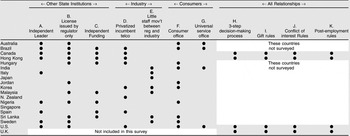
The following table summarizes how the surveyed regulators use these measures which can enhance their independence. The first three indicators, A–C, bear on the regulator's relationship with other state institutions; the next two, D and E, are relevant to its relationship with industry; F and G reflect its relationship with consumers, and the final columns, H through K reflect its overall decision-making and ethics rules.
Indicators of independent regulators: Summary of 18-country survey (A-G) and 4-country survey (H-K)

In no instance did any single regulator adopt the most independent option for all of the traits that were examined in this paper. However, nine of the countries have regulators that used most of the tools outlined in this paper: Australia, Brazil, Canada, Hong Kong, Hungary, Nigeria, Sri Lanka, Sweden, and the United States. Among the eighteen countries in the first survey, most had regulators with the sole authority to issue wireline licenses and offices that represented consumer interests. At least half had independent leadership and independent funding.
In democratic systems especially, demand for independent regulatory decisions must always be balanced against the need for all institutions to be accountable to the public. Which traits of independence are suitable for any one regulator to adopt will vary, depending on the state's institutional endowments and political culture. However, some combination of these traits is likely essential in establishing a regulatory institution perceived by all as independent. As the number of communications regulators grows, political scientists can contribute by refining our understanding of what practical arrangements make such regulators independent, and testing whether such regulators actually improve the development of communications services. These concerns affect not only economic growth, but also the evolution of political and social networks around the world that depend on the cell phone, television, the Internet, and other emerging technologies.
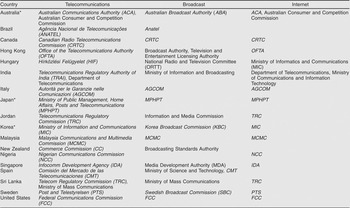
Communications regulatory organizations

(Survey responses from italicized organizations)
* Since 2003 when the survey was conducted, the Australian Communications Authority and Australian Broadcast Authority have merged to form the Australia Communications and Media Authority; Japan changed the English translation of ministry's name (soumusyo) to Ministry of Internal Affairs and Communication; and Korea announced that a new agency will be formed from the Ministry of Information and Communication and Korean Broadcast Commission.