Implications
Sexed semen might increase the genetic progress of dairy cows by enhancing selection intensity. Sexed semen decreases the reproductive performance of dairy herds owing to low fertility. Reduction in reproductive performance has a negative effect on genetic progress by increasing generation interval and reducing newborn calves. Previous researchers have not considered these positive and negative effects of sexed semen simultaneously in a stochastic simulation. The aim of this paper was to compare the effect of widespread (in cows and heifers) and limited (in heifers only) use of sexed semen on the genetic progress of dairy cows by considering low fertility of sexed semen.
Introduction
Reproductive technologies such as artificial insemination (AI) and semen sexing are effective tools in the world dairy industry to achieve genetic improvements of dairy cattle. Johnson et al. (Reference Johnson, Flook and Look1987 and Reference Johnson, Welch and Rens1999) showed that it is possible to separate X- and Y-bearing sperm by a flow cytometry system with 85% to 95% accuracy. Progeny test programs are the most important schemes for genetic improvement of dairy cows by using AI. In a progeny test program, the best bulls are selected on the basis of their genetic merit, which is predicted on the basis of the records of daughters and other relatives. Sexed semen alters sex ratio and produces more female calves and heifers in the population and increases effectiveness of AI progeny testing programs.
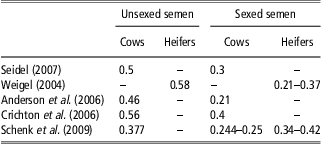
The conception rate (CR) of sexed semen is typically lower than conventional semen, possibly because of a negative mechanical effect of the sorting process and lower doses of sperm per straw (Garner and Seidel, Reference Garner and Seidel2003; DeJarnette et al., Reference DeJarnette, Nebel, Marshall, Moreno, McCleary and Lenz2008). Garner and Seidel (Reference Garner and Seidel2003) stated that if control pregnancy rates are in the 50% range, pregnancy rates with low dose of sexed semen are often around 30%. DeJarnette et al. (Reference DeJarnette, Nebel, Meek, Wells and Marshall2007) stated that the average CR of sexed semen is about 75% of the CR of conventional semen in heifers. Weigel (Reference Weigel2004) reported that the average CR with unsexed semen for heifers was 58% and with sexed semen varied between 21% and 37% relative to reproductive management of herds. Seidel (Reference Seidel2007) stated that low doses of sperm has a small effect on the CR of sexed semen in heifers when reproductive management is excellent, and that successful use of sexed semen depends on excellent management of cattle, careful handling of sperm and use of skilled inseminators. Anderson et al. (Reference Anderson, Taponen, Kommeri and Dahlbom2006) reported that the average CR was 21% with sexed semen and 46% with unsexed semen in cows. Crichton et al. (Reference Crichton, Huffman, McSeeney and Schenk2006) showed that the CR of sexed and unsexed semen at first insemination was 40% and 56%, respectively. Schenk et al. (Reference Schenk, Cran, Everett and Seidel2009) reported that lactating dairy cows resulted in similar pregnancy rates for 2 × 10⁶ sexed sperm in 0.25 ml straws (25.0%, n = 708) and 0.5 ml straws (24.4%, n = 776), but lower (P < 0.05) than unsexed control sperm (37.7%, n = 713). In addition, they stated that the CR of sexed semen for heifers varied between 34% and 42% relative to pressures for sorting sperm. DeJarnette et al. (Reference DeJarnette, Nebel, Marshall, Moreno, McCleary and Lenz2008) evaluated the CR of sexed and unsexed semen for lactating dairy cows and observed no evidence for difference between the CR of sexed and unsexed semen. The summary from all these studies is presented in Table 1.
Conception rate of sexed and unsexed semen in different studies

Van Vleck (Reference Van Vleck1981) showed that the rate of genetic progress could increase by 15% when sexed semen was widely available. Baker et al. (Reference Baker, Shannon, Garrick, Blair and Wickham1990) reported that use of sexed semen would have a very small effect on the rate of genetic improvement. Hohenboken (Reference Hohenboken1999), Weigel (Reference Weigel2004) and De Vries et al. (Reference De Vries, Overton, Fetrow, Leslie, Eicker and Rogers2008) stated that the rate of genetic progress would be expected to increase by less than 15% with the use of sexed semen. Abdel-Azim and Schnell (Reference Abdel-Azim and Schnell2007) concluded that by using female-sexed semen in commercial herds the average superiority in first lactation cows exceeded 30% in year 11 relative to a base scheme with unsexed semen, but continued to decrease until it reached 9% in year 20. Sorensen et al. (Reference Sorensen, Voergaard, Pedersen, Berg and Sorensen2009) showed that the use of sexed semen gave a positive increase in the annual genetic gain of 2.1% when used on the best cow dams and 2.7% when used on all heifers, but only the latter was statistically significant. Furthermore, use of sexed semen together with multiple ovulation embryo transfer (MOET) on bull dams (BD) increased the annual genetic gain by 1.8% to 2.5% compared with schemes without sexed semen and MOET on all BD. They stated that the increased annual genetic gain was caused by a larger contribution from the cow dams to the BD.
The objective of the current study was to compare the effects of widespread and limited use of sexed semen on the genetic progress of dairy cows in a conventional progeny testing scheme. Moreover, the negative effect of sexed semen on the reproductive performance of population was studied. Previous researchers have studied the effect of sexed semen on the genetic progress of animals, but most have not considered the negative effect of sexed semen on genetic progress because of the reduction in reproductive performance. Moreover, the effect of improving sexed semen fertility was studied by considering different levels of CR. In addition, the effects were studied in four distinct paths of selection: active sires (AS), young bulls (YB), bull dams (BD) and milking cows (CW).
Material and methods
Models and fixed and random factors
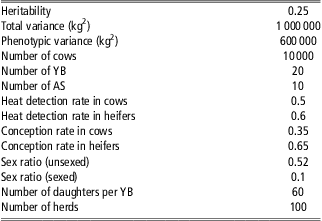
The simulation used the parameters given in Table 2. Management group (m), genetic merit (a), parity (p) and residual component (e) were considered for simulating a lactation record. Management groups consisted of herd, year and season effects. Thus, for the ith cow, her phenotypic value of a milk record (yi ) can be written as

Parameters used in simulation

YB = young bulls; AS = active sires.
For genetic evaluation, a general model was considered:

where b is a vector of fixed effects, a is a vector of genetic effects and X and Z are incidence matrices relating records in y to fixed and random effects, respectively. In addition,  , where
 is the variance–covariance matrix of a, with A representing the relationship matrix among animals. Additive genetic effects, a, were simulated under the assumption of an infinite loci model. Details of the stochastic simulation model can be found in Abdel-Azim and Freeman (Reference Abdel-Azim and Freeman2002).
For simulation of fixed and random factors, information that was available for a Holstein dairy cow population was used. In this study, variance of all observations was termed total variance and it was considered equal to 1 000 000 kg2. The total phenotypic value was divided into 40% because of fixed factors and 60% because of random factors (Hansen et al., Reference Hansen, Freeman and and Berger1983; Kuhn et al., Reference Kuhn, Boettcher and Freeman1994). Fixed factors were herd, year, season and parity. Proportions of herd and year were 22% and 6%, respectively. Proportions of other fixed factors were 12%. Therefore, simulation of values of fixed and random factors can be written as follows:


Equation (3) shows that herd effect is a variable that is distributed normally with a mean of 0 and variance of 0.22 × total variance. Herd effects were made once, and then randomly assigned to the base population. Herd effects for heifers were considered equal to those of their dams. Every 2 months was considered a season, starting from January. The values of each season were 179, 68, −153, −318, 43 and 187 kg. For the parity effect, 249 kg were added to first lactation cows and −249 kg were added to the latter records (Kuhn et al., Reference Kuhn, Boettcher and Freeman1994; Abdel-Azim and Freeman, Reference Abdel-Azim and Freeman2002).
Population structure and selection
Population structure was designed on the basis of information reported by Hansen et al. (Reference Hansen, Freeman and and Berger1983) and Kuhn et al. (Reference Kuhn, Boettcher and Freeman1994). Five parities with constant proportions were considered in the base population. Proportions for parities were 0.33, 0.26, 0.19, 0.14 and 0.08. Animals were culled from the population after the fifth parity. We considered the number of CW as being equal to 10 000; thus, there were 3300, 2600, 1900, 1400 and 800 cows in the population for parities 1 to 5, respectively. The population size was kept constant to avoid genetic gain caused by population growth. To maintain the number of CW at around 10 000, appropriate culling proportions were used, and a suitable compensatory number of heifers replaced cows every year. The culling proportions used for parities 1 to 5 were 0.22, 0.26, 0.29, 0.34 and 1, respectively (Kuhn et al., Reference Kuhn, Boettcher and Freeman1994). The number of replacement heifers was determined on the basis of the probability of a 1-year-old female making a first record. Naturally, the numbers of 1-year-old females in sexed semen schemes are more than WSS scheme, and because of this the probability of promoting a heifer to a first parity cow differs among schemes. More details can be found in Abdel-Azim and Freeman (Reference Abdel-Azim and Freeman2002).
It is obvious that the structure of populations will differ among schemes because of the lower CR of sexed semen. There is a correlation between pregnancy rate and culling rate. If pregnancy rate decreases, then the rate of non-voluntary culling increases, especially for SSCH15. In order to include this factor in simulation, a culling policy was considered so that animals with open days higher than 400 days were culled from the population. Therefore, in addition to the mentioned culling proportions, an extra culling was performed in SSCH (SSCH15, SSCH10 and SSCH5) schemes.
Simulation started with 5000 heifers that ranged between 1 and 12 months of age. A total of 1000 sires were simulated randomly to be mated with heifers. Heifers were monitored on a monthly basis, and when heifers reached 14 months of age they were mated to sires that were selected randomly from the list of sires. This cycle was repeated every month. In a new month, if a heifer was not pregnant, it was mated with a new sire again. In addition, the mean time between estrus was assumed to be 21 days and the mean time between inseminations depended on the probability of heat detection. Pregnancy length was considered to be 9 months. Animals were evaluated genetically at the end of each year. In the first few years, simulation was continued without genetic evaluation until the population was large enough to produce sufficient female calves for substitution. After genetic evaluation, female animals were sorted every year on the basis of estimated breeding values (BV). Females were selected every year to produce a new generation after considering appropriate culling proportions. Annually, sufficient BD were selected on the basis of their estimated BV for producing sufficient YB.
The numbers of AS and YB simulated were 10 and 20, respectively. Twenty YB were selected each year, and always unsexed semen was used in BD. It is necessary to emphasize in all schemes that unsexed semen was used for inseminating BD. For producing YB, 50% of the best AS were mated with BD. Although sexed semen is not produced from top bulls in reality, we ideally supposed it is available. Improvements of instruments and procedures offer opportunities to produce sexed semen from top bulls in the future. Semen of YB was available at 1 year of age, and after producing sufficient daughters YB entered a waiting period until the records of daughters were completed. The first list of AS was prepared after first proving YB. In the subsequent years, old AS and new proved YB were sorted on the basis of estimated BV, and a new list of AS was prepared. The sex ratio for unsexed and sexed semen was equal to 0.52 and 0.1, respectively. CR of 35% and 65% in cows and heifers, respectively, were simulated when unsexed semen was used. CR of sexed semen in cows and heifers of 15, 10, 5 and 0 percentage points lower than unsexed semen were simulated (CR = 20%, 25%, 30% and 35% in cows and 50%, 55%, 60% and 65% in heifers, respectively). Probabilities of heat detection in cows and heifers were assumed to be 0.5 and 0.6, respectively.
Selection was continued during 25 years, and parameters such as genetic progress, genetic superiority and reproductive performance were investigated every year. Mean percent superiority was computed as follows:

where Scheme i and WSS i (use unsexed semen in cows and heifers) are the true BV averaged for each of the four groups of animals concerned, namely AS, YB, BD and CW of the ith replicate of 25.
Moreover, parameters were examined in four paths of selection: AS, BD, YB and CW.
Scenarios and statistical analysis
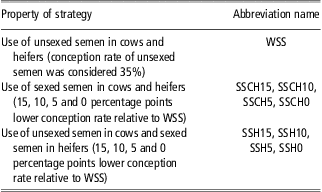
In the current study, the schemes were replicated 25 times. Results for all replicates were averaged and standard errors were evaluated. The CR of sexed semen was normally considered to be 15 percentage points lower than unsexed semen. Values of 10, 5 and 0 percentage points for the difference between CR of sexed and unsexed semen were also simulated. The nine different conditions compared are shown in Table 3. ANOVA was used to compare schemes. Scheme (9 levels) and year (16 levels: 10th to 25th year of selection) were considered as fixed factors for comparing genetic progress. Similar methods were used for statistical testing of reproductive performance with the scheme (9 levels) as one fixed factor. The GLM procedure of SPSS16 software was used for analyzing data. Duncan's method was used for mean comparisons.
Different conditions compared in the current study

WSS = use of unsexed semen for cows and heifers; SSCH = use of sexed semen for cows and heifers; SSH = use of sexed semen for heifers and unsexed semen for cows.
Results and discussion
For the three strategies, WSS, SSCH and SSH, the results are given as an average of 25 replicates. The results include genetic progress, genetic superiority and reproductive performance. Genetic progress was computed for AS, YB, BD and CW, and reproductive performance was reported only for female animals.
Genetic progress and genetic superiority
AS
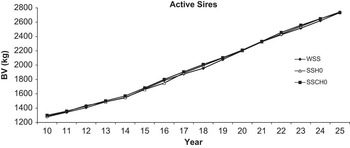
The effect of sexed semen on extra genetic improvement of AS in SSCH and SSH strategies was very low. Figure 1 shows the trends of genetic progress of AS in SSCH and SSH strategies from the 10th to 25th year of selection. Tables 4 and 5 present the average genetic progress and genetic superiority in four distinct paths of selection for different strategies relative to WSS, respectively. The genetic superiority of AS varied between 0.1% and 1.2% in SSCH and 0.03% and 0.5% in SSH strategies relative to WSS. There were no significant differences between BV of AS in WSS and SSH strategies. In a conventional progeny test program, selection intensity in the AS path is very high, and use of sexed semen has no effect on increasing selection intensity in this path. Thus, the effect of sexed semen on genetic progress in the AS path is limited to genetic improvement that is produced because of increasing genetic merit of cows and BD.
Trends of genetic progress (kg) in active sires from the 10th to 25th year of selection. WSS = use of unsexed semen for cows and heifers; SSH = use of sexed semen for heifers and unsexed semen for cows; SSCH = use of sexed semen for cows and heifers. Numbers 15, 10, 5 and 0 show differences between the conception rate of sexed semen and unsexed semen.

Average (±s.e.) genetic progress (kg) of strategies in four distinct paths of selection relative to WSS from the 10th to the 25th years

WSS = use of unsexed semen for cows and heifers; SSCH = use of sexed semen for cows and heifers; SSH = use of sexed semen for heifers and unsexed semen for cows; AS = active sires; YB = young bulls; BD = bull dams; CW = milking cows; MGL = mean generation length.
Numbers 15, 10, 5 and 0 show differences between conception rate of sexed semen and unsexed semen.
Values in the same row without common superscripts differ (P < 0.05).
Average (±s.e.) genetic superiority (%) of strategies in four distinct paths of selection relative to WSS from the 10th to the 25th years

WSS = use of unsexed semen for cows and heifers; SSCH = use of sexed semen for cows and heifers; SSH = use of sexed semen for heifers and unsexed semen for cows; AS = active sires; YB = young bulls; BD = bull dams; CW = milking cows.
Numbers 15, 10, 5 and 0 show differences between conception rate of sexed semen and unsexed semen.
Values in the same row without common superscripts differ (P < 0.05). There is no significant difference between WSS and the values with superscript ‘a’.
YB
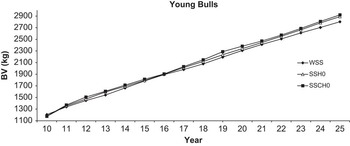
Trends of genetic progress of YB in SSCH and SSH strategies are presented in Figure 2. The results showed that the effect of sexed semen on extra genetic merit of YB was low, but that there was a significant difference between BVs of YB in SSCH and SSH strategies compared with WSS when the CR of sexed semen is 10% lower than unsexed semen. The average genetic superiority of YB in SSCH and SSH schemes varied from a minimum of 1% and 0.6% in SSCH15 and SSH15 to a maximum of 2.7% and 1.5% in SSCH0 and SSH0, respectively (Table 5).
Trends of genetic progress (kg) in young bulls in SSCH and SSH strategies relative to WSS from the 10th to 25th year of selection. WSS = use of unsexed semen for cows and heifers; SSH = use of sexed semen for heifers and unsexed semen for cows; SSCH = use of sexed semen for cows and heifers. Numbers 15, 10, 5 and 0 show differences between the conception rate of sexed semen and unsexed semen.

The use of sexed semen increased the genetic merit of YB compared with WSS, and percent genetic superiority of YB was higher than AS. YBs are produced by mating the best ASs with the best female cows in a progeny test program. Use of sexed semen can offer an opportunity to select better parents for producing YB. Sexed semen has no effect on increasing the selection intensity in YB and AS paths but can increase the genetic merit of female animals; this improvement extends to male animals because of better parent selection.
BD
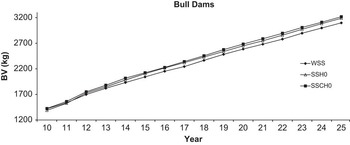
For the average of all replicates and years, genetic superiorities of BD in SSCH0 and SSH0 strategies were 3.4% and 2.1% relative to WSS strategy, respectively (Table 5). The percent genetic superiority of BD was higher than AS and YB. The superiority ranged from a minimum of 1.8% and 1.4% in SSCH15 and SSH15 to a maximum of 3.4% and 2.1% in SSCH0 and SSH0 strategies, respectively. The trends of genetic progress of BD in SSCH and SSH strategies are presented in Figure 3. Analysis of regression showed that each 1% increase of CR resulted in 0.1 ± 0.02% and 0.04 ± 0.006% increases in genetic superiority of BD in SSCH and SSH strategies relative to WSS, respectively. The use of sexed semen increased genetic merit of BD significantly compared with unsexed semen, but this effect in best conditions was lower than 3.5%. Annually, in order to produce a sufficient number of YB, few superior female animals are selected as BD in a progeny test program. The use of sexed semen increases the number of female animals, and it can decrease the proportion of selected animals.
Trends of genetic progress (kg) in bull dams in SSCH and SSH strategies relative to WSS from the 10th to 25th year of selection. WSS = use of unsexed semen for cows and heifers; SSH = use of sexed semen for heifers and unsexed semen for cows; SSCH = use of sexed semen for cows and heifers. Numbers 15, 10, 5 and 0 show differences between the conception rate of sexed semen and unsexed semen.

Therefore, the use of sexed semen increases selection intensity in this path, but this effect is low because the selection intensity in the BD path is very high in a base scheme of progeny test. For example, if sexed semen decreases the proportion of selected animals from 0.005 to 0.003, selection intensity increases from 2.9 to 3.03 (Falconer and Mackay, Reference Falconer and Mackay1996).
CW
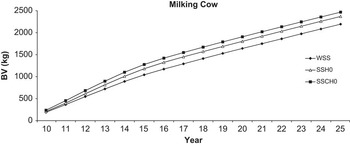
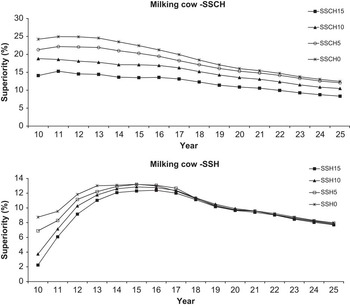
The use of sexed semen in cows and heifers (SSCH) and in heifers only (SSH) can successfully increase the genetic merit of CW relative to WSS. The average genetic progress and average genetic superiority of CW were calculated during years 10 to 25, and these are shown in Tables 4 and 5, respectively. The results show a significant difference between widespread and limited use of sexed semen. The difference is considerable when the CR of sexed semen is close to unsexed semen. In the strategies in which sexed semen might be used, a large genetic advantage was observed in CW. The average superiority of CW was 12.1% and 9.4% in SSCH15 and SSH15 strategies, respectively. Trends of genetic progress and genetic superiority of CW were shown in Figures 4 and 5, respectively. The average superiority in CW exceeded 13.5% and 12.2% in year 16 in SSCH15 and SSH15 strategies relative to WSS strategy, but continued to decrease until it reached 9% and 8% in year 25, respectively. The average superiority of CW was 19.2% and 10.6% in SSCH0 and SSH0 strategies, respectively. Regression analysis showed that genetic superiority increased 0.5 ± 0.04% and 0.1 ± 0.02% per each 1% increase in CR in SSCH and SSH, respectively. The effect of sexed semen on extra genetic merit of CW was much higher than other animals. In the best condition (SSCH0), the genetic superiority of CW was 19% compared with 3.5% in BD. The large effect of sexed semen on genetic improvement of CW is related to the large effect of sexed semen on selection intensity in this path. Typically, in the dairy cattle industry 90% of female offspring are selected for replacement; however, farmers need to replace culled cows in herds. Therefore, the proportion of selected animals in this path is very high, and consequently selection intensity is very low. Sexed semen alters the percentage of female calves from 48% to 90%, and it produces more female calves in the population and increases the supply of dairy replacement heifers in herds. This allows dairy producers to select superior female animals. Therefore, sexed semen decreases the proportion of selected cows from 0.9 to 0.45 in a conventional progeny test program. Subsequently, selection intensity increases from 0.2 to 0.9 (Falconer and Mackay, Reference Falconer and Mackay1996).
Trends of genetic progress (kg) in milking cows in SSCH and SSH strategies relative to WSS from the 10th to 25th year of selection. WSS = use of unsexed semen for cows and heifers; SSH = use of sexed semen for heifers and unsexed semen for cows; SSCH = use of sexed semen for cows and heifers. Numbers 15, 10, 5 and 0 show differences between the conception rate of sexed semen and unsexed semen.

Trends of genetic superiority (%) in milking cows in SSCH and SSH strategies relative to WSS from the 10th to 25th year of selection. WSS = use of unsexed semen for cows and heifers; SSH = use of sexed semen for heifers and unsexed semen for cows; SSCH = use of sexed semen for cows and heifers. Numbers 15, 10, 5 and 0 show differences between the conception rate of sexed semen and unsexed semen.

The general findings of previous research show that the rate of genetic progress has been expected to increase by 15% with the use of sexed semen (Van Vleck, Reference Van Vleck1981; Hohenboken, Reference Hohenboken1999; Weigel, Reference Weigel2004; Abdel-Azim and Schnell, Reference Abdel-Azim and Schnell2007; De Vries et al., Reference De Vries, Overton, Fetrow, Leslie, Eicker and Rogers2008). The result of this study confirms results of previous research. In contrast, Sorensen et al. (Reference Sorensen, Voergaard, Pedersen, Berg and Sorensen2009) reported that the genetic gain of sexed semen when used in heifers is 2.7%, which is lower than the results of others. The use of sexed semen has no effect on selection intensity in male selection paths. The increase of selection intensity in female animals (cows and BD) contributes to the genetic merit of future males. The overall results show that the use of sexed semen in cows and heifers (SSCH) and in heifers only (SSH) increases genetic response of selection significantly.
Reproductive performance
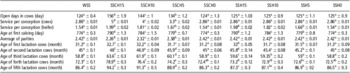
The use of sexed semen for cows and heifers increased open days in the population from 124 to 156 days in the SSCH15 strategy. Note that the assumed culling policy (culled animals with open days higher than 400 days) plays an important role to reduce open days in SSCH schemes. For instance, without this policy, open days increase to 183 days in SSCH15 scheme. The use of sexed semen for heifers increased age at first calving from 774 to 790 days in SSCH15 and SSH15 strategies. Services per conception increased from 2.86 to 5 in SSCH15 strategy. The means of parities from the use of sexed semen decreased and reached 2.26 v. 2.42. The use of sexed semen increased age of cows in different parities. The age average of fifth lactation cows increased from 86 to 94 months. The results for all strategies are reported in Table 6. Regression analysis showed that each 1% decrease of CR increased (P < 0.05) open days 2.1 ± 0.07 days, age at first calving 1.06 ± 0.03 days, services per conception in CW 0.14 ± 0.02, services per conception in heifers 0.03 ± 0.002, mean parities −0.01 ± 0.001, age of first lactation cows 0.1 ± 0.001 month, age of second lactation cows 0.2 ± 0.007 month, age of third lactation cows 0.32 ± 0.02 month, age of forth lactation cows 0.43 ± 0.02 month and age of fifth lactation cows 0.52 ± 0.01 month. The overall results show that the use of sexed semen has negative effects on reproductive performance of dairy herds, decreases reproductive efficiency and increases reproductive costs of herds. Furthermore, sexed semen increases age of CW and subsequently increases generation interval in the population. Increasing generation interval has a negative effect on genetic responses of strategies. Improvement of CR of sexed semen decreases calving interval in the population and increases calves in each year. Increasing the number of calves increases selection intensity in the CW path and subsequently increases the genetic response of strategies in progeny test programs.
Average (±s.d.) reproductive performance and age of milking cows with different strategies

WSS = use of unsexed semen for cows and heifers; SSCH = use of sexed semen for cows and heifers; SSH = use of sexed semen for heifers and unsexed semen for cows.
Numbers 15, 10, 5 and 0 show differences between conception rate of sexed semen and unsexed semen.
Values in the same row without common superscripts differ (P < 0.05).
The widespread use of sexed semen decreased reproductive performance of CW because of low CR. The limited use of sexed semen had a less negative effect on the reproductive performance of CW (except heifers), and consequently its negative effect on economic aspects is lower than widespread use of sexed semen. The use of sexed semen only for first services would greatly decrease negative effects on reproduction. Weigel (Reference Weigel2004) showed that CR of sexed semen is related to reproductive management of herds. Seidel (Reference Seidel2007) stated that successful use of sexed semen depends on excellent management of cattle, careful handling of sperm and use of skilled inseminators. Therefore, for widespread use of sexed semen, it is necessary to improve reproductive management of dairy herds. Reproductive management can increase reproductive efficiency of sexed semen, and this can decrease the negative effect of sexed semen on reproduction and increase genetic superiority of the schemes.
Conclusions
The results show the effects of using female sorted semen on genetic improvement of AS, YB and BD are low but can successfully increase genetic superiority of CW. The results show that widespread use of sexed semen increases genetic merit of the animal more than limited use of sexed semen. On the other hand, the use of sexed semen decreases the reproductive performance of dairy cows, especially when sexed semen is used both in cows and heifers. The use of sexed semen in heifers only (SSH) can successfully increase genetic merit of population with less negative effects on reproductive performance of CW, and it suggests that SSH scenarios might be a convenient tool for genetic improvement of dairy cows. Finally, to make decisions about which schemes are truly more appropriate, it is necessary to compare the economic aspects of schemes.