Introduction
The sustainable conservation of autochthonous swine breeds and local chains could be partly achieved by highlighting the high-quality intrinsic and extrinsic properties of the products derived from them and by promoting their consumption by specific market niches (Vitale et al., Reference Vitale, Kallas, Rivera-Toapanta, Karolyi, Cerjak, Lebret, Lenoir, Pugliese, Aquilani, Čandek-Potokar, Gil and Oliver2020). Moreover, traditional food products constitute an important element of European culture, identity and heritage (Ilbery and Kneafsey, Reference Ilbery and Kneafsey1999; Lebret et al., Reference Lebret, Kallas, Lenoir, Perruchot, Vitale and Oliver2018), and are increasingly being proposed as a way to raise societal awareness of rural landscapes (Soy-Massoni et al., Reference Soy-Massoni, Monllor, Nuss, Markuszewska and Tanskanen2019). However, innovation in traditional products may face some challenges related to the likely contested understanding of these concepts (Guerrero et al., Reference Guerrero, Claret, Verbeke, Vanhonacker, Enderli, Sulmont-Rossé, Hersleth and Guàrdia2012), making it particularly difficult to develop innovations acceptable to consumers. Improving breed profitability through niche markets and increased added-value products [i.e., healthier nutritional properties (Romanzin et al., Reference Romanzin, Corazzin, Piasentier and Bovolenta2013)] , ensuring a return to breed populations high enough to maintain adequate genetic diversity and hence safeguard breed survival (Bozzi and Crovetti, Reference Bozzi and Crovetti2013). Varga et al. (Reference Varga, Molnár, Biró, Demeter, Gellény, Miókovics and Babai2016) reported that swine grazing had almost disappeared in Europe by the 1970s. In this context, research on market opportunities and analysis of consumer preferences and the factors affecting sustainability will be a key strategy. This will focus on the renewability and resilience, thereby aiming to regenerate the social, environmental and economic impacts (Swisher et al., Reference Swisher, Ruiz-Menjivar and Koenig2018).
Some studies (Brown, Reference Brown2003; Conner et al., Reference Conner, Montri, Montri and Hamm2009) have concluded that local foods are related to spatial proximity, freshness and higher sensorial quality, but for the authors, the most important ‘local’ promotion message may be ‘Grown in’ and the name of the region or city rather than the distance (from food production to consumers). Howard (Reference Howard2006) also found that consumers prefer to obtain information that includes the word ‘local’ on labels or in brochures rather than through direct interaction with the seller. Unlike intensive production, the swine in the five local systems studied are raised outdoors/extensively and so depend on the resources of their natural surroundings, defined as grazing habitats in the review carried out by Varga et al. (Reference Varga, Molnár, Biró, Demeter, Gellény, Miókovics and Babai2016). Moreover, consumers perceive pasture-raised products as healthy, natural and environmentally friendly and some of them are willing to pay a premium price for pasture-raised meat-based products (Font-i-Furnols and Guerrero, Reference Font-i-Furnols and Guerrero2014; Stampa et al., Reference Stampa, Schipmann-Schwarze and Hamm2020). These Localized Agro-Food Systems also open new perspectives for territorial and regional development projects (Muchnik et al., Reference Muchnik, Sanz Cañada and Torres Salcido2008).
In this context, research on market opportunities, analysis of consumer preferences and the factors affecting their acceptance of different types of product is a crucial strategy to support traditional autochthonous swine breeds and promote their development. Effective promotional and marketing strategies have been defined for potential markets through developing the role of location in promoting more advantageous sales methods for farmers in non-traditional distribution channels (short distribution channels, direct sales). The present study has a twofold objective: first, to carry out a Strengths, Weaknesses, Opportunities and Threats (SWOT) analysis on five European autochthonous swine breed production systems to identify the critical points of the adopted marketing channels; and secondly, to identify appropriate marketing strategies for each study case to provide stakeholders along the supply chain with guidelines for enhancing added-value products and for developing direct marketing alternatives to analyze viability and feasibility.
Material and methods
The aim of the TREASURE H2020 project (Horizon 2020 Programme, 2015) was to improve the conservation status of 20 European autochthonous swine breeds through innovative strategies that included untapped new market options for these breeds (Čandek-Potokar and Nieto Linan, Reference Čandek-Potokar and Nieto2019). Five of them and their related value chains with contrasting properties in terms of level of development and organization and representing different EU regions were considered for a study of their marketing strategies (Karolyi et al., Reference Karolyi, Luković, Salajpal, Škorput, Vnučec, Mahnet, Klišanić, Batorek-Lukač, Candek-Potokar and Nieto Linan2019; Lukač et al., Reference Lukač, Tomažin, Škrlep, Kastelic, Poklukar, Čandek-Potokar, Čandek-Potokar and Nieto Linan2019; Mercat et al., Reference Mercat, Lebret, Lenoir, Batorek-Lukač, Čandek-Potokar and Nieto2019; Pugliese et al., Reference Pugliese, Bozzi, Gallo, Geraci, Fontanesi, Batorek-Lukač, Čandek-Potokar and Nieto2019; Tibau et al., Reference Tibau, Torrentó, Aguado, González, Oliver, Gil, Batorek-Lukač, Čandek-Potokar and Nieto2019). The reason for including the untapped breed is that it was mandatory in the UE call for proposals (Research and Innovation Action, Grant agreement N°: 634476).
Experimental design
We followed a mixed-method research methodology and applied a joint qualitative and quantitative approach (Weible et al., Reference Weible, Christoph-Schulz, Salamon and Zander2016), carrying out focus group (FG) sessions using the World Café (WC) method and the Analytical Hierarchical Process (AHP) because of their specific strengths. Five FG sessions, one for each of the case studies, were performed between May and July 2018 in Louey (Hautes-Pyrénées—France), Florence (Tuscany—Italy), Palma de Mallorca (Spain), Ljubljana (Slovenia) and Zagreb (Turopolje region—Croatia).
Each FG included at least 12 stakeholders from each local system, with a balanced representation of the five stages in the value chain (Fig. 1). The suggested shares of stakeholder profiles in the FG were three farmers, two processors, a civil servant/policy maker working in public administration (either regional or local), a representative related to the governance of the quality seal [protected designation of origin (PDO)/protected geographical indication (PGI)], if applicable, a traditional store retailer, a supermarket retailer, a food service representative (restaurants) and two people working in consumer associations (n = 60 in total). The final number of participants in each profile was adapted slightly in each case study, depending on the characteristics of the corresponding supply chain. The WC was applied to gain insights into two sets of attributes in each case study: (a) the SWOT matrix and (b) the most suitable marketing strategies based on the 4Ps of marketing (Product, Price, Place and Promotion) for the breed production system. The WC is a structured conversational process intended to facilitate open and intimate discussions, and share ideas within a larger group to obtain collective consensus decisions.
Stakeholders' type included in the focus groups. *: Hotels, Restaurants, and Catering.

All the participants were balanced (in terms of number and also the type of stakeholder in the chain) and separated into four thematic tables (groups for the discussion) with one moderator per table. Each table was designed to gather information about one of the four components of the SWOT analysis. For 10–12 min, the participants at each table expressed their thoughts about the SWOT regarding the pertinent swine production systems and their meat products. Further, the groups agreed among themselves on a list of the most relevant items, along with the moderator. Afterwards, they moved to another table, ensuring that no two participants coincided at two consecutive tables. This rotation was repeated until all the stakeholders had participated at all the four tables.
The most relevant items raised in terms of SWOT at each discussion table were then voted in a plenary session. Each participant chose three prominent items depending on their choice, and further ranked them to assign three, two or one point based on the rank. In a second step, participants addressed the marketing strategies (4Ps). The same procedure was then followed to obtain the preference values for the 4Ps, conducting four rounds of discussion (one P per table: Product, Price, Place and Promotion) and voting in a plenary session to determine the three most important items for each marketing strategy. At the end of the WC sessions, the information collected was used to design an AHP survey, which was emailed to the WC participants with a briefing on how to fill out the questionnaire, to be returned within the next 48 h after reception.
The relative importance of four marketing strategies: the AHP
The AHP was carried out to measure the relative importance of the main elements of the marketing mix strategies involved in the product, price, place and promotion policies extracted from the WC discussion sessions. The AHP methodology has been used previously to evaluate marketing mix elements (Abedi and Abedini, Reference Abedi and Abedini2017), but to the best of our knowledge, very few studies on this have been directed at the food sector (Borrisser-Pairó et al., Reference Borrisser-Pairó, Kallas, Panella-Riera, Avena, Ibáñez, Olivares, Gil and Oliver2016). Prioritizing marketing mix elements can help members of the supply chain make strategic decisions to attract customers and meet their needs. The AHP is a multi-criteria decision-supporting method in discrete environments, which aims to breakdown a complex decision problem into a hierarchy of smaller constituent sub-problems (Saaty, Reference Saaty1977, Reference Saaty1980). Determining the most preferred policy from a set of policies to help the untapped breeds to thrive is a decision problem for which the top level of the hierarchy represents the marketing mix strategy. It is broken down into a predefined number of characteristics (policy decisions) on the second level and their policy types on the third level (Fig. 2).
Hierarchical structure used to value the best policy for the untapped swine breeds.

The AHP estimates elicit weights (w) for each policy and policy level to explain individual behavior in choosing the preferred marketing mix strategy. The relative importance of weight (w) for each policy (Pn) and policy type (Ln.p) [where n (1…N) is the number of policies and p (1…P) is the number of policy levels] is obtained from pairwise comparisons. To implement the AHP, participants in the WC discussion were asked to make two types of pairwise comparisons: (a) pairwise comparisons of the policy level; and (b) pairwise comparisons between the policies (product, price, place and promotion). The respondent first had to indicate the relative importance of the two elements compared. A nine-point scale was then used to measure the strength of this relative importance using verbal judgments (Saaty, Reference Saaty1980).
An example of the pairwise comparison can be seen in Table 1. Using the result elicited from this, the AHP estimated the weights (w) for each policy and policy level to explain individual behavior in choosing the preferred marketing mix strategy.
Example of the AHP pairwise comparison across policies

Compare the following policies in a pairwise way to identify the most important one as the best marketing strategies for the added-value meat products from the untapped swine breeds.
Results and discussion
Main results and discussion of the SWOT analysis of local swine systems
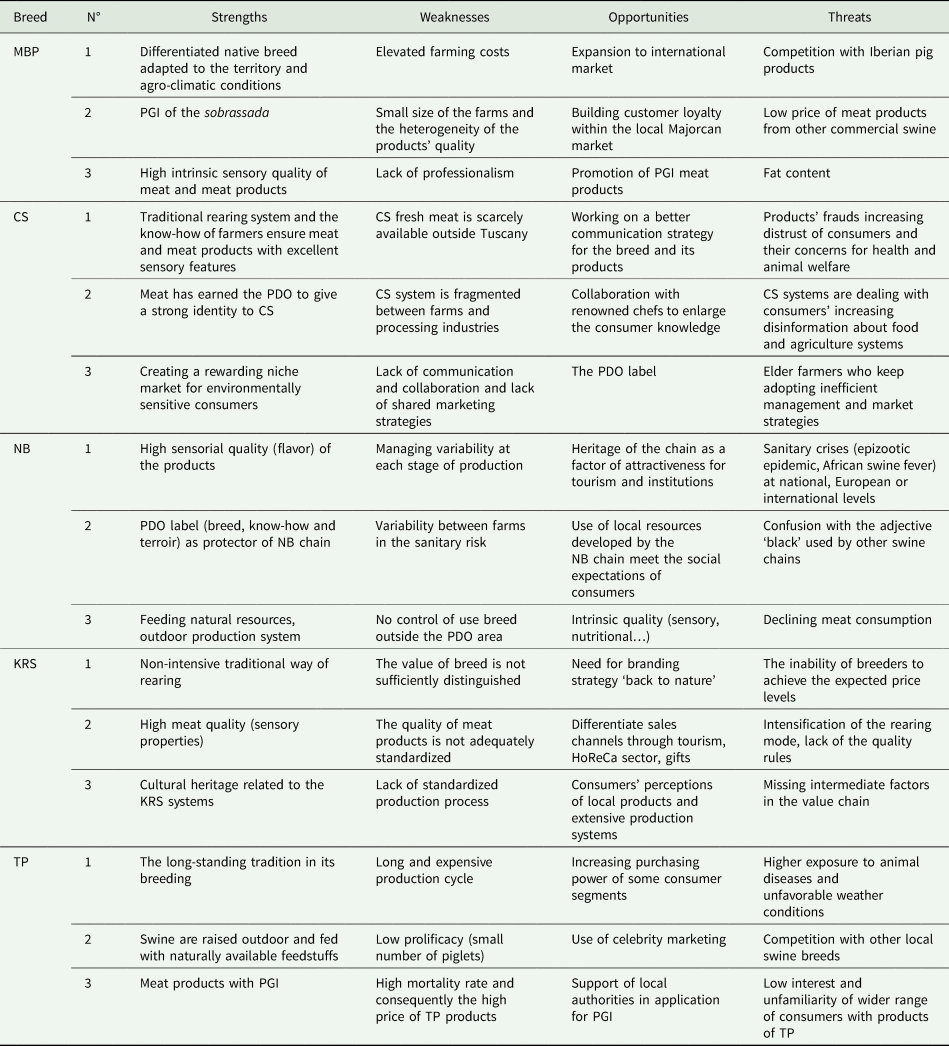
The most relevant SWOT for Majorcan Black Pig (MBP), Cinta Senese (CS), Noir de Bigorre (NB), Krškopolje Pig (KRS) and Turopolje pig (TP) are detailed below in Table 2. It provides a summary of the stakeholders’ opinions gathered from the SWOT analysis of each local swine breed system in which differences and common aspects can be appreciated.
Summary of stakeholders' points of view from SWOT analysis of each local swine breed system: differences and common aspects

The strengths of these swine breeds are based on their being differentiated native breeds adapted to the land and different agro-climatic conditions, reared within traditional extensive systems, and fed using natural resources (e.g., pasture grass, cereals, legume seeds, figs, almond, acorns and several Mediterranean shrubs). Another strength is that the meat and its products have the PGI or PDO seal. Furthermore, cultural heritage and terroir products were highlighted by the stakeholders of the NB and KRS local systems.
One of the main strengths identified in the SWOT analysis was the high quality of the products and their link to the «heritage patrimony». This is a very important aspect of these local production systems underlined by Pensado-Leglise and Sanz Cañada (Reference Pensado-Leglise and Sanz Cañada2018). However, their research also shows that these characteristics are insufficient to generate the incomes needed by farmers, which will put the sustainability of these chains at risk in the near future. In relation to this, Čandek-Potokar et al. (Reference Čandek-Potokar, Giusto, Conti, Cosola and Fontanesi2018) recommended that the majority of local swine breed producers still need to be supported by subsidies to ensure their conservation. However, these authors also reinforce the idea that the best strategy is to breed systems aiming to reach self-sustainability. This may be possible through an effective marketing strategy of the meat products obtained from local swine breeds (Čandek-Potokar et al., Reference Čandek-Potokar, Giusto, Conti, Cosola and Fontanesi2018).
The weaknesses included the high costs of farming derived from a low prolificacy (reproduction rate), the consequent high price of the products and the small size of the farms. Aging farmers, product heterogeneity in terms of quality, and a lack of professionalism, collaboration and marketing strategies are challenging for these breeds to adapt to the current market demands. These weaknesses should be overcome to face current consumer demand. Moreover, these local swine breed production systems should be in line with the Local Agro-Food System (SYAL), because this would imply a better mutual cooperation network among stakeholders along the entire chain and new perspectives for public policies and for territorial and regional development projects (Muchnik et al., Reference Muchnik, Cañada, Salcido, Muchnik, Cañada, Torres and Systèmes2020).
The opportunities were based on strengthening consumer loyalty within the local market, including the tourist market, and the promotion of traditional products with a PGI or a PDO label, highlighting their international expansion. Growing market demand for different cuts of fresh meat in the retail market and for high-quality fresh meat and ready-to-eat formats in the HORECA sector (HOtels, REstaurants and CAtering) has made the strategy of launching innovative products an attractive business opportunity, with positive consumer perceptions of local products and production systems.
All the main threats center on competition with other local swine breeds, mainly in the MBP and NB chain, and with other low-priced commercial meat products made from quality cuts. Also mentioned were the misconceptions surrounding the word black among the NB and Iberian products. Furthermore, consumers' negative perceptions regarding the high fat content of meat products and product frauds increase mistrust among consumers, and their health and animal welfare concerns may determine the swine breeds' survival. Another concern was regarding the aging farmers who adopt inefficient management practices.
To sum up, one of the main strengths identified from the SWOT analysis was the high quality of the products and their link to cultural patrimony. This is a very important aspect of these local production systems, underlined by Pensado-Leglise and Sanz Cañada (Reference Pensado-Leglise and Sanz Cañada2018). However, these authors also explain that the identified strengths are insufficient to justify the continued payments to farmers, risking the sustainability of these chains in the near future. They also point out that there may not be sufficient market support for these local systems, biodiversity and cultural patrimony. Along these lines, Čandek-Potokar et al. (Reference Čandek-Potokar, Giusto, Conti, Cosola and Fontanesi2018) recommend that most local swine breed production still need to be supported by subsidies to ensure their conservation. However, these authors also reinforce the idea that the best approach is making these breed systems self-sustainable, which may be possible with an efficient marketing strategy for their products. Another approach is the work of Sanz-Cañada and Muchnik (Reference Sanz-Cañada and Muchnik2016), who emphasized that these Local Agro-Food System (SYAL), built on identity-based food products, could be crucial for a more sustainable rural development. But, of utmost importance is the cooperation between farms, firms and institutions.
Main marketing strategies of the local systems based on the 4P analysis: implications for the potential to introduce the products into the market and for conserving the swine breeds
No scientific or systematized studies have previously been undertaken or published on marketing strategies for the self-sustainability of the five autochthonous swine breeds. There may only be a few publications containing descriptive characteristics.
Majorcan Black Pig
The most relevant product policy identified by stakeholders was the diversification of meat products to increase the position of the MBP brand in the market (37.43%) by including innovations focused on the nutritional properties of the products, process innovation and format size, thereby meeting consumer demands (Vitale et al., Reference Vitale, Kallas, Rivera-Toapanta, Karolyi, Cerjak, Lebret, Lenoir, Pugliese, Aquilani, Čandek-Potokar, Gil and Oliver2020), and strengthening the PGI brand (26.75%) (Fig. 3). Also relevant was improving the sensory quality of the products (35.82%), including extending their shelf life and highlighting their nutritional value. These strategies are similar to the ones mentioned by Guerrero (Reference Guerrero, Frewer, Risvik and Schifferstein2001).
Hierarchical structure used to value the best policy for the MBP breed. Product (Pd): Pd1: Boost PGI brand, Pd2: Enhance the organoleptic quality of the product, Pd3: Diversify the product and adapt to the needs of the young consumer. Place (Pl): Pl1: Selling MBP products in local restaurants, Pl2: Distribution of sobrassada in local shops, Pl3: (MBP sector) with access to different distribution channels. Promotion (Pm): Pm1: Marketing strategies based on public relations (food and gastronomic events), Pm2: Promotion in primary schools with the support of the Public Administration, Pm3: TV promotion, and Price (Pc): Pc1: To maintain a high price strategy based on a premium category, Pc2: To increase the transparency of prices along the production chain, and Pc3: To apply a premium strategy along all the production chain.

Regarding the place strategy, increasing the presence of MBP processed food, including sobrassada (seasoned, dried and fermented sausage with a PGI certification), porcella (suckling piglet) and fresh meat cuts, in local restaurants, was identified as one of the most important strategies (42.98%), together with enhancing the availability of sobrassada in local shops (33.58%). Besides, stakeholders stated that the PGI Regulatory Council and public administrations must be encouraged to support commercial actions that ensure the presence of MBP processed food in large retailers, thereby strengthening the MBP image (21.44%). These findings support the conclusions from Giraud (Reference Giraud2002), who suggested that marketing plans of typical foods should mainly focus on local consumers.
The most relevant action (42.29%) for the promotion strategy was to increase the presence of MBP products at sectoral and gastronomic fairs via public relations, followed by promotion on TV, online and in the press (31.19%), and the promotion of MBP products in primary schools with public administration support (26.52%). Furthermore, the proposed branding strategy using the TREASURE projects as support was considered as a ‘marketing tool that could promote the MBP as a differentiated and autochthonous swine production system’.
The stakeholders' price strategy (40.32%) was to maintain a high price based on a premium category. Some stakeholders also advocated for a different distribution of prices along the production chain, which would favor higher revenues for farmers, indirectly promoting the development of the primary sector. This aligns with some policy initiatives such as those launched by the French and Spanish governments to develop value chain legislation aimed at ensuring a minimum price for farmers.
Cinta Senese
In this system, product heterogeneity is considered a hurdle for building a loyal customer base. Thus, the most relevant product strategies were to improve the standardization of the food processing among producers (38.15%) (Fig. 4) and to promote the healthier nutritional properties of the processed food (35.75%). Modifying some of these characteristics, including reducing the salt and additive content, would help to better match customer needs. Increasing sales of raw meat should also eventually be promoted (26.10%); indeed, this type of product can be sold directly by the farmer, representing an immediate source of income and an interesting tool for rural development (Chambers et al., Reference Chambers, Lobb, Butler, Harvey and Bruce Traill2007; Sanjuán et al., Reference Sanjuán, Resano, Zeballos, Sans, Panella-Riera, Campo, Khliji, Guerrero, Oliver, Sañudo and Santolaria2012). Moreover, producers believe that the sensory traits associated with CS are more appreciated in fresh meat than in processed food. There was a certain disagreement among stakeholders regarding the prioritization of place strategies, with two strategies of almost equal importance emerging. The two most relevant strategies for the sale and distribution of CS processed food were high-quality restaurants (37.15%) followed by stores selling top-quality products (36.33%). The latter category also includes GDO (large-scale distribution) gourmet lines, even though most of the producers were against GDO sales policies. Despite the increasing difficulties faced by local stores such as butchers' shops to compete with GDO, they remain an important selling channel, making this placing strategy still worthwhile (26.53%). Moreover, short supply chains and local retailers are preferred over GDO for high added-value products such as PDO and/or PGI-labeled products, since they can provide consumers with direct information about meat origin, processing methods and animal rearing systems (Marsden et al., Reference Marsden, Banks and Bristow2000; Ilbery et al., Reference Ilbery, Maye, Kneafsey, Jenkins and Walkley2004).
Hierarchical structure used to value the best policy for the CS breed. Product (Pd): Pd1: Increase the diffusion of fresh meat, Pd2: Healthier products (less salt, less additives), Pd3: Improve the standardization of manufacturing process among producers to ensure homogeneous products. Place (Pl): Pl1: Stores of top-quality products (also GDO with gourmet lines), Pl2: Local shops, Pl3: High quality restaurants. Promotion (Pm): Pm1: Collaboration with chefs, Pm2: Collaboration with cooking schools, Pm3: Promotion on social networks. Price (Pc): Pc1: Different price between organic and conventional products, Pc2: Different prices depending on feeding strategy (i.e. finishing with acorn/chestnut or concentrate), and Pc3: Higher price, but let the consumers try the products in stores.

Within this context, the promotion policy using social networks was considered the most important one for the CS system (38.18%), followed by collaboration with renowned chefs (34.88%) and cooking schools (26.94%), which might help raise the profile of CS products outside Tuscany. Limited consumer knowledge of the breed and GDO competition for price polices were considered to be strong hurdles for price strategies in the CS chain. However, stakeholders firmly agreed that a further price increase could be an attractive strategy (49.70%) to differentiate CS production systems and acknowledge their value, but that it should go hand in hand with an enhanced marketing strategy, possibly encouraging tasting experiences at purchasing points.
Noir de Bigorre
The product strategy is a priority for the Noir de Bigorre chain-Gascon breed and is related to the development of products and their image. To strengthen product traceability for consumers, it was considered that an ‘identity card’ for hams and loins would enable a certain product to be associated with a particular farmer and the pig feeding method or practices (45.12%) (Fig. 5). The implementation of open-air drying/ripening rooms (33.28%) and the (increased) possibility of marketing ham slices cut with a knife (rather than a slicer) are possible innovations in the chain (21.60%).
Hierarchical structure used to value the best policy for the Noir de Bigorre chain-Gascon breed. Product (Pd): Pd1: To obtain traceability/identification card for ham and loin, Pd2: To set up ageing room in the open-air, Pd3: To bring to market knife sliced products. Place (Pl): Pl1: To extend the coverage of local stores in DPO area, Pl2: To develop their export sales. Pl3: To work with specialized high-end network. Promotion (Pm): Pm1: To support products from processing to tasting (showcase of products, cooking lesson), Pm2: To provide training in products history for all actors participating in product's sale, Pm3: To build two promotions: one for general public, another for professionals. Price (Pc): Pc1: To create carcass payment table at SICA to encourage meat quality, Pc2: To raise prices of rare products (dry-cured ham, dry sausage), and Pc3: To raise pig price at SICA.

The place strategy is ensured by the coverage of local stores in the PDO area, serving as ambassadors for the products (41.25%) and improving local product visibility. Working with a high-end specialized network (31.10%), possibly outside the geographical area of production, would be another opportunity to promote the distribution and sale of NB processed food.
Regarding the promotion strategy, this is mainly linked to its heritage dimension. This result is in line with the work of Sanz-Cañada and Muchnik (Reference Sanz-Cañada and Muchnik2016), who showed that identity-based food is related to territory. To support these products, it is important to focus on their showcasing and cooking lessons highlighting their sensory characteristics (44.68%). Different promotional strategies have been identified based on the relationship between the food and its story. Training in the product history for all the stakeholders in the sale of the product is a key element (37.49%). A two-pronged product promotion strategy was considered, one for the public, based around the PDO and the acknowledgement of values of the NB chain, and the other for professionals (17.84%).
Last, the price strategy is based on a modification of the carcass payment grid to include meat quality indicators (48.61%) in an attempt to improve the quality of the meat and fat and to manage its variability.
Krškopolje Pig
The stakeholders described dry-cured products, fresh meat and innovative culinary products to be the three most important product strategies. Following the AHP analysis, the highest relative importance (Fig. 6) was assigned to dry-cured products (49.46%).
Hierarchical structure used to value the best policy for the KRS breed. Product (Pd): Pd1: Dry-cured products, Pd2: Fresh Meat, Pd3: Innovative culinary products. Place (Pl): Pl1: Good, high-cuisine restaurants, Pl2: Direct sales (on farms, and to companies for business gifts), Pl3: State protocol. Promotion (Pm): Pm1: Prestigious brand, Pm2: Guided tours, tasting, Pm3: Through educational institutions. Price (Pc): Pc1: Premium price, Pc2: Differentiated price and Pc3: Price adjusted to sales channel.

Regarding the place strategy, the AHP analysis revealed that stakeholders considered the most important channel for the products from the breed (42.99%) to be direct sales, with business gifts mentioned. This type of distribution is further supported by the significant importance given to state protocol (use as gifts and in gala dinners) (23.29%) as the third most important distribution channel. Good high-cuisine restaurants were recognized as the second most important distribution channel (33.82%).
Focusing on the promotion strategy, having a prestigious seal was recognized by stakeholders as the most important (49.05%), and given twice as much weight as the next two key promotion strategies identified, namely guided tours with tasting (25.92%) and promotion via educational institutions (25.03%). The importance of the use of these products as state protocol gifts and the promotion of the breed and its products in education centers and schools were highlighted. Last, the key price policy strategies established with the AHP methodology were premium price, differentiated price and price adjusted to the sales channel. The premium price strategy was given the greatest weight (42.69%). In summary, the recognized assets were mainly non-intensive traditional rearing, good quality and flavor, and cultural heritage, while the main shortcomings were a disorganized value chain and no processed food standardization. The localized agro-food systems concept (SYAL) could be an interesting tool to improve cooperation in this chain (Muchnik et al., Reference Muchnik, Sanz Cañada and Torres Salcido2008).
Turopolje Pig
The product strategy for TP processed food should rely on high product quality and be used for product positioning. This is in line with previous research (Cerjak et al., Reference Cerjak, Haas, Brunner and Tomić2014) showing that Croatian consumers perceive a better quality of traditional products as one of the major motives for their purchase.
One of the most important elements of product policy is the standardization of processed food (40.58%) (Fig. 7). Next to it is the use of quality labels, with priority given to the PDO quality sign (38.27%) and the organic label, customer perception associated with higher product positioning, purchase frequency and willingness to pay, as shown by Bryła (Reference Bryła2017). Due to market saturation in terms of exclusive products, TP processed food should be sold in smaller packages and using innovative strategies such as sales in gift baskets. Images of the Turopolje region and/or TP should be used on the packages (21.15%) to highlight the product origin.
Hierarchical structure used to value the best policy for the TP breed. Product (Pd): Pd1: To obtain “Protected Designation of Origin” (PDO) status, Pd2: Standardization of production (recipe), Pd3: Exclusive packaging. Place (Pl): Pl1: In specialized shops, Pl2: Direct sale Pl3: In restaurants. Promotion (Pm): Pm1: Promotion of healthy, ecological, indigenous, traditional, high-quality products, Pm2: Direct marketing (fairs, local events, oral submission …), Pm3: Use Turopolje heritage in promotion. Price (Pc): Pc1: Premium price for premium products, Pc2: All Turopolje pig products should be in the same premium price segment and Pc3: Aligned price strategy along the entire value chain.

Regarding the place strategy, TP products could only be purchased directly from producers and were occasionally served in local restaurants, which was recognized as a major problem. Therefore, while representing an important percentage (29.09%), direct sales were evaluated as less important than sales in specialized shops (40.69%) and restaurants (30.22%). These findings are in line with a previous study (Jensen et al., Reference Jensen, Christensen, Denver, Ditlevsen, Lassen and Teuber2019) which showed that Danish local food consumers support short food chains. Only a few respondents agreed with an online sales strategy.
Focusing on the promotion policy, most of the stakeholders stated that the main message they would convey to consumers is that TP processed foods are healthy, environmentally friendly and of high quality, representing the tradition and indigenous nature of the breed and the raw materials involved (47.23%). However, a few respondents stated that they would segment consumers and use messages adapted to each type of target. Storytelling, which involved sharing stories about the history and traditions of the Turopolje region (30.57%), was considered an important promotion strategy. Respondents agreed on the usefulness of direct marketing, including promotion at fairs and local events, word of mouth and others (22.19%). Promotion through social networks (Facebook, Instagram, Twitter, etc.) was likewise considered a prospective promotional strategy. Last, all stakeholders agreed that TP products should cost a premium price due to their expensive production and product exclusivity. However, some stakeholders held a different opinion on the pricing strategy within the supply chain, believing that adding value to a product (e.g., exclusive packaging) should also influence the selling price (25.21%). Some respondents emphasized the need for common price negotiation if processed foods were to be standardized.
Strategies of the local systems
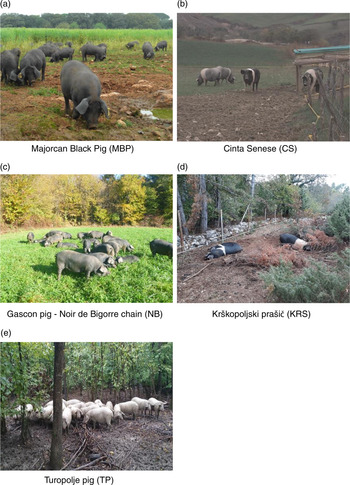
The extensive or semi-extensive local grazing systems characterizing the five swine breeds addressed in this study (Fig. 8) are essential toward the conservation and enhancement of high natural value farming systems, as described by Varga et al. (Reference Varga, Molnár, Biró, Demeter, Gellény, Miókovics and Babai2016). Autochthonous breeds play a role in supporting agroecosystem resilience (Hajjar et al., Reference Hajjar, Jarvis and Gemmill-Herren2008), maintaining socio-cultural traditions, local identities, traditional knowledge (Nautiyal, Reference Nautiyal2018) and cultural landscapes (Tisdell et al., Reference Tisdell, Eni and Mattei2003), all of which are public goods and attributes identified in our study.
Growing finishing pig from Mallorca island (a), Tuscany (b), Hautes-Pyrénées (c), Slovenia (d) and Turopolje region (e).

Recent research has demonstrated that the best chance of conserving the genetic diversity of autochthonous swine breeds comes from a mix of looking for niche markets for the processed food and increasing awareness among consumers who appreciate the high quality of traditional meat products (Kallas et al., Reference Kallas, Varela, Čandek-Potokar, Pugliese, Cerjak, Tomažin, Karolyi, Aquilani, Vitale and Gil2019). To this effect, the stakeholders in the present study identified the following actions as the best product strategies: enhancing and highlighting the sensory quality of the meat products, boosting the geographical indications and traditional specialties of the breed, where appropriate (PGI and PDO), improving the standardization of the food processing among producers to ensure homogeneous products, and increasing product diversity and traceability. This is in line with the emergent interest in local foods, where consumers perceive to have higher quality standards and to be tools for preserving tradition and local know-how (Gilg and Battershill, Reference Gilg and Battershill1998; Weatherell et al., Reference Weatherell, Tregear and Johanne2003; Vecchio, Reference Vecchio2011). In addition, the PDO and PGI logos are commonly considered the main purchasing motivation for a shopper with excellent knowledge of the EU certification label, according to Vecchio and Annunziata (Reference Vecchio and Annunziata2011). However, a better understanding of the relationships between people, products, and territory will be crucial to the survival of these local systems. Our study hints at organizational differences among these systems. Hence, in some of the studied chains (Cinta Senese and Krškopolje Pig), better cooperation among the stakeholders and major collective action is needed. This cooperation would improve the governance and increase negotiation ability with the other stakeholders related to the marketing strategy, as described by Pensado-Leglise and Sanz Cañada (Reference Pensado-Leglise and Sanz Cañada2018).
Regarding the price strategy, maintaining a high price based on a premium category while letting consumers taste the product in situ (show-cooking, direct marketing) and establishing price differentiation depending on feeding (extensive vs concentrate) were identified as key elements in our study, which is also in agreement with Stampa et al. (Reference Stampa, Schipmann-Schwarze and Hamm2020).
With regards to the place strategy, the stakeholders identified the need to increase the presence of traditional products in the HORECA sector and to improve and intensify their presence in specialized local food shops selling top-quality products and gourmet foods. This strategy, which was identified in most of the chains studied, is in line with Jensen et al. (Reference Jensen, Christensen, Denver, Ditlevsen, Lassen and Teuber2019). Similarly, Conner and Oppenheim (Reference Conner and Oppenheim2008) showed that natural food stores were the most promising distribution channel.
Several common strategies identified to promote the processed food from local systems were based on public relations, including food and gastronomic events, tourist events, workshops, guided tours, direct sales to companies for business gifts, web pages and collaboration with catering schools, popular chefs and athletes. They highlighted that any promotional message should include information about the history of the product and its healthy properties. However, the concept of ‘growing in’, referring to the information about the product origin, as discussed in the study from the USA by Conner et al. (Reference Conner, Montri, Montri and Hamm2009), must be enhanced. This aspect was not given enough consideration by the stakeholders of these European local systems. Securing public administration support is recommended to develop these aspects.
Concluding remarks
The participative bottom-up mixed-methods approach used in this study involving the key stakeholders in each untapped breed value chain is novel and enabled us to co-construct the identified strategies. This methodology increases the likelihood of successfully implementing these strategies since they are not seen as impositions from external agents.
The main parameters of this study of untapped swine breeds were based on non-intensive traditional rearing, good sensory quality and cultural heritage. The extensive production systems that characterize these native breeds are fully aligned with sustainability since they are an essential element in the conservation and enhancement of high nature value local farming systems.
The stakeholders identified having PGI and PDO seals as being of utmost importance to enhance the sensory quality of the products, improve the standardization and traceability of the food processing to ensure homogeneous products, and to enhance their high price based on the premium category and direct sales. Iberian meat products could be a strong competition mainly to the MBP and NB breeds and hence effective product identification and traceability is highly important. The stakeholders of these autochthonous breeds must place greater emphasis on highlighting grazing as a feeding strategy (extensive or semi-extensive), the meat products derived from the swine and their origin.
Acknowledgements
This study has received funding from the European Union's Horizon 2020 Research and Innovation program under grant agreement No 634476 (project acronym TREASURE). IRTA thanks CERTA funding. Authors thank Jaume Jaume (Semilla-Caib), who supported the organization of the study in Mallorca Island; Florence Garcia-Launay and Ludovic Brossard (PEGASE, INRAE, 35590 Saint-Gilles, France) and Alexandre Fonseca (Consortium Noir de Bigorre) who participated in the organization of the French case study and realization of the focus-groups. E. A. Rivera-Toapanta is a recipient of a doctoral fellowship awarded by the INIA (Instituto Nacional de Investigación y Tecnología Agraria y Alimentaria). This work has been carried out within the framework of the Doctorate Program in Food Sciences of the Autonomous University of Barcelona. The content of this paper reflects only the authors' view and the European Union Agency is not responsible for any use that may be made of the information it contains.
Author contributions
Evelyn Rivera-Toapanta: investigation, formal analysis, writing original draft, supervision, visualization. Zein Kallas: project administration, methodology, conceptualization, investigation and writing review and editing, supervision. Meta Čandek-Potokar: conceptualization, project administration, writing-review and editing, funding acquisition. Joel Gonzalez: conceptualization, investigation and writing original draft. Marta Gil: supervision, project administration, investigation, writing-review and editing. Elsa Varela: conceptualization, investigation, writing-review and editing, methodology. Justine Faure: conceptualization, investigation and writing original draft. Marija Cerjak: investigation, writing-review and editing. Tomažin Urška: investigation, writing-review and editing. Chiara Aquilani: investigation, writing original draft and writing-review and editing. Bénédicte Lebret: conceptualization, project administration, investigation, writing-review and editing, funding acquisition. Danijel Karolyi: conceptualization, project administration, investigation, writing-review and editing, funding acquisition. Carolina Pugliese: conceptualization, project administration, investigation, writing-review and editing, funding acquisition. José Maria Gil: project administration, methodology, conceptualization, funding acquisition.