Individuals throughout the world suffer severe hardship and injustice. The theory of collective action accurately predicts that their typical response is to suffer in silence rather than protest. Aggrieved individuals are usually unwilling to accept protest's unpalatable mixture of high, certain, and concentrated costs and low, uncertain, and dispersed benefits. Yet individuals occasionally do protest. What explains the behavior of these relatively rare individuals?
Political scientists have not offered a persuasive answer to this question. This is regrettable because the occurrence of protest is arguably the more important component of the protest puzzle. The theory of collective action appears to be falsified each time a disadvantaged or disenchanted individual decides to accept the supposedly unacceptable costs and benefits of protest. Furthermore, the theory suggests to these individuals that their plight is hopeless. The collective action problem is so insurmountable that passivity is the only rational response to even the harshest political and economic crises.
The two main attempts to explain why individuals occasionally protest are each based on a proposed “solution” to the collective action problem (Hardin 1982; Olson 1965). First, organizations are said to encourage members to protest by providing gifts, special access to information, and other selective incentives conditional on participation. The difficulty with this explanation is that many groups are “latent” or nonexistent prior to the emergence of their collective grievance. There is no organization to provide selective incentives, since the supposed members have no further connection to one another or to the group beyond the grievance itself. In addition, many grievances are so grave as to preclude the effective use of selective incentives. Aggrieved individuals are interested solely in grievance satisfaction, not in a magazine subscription, discount air fare, or other trivial perk (e.g., Muller, Dietz, and Finkel 1991).
Political entrepreneurs offer another “solution” to the collective action problem. Political entrepreneurs bear the cost of organizing collective action, presumably because they incur private benefits such as elective office or other career or material enhancements. The difficulty with this solution is that it does not explain how political entrepreneurs convince aggrieved individuals to protest. How do entrepreneurs reduce the costs of collective action for would-be free riders so that participating in a strike or demonstration or other event seems like a worthwhile investment of time and energy?
Thus neither selective incentives nor political entrepreneurs sufficiently explain why some individuals overcome collective action problems and attempt to redress grievances through protest. Without a better explanation, political scientists are left with a theory of collective action contradicted by empirical evidence. More importantly, individuals suffering from hardship and injustice are left with a theory that suggests no hope. Taking action to end suffering is futile.
This article offers a new approach to the puzzle of protest. Analyzing the Russian response to their most trying economic grievance, chronic wage delays and nonpayment, I show that the attribution of blame plays an important role in collective action, as does the interaction between the attribution of blame and entrepreneurial efforts to mobilize individuals.
CAUSAL RESPONSIBILITY VERSUS TREATMENT RESPONSIBILITY
The literature on blame attribution distinguishes between two types of blame, blame for causing a problem and blame for failing to treat or rectify a problem (e.g., Iyengar 1989, 1991). Aggrieved individuals may seek culprits to hold accountable, and they may also or instead seek problem-solvers. Specificity in either type of blame should theoretically facilitate collective action.
Specific causal attribution, or the identification of a specific culprit, facilitates collective action to the extent that protest is an expression of anger, frustration, or moral indignation against the source of harm or suffering (e.g., Gurr 1970). Expressive behavior is “narrowly rational” in the sense that it is noninstrumental but still provides the aggrieved with the satisfaction of venting or going on record as objecting to an injustice (Chong 1991, chap. 4). It is more likely when the source of the injustice has been specified. Thus, for centuries mobs vented their frustration over famine by taking “retributive action” against individual merchants and Jews whom they blamed for raising prices and hoarding (Tarrow 1998, 33–34, 162; Thompson 1971).
The specific attribution of treatment responsibility facilitates collective action to the extent that protest is instrumental—that is, an efficient means to achieve a public good or eliminate a public bad by convincing a particular actor to redress a grievance. For example, workers are among the most frequent subpopulations of protesters because their problems usually can be solved by a specific known party, their employers. On the other hand, the lack of specific attribution of blame—both causal and treatment—hinders collective action. For example, the passive response of black Americans to widespread problems in housing can be explained in part by the large and confounding number of culprits and potential remedies for the problems (Wilson 1961, 295–96).
Note that the distinction between specific and unspecific attributors of blame does not rest on the accuracy of the attribution. Blame is a subjective phenomenon, and its important feature as a motivator of protest rests in its range. Narrowly attributed blame is a more powerful motivator than diffuse blame, even if diffuse blame is warranted by the objective fact that several actors caused or could treat the grievance. An aggrieved individual who attributes blame specifically but incorrectly is still a more likely protester than the aggrieved individual who attributes blame unspecifically due to a thoughtful and accurate assessment of the origins of his/her problem or its potential solutions. Indeed, thoughtful and accurate assessment of a problem's origins and solutions can often get in the way of collective action because many problems of the contemporary social and economic world have highly complicated origins and solutions and are likely to defy simple explanations. The task of simplifying a problem and identifying a culprit and/or problem-solver is part of the task of collective action.
WHY SPECIFIC BLAME ATTRIBUTION IS DIFFICULT
Why is the task of simplifying a problem and attributing blame specifically often so difficult? One reason is suggested above. Real-world problems are often complicated. They are born and potentially remedied in political and economic systems where power is diffuse. Policymaking is often dispersed among several political parties or several institutions, and within any one institution, rules often prevent intense concentration of power or rapid decision making. These arrangements allow political actors to “point fingers” or “pass the buck,” making it difficult for outside observers to draw lines of accountability for problems. Voters, for example, face this difficulty in blame attribution when casting their ballots (e.g., Powell and Whitten 1993).
More generally, psychologists have shown that the task of blame attribution for even simple, everyday problems requires rather difficult “multivariate thinking” or “cognitive control” and that most people lack the necessary level of sophistication to apply knowledge from a variety of sources (Fischoff 1976, 432; Hammond and Summers 1972). Unlike the difficulties posed by the complexity of a real-world problem, however, the difficulties posed by cognitive abilities do not affect all aggrieved individuals equally. Cognitive abilities vary from person to person and therefore might make it more difficult for some individuals to attribute blame with specificity than for others.1
How exactly cognitive abilities affect blame attribution is not clear and is worthy of further investigation. Research by Zaller (1992) suggests the following plausible hypothesis: While a very low cognitive ability may be associated with unspecific blame attribution, a very high cognitive ability may lead to accurate but complicated and diffuse assessments of blame and therefore also be associated with unspecific blame attribution.
There is a variety of other individual characteristics that exhibit similar variation. For example, personality types, personal circumstances, and political sympathies vary from person to person. One individual might be naturally indecisive or feel personal conflict due to the role played by a friend, relative, patron, or hero or feel guilt or complicity due to the role played by a political party that he/she supported. Specific blame attribution will likely be more difficult for this type of individual than for others.
Given the difficulties of blame attribution, individuals often get it wrong. Their perceptions of accountability are not accurate (e.g., Nisbett and Ross 1980 and Tversky and Kahneman 1974, 1980). However, such errors in attribution do not concern us here. Here “successful” blame attribution is specific blame attribution, right or wrong from an objective standpoint.
A more important implication of the difficulties of specific blame attribution is that the difficulties might discourage individuals from attempting to make such an attribution in the first place. Or individuals might attempt to attribute blame specifically but not succeed. That is, they might conclude that multiple parties are accountable for their grievance or that it is impossible to disentangle the web of accountability (Snyder and Wicklund 1981, 198).
WHY SPECIFIC BLAME ATTRIBUTION IS ESPECIALLY DIFFICULT IN PROTEST SETTINGS
The difficulty of specific blame attribution is less pronounced in some settings than in others. Political candidates competing in elections, for example, are relatively easy to identify for blame. Formal elections tend to facilitate specific blame attribution in three ways. First, voting takes place in a purposely informative political environment. Campaigns and media coverage directly address the issue of culpability for problems and thereby provide the aggrieved with shortcuts to information gathering (Abramowitz et al. 1988, 860; Popkin 1991, 41). Second, this information is provided in a finite amount of time. Campaigns and campaign coverage end with the election, so office-seekers have every incentive to get their versions of blame to the public quickly and clearly. Third, voting provides very limited options for the expression of blame. Aggrieved individuals may blame their president, but they cannot express this blame through voting if their president is not currently up for reelection. Aggrieved individuals may not initially have blamed their legislator, but it is their legislator they must now remove or return to office.
The potential or latent protest setting enjoys none of these advantages for facilitating blame attribution. First, there may or may not be an informative political environment to help cut the costs of information gathering about culpability for their grievance. Certainly there is nothing systemic or systematic like an electoral cycle to ensure public discussion. There is also no set deadline to provide incentives for political leaders and the media to get their versions of culpability to the aggrieved quickly and clearly. The decision to protest can be taken at any time, and if anything, the indefinite nature of the activity provides incentives for politicians to conceal or confuse information and thereby buy time to prevent protest altogether. Third, protest allows far more options for the expression of blame. Aggrieved individuals are not presented with a list of potential targets from which they must choose one. Instead, their options are as numerous or as limited as they decide. Executives, legislators, managers, and others are never “up for protest,” but neither are they ever fully excluded from selection as a blameworthy target.
The implications of the special difficulties of blame attribution in protest settings are similar to the implications for any other activity. Difficulty in blame attribution decreases the likelihood of specific blame attribution. Without information shortcuts and parameters limiting the time for attributing blame and the pool of potential culprits, few aggrieved individuals contemplating protest attribute blame specifically.
BLAME AND THE COSTS AND BENEFITS OF COLLECTIVE ACTION
I assume that participation in collective action is partly a function of the expected utility of that participation, and I define utility as the relative size of costs and benefits. Other things being equal, an individual is more likely to protest when the potential benefits of protest seem to outweigh the costs. The difficulty of specific blame attribution is important because specific attributions of blame, both causal and treatment, lower the costs of collective action, increase the potential benefits, and thereby facilitate protest.
Specificity in both types of attribution increases the potential benefits of collective action in similar but not identical ways. For collective action against the cause of a problem, the potential benefit is the gratification felt from expressing anger, frustration, or discontent (Chong 1991, chap. 4). Specific attributions make this outcome more likely by directing emotions at a concrete target rather than vaguely or diffusely. For collective action against the solver of a problem, the potential benefit is the successful redress of grievances. Specific attributions make this outcome more likely by calling to task only a single political actor, who is then forced to answer. Theoretically, unspecific attributions might seem advantageous because they challenge more than one actor to redress the grievance, but unspecific attributions also allow the possibility that blame is diffuse and thus encourage these actors to use finger-pointing and other “blame avoidance” techniques rather than providing the public good (Weaver 1986).
Specificity in both causal and treatment attribution also reduces the costs of collective action, which I assume to be the costs of information, organization, and opportunity. Here both dimensions of blame operate in much the same way, and I refer to them jointly.
Specific attributions of blame lower information costs because specific attributions allow individuals to focus their assessments of the risks and rewards of protest on a single target. If aggrieved individuals attribute blame solely or mostly to the failings of the country's executive, they need only size up the likely outcome of protest against that single political actor. How gratifying will it feel to vent frustration against the executive? What rewards or solutions can the executive offer as appeasement? How capable is the executive of cracking down and repressing the protest? How likely is the executive to do either?
If, on the other hand, aggrieved individuals attribute blame unspecifically, their information-gathering task is far less manageable. Now they must size up the likely outcome of protest against several political actors. How gratifying will it feel to vent frustration against the country's executive, the country's legislature, the city council, the mayor, or any number of other actors? What rewards or solutions can be offered by each of these actors? How capable is each of these actors of repression? How likely is each to appease or repress? The costs of this information gathering might even increase at a higher-than-additive rate for each additional potential target of protest since the aggrieved individuals might also need to evaluate whether these actors will respond jointly in either appeasement or repression, whether only some actors will join together, or whether some actors will appease at the same time that others will repress.
This same line of reasoning explains why specific attributions of blame lower organizational and opportunity costs. Specific attributions allow individuals to focus and therefore limit the scope of their proposed collective action. Aggrieved individuals who blame the country's executive organize to protest against that executive and no other. Since the boundaries of their action are relatively finite, their costs of mobilization are also relatively limited.
Conversely, aggrieved individuals who are not specific in attributing blame for their grievance must incur a cost of decision making that other individuals can avoid. Since no clear target of protest emerges from these individuals' attribution of blame, their options are (1) to invest in identifying and protesting against some single target, (2) to protest against some randomly selected single target, (3) to protest against multiple targets, or (4) to protest without naming any target. In each case, mobilization is more costly.
In the first two options, aggrieved individuals settle on one political actor as their target of protest. They can do this in one of two ways. First, they can engage in an information search, sort through the many potential causes of the grievance and the many potential problem-solvers, and narrow the field to a concrete target. In other words, these individuals can solve their attribution problem and move from being unspecific attributors of blame to specific attributors. These tasks demand time, energy, and even money, raising the costs of collective action relative to those for individuals who had a conviction about blame attribution at the outset.
Alternatively, aggrieved individuals can ignore their attribution problem and simply join a protest with no regard for the protest target, that is, no a priori conviction that the specific chosen target is indeed the guilty party and/or capable of delivering the sought-after rewards. In this case, however, the individuals will be less convinced than more specific attributors that the proposed protest will be either emotionally satisfying or effective in rectifying the problem. These individuals will therefore expect fewer benefits and greater opportunity costs of wasted time from protest than specific attributors and, thus, will be less likely to protest.
In the third option, aggrieved individuals who are unspecific in attributing blame protest against multiple targets. Here again, the individuals expect greater costs because a dispersed protest demands more time, energy, and money for organization and for gathering information on the risks and rewards associated with the various targets and because a dispersed protest increases the likelihood of repression by at least one of the targeted political actors. These increased costs decrease the likelihood of protest.
In the fourth option, aggrieved individuals accept that they cannot or do not attribute blame for their grievance to a specific actor, and they consider a vaguely defined protest with an unnamed target. Here again, though, the individuals' costs are higher in that their assessment of the risks and rewards of protest is far more murky and laborious. Indeed, without a target as a point of reference, their assessment of risks and rewards might be laborious to the point of impossible. For example, these individuals could ask themselves, “What is the likelihood of retaliation?” but the question does not get them very far without consideration of specific political actors. The better question is “What is the likelihood that the country's executive will retaliate?” or “What is the likelihood that the mayor will retaliate?” or “What is the likelihood that my manager will retaliate?” because these different actors probably have different personalities, different sympathies, and different incentive structures. Since these individuals have chosen not to ask the more specific questions, they cannot make reasonable calculations of the costs and benefits of protest, and consequently, they are less likely than more specific attributors of blame to respond favorably to calls to action.
Concerns about retaliation, ineffectiveness, and lost time and opportunity are common to all aggrieved individuals, regardless of how specifically they attribute blame, and the concerns are likely to dissuade most from protesting. However, the magnitude of the concerns varies depending upon the specificity in blame attribution, so some individuals are more dissuaded than others. The more specific the attribution of blame, the easier it is to believe that the outcomes of protest—emotional gratification, successful redress of grievances, retaliation by the authorities, disappointed expectations, wasted time, etc.—fall within a reasonably limited range and that the protest is worth pursuing. The less specific the attribution of blame, the more likely it is that a proposed protest is preemptively declared a futile time-sink with unpleasant consequences for participants.
THE WAGE ARREARS CRISIS IN RUSSIA
The crisis of wage arrears in Russia provides the perfect laboratory to test these propositions. The crisis began as occasional delays of salaries and peaked in 1998 when a quarter of the Russian workforce was owed back wages in the ruble equivalent of about $10 billion. The delay or nonpayment of wages affected two-thirds to three-quarters of Russian workers directly and an even larger percentage indirectly through unpaid family members. The crisis aggravated the already difficult economic situation by increasing poverty, particularly in regions and industries that were already suffering the most. It forced a reduction in consumption and savings and an increase in the sale of personal belongings, intrafamily transfers of food and money, and subsistence farming (Desai and Idson 2000; Javeline 2003). These activities alleviated the crisis to some extent, but they did not compensate for the lost wages themselves or for the stress, frustration, and other psychological accompaniments to feelings of hardship and injustice. In survey after survey, Russians expressed dismay over their country's economic collapse, naming the wage arrears crisis as the single most serious problem (Javeline 2003).
The public reaction to the wage crisis, however, was underwhelming. True, the late 1990s saw a rise in strike activity, not to mention other forms of collective action such as demonstrations, rallies, hunger strikes, and sit-downs on railroad tracks, and the impetus for the vast majority of these activities was the nonpayment of wages. However, the rise in collective action hardly kept pace with the more dramatic rise in wage debt, or at least it did not keep pace in a consistent manner, and even generous estimates of protest turnout still put the number at only 1% or 2% of all Russian workers and also a small percentage of workers actually owed wages.
The question, then, is why this small percentage protested while the rest of their comrades in suffering did not. What accounts for the different reactions of aggrieved Russians?
Explanations of the Russian public's response to wage arrears are usually sought in economic, organizational, psychological, cultural, and other theories.2
These alternative theories are discussed at length and tested in Javeline 2003.
A widely overlooked piece of the puzzle is in the difficulty of specifying blame for the crisis. Wage arrears is a highly complicated problem requiring time, energy, and a tremendous amount of information to understand. Several parties might have had a hand in creating the problem, and several parties might potentially contribute to its solution.
Former Deputy Prime Minister Boris Nemtsov explains, for example, that wage arrears is “a joint problem, generally speaking. On the one hand, the government—and I mean general government, including regional governments, everybody, municipal governments, general government—does not pay salaries to teachers, to scientific workers, to everybody, because of the absence of money in the budget. On the other hand, companies did bad and do bad and produce nothing and steal a lot of money, and they can't pay taxes. That's why [the cause] is a combination.”3
Author's interview with Boris Nemtsov, February 16, 1999, Cambridge, MA.
Similarly, economists Earle and Sabirianova (
2002, 661) note that “a combination of peculiar conditions has tended to raise the relative attractiveness to managers of not paying their workers on time. [The conditions include] the economic decline and liquidity problems of the Russian economy…the poor monitoring of managerial behavior, the lack of contract enforcement, the crowding out by government borrowing of many financial flows, the effects of worker ownership in privatized firms, and the generalized [culture of non-payment.”] Economist
Gimpelson (2001) also cites “a number of interdependent reasons” for wage arrears, including leaders who feared the political implications of mass unemployment and thus avoided radical fiscal adjustment and hardening budget constraints, political institutions that provided incentives for inflating the total public sector wage bill, and employees who feared unemployment more than wage nonpayment. Vaughan-Whitehead's (
1998, 28–29) “great variety of factors” for wage arrears includes the collapse of demand, the problem of production and profitability, interenterprise arrears and state arrears to enterprises, skewed managerial priorities, artificially high prices set by monopolistic enterprises, heavy taxation, and restrictive monetary policies. Economists Desai and Idson (
1998, 3–4) offer no fewer than 10 separate explanations for wage arrears in Russia. These include (1) poor tax collection and an unrevised tax code; (2) the diversion of wage funds by local governments and military generals; (3) interenterprise debt; (4) cutbacks in state orders, especially from military factories and energy suppliers; (5) budget deficit targets specified by the International Monetary Fund and approved by the Duma, which lowered then ruled out (by the end of 1995) borrowing from the Central Bank; (6) prohibitive interest rates for enterprise borrowing; (7) the unwillingness of government and enterprises to lay off workers; (8) workers' willingness to settle for the nonwage benefits of being attached to a factory, such as low-cost housing and school, hospital, and day-care services; (9) 51% of stock ownership by managers and workers at most factories; and (10) the government's failure to enforce bankruptcy.
These public officials and economists attest to the difficulty of accounting for the missing $10 billion worth of unpaid rubles and the difficulty of explaining why Russian workers have not been getting paid regularly. The preceding theoretical discussion of blame attribution and collective action suggests that Russians who have made sense of the confusion, narrowed the sources of accountability, and chosen a most guilty culprit should be more likely to protest than those who have not.
TESTING THE HYPOTHESES
I now turn to testing this argument using data from a nationwide survey of 2,026 adult (18+) Russians that I conducted for the United States Information Agency (USIA; now State Department) between September 27 and October 12, 1998.4
After weighting, the sample size is 2,021. See Appendix.
More information on the sampling scheme, weighting, and other aspects of the survey is provided in the Appendix.
The dependent variable is individual-level protest activity, and I measure this in three ways. One measure is a dichotomous variable indicating participation in either a strike or a demonstration during the nationwide protests of March 1997. The second measure is a similar dichotomous measure indicating participation in either a strike or a demonstration during the nationwide protests of April 1998. The third measure is also dichotomous but is more general. It indicates participation in any strike or demonstration in the three years prior to the survey.
The main explanatory variable is specificity in blame attribution. Here we consider both causal attribution and treatment attribution and the relative specificity of each. There are many ways to measure specificity, and different manipulations of the variable produce substantively similar results in analysis, so I have chosen two simple measures that still make meaningful distinctions among individuals.
The first measure is a three-tiered ordered categorical variable of causal attribution. In the first category are those who did not make specific attributions of causal responsibility for the nonpayment of wages. They were asked, “Who or what do you think is mainly guilty for causing the ‘nonpayments’ problem?” and they could choose from major response categories that were developed after pretests using open-ended questions. The response categories were the central authorities, the local authorities, enterprises and enterprise managers, the general economic situation and the transition process, international organizations or foreign governments, and the Russian people themselves. Depending on their answers, these individuals were asked a follow-up question. For example, if they named the central authorities as mainly guilty, they were asked the follow-up question, “More specifically, who or what in the central government do you think is mainly guilty for causing the ‘nonpayments’ problem? Parliament, Central Bank, Chernomyrdin, Chubais, Yeltsin, etc.” Those who answered “don't know” or who blamed the central authorities in general but no one individual or institution in particular are considered not to have made specific causal attributions and are placed in this first category.
In the second category, I place individuals who made specific causal attributions by identifying President Yeltsin, the State Duma, a misguided reform process, or other specific individuals, institutions, or circumstances as the main source of blame for wage arrears. In the third category, I place individuals who go even further in their level of specificity. They not only identify a distinct individual, institution, or circumstance as the main cause of wage arrears, but also prove to be consistent in their opinions and in the narrowness of their attributions. When asked to provide independent ratings of guilt to each of the major parties mentioned above, those in this third category named one and only one party “very guilty” (compared to 61% who called two or more parties “very guilty” and 13% who did not call any party “very guilty”). Individuals in this third category also provide the same answer to differently phrased but substantively similar questions. If they answered “the central authorities” to the question “Who or what do you think is mainly guilty for causing the ‘nonpayments’ problem?” they gave the same answer to the later question, “Generally speaking, to the extent that government is to blame for workers not getting paid, do you think the blame rests more with the central government or more with the local government?” Similarly, if they blamed the local authorities in the first question, they blamed the local authorities in the second question as well.5
Only two-thirds (64%) of those who blamed the central authorities in the first question also blamed them in the second version, and fewer than half (43%) of those who blamed the local authorities in the first question also blamed them in the second version.
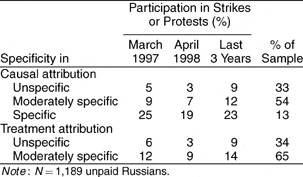
Distinguished in this way, 34% of survey respondents fall in the first category of unspecific causal attributors of blame, 54% fall in the second category of moderately specific attributors of blame, and 11% fall in the third category of specific attributors of blame. If we consider only Russians who were not paid regularly, the distribution is roughly the same: 33%, 54%, and 13% fall in the first, second, and third categories, respectively.6
In Javeline 2003, chap. 3, I provide greater detail on which particular individuals and institutions were held accountable by the specific and moderately specific attributors of blame, and I explain the likely reasons why those individuals and institutions were singled out. For example, information shortcuts based on the historical tendency for centralized decision making and a media focus on the executive, as well as thoughtful appraisals of Yeltsin's role, probably account for the 54% of specific attributors who identified the former President as the main culprit in the wage arrears crisis. Still, only 15% of unpaid Russians and 9% of the population as a whole singled out Yeltsin. The lack of specificity in blame attribution, causal and treatment, is the main story of the arrears crisis.
The second measure of blame is a dichotomous measure of treatment attribution. This measure parallels the measure of causal attribution but, due to the limitations of the survey data, distinguishes only between unspecific attributors and moderately specific attributors. Russians were asked, “Who or what do you think is now most responsible for solving the nonpayments problem?” and they could choose from the same categories described above. They were also asked a follow-up question with response categories similar to that above, such as “Who or what in the central government do you think is now most responsible for solving the nonpayments problem?” Those who answered “don't know” or who blamed the central authorities in general but no one individual or institution in particular are considered not to have made specific treatment attributions and placed in one category, whereas those who identified Yeltsin, the Duma, or another specific problem-solver are placed in another category.
Since the data do not allow us to distinguish further by even greater degrees of specificity, we should expect that the distribution of specificity in treatment attribution should resemble the distribution of only the first two categories of specificity in causal attribution. Indeed, 34% of survey respondents fall in the first category of unspecific treatment attributors, and 65% fall in the second category of moderately specific treatment attributors. Given that the attribution of causal responsibility and the attribution of treatment responsibility are highly correlated (0.43; p<0.01), we can reasonably assume that only a minority (probably between 10% and 15%) of the 65% would attribute treatment responsibility even more specifically if given the opportunity.
When Russians are placed in these three simple but distinct categories based on the specificity of their attributions of causal responsibility, we see that the level of participation in collective action increases with the level of specificity. Table 1 shows a cross-tabulation of protest events with causal attribution for Russians who were paid more than a month late or not at all during the six months prior to the survey.7
The cross-tabulation and subsequent analyses are similar if we consider all Russians, including those regularly paid.
For each of the three measures of protest, Russians who attributed causal responsibility specifically were more likely to participate than Russians who were less specific or unspecific attributors of blame. Notably, only about a tenth of Russians match the description of specific attributors of causal responsibility and are therefore relatively receptive to calls for collective action.
Table 1 also shows similar results for the relationship between treatment attribution and protest. For all three measures of protest, Russians who attributed treatment responsibility moderately specifically were more likely to participate than unspecific attributors. Greater precision in the measure of treatment responsibility would presumably show even higher participation rates for more specific attributors.
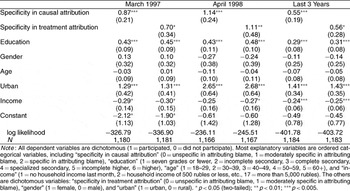
Multivariate analyses confirm these findings. In the following models, I use logit analysis on the subsample of Russians experiencing wage arrears, that is, those who were paid more than a month late or not at all during the six months prior to the survey and who were therefore most aggrieved and likely to protest. The dependent variables are the dichotomous measures of protest described above. The main explanatory variable is alternately the categorical variable for causal attribution and the dichotomous variable for treatment attribution also described above. Finally, I include some traditional demographic variables—education, gender, age, urban or rural residence, and income—known to have some association with protest behavior.8
One relevant variable, job position, is purposefully omitted. Although highly skilled white-collar workers have been among the most active protesters against wage arrears, many Russians who experience payment arrears are retired and depend on pensions or stipends. The inclusion of job position as an explanatory variable would eliminate the retired from the analysis. Furthermore, there is a high correlation between education and job position (0.65 [p<0.01] overall or 0.69 ]p<0.01[ for those experiencing wage arrears), and inclusion of both in the model would bias the results.
In all the analyses, specificity in blame attribution is statistically significant at a high level of confidence (Table 2).9
A more complex and fully specified model of protest confirms these findings. Specificity of blame attribution remains statistically significant when we add control variables for a wide variety of alternative explanations for protest and passivity in Russia, such as the receipt of nonwage benefits like housing and health care, payment in barter instead of money, second sources of income, a sense of efficacy about the impact of protest, the presence of a trade union at the workplace, confidence in the Communist Party, and interest in politics. See Javeline 2003, chap. 5.
All else being equal, a Russian who could identify at least some concrete individual or institution as the principal culprit to blame for the nonpayments crisis—either for causing it or for failing to treat it—has been more likely to strike or protest than a Russian who could not identify a principal culprit in the crisis. (The seemingly greater statistical significance of causal attribution over treatment attribution is probably due to the greater precision with which causal attribution is measured and the resulting lower standard errors.) The relationship between blame attribution and protest holds true for participation in the events of March 1997 and April 1998 and for more general participation in the last three years.
10 A case could be made that the explanation for protest based on blame attribution has the causal arrow in the wrong direction. The ability to attribute blame may be endogenous to, or result from, political protest. Structural equation models suggest that effects of the ability to attribute blame on protest are independent of the effects of protest on the ability to attribute blame, and vice versa. (Results not shown but available on request.)
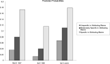
Using the parameters generated by the logit models in Table 2, we can estimate the probability of protest for individuals given their specificity, or lack thereof, in blame attribution (Figure 1). To generate predicted probabilities, all explanatory variables are held constant at their means, except for specificity in blame attribution, which is varied according to the three or two different values assigned for degree of specificity.11
The predicted probabilities were generated using a program developed by Michael Tomz, Jason Wittenburg, and Gary King (CLARIFY: Software for Interpreting and Analyzing Statistical Results, version 1.2, Harvard University, September 16, 1998). See King, Tomz, and Wittenburg 1998.
All else being equal, the probability that a Russian participated in the March 1997 protest actions is 0.04 if he/she was unspecific in attributing causal responsibility for his/her predicament. The probability that this Russian participated in these same protests increases to 0.08 if he/she was moderately specific in attributing causal responsibility to some concrete individual or institution, and it increases further to 0.17 if he/she attributed causal responsibility even more specifically and consistently to the same individual or institution. That is, clear and consistent causal attribution multiplies the probability that an individual would attempt to redress the grievance through protest by over four times. For the April 1998 events, the differences are even greater. The probability of participation jumps from 0.01 for someone unspecific in attributing causal responsibility to 0.04 for someone moderately specific in attributing causal responsibility and to 0.12 for the most specific attributors. For more general protest and strike activity in the last three years, the probability increases from 0.07 to 0.11 to 0.18.12
The predicted probabilities are similar when analyzing the entire sample, including the regularly paid. Where they differ, the general relationship still holds. The probability of protest increases along with increases in the specificity of blame attribution. Note that the survey questions on the March 1997 and April 1998 nationwide protests asked about events with the specific topic of wage delays and nonpayment, whereas the generic question about strike and protest activity did not specify the cause or topic of the strike or protest. The latter question therefore probably contains more measurement error. Some Russians who claim to have participated in protest activities in the last three years could have been protesting against less widespread grievances. This might account for the somewhat smaller effect on this one measure of the attribution of blame specifically for arrears.
Variation in the specificity of treatment attribution, like this variation in the specificity of causal attribution, generates almost identical increases in the probability of protest.
13 Results not shown but available on request. The changes in probability resemble the changes from unspecific attribution to moderately specific attribution only, since the data on treatment attribution do not allow for further distinctions of the most specific attributors.
In absolute terms, these probabilities are not terribly large, nor should we expect them to be. Given the many forces always working against collective action, the odds are usually very high that any single individual will not protest against even the most egregious injustice. A variable that substantially multiplies the likelihood that an individual will reject the opportunity to free ride and actually take the risks that protest entails is highly significant. In the aggregate, it could mean that a strike or demonstration attracts three or four or 12 times as many people from the pool of the aggrieved.
In Russia, where anywhere from one-half to three-quarters of the roughly 110 million adults have been in this pool of aggrieved, the difference between a population that attributes blame unspecifically and a population that attributes blame specifically could be millions of protesters. Two of every three Russians (69%), or just over 75 million people, reported that they were currently owed back wages, pensions, or stipends. If these people were unspecific in attributing blame and the probability of protest was only 0.04, disturbances would likely involve 3 million people. If a greater specificity in blame attribution increased the probability of protest to 0.17, the disturbances would likely involve almost 13 million people. Considering that the nonpayments crisis has affected most Russians at least indirectly through arrears to family members and that all 110 million adults might put themselves in this pool of aggrieved, the difference in turnout could jump from 4.4 million to 18.7 million protesters.
THE EFFECTS OF POLITICAL ENTREPRENEURSHIP ON PROTEST OVER WAGE ARREARS
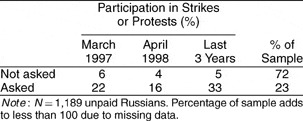
Political participation often proceeds from the simple request to do so (Varese and Yaish 2000; Verba, Schlozman, and Brady 1995, chap. 5). Accordingly, in addition to specificity in blame attribution, Russian political entrepreneurs have a significant independent effect on political protest. As Table 3 shows, unpaid Russians who have been asked to protest have done so at far higher rates than unpaid Russians who have not been asked. The effect of political entrepreneurship, however, is masked by the fact that entrepreneurial efforts to encourage protest in Russia are scarce: Only 23% of aggrieved Russians have been asked to protest by any political entrepreneur, and a far smaller percentage have been asked by trade union activists (11%), Communist Party members (6%), co-workers (14%), managers (1%), or another person (9%). Still, in the rare cases when these entrepreneurs rise to the occasion, they are often effective and confirm the idea that entrepreneurs can provide a “solution” to the collective action problem.
Effective entrepreneurs “prospect” for participants, sizing up the potential responses of individuals and targeting the most likely activists (Brady, Schlozman, and Verba 1999). In the United States, targeted individuals are usually those already most likely to participate spontaneously. However, there is some evidence that targeted individuals for social movements, as opposed to more conventional forms of participation, are often the least likely to participate spontaneously (Brady, Schlozman, and Verba 1999, 154).
Since the least likely to participate spontaneously are those who are least specific in attributing blame, we should expect an interaction effect between entrepreneurial requests to protest and blame specificity, with effective entrepreneurs targeting these least specific attributors. The least specific attributors are better targets because their probability of protest is often so low that mobilizing efforts could only have a positive effect, whereas there is less marginal utility in targeting the most specific attributors. Further analysis supports this hypothesis.
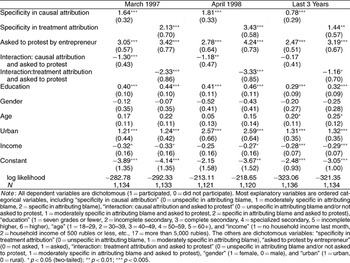
Table 4 shows the results of logit analysis as in Table 2 but with two new variables added to the model. One is a dichotomous variable representing whether or not the individual has been asked by a political entrepreneur to protest. The other variable accounts for the possibility that mobilizing efforts are less effective when entrepreneurs target those who are already specific attributors of blame. It is an interaction term measured two ways: The first variant represents the combined effects of specific causal attribution and political entrepreneurship in a three-tiered ordered categorical variable. Survey respondents who were unspecific attributors of causal responsibility and/or not asked to protest comprise one category, those who were moderately specific attributors of causal responsibility and asked to protest comprise another category, and those who were specific attributors of causal responsibility and asked to protest comprise the final category. The second variant represents the combined effects of specific treatment attribution and political entrepreneurship in a dichotomous variable. Survey respondents who were unspecific attributors of treatment responsibility and/or not asked to protest are distinguished from those who were moderately specific attributors of treatment responsibility and asked to protest.
As in Table 2, in all the analyses, specificity in blame attribution—both causal and treatment—is statistically significant at a high level of confidence. The more specifically an individual attributes blame, the more likely he/she is to protest. Similarly, in all the analyses, a request to protest by a political entrepreneur is statistically significant at a high level of confidence. An individual who is asked to protest is far more likely to do so than an individual not asked. The joint effect of specificity in blame attribution—both causal and treatment—and requests to protest is also statistically significant at a high level of confidence for all but one model, but notably the effect is negative. The more specifically an individual attributes blame, the smaller the impact that a request to protest by an entrepreneur can have. Aggrieved individuals who are less specific about their attributions of blame at the outset are much more receptive to mobilizing efforts.
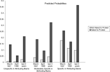
Figure 2 allows us to see the magnitude of these differences. It shows the predicted probabilities of protest when all variables are held constant at their means except for specificity in causal attribution, political entrepreneurship, and the interaction of the two, which were varied according to their different values. For unspecific attributors of causal responsibility, all else being equal, the probability of participating in the March 1997 protest actions is 0.01 if they were not asked to protest by a trade union activist, Communist Party member, or other political entrepreneur, but the probability jumps to 0.15 if they received such a request. Similarly, for moderately specific attributors of causal responsibility, all else being equal, the probability of participating in the March 1997 protest actions is 0.04 if they were not asked to protest and a much larger 0.19 if they were. For specific attributors of causal responsibility, however, the probability of protest in March 1997 is already a high 0.18 without being asked to participate, so it increases only slightly, to 0.26, with the request.
We see the same pattern for participation in the April 1998 protest events. An entrepreneur's request to protest increases the probability of protest for unspecific attributors of causal responsibility from 0.004 to 0.06, for moderately specific attributors of causal responsibility from 0.02 to 0.09, but for specific attributors of causal responsibility only from 0.12 to 0.17. Only for protest within the last three years did an entrepreneur's request to protest lead to a substantial increase in participation even for the most specific attributors of causal responsibility. However, as I describe in footnote 12, this finding probably reflects some error in this particular measure of protest. Unlike for the March 1997 and April 1998 protests, protests during the last three years may or may not have concerned wage arrears, in which case the effects of blame specificity precisely for wage arrears are more difficult to interpret.
If we substitute the attribution of treatment responsibility for the attribution of causal responsibility and assign it different values along with political entrepreneurship and the interaction of the two, the predicted probabilities look similar. A request to protest greatly and significantly increases the likelihood of protest for unspecific and moderately specific attributors of treatment responsibility. The data do not allow us to test for the effects of a request on even more specific attributors of treatment responsibility, but two factors suggest that the effects would be less significant or not significant at all. First, the sign on the interaction term for treatment attribution and a request to protest in Table 4 is negative, suggesting that a higher level of specificity in treatment attribution at a constant level of political entrepreneurship is associated with lower levels of protest. Second, the predicted probability of protest increases more extremely for unspecific attributors of treatment responsibility who are asked to protest than for moderately specific attributors, suggesting that requests to protest would have an even smaller effect, if any, on specific attributors. For example, the probability of participating in the March 1997 protest actions for unspecific attributors of treatment responsibility jumps from 0.01 to 0.21 based on a request to protest, whereas for moderately specific attributors of treatment responsibility, the probability still increases but more modestly, from 0.07 to 0.17.
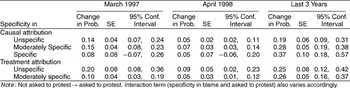
Further evidence that the mobilizing efforts of entrepreneurs are more meaningful for unspecific and moderately specific attributors of blame than for specific attributors of blame is given by the statistical significance of the changes in probability shown in Figure 2 (Table 5). For unspecific attributors of causal responsibility and for moderately specific attributors of causal responsibility, changes in the probability of protest thanks to entrepreneurial requests are statistically significant at a high level of confidence for all three measures of protest, the events of March 1997, the events of April 1998, and protest within the last three years. The same holds true for unspecific and moderately specific attributors of treatment responsibility. For specific attributors of causal responsibility, however, changes in the probability of protest thanks to entrepreneurial requests are statistically significant only for protest within the last three years. For March 1997 and April 1998, the changes in probability are not statistically significant, and the small increases that accompany being asked to protest by an entrepreneur could be due to chance.
THE LINK BETWEEN POLITICAL ENTREPRENEURSHIP AND BLAME
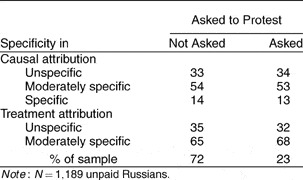
Given that political entrepreneurs have greater success mobilizing less specific attributors of blame, we might expect that the reason for their effectiveness lies in their ability to solve the blame attribution problem. Entrepreneurs might shoulder the information-gathering costs of collective action, identify a specific culprit, and convince the aggrieved to blame that culprit. As Table 6 shows, however, this probably does not describe the situation in Russia. Requests to protest by a Russian political entrepreneur have had little or no impact on an individual's specificity in blame attribution. If Russian political entrepreneurs have been trying to frame attributions of blame for wage arrears, they have been ineffective.
Table 6 distinguishes aggrieved individuals by whether they have been asked to protest by a trade union activist, Communist Party member, co-worker, manager, or other person, and it shows that those who were asked to protest by any of these political entrepreneurs were no more or less likely to attribute causal responsibility specifically than individuals who were not asked to protest. Nor were those asked to protest more or less likely to attribute treatment responsibility. These conclusions hold true when we control for other variables in multivariate analysis and when we examine the impact of different categories of political entrepreneurs individually. Ordered logit analysis with and without a variety of other variables does not reveal any significant effect of Russian political entrepreneurs on specificity of blame attribution, and a variety of bivariate and multivariate analyses with individual entrepreneurs such as trade union activists and Communist Party members substituted for the aggregate entrepreneur variable also does not reveal any significant effect on specificity of blame attribution.14
Results not shown but available on request.
It is not the case that the requests to protest by some potential entrepreneurs in Russia make the aggrieved more likely to attribute blame specifically and that the positive impact of these entrepreneurs is being diluted by including them in the general pool of all potential entrepreneurs.
To the extent that Russian entrepreneurs have an effect on protest, therefore, it is not an indirect effect through the ability of entrepreneurs to convince the aggrieved about specific blame attribution. The effect of Russian entrepreneurs on protest is largely a direct effect: Entrepreneurial requests to protest create a simple, selective incentive of satisfying the requestor, fulfilling an obligation, or relieving guilt through participation. Entrepreneurial requests have a smaller effect on specific attributors of blame probably because specific attributors are already more predisposed to protest, rendering the selective incentive of obligation fulfillment weak, unnecessary, and occasionally even counterproductive, if the named culprit in the request to protest conflicts with the aggrieved's preconceived attribution of blame.
These findings about Russian political entrepreneurs need not apply to political entrepreneurs at other times and other places. The empirical point made here is simply that Russian political entrepreneurs are less effective than they could be. They rarely ask the aggrieved to protest, and when they do, their mobilizing efforts seem limited to simple requests rather than labor-intensive information dissemination to promote greater blame specificity. Indeed, the results suggest that Russian entrepreneurs might do better at solving collective action problems if they first solved blame attribution problems. If they can convince the aggrieved to attribute blame to a specific culprit, they should reduce the costs of participation, and the aggrieved should be more likely to protest.
In general, political entrepreneurs who do not include persuasion about blame attribution in their requests to protest may be somewhat effective in encouraging protest thanks to the simple selective incentive of obligation fulfillment that a request creates. On the other hand, political entrepreneurs who do include persuasion about blame attribution in their requests offer not only a selective incentive of obligation fulfillment but also cost-cutting information. It is reasonable to expect that further empirical testing would show that these stronger requests generate a much higher level of protest.15
Of course, there are many other variables that play a role in determining individual decisions to protest, including education, urban or rural residence, income, organization, and even idiosyncratic factors such as the pursuit of entertainment or self-actualization (Lichbach 1995, 121, 281). These and other variables are discussed at length in Javeline (2003, chap. 5. Alternative theories are consistent with a theory about blame attribution, and most importantly, specificity in blame attribution proves to be a very robust explanatory variable, remaining statistically significant and substantively meaningful even with the addition of a wide range of variables to the model.
IMPLICATIONS: BLAME ATTRIBUTION AND THEORIES OF COLLECTIVE ACTION
The major empirical findings of this study are that Russians who most clearly and specifically attribute blame for their grievances have been more active in strikes, demonstrations, or other acts of protest than Russians who do not attribute blame specifically and that those less specific in their attributions of blame have been relatively receptive to requests by entrepreneurs to protest. The vast majority of Russians do not attribute blame specifically and have not been asked to protest. They have therefore not taken collective action.
The implications of these findings are that individuals faced with any grievance should be more likely to protest if they can make specific attributions of blame for the grievance and that one mechanism by which entrepreneurs might solve collective action problems is by first solving blame attribution problems. Conclusions about the effects of blame attribution on the public response to a particular economic problem in Russia should apply more broadly to other issues at other times and in other countries. For example, the limited public outcry over unemployment and other grave but complicated problems should be explained partly by the wide range of possible causes and solutions for the problems. On the other hand, the great social unrest experienced in unequivocal dictatorships like Iran in 1979, the Philippines in 1986, China in 1989, and Indonesia in 1998 should be explained partly by the simplicity of political systems that draw clear lines of accountability to a single ruler for all decisions. In either scenario, those who specify a culprit or problem-solver should be more easily mobilized than those who attribute blame diffusely or not at all (Javeline 2003, chap. 6).
The concept of blame attribution thus has much to contribute to studies of collective action and social movements. First, blame has independent effects on protest. Individuals who attribute blame specifically—whether because their problems have objectively clearer origins or because they have the motivation to sort through their problems and identify a specific culprit or because they are naturally impulsive—are more likely to protest than individuals who do not attribute blame specifically—whether because they are unable to make the attribution or unwilling to try.
The concept of blame attribution also enhances many existing explanations that already serve as the foundation for collective action and social movement theories. For example, decades ago, scholars focused on the perceptions of deprivation among the aggrieved (e.g., Gurr 1970), but it turns out that individuals with comparable levels of perceived deprivation respond differently to calls for collective action. Variation in the specificity of blame attribution helps explain why. Since only some deprived actors attribute blame specifically, only some engage in collective action.
Resource mobilization theory focused on the resources that organizations and their leaders mobilize on behalf of grievances, such as time and money. These resources are used to inform members about impending collective action and to encourage participation. Blame attribution theory suggests that another chief function of these resources is to inform members about the source of their grievance and, especially when the grievance is complicated, to simplify it for them by attributing blame to a specific culprit. Indeed, mobilizing resources to answer the question of whom to blame may precede these other tasks in importance. Blame attribution theory also suggests that the amount of resources needed to mobilize the aggrieved may vary according to preconceptions of the complexity of the grievance and the clarity of culpability. Some grievances may compel the use of more resources than others to inform or convince members about blame successfully.
Many contemporary theories of collective action focus on the construction of collective action “frames” (e.g., Snow and Benford 1988 and Snow et al. 1986). These frames make a grievance comprehensible to the aggrieved by demonstrating that their situation is unjust and shared by many others. The frames convey information such as the number of people affected by the grievance, planned actions to redress the grievance, previous actions to redress the grievance, and the outcome of these previous actions. They thus help inspire collective action. Blame attribution theory can enhance the notion of collective action frames by identifying another critical task for framing. Frames need to convey information about the origins of the grievance: Why did the grievance come about? Who or what is the guilty culprit? Who is the “us,” and who is the “them”? (Hardin 1995; Tarrow 1998, 21–22).
Contemporary theories also focus on the risks and rewards of collective action. As mentioned earlier, blame attribution theory can enhance these theories by describing how calculations of risks and rewards vary among similarly aggrieved individuals. Specificity in blame attribution facilitates the calculations. Aggrieved individuals who identify a specific person or institution as the cause of a grievance face fewer costs in assessing the ability and willingness of that specific culprit to redress the grievance or impose sanctions. They are thus more likely to bear the costs and ultimately engage in collective action than individuals who are unspecific in attributing blame and must shoulder a larger burden in information gathering and organization. Political entrepreneurs can help facilitate collective action by focusing on these less specific attributors of blame and convincing them to blame more specifically.
Still other contemporary theories focus on the role of the political system in fostering or hindering collective action. The political system provides incentives and constraints for collective action through the relative openness of the institutions of governance, the relative stability of elite alignments, the presence or absence of elite allies, and the state's capacity and propensity for repression. These determine the “structure of political opportunities” available to would-be protesters (e.g., Eisinger 1973, McAdam 1982, and Tilly 1978). Blame attribution theory suggests another aspect of the political system that influences opportunities for collective action, the transparency of the system. When lines of authority are clear and distinct in a political system, aggrieved individuals can more easily make specific attributions of blame and therefore mobilize. When lines of authority are confused, due to either institutional design or the machinations of self-preserving elites, aggrieved individuals are less likely to make specific attributions of blame and less likely to mobilize.
Note here that this claim runs counter to some intuitions in the literature on political opportunity structures. The literature usually suggests that a divided elite is conducive to collective action because it signifies weak and vulnerable leadership. Blame attribution theory instead suggests that a divided elite hinders collective action because the divisions cloud the source of blame. They legitimize finger-pointing and passing the buck. Similarly, theories about state strength usually suggest that decentralized states are more conducive to collective action than centralized states because decentralized states are weaker and more vulnerable at several points of contact (Lichbach 1995, 68–74). Blame attribution theory instead suggests that decentralized states hinder collective action because they cloud the source of blame. By definition, decentralized states involve multiple sources of power and decision-making, and they raise the cost of information gathering for the aggrieved to isolate the most important one. Centralized states might be stronger, but they also make clear where the buck stops for accountability (Tarrow 1998, 81–82, 209).
As these examples show, blame plays an important role in protest and other forms of collective action, and further study of the attribution of blame should advance the collective action research program.






Comments
No Comments have been published for this article.