INTRODUCTION
Due to the pressure of technological diffusion, the capability for new product development (NPD) has been recognised as a critical factor in firm survival (Burroughs, Dahl, Moreau, Chattopadhyay, & Gorn, Reference Burroughs, Dahl, Moreau, Chattopadhyay and Gorn2011); indeed, many new startups have collapsed major companies with their novel technologies (Depoorter, Reference Depoorter2014). In particular, the online game industry is characterised by a high degree of innovation and dynamics (Marchand & Hennig-Thurau, Reference Marchand and Hennig-Thurau2013). Major online game firms try to sustain their competitive edge through intensive NPD, the success of which depends on their abundance of innovative and creative ideas (Choi, Sung, Lee, & Cho, Reference Choi, Sung, Lee and Cho2011; Min & Oh, Reference Min and Oh2015). The process of generating innovative ideas is generally informal and nonstandardised, and involves numerous complex tasks (Nsenduluka & Shee, Reference Nsenduluka and Shee2009). Collaborative behaviour facilitates the cross-fertilisation of innovative ideas (Liu, Chen, & Tao, Reference Liu, Chen and Tao2015). Moreover, because simply focussing on the engagement of one employee is insufficient to account for a firm’s ability to face challenges, and because the efforts of hundreds of employees must be coordinated, firms usually adopt teamwork structures for mutual support and task collaboration. For example, online game development combines several aspects and requires various specialists, such as writers to render characters and landscapes, artists to create visually stunning presentations, programmers to produce fluid game play, and sound designers to create sound effects. Accordingly, a team-style work design must be adopted to develop high levels of collaborative behaviour.
Group efficacy represents a team’s collective estimate of its own ability to perform a task objective (Bandura, Reference Bandura1986). When team members have confidence in their team-level abilities, they are more willing to devote extra cognitive and behavioural efforts to collaborative activities (Rico, Sanchez-Manzanares, Gil, & Gibson, Reference Rico, Sanchez-Manzanares, Gil and Gibson2008). Additionally, because the relationship between efficacy beliefs and behaviour may be influenced by risk and uncertainty, efficacy beliefs are appropriate for examining innovation management (Chen, Greene, & Crick, Reference Chen, Greene and Crick1998). Efficacy belief has been demonstrated to be a critical facilitator of innovation performance (Vinarski-Peretz, Binyamin, & Carmeli, Reference Vinarski-Peretz, Binyamin and Carmeli2011; Wang & Lin, Reference Wang and Lin2012; Choi & Park, Reference Choi and Park2014; Liu, Chen, & Tao, Reference Liu, Chen and Tao2015; Wu, Lii, & Wang, Reference Wu, Lii and Wang2015). Most research has focussed on technology ventures and high-technology or large-scale firms, or has adopted experimental designs involving students as respondents; however, few studies have investigated the online game industry, which has exhibited continuous growth (Chang, Ku, & Fu, Reference Chang, Ku and Fu2013). The online game industry is characterised by only a few games accounting for most of the market share, an agglomeration that coincides with ongoing technical and organisational change (Ernkvist & Ström, Reference Ernkvist and Ström2008). The NPD process for online games is relatively complex and time-consuming, and the operational service usually spans many years after the initial release (Ström & Ernkvist, Reference Ström and Ernkvist2014). Compared with technology ventures and high-technology or large-scale firms, most online game firms directly service their customers. In other words, online games must be updated regularly with new content, features, and services according to the requirements of consumers. In particular, many online game firms adopt a type of producer-driven coproduction process to ensure that the service quality meets consumer expectations. However, the heterogeneous consumer demand and dynamic technology environment of the online game industry continuously create challenges for online game firms (Ström & Ernkvist, Reference Ström and Ernkvist2014). Specifically, employees at online game firms require confidence in their ability to adjust game design and features on the basis of consumer feedback, and they must launch new games that support new technologies (e.g., augmented and virtual reality). Because the advantages of self-efficacy are evident across different performance domains (Walumbwa & Hartnell, Reference Walumbwa and Hartnell2011), whether the research findings derived from technology ventures and high-technology or large-scale firms can be generalised to the online game industry is unclear. Accordingly, elucidating how group efficacy affects innovation effectiveness in the online game industry is imperative and warrants further exploration.
Teams are inherently multilevel phenomena (Klein & Kozlowski, Reference Klein and Kozlowski2000), and team performance is composed of each team member’s capabilities and teamwork processes (Katz-Navon & Erez, Reference Katz-Navon and Erez2005). Unlike measuring an individual’s perceptions of the entire team or organisation, self-efficacy evaluates one’s perceptions of the work situation (Lee, Suh, Kim, & Lee, Reference Lee, Suh, Kim and Lee2004). Studies pertaining to self-efficacy have focussed on the degree of certainty that individuals have regarding their ability to achieve performance targets (Lee & Farh, Reference Lee and Farh2004; Bell, Morgan, Kromrey, & Ferron, Reference Bell, Morgan, Kromrey and Ferron2010) and have explored the contributions of self-efficacy to individual problem-solving capabilities (Rico et al., Reference Rico, Sanchez-Manzanares, Gil and Gibson2008). As Bandura (Reference Bandura2000) suggests, self-efficacy may not be a phenomenon solely at the individual level of analysis, but may also be applicable to several levels within an organisation. A multilevel view of teams recognises that team members can impact team-level process in a ‘bottom-up’ manner, while organisation and situational factors can have a ‘top-down’ influence on individual-level processes and behaviour within teams (Klein & Kozlowski, Reference Klein and Kozlowski2000). More specifically, the role of self-efficacy may result from the interaction with team factors, such as leadership style, culture difference, and organisational climate (Choi, Price, & Vinokur, Reference Choi, Price and Vinokur2003; Chen, Gully, & Eden, Reference Chen, Gully and Eden2004; Barbosa, Gerhardt, & Kickul, Reference Barbosa, Gerhardt and Kickul2007). However, limited research has investigated how to stimulate self-efficacy through individual motivation or management policy (Baron & Morin, Reference Baron and Morin2010). In response, this study investigates the antecedents of self-efficacy from both individual and team levels. This approach follows several previous studies, which argue that contextual factors play a key role in shaping personal behaviour and team performance (Illia, Bonaiuto, Pugliese, & Rekom, Reference Illia, Bonaiuto, Pugliese and Rekom2011; Tasa, Sears, & Schat, Reference Tasa, Sears and Schat2011).
This study primarily investigates efficacy beliefs through empirical testing. Although the integration of the theoretical development of self- and group efficacy has been discussed, an empirical testing of these two constructs, using multilevel analysis, has generally been limited (Ye, Chen, & Jin, Reference Ye, Chen and Jin2006). At the individual level, this study examines the mediating role of self-efficacy for the influence of internal factors (including learning orientation and affective commitment) on group efficacy, which further influences innovation effectiveness at the team level. In addition, the effects of external support (including training and goal clarity) on self-efficacy are explored. The moderating role of training for the mediating effect of self-efficacy on the relationship between learning orientation and group efficacy is also confirmed, as is the moderating roles of goal clarity for the mediating effect of self-efficacy on the relationship between affective commitment and group efficacy. Thus, the results may provide valuable information for both academics and practitioners seeking to increase group efficacy belief and enhance innovation effectiveness.
The specific contributions of this study are described as follows. First, the antecedents of self-efficacy from management efforts or policies that facilitate team members’ efficacy beliefs are, to date, largely ignored in the literature. To address this gap, both team members’ internal motivation (individual level) and management support (team level) are included in the present research model. Specifically, this study attends to the observation of Liu, Chen, and Tao that ‘little is known about how behavioural and motivational team processes jointly shape innovation performance in NPD teams’ (Reference Liu, Chen and Tao2015: 30–31). The integration of internal and external factors for self-efficacy thus provides insights into the formulation of efficacy beliefs for high performance.
Second, this study provides a cross-level moderated mediation model for the relationship between internal factors, external factors, and group efficacy. As Hasan and Ali (Reference Hasan and Ali2007) argue, examining cross-level effects is a promising approach to advance efficacy belief research. Using cross-level analyses within a work team context, this study empirically discovers a series of team processes that may be missed for innovation effectiveness, by considering both the mediating effect of self-efficacy and the moderating effects of management policy.
Finally, several previous studies have advocated that group efficacy is the product of members, processes, and teams (Gibson & Earley, Reference Gibson and Earley2007). By aggregating individual ratings of group efficacy to predict group efficacy and team outcomes, this present research contends that group efficacy may not be simply the summation of self-efficacy. This proposal aligns with both Gibson and Earley (Reference Gibson and Earley2007) and Hasan and Ali (Reference Hasan and Ali2007), who note that teams vary in their degree of internal agreement about their group’s efficacy for a particular task. Moreover, these findings complement previous scholarship that assumes self- and group efficacy are homologous (e.g., Chen & Bliese, Reference Chen and Bliese2002). In short, the results of this study offer a solid empirical foundation on which the proposed research framework can be supported.
THEORETICAL BACKGROUND AND LITERATURE REVIEW
The construct of self-efficacy is derived from social cognitive theory and can be defined as an individual’s belief in their own ability to organise and execute the courses of action required to reach attainments (Bandura, Reference Bandura1977b: 3). Self-efficacy reflects an individual’s self-perceptions of whether he or she has the necessary skills or ability to convert those skills to achieve a desired outcome (Brazeal, Schenkel, & Azriel, Reference Brazeal, Schenkel and Azriel2008; Kickul, Wilson, Marlino, & Barbosa, Reference Kickul, Wilson, Marlino and Barbosa2008). People tend to select tasks in which they believe they have a high ability, and refrain from activities in which they perceive a low self-efficacy. Because thoughts are a potent precursor of an individual’s behaviour, actions are typically based more on what people believe than on what is objectively true.
Bandura (Reference Bandura1997) proposed three types of self-efficacy: general self-efficacy, task-specific efficacy, and domain-specific self-efficacy. General self-efficacy is an individual’s belief associated with an overall sense of competence, task-specific efficacy refers to an individual’s belief regarding their ability within a narrow focus, and domain-specific efficacy is defined as an individual’s belief regarding their ability to perform the general functions related to a given situation. Because the NPD process is inherently complex, a team member may only be responsible for a specific and narrow task. Thus, following Royle, Hall, Hochwarter, Perrewé, and Ferris (Reference Royle, Hall, Hochwarter, Perrewé and Ferris2005), this study adopts task-specific efficacy to illustrate an individual’s judgement of ability to implement the task.
According to Bandura (Reference Bandura1977a), self-efficacy can develop from enactive mastery, emotional arousal, vicarious experience (social modelling), and verbal persuasion. Enactive mastery represents knowledge and skill gained through past experiences and perseverance. Emotional arousal implies reducing people’s stress reactions and altering their negative emotional proclivities. Vicarious experience is defined as an individual’s observation of a role model performing a task. Verbal persuasion involves strengthening individuals’ beliefs that they have what it takes to succeed by providing meaningful and accurate information.
Self-efficacy partly stems from a paucity of personal or related experiences that are associated with the tasks (Kickul et al., Reference Kickul, Wilson, Marlino and Barbosa2008), because success is achieved by learning from mistakes. Gist and Mitchel (Reference Gist and Mitchell1992) suggest that self-efficacy changes because of learning, experience, and feedback; indeed, as van Beuningen, de Ruyter, and Wetzels (Reference van Beuningen, de Ruyter and Wetzels2011) note, learning orientations help employees to accumulate experiences of successful mastery. By extending enactive mastery, the present study adopted learning orientation as an antecedent of self-efficacy at the individual level. Furthermore, individuals depend partly on their emotional state when judging their capabilities, with positive emotional arousals towards a task increasing individuals’ motivation to perform successfully and increase task satisfaction (Bandura, Reference Bandura1977a). Moreover, affective commitment reflects employees’ emotional attachment to and involvement in the organisation (Simosi, Reference Simosi2010). Thus, by extending emotional arousal, the present study uses affective commitment related to the task to represent another antecedent of self-efficacy at the individual level.
Several studies have investigated the triggers of self-efficacy at an individual level. Although some scholars have explored the influence of learning or affective commitment on self-efficacy (Zhao, Seibert, & Hills, Reference Zhao, Seibert and Hills2005; Gong, Huang, & Farh, Reference Gong, Huang and Farh2009; Baron & Morin, Reference Baron and Morin2010; van Beuningen, de Ruyter, & Wetzels, Reference van Beuningen, de Ruyter and Wetzels2011), few have either used the online game industry as the research context or explored both the effects of learning orientation and affective commitment on self-efficacy. According to Shepherd, Patzelt, and Wolfe (Reference Shepherd, Patzelt and Wolfe2011), learning from failure and affective commitment determine how individuals move forward after project failure. Most online game firms use project teams to perform tasks. To avoid project failure, learning orientation and affective commitment should be regarded as two critical factors for self-efficacy.
Cox, Muller, and Moss (Reference Cox, Muller and Moss2002) argue that self-efficacy is influenced by numerous external and internal factors. Because this study focusses on task-related efficacy, external factors can be regarded as firm or management strategies. Firms improve employees’ abilities and direct them towards achieving expected goals through training, effective techniques of which include actual experience, modelling, and persuasion (Gist & Mitchell, Reference Gist and Mitchell1992). Bandura (Reference Bandura1986) notes that successful modelling transmits knowledge and teaches observers effective skills and strategies. Moreover, employees consult and refer to modelling through training, thereby rectifying inappropriate behaviours to fulfil a firm’s expectation. In other words, training can be considered a type of modelling that enhances an individual’s efficacy belief. Thus, clear goals and training are adopted here to represent social persuasion and modelling to investigate the antecedents of self-efficacy at the team level.
Meyer and Gellatly (Reference Meyer and Gellatly1998) assert that goal-setting shapes beliefs about an individual’s task-relevant capabilities. Previous research on goal setting has primarily focussed on self-efficacy and personal goals because goals motivate individuals to direct their actions in accordance with goal requirements, and thus to expend effort in proportion to goal difficulty (Gellatly & John, Reference Gellatly and John1992). In particular, specific and ambitious goals result in a higher level of performance (Latham & Locke, Reference Latham and Locke2002). Although goals can be difficult, if they are presumed to be achievable by firms, individuals are motivated to complete the tasks. Thus, clear goals can function as the social persuasion for employees to complete tasks.
Several studies have also analysed the causes of self-efficacy at the team level. Specifically, the influences of self-efficacy on goal level or choice have been explored (Edwin, Frederick, & Bobko, Reference Edwin, Frederick and Bobko1984; Bandura & Wood, Reference Bandura and Wood1989; Baum and Locke, Reference Baum and Locke2004; Brown, Jones, & Leigh, Reference Brown, Jones and Leigh2005), but few studies have investigated the influence of clear goals on self-efficacy. As Guzzo, Jette, and Katzell (Reference Guzzo, Jette and Katzell1985) contend, training and goal setting are the most powerful intervention skills that enhance employees’ productivity. Because of a high degree of innovation and dynamics, project teams at online game firms require collaborations from different specialists. Training helps team members acquire others’ complementary skills, whereas clear goals enable employees to share a common understanding of what must be achieved. Thus, both training and goal clarity are critical for collaboration and project performance (Chiocchio, Rabbat, & Lebel, Reference Chiocchio, Rabbat and Lebel2015).
In sum, except for research by Hodges and Murphy (2009) (which examines the influences of the four traditionally hypothesised sources of self-efficacy on students’ beliefs about learning mathematics in an asynchronous environment), few studies have provided a comprehensive framework for empirically investigating the antecedents of self-efficacy, particularly in the online game industry. On the basis of a study by Bandura (Reference Bandura1977a), the current study adopts learning orientation (enactive mastery) and affective commitment (emotional arousal) at the individual level, in addition to training (social modelling) and goal clarity (verbal persuasion) at the team level, as the antecedents of self-efficacy.
Numerous studies have investigated the consequences of efficacy belief. Although some scholars have explored the influence of efficacy belief on innovation outcome across different industries, such as technology ventures or public and private sector firms (Lin, Reference Lin2007; Wang & Lin, Reference Wang and Lin2012; Choi & Park, Reference Choi and Park2014), there is a dearth of information about the online game industry. Because innovation is essential for the survival of this industry (Yoo, Yang, Kim, & Heo, Reference Yoo, Yang, Kim and Heo2012), the investigation into the influence of efficacy beliefs on innovation effectiveness conducted here is warranted.
HYPOTHESIS DEVELOPMENT
Multilevel perspective of efficacy belief
According to Bandura, group efficacy refers to ‘a team’s shared belief in its conjoint capabilities to organise and execute the courses of action required [to] produc[e] given levels of attainments’ (Reference Bandura1997: 477). Group efficacy evolves from information and experiences combined through patterns of communication and a behavioural repertoire (Gibson & Earley, Reference Gibson and Earley2007), and is influenced by both individual-level variables (e.g., optimism) and team-level variables of team attributes and past team performance (Watson, Chemers, & Preiser, Reference Watson, Chemers and Preiser2001). Furthermore, as Lee and Farh (Reference Lee and Farh2004) argue, self- and group efficacy are positively related but independent constructs. Self-efficacious employees willingly contribute to their group’s performance, thereby formulating positive efficacy judgements regarding the group (Borgogni, Dello Russo, & Latham, Reference Borgogni, Dello Russo and Latham2011). Furthermore, Durham, Locke, Poon, and McLeod (Reference Durham, Locke, Poon and McLeod2000) and Kellett, Humphrey, and Sleeth (Reference Kellett, Humphrey and Sleeth2009) have suggested that perceived self-efficacy affects performance indirectly through the effects of group efficacy. Therefore:
Hypothesis 1: Team members with higher levels of self-efficacy perceive higher levels of group efficacy.
Antecedents of self-efficacy
A learning orientation is an internal mindset that motivates and compels individuals to develop their competence (Dweck, Reference Dweck2000). An individual with learning orientation believes that ability is malleable, and thus prefers to acquire new knowledge continually. By enhancing perceptions of self-competence from new knowledge, individuals nurture their belief in their personal skills and abilities (Hu & Zhao, Reference Hu and Zhao2016). In other words, employees with learning orientation have a desire to continually improve their skills and abilities (Kohli, Shervani, & Challagalla, Reference Kohli, Shervani and Challagalla1998). High levels of learning orientation increase an individual’s ability to recognise and apply new knowledge, thereby enhancing their perceptions of their personal capabilities. Moreover, employees with learning orientation are likely to accumulate successful mastery experiences (van Beuningen, de Ruyter, & Wetzels, Reference van Beuningen, de Ruyter and Wetzels2011). Enactive mastery experiences are considered the most influential source of self-efficacy (Bandura, Reference Bandura1986; Zhao, Seibert, & Hills, Reference Zhao, Seibert and Hills2005); furthermore, self-efficacy is necessary for collective efficacy perceptions (Gibson & Earley, Reference Gibson and Earley2007; Jugert, Greenaway, Barth, Büchner, Eisentraut, & Fritsche, Reference Jugert, Greenaway, Barth, Büchner, Eisentraut and Fritsche2016). Accordingly, self-efficacy mediates the relationship between learning orientation and group efficacy. When team members are learning oriented, they are more willing to accumulate knowledge and experience over time, and thus become more self-efficacious. Additionally, team members who believe that they can personally achieve task objectives are likely to share that confidence as their team develops group efficacy. Therefore:
Hypothesis 2: Team members with higher levels of learning orientation have higher levels of self-efficacy.
Hypothesis 3: Self-efficacy mediates the relationship between learning orientation and group efficacy.
Affective commitment is defined as the relative strength of an individual’s identification with involvement in a particular organisation (Hackman, Reference Hackman1990), and is positively correlated with many beneficial work behaviours and intentions, such as work performance (Riketta & Landerer, Reference Riketta and Landerer2002). Moreover, affective attachment is characterised by shared values, a desire to remain in the firm, and a willingness to exert effort on its behalf (Simosi, Reference Simosi2010). Driven by their attachment to and identification with an organisation, employees adopt behaviours that benefit the organisation (Huyghe, Knockaert, & Obschonka, Reference Huyghe, Knockaert and Obschonka2016). Affective commitment thus increases an individual’s investment at the workplace and invigorates personal behaviour (Nguyen, Groth, & Johnson, Reference Nguyen, Groth and Johnson2016). Allen and Meyer (Reference Allen and Meyer1990) similarly note that an employee with higher levels of affective commitment tends to invest knowledge and effort in achieving organisational goals. For an organisation to succeed, employees must be motivated to increase their skill levels and capacities for task requirements, which thereby enhances their perceptions of personal competence (Baron & Morin, Reference Baron and Morin2010). If group members have affective commitment towards the task, they may exert additional effort for task success, which further increases members’ competence and develops a correspondingly higher degree of belief in their abilities to be successful at tasks. In addition, affective commitment facilitates open discussion and collaborative behaviour, thereby promoting task performance (Liu, Chen, & Tao, Reference Liu, Chen and Tao2015). When employees with affective commitment towards the task engage in information sharing and collaboration, their perceptions of the team’s ability to successfully implement the task are enhanced. Therefore:
Hypothesis 4: Team members with higher levels of affective commitment towards the task are inclined to have higher levels of self-efficacy.
Hypothesis 5: Self-efficacy mediates the relationship between affective commitment towards the task and group.
According to organisational support theory (Eisenberger, Huntington, Hutchison, & Sowa, Reference Eisenberger, Huntington, Hutchison and Sowa1986), when a firm is concerned about employees’ well-being and values their contributions, employees may perceive high levels of firm support. Employees who receive this support and other resources from the firm tend to actively collaborate and respond with extra effort. In other words, employees can be externally motivated by a firm’s support and strategies (Osca, Urien, Gonzalez-Camino, Martinez-Perez, & Martinez-Perez, Reference Osca, Urien, Gonzalez-Camino, Martinez-Perez and Martinez-Perez2005; van Beuningen, de Ruyter, & Wetzels, Reference van Beuningen, de Ruyter and Wetzels2011). Training can be regarded as one type of management support from firms that is provided to enhance employee capabilities (Brazeal, Schenkel, & Azriel, Reference Brazeal, Schenkel and Azriel2008). Training influences job-related behaviours, cognitions, and attitudes (Chiocchio, Rabbat, & Lebel, Reference Chiocchio, Rabbat and Lebel2015), and increases employees’ confidence regarding perceived behavioural control. An individual’s perception of the existence of means to control threats then influences efficacy beliefs (Rhee, Kim, & Ryu, Reference Rhee, Kim and Ryu2009). Overall, team members who receive training are likely to have higher levels of self-efficacy than are those who do not receive training. Furthermore, Earley (Reference Earley1994) and Gibson (Reference Gibson2001) have posited that self- and team-focussed training affect both self-efficacy and effectiveness. Florin, Karri, and Rossiter (Reference Florin, Karri and Rossiter2007) and McGee, Peterson, Mueller, and Sequeira (Reference McGee, Peterson, Mueller and Sequeira2009) have also argued that training affects subsequent entrepreneurial self-efficacy and performance. Accordingly:
Hypothesis 6: Training increases team members’ self-efficacy.
Employees who perceive high levels of organisational support are more committed to the organisation and are often satisfied with their jobs (Zampetakis, Beldekos, & Moustakis, Reference Zampetakis, Beldekos and Moustakis2009). Zhao, Seibert, and Hills (Reference Zhao, Seibert and Hills2005) indicate that training exemplifies the lifestyles and working styles of successful entrepreneurs, thereby motivating students to develop their own psychological coping strategies; similarly, training at the workplace provides a platform for team members to anticipate possible problems and determine solutions. Baron and Morin (Reference Baron and Morin2010) also suggest that individuals who perceive training to be very useful for their work are more likely to control the work, and Chiocchio, Rabbat, and Lebel (Reference Chiocchio, Rabbat and Lebel2015) argue that training fosters a more in-depth understanding of individuals’ roles and engenders a high perception of utility. When a firm provides sufficient training for team members, employees have opportunities to gain knowledge and skills; additionally, if these employees are highly learning oriented, they can enhance their problem-solving capabilities and knowledge to maintain task motivation and thereby strengthen their self-efficacy. By contrast, when team members have insufficient training, they have fewer opportunities to improve their skills effectively or efficiently. Although they may be learning oriented, confidence in their own competence is difficult to enhance. In summary, the influence of learning orientation on employees’ self-efficacy is stronger when firms provide a high level of training compared with when a low level of training is provided. Thus:
Hypothesis 7: Training moderates the relationship between learning orientation and self-efficacy; therefore, employees with high learning orientation have higher levels of self-efficacy compared with those with low learning orientation.
Collectively, the theoretical framing of training and its concomitant implications for the relationship between learning orientation and group outcome can be operationalised as a moderated mediation model that explains the effects of learning orientation on group efficacy. In particular, learning orientation increases team members’ self-efficacy, which subsequently strengthens their willingness to contribute to their group’s performance, thereby formulating positive group efficacy. Training is likely to be a critical mechanism in determining the proposed mediating effect of self-efficacy. Moreover, training assists team members in finding solutions for possible problems, enhances their personal capabilities, and reinforces group efficacy. Specifically, the mediating effect of self-efficacy on the learning orientation–group efficacy relationship is stronger when team members receive sufficient training than it is when they receive insufficient training. This represents a moderated mediation effect, wherein the mediated effect is stronger or weaker than a third variable (Edwards & Lambert, Reference Edwards and Lambert2007). Thus:
Hypothesis 8: Training moderates the mediating effect of self-efficacy on the relationship between learning orientation and group efficacy to the extent that the mediating effect of learning orientation on group efficacy through self-efficacy is stronger when training is sufficient.
In addition to training, goal setting potentially increases cohesiveness, the establishment of norms and routines, and information processing (Gibson, Reference Gibson2001). Goal clarity is defined as the extent to which objectives are explicit and known (Sawyer, Reference Sawyer1992). Clear goals foster direction, intensity, and persistence of behaviour (Gibson & Earley, Reference Gibson and Earley2007), as well as define the target of a firm and orient the employees towards their obligations and responsibilities. Specifically, performance expectations are elucidated and team members’ activities are given directions. Goal clarity also cultivates individuals’ beliefs in their capabilities and increases their focus on relevant behaviours or outcomes (Wood & Bandura, Reference Wood and Bandura1989b; Gibson, Reference Gibson2001). By contrast, when a goal is unclear, team members can be unaware of their role expectations and may not have confidence in their abilities to complete the tasks.
When team members acquire a comprehensive understanding of work processes and targets, they can evaluate their capabilities for goal attainment. If team members believe that the goals can be accomplished, they are likely to increase their efficacy strongly, because they can determine the levels of involvement for the task and thus control the success of the task. By contrast, if team members assume that the goals are unrealistic or unfeasible, they communicate with their supervisors to acquire more resources or aid for problem solving to achieve such goals. Essentially, in working environments, firms tend to hire suitable employees to complete the tasks for profit-making purposes; therefore, employees are seldom assigned an unattainable task by managers. In instances where managers consider a goal to be achievable and employees do not, the managers may persuade the employees and specify incentives or resources. Accordingly, when people are clear about what they need to accomplish, their motivation is high and efforts are strongly directed (Wood & Bandura, Reference Wood and Bandura1989b). Furthermore, as Gibson and Earley (Reference Gibson and Earley2007) suggest, a lack of goal clarity divides members’ perceptions of their ability to achieve the task objective; similarly, van Beuningen, de Ruyter, and Wetzels (Reference van Beuningen, de Ruyter and Wetzels2011) indicate that self-efficacy and role clarity are significantly correlated. In short, when team members understand the goal of a task, they tend to have higher levels of self-efficacy. Therefore:
Hypothesis 9: Goal clarity increases team members’ self-efficacy.
Goals specify the conditional requirement for self-evaluation (Wood & Bandura, Reference Wood and Bandura1989a), with clear goals conveying information about the level of expected performance and providing individual members with a sense of what can be achieved (Whitney, Reference Whitney1994). Overall, goal clarity results in positive outcomes, which facilitate employee involvement (Gibson & Earley, Reference Gibson and Earley2007). Affective commitment entails group members’ willingness to achieve organisational goals (Huyghe, Knockaert, & Obschonka, Reference Huyghe, Knockaert and Obschonka2016), and induces employees to exert sustained efforts when faced with difficulties and to integrate errors and feedback (van Beuningen, de Ruyter, & Wetzels, Reference van Beuningen, de Ruyter and Wetzels2011); with clear goals, employees possess a thorough understanding of their roles in relation to the team (Chiocchio, Rabbat, & Lebel, Reference Chiocchio, Rabbat and Lebel2015). Moreover, when team members understand their performance and role expectations, and have affective commitment towards a task, they voluntarily acquire new knowledge or enhance their skills to achieve the goals; this subsequently increases confidence in their ability to complete the task. With unclear goals, however, team members know neither their role expectations nor performance evaluation criteria, regardless of whether they have high levels of affective commitment. Team members might even implement a task inefficiently or with the wrong objective in mind, and thus their self-perceived competence cannot be enhanced. Accordingly:
Hypothesis 10: Goal clarity moderates the relationship between affective commitment and self-efficacy to the extent that employees with high goal clarity have higher levels of self-efficacy, compared with those with low goal clarity.
Collectively, if goal clarity moderates the effect of affective commitment on self-efficacy, then the mediating factor of self-efficacy that links affective commitment and group efficacy can be moderated by goal clarity. If such moderation is realised, the moderating effect is restricted to the relationship after mediation. Thus:
Hypothesis 11: Goal clarity moderates the mediating effect of self-efficacy on the relationship between affective commitment and group efficacy to the extent that the mediating effect of affective commitment on group efficacy through self-efficacy is stronger when the goal is clear.
Influence of group efficacy on innovation effectiveness
Innovation is the tendency to develop and successfully introduce to the market new or improved products or services (Lale Gumusluoglu, Reference Lale Gumusluoglu2009), and innovation effectiveness represents the extent to which a firm accrues benefits from the innovation (Choi & Yoon, Reference Choi and Yoon2009). According to Gibson (Reference Gibson2001) and Lin and Peng (Reference Lin and Peng2010), group efficacy is related to team-level performance; innovation effectiveness can be considered a type of team-level performance. For example, Markman, Balkin, and Baron (Reference Markman, Balkin and Baron2002) reveal that patent inventors with higher efficacy tend to be actively involved in the formation of new businesses. Liu, Chen, and Tao (Reference Liu, Chen and Tao2015) suggest that collective efficacy facilitates shared goal commitments, which consequently motivate idea generation and implementation and results in innovative performance. Furthermore, Kahai, Sosik, and Avolio (Reference Kahai, Sosik and Avolio2003) argue that group efficacy is associated with the motivation of team members, particularly for innovative tasks that tend to be unstructured and ambiguous. Finally, Hill, Craig Wallace, Ridge, Johnson, Paul, and Suter (Reference Hill, Craig Wallace, Ridge, Johnson, Paul and Suter2014) determine that cofounders’ collective efficacy positively relates to the effectiveness of new ventures. Thus:
Hypothesis 12: Teams with higher levels of group efficacy are more likely to have superior innovative effectiveness, compared with those with lower levels of group efficacy.
On the basis of the preceding literature review and developed hypotheses, the research model of this study is proposed. An outline of the model is presented in Figure 1.
Research framework of this study

RESEARCH DESIGN AND METHODOLOGY
Survey administration
Data collection was conducted using a cross-sectional mail survey, and the sampling frame was 50 online game firms that have research and development teams in Taiwan. Online games refer to digital games in which players use a platform to connect to a remote server through the internet (Taylor, Reference Taylor2006). Personal interviews with team leaders were conducted to confirm their involvement in the NPD process and their willingness to join the study. Notably, team leaders comprised both the leaders and immediate supervisors of the team members. In total, 39 team leaders participated in the study; they also provided the names of the team members engaged in the design of new games. In each case, telephone contact was made before distributing questionnaires to the team leaders, in an effort to increase the response rate.
After two rounds of telephone follow-up, a total of 418 team members and their leaders in 38 teams completed the survey. Of the 414 employees identified, four did not complete the questionnaire. The sample was highly homogeneous regarding firm size and type of tasks performed. Additionally, all of the companies were small (8–24 employees), and all were engaged in the improvement of existing products and NPD (Keller, Reference Keller1992). The reason for selecting this sample was to enable an investigation into both individual-level efficacy beliefs and team-level innovation effectiveness; such teams can produce highly innovative products (Durmuşoğlu & Barczak, Reference Durmuşoğlu and Barczak2011).
Two types of questionnaires were circulated: one for the team members and the other for their leaders. To ensure that team members and leaders were appropriately matched for further analysis, the questionnaires included both team and member identification codes. However, all respondents were guaranteed confidentiality. The team members’ questionnaires gathered information on their personal information and each research construct, expect for innovation effectiveness; team leaders were asked to provide data on their team’s innovation effectiveness. On average, 11 team members were evaluated by each leader. In total, the sample consisted of 350 men (85%) and 62 women (15%). Approximately 45% were between 36 and 45 years of age, and >50% had over 10 years of work experience. Furthermore, ~85% of the respondents worked in high-technology firms, 63% worked in firms that had been in business for <5 years, and nearly 82% of the firms had <50 employees. Finally, >65% of the firms operated on a comparatively small scale, with revenues of less than US$5 million.
Measures
Because the data were collected in Taiwan, a management professor translated the original questionnaire into Chinese, which was then back-translated into English by another professor who is competent in both languages (Drucker, Reference Drucker1954; Lovelock & Wirtz, Reference Lovelock and Wirtz2011). Subsequently, a bilingual management scholar compared the English and Chinese versions of the survey, and determined that they were comparable to a high degree of accuracy; small modifications were made to resolve minor discrepancies. In a pretest of the questionnaire, 15 graduate students in the International Master of Business Administration programme at National Cheng Kung University completed the English version of the questionnaire; another 15 copies of the Chinese version were randomly distributed to graduate students in the Service Marketing course at National Taichung University of Science and Technology. The results from the back-translation of the original English questionnaire into Chinese were satisfactory; thus, the English and Chinese versions were mutually consistent.
Measures were adapted primarily and whenever possible from previous validated questionnaires, with minor modifications made to fit the context of the present study. When such items or scales were unavailable, reliability and validity was assessed; additionally, the scale purification process was conducted following (Churchill, Reference Churchill1979). Except for innovation effectiveness, all of the items used a 7-point Likert scale with anchors from 1=‘strongly disagree,’ to 7=‘strongly agree’. The measurement items for each construct are listed as follows.
Individual-level measures
Learning orientation
To assess team members’ learning orientation, three items adapted from Kohli, Shervani, and Challagalla (Reference Kohli, Shervani and Challagalla1998) were used: ‘Learning how to finish my job is of fundamental importance to me’, ‘An important part of my job is continually improving my skills’, and ‘It is important for me learn from each job-related experience I have’. The Cronbach’s α for this item was 0.87.
Affective commitment
Affective commitment was measured with five items adapted from Allen and Meyer (Reference Allen and Meyer1990): ‘I am proud to tell others that I work for my team’; ‘If I could not work for my team any more, I would miss something’; ‘I have many things in common with other members of my team’; ‘I am still satisfied with my decision to work for my team’; and ‘I care about the problems of my team, even if my workplace is not involve in them’. The Cronbach’s α for this item was 0.83.
Self-efficacy
Four items were adapted from Webster and Martocchio (Reference Webster and Martocchio1995) to measure self-efficacy: ‘I feel that I am qualified for the job I am doing’, ‘I often feel good about the quality of work I do’, ‘I believe that I perform well at my job’, and ‘I think my job performance is optimal’. The Cronbach’s α for this item was 0.88.
Team-level measures
Training
Four training scales were adapted from Schmidt (Reference Schmidt2007): ‘Learning is planned and purposeful in my team’, ‘My team provides training opportunities’, ‘My team provides support for personal and professional development’, and ‘Training is encouraged and rewarded in my team’. The measure of agreement among team members’ ratings produced a median r wg of 0.93. The intraclass correlation coefficient (ICC)(1) coefficient, which refers to the degree of variability in responses at the individual level that is attributed to the team membership, was 0.58. The ICC(2) coefficient, which represents the reliability of the team level means, was 0.78.
Goal clarity
Goal clarity was measured by five items adapted from Sawyer (Reference Sawyer1992): ‘My team clearly identifies my duties and responsibilities’, ‘My team clearly identifies my goals and the objective of my job’, ‘My team provides me with the expected results of my work’, ‘My team provides me with the extent to which my work is related to the overall objectives of my team’, and ‘My team provides me with the aspect of my work that will lead to a positive evaluation’. The measure of agreement among team members’ ratings produced a median r wg of 0.85; additionally, the ICC(1)=0.12, and ICC(2)=0.43. Because these aggregation statistics are either within or only slightly below the acceptable range of values summarised in the literature, and are comparable with previously reported values in specific studies (e.g., Marrone, Tesluk, & Carson, Reference Marrone, Tesluk and Carson2007) as suggested by Bliese (Reference Bliese2000), they are not low enough to prohibit aggregation, particularly when viewed in combination.
Group efficacy
Echoing Bandura (Reference Bandura1997), this study argues that group efficacy may be more than the sum of self-efficacy beliefs of individual members, if between-groups differences exist. Group efficacy was thus assessed using six items developed by Hasan and Ali (Reference Hasan and Ali2007) and Pan and Zhao (Reference Pan and Zhao2007): ‘I believe that my team has the necessary skills to do an outstanding job on this project’; ‘I believe that my team is willing to put in the effort needed to do an outstanding job on this project’; ‘I believe that my team has the ability to accomplish its objective’; ‘I believe that my team has sufficient ability to conduct an effective discussion to reach appropriate results’; ‘I believe that my team members are confident in implementing this project’; and ‘I believe that my team members understand this project very well’. Interrater and intraclass measures (median r wg=0.90, ICC(1)=0.41, ICC(2)=0.74) justified the aggregation across raters.
Innovation effectiveness
Innovation effectiveness is the ratio of sales generated by NPD to the expenditures levied to produce those new products. According to Lale Gumusluoglu (Reference Lale Gumusluoglu2009), this ratio implies the success of the team, regarding the satisfaction of market needs and the use of team resources to produce new products. Moreover, this measure is more accurate than the absolute amount of research and development expenditure, because expenditures for innovation reflect the willingness to support NPD (Jung, Chow, & Wu, Reference Jung, Chow and Wu2003). Thus, this study asked each team leader to provide information about the sales generated by NPD and the costs devoted to producing those products.
Aggregation of team-level variables
Team self-efficacy
According to Chan (Reference Chan1998), a referent-shift consensus model is a composition model in which individual ratings of a higher level phenomenon are used to represent the higher level construct. Similarly, this study calculated self-efficacy at team level as the aggregated mean score of all team members’ scores on each of the self-efficacy items at the individual level. Because this variable conceptually and empirically reflects a simple average, such models do not require interrater agreement. Instead, this study conducted a one-way analysis of variance and determined significant between-teams variance for team self-efficacy (p=.001).
Control variables
In team-level analyses, this study controlled for team size and average team tenure, in accordance with other scholars (Jehn, Rispens, & Thatcher, Reference Jehn, Rispens and Thatcher2010; Shin, Kim, Lee, & Bian, Reference Shin, Kim, Lee and Bian2012). At the individual level, gender and participants’ tenure with the team were controlled.
Analytic strategy
The theoretical model is inherently multilevel and comprises variables at both individual (i.e., learning orientation, affective commitment, and self-efficacy) and team (i.e., training, goal clarity, group efficacy, and innovation effectiveness) levels. Specifically, this study used hierarchical linear modelling (HLM), which is a statistical technique for examining relationships across multiple levels through a two-level approach that accounts for the nonindependence inherent within nested data (Raudenbush & Bryk, Reference Raudenbush and Bryk2002); this is done by simultaneous partitioning and modelling of within- and between-team variances. Thus, this method can test for cross-level relationships while accounting for their different sources of variance. The model testing here followed sequential steps and standard HLM practices (Bryk & Raudenbush, Reference Bryk and Raudenbush1992). Models derived through HLM were estimated using HLM 6.08 software.
The moderated mediation hypothesis was tested by demonstrating that moderation occurs between the independent and mediating variables (i.e., learning orientation, affective commitment, and self-efficacy) and that mediating effects vary according to the level of moderation (i.e., training and goal clarity). To assess moderated mediation, four conditions (Muller, Judd, & Yzerbyt, Reference Muller, Judd and Yzerbyt2005) were examined: (i) the significant effect of the independent variables (learning orientation and affective commitment) on the mediator (self-efficacy); (ii) the significant interaction between independent variables (learning orientation and affective commitment) and moderators (training and goal clarity) on the mediator; (iii) the significant effect of the independent variables on the dependent variable (group efficacy); and (iv) the different conditional indirect effects of independent variables on the mediator across low and high levels of moderation. The final condition, which is the core of moderated mediation, establishes whether the strength of the mediation differs across two levels of moderation (Edwards & Lambert, Reference Edwards and Lambert2007; Preacher, Rucker, & Hayes, Reference Preacher, Rucker and Hayes2007). Referring to the procedure developed by Edwards and Lambert (Reference Edwards and Lambert2007), the bootstrapping method was adopted to test the significance of the moderated mediation test. Although the HLM software does not support bootstrapping, previous studies (Pan, Sun, & Chow, Reference Pan, Sun and Chow2012; Guillaume, van Knippenberg, & Brodbeck, Reference Guillaume, van Knippenberg and Brodbeck2014) have recommended the Monte Carlo method provided by Preacher and Selig (Reference Preacher and Selig2010).
RESEARCH RESULTS
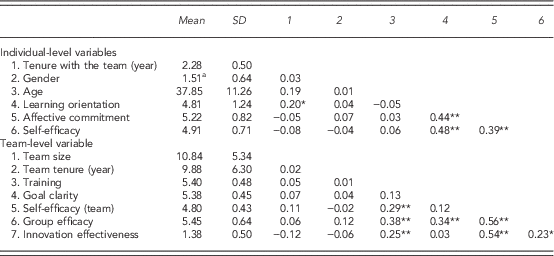
Table 1 presents the means, standard deviations, and bivariate correlations among the constructs at the team and individual levels of analysis, respectively. To assess the possibility that the three individual-level variables (learning orientation, affective commitment, and self-efficacy) are not distinct, this study conducts confirmatory factor analysis using AMOS 22.0. The models tested comprise (i) a one-factor model (χ2=316.22, comparative fit index [CFI]=0.60, root mean square error of approximation [RMSEA]=0.21, and Tucker–Lewis index [TLI]=0.59); (ii) a two-factor model (χ2=143.44, CFI=0.77, RMSEA=0.16, and TLI=0.82); (iii) a three-factor model (χ2=105.54, CFI=0.90, RMSEA=0.10, and TLI=0.90); and (iv) a hypothesised three-factor model. Notably, the hypothesised model with four distinct factors has better fit indices (χ2=67.42, CFI=0.95, RMSEA=0.06, and TLI=0.97) than each of the other models, thereby supporting the discriminant validity of the variables.
Descriptive statistics and correlations

Note.
a Gender (0=male, 1=female).
*p<.05; **p<.01.
To test the hypotheses, this study first ensures that significant team variance in self-efficacy exists (otherwise, team-level and further cross-level analyses are unnecessary). A null model that has no predictors at either the individual level or team level is estimated. ICC(1) values and associated χ2 tests reveal that 16% of the variance in self-efficacy resides between teams (χ2[50]=55.28, p<.01). In each case, the significant between-team variance provides justification for testing the full model; accordingly, this study uses HLM to predict self-efficacy (Hypotheses 1–11).
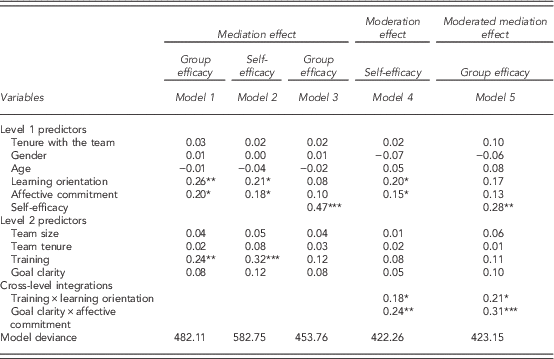
In Table 2, a summary of the results of the HLM analyses is provided. Specifically, Model 3 reveals that self-efficacy has a positive effect on group efficacy (γ=0.47, p<.001); these results support Hypothesis 1. Moreover, individual-level learning orientation (γ=0.21, p<.05) and affective commitment (γ=0.18, p<.05), as well as team-level training (γ=0.32, p<.001) significantly predict self-efficacy. However, team-level goal clarity has no significant effect on self-efficacy (γ=0.10, p>.05); thus, Hypotheses 2, 4, and 6 are supported, but Hypothesis 9 is rejected. Furthermore, individual-level learning orientation (γ=0.26, p<.01) and affective commitment (γ=0.20, p<.05) significantly predict group efficacy. When the mediator (self-efficacy) is included in the equation, the relationship between learning orientation and group efficacy, and that between affective commitment and group efficacy, become nonsignificant. Bootstrapped confidence intervals (CIs) corroborate the significant, indirect effect of learning orientation (95% CI: 0.07–0.31) and affective commitment (95% CI: 0.11–0.22), thereby supporting Hypotheses 3 and 5.
Multilevel analysis: Joint effects of antecedents of self-efficacy and the effect of self-efficacy on group efficacy

Note. *p<.05; **p<.01; ***p<.001.
The previously specified four conditions, used to assess the moderated mediation, are also tested. The analysis results presented in the preceding section confirm conditions 1 (significant direct effect of learning orientation and affective commitment on self-efficacy) and 3 (significant direct effect of learning orientation and affective commitment on group efficacy). When testing condition 2 (i.e., Hypotheses 7 and 10), this study centres the predictor and moderator variables, after which it creates the product terms for testing interaction effects and applies the standardised scores in subsequent analyses (Saks, Reference Saks1995).
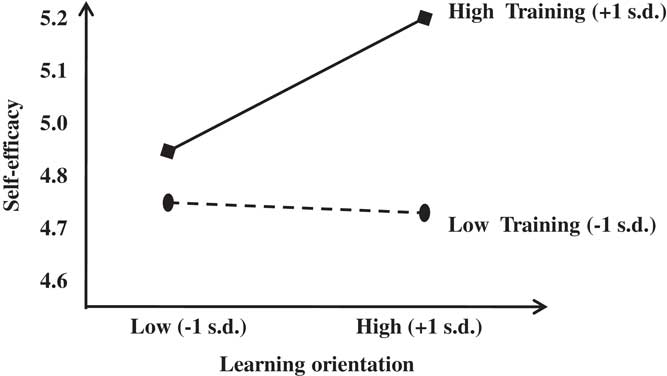
As shown in Table 2, the results support Hypothesis 7 (γ=0.18, p<.05), indicating that when team members receive sufficient training for a task, learning orientation has a positive effect on self-efficacy. To further examine the moderating effect, separate simple slopes are plotted by depicting the relationship between learning orientation and self-efficacy at high and low values of training (1 SD greater and less than the mean); the interaction is depicted in Figure 2. When team members receive sufficient training for the task, learning orientation and self-efficacy exhibit a positive relationship (γ=0.55, p<.001); however, the relationship is nonsignificant when team members receive insufficient training (γ=−0.12, n.s.).
Cross-level moderating effect of training on the relationship between learning orientation and self-efficacy

The results also reveal that goal clarity moderates the relationship between affective commitment and self-efficacy (γ=0.24, p<.01); this interaction is illustrated in Figure 3. As anticipated, the plot reveals that the positive relationship between affective commitment and self-efficacy is strongest when team members have high goal clarity (γ=0.32, p<.05); by contrast, the positive slope between affective commitment and self-efficacy is weakened when team members have low goal clarity (γ=0.07, n.s.). Thus, Hypothesis 10 is supported and condition 2 for assessing moderated mediation is fulfilled.
Cross-level moderating effect of goal clarity on the relationship between affective commitment and self-efficacy

To further assess moderated mediation, this study examines condition 4, which requires the magnitude of the conditional indirect effect of learning orientation and affective commitment on group efficacy through self-efficacy to be different across high and low levels of training and goal clarity. Referring to the procedures implemented by Preacher, Rucker, and Hayes (Reference Preacher, Rucker and Hayes2007), this study operationalises high and low levels of training and goal clarity, and additionally examines the significance of the indirect effects of learning orientation and affective commitment on group efficacy. The results reveal that the conditional indirect effects of learning orientation are significant for team members with high levels (95% CI: 0.02–0.05) and low levels (95% CI: between −0.10 and 0.02) of training. In addition, the results indicate that the conditional indirect effects of affective commitment are significant for team members with high goal clarity (95% CI: 0.05–0.45) and low goal clarity (95% CI: between −0.05 and 0.11). Thus, Hypotheses 8 and 11 are supported.
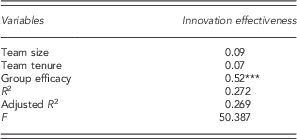
Hypothesis 12 focusses on team-level outcome. The average self-efficacy within each team is computed and ordinary least square regression is adopted to address this hypothesis. This multiple methods approach, where HLM is used for the nested models and ordinary least square is used for the pure team-level model, is similar to the approach used by Marrone, Tesluk, and Carson (Reference Marrone, Tesluk and Carson2007). Control variables (team size and team tenure) are entered and followed by the predictor (self-efficacy). As outlined in Table 3, group efficacy has a positive influence on innovation effectiveness (β=0.52, p<.001), thereby supporting for Hypothesis 12.
Results of regression analyses for innovation effectiveness

Note. ***p<.001.
CONCLUSIONS AND SUGGESTIONS
Major observations and conclusions
This study primarily investigates efficacy beliefs at both the individual and team levels, and numerous noteworthy findings are obtained. First, self-efficacy mediates the influences of learning orientation and affective commitment on group efficacy. When team members are learning oriented and have high affective commitment towards a task, they tend to be more confident about their personal and team capabilities. These results are consistent with those of Kickul et al. (Reference Kickul, Wilson, Marlino and Barbosa2008), who argues that personal factors or related experiences affect feelings of competence. Second, training not only affects self-efficacy but also moderates the relationship between learning orientation and self-efficacy. Specifically, team members receiving sufficient training for a task tend to have higher levels of self-efficacy than do those receiving insufficient training. These results are consistent with those of Gibson (Reference Gibson2001), who notes that training can be regarded as a strategy for enhancing subsequent efficacy and effectiveness. Furthermore, training is a critical moderator of the mediating effect of self-efficacy. Self-efficacy is a more powerful mediator of the effects of learning orientation on group efficacy when firms provide insufficient training; however, when receiving sufficient training, learning-oriented team members tend to be group-efficacious, regardless of low self-efficacy.
Third, contrary to our prediction, goal clarity does not directly affect self-efficacy. This is possibly because clear goals merely guide team member behaviour and action, but do not increase their confidence. Whitney (Reference Whitney1994) argues that further research should focus on the mediators and moderators of the goal–performance relation. Similarly, self-efficacy can be a performance index, when firms exercise strategies to promote employees’ efficacy beliefs (Srivastava, Bartol, & Locke, Reference Srivastava, Bartol and Locke2006). The nonsignificant relationship between clear goals and self-efficacy may also be attributed to the existence of moderators or mediators. Goal clarity moderates not only the relationship between affective commitment and group efficacy but also the mediating effect of self-efficacy on the relationship between affective commitment and group efficacy. These findings suggest that the mediating effect of self-efficacy in the affective commitment–group efficacy relationship is weak when team members clearly understand the goal of a task. Nevertheless, when team members possess affective commitment towards a task, clear goals guide and motivate them to more willingly accept challenges and exert effort to achieve goals. In the process of potential exploitation, team members understand their limits and capabilities and thus have greater confidence in group efficacy.
Finally, group efficacy can play a critical role in eliciting innovation effectiveness. Specifically, team members with greater confidence in their team capabilities tend to be entrepreneurially oriented and thus seek greater innovation effectiveness. Durham et al. (Reference Durham, Locke, Poon and McLeod2000) argues that in pursuit of performance improvement, teams with high efficacy tend to adopt more active strategies. Similarly, our results reveal that efficacious teams are more likely to behave creatively, act with foresight, be aware of new opportunities, and be more comfortable in managing situations of risk, thereby enhancing their innovation effectiveness.
Managerial implications
This study provides critical insights and practical strategies for practitioners who manage teams. First, team leaders must consider learning orientation and affective commitment as the two critical criteria when recruiting team members. This is because team members with a learning orientation and affective commitment towards a task tend to develop a correspondingly higher degree of belief in their own ability to achieve the task objective, which reflects their task performance. Accordingly, team leaders can provide training and clear goals to positively develop team members’ efficacies.
Second, training and goal clarity provide information that enables team members to gain a more thorough understanding of task attributes, complexity levels, and environments. Training entails providing relevant courses or knowledge to enhance team members’ capabilities, and goal clarity involves conveying expectations and other feedback as well as stressing connections between team members’ efforts and achievements. As Tierney and Farmer (Reference Tierney and Farmer2011) suggest, team leaders are instrumental for employee efficacy development; specifically, providing sufficient training and clear goals represents firms’ strategies to enhance team members’ efficacy beliefs. Thus, efficacy building may be fostered by providing relevant resources from management or team leaders.
Finally, from a multilevel perspective, the individual level can have a ‘bottom-up’ influence on the team-level process, whereas team-level factors can have a ‘top-down’ influence on individual-level behaviour. This study provides evidence for the influence of both individual- and team-level factors, as well as their interactions with self-efficacy. Team leaders should be aware that team efficacy is distinct from self-efficacy, although they are highly correlated. Although team characteristics and team processes may influence group efficacy, self-efficacy cannot be ignored during team formation. Furthermore, enhancing team members’ confidence in their capabilities places the team in a prime position to implement innovative and creative work, thereby improving innovative effectiveness. Thus, team leaders should offer encouragement conducive to the development of efficacy beliefs.
Limitations
This study has some limitations. First, the research design of this study is essentially cross-sectional. Because of the nature of the relationship between self-efficacy and performance, a meaningful time lag should be considered; thus, an additional longitudinal study involving lagged data collection is required to confirm the results herein. Second, this study only collects data once on each research construct; therefore, the reciprocal relationship between efficacy beliefs and team performance could not be assessed. Finally, management support, such as training and goal clarity, is not the only determinant of individual efficacy beliefs. Other team-level factors, such as team characteristics or task attributes, should also be considered in developing efficacy perception.
Acknowledgements
This research was supported by the National Science Council (NSC), under grant number NSC 99-2410-H-126 -022 -MY2. This manuscript was edited by Wallace Academic Editing (www.editing.tw).
About the authors
Chia-Ying Li is an Associate Professor in the Department of Business Administration at the National TaiChung University of Science and Technology, Taiwan. She received her PhD in Business Administration from National Cheng Kung University, Taiwan. Her research interests are in electronic commerce, and service marketing, etc. She has published articles in Telematics and Informatics, Journal of Service Theory and Practice, Service Business, Human Systems Management, Asia Pacific Management Review, Total Quality Management and Business Excellence, Computers in Human Behavior, International Journal of Information Management, Journal of Information Science, Expert Systems and Applications, International Journal of Human Resource Management, Industrial Management and Data System, and elsewhere.
Chiun-Yi Tsai is a PhD student in the Graduate Institute of Political Economy at the National Cheng Kung University, Taiwan. His research interests are in strategic management, and service management, etc.