1. Introduction
Slab subduction on the Earth is generally regarded as an important mechanism for transporting crustal materials into the mantle, triggering extensive crust–mantle interactions and causing chemical heterogeneity in the mantle (e.g. Hofmann, Reference Hofmann1997). Oceanic subduction, accompanied by melting of the subduction-modified mantle wedge and/or a young subducting oceanic crust and melt–peridotite interactions, produces various types of arc magmatic rocks (such as the typical calc-alkaline rock association, adakites and high-Mg andesites; Defant & Drummond, Reference Defant and Drummond1990; Tatsumi & Eggins, Reference Tatsumi and Eggins1995; Spandler & Pirard, Reference Spandler and Pirard2013). In the past 35 years, many studies have discovered that continental crust can also be subducted into the deep mantle, even to depths of >100 km (e.g. Smith, Reference Smith1984; Sobolev & Shatsky, Reference Sobolev and Shatsky1990) where the crust would experience high-pressure (HP) to ultra-high-pressure (UHP) metamorphism and then return to crustal levels by continental exhumation (Zhao et al. Reference Zhao, Dai and Zheng2013). Compared with oceanic subduction, continental subduction rarely develops syn-subduction arc magmatic rocks owing to the relatively low contents of aqueous fluids in the subducting continental crust (e.g. Zheng, Reference Zheng2012). However, syn-exhumation or post-collisional magmatic rocks have been discovered in many well-known continental collision-related orogenic belts, such as the Alpine–Himalaya, Pan-African, Dabie-Sulu and Eastern Kunlun orogens (Bonin, Reference Bonin2004; Chung et al. Reference Chung, Chu, Zhang, Xie, Lo, Lee, Lan, Li, Zhang and Wang2005; Liu et al. Reference Liu, Ma, Zhang, Xiong, Huang and Jiang2012; Zhao et al. Reference Zhao, Dai and Zheng2013). Such magmatic rocks can record critical information about the geodynamic processes of continental subduction and exhumation as well as the effects of deep crust–mantle interactions.
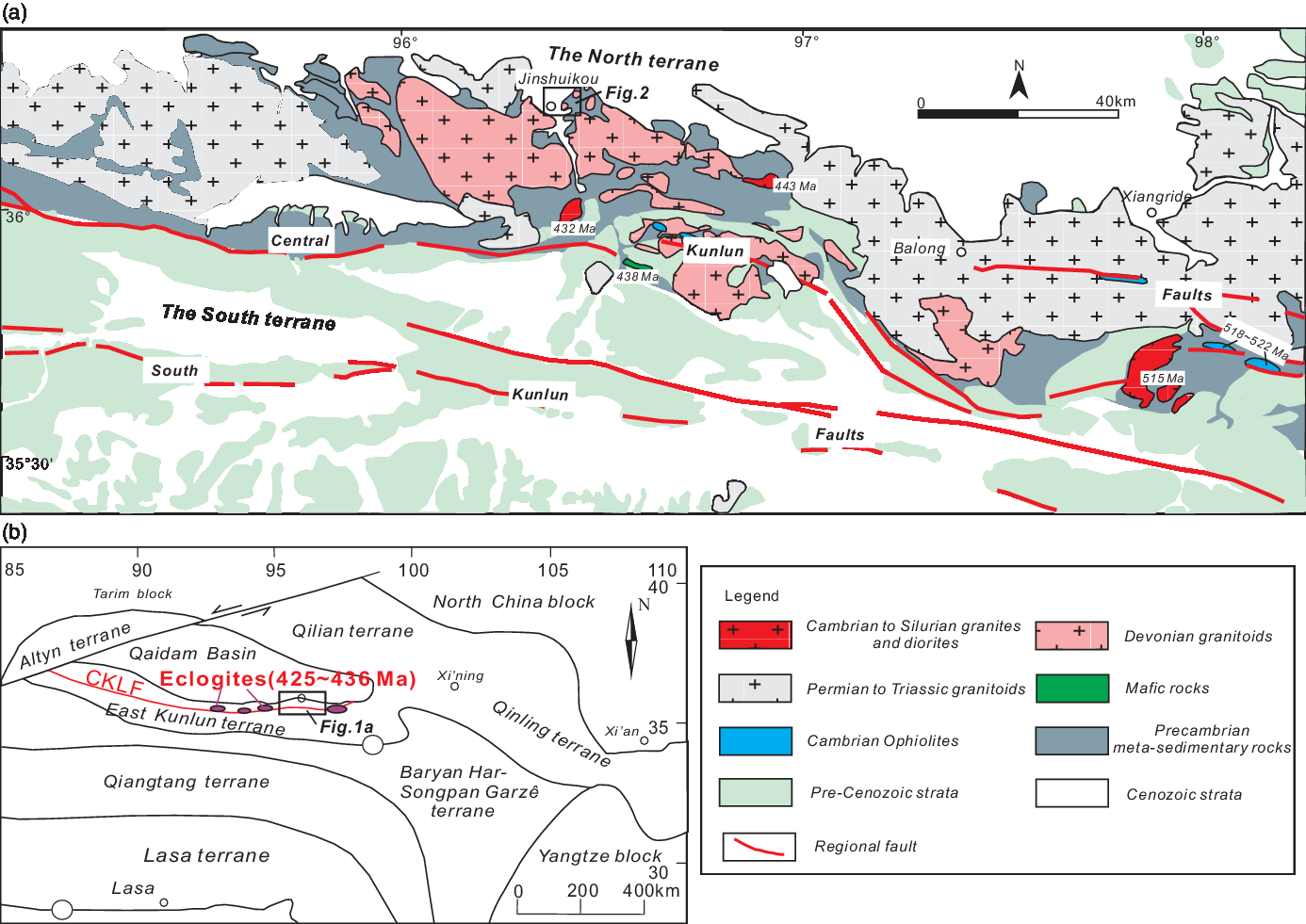
The East Kunlun orogenic belt (EKOB) is one of the very large magmatic belts in the northern part of the Tibetan Plateau (Harris et al. Reference Harris, Xu, Lewis and Jin1988; Mo et al. Reference Mo, Luo, Deng and Yu2007; Dong et al. Reference Dong, He, Sun, Liu, Zhou, Zhang, Yang, Cheng, Zhao and Li2018) and is mainly composed of early Palaeozoic and late Permian to Triassic granitic intrusions (Fig. 1; Liu et al. Reference Liu, Ma, Zhang, Xiong, Huang and Jiang2012; Xiong et al. Reference Xiong, Ma, Zhang, Liu and Jiang2014). In recent years, voluminous eclogites have been identified in the Precambrian basement rocks of the EKOB, which constitutes one of the largest HP metamorphic belts (∼500 km long) on the Earth (Fig. 1a; Bi et al. Reference Bi, Song, Dong, Yang, Qi and Allen2018; Song et al. Reference Song, Bi, Qi, Yang, Allen, Niu, Su and Li2018). The protoliths of the eclogites are dominated by Proterozoic continental basaltic rocks (∼934 Ma; Meng et al. Reference Meng, Zhang and Cui2013), as evidenced by their continental tholeiite basalt-like geochemical composition, significant crustal contamination and abundant old inherited zircons (Meng et al. Reference Meng, Zhang and Cui2013, Reference Meng, Cui, Jia, Ren and Feng2015). U–Pb dating of metamorphic zircons from the eclogites and their surrounding rocks (e.g. garnet-mica schists) has shown that the timing of eclogite-facies metamorphism is 425∼436 Ma (Meng et al. Reference Meng, Zhang and Cui2013; Zhang et al. Reference Zhang, Qian, Li, Wang, Zhang, You and Liu2017; Song et al. Reference Song, Bi, Qi, Yang, Allen, Niu, Su and Li2018) and the timing of exhumation of these HP rocks is c. 409∼411 Ma (Zhang et al. Reference Zhang, Qian, Li, Wang, Zhang, You and Liu2017; Song et al. Reference Song, Bi, Qi, Yang, Allen, Niu, Su and Li2018). The discovery of coesite inclusions in these eclogites provides robust evidence that the continental crust was subducted into the deep mantle to depths of 100–120 km and then exhumed to crustal levels (Bi et al. Reference Bi, Song, Dong, Yang, Qi and Allen2018; Song et al. Reference Song, Bi, Qi, Yang, Allen, Niu, Su and Li2018). The widespread Devonian magmatic rocks are generally considered to be products of Proto-Tethyan collision-related magmatism in the EKOB (e.g. Zhao et al. Reference Zhao, Ma, Wang, Bai, Li and Ji2008; Liu et al. Reference Liu, Ma, Zhang, Xiong, Huang and Jiang2012; Dong et al. Reference Dong, He, Sun, Liu, Zhou, Zhang, Yang, Cheng, Zhao and Li2018). They consist of abundant granitic intrusions and scarce mafic rocks, which mostly intrude the Precambrian basement rocks (Figs 1, 2). Moreover, their zircon U–Pb ages range from 411 Ma to 402 Ma (Zhang et al. Reference Zhang, Meng, Wan, Yang and Dong2003; Long et al. Reference Long, Jin, Ge and Yu2006; Liu et al. Reference Liu, Ma, Zhang, Xiong, Huang and Jiang2012; Wang et al. Reference Wang, Dong and Dong2018), which is identical within error to the timing of exhumation of the eclogites. Compared with the granitic intrusions, the genetic mechanism, magma source and geodynamics of these mafic rocks are still poorly understood. Thus, investigations of these Devonian magmatic rocks could provide excellent insights into the process of continental exhumation and its related deep crust–mantle interactions. This paper presents a comprehensive study of the zircon geochronology, geochemistry and Sr–Nd isotope geology of the Devonian mafic rocks in the EKOB. The data are used to ascertain the composition of the mantle sources and petrogenesis and then to reveal their geodynamic relationship with continental exhumation.
(a) Simplified geological map showing the distribution of magmatic rocks in the EKOB; and (b) the location of the EKOB in the Tibetan Plateau.

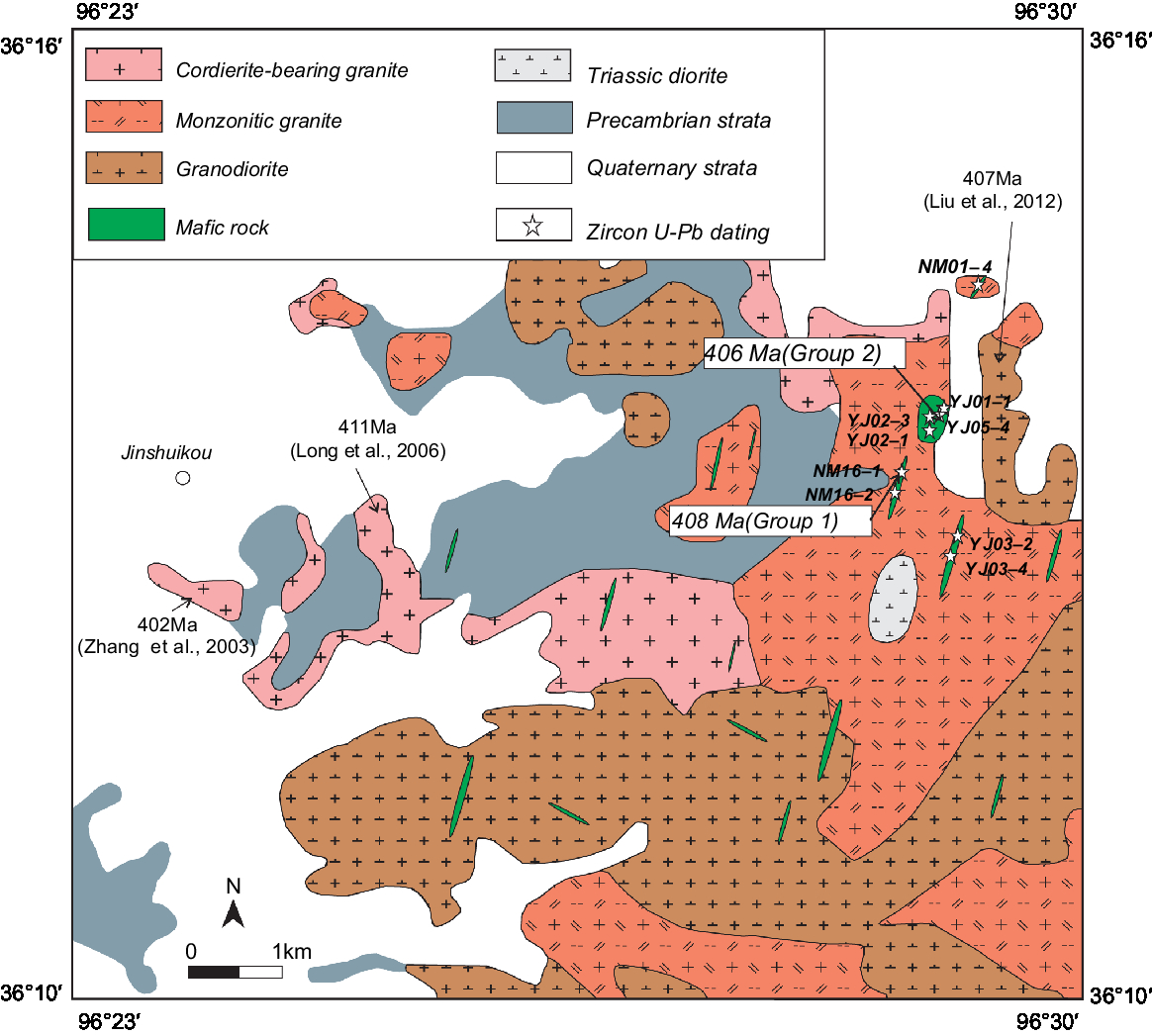
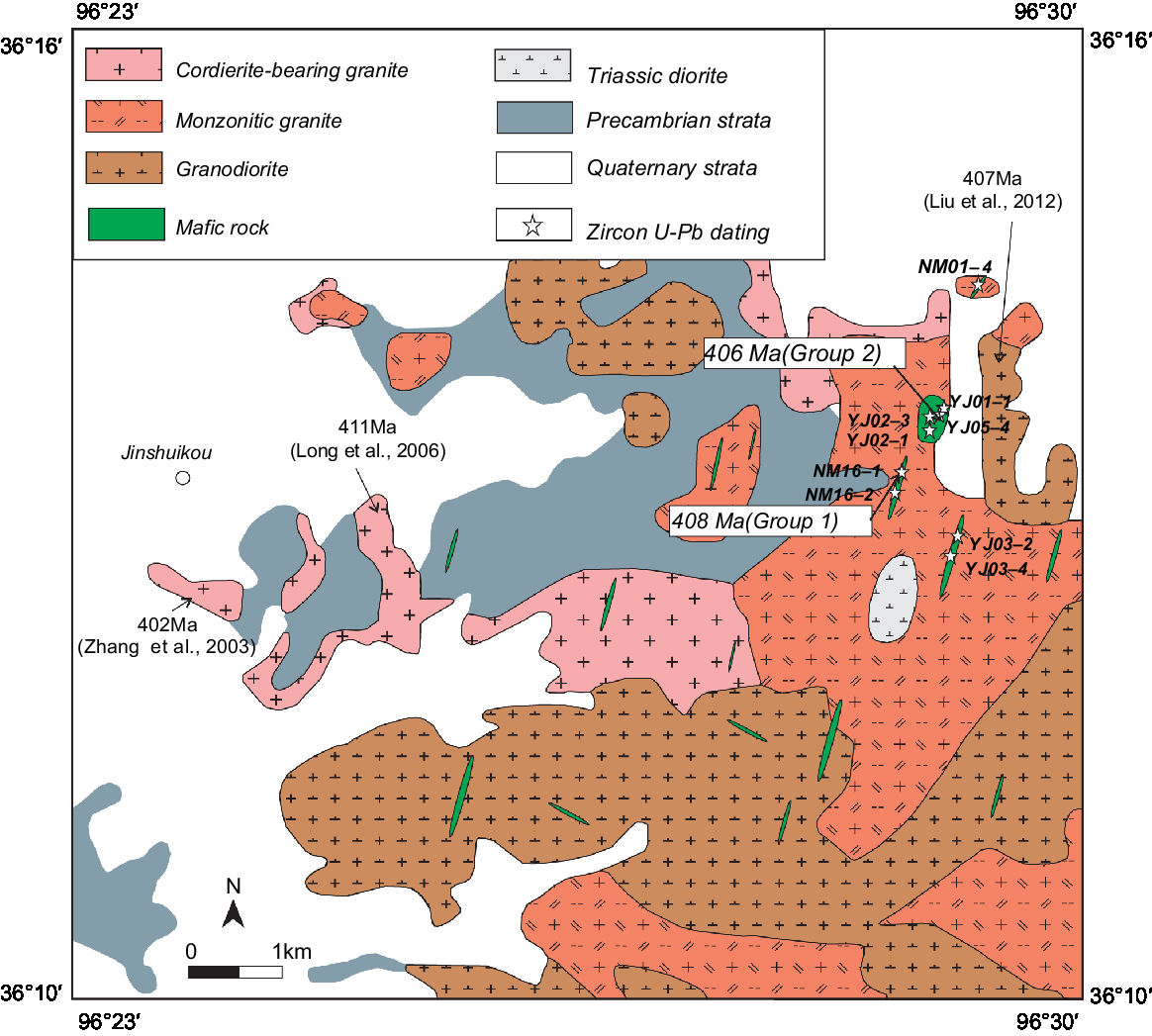
Simplified geological map of the study area.
2. Geological background and sample descriptions
The EKOB is situated in the northern part of the Tibetan Plateau and is bounded by the Qaidam basin and Bayan Har – Songpan-Garzê terrane (Fig. 1). The Central Kunlun fault zone (CKLF) divides the EKOB into two segments: the north terrane of the East Kunlun (NEKL) and the south terrane of the East Kunlun (SEKL). The NEKL is mainly composed of Precambrian metamorphic basement rocks (namely, the ‘Jinshuikou Group’) and Silurian to Triassic magmatic rocks. The Jinshuikou Group can be divided into two parts (Wang et al. Reference Wang, Wei, Jia, Zhang, Li, Zhu and Xiang2007; Chen et al. Reference Chen, Pei, Li, Liu, Li, Zhang, Chen, Liu, Ding and Guo2011). The lower part (namely, the ‘Baishahe Formation’) is dominated by marbles, gneisses, migmatites and amphibolites and is considered to have formed during Palaeoproterozoic times (c. 1.9∼2.0 Ga; Wang et al. Reference Wang, Wei, Jia, Zhang, Li, Zhu and Xiang2007), while the upper part (namely, the ‘Xiaomiao Formation’) consists of quartzites, marbles, gneisses and schists with formation ages of 1.6∼1.7 Ga (Chen et al. Reference Chen, Pei, Li, Liu, Li, Zhang, Chen, Liu, Ding and Guo2011). The SEKL is mainly composed of Proterozoic metamorphic rocks (namely, ‘the Kuhai Group and the Wanbaogou Group’), Triassic flysch and some granitic rocks. The CKLF comprises ophiolites, volcanic rocks, mafic intrusions and some metamorphic rocks. The recent identification of eclogites or coesite-bearing eclogites suggests that the CKLF also marks an early Palaeozoic HP metamorphic belt (Meng et al. Reference Meng, Zhang and Cui2013; Bi et al. Reference Bi, Song, Dong, Yang, Qi and Allen2018; Song et al. Reference Song, Bi, Qi, Yang, Allen, Niu, Su and Li2018). The formation ages of the ophiolites are 518∼522 Ma (e.g. Yang et al. Reference Yang, Robinson, Jiang and Xu1996; Lu et al. Reference Lu, Yu, Jin, Li and Zheng2002), suggesting the presence of a Proto-Tethyan Ocean in the EKOB. Previous studies on the Qingshuiquan granulites in the CKLF suggested that the subducted oceanic slab arrived at depths of 40∼50 km before ∼508 Ma (e.g. Li et al. Reference Li, Lu, Xiang, Zhou, Guo, Song, Zheng and Gu2006). The development of calc-alkaline magmatic intrusions with zircon U–Pb ages of 438∼515 Ma (Mo et al. Reference Mo, Luo, Deng and Yu2007; Zhang et al. Reference Zhang, Pei, Ding, Li, Feng, Sun, Li and Chen2010, Reference Zhang, Ma, Xiong, Liu, Li and Pan2014; Liu et al. Reference Liu, Ma, Zhang, Xiong, Huang and Jiang2012, Reference Liu, Ma, Jiang, Guo, Zhang and Xiong2013b; Xiong et al. Reference Xiong, Ma, Jiang, Liu, Zhang and Zhou2013; Zhou et al. Reference Zhou, Dong, Zhang, Yang, Sun and He2016; Dong et al. Reference Dong, He, Sun, Liu, Zhou, Zhang, Yang, Cheng, Zhao and Li2018) suggests prolonged subduction of the Proto-Tethyan Ocean during early Cambrian to early Silurian times. The widespread Devonian magmatic rocks are generally considered to have been formed in a collision-related environment (Zhao et al. Reference Zhao, Ma, Wang, Bai, Li and Ji2008; Liu et al. Reference Liu, Ma, Zhang, Xiong, Huang and Jiang2012; Dong et al. Reference Dong, He, Sun, Liu, Zhou, Zhang, Yang, Cheng, Zhao and Li2018). They mostly intrude the Precambrian basement rocks and consist of numerous granitic intrusions and minor mafic rocks (Figs 1, 2). The granitic intrusions account for a large proportion (∼60 %) of all Palaeozoic granites in the EKOB and display a narrow range of crystallization ages (402∼411 Ma; Fig. 1a, 2; Zhang et al. Reference Zhang, Meng, Wan, Yang and Dong2003; Long et al. Reference Long, Jin, Ge and Yu2006; Liu et al. Reference Liu, Ma, Zhang, Xiong, Huang and Jiang2012; Wang et al. Reference Wang, Dong and Dong2018). Many studies have addressed the idea that partial melting of Precambrian basement rocks and associated magma mixing had played essential roles in the generation of these granitic intrusions (Zhao et al. Reference Zhao, Ma, Wang, Bai, Li and Ji2008; Liu et al. Reference Liu, Ma, Zhang, Xiong, Huang and Jiang2012).
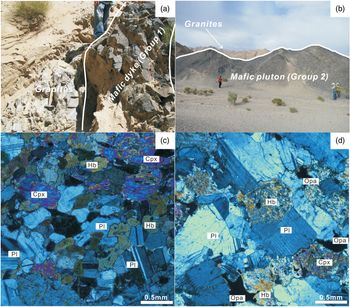
In this study, we have identified two different groups of mafic rocks in the NEKL (Fig. 2). Both of them intrude a typical Devonian granitic intrusion with zircon U–Pb ages of ∼407 Ma (Liu et al. Reference Liu, Ma, Zhang, Xiong, Huang and Jiang2012). The host granitic intrusion is mainly composed of monzonitic granite and granodiorite (Fig. 2), which are peraluminous granites in composition. The two groups of mafic rocks crop out differently in the field (Figs 2, 3), and there are no cross-cutting relationships between them. Group 1 rocks occur as dykes with a NE–SW-trending strike (Fig. 3a). We have investigated more than five dykes, and the dykes usually have thicknesses ranging from 1.0 m to 1.6 m. All the dykes show sharp contacts with the host granitic intrusion (Fig. 3a), and most of them have fine-grained textures (Fig. 3a, c). The Group 2 mafic rocks appear as a small pluton with a distribution area of ∼0.1 km2 (Figs 2, 3b). The mafic pluton also has a sharp contact with the enclosing granitic rocks, and xenoliths from the host granites are not found in the pluton. Most of the Group 2 rocks are medium to coarse grained, although some rocks near the contact zone exhibit relatively fine-grained textures.
Field photographs and photomicrographs for the two groups of Devonian mafic rocks. Cpx – clinopyroxene; Hb – hornblende; Opa – opaque minerals; Pl – plagioclase. Hammer for scale is ∼35 cm long.
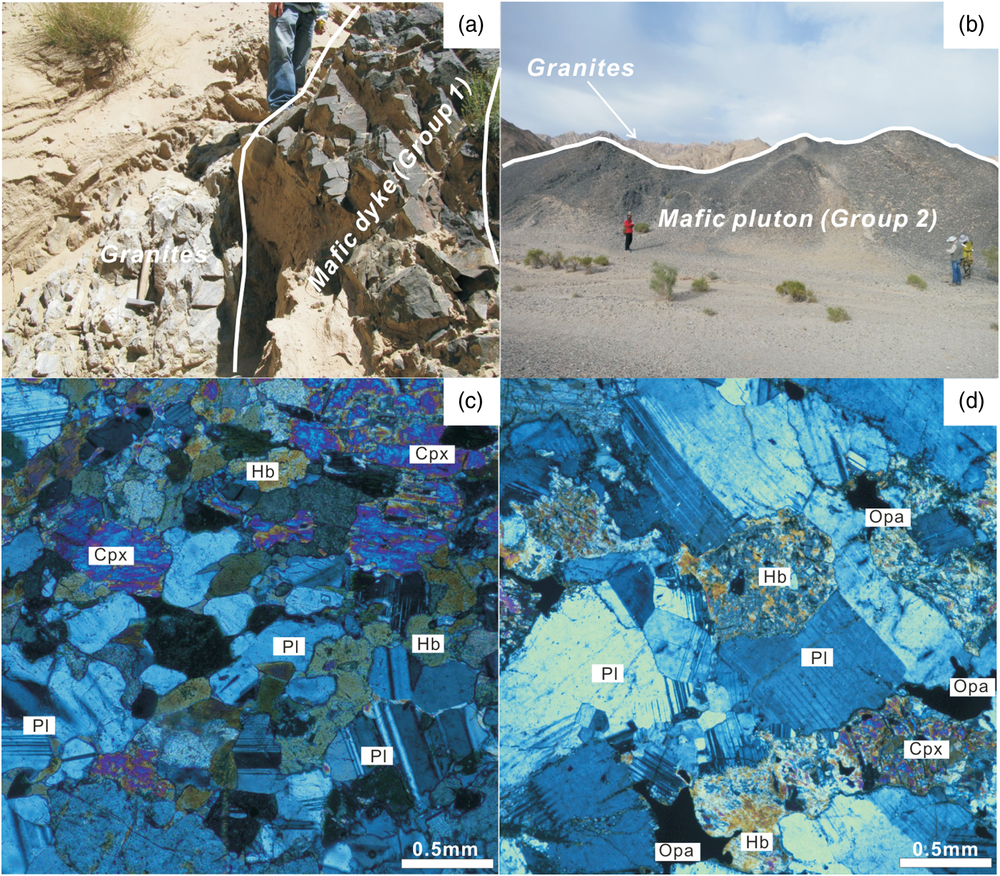
Group 1 rocks are mainly composed of plagioclase (40∼45 %), clinopyroxene (15∼20 %) and hornblende (25∼30 %; Fig. 3c). Plagioclases have subhedral crystals and mostly display polysynthetic twinning. Clinopyroxenes are subhedral and partly altered along the margins and cleavage of the grains. Hornblendes are subhedral to anhedral and exhibit obvious pleochroism under plane-polarized light. Group 2 rocks consist of plagioclase (45∼50 %), clinopyroxene (5–10 %) and hornblende (30∼35 %) with some opaque minerals (5∼10 %; Fig. 3d). Plagioclases are subhedral, and they exhibit apparent polysynthetic twinning. Most of the clinopyroxenes have been partly or entirely replaced by hornblendes, uralites, chlorites and some opaque minerals. Opaque minerals show anhedral columnar crystals and occur in the interstices between the clinopyroxenes and plagioclases (Fig. 3d), suggesting they may have crystallized in the late stage of magma evolution.
3. Analytical methods
The samples for the experimental analysis of the chemical and isotopic compositions were selected from fresh outcrops, and detailed analytical methods are described as follows.
To obtain sufficient numbers of magmatic zircons, zircon grains were isolated from ∼22 kg of Group 1 mafic rocks (NM16-1) by using mechanical crushing, magnetic techniques and handpicking under microscopes. The appropriate analytical sites for the zircon grains were selected based on systematic petrographic observations and analyses of cathodoluminescence (CL) images. Analysis of U–Pb isotopes and trace-element compositions of the zircon grains were conducted at the State Key Laboratory of Geological Processes and Mineral Resources (GPMR), China University of Geosciences (Wuhan), using laser ablation inductively coupled plasma mass spectrometry (LA-ICP-MS). A GeoLas 2005 instrument and an ICP-MS instrument (Agilent 7500a) were used for laser sampling and obtaining ion signal intensities, respectively. Harvard zircon 91500 was used as an external standard to normalize isotopic fractionation during analysis, while NIST SRM 610 glass was used as an external standard and Zr as an internal standard to calculate the trace-element concentrations of unknowns. The detailed operating conditions of these instruments, analytical procedures and calculation of off-line data were the same as those described by Liu et al. (Reference Liu, Hu, Gao, Günther, Xu, Gao and Chen2008a, Reference Liu, Gao, Hu, Gao, Zong and Wang2010a,b).
Analysis of whole-rock major elements was carried out at the Hubei Province Geological Experimental Testing Centre, China. The contents of major oxides were determined using X-ray fluorescence (XRF) spectrometry (Magix_pro2440), while the values of loss on ignition (LOI) were measured by the weight loss after heating at high temperature. The relative standard deviations (RSDs) for major elements were better than 1 %. Trace-element contents were measured using an ICP-MS instrument (Agilent 7500a) at the GPMR. HF+HNO3 in Teflon bombs was used to digest the powder samples. Detailed methods of sample digestion and pre-treatment as well as RSDs for trace elements are described by Liu et al. (Reference Liu, Zong, Kelemen and Gao2008b). The analytical results for the international reference materials and replicate samples are listed in online Supplementary Material Table S1.
Sr–Nd isotope ratios of the mafic rocks were measured at the GPMR. Ratios of 87Sr/86Sr were measured using a Finnigan Triton thermo-ion mass isotope spectrometer, while ratios of 143Nd/144Nd were determined using a multiple collector (MC)-ICP-MS instrument. The detailed sample preparation and experimental procedures were the same as those described by Gao et al. (Reference Gao, Rudnick, Yuan, Liu, Liu, Xu, Ling, Ayers, Wang and Wang2004). The mass fractionation correction for Sr–Nd isotope compositions was carried out using 88Sr/86Sr = 8.375209 and 146Nd/144Nd = 0.721900. Replicate analyses of the NBS 987 standard gave a 88Sr/86Sr ratio of 0.710274 ± 0.000009, showing good agreement with approved published data (0.710241 ± 0.000011; Fantle & DePaolo, Reference Fantle and DePaolo2006). Replicate analyses of the JNdi-1 standard yielded a 146Nd/144Nd ratio of 0.512118 ± 0.000009, also displaying good agreement with approved published data (0.512115 ± 0.000007; Tanaka et al. Reference Tanaka, Togashi, Kamioka, Amakawa, Kagami, Hamamoto, Yuhara, Orihashi, Yoneda, Shimizu, Kunimaru, Takahashi, Yanagi, Nakano, Fujimaki, Shinjo, Asahara, Tanimizu and Dragusanu2000). In addition, replicate analyses of two samples (YJ03-4 and YJ05-1) are shown in Table 3.
4. Results
4.a. Zircon U–Pb ages
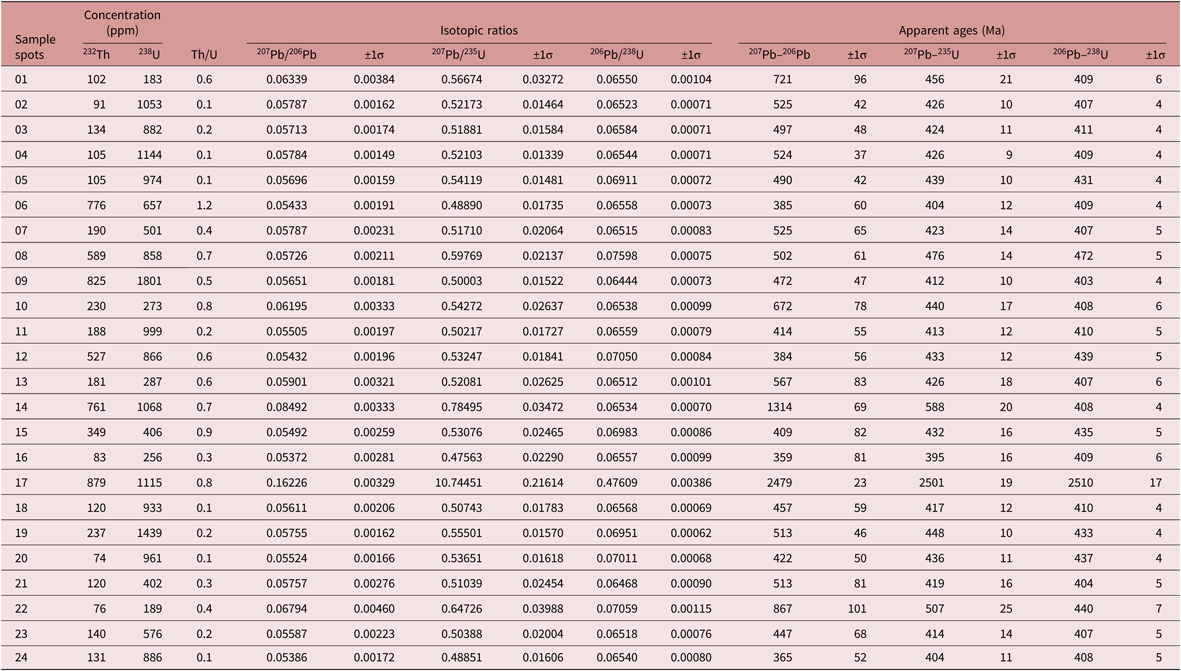
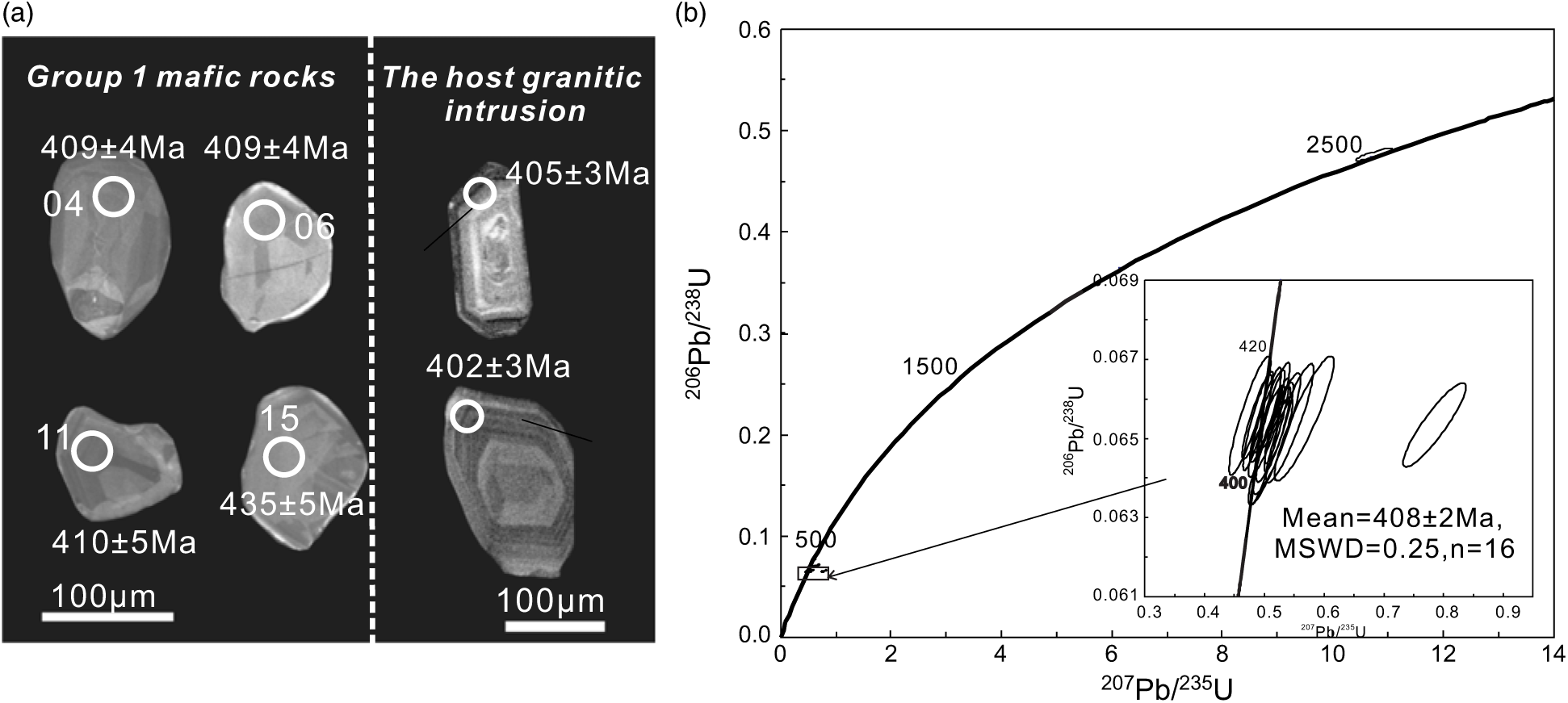
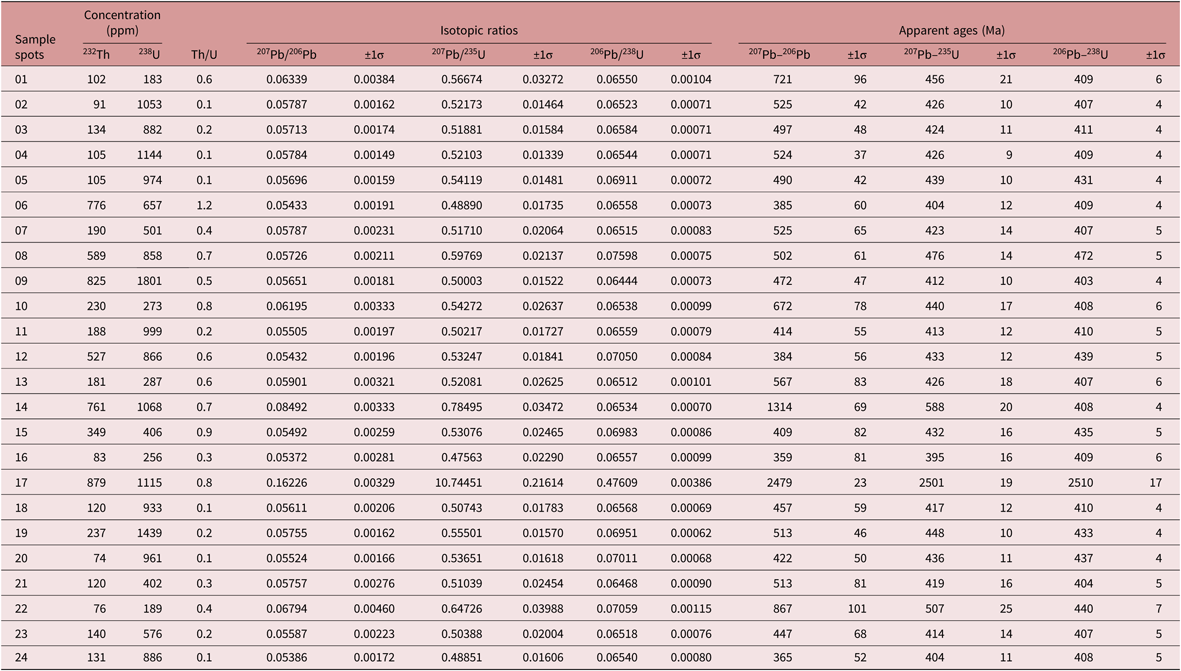
The zircon U–Pb isotope analyses for the Group 2 mafic rocks were reported in Liu et al. (Reference Liu, Ma, Zhang, Xiong, Huang and Jiang2012) by the authors, and the results yielded a zircon U–Pb age of 406 ± 3 Ma (MSWD = 1.8). Therefore, zircon U–Pb isotope analysis of the Group 1 mafic rocks was performed in this study. The representative sample (NM16-1) was selected from the site at 36° 13.212′ N, 96° 29.003′ E. The results and CL images of the zircon grains are presented in Table 1 and Figure 4, and trace-element compositions of the zircon grains are listed in online Supplementary Material Table S2.
Zircon LA-ICP-MS U–Pb dating results of Devonian mafic rocks
(a) CL images and (b) LA-ICP-MS U–Pb concordant diagrams for zircons from the Devonian mafic rocks. Data for chondrite are from Taylor & McLennan (Reference Taylor and McLennan1985). CL images of typical magmatic zircons from the host granitic intrusion (after Liu et al. Reference Liu, Ma, Zhang, Xiong, Huang and Jiang2012) are also shown for comparison.
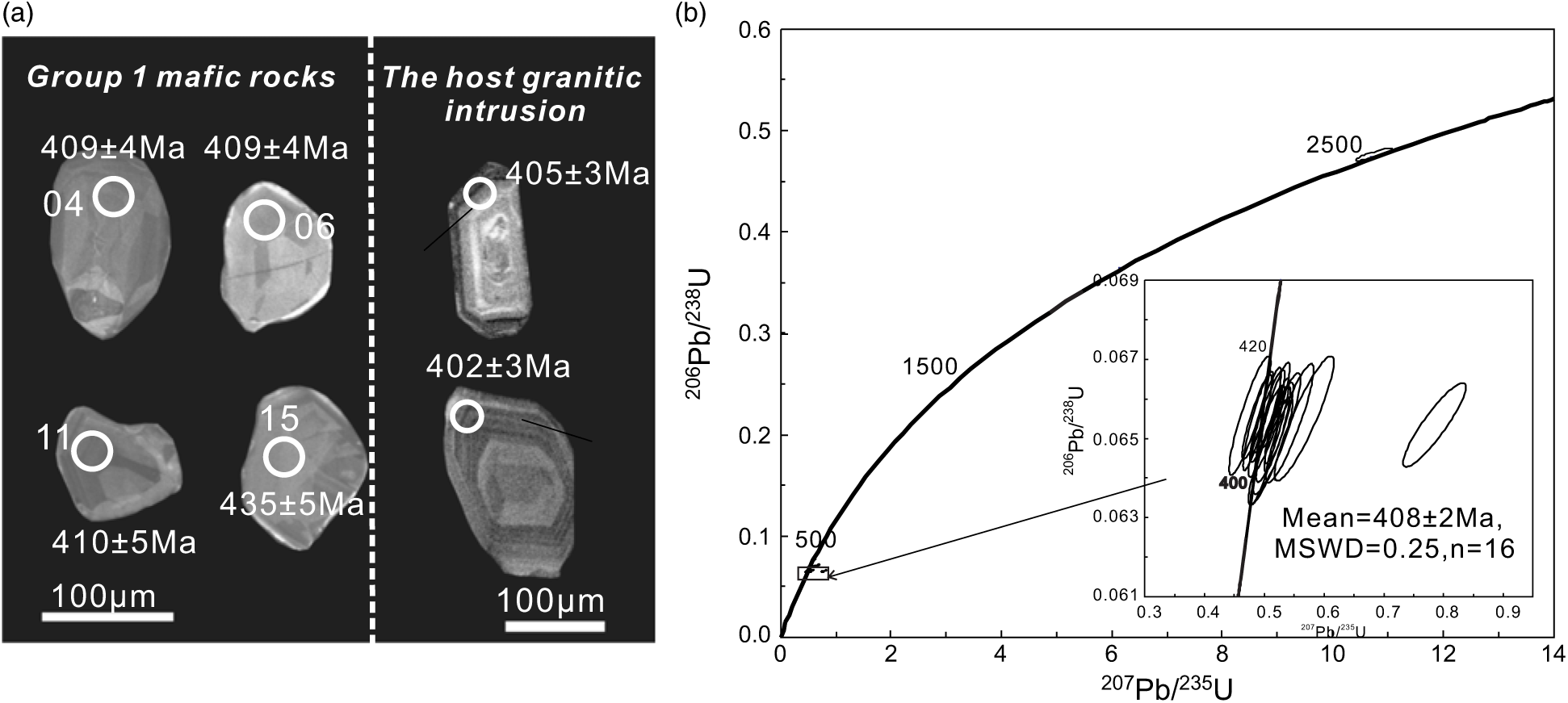
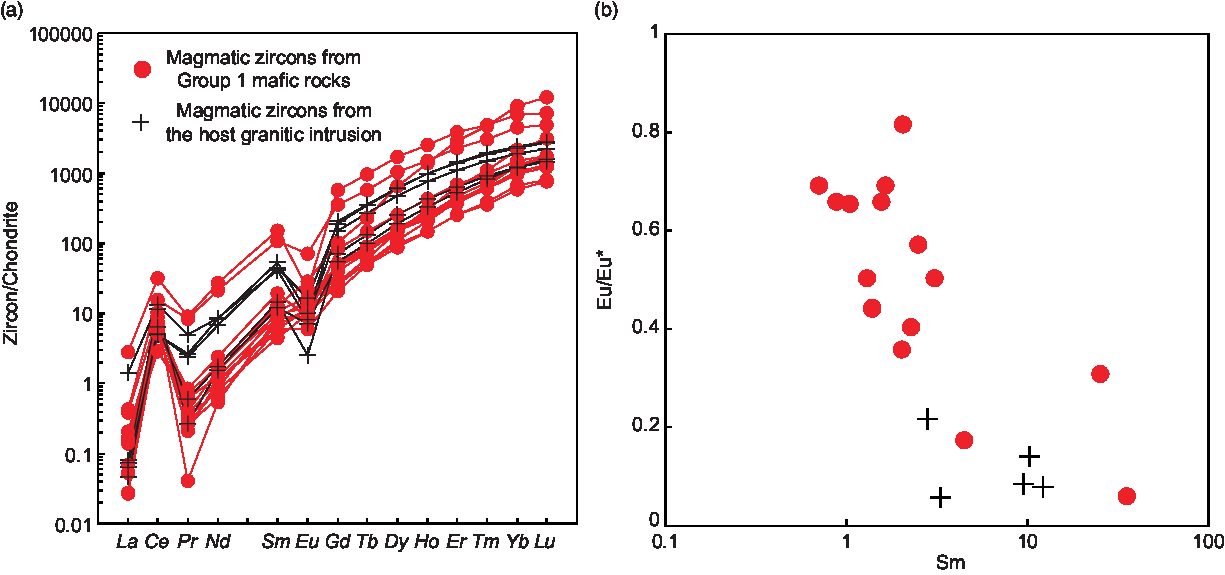
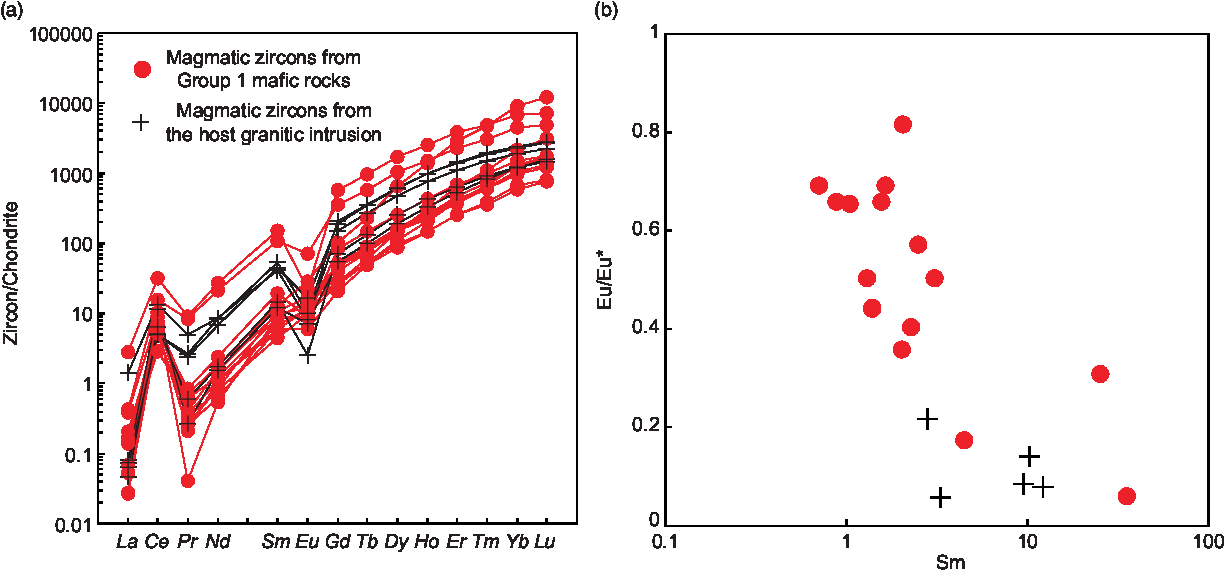
All the zircon grains are colourless and transparent, and most of them show subhedral to columnar shapes with lengths of ∼50–160 μm (Fig. 4a). LA-ICP-MS analyses of U–Pb isotope compositions were carried out on 24 grains. Eight of them give relatively old 206Pb–238U ages, including 2510 Ma and 431–440 Ma (Fig. 4b), which could be interpreted as the formation ages of inherited zircons. The other 16 grains have relatively high Th/U ratios and Sm contents, positive Ce anomalies and obvious enrichment of heavy rare earth elements (HREEs; Fig. 5a; online Supplementary Material Table S2), comparable to those of typical magmatic zircons (Hoskin & Schaltegger, Reference Hoskin and Schaltegger2003). These grains show broadly spaced oscillatory zoning or weak zoning without complex internal structures (e.g. inherited cores) in the CL images (Fig. 4a), which is consistent with the features of typical zircons crystallized from mafic melts (Corfu et al. Reference Corfu, Hanchar, Hoskin and Kinny2003; Wang et al. Reference Wang, Wu, Qin, Zhu, Liu, Liu, Gao, Wijbrans, Zhou, Gong and Yuan2013). Furthermore, zircon grains from the surrounding Devonian granitic intrusion described by Liu et al. (Reference Liu, Ma, Zhang, Xiong, Huang and Jiang2012) exhibit entirely different internal structures (such as narrow oscillatory zoning and distinct old inherited cores; Fig. 4a), and most of them have relatively lower Eu/Eu* ratios (Fig. 5b; online Supplementary Material Table S3). These features strongly suggest that the 16 grains may be crystallized from the Group 1 mafic melts rather than inherited from the host granitic intrusion. Sixteen analyses on the zircon grains yielded relatively young 206Pb–238U ages of 404∼411 Ma (Fig. 4b) with a weighted mean 206Pb–238U age of 408 ± 2 Ma (MSWD = 0.25, n = 16), representing the crystallization age of the Group 1 rocks. In addition, the mean 206Pb–238U age is similar to the crystallization age of the Group 2 mafic rocks (Liu et al. Reference Liu, Ma, Zhang, Xiong, Huang and Jiang2012), suggesting that both groups of mafic rocks from the EKOB formed contemporaneously.
(a) Chondrite-normalized REE patterns and (b) Eu/Eu* v. Sm plot for zircons from the Devonian mafic rocks. Trace-element compositions of typical magmatic zircons from the host granitic intrusion (after Liu et al. Reference Liu, Ma, Zhang, Xiong, Huang and Jiang2012) are also shown for comparison.
4.b. Whole-rock geochemistry
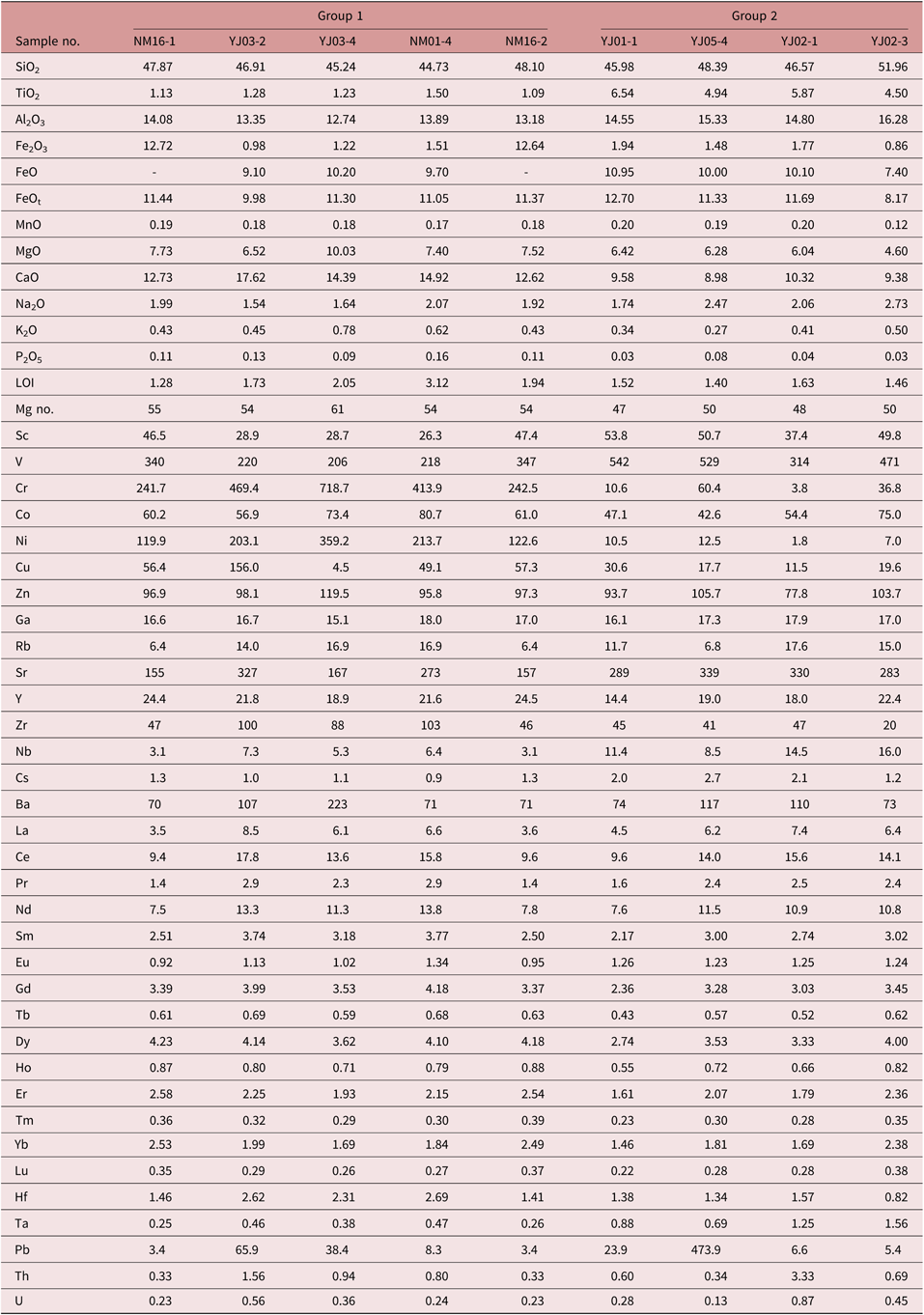
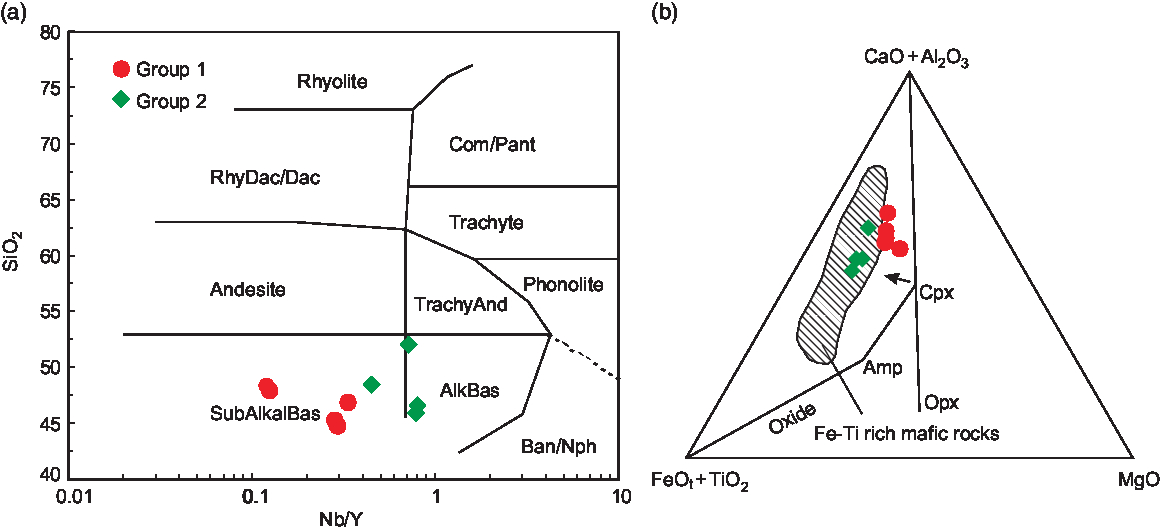
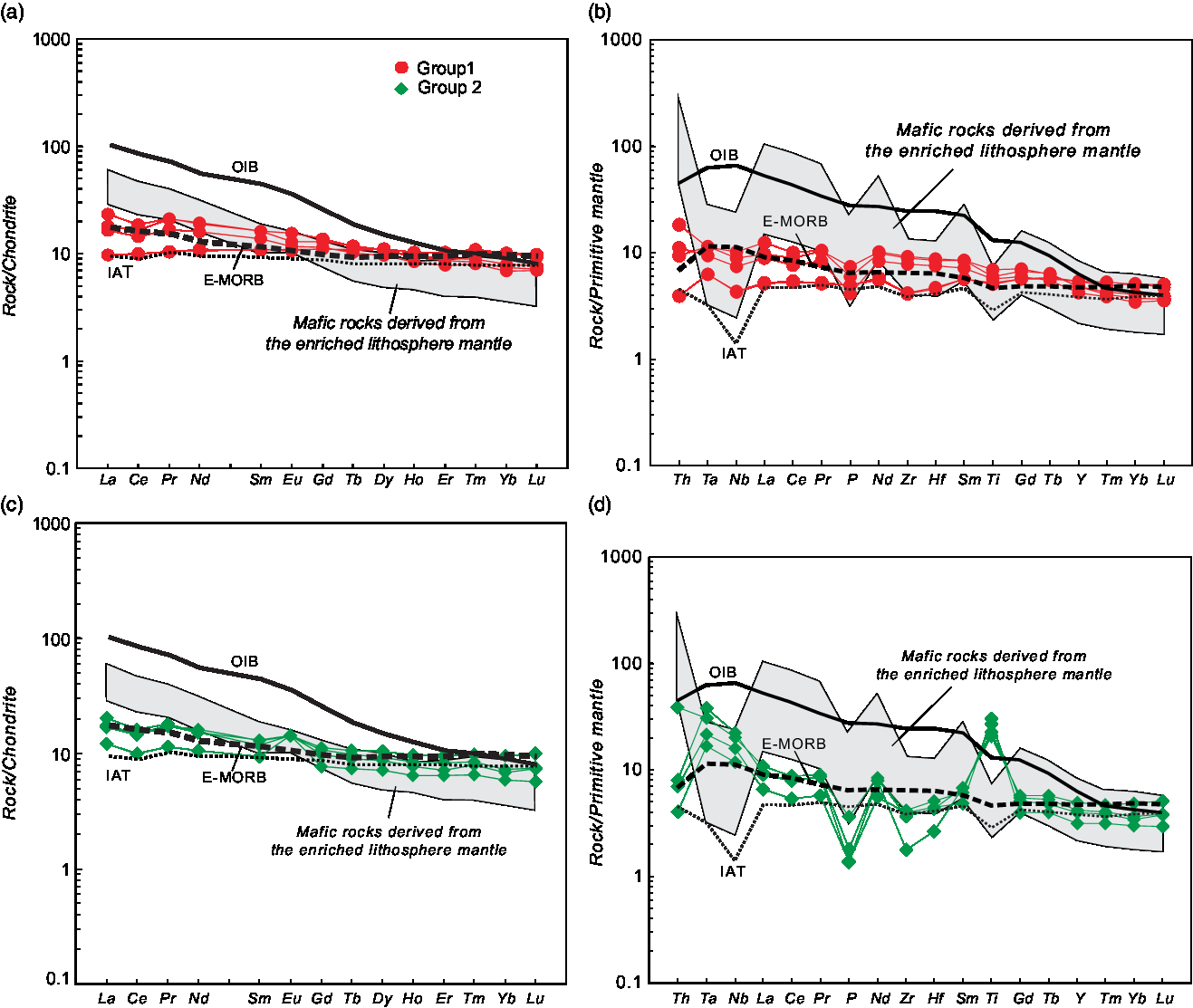
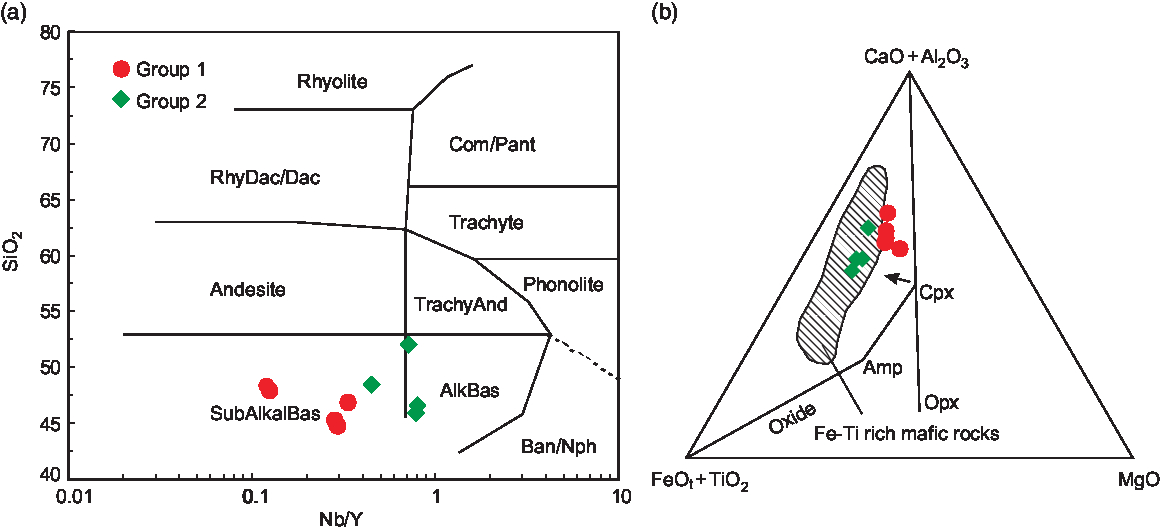
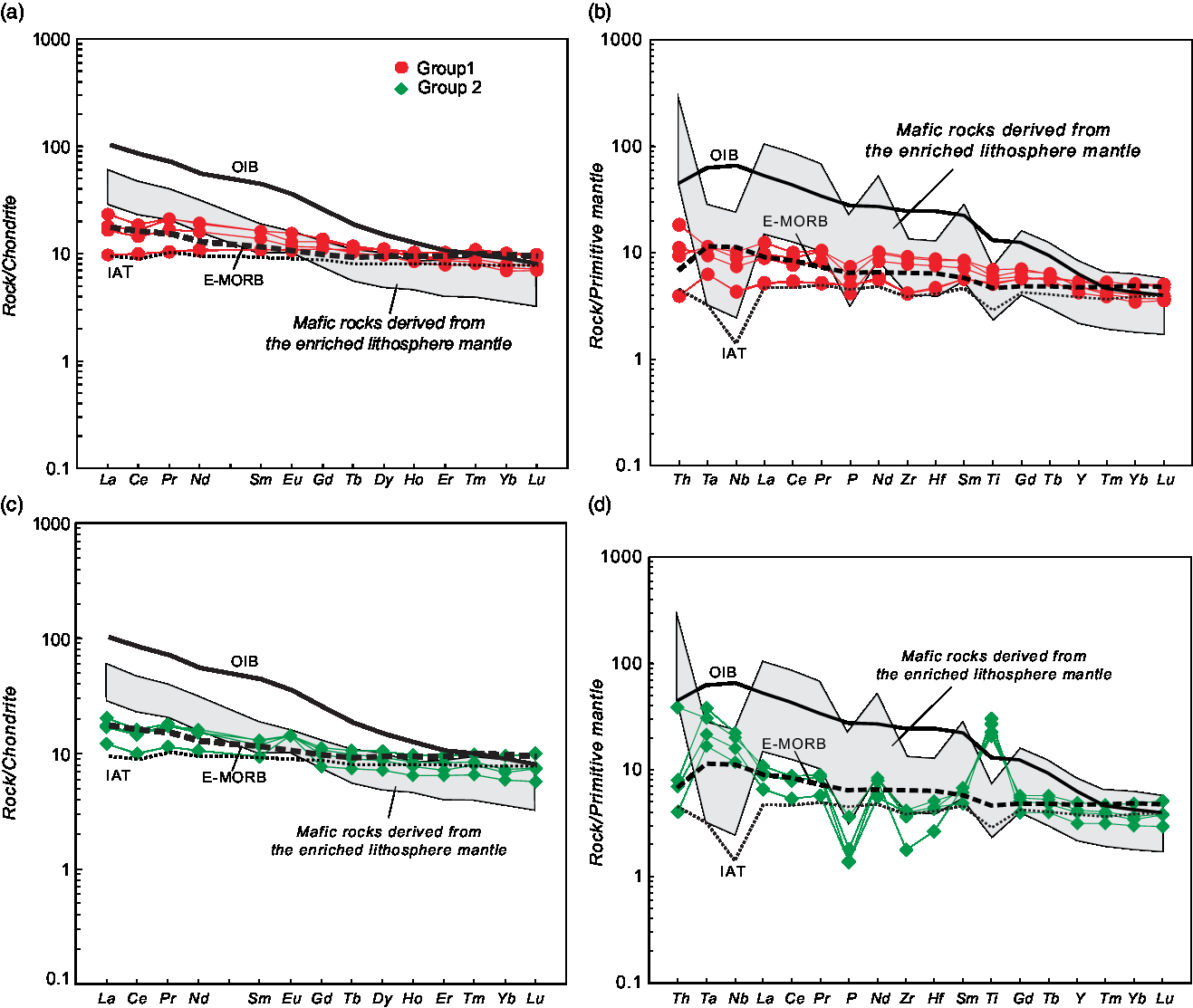
The whole-rock chemical compositions of the representative samples are listed in Table 2. All of the Group 1 rocks have moderate SiO2, low FeOt and TiO2 contents, and moderate MgO contents and Mg no. values (Table 2). They have relatively low Nb/Y ratios of 0.13∼0.33 and plot in the field of sub-alkaline basalt on the SiO2 versus Nb/Y diagram (Fig. 6a). The samples exhibit weak enrichment in light rare earth elements (LREEs) relative to HREEs, with LREE/HREE values of 1.70∼3.28 (Fig. 7a). Most of the samples show slight negative Eu anomalies with Eu/Eu* values of 0.89∼1.03. The primitive mantle-normalized trace-element patterns display moderate enrichments in Th and LREEs with slight depletions in Nb and Ta; these characteristics are similar to those of enriched mid-ocean ridge basalt (E-MORB) (Fig. 7b). Compared with Group 1 rocks, Group 2 rocks are distinguished by relatively higher contents of TiO2 and FeOt and low MgO and Mg nos. (Table 2). Most of the samples have relatively high Nb/Y ratios of 0.45∼0.80 and belong to the alkaline basalt series in composition (Fig. 6a). All of the Group 2 rocks show strong enrichments in Fe and Ti, comparable to those of typical Fe–Ti-rich mafic rocks worldwide (Fig. 6b; e.g. Brooks et al. Reference Brooks, Larsen and Nielsen1991; Zhou et al. Reference Zhou, Robinson, Lesher, Keays, Zhang and Malpas2005). All the samples display small enrichments in LREEs relative to HREEs (LREE/HREE = 2.65∼3.48) and weak positive Eu anomalies (Eu/Eu* = 1.17∼1.69) in the chondrite-normalized REE patterns (Fig. 7c). Compared with the primitive mantle, all of the Group 2 rocks exhibit apparent enrichments in Th, LREEs, Nb and Ta, with depletions in Zr, Hf and P (Fig. 7d).
Major- (in wt %) and trace-element (in ppm) compositions of Devonian mafic rocks

FeOt = 0.89981*Fe2O3 + FeO; Mg no. = 100*Mg2+/(Mg2+ + Fet2+); - = undetected.
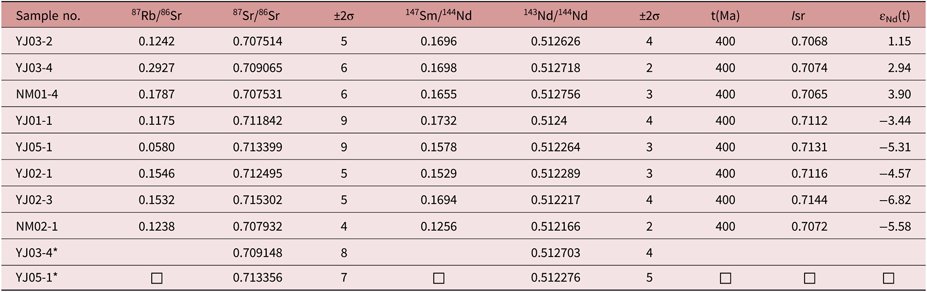
Sr–Nd isotopic compositions of the selected samples from the Devonian mafic rocks
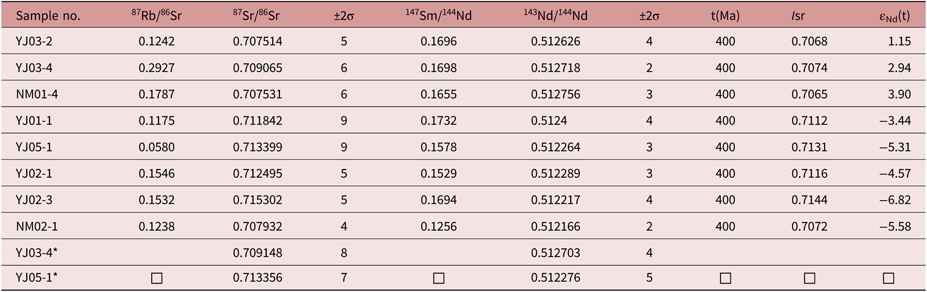
* Replicate analyses at the State Key Laboratory of Geological Processes and Mineral Resources (GPMR), China University of Geosciences (Wuhan).
SiO2–Nb/Y (Winchester & Floyd, Reference Winchester and Floyd1977) and (CaO + Al2O3)–(FeOt + TiO2)–MgO (Zhou et al. Reference Zhou, Robinson, Lesher, Keays, Zhang and Malpas2005) plots of Devonian mafic rocks. Data for Fe–Ti-rich mafic rocks are from Aden & Frizzo (Reference Aden and Frizzo1996), Brooks et al. (Reference Brooks, Larsen and Nielsen1991) and Zhou et al. (Reference Zhou, Robinson, Lesher, Keays, Zhang and Malpas2005).
(a, c) Chondrite-normalized REE distribution patterns and (b, d) primitive mantle-normalized trace-element spider diagrams for the Devonian mafic rocks. Data for chondrite are from Taylor & McLennan (Reference Taylor and McLennan1985); data for primitive mantle and E-MORB are from Sun & McDonough (Reference Sun, McDonough, Saunders and Norry1989); IAT (island arc tholeiitic basalt) compositions are from Niu & O’Hara (Reference Niu and O’Hara2003); data for mafic rocks derived from the enriched lithospheric mantle are from Liu et al. (Reference Liu, Ma, Jiang, Guo, Zhang and Xiong2013b).
4.c. Sr–Nd isotope compositions
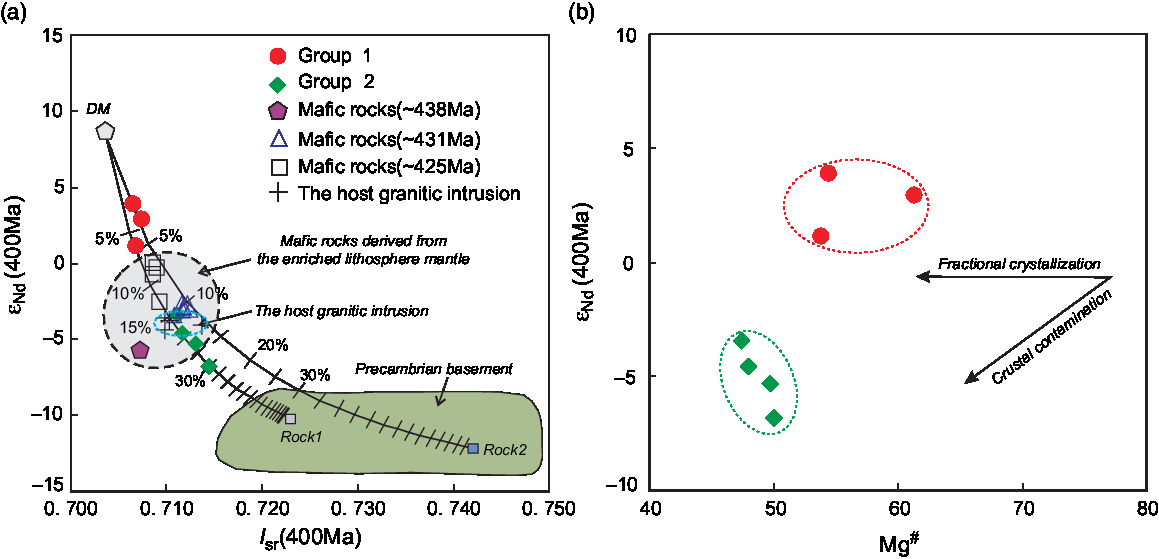
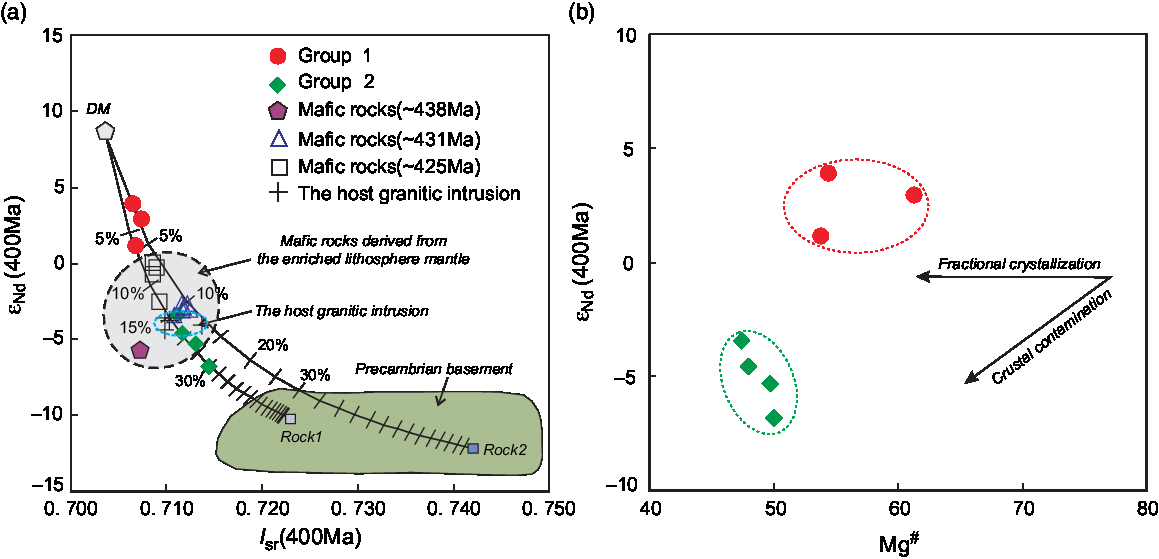
The whole-rock Sr–Nd isotope compositions of the two groups of samples are listed in Table 3 and plotted in Figure 8. One sample (NM02-1) from the Silurian mafic rocks (∼438 Ma; Liu et al. Reference Liu, Ma, Jiang, Guo, Zhang and Xiong2013b) was also analysed for comparison in the discussion below. The initial ratios of Sr and Nd isotopes for the mafic rocks are calculated using a time of 400 Ma. Group 1 rocks have relatively higher and positive εNd(t) values (+1.2 ∼ +3.9) with lower initial 87Sr/86Sr ratios (I sr) of 0.7065∼0.7074, while Group 2 samples have apparent lower and negative εNd(t) values (−6.8 ∼ −3.4) and higher I sr values that range from 0.7112 to 0.7144. Sample NM02-1 has a moderate I sr value of 0.7072 and a low εNd(t) value of −5.6.
Plot of εNd(t) versus Isr and εNd(t) versus Mg no. for the Devonian mafic rocks. Data for the mafic rocks with the ages of 425∼431 Ma are from Zhang et al. (Reference Zhang, Wang, Qian and Li2018). Data for the host granitic intrusion are from Liu et al. (Reference Liu, Ma, Zhang, Xiong, Huang and Jiang2012). Data for the Precambrian basement rocks in the EKOB are from Ba et al. (Reference Ba, Chen, Wang, Wang, Zhang and Wang2012) and Yu et al. (Reference Yu, Jin, Ge and Long2005). Values of 3.015 ppm Nd, 92.52 ppm Sr, 87Sr/86Sr = 0.703829 and 147Nd/143Nd = 0.513192 are from Bian et al. (Reference Bian, Li, Pospelov, Yin, Li, Zhao, Chang, Luo, Gao, Astrakhantsev and Chamov2004). Values of 31.4 ppm Nd, 281.40 ppm Sr, 87Sr/86Sr = 0.729107 and 147Nd/143Nd = 0.511899 and values of 31.41 ppm Nd, 243.48 ppm Sr, 87Sr/86Sr = 0.74902 and 147Nd/143Nd = 0.511796 for the two different types of Precambrian basement rocks (Rock 1 and Rock 2) are from Ba et al. (Reference Ba, Chen, Wang, Wang, Zhang and Wang2012) and Yu et al. (Reference Yu, Jin, Ge and Long2005).
5. Discussion
5.a. Petrogenesis of the Devonian mafic rocks
5.a.1. Roles of fractional crystallization and crustal assimilation
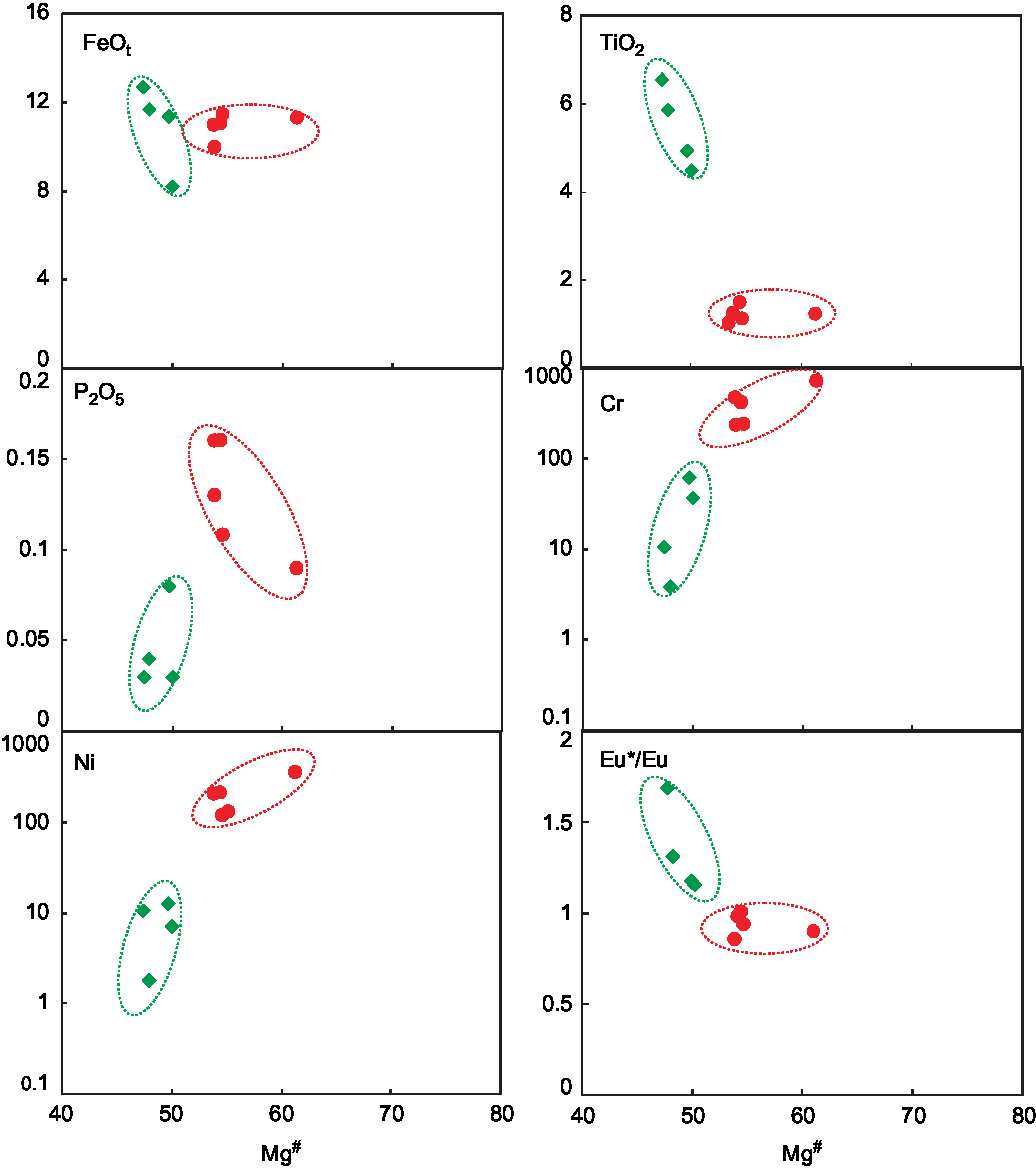
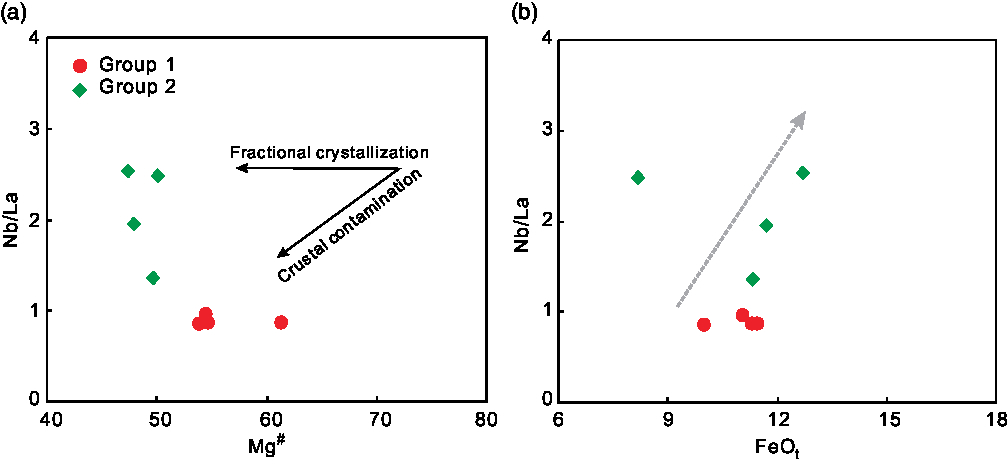
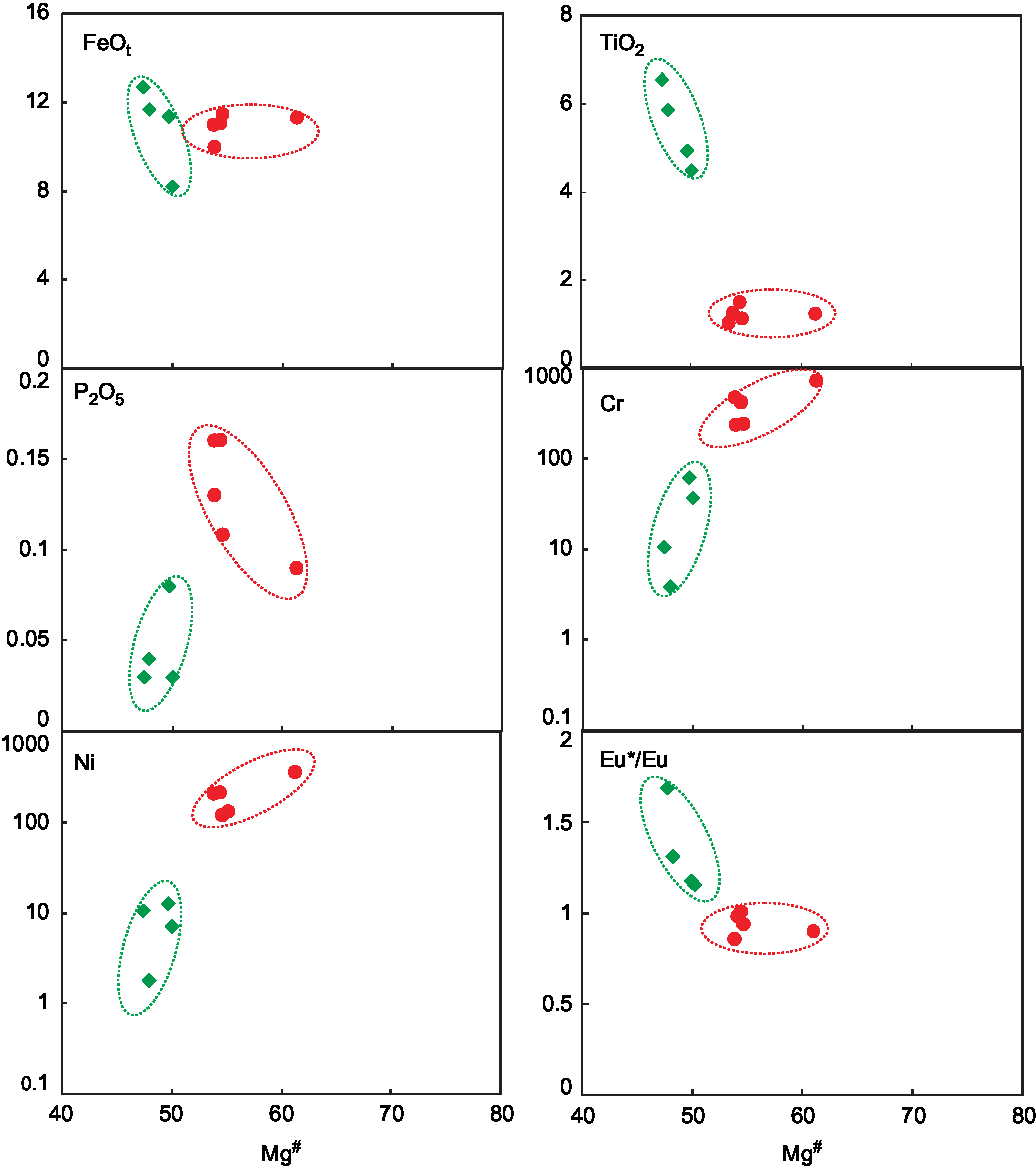
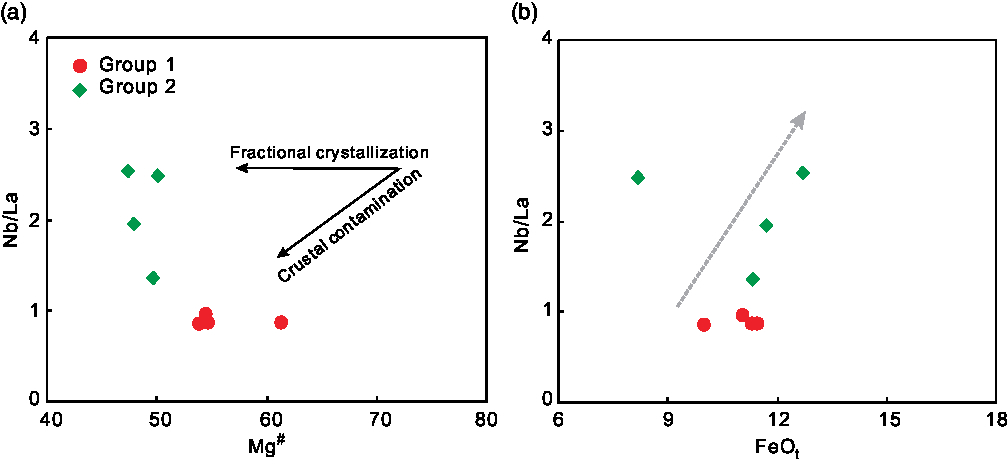
Both groups of samples have low and variable MgO, Mg no., Cr and Ni (Table 2) compared to primitive basaltic melts (Tatsumi & Eggins, Reference Tatsumi and Eggins1995), indicating that the samples may have experienced some degree of fractional crystallization. Both groups of rocks have decreasing Cr and Ni with decreasing Mg no. (Fig. 9), suggesting the differentiation of olivine and clinopyroxene. The differentiation of Fe–Ti oxides and plagioclases did not play a vital role in the generation of the two groups of samples, as indicated by the constant or increasing Eu*/Eu ratios, FeOt and TiO2 with decreasing Mg no. (Fig. 9). The Group 2 mafic rocks exhibit strong enrichments in FeOt and TiO2 (Table 2), and opaque minerals (such as Fe–Ti oxides) occur as interstitial phases in the thin-sections (Fig. 3b), suggesting they record the late-stage differentiation of Fe–Ti oxides under low oxygen fugacity (fO2), as discussed below. Moreover, the Group 2 mafic rocks may have experienced some degree of apatite differentiation because of the positive correlation between P2O5 and Mg no. Crustal assimilation accompanied by fractional crystallization (AFC) is prevalent when magma passes through the continental crust and can markedly modify the chemical and isotopic composition of the primary magma (DePaolo, Reference DePaolo1981; Halama et al. Reference Halama, Marks, Brügmann, Siebel, Wenzel and Markl2004). For instance, crustal assimilation into mafic magma would result in obviously increasing contents of large ion lithophile elements, Na2O and K2O with decreasing contents of P2O5 and TiO2, Nb/La ratios and εNd(t) values (e.g. Zhao & Zhou, Reference Zhao and Zhou2009). Both groups of samples presented above exhibit constant or increasing TiO2 and Nb/La with decreasing Mg no. (Figs 9, 10a), which is different from the characteristics of crustal contamination. Group 1 rocks have no correlation between εNd(t) values and Mg no., while Group 2 rocks display a negative correlation between εNd(t) values and Mg no. (Fig. 8b). These features strongly support a negligible contribution from crustal contamination. Lu/Yb ratio cannot be modified by partial melting or fractional crystallization of mafic melts and has been used to evaluate the effects of crustal assimilation (Zhou et al. Reference Zhou, Zhao, Jiang, Gao, Wang and Yang2009). Both groups of mafic rocks have relatively low Lu/Yb ratios (0.14∼0.16 and 0.15∼0.17, respectively), which are comparable to those of mantle-derived melts (0.14–0.15; Sun & McDonough, Reference Sun, McDonough, Saunders and Norry1989), and thus argue against significant crustal contamination. In addition, the uniform distribution patterns of the trace elements (Fig. 7) further indicate that crustal contamination was insignificant for the generation of the two different groups of Devonian mafic rocks in the EKOB.
Plots of FeOt, TiO2, P2O5, Cr, Ni and Eu*/Eu versus Mg no. for the Devonian mafic rocks.
Plots of Nb/La versus Mg no. and Nb/La versus FeOt for the Devonian mafic rocks.
5.a.2. Mantle sources and magma generation
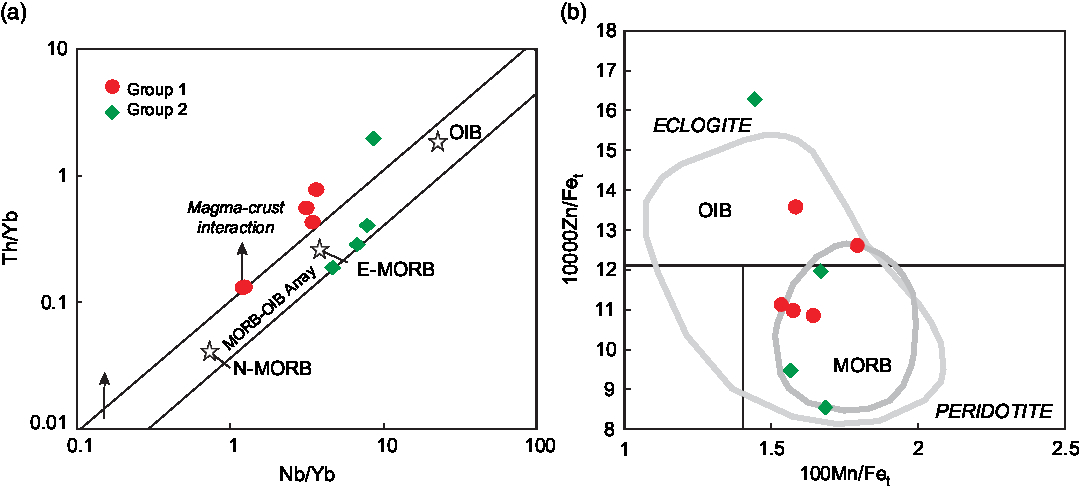
All the Group 1 samples exhibit enriched mid-ocean ridge basalt (E-MORB)-like trace-element patterns relative to the primitive mantle; such a signature is not typically associated with mafic rocks derived from the enriched lithospheric mantle of the EKOB (Fig. 7b; Liu et al. Reference Liu, Ma, Jiang, Guo, Zhang and Xiong2013b). All the Group 1 samples have relatively higher εNd(t) values (+1.2 ∼ +3.9) than mafic rocks derived from the enriched lithospheric mantle of the EKOB (Fig. 8a), indicating that the mantle source may have been dominated by depleted mantle materials. Most of the samples plot along the line of the MORB–ocean island basalt (OIB) array in Figure 11a, while some samples plot above the line of the MORB–OIB array. These features point to the participation of some crustal materials in their magma generation (Pearce, Reference Pearce2008). Two main pathways have been proposed: source mixing before partial melting and crustal contamination during magma evolution at crustal levels, which could incorporate crustal materials into basaltic melts (Zhao et al. Reference Zhao, Dai and Zheng2013). As mentioned above, the contribution of crustal contamination seems to have been insignificant during magma evolution. The relatively high Th/Yb ratios of some samples may be related to source mixing between the depleted mantle and crustal materials. The results of source mixing modelling suggest that the Group 1 rocks may have originated from a depleted mantle metasomatized by nearly 3–5 % continental crustal components (e.g. Precambrian basement rocks; Fig. 8a). The Group 2 rocks have distinct low and negative εNd(t) values of −6.8 ∼ −3.4 with high I sr values of 0.7112∼0.7144. They plot on the line of binary mixing between crustal materials and depleted mantle on the I sr–εNd(t) diagram (Fig. 8a). The results of source mixing modelling further suggest that up to 30 % crustal components would be required to mix with the mantle to balance the observed variations in the Sr–Nd isotope composition of the Group 2 rocks. However, for such a large volume of crustal components mixed with the depleted mantle, maintaining their relatively low SiO2 contents is impossible. Moreover, the Group 2 rocks mostly plot in the field of mafic rocks derived from the enriched lithospheric mantle of the EKOB (Fig. 8a), further suggesting an enriched lithospheric mantle.
Plots of Th/Yb versus Nb/Yb (Pearce, Reference Pearce2008) and 10000Zn/Fet versus 100Mn/Fe (Murray et al. Reference Murray, Ducea, Schoenbohm, DeCelles, Ducea, Carrapa and Kapp2015) for the Devonian mafic rocks.
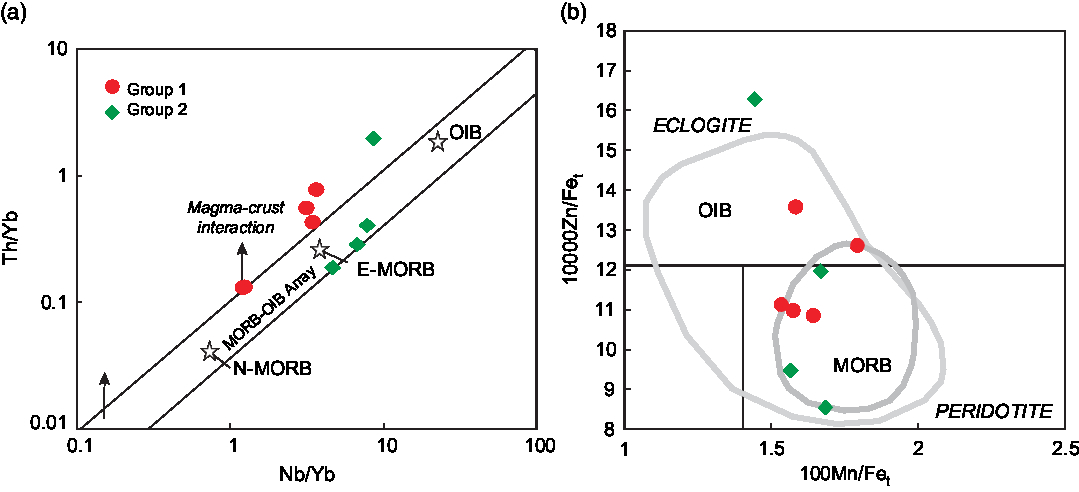
Partial melting of non-peridotite lithologies (such as pyroxenites) in the deep mantle could be responsible for the generation of mafic melts (e.g. Pilet et al. Reference Pilet, Baker, Muntener and Stolper2011; Dai et al. Reference Dai, Zhao, Zheng and Zhang2012; Murray et al. Reference Murray, Ducea, Schoenbohm, DeCelles, Ducea, Carrapa and Kapp2015). Therefore, ascertaining the petrological characteristics of mantle sources for the Devonian mafic rocks is very necessary. Experimental studies have demonstrated that pyroxenite-derived mafic melts usually exhibit relatively higher Zn/Fe ratios and lower Mn/Fe ratios than peridotite-derived mafic melts (e.g. Sobolev et al. Reference Sobolev, Hofmann, Kuzmin, Yaxley, Arndt, Chung, Danyushevsky, Elliott, Frey, Garcia, Gurenko, Kamenetsky, Kerr, Krivolutskaya, Matvienkov, Nikogosian, Rocholl, Sigurdsson, Sushchevskaya and Teklay2007; Le Roux et al. Reference Le Roux, Dasgupta and Lee2011). As shown in Figure 11b, most of the rocks in the two groups display obvious low Zn/Fe ratios with high Mn/Fe ratios, comparable to those of typical mantle peridotite-derived melts and MORB. These features suggest that the mantle lithologies of the two groups of mafic rocks were mainly composed of peridotites rather than pyroxenites. Furthermore, both groups of mafic rocks have relatively low Ce/Y ratios (0.39∼0.73 and 0.63∼0.86, respectively), low (Tb/Yb)N ratios (1.04∼1.57 and 1.11∼1.35, respectively) and flat HREE patterns (Fig. 7), suggesting that the mantle source may have been dominated by spinel-bearing peridotites (McKenzie, & Bickle, Reference McKenzie and Bickle1988; Wang et al. Reference Wang, Plank, Walker and Smith2002).
Although the Group 2 mafic rocks have been suggested to have been derived from an enriched lithospheric mantle, the genetic mechanisms responsible for the distinct geochemical variations (such as obvious Fe–Ti enrichments and positive Nb anomalies; Figs 6b, 7b) are still unconstrained. Fe–Ti enrichments in mafic rocks have been attributed to various mechanisms, including liquid immiscibility (e.g. Zhou et al. Reference Zhou, Robinson, Lesher, Keays, Zhang and Malpas2005), melting of an Fe-rich eclogite-bearing peridotite (e.g. Gibson, Reference Gibson2002) and crystallization under low oxygen fugacities (fO2) (e.g. Perfit & Fornari, Reference Perfit and Fornari1983; Peng et al. Reference Peng, Wilde, Fan, Peng and Mao2013). Liquid immiscibility is widely used to explain the high Fe–Ti contents of typical layered mafic intrusions (e.g. the Bushveld complex and Skaergaard intrusion; Jakobsen et al. Reference Jakobsen, Veksler, Tegner and Brooks2011; Vantongeren & Mathez, Reference Vantongeren and Mathez2012). The Group 2 mafic rocks display rock associations and field outcrops that are different to the mafic layered intrusions mentioned above, excluding the model of liquid immiscibility. Melting of an Fe-rich eclogite-bearing peridotite produces melts with high contents of TiO2 and FeOt, and the melts usually show OIB- or MORB-type trace-element patterns with high Al2O3 contents (mostly >15 %) and εNd(t) values (>+6; Herzberg & Zhang, Reference Herzberg and Zhang1996; Gibson, Reference Gibson2002). However, this interpretation cannot be the case for the Group 2 mafic rocks because of their relatively low Al2O3 contents of 14.55∼16.28 and strongly negative εNd(t) values of −6.8 ∼ −3.4. Experimental studies and observations have suggested that high degrees of magma differentiation (such as olivine and clinopyroxene differentiation) can promote Fe–Ti enrichment in the residual melts and that low fO2 can also delay Ti-magnetite saturation and then produce melts with high Fe–Ti contents (e.g. Toplis & Carroll, Reference Toplis and Carroll1995; Rutherford et al. Reference Rutherford, Barovich, Hand and Foden2006). As mentioned above, all the Group 2 rocks have relatively low Mg no. values (47–50) and contents of Cr (3.8∼60.4 ppm) and Ni (1.8∼12.5 ppm), suggesting that they may have experienced a high degree of olivine and clinopyroxene fractionation. Increasing FeOt and TiO2 contents with decreasing Mg no. values (Fig. 9) further suggest a delay in crystallization of Fe–Ti oxides during magma evolution, which is also evidenced by the fact that these minerals occur as interstitial phases surrounding clinopyroxenes and plagioclases in the thin-sections (Fig. 3d). The empirical method provided by Smythe & Brenan (Reference Smythe and Brenan2016) was applied for estimating the fO2 conditions at the time of crystallization from Ce anomalies in zircon, and the results show relatively low fO2 conditions (−21 ∼ −20; online Supplementary Material Table S4). Therefore, a high degree of olivine and clinopyroxene crystallization under low fO2 conditions could have been the key mechanism for promoting the high Fe–Ti contents of the Group 2 mafic melts. Experimental studies have shown that high-field-strength elements (such as Nb and Ta) could be moderately compatible in Fe–Ti oxides (e.g. Nielsen & Beard, Reference Nielsen and Beard2000; Klemme et al. Reference Klemme, Günther, Hametner, Prowatke and Zack2006), and the differentiation of Fe–Ti oxides would reduce the contents of Nb and Ta in the evolved magma. The Group 2 rocks exhibit increasing Nb/La ratios with increasing FeOt (Fig. 10b), and a negative correlation between FeOt and Mg no., indicating that the delayed nucleation of Fe–Ti oxides would lead to the generation of Nb-rich melts during the late stage of mafic magma evolution.
5.b. Geodynamic implications
The voluminous eclogites in the EKOB are generally considered to have been formed by the HP metamorphism of Proterozoic continental basaltic rocks (∼934 Ma; e.g. Meng et al. Reference Meng, Zhang and Cui2013, Reference Meng, Cui, Jia, Ren and Feng2015), pointing to deep subduction of the continent crust in the EKOB during continental collision. Moreover, the recent discovery of coesite inclusions in the eclogites further indicates that the continental crust could be subducted into the deep mantle even to depths of 100–120 km (e.g. Bi et al. Reference Bi, Song, Dong, Yang, Qi and Allen2018; Song et al. Reference Song, Bi, Qi, Yang, Allen, Niu, Su and Li2018). How such voluminous eclogites, buried in the deep mantle, can be exhumed to the crustal level of the EKOB is very interesting. However, the mechanism of exhumation of these HP rocks remains poorly understood.
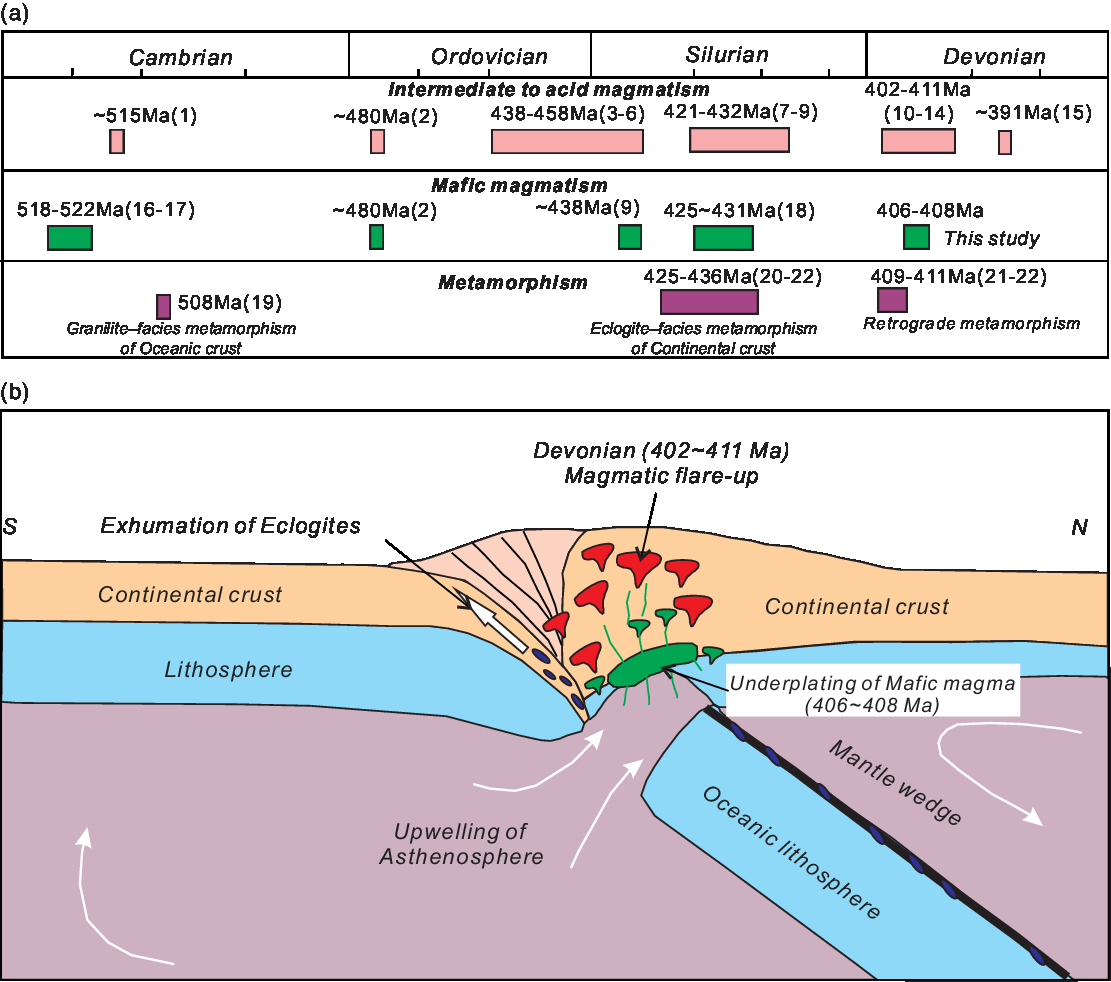
The formation ages of Devonian magmatic rocks in the EKOB (402∼411 Ma) are identical within error to the time of retrograde metamorphism or exhumation of the HP rocks (409∼411 Ma; Fig. 12a; Zhang et al. Reference Zhang, Qian, Li, Wang, Zhang, You and Liu2017; Song et al. Reference Song, Bi, Qi, Yang, Allen, Niu, Su and Li2018), strongly suggesting that the Devonian magmatism may have a close genetic relationship with continental exhumation. It has been documented that the Devonian granitic intrusions were generated by partial melting of Precambrian basement rocks and associated magma mixing in a collision-related environment (e.g. Zhao et al. Reference Zhao, Ma, Wang, Bai, Li and Ji2008; Liu et al. Reference Liu, Ma, Zhang, Xiong, Huang and Jiang2012). Underplating of mafic magmas may have played a vital role in the formation of granitic magmas, owing to their unusually high crystallization temperatures (up to 853 °C; Liu et al. Reference Liu, Ma, Zhang, Xiong, Huang and Jiang2012). Such a process can also be supported by the new results of this study for the mafic rocks intruding the granitic intrusions. The crystallization ages of the Devonian mafic rocks (406∼408 Ma) are similar to those of the Devonian granitic intrusions, suggesting the activity of mantle-derived magma during the generation of granitic magmas. Compared to the other mafic rocks with ages of 425∼438 Ma, the Group 1 mafic rocks have relatively high and positive εNd(t) values (+1.2 ∼ +3.9; Fig. 8a), further indicating the upwelling of a large volume of hot depleted mantle materials (such as asthenospheric mantle). Lithospheric delamination and slab break-off are generally regarded as two key factors for triggering the upwelling of asthenospheric mantle and resulting in large-scale crustal anatexis in many typical collisional orogenic belts (e.g. Davies & Von Blanckenburg, Reference Davies and Von Blanckenburg1995; Bonin, Reference Bonin2004; Dokuz, Reference Dokuz2011). Collision-related magmatism induced by lithospheric delamination usually exhibits a regional distribution, while the magmatism caused by slab break-off occurs in a narrow and linear zone (Mahéo et al. Reference Mahéo, Blichert-Toft, Pin, Guillot and Pêcher2009; Dokuz, Reference Dokuz2011). The Devonian magmatic rocks exhibit a narrow linear NW–SE distribution along the CKLF (Fig. 1b; Liu et al. Reference Liu, Ma, Zhang, Xiong, Huang and Jiang2012), suggestive of slab break-off rather than lithospheric delamination. Many studies have proposed that slab break-off would lead to crustal uplift over a short time period (Davies & Von Blanckenburg, Reference Davies and Von Blanckenburg1995; Xu et al. Reference Xu, Yang, Wu, Li, Zhang, Qi, Song and Qiu2006). The rapid uplift of continental crust also occurred in the EKOB during Devonian time, as shown by the deposition time of local molasse rocks (400∼423 Ma; Lu et al. Reference Lu, Wu, Hu, Barosh, Hao and Zhou2010). In addition, slab break-off usually induces calc-alkaline magmatism associated with small volumes of mafic rocks and leads to the relatively rapid exhumation of eclogites in many typical HP–UHP belts (such as the HP metamorphic belt in the Qiangtang terrane; e.g. Zhang et al. Reference Zhang, Tang, Wang and Zhang2011). The development of voluminous granitic intrusions and minor mafic rocks in the EKOB, associated with the contemporaneous exhumation of extensive HP rocks, further suggests that slab break-off may be a reasonable interpretation for the continental exhumation and the Devonian magmatic activity (Fig. 12).
(a) A timeline of Cambrian to Devonian magmatism and typical metamorphism of the EKOB; and (b) a slab break-off model for the continental exhumation and magmatic flare-up in the EKOB. Data sources for the zircon U–Pb ages are as follows: 1 – Zhang et al. (Reference Zhang, Pei, Ding, Li, Feng, Sun, Li and Chen2010); 2 – Cui et al. (Reference Cui, Meng and Wu2011); 3 – Gao et al. (Reference Gao, Xiao, Xie, Fan, Guo and Xi2010); 4 – Xiong et al. (Reference Xiong, Ma, Jiang, Liu, Zhang and Zhou2013); 5 – Zhou et al. (Reference Zhou, Dong, Zhang, Yang, Sun and He2016); 6 – Wang et al. (Reference Wang, Li, Chen, Wang, Li and Jin2016); 7 – Zhang et al. (Reference Zhang, Ma, Xiong, Liu, Li and Pan2014); 8 – Wei et al. (Reference Wei, Sun, Li, Yan, Zhang, Wang, Shen and Yang2018); 9 – Liu et al. (Reference Liu, Ma, Jiang, Guo, Zhang and Xiong2013b); 10 – Liu et al. (Reference Liu, Ma, Zhang, Xiong, Huang and Jiang2012); 11 – Long et al. (Reference Long, Jin, Ge and Yu2006); 12 – Zhang et al. (Reference Zhang, Meng, Wan, Yang and Dong2003); 13 – Zhao et al. (Reference Zhao, Ma, Wang, Bai, Li and Ji2008); 14 – Wang et al. (Reference Wang, Dong and Dong2018); 15 – Liu et al. (Reference Liu, Ma, Guo, Zhang, Xiong and Huang2013a); 16 – Lu et al. (Reference Lu, Yu, Jin, Li and Zheng2002); 17 – Yang et al. (Reference Yang, Robinson, Jiang and Xu1996); 18 – Zhang et al. (Reference Zhang, Wang, Qian and Li2018); 19 – Li et al. (Reference Li, Lu, Xiang, Zhou, Guo, Song, Zheng and Gu2006); 20 – Meng et al. (Reference Meng, Zhang and Cui2013); 21 – Song et al. (Reference Song, Bi, Qi, Yang, Allen, Niu, Su and Li2018); 22 – Zhang et al. (Reference Zhang, Qian, Li, Wang, Zhang, You and Liu2017).

In the classic scenario of slab break-off (e.g. Davies & Von Blanckenburg, Reference Davies and Von Blanckenburg1995; Garzanti et al. Reference Garzanti, Radeff and Malusà2018), the opposing buoyancy forces could induce the extensional deformation of the subducted slab and form early narrow rifts, and the asthenosphere would then rise into the narrow rifts. After the termination of subduction and the replacement of oceanic lithosphere by hot asthenosphere, a series of geological processes (such as magmatic activity, exhumation of eclogite-facies rocks and rapid uplift of the crust) would occur. Moreover, if so, the development of the mafic rocks at ∼425 Ma (Figs 1a, 12a) may mark the early narrow rifting of the subducted slab. Most of these rocks display obviously higher εNd(t) values than the subduction-related mafic rocks (∼438 Ma; Figs 1, 12a) identified in the EKOB (Liu et al. Reference Liu, Ma, Jiang, Guo, Zhang and Xiong2013b), possibly indicating the early upwelling of asthenospheric materials. Furthermore, the Devonian magmatism and rapid crustal uplift associated with the exhumation of extensive HP rocks should be the manifestation of the subsequent slab break-off (Fig. 12b).
Numerical modelling and observations from continental collision zones reveal that the slab strength controls the initiation of slab break-off and the speed of slab tearing (Van Hunen & Allen, Reference Van Hunen and Allen2011). For instance, the timing of slab break-off after continental collision for an old, strong subducting oceanic slab (nearly 20∼25 Ma after the onset of continental collision) is later than that for a young, weak subducting oceanic slab (nearly 10 Ma after the onset of continental collision; Van Hunen & Allen, Reference Van Hunen and Allen2011). Previous studies have documented that the Proto-Tethyan oceanic lithosphere in the EKOB formed during Cambrian time (518∼522 Ma; Fig. 12a; Yang et al. Reference Yang, Robinson, Jiang and Xu1996; Lu et al. Reference Lu, Yu, Jin, Li and Zheng2002) and then experienced prolonged subduction during early Cambrian to early Silurian times (438∼515 Ma; Fig. 12a; Gao et al. Reference Gao, Xiao, Xie, Fan, Guo and Xi2010; Zhang et al. Reference Zhang, Pei, Ding, Li, Feng, Sun, Li and Chen2010; Xiong et al. Reference Xiong, Ma, Jiang, Liu, Zhang and Zhou2013; Liu et al. Reference Liu, Ma, Jiang, Guo, Zhang and Xiong2013b), suggesting an old and strong subducting oceanic slab. If the time of the slab break-off is assumed to be 411 Ma, the continental collision and the beginning of continental subduction should have initiated during the interval from 431 to 436 Ma.
6. Conclusions
(1) Zircon U–Pb ages of the Devonian mafic rocks are 406∼408 Ma and are comparable to the exhumation time of extensive HP rocks in the EKOB.
(2) Group 1 mafic rocks were formed by partial melting of depleted asthenospheric mantle metasomatized by c. 3–5 % continental crustal components, while Group 2 rocks originated from partial melting of enriched lithospheric mantle.
(3) The high degree of olivine crystallization under low fO2 conditions and the delayed nucleation of Fe–Ti oxides could have been responsible for the enrichment in Fe, Ti and Nb in the Group 2 rocks.
(4) Slab break-off was the key factor causing the exhumation of extensive HP rocks and triggering Devonian magmatic activity, and continental collision or continental subduction may have initiated during the interval from 431 to 436 Ma.
Supplementary Material
To view supplementary material for this article, please visit https://doi.org/10.1017/S0016756819001353.
Acknowledgements
This work was financially supported by the National Natural Science Foundation of China (Grant 41972148 and 41502050), the Foundation of the State Key Laboratory of Petroleum Resources and Prospecting, China University of Petroleum, Beijing (PRP/open-1908), the China Geological Survey (Grants DD20160022 and 12120115026901) and the Yangtze Youth Fund (Grant 2015cqn29). We thank Editor-in-Chief Dr Kathryn Goodenough and two anonymous reviewers for their valuable comments and constructive suggestions on the manuscript. We also thank Zhao-Chu Hu, Lian Zhou and Hai-Hong Chen for their help with the analytical work.