The bumper sticker slogan “when women run, women win” is a popular one among U.S. women's groups. It instructs women that they are viable candidates and informs voters and donors that their support of women candidates will be worthwhile.1
Uhlaner and Schlozman (1986) pursue a similar line of inquiry about campaign finance. They find no direct effects of gender on fund-raising for congressional races. But they explain the potential implications of the belief that women are disadvantaged in fund-raising: “If potential women contenders believe that they will have trouble filling their campaign coffers, they will hesitate to run” (1986, 46). Likewise, if political elites believe that women have difficulty fund-raising, they are unlikely to recruit women candidates.
No one likes to back a sure loser, so the message that women have a tougher time winning elections and a tougher time raising money can only make it more difficult for women to achieve credibility and attract supporters, endorsements, and financial contributions. And if potential women candidates keep hearing how tough conditions will be for them, they will be less likely to decide to run, which will exacerbate the shortage of women candidates, the most severe obstacle to women's political progress today. (Seltzer, Newman, and Leighton 1997, 9)
Scholars have demonstrated women's electability through a comparison of the success rates and vote share of men and women candidates. R. Darcy and Sarah Slavin Schramm (1977), for example, conclude that men and women fared about the same in general election races for the U.S. House of Representatives once incumbency was taken into account. Barbara Burrell (1994) analyzed the vote share and success rates of women congressional candidates in both primary and general elections, finding parity as well as some instances of a female advantage. Studies of state legislative races also reveal that men and women candidates fare about the same once the type of race is controlled (Clark et al. 1984; Seltzer, Newman, and Leighton 1997).
Indeed, today it is not uncommon to ask if women candidates outperform men—particularly since the 1992 “Year of the Woman” in which a record number of women ran for Congress. Surveys and experimental research indicate that women stand to gain from some sex stereotypes, such as the belief that women are agents of change (Burrell 1994). In sum, the most common scholarly response to the question of whether voters are willing to elect a woman is “yes”: Voter prejudice against women candidates appears to be limited to the past.
Presumably, political practitioners, including political party leaders, are aware that women candidates win as often as men candidates. The parties' relationship with women congressional candidates has evolved over time: “Traditionally the operative message from party leaders was ‘no woman need apply’ for a party nomination…. In the 1990s, women candidates have become mainstreamed in the parties, and are treated like any other candidates” (Burrell 1994, 99). The parties fund men and women candidates at the same rates and no longer slate women for hopeless races (Burrell 1994; Darcy, Welch, and Clark 1994).
Yet we have very little direct, empirical evidence of party leader beliefs. This hole in our knowledge is problematic precisely because the parties are actively involved in candidate recruitment. Indeed, the failure of the parties to recruit women may be a cause of women's underrepresentation (Carroll 1994). The continued underrepresentation of women in elective office remains puzzling and suggests the need to revisit our conclusions about the success of women candidates. Women remain much less likely than men to seek office—even in open-seat races in which no incumbent is seeking reelection. The scarcity of women candidates is particularly unexpected for state legislative office, which is often regarded as the first rung of the political career ladder. Women comprised only about 23% of major party general election candidates for the legislature in 2004 (Sanbonmatsu 2006b). Although more than one-quarter of state legislative seats turned over in the 2004 elections, the overall level of women's representation did not increase (Sanbonmatsu 2006c).2
Women comprise 22.6% of all state legislators, though women's representation varies significantly across states, from a low of 8.2% in South Carolina to a high of 35.6% in Maryland (CAWP 2005a).
Norris and Lovenduski (1995) find that the limited supply of women candidates is a better explanation for women's underrepresentation in the British Parliament than the attitudes of gatekeepers. However, they find that gatekeepers believe that women candidates are more likely to lose votes than men candidates.
Scholars have paid scant attention to elite beliefs about women's electability. Do the political parties know that “women win”? Because the Democratic and Republican Parties actively recruit candidates, party leader perceptions are likely to be consequential for women's representation. Any reservations about the competitiveness of women candidates are likely to reduce party leader interest in recruiting them (Sanbonmatsu 2006d). Thus, party leader views may shed light on why women are underrepresented in public office.
In this article, I analyze the results of the 2002 state legislative elections in order to determine if women candidates are as successful as men. I compare these objective measures of women's electoral success with perceptual measures: What do party leaders believe about women's electability? I analyze party leader views to determine if party leaders know that women win. I then conduct a multivariate analysis of party leader views.
I confirm that men and women fare about the same when they run for the legislature: Few sex differences exist in the vote share and success rates of candidates. Yet I find that many party leaders believe that one sex has an electoral advantage. Some party leaders believe that women candidates have an advantage, while others believe that men have an advantage. I find some evidence of a relationship between these party leader perceptions and the objective measures of the electability of women candidates. However, most of my analyses reveal a gap between elite perceptions and the objective measures. In the conclusion, I argue that this discrepancy may mean that party leaders are misperceiving women's electability. Alternatively, this discrepancy may reveal the limitations of commonly used measures of women's electability. If women run where they are most likely to win, then the similar success rates of men and women candidates may indicate the existence of a level playing field for women where women have run, rather than a level playing field for women in general. Therefore, because women comprise a small proportion of all candidates, we can only speculate as to how they would fare if they ran in more districts. Scholars may have overestimated the level of party—and voter—support for women candidates.
EVALUATING THE ELECTABILITY OF WOMEN CANDIDATES
My investigation focuses on the state legislatures. Because the legislature is an entry-level office, women's status as state legislative candidates is critical to the presence of women in higher levels of office. Control of the state legislatures is increasingly competitive between the two parties, heightening both parties' interest in finding the strongest candidates. Any doubts that party leaders may have about women's electability are likely to reduce the chances that a woman will be the party's first choice for party nominee.
In order to investigate party leader beliefs, I conducted a mail survey of Democratic and Republican legislative leaders following the 2002 elections.4
The survey was conducted by the Ohio State University Center for Survey Research after the 2002 elections. At least one respondent from 71 of the 95 legislative caucuses completed the survey, for a response rate at the caucus level of about 75%. Forty-five states are represented in the legislative leader sample. Legislative leaders from outside the South and from legislatures with shorter session lengths were more likely to return the survey. Party, gender, majority party status, seat share, total number of leaders surveyed, legislative compensation, and percentage of women in the chamber were not significantly related to returning the survey. Respondents were promised confidentiality. The survey was four pages in length and consisted almost entirely of closed-ended questions. See Sanbonmatsu 2006d for additional details on the methodology. The following legislative parties participated in the study: AK (R), AL (D), AR (D), AZ (R), CA (R), CO (D, R), CT (D, R), DE (R), FL (D, R), GA (R), HI (D, R), IA (D, R), ID (D, R), IL (D, R), IN (D, R), KS (D, R), KY (D, R), MA (D, R), MD (D, R), ME (D), MI (D, R), MN (D), MO (D, R), MS (D), MT (D, R), ND (D, R), NH (D, R), NJ (D, R), NM (D, R), NV (D, R), NY (R), OH (R), OK (D, R), OR (D), PA (D), SC (R), SD (D, R), TN (D, R), UT (D, R), VA (R), VT (R), WA (D), WI (D, R), WV (D), WY (D, R). The response rate for my mail survey is not unusual. For example, Aldrich's (2000) survey of state party organizations yielded responses from 65 state parties. I am not aware of another mail survey sent to the legislative leaders of all lower chambers. However, mail surveys of state legislators are quite common. Carey, Niemi, and Powell's (2000) 1995 survey of state legislators yielded a 47% response rate.
The State Legislative Leader Survey was sent to state legislative leaders from the lower house of the legislature (N = 429) and was completed by 149 leaders for an individual-level response rate of about 35%.5
I exclude Nebraska because it is unicameral and nonpartisan. I chose to survey the top five leaders in the lower chamber of each state with the goal of receiving a completed survey from at least one member of the leadership team. Because the leadership structure varies across states, the number of leaders included in the sample from each state varied as well.
About half of legislative parties in the South, compared to 80% of legislative parties from outside the South, participated in the study. In part, this differential is a result of the smaller size of the leadership teams in the South, and therefore the smaller number of respondents contacted.
The survey asked questions about the party's involvement in state legislative elections and candidate recruitment, but also included a few questions about women candidates. One question asked about the existence of an electoral advantage in house races: “In races for the House/Assembly, other factors being equal, do you think that women candidates usually have an electoral advantage over men candidates, that men have an electoral advantage over women, or that neither has an advantage?” The survey asked leaders about women's electability across districts: “Are there districts in your state where it might be hard for a woman to win election to the House/Assembly?” Response options were “Yes, many,” “Yes, a few,” “No,” and “Don't know.”7
The two measures are positively correlated (r = .29, p < .01, N = 136).
A majority of party leaders report the existence of an electoral advantage for one sex, with 24% of leaders seeing an advantage for men and 27% of leaders seeing an advantage for women. Thus, slightly more leaders see an advantage for women than for men. However, 62% of all legislative party leaders believe that there are many or a few districts in their state where it might be hard for a woman to win election to the house; most of these respondents reported that there are “a few” such districts, rather than “many.” Meanwhile, 38% of legislative leaders answered that there were no districts in their state where it might be hard for a woman to win.8
If “don't know” responses are included in the calculation, the distribution of responses are as follows: 8% many districts; 49% a few districts; 35% no districts; and 8% don't know.
The slogan “when women run, women win” suggests the end of debate about women's electability. Yet these surveys indicate disagreement among party leaders as to whether or not this statement is true. Respondents who see an advantage for men are somewhat outnumbered by those who see an advantage for women. However, most party leaders believe that women's electability depends on the district under consideration. Thus, the presence of a perceived net advantage for women candidates does not preclude concern about women's chances in particular districts.
It is possible that social desirability affects party leader responses. Because contemporary changes in the role of women have sparked debate about whether traditional gender role arrangements are more desirable, survey responses related to gender—like race—may not represent respondents' sincere beliefs but may instead reflect what is appropriate to reveal in public settings. In this case, the socially appropriate response might be to report either a level playing field or a net advantage for women candidates. However, most party leaders reported that there are at least a few districts in their state where it might be hard for a woman candidate to win election to the house. Some party leaders also see a net advantage for men candidates. Thus, the distribution of responses suggests that party leaders have not merely provided a socially desirable response. Moreover, if some party leaders have provided a socially appropriate response, then the survey likely underestimates the disadvantages for female candidates and provides a conservative estimate of the extent to which party leaders perceive women to be less competitive.
In order to analyze the actual track record of women candidates in each state, I compiled an original data set of general election results from the 2002 state legislative elections.9
For New Jersey and Virginia, which have off-year elections, I analyzed the 2001 elections. For all states, data on candidate gender were obtained from the Center for American Women and Politics (CAWP).
I conducted a multivariate analysis for each state to determine if sex had an effect on success in the general election when party and type of race (i.e., incumbent/challenger or open seat race) are controlled. The results of these logistic regression analyses confirmed past research: Men and women candidates fared about the same in the general election in almost all states. However, in a small number of states (N = 4), sex was related (p < .10) to electoral success.10
In the analyses of state legislative election results, I use a p = .10 threshold for significance because the small n in some cases—fewer than 100 candidates in some states—and women's general underrepresentation as candidates reduce the likelihood of a statistically significant effect at conventional levels. Even with this generous approach to identifying sex differences, I find very few differences. A total of 44 states are included in the analysis. The excluded states are LA (which has a blanket primary); MS (which holds elections only every four years); NE (which is unicameral); NH (which allows candidates to run with both party designations); and KY and NY (in which no incumbents lost in the general election).
I also analyzed the relationship between sex and the vote in contested races.11
This measure is limited to single-member districts. Uncontested general election races are excluded. A total of 42 states are included in this analysis.
I should note that I am unable to determine if women candidates need to be better candidates in order to yield seemingly gender-neutral electoral results. I control for incumbency and party affiliation consistent with past studies. But as with past studies, I lack biographical information or measures of the personal qualifications of the approximately 7,000 candidates in my analysis of the 2002 elections.
At first glance, it would appear that a gap exists between the actual electability of women and party leader beliefs about women's electability. About one-quarter of legislative leaders in my sample perceive an advantage for men and slightly more an advantage for women, with about half taking a neutral position, but my analysis of the 2002 election results suggests that the existence of an advantage for one sex is confined to far fewer states. However, I have not yet sought to match party leader responses with the election results from their state. For further investigation, I turn to a multivariate analysis of party leader attitudes.
MULTIVARIATE ANALYSIS OF PARTY LEADER VIEWS
The main independent variables of interest concern the actual electoral success of women candidates in each state. I expect variation across states in party leader views to be a function of variation across states in the actual performance of women candidates. Thus, where women candidates fare worse on average than male candidates, party leaders should be more skeptical about women's chances.
Gender and success is based on the state models of sex and general election victory discussed in the previous section. If candidate sex had no effect on the likelihood of winning in the 2002 elections, gender and success is coded 0; if being a woman had a negative effect on the likelihood of winning—indicating that women fared worse than men—it is coded −1; and if being a woman had a positive effect on success, it is coded 1. Most states are coded “0” because men and women candidates fared about the same. In those states (N = 4) where sex was related to general election victory, gender and success is coded 1 or −1, depending on whether women or men had an advantage.
A second categorical variable, gender and vote share, is based on my analyses of candidate sex and vote share in contested general election races. It takes the value of −1, 0, or 1, depending on whether I found that women were at a disadvantage in vote share, had an advantage, or neither when party and incumbency status were controlled. Because women and men performed about the same in most states, gender and vote share is usually coded “0”. But in the states where one sex had an advantage (N = 7), states are coded −1 if men had an advantage and 1 if women had an advantage.
Because of the limited variation across states on these measures of electoral success and vote share, I examine one alternative measure of the candidate's share of the two-party vote. Simple gender gap is the difference between men and women's average share of the two-party vote. This continuous measure is positive where women obtained more votes than men on average and negative where men obtained more votes than women. This measure does not take into account party or incumbency status; it is simply the average sex gap in vote share for each state.
The expected relationship between these electoral variables and the dependent variables is straightforward: Where women outperform men, party leaders should be less likely to see an overall advantage for men and less likely to see difficulties for women candidates across state legislative districts. The direction of causality I am positing is from women candidates' success rates and vote share to party leader assessments about women's chances. Thus, I am assuming that party leader views do not affect the performance of women candidates in the general election. Once a woman candidate has secured her party's nomination, it seems unlikely that the party would withdraw support from her in the general election, and thereby cause any poor performance of women in the general election. Past research has shown that the Democratic and Republican Parties fund men and women party nominees equally (Burrell 1994).13
Burrell analyzed congressional races. Scholars have only recently begun to examine this relationship in state legislative races. Young (2006) found in a study of Illinois and New York that legislative campaign committees were more likely to contribute to women's general election races than men's, although she found no sex difference in the level of funding.
Individual-level factors may also be related to party leader beliefs. Women leaders may be more likely than men to believe that women are viable candidates. Because women are usually more interested than men in increasing women's representation (Cook 1998), I expect that women leaders will be more inclined to think favorably about women's chances. In addition, women party leaders have, by definition, been successful in electoral politics and may be more confident about the performance of women candidates. Indeed, Niven (1998) found that women county party leaders rated the electoral chances of women candidates more highly than did men party leaders.
I also hypothesize that Democrats will be more likely than Republicans to hold favorable views about women's chances. Although the effect may depend on women's track record by party in a given state, overall I expect that Democratic leaders are more accustomed than Republican leaders to seeing women win because most women legislators are Democrats (CAWP 2005b). In addition, Democratic voters are more likely than Republican voters to express support for hypothetical women candidates (Dolan 2004; King and Matland 2003; Sanbonmatsu 2002a). I test the individual-level explanations using dummy variables for the sex (woman) and party (Democrat) of the leaders surveyed. Of the leaders, 56% are Democrats and 28% are women.
State characteristics may also affect party leader beliefs. I control for region (South) and the balance of seats between the two parties (house margin).14
The margin variable, which is a percentage, is the difference between the two parties' seat share out of all seats. It ranges from −74 to 74. Positive values indicate that the leader's party is in the majority in the chamber, whereas negative values indicate that the party is in the minority. Data on partisan composition of the legislatures in 2001 were taken from the National Conference of State Legislatures (2001).
Data on length of session are for 2003 from the National Conference of State Legislatures (2003). Length of session is in days.
Data on age are from the 2000 Census, 〈www.census.gov〉. Age is operationalized as the percentage of the state's population that is 65 years and over. The education measure, which ranges from .42 to 1, is the share of state legislative districts in which the average education level of the district is equal to or greater than the national average. Data are for 1997, which is the most recent year that education data has been calculated for all state legislative districts. Education data by state legislative district are from Lilley, DeFranco, and Bernstein (1998). The average education level for the nation is from the U.S. Bureau of the Census (1998), measured as the percentage of the population age 25 and over with a college education. The state legislative education data predate the most recent round of redistricting, and so may not match the educational attainment levels of the districts at the time of the 2002 survey.
RESULTS
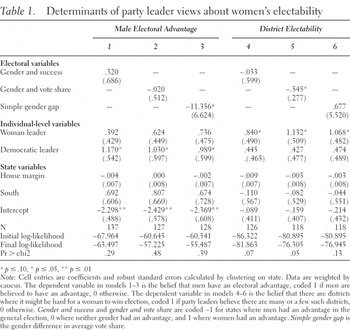
I use logistic regression to examine the likelihood that party leaders see an unequal playing field for women state legislative candidates (Table 1).17
I calculate robust standard errors clustering on state to take into account the presence of multiple respondents from the same state. A total of 41 states are included in these analyses. Because the leadership structure varies across states and by majority party status, the total numbers of leaders included in the sample varies across states. I therefore weight the legislative party data to ensure that a caucus with multiple respondents is not overrepresented in the analysis. In most cases, one or two respondents from a given caucus completed the survey. In about half the caucuses, two or more leaders from the same caucus responded. On average, two respondents participated. The response rate within each caucus averaged 45%. In 28 cases, one leader responded; 21 cases, two leaders; 13 cases, three leaders; six cases, four leaders; two cases, five leaders; and one case, six leaders.
Determinants of party leader views about women's electability

This reduced model provides a generous test of the hypothesis that the objective and perceptual measures are related. Yet looking across the first three columns, the electoral variables are not usually statistically significant. In only one case, simple gender gap, is the objective measure related to the belief that men have an electoral advantage, though the result is not statistically significant at conventional levels (p = .09). Meanwhile, only one of the electoral variables—gender and vote share—is related to party leader views about women's electability across districts. In both cases, the effect is negative, as I hypothesized: Where women attract more votes, party leaders are less likely to believe that men have an advantage and less likely to believe that women might have trouble winning election across districts. These effects are also substantively significant.18
For example, using the results of model 5 in Table 1, moving from a gender-neutral state with regard to vote share to a state where women have an advantage reduces the predicted probability of believing some districts to be problematic for women candidates from .24 to .15. Predicted probabilities were calculated setting Democrat and region to 0, woman to 1, and margin to the sample mean.
Table 1 also reveals some support for the idea that the sex of party leaders affects perceptions. Women leaders are more likely than men to believe that some districts are problematic for women. This effect is in the opposite direction than I had expected, but some studies have found that women candidates perceive more barriers in the electoral process than do men (Faucheux and Herrnson 1999; Fox 1997). In addition, surveys of the mass public reveal that women are often more likely than men to perceive sex discrimination (Public Perspective 1993). At the same time, this effect may indicate that women are too skeptical about women's opportunities.
I also find that party matters to perceptions, though in the opposite direction than I had hypothesized. The effects of both party and sex are substantively significant.19
For example, I calculated the effect of party using the results of model 1 from Table 1. Being a Democratic leader rather than a Republican leader increases the probability of reporting an advantage for male candidates from .09 to .24. Predicted probabilities were calculated setting margin to the sample mean and gender, region, and electoral success to 0. Using the results from model 5 from Table 1, being a woman increases the probability of believing some districts to be problematic for women from .09 to .24. Predicted probabilities were calculated setting margin to the sample mean and region, vote share, and Democrat to 0.
The survey item in the Convention Delegate Studies asked for agreement or disagreement with the statement “Most men in the party organization try to keep women out of leadership roles.”
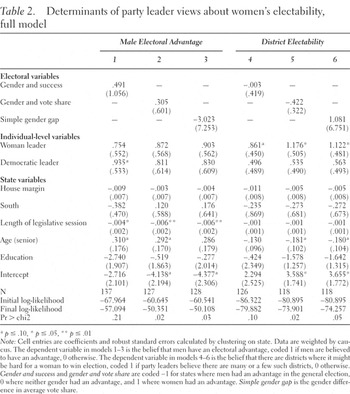
In Table 2, I include additional state characteristics in the models, with a measure for legislative professionalism and voter demographics. This full model provides a more stringent test of the main hypothesis of interest. Once these variables are included, none of the objective measures of women's status as candidates achieves statistical significance.21
If I add a control for state public opinion, as measured by state ideology or gender role ideology, the electoral variables still do not have an effect (Brace et al. 2002; Erikson, Wright and McIver 1993).
Determinants of party leader views about women's electability, full model

In this full model, I find that legislative professionalism is related to the party leader belief that men have an advantage. However, the effect of the length of the legislative session is negative—suggesting that party leaders are less likely to see an electoral advantage for men in legislatures with longer sessions. Past research found that more professionalized legislatures were negatively related to women's representation, but more recent research suggests that professionalism is no longer a barrier to women's candidacies (Fulton 2005). Legislative leaders in more professionalized legislatures may also have access to more resources and better polling data than less professionalized legislatures, and perhaps more accurate information about women's performance.
Age—measured by the percentage of state residents 65 and over—is not significantly related to either dependent variable. The state's education level is usually in the negative direction but does not achieve statistical significance. Meanwhile, women leaders continue to be more likely to see problems for women candidates, depending on the district.
Thus, I find very limited support for a connection between measures of women's actual success in the state and party leader views about women's chances. I should note that the absence of a stronger relationship between party leader views about women's fate across districts and the objective measures may be partly due to the fact that these objective measures concern how women fare in the state as a whole, rather than on a district-by-district basis.
DISCUSSION
Party leader perceptions about the electability of women candidates are partially related to a logical source of information: the actual track record of women candidates. This suggests that party leaders are aware of how women perform in their state, providing some confirmation that party leaders gauge women's chances appropriately. However, most of the evidence does not confirm this hypothesis. The simple, bivariate comparison of frequencies and weak evidence of a statistical relationship between party leader views and the actual effect of sex on electoral outcomes point to a disjuncture between perception and reality.
This gap between party leader views and election results may have one of two origins—both of which are at odds with much of the existing scholarship. First, the gap between the perceptual and objective measures may indicate that party leaders are misperceiving women's electability. Some party leaders were more optimistic about the existence of an advantage for women candidates than appears to be warranted, suggesting that party leaders are overstating voter support for women candidates. This optimism about women candidates may increase party leader support for recruiting women. However, other party leaders appear to be overly pessimistic about women's chances: Some party leaders believe men have an advantage when my election analysis did not reveal this to be the case. Moreover, beliefs about women's chances hinge a great deal on the district under discussion. Together, this evidence suggests that the “women win” message may not have reached party leaders in all states. Party leaders may have inaccurate or outdated views of women's chances. Therefore, scholars may have overestimated the extent of party leader support for women candidates and the likelihood that women will be recruited to run for office.
Although it appears that party leaders are misunderstanding the performance of men and women candidates, an alternative explanation is plausible. My results point to the potential shortcomings of the ways in which scholars have evaluated women's electability. Scholars infer that women candidates operate in a gender-neutral environment because women fare about as well as men in state legislative and congressional races. However, studies of women candidates suffer from a selection problem. The success of women candidates in the aggregate may not indicate how women would fare on average were more women to run for office. My survey of party leaders essentially posed a counterfactual, asking party leaders about a hypothetical electoral environment: What is the effect of candidate sex when other factors are equal? Scholars have inferred widespread voter support for women based on the success rates of women candidates, but the dearth of women candidates means that we have not observed women candidates in large numbers. We may observe gender parity in success rates precisely because women are only running in the most favorable districts. Indeed, studies have provided systematic evidence that some states and districts offer more favorable contexts to women candidates than others. Women legislators are not randomly distributed across states or districts. Instead, a host of scholars have successfully predicted the likelihood that women will hold state legislative office using various state-level and district measures, including voter demographics (e.g., Arceneaux 2001; Hogan 2001; Norrander and Wilcox 1998; Sanbonmatsu 2002b; Werner 1998).
Thus, the gap between standard measures of women's success and party leader beliefs may indicate that party leaders are accurately gauging the situation facing women in their state, and that scholarly measures of women's success rates are inaccurate. Party leaders may have access to other sources of information about women's chances in their state, such as polling or other research conducted by the parties. Indeed, the effect of state characteristics on party leader views about women candidates provides some support for this view that party leaders are making judgments that reflect the reality of their states.
CONCLUSION
Past studies have argued that women candidates fare about the same as men. In some cases, women win at higher rates than men; but in other cases, men win at higher rates than women. These results seem to cancel each other out, with the conclusion that women win about as often as men. In addition, much evidence suggests that the parties are no longer negative gatekeepers to women's candidacies (Burrell 1994; Darcy, Welch, and Clark 1994). Surprisingly, however, scholars have overlooked party leader views about women candidates. This hole in the literature is unfortunate because party leaders are increasingly involved in candidate recruitment (Moncrief, Squire, and Jewell 2001; Sanbonmatsu 2006d).
I have argued that party leaders disagree among themselves about the electoral consequences of candidate sex. I have also argued that these perceptions are only partly related to the actual track record of women in their state. Women's success does predict party leader views to some extent. But most electoral measures are not related to party leader beliefs. The disjuncture between the objective and perceptual measures may indicate that party leaders are misperceiving the extent to which voters support women candidates.
The message that women and men fare about the same is usually aimed at potential women candidates. Informing women that they are viable candidates may lead more of them to run. However, party leader beliefs about women's electability are more variable than the success rates indicate. If party leaders remain unconvinced that women and men are equally electable, then the continued underrepresentation of women officeholders is less puzzling than it first appears; party leader views and candidate recruitment patterns may explain women's underrepresentation in the states. Party leader views about women candidates may be a self-fulfilling prophecy: Where party leaders are skeptical about women's chances, women candidates are less likely to be recruited. In turn, party leader doubts about women may mean that they are not recruited and that the number of women in the legislature is unchanged. This cycle is the likely reason that women's groups have sought to publicize the success of women candidates and encourage more women to run.
My investigation of the electoral success of women candidates confirms the basic conclusion of much past research: Women perform about as well as men in general election contests for the state legislature when other factors are controlled. Yet there are some sex differences that become visible when the states are disaggregated. In several states in my analysis, either women outperformed men or men outperformed women in the general election. Scholars have not made this variation across the American states a focus of their research. But this variation may help explain why women are more likely to hold state legislative office in some states than in others.
Several limitations of this study warrant mention. I conducted this analysis for one point in time and for one set of party leaders, but future studies could expand the analysis over time and with a larger set of party leaders with questions about multiple levels of office. A future study could also pursue a larger set of survey questions about women candidates to try to discern the reasons behind party leaders' views. Collecting data about party leader views at the state legislative district level would be another strategy for future inquiry, given that party leader views seem to depend on the district in question.
Moreover, party leader beliefs about women's electability are only one aspect of the complex processes that give rise to women's candidacies. For example, women are less likely than men to be incumbents, which presents a structural constraint on women's opportunities for office (Burrell 1994; Carroll 1994; Darcy, Welch, and Clark 1994; Fox 2000; Uhlaner and Schlozman 1986). Women also tend to lack the personal resources and networks that men have, and women are less likely to work in occupations that lead to elective office (Darcy, Welch, and Clark 1994). Gender-role socialization continues to reduce women's interest in seeking office—even among women with the requisite backgrounds for a political career (Fox and Lawless 2004). Women and men tend to raise the same amounts of money for their campaigns (Burrell 1994; Uhlaner and Schlozman 1986), but many questions remain about the relationship between candidate sex and campaign finance (Thompson, Moncrief, and Hamm 1998; Young 2006).
Women tend to win their races at rates similar to men. But women are much less likely to run in some districts and states than in others. Thus, commonly used measures of women's success rates may have painted an overly optimistic view of their chances. Because women do not run in all districts, we can only speculate about how they would fare if they did.