1. Introduction
Various linguistic paradigms have sought to explain why first language (L1) attrition unfolds the way it does and what domains of language are more or less likely to be affected by it (e.g., the Threshold Hypothesis, Paradis, Reference Paradis2007; Regression Hypothesis, Jakobson, Reference Jakobson1941; the Interface Hypothesis (Sorace, Reference Sorace, Cornips and Corrigan2005, Reference Sorace2011, Reference Sorace2016) and L2 induced selectivity (Gürel, Reference Gürel2004, see Gürel, Reference Gürel2007 for review). While it seems relatively clear that certain domains of grammar are more or less vulnerable to attrition than others, evidence and opinions are mixed with respect to what exactly the underlying mechanistic processes of attritional change look like (see Schmid, Köpke & De Bot, Reference Schmid, Köpke and De Bot2011; Schmid and Köpke, Reference Schmid and Köpke2017 for review).
To best understand attritional change, one must put in context some of the differences between monolingual and sequential bilingual acquisition. In addition to the age factor, even child sequential bilinguals commence the acquisition process with an array of language specific experiences – except for simultaneous child bilingualism, which entails that younger and older age acquisition involve distinct cognitive-linguistic mechanisms (see e.g., Hartshorne, Tenenbaum & Pinker, Reference Hartshorne, Tenenbaum and Pinker2018). Among such experiences are a more mature level of domain-general cognitive development and a need to divide attentional resources across languages that play a role in competence and performance outcomes. In addition, adult bilinguals have a fully developed L1, heightened metalinguistic awareness, and other relevant experiences with language (Bialystok, Reference Bialystok1988; Cummins, Reference Cummins1978; Galambos & Goldin-Meadow, Reference Galambos and Goldin-Meadow1990; Reder, Marec-Breton, Gombert & Demont, Reference Reder, Marec-Breton, Gombert and Demont2013). Central to the sequential bilingual process is the malleability of one's mental grammar such that it can revise (un)conscious expectations and circumvent automatic reflexes relevant only to the L1, especially where such expectations and reflexes are not analogous to the L2 system. Cross linguistic effects, however, are not unidirectional. The learner may also experience a variety of changes associated with the L1 as a byproduct of reduced L1 input and use, extended co-activation with a competing L2 system (e.g., Iverson, Reference Iverson2012), as well as substantial change as a byproduct of language contact, such as L2 characteristics becoming permanent features of the L1 (Schmid & Köpke, Reference Schmid and Köpke2017).
It is generally acknowledged that adult L2 acquisition differs from child monolingual acquisition in path and ultimate attainment, although the underlying reasons for observable differences are debated. For example, Rothman (Reference Rothman2008) highlights that while it is true that adult L2 learners are often distinguishable in proficiency from native counterparts, this alone speaks very little to whether it is impossible for L2 learners to become native-like. Behavioral evidence from proficient L2 speakers with greater opportunities for L2 success, coupled with neurolinguistic evidence showing similarities in language processing between L1 and L2 speakers (see DeLuca, Miller, Pliatsikas & Rothman, Reference DeLuca, Miller, Pliatsikas, Rothman, Schwieter and Paradis2019 for review), suggests the underlying mechanisms might not be as distinct as argued by some.
There are many linguistic and extra-linguistic factors that come together to account for L2 variation, one such factor being the role of the L1. Whether the L1 end-state grammar constitutes the starting point of L2 acquisition, via full transfer (Schwartz & Sprouse, Reference Schwartz and Sprouse1996, Reference Schwartz, Sprouse, Herschensohn and Young-Scholten2013; White, Reference White2003), or it exhibits cross-linguistic influence iteratively over the course of L2 development, research agrees that the L1 is at least partly deterministic in the L2 process. Again, however, such influence is not unidirectional. Proficiency in another language has consequences for a person's native grammar. Thus, because sequential bilinguals may also become non-convergent in their native language, the challenge becomes examining whether the mechanisms driving bi-directional non-convergence are similar in the L2 to L1 direction. The present study aims to address the above question through an exploration of how implicatures are calculated in the Spanish of sequential bilinguals living in an L2 majority setting in the UK. Given the above, we also highlight the utility of using a variety of methods, such as event-related potentials (ERPs) and offline judgments, to examine the mechanisms driving attrition, as well as its surface effects.
Much of the previous neurolinguistic research examining implicature has focused on the time course and nature of the realization of different aspects of meaning for scalar quantifiers (Huang & Snedeker, Reference Huang and Snedeker2018 for review). Findings demonstrate that content words downstream of the implicature-generating item trigger a negative brain potential known as the N400 when the quantifier, generally in sentence initial position, mismatches the context in which it is presented (Noveck & Posada, Reference Noveck and Posada2003; Nieuwland, Ditman & Kuperberg, Reference Nieuwland, Ditman and Kuperberg2010; Hunt, Politzer-Ahles, Gibson, Minai & Fiorentino, Reference Hunt, Politzer-Ahles, Gibson, Minai and Fiorentino2013; Sikos, Tomlinson & Grodner, Reference Sikos, Tomlinson, Traut and Grodner2013; Spychalska, Kontinen & Werning, Reference Spychalska, Kontinen and Werning2016). It is worth noting, however, that other negative effects such as the Nref, a sustained late negativity typically distributing over anterior electrodes (e.g., Politzer-Ahles et al., Reference Politzer-Ahles, Fiorentino, Jiang and Zhou2013) have also been found. Additionally, some studies have found positivities in response either to pragmatically infelicitous contexts (Spychalska et al., Reference Spychalska, Kontinen and Werning2016) or to contexts in which the precise moment an implicature derived in a phrase downstream of the quantifier is measured (Hartshorne, Snedeker & Kim, Reference Hartshorne, Snedeker and Kim2015).
ERPs, in combination with traditional offline methods such as truth-value judgments, present an insightful methodological choice in the present study given the nature of pragmatic processing. While we will not explore the time-course or theoretical analysis of implicature per se, the behavioral methods we use will serve to tap into the slower and potentially more reason-laden outcomes of semantic-pragmatic processing, while the ERPs will provide insight into the faster, more automatic reflexes of intuition. By examining both processes in an attriter group, we aim to evaluate in a fine-grained way the behavioral and psycholinguistic outcomes underlying language attrition, as well as some of the sociolinguistic variables known to affect it. With those sociolinguistic variables in mind, Iverson and Miller (Reference Iverson and Miller2017) proposed the Equilibrium Hypothesis, which posits that language attrition and maintenance may be one and the same, each being determined by a linguistic system that is either adequately fed by a continual input-output feedback loop or one that is not. Any (linguistic) system not afforded an ample linguistic diet will suffer from degradation over time. In the present study, we draw on the tenets of the Equilibrium Hypothesis and relate them to the concept of entropyFootnote 1 given their relatedness with one another.
In thermodynamics, entropy is considered to be the degree of disorder (also randomness) in an isolated system (Callen, Reference Callen1998; Prigogine & Pysicien, Reference Prigogine and Physicien1961; Zurek, Reference Zurek2018). We draw two main arguments from entropy and apply them to language attrition: 1) nature generally follows the trend from order to disorder in an isolated system; 2) said order/disorder tells us something about the evolution of a system over time. By definition, entropy either always increases or remains the same, thus the system with greater entropy will be the one that has had more time to evolve. As applied to attrition, we propose that the earlier any entropy-inducing variables become relevant in the process of acquiring an additional language, the more degradation will be found in that system. Thus, bilinguals continually exposed to a competing system where the L1 is not adequately fed and/or used from early on are those likely to undergo attrition. We do not argue that being exposed to an additional language alone will be the primary cause of attrition, but rather a bilingual's language use patterns, their predominant input types relied upon, and other sociolinguistic variables affected by age of arrival in the L2 setting may be contributing to degradation in the L1 system. While any number of variables could affect the way one's language is maintained or attrited, we highlight the potential outcomes of beginning the bilingual experience post puberty – in our case as an immigrant – within the general time frame in which one is more likely to attend university, form broad and dense social relationships, identify with the L2 more readily, and use the L2 to a greater extent than the L1: late adolescence to early adulthood (Adelman, Reference Adelman2005; Feld, Reference Feld1981; Hurlbert, Reference Hurlbert1991; Justice & Dornan, Reference Justice and Dornan2001; Leeman, Reference Leeman2015; Norton, Reference Norton2010; Potowski, Reference Potowski2007, Reference Potowski, Bayley, Cameron and Lucas2013, Reference Potowski2018).
2. Algunos and unos in Spanish
Scalar implicatures are the interpretation of an utterance as having an implicit meaning beyond a literal one, whereby the utterer has some pragmatic reason for using a so-called weaker term instead of a stronger one. For example, in English the sentence Some linguists like pragmatics is inferred to mean that not all linguists like pragmatics precisely because if the speaker had wished to convey all, she would have said so. Unlike English, Spanish has two plural scalar quantifiers that correspond in meaning with English some: i) algunos/as ‘some-pl’ and ii) unos/as ‘some-pl’. While these determiners overlap in semantic distribution as shown in (2), they have distinctive pragmatic distributions (see (3a and b)).
2. Algunos/unos niños están durmiendo.
‘Some/some children are sleeping.’
3. a. Context: 3/5 children are sleeping:
Algunos/unos niños están durmiendo.
‘Some/some children are sleeping.’
b. Context: 5/5 children are sleeping:
#Algunos/unos niños están durmiendo.
‘Some/some children are sleeping.’
Though various theoretical descriptions of algunos and unos exist, we highlight three prominent analyses. Firstly, Gutiérrez-Rexach (Reference Gutiérrez-Rexach2001, Reference Gutiérrez-Rexach2010) argues that algunos is compatible with a pragmatically enriched quantity implicature and unos is not, due to a “no linking” constraint on unos. Such a constraint means that unos is not discourse-linked like algunos. Thus, while each quantifier can take a subset reading, only unos can refer to both a set and subset of referents (see 3b). Moreover, unos is not able to relate back to a salient referent already mentioned in the discourse because it is claimed to lack a specific/partitive interpretation:
4. Los libros de matemáticas están en el cajón, los de física debajo de la cama y hay ??unos/algunos de lingüística sobre la mesa.
“The math books are in the drawer, the physics ones are under the bed and there are some linguistics ones on top of the table.”
[Vargas-Tokuda et al., Reference Vargas-Tokuda, Grinstead and Rexach2009, p.103, example (37)].
While unos can have a subset reading, this is most common in cases where its meaning is constrained by the topic or focus marking characteristics of the utterance in which it appears (5). Algunos, contrastively, does not require the use of any additional material to be interpreted as ‘some but not others’ as it is naturally partitive. Further revealing the pragmatic status of algunos, (6) shows that the ‘not all’ interpretation associated with it can be cancelled or defeated – a hallmark of (scalar) inferences as opposed to semantic entailments.
5. Unos chicos están nadando, otros no.
‘Some kids are swimming, others are not.’
6. Salieron algunos/#unos huelguistas, de hecho todos.
‘Some protesters left, in fact all of them did.’
Second, Martí (Reference Martí2008) posits that the difference between the two quantifiers is related to their unique morphology. Algunos, for example, can be broken down by its prefix alg- (derived from algo ‘something’), and its affix unos. Alg- is simply added to unos thereby inheriting its relevant features (i.e., [+ quantifier][+ indefinite][+ plural][+ scalar]) to disambiguate subset and whole readings. As with Gutiérrez-Rexach (Reference Gutiérrez-Rexach2001, Reference Gutiérrez-Rexach2010), Martí holds that algunos is the determiner that gives rise to the quantity implicature.
Third, Alonso-Ovalle and Menéndez-Benito (Reference Alonso-Ovalle and Menéndez-Benito2002, Reference Alonso-Ovalle and Menéndez-Benito2010, Reference Alonso-Ovalle and Menéndez-Benito2012) assert that unos can be presuppositional only if it marks a change in topic or induces contrastive focus, such as in (5), while algunos is both presuppositional and non-presuppositional, where neither reading is dependent on the topic or focus marking characteristics of the sentence in which it appears.
Regardless of which analysis one prefers, only algunos is associated with an implicature, seemingly due to some semantic features that distinguish it from unos. For our purposes, we take it that the partitivity of algunos distinguishes it from unos in the canonical conditions in which implicatures arise, such as upward entailing (i.e., set to superset) and non-monotonic environments (i.e., defeasible inferences). We hold that this trait also distinguishes algunos from some in English, where some’s interpretation is generally narrowed with supportive linguistic and extra-linguistic context (see Chemla & Singh, Reference Chemla and Singh2014; Degen & Tanenhaus, Reference Degen and Tanenhaus2015; Skordos & Papafragou, Reference Skordos and Papafragou2016).
3. The nature of Scalar Implicatures (SIs)
Various explanations of the nature and derivation of SIs have been put forward. One main line of reasoning suggests that SIs are derived automatically (e.g., Levinson, Reference Levinson2000) whereas another prominent perspective posits that they are derived only when the context is sufficiently relevant (e.g., Carston, Reference Carston1990; Sperber & Wilson, Reference Sperber and Wilson1995).
Additionally, because some in particular belongs to a set of quantifiers with unique informational content, its meaning may be derived on the basis of scaled informativity (e.g., Chierchia, Fox & Spector, Reference Chierchia, Fox and Spector2012; Hirschberg, Reference Hirschberg1991; Horn, Reference Horn1972; Levinson, Reference Levinson2000; Sauerland, Reference Sauerland2012). For example, speakers typically follow a set of communication guidelines in order to be maximally cooperative and informative (Grice, Reference Grice and Stainton1975, Reference Grice1989). The Gricean ‘Maxim of Quantity’, within what is known as the ‘Cooperative Principle’, stipulates that interlocutors be only as informative as needed and that they give only relevant information to the purposes, timing and direction of the exchange. Thus, if a speaker chooses to use some as opposed to all, it must be that all is not applicable, in which case some is taken as ‘not all’.
SIs also arise by contributing to the truth-conditional content within an expression rather than the implied content (e.g., Carston, Reference Carston1990; Horn, Reference Horn1992), and as a result of lexical calculations (Levinson, Reference Levinson2000). Notwithstanding, there is evidence that SIs are not derived merely at the lexical level, but that they are contingent upon higher-level structure. For example, SIs are unexpected in downward entailing (DE) or non-monotonic environments (Chierchia et al., Reference Chierchia, Fox and Spector2012). Scalar items also optionally activate scalar alternatives that are subject to a recursive compositional procedure by way of an operator similar to only, thus giving rise to the upper-bound (i.e., pragmatic) meaning (Chierchia, Reference Chierchia2006).
While the available data support the above explanations regarding the nature of SIs, the source of inter-individual variation in their interpretation – especially among adult populations – is unclear. Katsos (Reference Katsos2008), however, highlights that investigating the optionality of SIs can benefit from methodologies that are appropriate for examining the role of contextual informativeness in SI derivation, such as eye-tracking, self-paced reading or event-related potentials (ERPs). Recent psycholinguistic work examining SIs has in fact shown that some adults accept some in underinformative contexts (i.e., logical responders) while others reject it (i.e., pragmatic responders) (e.g., Bott & Noveck, Reference Bott and Noveck2004; Hunt et al., Reference Hunt, Politzer-Ahles, Gibson, Minai and Fiorentino2013; Noveck & Posada, Reference Noveck and Posada2003; Politzer-Ahles, Fiorentino, Jiang & Zhou, Reference Politzer-Ahles, Fiorentino, Jiang and Zhou2013; Spychalska, Kontinen & Werning, Reference Spychalska, Kontinen and Werning2016; Tavano, Reference Tavano2010). While such a dichotomy between truly “logical” and truly “pragmatic” responders is unclear – all things being equal – there is incontrovertible variation in the way individuals treat them on specific tasks. The above research, thus, has been partially responsible for a sharp increase in work examining both the cognitive differences among individuals, as well as differences in task design, that promote individual variation in SI derivation.
In relation to the above, it is prudent to point out that pragmatic inferencing has been associated with working memory when cognitive load is increased (Marty & Chemla, Reference Marty and Chemla2013), as well as with a subset of scores on the Autism Spectrum Quotient (ASQ) (Nieuwland, Ditman & Kuperberg, Reference Nieuwland, Ditman and Kuperberg2010; Zhao et al., Reference Zhao, Liu, Chen and Chen2014), the Systemizing Quotient-Revised (SQR) questionnaire (Barbet & Thierry, Reference Barbet and Thierry2016), and even differences in methodological design across studies (e.g., Degen & Tanenhaus, Reference Degen and Tanenhaus2011, Reference Degen and Tanenhaus2015; Guasti, Chierchia, Crain, Foppolo, Gualmini & Meroni, Reference Guasti, Chierchia, Crain, Foppolo, Gualmini and Meroni2005; Papafragou & Musolino, Reference Papafragou and Musolino2003; Pouscoulous, Noveck, Politzer & Bastide, Reference Pouscoulous, Noveck, Politzer and Bastide2007). While the implementation and results of cognitive tests like the ASQ in implicature work are not used as a diagnostic tool, nor do researchers explicitly claim that individuals who fail to derive SIs are cognitively or pragmatically amiss, such metrics are used to better understand why some people are naturally inclined to derive upper-bound meanings to scalar terms and others are not – especially when provided with the same experimental contexts. While the present study does not deal with SI-related cognitive differences between individuals, given that Spanish algunos inherently gives rise to an implicature reading due to its partitivity, the central question is concerned with whether or not language attrition will similarly affect the way individuals interpret scalar terms in their native language, and what the findings might suggest concerning the link between cognition and SI derivation more generally.
3.1 ERPs and SIs
To date, the N400 component has played a significant, though not exclusive, role in SI ERP work (e.g., Nieuwland et al., Reference Nieuwland, Ditman and Kuperberg2010; Noveck & Posada, Reference Noveck and Posada2003 though see Hartshore et al., Reference Hartshorne, Snedeker and Kim2015 for P600 effects) given its association with content stimuli, semantic (im)plausibility, and/or its more general correlation to prediction or expectedness (Kutas & Hillyard, Reference Kutas and Hillyard1980; see Lau, Phillips & Poeppel, Reference Lau, Phillips and Poeppel2008 for contemporary review). In these studies, participants tend to make acceptability judgments of underinformative sentences based on world knowledge, violations of which can modulate N400 effects (see Hagoort, Hald, Bastiaansen & Petersson, Reference Hagoort, Hald, Bastiaansen and Petersson2004; Hagoort & Van Berkum, Reference Hagoort and van Berkum2007; Hald, Steenbeek-planting & Hagoort, Reference Hald, Steenbeek-Planting and Hagoort2007). Notwithstanding, Noveck & Posada (Reference Noveck and Posada2003) found that the N400 was flat in underinformative conditions as compared to conditions that were patently true or false, even among responders who were deemed “pragmatic” based on their offline responses to a pretest. The authors attributed the flat N400s to a lack of deeper processing being associated with N400 activity.
However, some caution should be afforded not only to the overall interpretation of emerging N400 effects in these studies, but also to methodological design. The N400, for instance, can be modulated by the lexico-semantic relationship of words. This relationship is generally measured with respect to the frequency with which words co-occur and is referred to as the latent semantic analysis value or LSA (Landauer, Foltz & Laham, Reference Landauer, Foltz and Laham1998). While larger N400 effects are expected in designs that employ underinformative some in world knowledge contexts compared to informative ones, this effect may be attenuated by the LSA value of the main noun phrase and the target predicate. Thus, in sentences such as some elephants have trunks, the strong relationship between the subject and the final word may not give rise to strong unexpectedness: in which case, flatter N400 effects may not have the same significance as when the association is less robust. Since utterances like some birds have televisions and some houses have bricks are shown to prompt more robust N400 effects, a flatter N400 in cases where stronger associations are prevalent seems less problematic in terms of revealing something more generalizable related to SI processing.
In light of the above discussion, the not-so-infrequent categorization of an individual as being “logical” or “pragmatic” resting on the basis of whether or not she more or less readily accepts or rejects underinformative sentences like (7) is important to note.
(7) Some birds have feathers.
Barbet and Thierry (Reference Barbet and Thierry2016) highlight that differences in the strength of the underinformative statements play a role in how individuals interpret them. For example, some infants are young is underinformative because, by definition, all infants are young. Contrastively, some hammers have a handle allows individuals to more easily envisage counter-examples to the alternative all statements. Because additional context is needed for the latter (weaker) example but not the former, using such statements to judge whether an individual does or does not calculate the associated SI may fail to entirely explain why some individuals are more tolerant of pragmatic violations than others, especially considering the evidence that underinformative sentences of this type are effort-demanding and their electrophysiological effects emerge later. Thus, flat N400 effects found on the basis of this type of stimulus may not reflect pragmatic inferencing mechanisms, but rather decision-making and reasoning strategies that emerge later (see Noveck & Posada, Reference Noveck and Posada2003 for discussion). As described below, our methodology was designed in an effort to sidestep the confound of world knowledge to the extent this is possible.
4. Research questions and hypotheses
Research question 1: Is there a difference in interpretation of algunos in whole set contexts based on speaker type?
Hypothesis: Work on algunos in Spanish shows a clear difference in acceptability between whole set and subset contexts among native monolinguals. Work on child and adult bilinguals (adult L2ers in the latter case) shows that bilinguals often overaccept aglunos in whole set contexts (Miller, Giancaspro, Iverson, Rothman & Slabakova, Reference Miller, Giancaspro, Iverson, Rothman and Slabakova2016; Slabakova, Reference Slabakova2010; Syrett, Austin, Sánchez, Germak, Lingwall, Perez-Cortes, Arias-Amaya & Baker, Reference Syrett, Austin, Sánchez, Germak, Lingwall, Perez-Cortes, Arias-Amaya and Baker2017a; Syrett, Lingwall, Perez-Cortes, Austin, Sánchez, Baker, Germak & Arias-Amaya, Reference Syrett, Lingwall, Perez-Cortes, Austin, Sánchez, Baker, Germak and Arias-Amaya2017b). Thus, we expect that our immersed bilingual group will show some degree of overacceptance of algunos in whole set contexts.
Research question 2: Is there a difference in response patterns between groups based on the type of task employed (i.e., offline and online)? If so, what does that reveal?
Hypothesis: We expect there to be some congruence between the data from each of our tasks. While we do not know what effect, if any, our differing tasks may have, we recognize that there are often disparities across task designs (e.g., Jegerski, Keating & VanPatten, Reference Jegerski, Keating and VanPatten2016; Marinis, Reference Marinis2003; Villegas, Reference Villegas2014) that can contribute to an explanation of observed effects. Such results may shed light on the extent to which attrition has taken place in a given group.
Research question 3: What effect, if any, do daily language use patterns, predominant input types, and age of arrival have on attritional affect? If so, what does that reveal?
Hypothesis: Given our discussion on entropy, we propose that individuals considered to be candidates for attriters will show a degree of attrition commensurate with their age of arrival to the L2 setting, which is expected to affect the bilinguals’ daily use of and exposure to the L1 in relation to the L2, as well as the type of input they rely upon predominantly for exposure. Again, such results may help explain the extent to which attrition has taken place in a given group.
5. Methods
5.1 Participants
We juxtapose data from two sets of native Spanish speakers, those who were recent arrivals to the UK, on average 4.7 months, and those who had lived in the UK for a significant period of time, on average 12.7 years. By design, we avoided a traditional monolingual group for the following reasons. Firstly, some knowledge of English by Spanish people of this age group is very common, whether individuals live in Spain or an English-speaking L2 environment. Secondly, in light of various calls for more ecologically valid comparisons in what some have labeled the “bilingual turn” (see Rothman and Iverson, Reference Rothman and Iverson2010; Ortega Reference Ortega2013), having a comparison group that has some competence in the same languages was ideal given that we were able to test all participants in the same L2 environment, differentiating the native Spanish speaker groups crucially by opportunity for language change to reasonably have taken place. In doing so, we can isolate time in immersion as a relevant factor for potential attrition.
As all participants did both tasks in one session, the order of the tasks was counterbalanced such that half of the participants were administered task 1 first, followed by task 2, and the other half were administered the tasks in reverse order. After the testing session, a short debrief was carried out to gain insights into the participants’ awareness of the specific aims of the study. Ethical approval was granted by the University of Reading Ethics Committee.
5.1.1 Baseline group
Baseline participant data (recent arrivals to the UK) were collected from 30 native Spanish speakers from Spain (23 females, age range 21–47, M = 26.5, SD = 4.1). All participants in this group were in the UK for work, school, or personal travel. Two participants had been in the UK for one year, while the rest (on average) only 4.7 months at the time of testing. Prior to beginning the experimental tasks, participants filled out the LEAP-Q to gather linguistic and biographical information (Marian, Blumenfeld & Kaushanskaya, Reference Marian, Blumenfeld and Kaushanskaya2007). In order to ensure a higher degree of group homogeneity as compared to the immersed bilingual group, all were recruited from a tightly knit group of Spaniards in the greater London area with minimal exposure to English. Based on experimenter interviews during experiment preparation, post-experiment debriefing, and congruous self-reported proficiency, the baseline participants were deemed to have low productive proficiency in English. All participants were right handed as measured by the handedness questionnaire (Oldfield, Reference Oldfield1971).
5.1.2 Extended immersion group
Immersion group data were collected from 30 Spanish native speakers (18 females, age range 24–48, M = 28.7, SD = 3.3) with significant L2 immersion experience, living in the UK between 5 and 24 years (M = 12.7) at the time of testing. Participants also filled out the LEAP-Q questionnaire for biographical information and linguistic history (Marian et al., Reference Marian, Blumenfeld and Kaushanskaya2007). In addition, and given our discussion of entropy, we gathered data on daily use of each language, in which contexts each language was used, time spent per year in the home country, and age of arrival (AoA, M = 26.2 years) as a supplement to the LEAP-Q questions. Participants reported not returning home more than twice per year and for no longer than three weeks total. All participants were right handed as measured by the handedness questionnaire (Oldfield, Reference Oldfield1971).
5.2 Task 1 – Picture-sentence verification task
Task 1 was a picture-sentence verification design modified from Politzer-Alhes et al. (Reference Politzer-Ahles, Fiorentino, Jiang and Zhou2013) and similar designs found in Spychalska et al. (Reference Spychalska, Kontinen and Werning2016), Tavano (Reference Tavano2010) and Wu and Tan (Reference Wu and Tan2009). This task was used for the ERP responses while also providing an offline acceptability judgment after each trial in order to compare pragmatically infelicitous contexts to semantically correct ones via pictures.
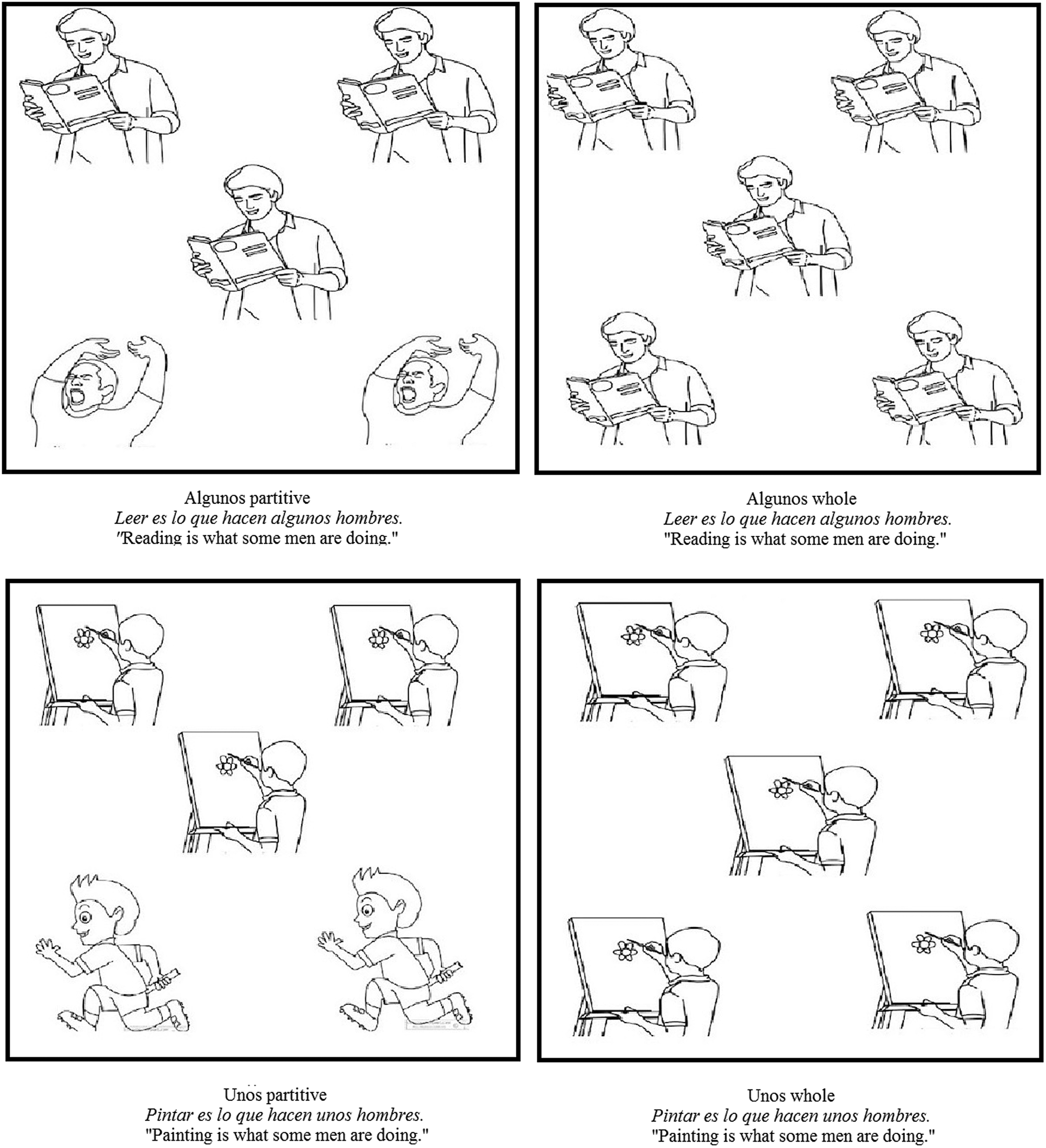
Each trial presented one of two possible scenarios using unos as a control/filler and algunos as the relevant target: a SOME-type picture in which some but not all the characters were in involved in a target activity, and an ALL-type picture in which all characters were involved. Recall that unos can refer to both a set and a subset, though the subset reading is generally triggered (and preferred) in cases where it contrasts with another available set. Thus, while algunos is claimed to have both felicitous and infelicitous conditions, neither unos interpretation is said to be affected by the number of referents to which it refers.
Each image was preceded by the phrase En esta imagen ‘In this image’ and followed by a sentence that described the image felicitously or infelicitously by using the quantifiers algunos and unos in rapid serial visual presentation (RSVP). Each quantifier phrase (QP) was followed by a prepositional phrase (PP) such as “at the school” or “in the tree” to ensure both that the critical QP did not appear in nor would the EEG signal be time-locked to the sentence final position, thus avoiding unwanted extraneous noise in the EEG signal (i.e., possible wrap-up effect, though see Stowe, Kaan, Sabourin & Taylor, Reference Stowe, Kaan, Sabourin and Taylor2018).
Experimental conditions for picture-sentence verification task

Similar work on SIs using picture designs similar to ours has noted that having quantifier in sentence-initial position and time-locking the ERP to this segment (e.g., somegirls are sitting on blankets) does not offer individuals enough information prior to quantifier onset to make an representative judgment (see Politzer-Ahles et al., Reference Politzer-Ahles, Fiorentino, Jiang and Zhou2013). In Spanish, however, the infinitive verb can be nominalized and appear as the subject of a sentence, such as Bailar es aburrido ‘Dancing is boring’. To avoid having the quantifier appear too early, then, we placed the nominalized verb at the front and chunked the critical QP (e.g., algunos perros) downstream so that one could judge the status of the QP at its onset later in the sentence.
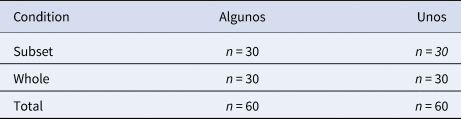
Participants performed eight practice trials prior to beginning the experiment. Following each experimental trial (n = 120), participants were asked to indicate whether the sentence described the image well or not. 120 sets of black and white image arrays were designed for the target trials (see Table 1). All images were obtained freely through Google and were modified with Microsoft Paint or Adobe Photoshop. No target quantifier appeared in tandem with the same image more than once for any individual trial. Whole and subset algunos conditions, for example, shared the same sentence, though an ALL-type picture was used for whole conditions and a SOME-type picture for partitive ones. Fillers (n = 270) required participants’ judgments of the sentences against pictures in which the position of relevant objects either matched or mismatched the sentence and were not quantificational in nature.
Type and number of conditions within Task 1

Six lists were created for presentation, which were made by counterbalancing the order and type (i.e., partitive or whole sets) of each quantifier. Each of the lists began with one of the target trials and the rest were randomized. Stimuli were presented in 10 blocks of 39 sentences with a break between each block. Images were preceded by a fixation cross lasting 250 ms and were presented in the center of the screen for 2000 ms. Each image was followed by a 250 ms blank interval before beginning the presentation of the sentences. Individual words were presented for 350 ms with a 250 ms stimulus onset asynchrony (SOA). A randomized blank inter-trial interval between 500–1000 ms appeared prior to each subsequent trial.
5.3 Results – Picture-sentence verification task
5.3.1 Baseline group
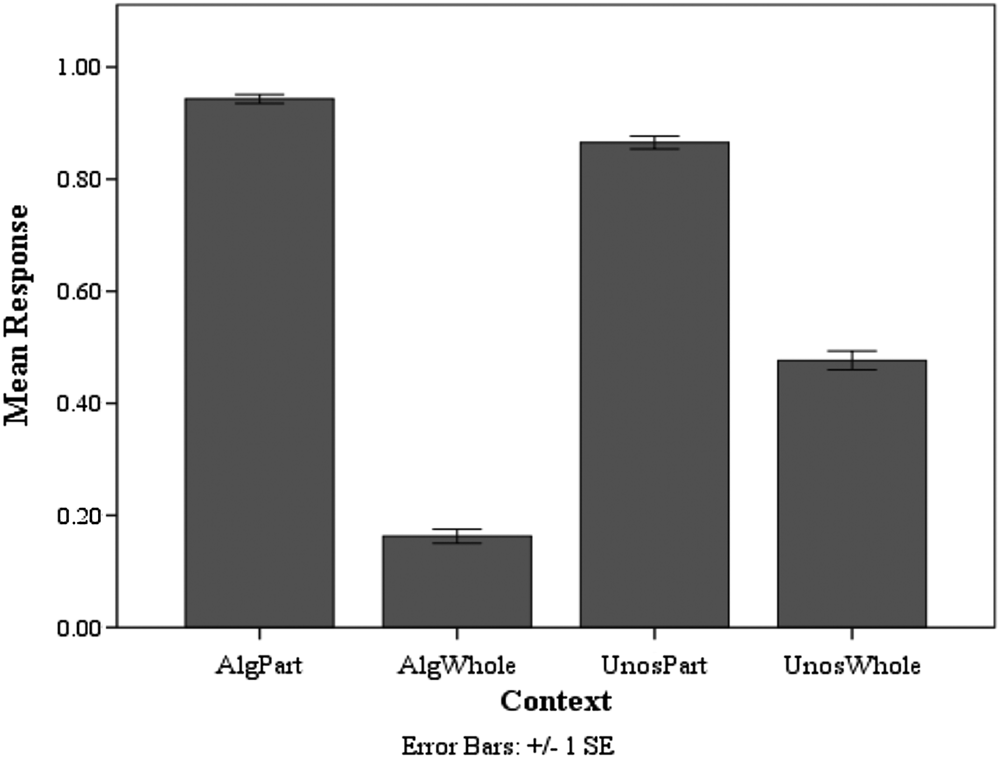
A binary logistic regression was used in R: A Language and Environment for Statistical Computing (R Core Team, 2018, version 3.5.1) to assess algunos, the quantifier of interest. The model included variables of Condition (subset, whole set), Word (Algunos, Unos), a Word*Condition interaction, and Response (Accept, Reject) with random by-subjects and by-items intercepts and slopes. “Accept” was set as the baseline. Model fit was assessed using a bottom up procedure, going from a model with only fixed parameters to one with random intercepts and then random slopes, where fit was determined by lowest AIC, BIC and -2LL. The fixed effects only model showed AIC = 4957.61, BIC = 4969.96, and -2LL = −2476.81. The final model including random intercepts and slopes showed AIC = 2315.01, BIC = 2364.46, and -2LL = −1149.55, where the difference between the two was significant, p < .001. Overall responses can be seen in Figure 2.
Mean percent acceptance by context for baseline group

The relationship between Item and Response showed significant variance in intercepts across participants, SD = .152 (95% CI: .11, .22), X 2(1) = 1466.3, p < .001. The slopes also varied across participants, SD = .003 (95% CI: .002, .004), X2(3) = 713.5, p < .001, and the slopes and intercepts were negatively and significantly correlated, cor = -.83 (-.93, -.59). Acceptance of the quantifiers was significantly predicted by Word, b = -.45, t(3503) = −12.37, p < .001, Condition, b = −1.16, t(3503) = −33.5, p < .001, and the interaction of Word*Condition, b = .39, t(3503) = 15.6, p < .001 such that in whole sets the acceptability of algunos decreases.
In summary, the group's behavior was in direct accord with the theoretical expectations from the descriptive literature of Spanish. That is, the baseline group largely rejected algunos in wholeset contexts and accepted it in subset ones. From the performance at the group level, we can appreciate that this group is indeed a viable, good baseline. Using them as such, we will be able to see if other variables that correlate with extended immersion, such as quantity and quality of use of the L2 (English), conspire to make this domain vulnerable to attritional effects.
5.3.2 Extended immersion group
Included in the model were variables of Condition (subset, whole set), Word (Algunos, Unos), Length of Residence (LoR), Age-of-Arrival (AoA), a Word*Condition interaction, a Word*Condition*AoA interaction, a Word*Condition*LoR interaction, and Response (Accept, Reject) with random by-subjects and by-items intercepts and slopes. “Accept” was set as the baseline. For our purposes AoA refers to the age of arrival to the UK, not age of exposure to English in general. A Pearson correlation analysis revealed that there was no significant correlation between LoR and AoA, r(3569) = .11, p = .79. That is, in our sample it is not the case that those with an earlier AoA have a greater LoR, as is true of some other samples.
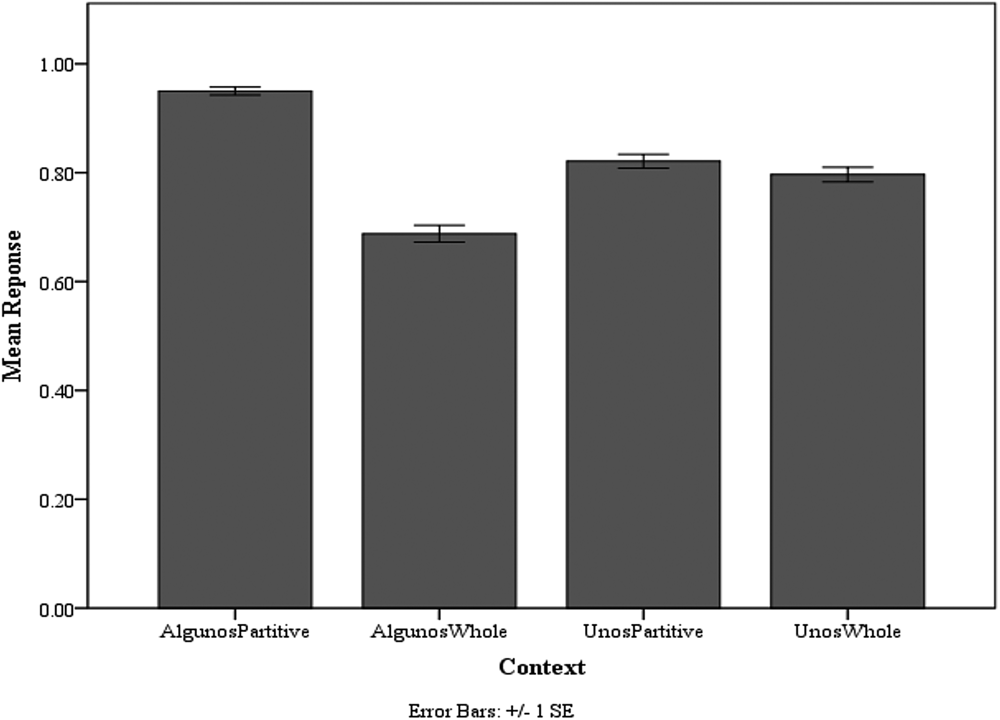
Model fit was assessed using the same bottom up procedure as the baseline group analysis. The fixed effects only model showed AIC = 3425.9, BIC = 3438.3, and -2LL = −1710.9. The final model including random intercepts and slopes showed AIC = 2836.8, BIC = 2898.7, and -2LL = −1408.4, where the difference between the two was significant, p < .001. Overall responses can be seen in Figure 3.
Mean percent acceptance by context for immersion group

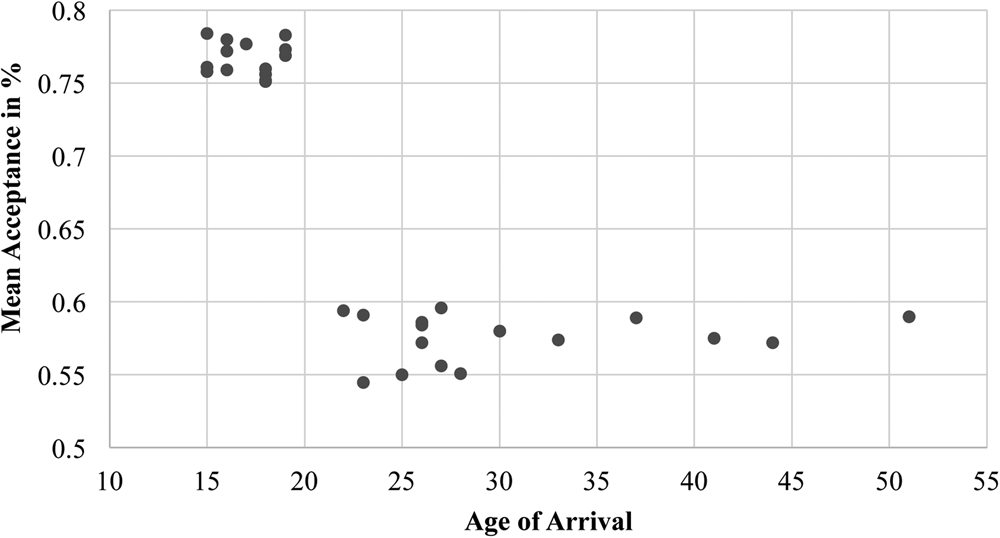
The relationship between Item and Response showed significant variance in intercepts across participants, SD = .10 (95% CI: 1.5, 1.7), X 2(1) = 94.22, p < .001. The slopes also varied across participants, SD = .001 (95% CI: .09, .24), X2(3) = 85.1, p < .001, and the slopes and intercepts were negatively and significantly correlated, cor = -.23 (-.62, -.26). Acceptance of the quantifiers was not significantly predicted by Word, but it was by Condition, b = -.5, t(3569) = −13.4, p < .001, and the interaction of Word*Condition*AgeofArrival, b = .007, t(3569) = 4.27, p < .001. Together, but crucially with the interaction, these effects show that in whole sets the acceptability of algunos decreases similarly to the monolinguals, though the earlier learners show a greater insensitivity to these contexts than the older learners.
Due to the three-way interaction of Word*Condition*AoA, we performed an exploratory analysis on the mean responses as conditioned by age of arrival, which showed considerable individual variation. In comparison to the baseline group, Figure 4 shows clear signs of emerging interpretation differences based on AoA that do not accord with what the descriptive literature of Spanish. Thus, we performed descriptive analyses on relevant sociolinguistic data for the immersion group to better understand what might condition these apparent changes. To start, the analyses were carried out on so-called early versus late learners of English. As this was carried out post hoc, inferential statistics were not performed.
Individual mean percent acceptance by Age of Arrival

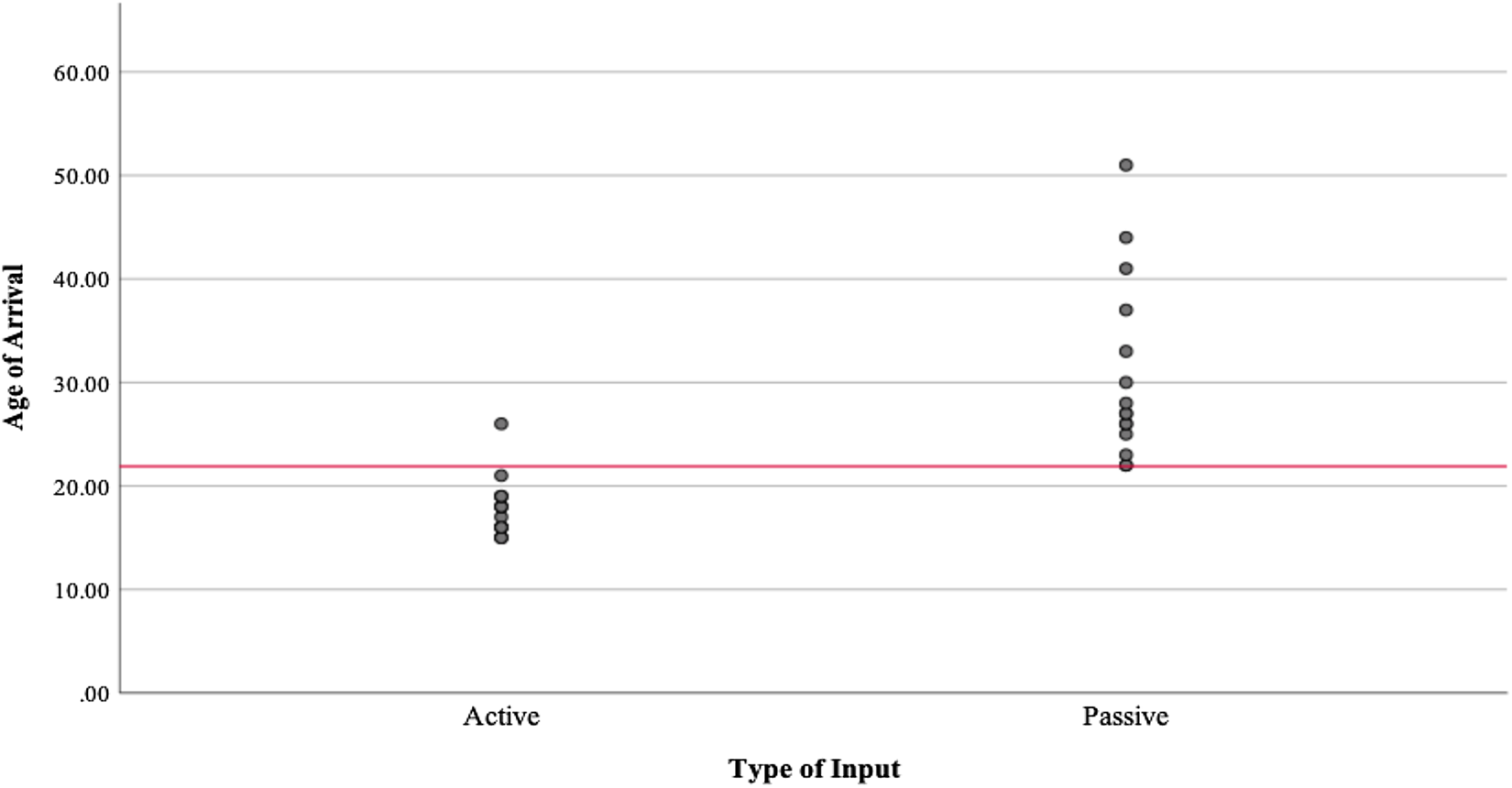
The descriptive data revealed that the younger one was at the onset of English-immersion, the more likely she was to over-accept algunos in infelicitous contexts. These individuals also reported relying on an active predominant input such as friends, social networking, social media, and work – in that order. We binned all passive and active input types and associated them with unique coding variables. A Pearson correlation revealed that a lower AoA was associated with a more active input type r = .82, p = .013. Figure 5 shows that, with rare exception, as the AoA increased so did the reliance on passive input types. A reference line was set at 22 years of age to further highlight the cut-off point selected for exploration. The participants who were younger at the time of immersion onset also reported using Spanish less than English on a daily basis (M = 1.6 hours/day) while the slightly older ones reported using Spanish more (M = 5.4 hours/day).
Scatterplot of type of input as conditioned by AoA

The data thus presented a clear cutoff between AoA and InputType (and Daily Usage) emerging at 22 years of age, after which self-reported predominant inputs became arguably more passive.
5.3.3 Results – Event-related potentials
Continuous EEG was recorded from 64 sintered Ag/AgCl electrodes on an Easycap (BrainProducts GmbH, Gilching, Germany) as subjects performed the task silently. An additional external electrode (IO) was placed on the outer canthus of the right eye to monitor (horizontal) eye movements. EEG was recorded relative to FCz and later re-referenced offline to the average of the linked mastoid channels. Impedances were maintained below 10 Ω for all channels. Signals were amplified by a BrainAmp MR Plus amplifier (BrainProducts GmbH), applying a bandpass filter of 0.016 to 200 Hz, digitized at a sampling rate of 1 kHz, and filtered offline using a 30 Hz low-pass filter. Epochs of 1500 ms were centered around the critical phrase and were corrected with a 300 ms pre-stimulus baseline. Rejection of artefacts was done manually. The minimum number of trials within each condition was 22 (73%). Overall, artefact rejection lead to the exclusion of 12% of the data prior to grand averaging of the waveforms and only artefact-free trials were included in the analysis.
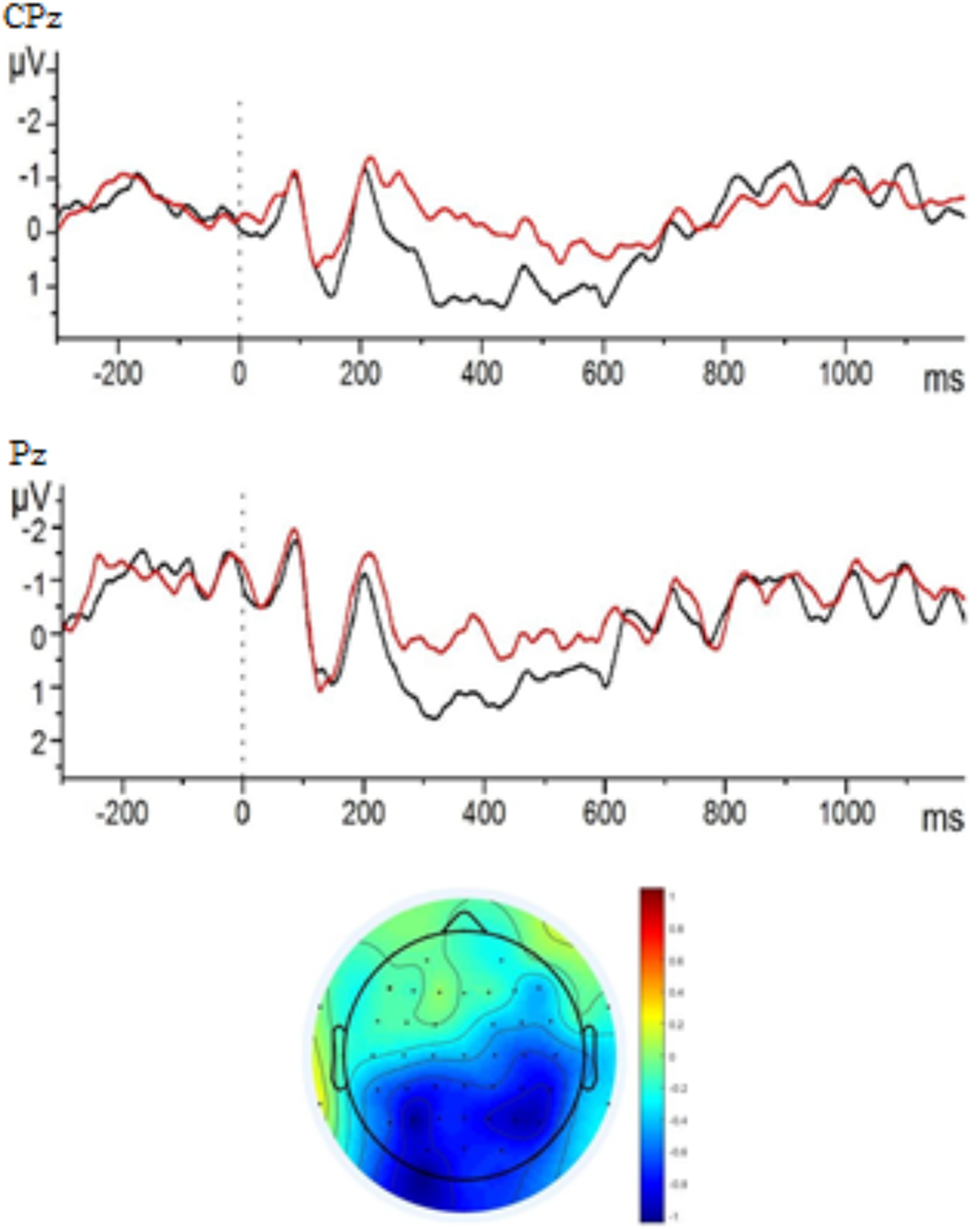
ERPs were time-locked to the critical quantifier phrase and were averaged offline for each condition at each electrode for each participant. The analysis focused on the 250–500 ms post-stimulus time window, which corresponds to the N400 effect. As N400 effects are maximal over centro-parietal scalp sites with a right hemisphere bias for written words (Kutas & Federmeier, Reference Kutas and Federmeier2011), we focused on the following electrode sites: right medial: C2, C4, C6, CP2, CP4, CP6; left medial; C1, C3, C5, CP1, CP3, CP5; left posterior: P1, P3, P5, P7, PO3, PO7; right posterior: P2, P4, P6, P8, PO4, PO8; midline medial: Cz, CPz; and midline posterior: Pz, POz). This was done primarily to reduce the number of unnecessary/irrelevant analyses and to avoid Type I error in the statistical model (Tanner, Grey & VanHell, Reference Tanner, Grey and van Hell2017; see Luck & Gaspelin, Reference Luck and Gaspelin2017 for discussion). Midline sites were analyzed separately due to having different numbers of electrodes. Data from the selected electrodes were submitted to an ANOVA with word, context, hemisphere, and caudality as repeated factors. For the L2 immersion group, between-subjects factors were length of residence and age of arrival.
5.3.4 Baseline group
The model revealed that the context in which the quantifiers appeared had a significant effect on the amplitude of the ERPs, X 2(3) = 32.50, p < .0001.
Baseline group ERPs for algunos whole set contexts shown at CPz and Pz. Topographical distribution shown between 250–500 ms post stimulus, range between + 1 and -1 μV.

Orthogonal contrasts were run with variables of Word (Algunos/Unos), Context (Subset/Whole set) Hemisphere (right, left), Caudality (medial, posterior), and all interactions of these variables, with random effects allowed for Participants. Subset contexts were set as the baseline, as was algunos for the Word variable. A Word*Context interaction revealed that amplitude was significantly larger in the N400 time window for whole set contexts than subset ones, b = .18, t(1887) = 2.37, p = .02. This effect suggests that the baseline group is sensitive to the pragmatic violation of whole set contexts. The model revealed no bias for hemisphere or caudality, and no other effects or interactions were significant.
5.3.5 Extended immersion group
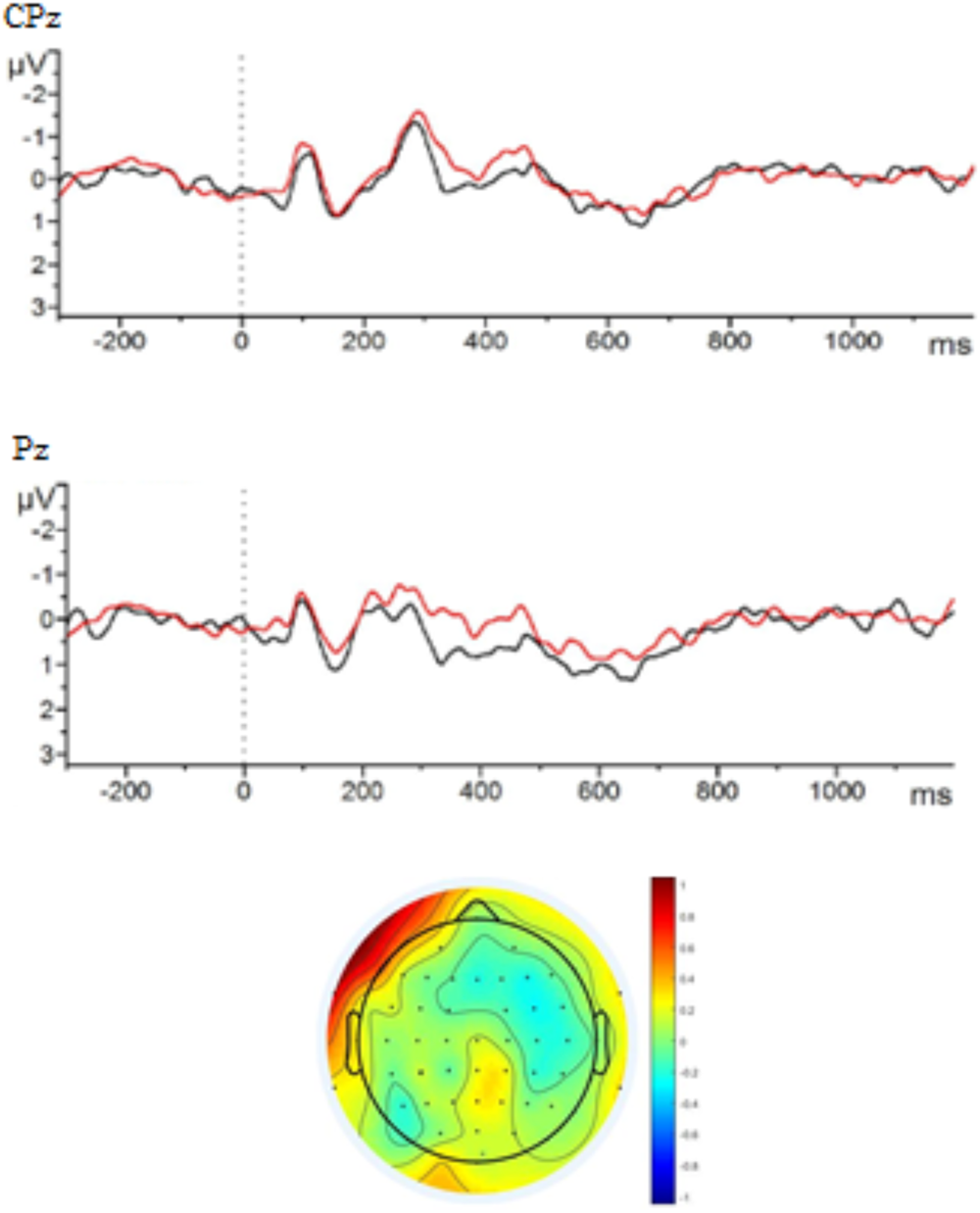
The model revealed that the context in which the quantifiers appeared did not have a significant effect on the amplitude of the ERPs, X 2(3) = 1.52. p = .71.
Immersion group ERPs for algunos whole contexts shown at CPz and Pz. Topographical distribution shown between 250–500 ms post stimulus, range between + 1 and -1 μV.

Orthogonal contrasts of Word (Algunos/Unos), Context (Subset/Whole set) Hemisphere (right, left), Caudality (medial, posterior), LoR, AoA, and all interactions of these variables, with random effects allowed for Participants, revealed no significant differences between any variables or their interactions. The lack of effects suggests that the immersion group is, contrary to the baseline group, insensitive to the pragmatic violation of whole set contexts online. Importantly, unlike the offline data showed, these data did not show that later-arrived versus earlier-arrived individuals were more or less sensitive, respectively, to the pragmatic violations manipulated in the experiment.
5.4 Task 2 – Non-binary free interpretation task
The second task was created avoiding the need for participants to dichotomize judgments, allowing for an explicit, non-binary association of a specific numerical quantity with each of the quantifiers in pre-defined contexts. Moreover, in many SI studies, participants’ responses are manipulated purposefully by instruction (e.g., Barbet & Thierry, Reference Barbet and Thierry2016; Bott & Noveck, Reference Bott and Noveck2004), enriched context (e.g., Guasti et al., Reference Guasti, Chierchia, Crain, Foppolo, Gualmini and Meroni2005; Papafragou & Musolino, Reference Papafragou and Musolino2003), high cognitive demands (e.g., Marty & Chemla, Reference Marty and Chemla2013), prosodic focus (see Crain, Reference Crain2012 for overview) and by limiting response time (Bott & Noveck, Reference Bott and Noveck2004, De Neys & Schaeken, Reference De Neys and Schaeken2007). In these cases, however, it is difficult to know how a participant would interpret scalar items in an environment that calls for untimed reasoning and when they are free to give a non-coerced, non-binary, and explicit judgment, which was our goal to understand with this task.
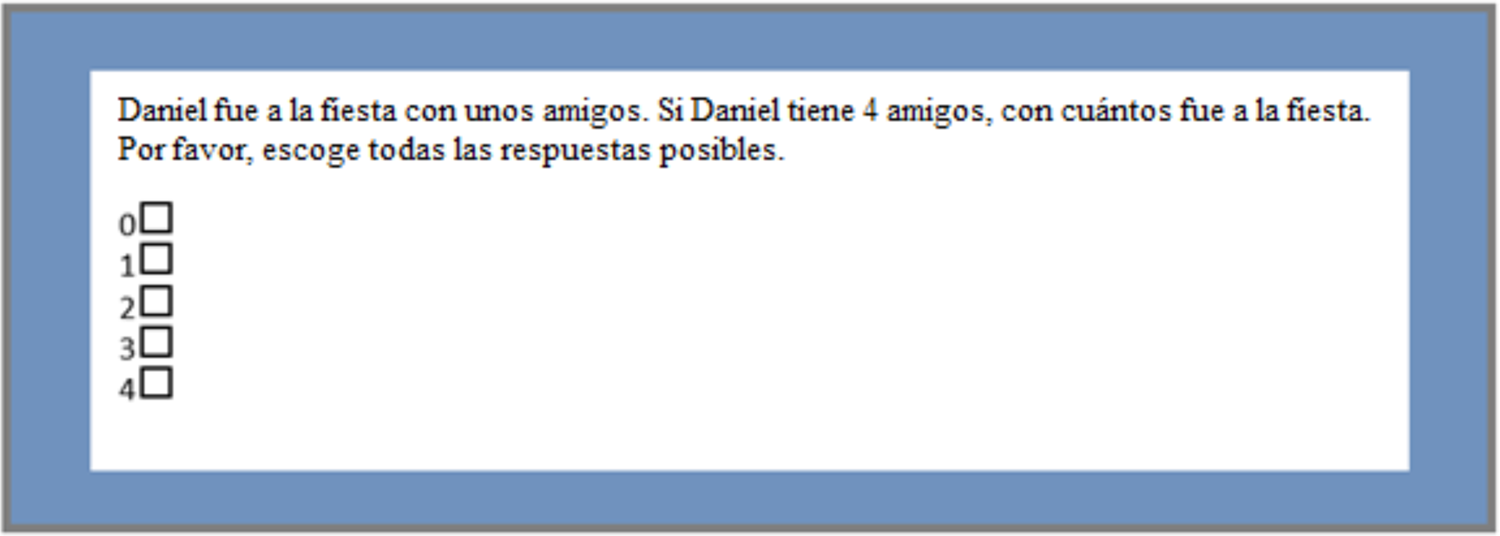
Each condition defines a set of characters and asks the participant to choose all possible quantities from 0-X associated with the scalar term used to refer to the pre-defined set of characters. For each trial, the participant was provided with a short context containing one or the other scalar term and was asked to choose all possible quantities associated with it given in the context (see Figure 8). Both algunos and unos were used in conditions in which there were four, five, or six possible referents in order to determine if Number differentially affected the overall interpretation of each scalar term (e.g., Degen & Tanenhaus, Reference Degen and Tanenhaus2011, Reference Degen and Tanenhaus2015). It should be noted here that the 4 out of 4 condition falls within the subitizing range, whereas the larger set sizes offer a context for some to be more naturally acceptable in reference to a subset. Thus, we might expect that individuals would differentially treat the scalar terms based on the set size to which they refer. In order to remain consistent across both filler and target trials, all answers contained the values between ‘0’ and the highest possible number within the set (4, 5, or 6). The context in Figure 8 is translated as follows: “Daniel went to a party with unos ‘some’ friends. If Daniel has four friends, how many did he go to the party with? Please choose all possible answers.”
Sample of Task 2 Unos condition

Each quantifier was used three times in each numerical context, totaling nine targets for algunos and nine for unos. We also created 36 unique fillers to give a ratio of one target to two fillers, which were made with similar short contexts. Rather than using a scalar quantifier, however, we used simple arithmetic problems.
5.4.1 Results – Baseline group
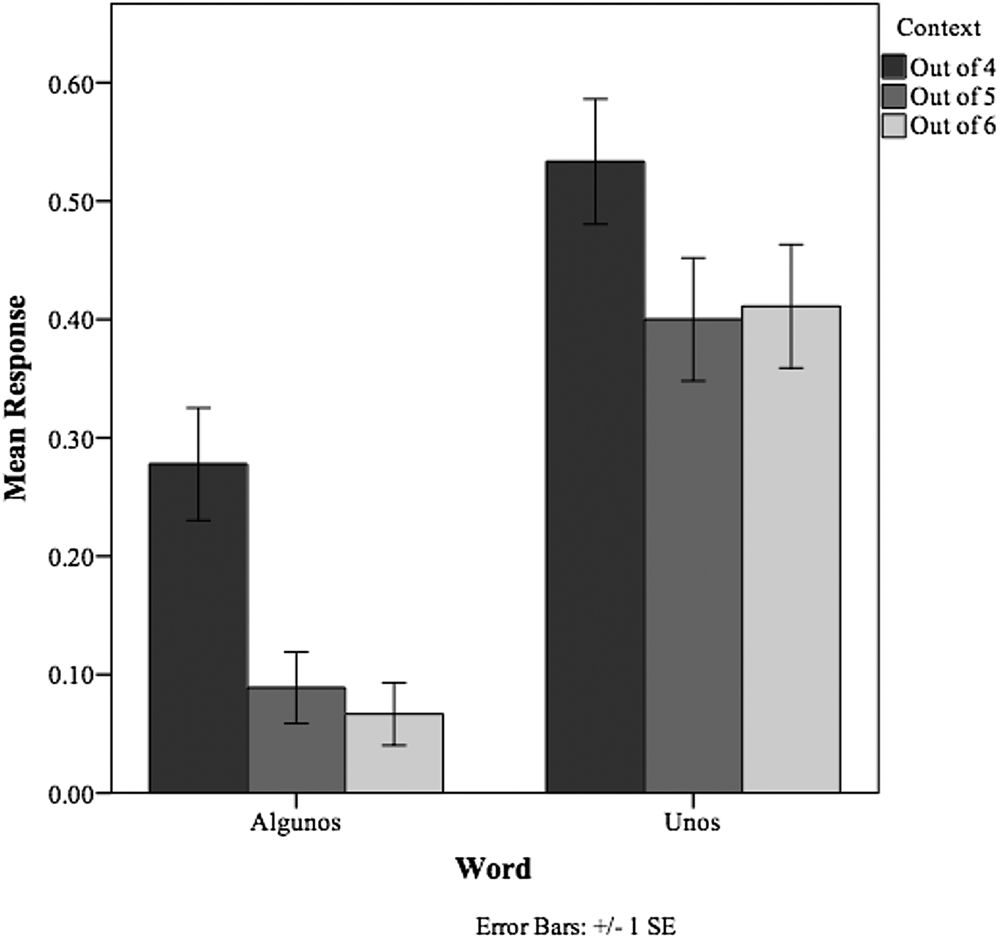
Again, a binary logistic regression was carried out to assess algunos, the quantifier of interest. Included in the model were variables of Condition (out-of-4, out-of-5, out-of-6), Word (Algunos, Unos), a Word*Condition interaction, and Response (Accept, Reject) with random by-subjects and by-items intercepts and slopes. “Accept” was set as the baseline. Model fit was assessed using the same procedures for the other offline task. The fixed-effects only model showed AIC = 689.9, BIC = 698.4, and -2LL = −342.9. The final model including random intercepts and slopes showed AIC = 538.2, BIC = 572.5, and -2LL = −261.1, where the difference between the two was significant, p < .001. Overall responses can be seen in Figure 9.
Mean percent acceptance by Word by Context

The relationship between Item and Response showed significant variance in intercepts across participants, SD = .14 (95% CI: -.41, .32), X 2(1) = 47.7, p < .001. The slopes also varied across participants, SD = .01 (95% CI: .1, .7), X2(2) = 85.3, p < .001, and the slopes and intercepts were negatively and significantly correlated, cor = -.04 (-.60, .54). Acceptance of the quantifiers was significantly predicted by Word, b = .40, t(507) = 2.6, p = .01, and Condition, b = -.15, t(507) = −2.42, p = .02. The interaction of Word*Condition was not significant, though posthoc comparisons revealed that the outof4 conditions were accepted significantly more often than the outof5 and outof6 conditions, p < .001 in both cases. These effects show that the acceptability of algunos decreases as set size becomes larger, particularly as is goes beyond the subitizing range in line with Degen and Tanenhaus’ data (Reference Degen and Tanenhaus2011, Reference Degen and Tanenhaus2015).
5.4.2 Extended immersion group
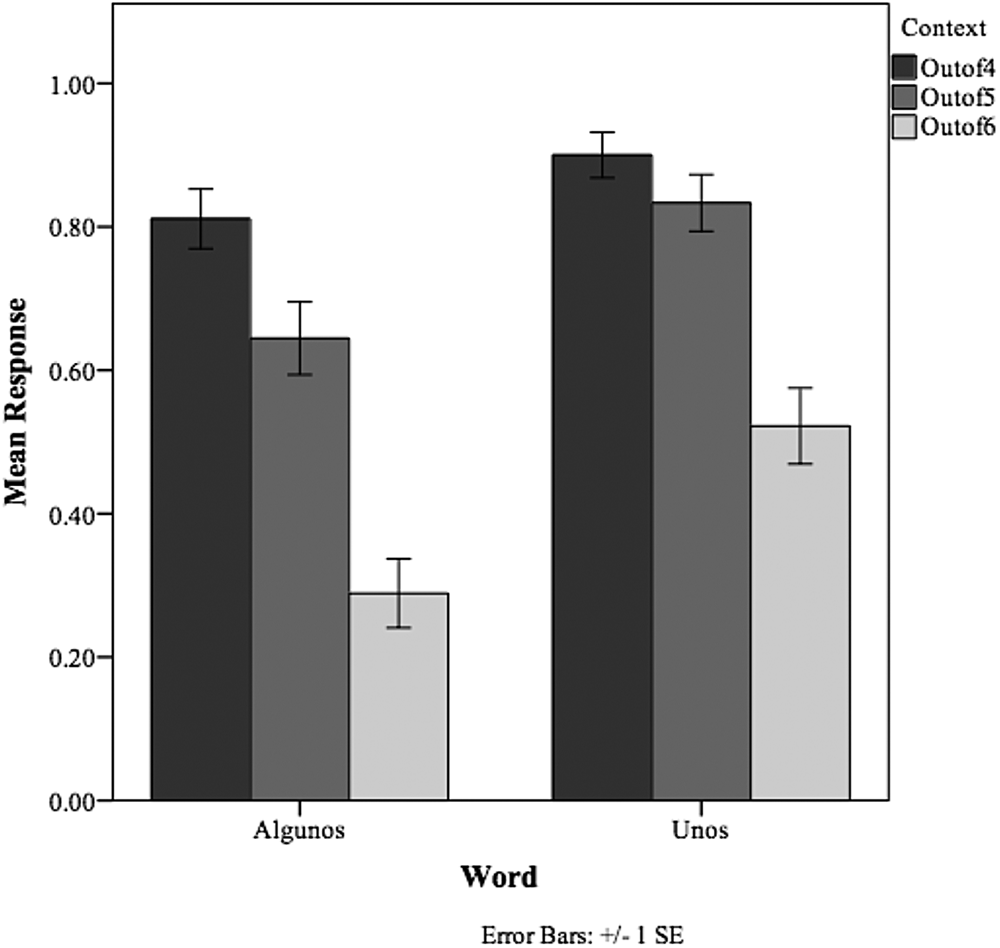
Included in the model were variables of Condition (out-of-4, out-of-5, out-of-6), Word (Algunos, Unos), LoR, AoA, a Word*Condition interaction, a Word*Condition*AoA interaction, a Word*Condition*LoR interaction, and Response (Accept, Reject) with random by-subjects and by-items intercepts. “Accept” was set as the baseline. Model fit was assessed using the same bottom up procedure as the baseline group analysis. The fixed effects only model showed AIC = 724.3, BIC = 732.8, and -2LL = −360.1. The final model including random intercepts and slopes showed AIC = 623.5, BIC = 657.8, and -2LL = −303.7, where the difference between the two was significant, p < .001. Overall responses can be seen in Figure 10.
Mean percent acceptance by Word by Context

The relationship between Item and Response showed significant variance in intercepts across participants, SD = .21 (95% CI: .2, 1.1), X 2(1) = 87.3, p < .001. Contrary to the baseline group analysis, the slopes did not vary across participants nor was the model with random slopes a significantly better fit than the one without. Thus, the final model did not include random slopes. Acceptance of the quantifiers was significantly predicted by Word, b = .60, t(511) = 3.38, p = .008, Condition, b = -.33, t(511) = −4.7, p 0, and a Word*Condition*AoA interaction, b = .49, t(511) = 2.19, p = .01. No other variables or interactions were significant.
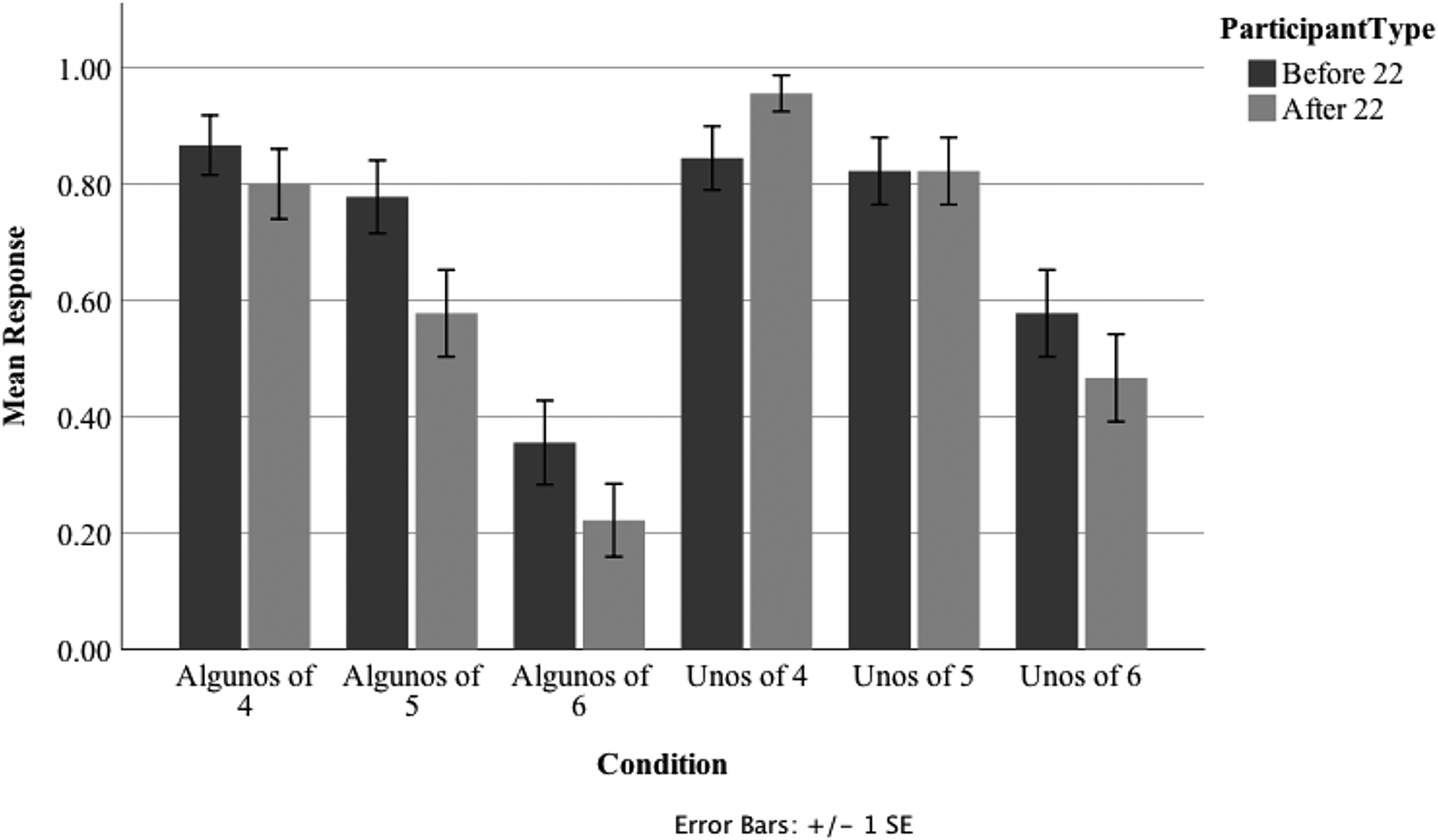
These effects show that the acceptability of algunos decreases as set size increases similarly to the baseline group, though again – in line with experiment 1 – the participants who were younger at arrival showed a slightly greater insensitivity to these contexts than the older ones. This result can be seen in Figure 11. We surmise that the non-uniform, yet conditioned by age of onset of immersion pattern coming up in both experiments is not a coincidence, but rather reflects in both cases the same reasoning alluded to above. We return to this point in greater detail immediately below.
Mean percent acceptance by Condition and ParticipantType

6. Discussion
This study examined scalar implicatures among native Spanish speakers in an L2 English immersion context who, given their (length of residence) in an English-majority environment and their engagement with English, were deemed good candidates to be undergoing native language attrition. In an effort to examine both processing and interpretation, we employed two offline judgment tasks while also measuring event-related potentials for the picture-sentence verification task.
6.1 AoA, LoR, daily use, and predominant input
Given the aforementioned results, we argue that our data, and attrition data more generally, are aptly interpreted in the context of entropy. Entropy dictates that in a closed system, disorder never decreases. That is, if a system cannot rely on a constant source of energy, some degree of disorder/deterioration will inevitably follow. As a system absorbs energy, however, it stabilizes and/or mitigates the effects of entropy (Zurek, Reference Zurek2018). This is reminiscent of the Equilibrium Hypothesis (Iverson & Miller, Reference Iverson and Miller2017), which posits that the relative stability in a system is merely being reinforced through a sufficient input-output feedback loop without a substantial influence from a competing system.
Recall that there was a difference in the acceptance of infelicitous uses of algunos between individuals arriving to the UK before the age of 22 and those arriving after. Although our data represent only synchronic language change, it is clear that patterns of daily use, as well as the type of predominant input for each language upon which a bilingual relies, affect the extent of emerging non-monolingual-like behavior. While 22 years of age may seem arbitrary, recall that AoA interacted with the Word and Condition variables for the models run on the offline data sets. Post hoc exploration revealed that that not a single bilingual who arrived after the age of 22 (n = 16) showed above 59% acceptance of infelicitous uses of algunos, while all those who arrived before 22 showed between 75 and 78% acceptance of the same trials. While exploring what may have given rise to the above difference in target responses, we examined the participants’ self-reported data concerning daily usage of each language, their social circles, and the types of input they relied on most for their exposure to the L2. All participants who arrived to the UK before the age of 22 reported that friends, social networking, social media, and work – in that order – were their main inputs, while the remainder of participants (except one) reported relying on books, work, TV, and internet – in that order. This makes sense given that our younger learners more often than not matriculated as degree-seeking students in university after arriving in the UK. Moreover, teens, in general, tend to use social media, broad friend circles, and social networking more than individuals beyond their teen years (Anderson & Jiang, Reference Anderson and Jiang2018; Roehl & Stewart, Reference Roehl and Stewart2018). Not surprisingly, the younger adults also reported using and being exposed to Spanish less frequently than English (M = 1.6 hours/day) as compared to those arriving after the age of 22 (M = 5.4 hours/day).
Arguably, the above factors contributed to two language systems: one that was being sufficiently reinforced among those arriving after 22 with greater quantity and quality of input and higher engagement with (if not attachment to) their L1, thus minimizing the effects of attrition; and another that, given levels of access to and engagement with the L1, was more susceptible to greater effects of attrition. Among the former group, all bilinguals over-accepted algunos in infelicitous contexts, but it was those who arrived prior to age 22 who showed the greatest extent of non-monolingual-like scalar interpretations. Notwithstanding, overall change is minimized because the constant source of proverbial energy did not decrease enough to allow for total change (i.e., below a minimal threshold from which balance is shifted at all or as dramatically as compared to other groups with different behavioral profiles (Iverson & Miller, Reference Iverson and Miller2017)). We argue that arriving early, immediately establishing a social network, using the L1 less than the L2, and relying on more active types of L2 input explains an emerging pattern in our bilingual data.
Though by random sampling our data show clear differences between before-22 and after-22 learners in terms of certain variables that may explain the differences between groups, there is nothing to say that there would not be other variables that would give rise to a difference between learners beginning their L2 immersion experience within varying age ranges. Our data merely show that before-22s and after 22s reported relying on opposing types of inputs (i.e., passive vs. active) and having differing daily usage patterns in our sample. In future studies that consider these variables, we may begin to combine data sets from a wider set of age ranges to tease apart more meaningful and powerful differences between unique learners, and what age, social network, and language usage patterns are primarily responsible for language maintenance and/or attrition.
6.2 Offline versus online data and task design
It is not so uncommon for data disparities to arise between methodologies employed that assess real-time processing and those that measure its outcomes (e.g., comprehension) (e.g., Jegerski, Keating & VanPatten, Reference Jegerski, Keating and VanPatten2016; Marinis, Reference Marinis2003; Villegas, Reference Villegas2014). Offline and online methodologies, however, can combine to be more explanatory together than each is in isolation (Bott & Noveck, Reference Bott and Noveck2004; Nieuwland et al., Reference Nieuwland, Ditman and Kuperberg2010). This is particularly relevant in light of our immersed bilinguals’ outcomes. Results from task 1 showed that algunos was being over-accepted in infelicitous contexts by bilinguals, and the simultaneous electrophysiological data reveal much the same picture. That is, the bilinguals were insensitive to the pragmatic violation online. However, task 2 showed that as set size was systematically manipulated, the acceptability of algunos in whole contexts decreased. Thus, whatever attrition, or entropy, had taken place, it was seemingly mitigated not only by the openness of the system, but also by task design.
Thus, while entropy may have driven the response patterns of our immersion group in task 1, the results of task 2 have at least two possible explanations. First, a reliance on (offline) formal reasoning strategies as compared to faster intuition-based interpretations attenuates the effect of over-accepting infelicitous trials. In this vein, De Neys and Schaeken (Reference De Neys and Schaeken2007) and Bott and Noveck (Reference Bott and Noveck2004) both showed that the frequency with which SIs are derived can be affected by the time allotted to participants to make judgments (see also Marty and Chemla, Reference Marty and Chemla2013). While no time constraint was strictly relevant for either of the offline tasks herein, the picture-sentence verification task (ERP task) naturally called for faster judgments than those in the offline task given its online nature, potentially tapping responses with roots in intuition rather than reasoning. Second, a conceptual artifact of quantifier acceptability introduced by the set size modulation may have further bootstrapped our immersed bilinguals’ interpretation strategies, partially reducing the effects of attrition. These findings present the possibility that attritional effects may be both an amalgamation of all of an individual's prior sociolinguistic history, as well as the type of knowledge she is asked to rely upon in a given experiment. Perhaps, then, an attriter is only an attriter to the extent she exhibits attrition on a specifically designed experiment while also considering a given set of language background variables, which suggests that attrition lies on a continuum.
These results are particularly interesting in light of the fact that the vast majority of research on language attrition has historically relied on offline methods despite some recent – yet limited – examples using online methods (e.g., Bergmann, Meulman, Stowe, Sprenger & Schmid, Reference Bergmann, Meulman, Stowe, Sprenger and Schmid2015; Kasparian & Steinhauer, Reference Kasparian and Steinhauer2016; Kasparian, Vespignani & Steinhauer, Reference Kasparian, Vespignani and Steinhauer2017). Even in such studies, however, online and offline measures are not always used in tandem. The combination is important, however, as we see attrition on a continuum in the following ways: a subset of individuals who began their L2 immersion experience primarily in their late teens/early adulthood showed greater over-acceptance of target trials than those who arrived after this time, seemingly as a result of factors relevant only to the younger group; the immersed bilinguals showed less over-acceptance of target trials as a result of manipulating task design, which was true of earlier and later arrivals; and the intragroup difference among the immersion group was lost when analyzing the ERP data, suggesting an online insensitivity even in light of a partial offline sensitivity. Given that processing and representational changes lie on the above-mentioned continuum, one is hard-pressed to tease them apart meaningfully into discrete stages. It is plausible for the effects of attrition to fluctuate from one side of the continuum to the other over the course of the emerging bilingual experience. Fluctuations that arise as a function of competing input, less use, and/or other related variables that contribute to entropy in the language system are important, and understanding how these cluster together in various groups under similar and distinct contexts helps us to understand better the dynamic processes involved in language attrition. Using methodologies that allow one to tap into the faster, more intuitive responses captured by ERPs, as well as those that highlight the outcomes of slower, reason-based interpretations, also shed light on the nature of attrition at whatever stage one is at on the continuum. In turn, this helps us to better understand how language is represented in the mind, the interdependence of language performance, the fluid changes individuals have with language across the lifespan, as well as language and cognition more generally.
Acknowledgements
David Miller was provided funding from the European Union's Seventh Framework Programme for research, technological development and demonstration under grant number 613465, which is part of the Advancing the European Multilingual Experience (AthEME) project.