INTRODUCTION
Feed conservation is critical to ensure feed availability during dry and/or cold seasons, with ensiling offering the possibility of feed conservation under diverse agro-climatological conditions (‘t Mannetje Reference ‘t Mannetje and ‘t Mannetje2000). However, adequate and balanced amounts of both rumen-degradable and bypass protein (Lima et al. Reference Lima, Díaz, Castro and Fievez2011a ) from ensiled forages might be challenging, given limitations for adequate conservation of pure legume silages (Lima et al. Reference Lima, Lourenço, Díaz, Castro and Fievez2010).
In a previous report, the potential of ensiled sorghum–soybean as a ruminant feed was shown (Lima et al. Reference Lima, Díaz, Castro and Fievez2011a ). However, other legumes might be better adapted to tropical conditions, so legumes with higher forage yields should be studied, such as Jack bean (JB; Canavalia ensiformis (L.) DC.; 6–19 t dry matter (DM)/ha (Díaz Reference Díaz2000; Lima-Orozco et al. Reference Lima-Orozco, Castro-Alegría and Fievez2013)) and/or velvet bean (VB; Mucuna pruriens (L.) DC; 4–10 t DM/ha (Díaz Reference Díaz2000; Mbuthia & Gachuiri Reference Mbuthia and Gachuiri2003)). These legumes could be ensiled as whole forage together with sorghum or could be combined with ensiled sorghum as dry beans. Those two options are of particular interest for JB due to its high forage and grain yield (2–6 t/ha) compared with other legumes cultivated in the tropics (Contreras et al. Reference Contreras, Marín Ch. and Viera1989; Díaz Reference Díaz2000; Jiménez et al. Reference Jiménez, Cortés and Ortiz2005).
Furthermore, the combined ensiling of sorghum and legumes could allow a better balance between degradable and bypass protein, through the presence of sorghum and legume tannins. Indeed, limited amounts of, for example, condensed tannins could be positive through protection of protein against breakdown during ensiling and rumen degradation (Makkar Reference Makkar2003), which might increase the amount of bypass protein.
Hence, the aim of the current study was to evaluate the nutritive value of conserved diets based on sorghum and either JB or VB as protein sources. Accordingly, the following specific goals were formulated: (i) to assess pre-requisites to obtain an acceptable silage quality in terms of, e.g. the maximum legume proportion in mixed legume–sorghum silages, as well as the need for an additional source of water-soluble carbohydrates (WSC) and/or microbial inoculants; (ii) to assess rumen and intestinal digestibility of mixed sorghum–legume silages, as well as dry beans combined with pure sorghum silage; (iii) to evaluate the potential to increase the amount of bypass protein through the action of sorghum and legume tannins in mixed sorghum–legume silages, experimentally assessed by (partial) inactivation of tannins through polyethylene glycol (PEG) (Ben Salem et al. Reference Ben Salem, Nefzaoui, Ben Salem and Tisserand1999).
MATERIALS AND METHODS
Plant material
Two legume species, JB and VB, with the former having higher grain and total DM yield as well as a lower tannin content (Ajayi et al. Reference Ajayi, Akande, Adegbite and Idowu2009; Chikagwa-Malunga et al. Reference Chikagwa-Malunga, Adesogan, Sollenberger, Badinga, Szabo and Littell2009), and one sorghum (Sorghum bicolor (L.) Moench) cultivar (CIAP 132 R-05) were sown at a research farm (22°43′N, 79°90′W, 100 m a.s.l.) from the Centro de Investigaciones Agropecuarias (CIAP) of the Universidad Central ‘Marta Abreu’ de Las Villas, Santa Clara, in the centre of Cuba. Sorghum and either one of the legume species were intercropped (one row of JB or VB and one row of sorghum with 70 cm row spacing) at a rate of 17·6 plants/m2. Legumes were sown (29 April 2011) 45 days prior to sorghum (13 June 2011) to guarantee the same grain maturity for both the legume and sorghum (dough grain stage) at harvest (12 September 2011). Each intercropped pair was sown in triplicate on separate fields (250 m2/fields) but with similar soil type (brown calcareous inceptisols; McCune et al. (Reference McCune, González, Alcántara, Martínez, Fundora, Arzola, Cairo, D'Haese, DeNeve and Hernández2011)) and fertility. Average accumulated precipitation, temperature and humidity during the cropping period (±SD) were 193±24 mm, 28·2±0·4 °C and 80±2%. Crops were neither fertilized nor irrigated. Harvesting took place during the rainy season and for experimental purposes, legumes and sorghum plants were harvested separately. After harvesting, materials from the three separate fields were mixed. Sorghum plants were harvested from the top to the lowest leaf with yellow colouration and legumes were harvested c. 20 cm above the soil. Whole sorghum and legume plants were chopped separately to a particle size of 2 cm and ensiled immediately.
Procedure to prepare laboratory silages
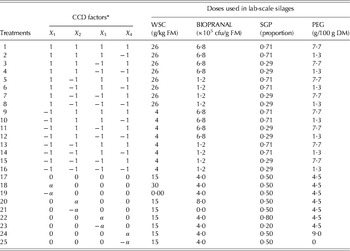
Plants (either 250 or 300 g of fresh material (FM)) were packed into laboratory silos (flasks with a volume of 385 or 462 ml, respectively) (Cullinson Reference Cullinson1960; El Hag et al. Reference El Hag, Vetter, Kenealy and Smith1982; Ojeda Reference Ojeda1986). Each treatment was set up in triplicate. Before packing, sorghum and legumes were combined and the necessary additives were added. Treatments were chosen according to a central composite design (CCD) as outlined in Table 1. The sorghum proportion (SGP) varied from 0·2 to 0·8 g FM and 0–30 g/kg FM WSC from molasses (Perucho Figueredo Sugar Company, Encrucijada, Villa Clara, Cuba) were added. A mixture of microbial inoculants, BIOPRANAL (Marin-Cárdenas et al. Reference Marin-Cárdenas, García, Herrera and Gómez2005), containing Lactobacillus acidophilus, Kluveromyces fragilis L/12-8-1 (L/1930) and Kluveromyces fragilis (L-4 UCLV) was added in the range of 0–8×10⁵ colony-forming units (CFU)/g of FM and 0·0–0·9 g DM PEG was also added (Ben Salem et al. Reference Ben Salem, Nefzaoui, Ben Salem and Tisserand1999). The design included a centre point treatment, with 15 g WSC/kg FM, 4×10⁵ CUF from BIOPRANAL, 50 : 50 sorghum/legume and 4·5 g/100 g DM of PEG (treatment 17; Table 1). The plant material and additives were homogenized before packing and compacted by hand (with the aid of a rod), ensuring expulsion of the air and to obtain a density of 650 kg FM/m3 (Ojeda et al. Reference Ojeda, Cáceres, Esperance, López Tapanes, Pereira Pérez, Loidi Ramos and Pérez Navarrete1991). The laboratory silos were covered and placed in the absence of light at room temperature (average±SD: 28±3 °C) until opening 30 days later.
Overview of treatments performed according to a central composite design (CCD)
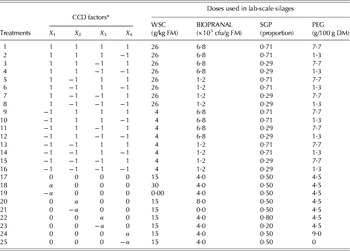
* X 1=WSC: water-soluble carbohydrates; X 2=BIOPRANAL: microbial inoculant mixture containing Lactobacillus acidophilus, Kluveromyces fragilis L/12-8-1 (L/1930) and Kluveromyces fragilis (L-4 UCLV) (Marin-Cárdenas et al. Reference Marin-Cárdenas, García, Herrera and Gómez2005); X 3=SGP: sorghum proportion; X 4=PEG: Polyethylene glycol.
Sampling and chemical analysis of fresh and ensiled forage
Fresh forage
After chopping and thorough mixing, 350 g of FM was dried at 65 °C for 72 h, in triplicate. Both pure plant material as well as their combinations were dried, after which the material was ground to pass through a 1 mm screen and stored in glass bottles at room temperature (average±SD: 28±3 °C) until chemical analysis.
Ensiled forage
After 30 days of ensiling, and immediately upon opening, a subsample was collected to determine silage pH, ammonia, lactic acid, short-chain fatty acids (SCFA) and alcohol. Another subsample was dried (65 °C for 72 h) and stored for proximate chemical analysis.
A silage extract was prepared, stored and analysed (pH, lactate and alcohol) as described by Lima et al. (Reference Lima, Lourenço, Díaz, Castro and Fievez2010). Ammonia was determined prior to acidification according to Broderick & Kang (Reference Broderick and Kang1980). For SCFA, acidified extracts (2 ml of orthophosphoric acid per 100 ml of extract) were centrifuged (15 min at 31 000 g , Beckman J2-HS, Palo Alto, CA, USA) and analysis was done in the supernatant through gas chromatography (Castro-Montoya et al. Reference Castro-Montoya, De Campeneere, Van Ranst and Fievez2012).
Proximate chemical analysis
Samples were assayed in duplicate for the proximate chemical fractions: DM (ID 930.15), nitrogen (N; ID 954.01) converted to crude protein (CP=N×6·25) (AOAC 1995) and organic matter (OM) (EC 2009). Neutral detergent fibre (NDF) was analysed with sodium sulphite but without a heat-stable amylase and expressed exclusive of residual ash (Van Soest et al. Reference Van Soest, Robertson and Lewis1991). Acid detergent fibre (ADF) was determined by sequential analysis of the residual NDF and expressed exclusive of residual ash (Van Soest et al. Reference Van Soest, Robertson and Lewis1991). Hemicellulose (Hcell) was calculated as the difference between NDF and ADF. Silage dry matter was corrected considering SCFA, lactic acid, alcohol and ammonia losses according to Lima et al. (Reference Lima, Díaz, Castro, Hoedtke and Fievez2011b ), depending on silage pH.
In vitro incubation
Procedure
During in vitro incubation, the process of rumen degradation was imitated based on the protocol described by Hassim et al. (Reference Hassim, Lourenço, Goel, Vlaeminck, Goh and Fievez2010). The in vitro study was done for the central point treatment (treatment 17, Table 1). Furthermore, to assess the impact of tannins on the rumen bypass fraction, treatment 25 (without PEG) was included. In addition, rumen degradation characteristics of sorghum–JB silages were compared with dry grains of JB in combination with pure sorghum silages (treatment 26). Dry beans from JB (12 g) and ensiled sorghum (88 g) were combined in such a way that the CP supply from the latter treatment was equal to the CP supply from the mixed sorghum–JB silage.
A feed sample of 250 mg (500 mg in the 12 h series bags) was sealed into nylon bags (Solana, Edegem, Belgium, pore size 37 μm). The incubation was performed for 0, 2, 4, 6, 10, 12, 24, 48, 72 and 96 h. From each feed combination, 11 nylon bags were prepared (including a spare bag in case one of the others tore). The 0-h incubation allowed determination of the soluble fraction. One bag was introduced per incubation flask. The residue in the bags after 12 h incubation was used to further assess the in vitro small intestine digestibility of rumen undegraded CP (see below). An anaerobic environment was created by removal of air from the flasks which were filled with CO2.
The buffer contained the following compounds (per litre): 3·58 g disodium phosphate (Na2HPO4 12H2O), 1·55 g potassium phosphate (KH2PO4), 0·124 g magnesium chloride (MgCl2 6H2O), 8·74 g sodium bicarbonate (NaHCO3), and 1·00 g ammonium bicarbonate (NH4HCO3). The buffer was saturated with CO2 overnight and kept at 39 °C.
The rumen fluid was taken from three sheep and collected prior to the morning feeding. Sheep were fed hay ad libitum with free access to drinking water (Castro-Montoya et al. Reference Castro-Montoya, De Campeneere, Van Ranst and Fievez2012).
At the day of incubation, 25 ml (50 ml in the 12 h series bags) of the rumen fluid/buffer solution (1 : 4) were injected through the septum. Subsequently, the flasks were put in the incubator at 39 °C. After each incubation period, the corresponding flasks were removed from the incubator and put directly in an ice bath to stop bacterial activity. Nylon bags were rinsed with tap water three times for 10 min each to remove bacteria and dried for 3 days at 65 °C. Dry material was used to determine the degradation of DM and CP. The pH of the solution in the flask was measured and an internal standard of ethyl butyric acid (EBA, 10 mg/ml formic acid) was added. After centrifugation (15 min at 31 000 g , Beckman J2-HS, Palo Alto, CA, USA), 1 ml of the supernatant was put in vials for SCFA analysis (Castro-Montoya et al. Reference Castro-Montoya, De Campeneere, Van Ranst and Fievez2012), and another 1 ml was used for ammonia determination (Broderick & Kang Reference Broderick and Kang1980).
An in vitro test was setup to determine the small intestine digestibility of the rumen undegraded crude protein according to the protocol described by Kaitho et al. (Reference Kaitho, Umunna, Nsahlai, Tamminga and van Bruchem1998) as follows: 150 mg of dried undegraded material from the 12 h bags were placed into a new nylon bag, sealed and incubated in an Erlenmeyer flask containing 20 ml of a hydrochloric acid (HCl)-pepsin solution (2 g pepsin/l of HCl solution at 0·075 M) during 2 h at 39 °C in a shaking incubator. The nylon bags were then washed three times with distilled water and placed in the Erlenmeyer flask with 20 ml of pancreatin solution (2 g pancreatin/l of phosphate buffer (pH 7·4, 80 ml 0·2 M sodium phosphate (NaH2PO4)+420 ml 0·2 M disodium phosphate (Na2HPO4) made up to 1 litre with distilled water) and incubated for 2 h at 39 °C in a shaking incubator. Afterwards, another 20 ml of phosphate buffer were added to the Erlenmeyer flask and kept overnight at 39 °C in the incubator without shaking. Then, the nylon bags were washed three times with distilled water and placed in the oven to dry at 50 °C for 24 h. Dry material was used to determine the degradation of DM and CP.
Calculations
Data of in vitro degradability (D, g/g) of DM and CP were fitted to the equation:
 $$D = a {\rm +} b\left( {{\rm 1} - e^{( - k_f {\rm \times} t)}} \right),$$
where t is the time (h), a is the soluble fraction (g/g), b is the potentially rumen degradable fraction (g/g), and k f is the fractional degradation rate (/h) (Ørskov & McDonald Reference Ørskov and McDonald1979). Effective rumen degradability (ERD, g/g) was calculated as:
 $$ = a + b \times k_f /(k_f + k_p ),$$
where k p (0·03/h) is assumed as the rumen passage rate (Ørskov & McDonald Reference Ørskov and McDonald1979).
Statistical analysis
The CCD, ANOVA and general linear model (GLM) analyses were performed with JMP (JMP 9.0.2).
The CCD was used to allow the simultaneous testing of four factors, which would require 81 treatments in a full factorial design. With a CCD, only 25 treatments are required without loss of performance (St-Pierre & Weiss Reference St-Pierre and Weiss2009). The lower number of treatments allowed each treatment to be tested in triplicate. The CCD only uses 2 k (with k=factor) treatment points, one central point and 2×k axial points. So each factor was included at five levels: −α, −1, 0, 1 and α (see Table 1). Alpha in case of four factors (α=1·1414) was calculated according to St-Pierre & Weiss (Reference St-Pierre and Weiss2009). The CCD allowed fitting of a quadratic polynomial function with four factors:
 $$\eqalign{Y = & a + b_1 \times X_1 + b_2 \times X_2 + b_3 \times X_3 + b_4 \times X_4 + b_5 \cr & \times X_1^2 + b_6 \times X_2^2 + b_7 \times X_3^2 + b_8 \times X_4^2 + b_9 \times X_1 \cr & \times X_2 + b_{10} \times X_1 \times X_3 + b_{11} \times X_1 \times X_4 + b_{12} \cr &\times X_2 \times X_3 + b_{13} \times X_2 \times X_4 + b_{14} \times X_3 \times X_4 + \varepsilon,} $$
with Y the response, X x the factors (X 1, the amount of WSC from molasses; X 2, BIOPRANAL; X 3, SGP or the sorghum/legume ratio; X 4, the amount of PEG), b x the regression parameters, which are being estimated and ε the residual error, which is assumed to be independent and normally distributed with μ=0 and σ 2=σ ε 2 (St-Pierre & Weiss Reference St-Pierre and Weiss2009).
Differences for silage quality, chemical composition and in vitro incubation parameters between treatments were compared by a one-way ANOVA by means of a non-parametric Wilcoxon rank sum test.
The model (GLM, univariate) to assess the effect of addition of PEG and of legume type on in vitro rumen fermentation characteristics (SCFA, ammonia, parameters of DM and CP degradability) of the feeds used in the in vitro incubations was as follows:
 $$Y = \mu + LT_{i = 1 - 2} + PEG_{\,j = 1 - 2} + LT_i \times PEG_j + \varepsilon $$
where LT i=1−2 is the legume type (JB v. VB); PEG j=1−2 is the PEG dose used (zero v. 4·5 g/100 g DM); LT i ×PEG j is the interaction between the indicated factors and ε is the residual error.
RESULTS
Chemical characteristics of fresh and ensiled feed
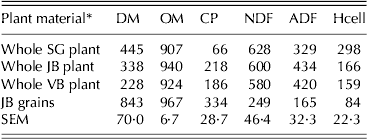
The chemical composition of the FM (at harvest) used in the experiment is shown in Table 2.
Dry matter (DM) content (g/kg FM), organic matter (OM), crude protein (CP), neutral detergent fibre (NDF), acid detergent fibre (ADF) and hemicellulose (Hcell) contents (all g/kg DM) of plant material used in the study (n=3)
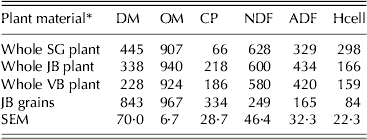
* SG: sorghum (Sorghum bicolor (L.) Moench; CIAP 132 R-05 cultivar; JB: jack bean (Canavalia ensiformis (L.) DC); VB: velvet bean (Mucuna pruriens (L.) DC).
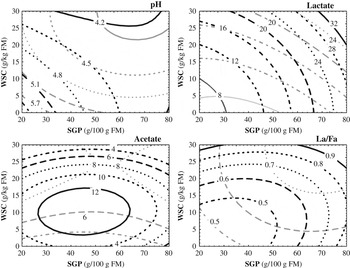
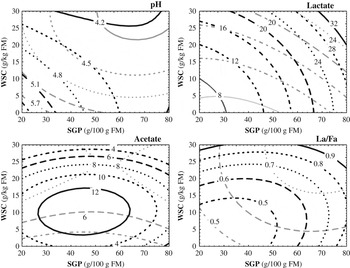
For the ensiled material, the addition of PEG or BIOPRANAL did not affect their chemical composition (Supplementary Table 1). From a quality point of view, silage should have a pH of at least 4·5 (Ojeda et al. Reference Ojeda, Cáceres, Esperance, López Tapanes, Pereira Pérez, Loidi Ramos and Pérez Navarrete1991) and from a nutrition perspective the aim was to obtain silages with a CP content of at least 100 g/kg DM (Lima et al. Reference Lima, Díaz, Castro, Hoedtke and Fievez2011b ). Apparently, these pre-requisites could only be reached in silages with at least half of the FM consisting of legumes to which at least 15 g WSC/kg FM were added (Fig. 1) (i.e. in combined sorghum–JB, treatments 3, 4, 7, 8, 17, 18, 20 and 24; in combined sorghum–VB, treatments 3, 4, 17, 18, 19, 20 and 24).
Contour plot indicating the interaction between sorghum proportion (SGP) and water-soluble carbohydrates (WSC) from molasses on pH, lactate (mg/g FM), acetate (mg/g FM) and lactate to fermentation acids ratio (La/Fa) after 30 days of ensiling of sorghum mixed either with jack bean (black lines) or with velvet bean (grey lines) forage.
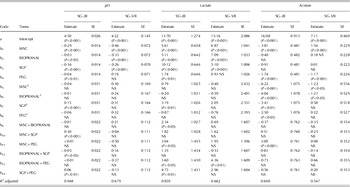
The responses to the addition of WSC, PEG, BIOBRANAL and SGP were different depending of the factor studied (pH, lactate or acetate) and legume type (Table 3). Lactate and pH were affected negatively and positively, respectively (P<0·001) by WSC, BIOPRANAL and SGP in sorghum–legume silages. Lactate was significantly increased by PEG addition (P<0·01) in sorghum–JB silages, but not significantly in sorghum–VB silages. In the case of acetate, responses to BIOPRANAL and SGP were negligible. Silage acetate was reduced (P<0·001) by PEG in both sorghum–legume silages, whereas WSC increased acetate in sorghum–VB silages (P<0·001), but decreased acetate in sorghum–JB silages (P<0·001).
Responses of pH, lactate (mg/g FM) and acetate (mg/g FM) in lab-scale silages of whole plants from sorghum (SG) and legumes (jack bean (JB)/velvet bean (VB)) to variation in sorghum proportion (SGP), addition of water-soluble carbohydrates (WSC), BIOPRANAL* and PEG (polyethylene glycol) (n=75)
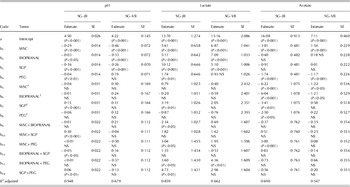
* BIOPRANAL, microbial inoculant mixture containing Lactobacillus acidophilus, Kluveromyces fragilis L/12-8-1 (L/1930) and Kluveromyces fragilis (L-4 UCLV) (Marin-Cárdenas et al. Reference Marin-Cárdenas, García, Herrera and Gómez2005).
NS, not significant.
Chemical and in vitro rumen characteristics of selected treatments
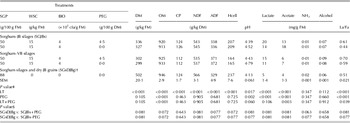
Rumen degradability was assessed for some mixed sorghum–legume silages (treatments 17 and 25) and an extra treatment (26), allowing an assessment of the effect of tannins (mixed silages with or without PEG) on rumen degradation parameters, as well as to compare the use of dry beans from JB supplemented to ensiled sorghum with mixed silages from whole sorghum and JB forages. In addition, this also resulted in similar values for the other proximate chemical characteristics. The effects of those variables on chemical composition and ensiling characteristics are shown in Table 4. The lower CP content of VB compared with JB was reflected in lower amounts of CP in the mixed legume–sorghum silages. Hemicellulose content was lower and ADF content higher in mixed VB–sorghum silages although the ADF content of the fresh VB forage was somewhat lower than ADF of the JB forage (Table 2). Mixed silages with VB showed lower concentrations of fermentation acids (e.g. acetate and lactate). Addition of PEG increased the production of lactate, as well as the proportion of lactate in the fermentation acids, whereas acetate content was decreased.
Chemical composition (dry matter (DM), organic matter (OM), crude protein (CP), neutral detergent fibre (NDF), acid detergent fibre (ADF) and hemicellulose (Hcell)) and ensiling fermentation characteristics (pH, lactate, ammonia (NH3), alcohol and lactate/total fermentation acids ratio (La/Fa)) of combined (50:50) silages of whole sorghum and legume (jack bean (JB) or velvet bean (VB)) plant with additives* and sorghum ensiled alone supplemented with dry grains of jack bean
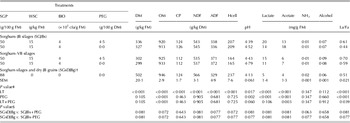
* Additives: BIO: BIOPRANAL; WSC: water-soluble carbohydrates from molasses prior to ensiling; PEG: polyethylene glycol added or not prior to ensiling.
† This treatment was additionally performed for comparative purposes with SGJBs treatments. Here, pure sorghum silage was combined with dry beans from JB (88:12, w : w as feed) to obtain a similar CP content as with treatments SGJBs.
‡ P value: refers to the general linear model performed to compare characteristics of combined silages of whole plants from sorghum and legume types (LT; jack bean/velvet bean).
§ P value: refers to non-parametric test (Wilcoxon rank sum test) performed to compare treatments of SGJBs with SGsDJBg.
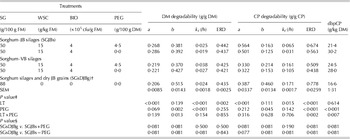
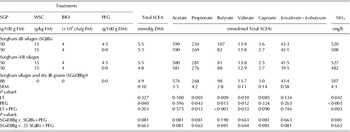
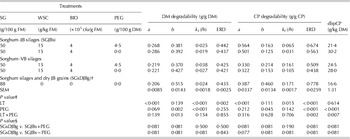
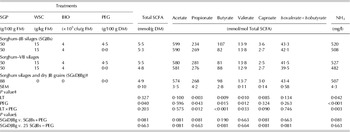
Moreover, the effect of PEG and legume type on in vitro degradability of DM and CP was studied (Table 5). The addition of PEG affected degradability parameters of DM (decreased b; P<0·01 and increased k f ; P<0·001) and CP (increased b and ERD; P<0·05). The legume type affected several rumen degradability parameters (P<0·01), in particular a, k f and ERD, with VB showing lower soluble fractions but faster degradation rates of the potentially degradable fraction. Nevertheless, VB generally showed lower ERD compared with JB. Furthermore, the degradation characteristics of pure sorghum silages in combination with dry Jack beans were closer to those of combined sorghum–JB silages with PEG than to those without PEG (Table 5). The in vitro rumen fermentation characteristics and the effect of LT and PEG addition are shown in Table 6. Removal of PEG decreased (P<0·05) the production of SCFA and accumulation of ammonia for both mixed silages. Propionate proportions were increased (P<0·05) and butyrate proportions reduced (P<0·05) for mixed silages with JB but not with VB. Valerate proportions were lower (P<0·05) in the mixed sorghum–VB silage but not in the silage with JB. Dry beans from JB with sorghum silage generally showed rumen fermentation characteristics, which were more in line with mixed silages without PEG, i.e. lower SCFA production and ammonia accumulation as well as increased propionate proportions.
In sacco degradation characteristics [soluble fraction (a), potentially degradable fraction (b), fractional fermentation rate (kf) and effective rumen degradability (ERD) and digestible bypass CP (dbpCP)] of combined (50 : 50) silages of whole sorghum and legume (jack bean (JB) or velvet bean (VB)) plants with additives* and sorghum ensiled alone supplemented with dry grains of JB obtained from in vitro rumen incubation during various periods (2–96 h) and in vitro small intestinal incubation
* Additives: BIO: BIOPRANAL; WSC: water-soluble carbohydrates from molasses prior to ensiling; PEG: polyethylene glycol added or not prior to ensiling.
† This treatment was additionally performed for comparative purposes with SGJBs treatments. Here, pure sorghum silage was combined with dry beans from JB (88 : 12, w : w as feed) to obtain a similar CP content as with treatments SGJBs.
‡ P value: refers to the general linear model performed to compare characteristics of combined silages of whole plants from sorghum and legume types (LT; Jack bean/Velvet bean).
§ P value: refers to non-parametric test (Wilcoxon rank sum test) performed to compare treatments of SGJBs with SGsDJBg.
In vitro rumen fermentation characteristics [total production of short chain fatty acids (Total SCFA), proportion of individual SCFA and ammonia concentration (NH3)] of combined (50 : 50) silages of whole sorghum and legume (jack bean (JB) or velvet bean (VB)) plants with additives* and sorghum ensiled alone supplemented with dry grains of JB after 96 h of in vitro rumen incubation
* Additives: BIO: BIOPRANAL; WSC: water-soluble carbohydrates from molasses prior to ensiling; PEG: polyethylene glycol added or not prior to ensiling.
† This treatment was additionally performed for comparative purposes with SGJBs treatments. Here, pure sorghum silage was combined with dry beans from JB (88 : 12, w : w as feed) to obtain a similar CP content as with treatments SGJBs.
‡ P value: refers to the general linear model performed to compare characteristics of combined silages of whole plants from sorghum and legume types (LT; Jack bean/Velvet bean).
§ P value: refers to non-parametric test (Wilcoxon rank sum test) performed to compare treatments of SGJBs with SGsDJBg.
DISCUSSION
Chemical characteristics of ensiled feed
According to Ojeda et al. (Reference Ojeda, Cáceres, Esperance, López Tapanes, Pereira Pérez, Loidi Ramos and Pérez Navarrete1991) an acceptable silage quality is characterized by pH<4·5, an ammonia content <10 g NH3/100 g N, a lactate content on the total of fermentation acids of minimum 0·70 and an acetic acid and butyric acid content on the total of fermentation acids <0·20 and 0·025, respectively. The content of ammonia and butyric acid (data not shown) was negligible for all silages tested, probably due to the concomitant production of lactate and acetate (McDonald et al. Reference McDonald, Henderson and Heron1991) and the role of acetate to control proteolytic microorganisms such as moulds (Danner et al. Reference Danner, Holzer, Mayrhuber and Braun2003).
As reported by Lima et al. (Reference Lima, Díaz, Castro, Hoedtke and Fievez2011b ) for silages of sorghum–soybean, mixtures with low SGP (30 g/100 g FM) need at least the addition of 20 g of WSC/kg FM to obtain good silage quality. In the present experiment, sorghum–JB silages required at least 60 g sorghum/100 g FM to reach a pH<4·5 without extra WSC. These sorghum–JB silages also met the CP criterion. To reach a similar pH for sorghum–VB silages with a SGP of 60 g/kg FM, the addition of 12 g of WSC was needed (Fig. 1). However, CP contents for these silages were below 100 g/kg DM. Mixed sorghum–JB or sorghum–VB with sorghum : legume proportions of 50 : 50 always reached the CP requirements but the addition of 15 g of WSC was required to guarantee acceptable silage quality (Fig. 1, Supplementary Tables 1 and 2). These results are in line with the findings of Lima et al. (Reference Lima, Lourenço, Díaz, Castro and Fievez2010) in mixed sorghum–soybean silages. The pH effects were to a large extent a reflection of lactate concentrations in the silages. Hence, addition of increasing amounts of WSC and SGP in both combined sorghum–legumes silages increased the lactate production. In previous research, WSC addition reduced the pH more strongly compared with SGP, although lower amounts of WSC could be compensated by increasing proportions of sorghum (Lima et al. Reference Lima, Díaz, Castro, Hoedtke and Fievez2011b ). A similar stronger effect of additional WSC as compared with SGP was observed mainly for mixed sorghum–VB silages but not for mixed sorghum–JB silages in the current study. Formerly, the effect of WSC was reinforced by a microbial inoculant (Lima et al. Reference Lima, Díaz, Castro, Hoedtke and Fievez2011b ; Heinritz et al. Reference Heinritz, Martens, Avila and Hoedtke2012). In the current study, the microbial inoculant, BIOPRANAL, only showed minor effects on pH of mixed sorghum–JB silages and as such was not essential in terms of silage quality. In contrast, BIOPRANAL had a stronger effect on pH and lactate content when added to sorghum–VB silages. Hence, the microbial inoculum did not seem essential to guarantee silage quality in the current trial, and particularly showed its potential when applied to combinations such as sorghum–VB, which seem more difficult to ensile compared with sorghum–JB.
Mixed silages of whole plant sorghum with JB or VB have a sufficient quality to be used as animal feed during periods of fresh forage shortage (dry/cold conditions). Previous research has indicated that good silage quality was reached when whole soybean plants were combined with sorghum in a 60 : 40 or 40 : 60 ratio (Lima et al. Reference Lima, Lourenço, Díaz, Castro and Fievez2010) which is comparable with the 50 : 50 ratio of sorghum combined with whole plant JB or VB. The CP content could reach between 115 and 123 g/kg DM in the sorghum–soybean combination (Lima et al. Reference Lima, Lourenço, Díaz, Castro and Fievez2010). These amounts of CP are comparable with both mixtures of sorghum with either JB or VB (Table 4).
In vitro rumen and small intestine characteristics of selected treatments
As expected, soluble CP was higher in silages as compared with dry beans (Table 5) due to proteolysis during ensiling (McDonald et al. Reference McDonald, Henderson and Heron1991), which was further increased through addition of PEG, which attempted to deactivate tannins. Nevertheless, the whole plant sorghum–JB silage showed lower (P<0·10) ERDCP than the ensiled sorghum combined with dry beans of JB (Table 5), which is in line with the slightly lower production of iso SCFA in the rumen (Table 6 and Supplementary Table 3 for data after 96 and 12 h of in vitro incubation, respectively) and results in higher amounts of bypass CP (52·8 g/kg DM in mixed sorghum–JB silages v. 30·9 g/kg DM in sorghum silages combined with dry grains from JB). The greater amount of bypass protein in silages as compared with dry beans might be explained by partial degradation of cell structures during ensiling (Lima et al. Reference Lima, Lourenço, Díaz, Castro and Fievez2010), which might result in close contact between proteins and phenols. The phenomenon of complexation of protein with tannins in silages also might happen in the silage of sorghum alone, but in these silages the protein content is much lower than in the combined sorghum–JB silage and the complexation between sorghum tannins and proteins from dry JB could be negligible due to the limited time of contact. Next to the improvement of physical contact between protein and tannins in the silage, the lower content of total phenolic compounds present in the grains from JB, i.e. 7–18 g/kg DM (Agbede & Aletor Reference Agbede and Aletor2005; Sridhar & Seena Reference Sridhar and Seena2006); as compared with the content in the JB foliage (39 g/kg DM; Ajayi et al. Reference Ajayi, Akande, Adegbite and Idowu2009; Chikagwa-Malunga et al. Reference Chikagwa-Malunga, Adesogan, Sollenberger, Badinga, Szabo and Littell2009) could be another reason for the lower rumen CP degradation in combined silages in comparison with the sorghum ensiled alone and supplemented with dry grains.
Moreover, tannins not only seem to protect protein against rumen degradation, but this protection seems to be largely removed after passage through the abomasum, as the amount of digestible bypass CP at the level of the small intestine is 50% higher in mixed sorghum–JB silages as compared with sorghum silages combined with dry JB (Table 5). This result is in line with Kondo et al. (Reference Kondo, Kita and Yokota2004), who showed a stable binding of protein with tannins within a pH range of 3·5–7·7.
Sorghum–JB silages showed higher ERDCP than sorghum–VB silages. Nevertheless, proportions of branched SCFA (i.e. isobutyrate and isovalerate) are comparable for both silages (Table 6). The previous result could be related to the slightly higher amount of leucine and valine in JB grains than in VB grains (5·7 v. 3·8 g/100 g CP and 2·0 v. 1·7 g/100 g CP, respectively) (Ogunji et al. Reference Ogunji, Wirth and Osuigwe2003), which can be used as an indication of differences in the amino acid profile of the whole plant. Leucine and valine are precursors of isovalerate and isobutyrate, respectively (Vlaeminck et al. Reference Vlaeminck, Fievez, Cabrita, Fonseca and Dewhurst2006). Furthermore, the effect of PEG, which deactivates phenols (e.g. tannins), resulting in higher ERDCP (Ben Salem et al. Reference Ben Salem, Nefzaoui, Ben Salem and Tisserand1999), was slightly higher in the whole plant sorghum–JB combination than in the whole-plant sorghum–VB combination (Table 5). Nevertheless, a lower tannin content has been reported in JB foliage as compared with VB (39 g/kg DM (Ajayi et al. Reference Ajayi, Akande, Adegbite and Idowu2009) v. 74 g/kg DM (Chikagwa-Malunga et al. Reference Chikagwa-Malunga, Adesogan, Sollenberger, Badinga, Szabo and Littell2009), respectively). A greater phenolic content also has been reported for VB grains (34 g/kg DM, Vadivel & Janardhanan Reference Vadivel and Janardhanan2000) as compared with JB grain (7–18 g/kg DM, Sridhar & Seena Reference Sridhar and Seena2006). The greater effect of JB tannins might be related to differences in the nature of the tannins, which is suggested from the rumen fermentation pattern: deactivation of JB tannins through PEG resulted in an increase in propionate and decrease in butyrate proportion, which was not the case for VB tannins. Moreover, VB tannins might be more susceptible than other legume tannins to breakdown during ensiling (Bagheripour et al. Reference Bagheripour, Rouzbehan and Alipour2008).
CONCLUSION
The present study demonstrated that whole sorghum plant with JB or VB forages can be ensiled in combination, giving a good quality when the proportion of sorghum is not less than 50 g/100 g FM and WSC are added (at least 15 g/kg FM). In addition, combined sorghum–legumes silages showed higher amounts of bypass protein as well as higher digestible bypass CP than pure sorghum silage supplemented with dry JB grains.
The supplementary material for this article can be found at http://www.journals.cambridge.org/AGS
The authors would like to thank Ghent University (UGent), Belgium and Universidad Central ‘Marta Abreu’ de Las Villas (UCLV), Cuba for supporting this research. Special acknowledgements to VLIR-UOS for a short research grant to R. Lima-Orozco and to the commission of Scientific Research of the Faculty of Bioscience Engineering, UGent for the travel grant of Inge Van Daele, to the staff of the Laboratory for Animal Nutrition and Animal Product Quality of UGent and to the staff from the Experimental Stations in CIAP of UCLV for the technical assistance during this research.