


Introduction
During adolescence, biological and psychosocial changes compete with developmental sleep requirements. Inadequate sleep can contribute to health, cognitive, emotional, and behavioural problems (Roberts, Roberts and Duong, Reference Roberts, Roberts and Duong2008) and prevalence rates of sleep problems in adolescence range from 25–40% (Mindell and Meltzer, Reference Mindell and Meltzer2008). Insomnia is defined as difficulty with sleep initiation or maintenance along with impaired daily functioning. Insomnia can be difficult to diagnose in youth (Mindell and Meltzer, Reference Mindell and Meltzer2008), and sleep initiation difficulties are often associated with sleep phase delay, particularly during adolescence. Adolescents have other developmental considerations that impact sleep treatment, such as seeking independence/autonomy, new psychosocial demands, ambivalence about changing sleep habits, and variable treatment adherence. Behavioural and cognitive-behavioural techniques to improve sleep are plentiful (Perlis, Aloia and Kuhn, Reference Perlis, Aloia and Kuhn2011), and multicomponent interventions have been shown to ameliorate sleep problems in children and adults with insomnia. However, there are no well-established treatment packages for adolescents and few published studies have evaluated multicomponent cognitive-behavioural sleep interventions for adolescents (Norell-Clarke, Nyander and Jansson-Frojmark, Reference Norell-Clarke, Nyander and Jansson-Frojmark2011). Our study tested a developmentally-appropriate, individualized, multicomponent cognitive-behavioural treatment package to improve sleep in adolescents, which was adapted from empirically supported cognitive-behavioural treatments for children and adults.
Method
Participants
Participants included three adolescent females aged 13–17 referred for treatment of sleep problems including insomnia, sleep schedule inconsistency, inadequate sleep hygiene, and somatic/cognitive arousal before bed.
Michelle was 13. Her past medical history included narcolepsy, which was well-controlled with a medication prescribed by her neurologist. She reported a 2-year history of insomnia (delayed sleep onset latency regardless of bedtime, intermittent disruptive nighttime awakenings, autonomic arousal, and anxious/maladaptive thoughts impacting sleep onset) and nightmares. Previous unsuccessful interventions included use of a sound machine and supportive mental health services to address anxiety.
Aubrey was 13, and had a 5-year history of insomnia (delayed sleep onset latency regardless of bedtime, disruptive nighttime awakenings, daytime fatigue, and weekday/end sleep schedule inconsistency). She also reported worry and somatic arousal impacting sleep onset. She had seasonal allergies and asthma that were managed medically and did not disrupt sleep. She also reported psychosocial stress and depressive symptoms that were managed through community mental health services, which did not target or improve her insomnia, and preceded and remained unchanged during the study. Previous unsuccessful sleep interventions included melatonin and Tylenol PM.
Samantha was 17, and sought services for a 6-year history of insomnia with sleep phase delay (variable sleep onset latency, disruptive nighttime awakenings, daytime fatigue, poor school functioning, weekday/weekend sleep schedule inconsistency). She reported worry, and somatic arousal at bedtime due to family stressors and conflict.
Measures
Participants completed self-report sleep logs each morning upon awakening. Sleep logs are commonly used in clinical practice and have demonstrated reliability and acceptable agreement with actigraphy monitors (Tremaine, Dorrian and Blunden, Reference Tremaine, Dorrian and Blunden2010). The following sleep parameters were calculated from the sleep logs: total sleep time (TST) - duration of nighttime sleep, in hours, from time of sleep initiation to time of morning waking; sleep onset latency (SOL) - time, in hours, from getting into bed to reported sleep initiation; sleep efficiency (SE) - percentage of time in bed (TIB) spent asleep; nighttime awakenings (NA) - awareness of awakenings per night as recorded retrospectively on the log; and average time of sleep onset (adolescents retrospectively reported sleep initiation on their logs the following morning).
Design
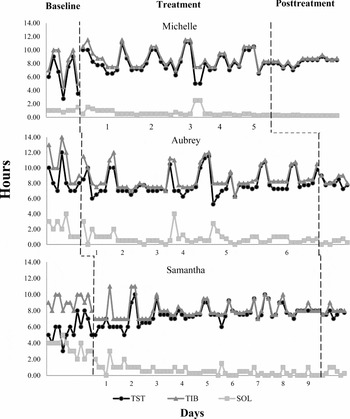
A nonconcurrent multiple baseline across subjects design was employed. Baseline data were extracted from sleep logs completed for 7, 8, and 13 days before intervention by Michelle, Aubrey, and Samantha, respectively. Following baseline, the girls continued to complete sleep logs throughout treatment and posttreatment (see Figure 1).
Individual adolescent sleep data from baseline, treatment and posttreatment for total sleep time (TST, circle data markers), time in bed (TIB, triangles), and sleep onset latency (SOL, squares)

This project complied with institutional privacy policies; institutional review board approval was not required for a retrospective report including three cases provided that all personal identifying information was removed.
Procedure
Treatment consisted of 1-hour sessions (range 5–9, depending on individual goals and progress) and included sleep hygiene training, bedtime routine development, cognitive restructuring, relaxation skills training, stimulus control, sleep restriction, bedtime fading, and problem-solving. Nightly skills practice and bedtime routine implementation were assigned to promote skill acquisition, generalization, and maintenance. Services were provided by a predoctoral intern or postdoctoral fellow (the first three authors) and supervised by licensed psychologists (including the last author). Intervention was guided by the empirical literature on children and adults, and the few studies available on adolescent sleep interventions. No formal treatment manual was used.
Sleep hygiene training
Adolescents received education about the benefits of, and factors influencing, healthy sleep and behavioural or environmental recommendations to improve sleep (calming bedtime routines, consistent sleep schedule, eliminating caffeine and daytime naps, relaxation before bed, a temperate, dark and quiet bedroom). Limited variation in weekday/weekend bed and wake times was allowed for adolescent lifestyle (1–2 hours later than weekdays).
Bedtime routine development
Adolescents and caregivers identified nightly activities that could prepare for the next day (e.g. lay out clothes, pack backpack), prepare for bed (e.g. take medications, brush teeth), and relax before and in bed (e.g. quiet reading, relaxation exercises).
Cognitive therapy/relaxation training
Adolescents were taught relaxation strategies (e.g. deep breathing, guided imagery, progressive muscle relaxation), cognitive restructuring (identifying automatic negative thoughts, modeling/rehearsal of replacement thoughts, positive self-talk), and self-monitoring to reduce arousal before bed and during NA.
Stimulus control
Adolescents were taught to restrict non-sleep and potentially arousing activities in bed (i.e. no homework, computers, or cell phones). They were encouraged to get out of bed if they experienced delayed sleep onset (>30 minutes) at bedtime or during NA, and once out of bed, to do a low-stimulation activity (e.g. reading) for a brief time before returning to bed and trying to reinitiate sleep.
Sleep restriction
Designated bed/wake-times were selected based on current sleep patterns; adolescents were encouraged to delay their bedtime (i.e. restrict TIB) to when they were likely to initiate sleep with ease. Then bed/wake times were advanced gradually.
Bed/wake time fading
Participants’ bed/wake times were gradually shifted to more consistent and appropriate schedules, taking into account motivation, readiness, and efficiency of sleep initiation (i.e. SOL < 30 minutes).
Problem-solving
Barriers to adherence were identified, then the clinician, adolescent, and, when appropriate, caregivers generated possible solutions, such as ways to balance competing psychosocial demands with good sleep hygiene.
Intervention techniques were further individualized as clinically indicated (e.g. contingent reinforcement for Michelle and Aubrey to increase motivation to complete/maintain bedtime routines); this information is included in the extended report (available online).
Results
Figure 1 presents baseline, treatment, and posttreatment data for each adolescent's TST, TIB, and SOL. At baseline, all three adolescent's TST and TIB was variable and each had longer than desired SOL. Visual inspection of data shows gradually increasing overlap of TST and TIB data, suggesting greater SE. A decreasing trend in SOL also is visible. These improvements occurred only after sleep intervention, and were replicated across participants.
Michelle participated in 5 treatment sessions. After treatment, she documented increased mean TST (baseline: 6.36 hours; posttreatment: 8.18 hours), decreased mean SOL (baseline: 1.04 hours; posttreatment: 0.27 hours), improved mean SE (baseline: 79%; posttreatment: 97%), a more consistent and appropriate mean time of sleep onset (baseline: 12:15 AM; posttreatment: 10:45 PM) and elimination of NA (baseline: 29%; posttreatment: 0%). She also reported decreased daytime fatigue and improvements in time management, coping, and sense of wellbeing.
Aubrey participated in 6 treatment sessions and, after treatment, maintained an adequate mean TST (baseline: 8.38 hours; posttreatment: 8.00 hours), demonstrated decreased mean SOL (baseline: 2.13 hours; posttreatment: 0.32 hours), improved mean SE (baseline: 80%; posttreatment: 96%), had a more consistent, moderately advanced, mean time of sleep onset (baseline: 1:30 AM; posttreatment: 12:00 AM), and decreased percentage of nights with NA (baseline: 38%; posttreatment: 14%). She reported improvement in her overall sleep, and planned to continue to fade her bedtime to be more developmentally-appropriate and increase her TST. She reported improvements in daytime fatigue, coping, and sense of wellbeing.
Samantha participated in 9 treatment sessions. Following treatment, she documented increased mean TST (baseline: 5.69 hours; posttreatment: 7.61 hours), decreased mean SOL (baseline: 3.46 hours; posttreatment: 0.43 hours), improved mean SE (baseline: 62%; posttreatment: 95%), a more consistent and appropriate mean time of sleep onset (baseline: 1:30 AM; posttreatment: 11:30 PM) and maintenance of low mean nightly frequency of NA (baseline: 0.23 (0–2); posttreatment: 0.43 (0–2). She reported less concern about NA, less daytime fatigue, and improvements in school functioning, coping, and sense of wellbeing.
Discussion
Following cognitive-behavioural intervention, sleep logs indicated participants increased or maintained TST, decreased SOL, improved SE, advanced sleep onset time, and decreased or maintained a low frequency of NA. Although the sample size was small, a multiple baseline design was employed. Baseline data documented sleep difficulties for all participants despite prior and ongoing other treatments. Treatment effects were observed only after the cognitive-behavioural intervention was introduced, and results were replicated across participants. These results contribute to the growing literature on multicomponent cognitive-behavioural sleep treatments and extend treatments established with children and adults to adolescents. Many variables impact sleep in adolescence, and multicomponent treatments may have particular utility for this population because they can be flexibly individualized to accommodate motivation for autonomy, competing psychosocial demands, and ambivalence about behavioural change. With appropriate guidance, our participants were able to productively implement individually and developmentally targeted sleep treatments that were acceptable and beneficial to them and their families with relatively brief intervention. They also reported secondary improvements in daily functioning, coping, and sense of wellbeing, following intervention.
Research is needed on the relative benefits of our treatment components, and future studies could be strengthened by actigraphy and standardized questionnaire data to corroborate sleep logs. Ultimately, randomized controlled trials with larger sample sizes are needed to empirically validate of this cognitive-behavioural intervention.




Comments
No Comments have been published for this article.