Bloodstream infections (BSIs) used to be classified as community-associated (CA) or nosocomial.Reference Garner, Jarvis, Emori, Horan and Hughes1 With more care provided outside hospital settings, nosocomial classification was considered obsolete and was replaced by healthcare-associated BSI (HCA-BSI), which includes community-onset (HCA-CO) BSI if the blood culture was collected within 3 days of facility admission from patients with defined healthcare exposure, and hospital onset (HO) if collected ≥4 days of facility admission.Reference Rock, Thom and Harris2–Reference Friedman, Kay and Stout5 This classification aims to distinguish patients at risk for less susceptible hospital-associated pathogens and contributes to monitoring healthcare facility performance measures. Accurate classification, however, requires the examination of historical information of individual patients. Many large retrospective studies and meta-analyses of HO BSIs are based on computer-generated identification through subtraction of admission date from the blood culture collection date in laboratory-identified bloodstream infections (LAB-ID BSIs).Reference Afonso, Blot and Blot6–Reference Cardosa, Almeida, Friedman, Aragao and Costa-Pereira8 This method may miss recent hospitalizations associated with BSI and classify these cases as HCA-CO according to current definition although they may well have been acquired during prior hospitalization. The shorter the period between discharge and BSI, the more likely the infection to be related to prior hospitalization. Readmission with BSI within 1–3 days probably represents incubating infection acquired prior to discharge. Lenz et alReference Lenz, Leal, Church, Gregson, Ross and Laupland9 considered BSI that occurs within 2 days of discharge to be HO BSI. The actual interval, however, is likely to vary according to the source and the organism. We looked at all cases with BSI to determine the frequency of recent hospitalization. We chose hospitalization within 14 days of BSI to look for possible HO during prior hospitalization (HO-PH).
Methods
We reviewed blood culture results between January 1, 2010, and December 31, 2017, selected patients with BSI defined as the isolation of a pathogen in 1 or more blood cultures and a commensal organism in 2 or more blood cultures within 48 hours. Place of onset was defined as CO if the first implicated blood culture was obtained within the first 3 days of admission and HO if 4 or more days of admission. The medical records of all patients were evaluated to determine the source, type of organisms, and antibiotic susceptibility. Source was identified based on clinical and microbiological criteria. Patients with CO BSI were examined to determine whether they were recently hospitalized and the date of latest hospitalization, abstracted from admission history and visit history to 5 regional hospitals. Bloodstream infections in patients discharged within 14 days were further reviewed to determine whether they represented HO-PH or HCA-CO infections. HO-PH was defined as BSI due to surgical site infection, intravascular line within 3 days of discharge without signs of infection during prior hospital stay, pneumonia within 3 days of discharge, and urinary tract infection within 1 day of discharge in patients with prior urinary instrumentation or indwelling catheters, based on the national healthcare and safety network (NHSN) guidelines for assigning BSI to hospital onset.10 A BSI in a recently discharged patient that did not meet HO-PH definition was considered an HCA-CO BSI. We compared HO-PH cases with HO-BSI and HCA-CO BSIs.
Statistical analysis
The significance of differences between groups were evaluated using the χ2 and Student t tests for categorical and continuous variables, respectively, using SPSS version 23.0 software (IBM, Armonk, NY). P < .05 was considered significant.
Results
We encountered 5,946 possible BSI episodes; 11 of these were considered contaminants and were excluded. Overall, 4,315 BSIs (72.7%) were considered CO cases. Prior hospitalization within the preceding 1–14 days was documented in 756 cases (17.5%), including 213 within 1–3 days of discharge and 543 within 4–14 days of discharge. Bloodstream infections in recently discharged patients were categorized as HO-PH in 109 cases (14.4%), including 65 patients readmitted within 1–3 days (30.5%) and 44 patients readmitted within 4–14 days (8.1%). These patients were readmitted from home (55.0%) or from an extended-care facility (45.0%). The source of HO-PH BSI was determined based on clinical plus microbiological findings in 54.1% and clinical findings only in the remainder.
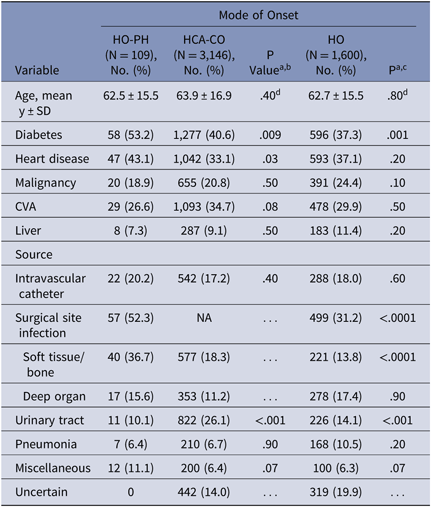
Patient characteristics in HO-PH, HCA-CO, and HO BSIs were similar except for mean age, incidence of diabetes, and heart disease (Table 1). The most common source in HO-PH cases was surgical site infection, which exceeded HO cases. In comparison, urinary tract infection was the predominant source in HCA-CO cases. The source of HO-PH BSI in patients discharged within 1–3 days included surgical site infection (n = 25, 38.8%), intravascular catheter within 3 days of discharge (n = 23, 35.4%), urinary tract infection within 1 day of discharge (n = 11, 16.9%), and pneumonia in patients with ventilatory support or post intubation (n = 6, 9.2%), including 1 case with Streptococcus pneumoniae pneumonia and bacteremia 2 days following laryngoscopy for stridor. The source in patients discharged within 4–14 days was mainly surgical site infection including wound infection and osteomyelitis (n = 30, 68.2%), peritonitis or deep organ infection (n = 8, 18.2%), endocarditis (n = 2, 4.5%), endometritis (n = 2, 4.5), pneumonia and empyema 7 days after lobectomy for malignancy (n = 1, 2.3%), and Streptococcus anginosus retropharyngeal abscess and bacteremia 5 days after transient endotracheal intubation for narcotics-related respiratory failure (n = 1, 2.3%).
Patient Characteristics and Source of Bloodstream Infection Stratified to Onset Type

Note. HO-PH, hospital-onset—previous hospitalization; HCA-CO, healthcare-associated community-onset; HO, hospital-onset; CVA, cerebrovascular accident.
a χ2 test unless otherwise specified.
b HO-PO vs HCA-CO.
c HO-PH vs HO.
d Student t test.
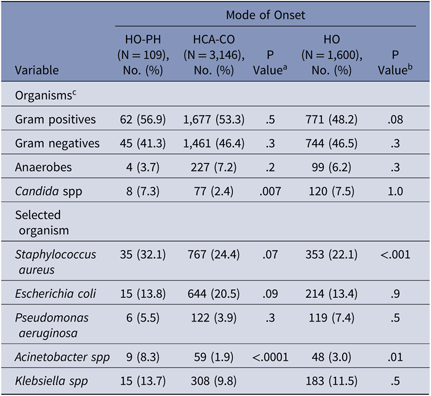
We stratified the type of organism according to onset mode (Table 2). Staphylococcus aureus predominated in all cases and was highest in HO-PH BSIs followed by HO BSIs, whereas E. coli predominated HCA-CO cases. Pseudomonas aeruginosa was more frequent in HO cases and Acinetobacter spp were more frequent in in HO-PH cases. Candida spp were more common in HO and HO-PH cases.
Type of Organisms in Bloodstream Infection Stratified to Onset Mode

Note. HO-PH, hospital onset–previous hospitalization; HCA-CO, healthcare-associated community onset; HO, hospital onset.
a χ2 test HO-PH vs HCA-CO.
b HO-PH vs HO.
c Organism % exceeded 100 due to polymicrobial cases.
Discussion
Many patients are treated for BSI during a hospital stay.Reference Garner, Jarvis, Emori, Horan and Hughes1 These infections are classified into CO and HO cases. Many studies focus on HO infections, a more clearly defined population with less need for historical information. However, a sizable proportion of infections recognized after discharge may have originated in the hospital and resemble HO cases in the type of infection and microbiology. When a patient is readmitted into the same or alternate healthcare facility, their BSI may not be captured as a HO-BSI case, which can lead to the underestimation of the infection risk to hospitalized patients.
Bloodstream infections in recently discharged patients have been categorized as a mixture of HO and CO infections. In our study, 14.4% of BSIs identified within 14 days after discharge were acquired during the preceding hospitalization and would have been misclassified as HCA-CO if historical information had not been included. Patients discharged within 3 days of readmission are at higher risk for misclassification of BSI. A surgical infection, however, may develop at a later date and may cause a delayed BSI. The NHSN assigns superficial and deep surgical infections that develop 30 and 90 days after surgery, respectively, to HO.
Based on these observations, a closer evaluation is needed for patients who are rehospitalized, presenting with infection. The artificial labeling of HO based on days of admission may miss important information that has infection prevention ramifications. Additionally, a consensus for classification of BSI in patients with recent hospitalization is needed.
Acknowledgments
Financial support
No financial support was provided relevant to this article.
Conflicts of interest
All authors report no conflicts of interest relevant to this article.