The essential character of Mania, is general delirium [delusions]; that is, delirium extending to a multitude of different objects, evinced by confusion and incoherence of ideas succeeding each other with morbid rapidity, and without connection. The perceptions are erroneous, and frequently accompanied with violent passions, as contempt, suspicion, anger, and hatred. Alexander Morison, Scotland 1828 (Morison, Reference Morison1828, p. 11).
Mania is a term, which appears to have been in use from the earliest period in the history of medicine. It has borne throughout very much its modern significance, expressed briefly in the old English synonym of furious madness…. the modern tendency certainly is to restrict the meaning of mania to a form of acute insanity having more or less definite limitations, and exhibiting certain groups of symptoms more or less distinctly marked. Dictionary of Psychological Medicine, Tuke (ed), 1892 (Tuke, Reference Tuke1892, p. 761).
As indicated by the present-day lay meaning of the term ‘maniac’, in the early nineteenth century, mania referred to a generic, agitated psychotic syndrome. In the first edition of his Treatise on Insanity written in 1801 (translated 1805), Phillipe Pinel (1745–1826), one of the founders of modern psychiatry, proposed four major categories of psychiatric illness: melancholia, mania, dementia, and idiocy. Cases of mania were, he described, ‘under the dominion of instinctive and abstract fury’ (Pinel, Reference Pinel1806, p. 150). Later, he noted that mania was
Marked by the lesion of one or more of the functions of the understanding, accompanied by emotions of gaiety, or despondence or of fury (Pinel, Reference Pinel1806, p. 159).
In 1856, the British alienist Monro noted that the syndrome of mania was traditionally applied to all patients who were ‘excited and raving’ (Monro, Reference Monro1856, p. 291). He noted that ‘We find practitioners in the present day using the word mania in this loose way … generally understood to be equivalent to lunatic’ (Monro, Reference Monro1856, p. 296).
In 1858, Bucknill and Tuke, in what was the most widely read psychiatric textbook in the UK in their day, began their description of mania by noting that earlier authors defined the syndrome as a disorder of reasoning dominated by delusions and agitated behavior or ‘raving madness’ (Bucknill & Tuke, Reference Bucknill and Tuke1858). But their view of mania differed from their forebears. They wrote ‘While we regard mania as usually having its origin in disordered emotions, we fully admit that the whole mind generally suffers in consequence’ (Bucknill & Tuke, Reference Bucknill and Tuke1858, p. 223). That is, in mania the emotional disorder was primary, and the delusional beliefs and disturbed behavior were secondary consequences of the disordered mood. Psychiatric historians, summarizing these developments, conclude that our current concept of mania is a product of the second half of the nineteenth century during which the older and broader definition of mania – as an agitated psychotic state – was gradually replaced with a narrower syndrome conceptualized as a disorder of affect (Berrios, Reference Berrios and Paykel1982; Healy, Reference Healy2008; Hill & Laugharne, Reference Hill and Laugharne2003). This conclusion is supported by two textbook authors writing in the late 1890s. In 1897, Clark, a well-known Scottish Alienist, noted that ‘Mania is a generic term which has been used rather loosely, until, like the word madness, its English equivalent, it has become almost synonymous in popular phraseology with insanity’ (Clark, Reference Clark1897, p. 145). In 1898, the American alienist Kellogg wrote ‘The term mania has been vaguely applied by some writers to all active forms of insanity; but it now signifies a distinct type of mental disorder, the opposite of melancholia, running an acute and definite course, and having well-defined symptoms’ (Kellogg, Reference Kellogg1897, p. 723). For a more detailed background in 19th psychiatry that forms the historical context of this inquiry, readers might consult the following: Goldstein (Reference Goldstein1987), Engstrom (Reference Engstrom2003), Scull et al. (Reference Scull, MacKensie and Hervey1996), Noll (Reference Noll2011).
Turning to the recent past, our current DSM criteria for mania derive, with modest changes, from those proposed in DSM-III in 1980 (American Psychiatric Association, 1980). The DSM-III criteria for mania were strongly influenced by those contained in the Research Diagnostic Criteria in 1975 (Spitzer et al. Reference Spitzer, Endicott and Robins1975) which were, in turn, partly based on those proposed by Feighner et al. (Reference Feighner, Robins, Guze, Woodruff, Winokur and Munoz1972). The Feighner criteria for mania are similar to those utilized in a 1967 paper from other faculty at Washington University (Hudgens et al. Reference Hudgens, Morrison and Barchha1967). Then, the historical trail peters out.
To further clarify the historical origins of our concept of mania, I reviewed the clinical descriptions of mania in 18 psychiatric textbooks published in Europe and North America from 1900 to 1956 (Kendler, Reference Kendler2016a). I started in the year 1900 because it was in 1899 that Emil Kraepelin presented for the first time his influential diagnostic synthesis including his concept of manic-depressive illness in the 6th edition of his textbook (Kraepelin, Reference Kraepelin1899). I identified 22 prominent symptoms and signs of mania reported by five or more authors, which closely resembled both those presented by Kraepelin (Reference Kraepelin1899), and those adopted in the DSM-III (American Psychiatric Association, 1980) and subsequent DSM editions. These 18 textbook authors reported a mean (s.d.) of 17.0 (2.3) of these symptoms/signs, the most common of which were elevated mood, grandiosity, hyperactivity, pressured speech, irritability, and new activities with painful consequences.
In this report, I follow the story of the diagnostic concept of mania back a further 20 years, from 1880 to 1900. I do this first by examining the clinical descriptions of mania in 25 psychiatric textbooks published during these 20 years. To quantify the continuity in the clinical views of mania from the late 19th to the twentieth century, I rated, in these nineteenth century texts, the presence/absence of the 22 characteristic manic symptoms identified in the twentieth century authors (Kendler, Reference Kendler2016a). Second, I examine the clinical descriptions of mania in three other important period documents: an influential monograph on mania by Mendel in 1881 (Mendel, Reference Mendel1881), the entry for mania in Tuke's, Reference Tuke1892 dictionary of Psychological Medicine (Tuke, Reference Tuke1892), and, Kraepelin's earliest detailed description of mania from the first edition of his textbook published in 1883 (Kraepelin, Reference Kraepelin1883).
The period of 1880–1900 was chosen for two major reasons. First, these were the years when Kraepelin was training and working in psychiatry in Munich, Leipzig, Dorpat, and Heidelberg (Kraepelin, Reference Kraepelin1987; Trede et al. Reference Trede, Salvatore, Baethge, Gerhard, Maggini and Baldessarini2005), and formulating his diagnostic synthesis presented in 1899 (Kraepelin, Reference Kraepelin1899). My goal is to describe the concept(s) of mania to which Kraepelin was exposed in the early and middle years of his professional life. Second, expert opinion in these years was especially well documented by a profusion of psychiatric textbooks providing an excellent historiographic resource.
Methods
I identified textbooks of Psychiatry authored by physicians published 1880–1900 from references available to me and from searches with the term mania, insanity, psychological medicine, psychiatry, alienism and German and French equivalents in https://archive.org and https://www.vialibri.net. I identified 25 usable textbooks from the USA (11), UK (six) (three from England and three Scotland), Germany (four), France (two), and Austria (two). I rejected three texts that provided insufficient clinical details (Folsom, Reference Folsom1886; Clark, Reference Clark1892; Gray, Reference Gray1893) and one – to be discussed later (Blandford, Reference Blandford1886) – that utilized a clinical concept of mania similar to early nineteenth century authors and so could not be well captured by our selected symptoms/signs.
I conducted this study in as similar a manner as possible to my prior investigation of twentieth century texts (Kendler, Reference Kendler2016b) reviewing carefully each book, and summarizing descriptions, if present, for the 22 commonly described manic symptoms and signs identified from the twentieth century authors (Table 1 and online Supplementary Appendix Table 1). For the sake of brevity, I term these characteristic manic symptoms. When possible, I used their actual words, but often for concision, paraphrased or condensed their text. Five issues arose during this review. First, I focused on the descriptions of what nearly all authors termed ‘mania’ (or some modification thereof such as acute mania or states of exaltation). In Table 1, I list the specific diagnostic label used by each author. Second, I never accepted symptoms/signs solely described in case reports. Third, if, as they often did, the author described several subtypes of mania (most typically simple, acute, delirious, delusional, and chronic), I took representative symptoms largely or entirely from the mildest category, the syndrome closest to the DSM concept of mania. I never included symptoms or signs only noted for delirious or chronic mania. Fourth, several authors described manic syndromes as part of ‘circular insanity’ or similar terms. I did not include those descriptions. Fifth, when textbooks had multiple available editions, I examined the earliest that I could find that fell within our time-period.
Descriptions of 22 characteristic symptoms and signs of mania in 25 textbooks and Tuke's Dictionary of psychological medicine published 1880–1900 (for results from an Additional 12 Textbooks see online Supplementary Appendix Table 1)

In addition to these 25 texts, I sought out other relevant material from various sources including major psychiatric and general medical Anglophonic journals published 1880–1900. However, this search yielded no useful articles. I did, however, find one key historical monograph on mania by the German neuropsychiatrist, Emanuel Mendel (1839–1907) (Mendel, Reference Mendel1881). Berrios recognized Mendel as ‘perhaps the greatest specialist on mania’ (Berrios, Reference Berrios, Georgotas and Cancro1988, p. 16) during the late nineteenth century and argued that his monograph was the first major work to use the modern definition of mania (Berrios, Reference Berrios2004). Mendel's monograph was the first citation in Kraepelin's chapters on mania in the 1st (Kraepelin, Reference Kraepelin1883), 2nd (Kraepelin, Reference Kraepelin1887), 3rd (Kraepelin, Reference Kraepelin1889), 4th (Kraepelin, Reference Kraepelin1893), and 5th editions (Kraepelin, Reference Kraepelin1896) of his textbook. I also examined the entry for mania in Tuke's Dictionary of Psychological Medicine published in 1892 (Tuke, Reference Tuke1892). Finally, because of its direct historical relevance, I examined in detail the description of mania in the first edition of Kraepelin's textbook, published in 1883 when he was 27 years old (Kraepelin, Reference Kraepelin1883).
Where possible, I relied on English translations. When none was available, I worked with the French and German texts, relying extensively on on-line translators and dictionaries. I had the assistance of a professional German-English translator, Ms. Astrid Klee, for key sections of Mendel and Kraepelin. The translations of the textbooks in Table 1 (and online Supplementary Appendix Table 1) are rough and literal with no claims to linguistic subtlety or high literary quality.
Results
Survey of textbook descriptions
The number of 22 characteristic manic symptoms and signs described in each of the 25 textbooks outlined in Table 1 (and online Supplementary Appendix Table 1) ranged from 11 to 19 with a mean (s.d.) of 15.9 (2.3), non-significantly lower than those reported by the twentieth century authors (t = 1.58, df = 41, p = 0.12) (Kendler, Reference Kendler2016b). The frequency of the occurrence of each of the 22 symptoms in the nineteenth and twentieth century texts were compared by a Fisher exact test (two-tailed) with a Bonferroni corrected p value of 0.05/22 = 0.002. None differed at this threshold. A Spearman rank correlation of the frequency of reporting of the 22 symptoms/signs in the late nineteenth and the twentieth century authors was r = +0.64 (p < 0.001).
All 25 authors described, in a variety of ways, mood changes as present and prominent in the manic syndrome. The terms applied were diverse and included ‘exuberance, exaltation, excitement, boisterousness, gayety, hilarity, ecstasy, joyfulness, elevation, euphoria, elation, expansiveness, exuberance, and cheerfulness.’ While most authors emphasized the importance of elevated mood in their description, this was not the case for three of them, two of which published in the early 1880s. Schüle noted joy as often present but put greater emphasis on the intense display of a wide variety of moods with irritability and anger as prominent as more positive affect, sometimes with sadness inter-mingled (Schüle, Reference Schüle1880). Luys emphasized excitation and hyperactivity in the manic state without a clear description of prominent positive mood (Luys, Reference Luys1881). Clark (Reference Clark1897) also does not clearly describe euphoria or increased well-being. He pictures mania as an agitated state, which could be grandiose but as likely was paranoid, irritable, and irascible.
Twenty-three or 24 of our authors described five other key symptoms and signs of mania: hyperactivity, pressured speech, delusions, disorganized speech, and hallucinations. When commented upon, the content of the delusions and hallucinations were usually grandiose but sometimes persecutory. A number of authors noted that the delusions were often fleeting and not fixed in nature, and usually ‘remain[ed] within certain limits not far removed from possibility’ (Wernicke, Reference Wernicke2015).
Twenty-two of our 25 authors noted non-delusional grandiose ideation, reductions in sleep and often colorful descriptions of the effects of an increased sex drive. Twenty authors described a basal sense of increased well-being (using additional terms such as joyfulness, self-confidence, cheerfulness, and hopefulness) and a range of alterations in appetite as important parts of the manic syndrome.
Nineteen authors noted a change in moral standards as typical in mania. Comments include ‘a conspicuous character transformation…they demonstrate a range of bacchic and venereal misdeeds, … from having held the most moral sentiments, the patient expresses licentious and obscene views… A deterioration of the moral and social self.’
The effects of poor judgment, often in financial, business or romantic ventures, were described by 17 authors. Sixteen authors commented on the frequent presence of irritability during manic episodes and a change in the patient's physical appearance, particularly looked younger, the skin looking fresh and healthy and the eyes bright and sparkling.
Fifteen authors comment on mood lability, 14 on impulsivity and 13 on distractibility prominent during mania. The remaining symptoms and signs, noted by 12 or fewer of the authors, include changes in body weight, improved sense of humor or wittiness, hypergraphia and lack of insight.
While not noted in the twentieth century texts, 10 of our nineteenth century authors commented about the heighted sensory acuity associated with mania with the following descriptions being typical:
Demonstrate a hyperesthesia of the senses: all sensations are felt in a more intense way (Schüle, Reference Schüle1880)… perceptions appear more acute (Spitzka, Reference Spitzka1883) … The organs of special sense are almost always the seat of a more or less marked hyperesthesia (Régis, Reference Régis1895).
Fifteen of our authors commented about course and outcome, eight of whom gave estimates of the average duration, the mean (s.d.) of which was 4.3 (1.5) months. Eleven commented on prognosis and/or the probability of recovery. All stated that general prognosis was favorable, some noting that relapse was relatively common. One wrote ‘Mania is one of the most curable of all forms of insanity’ (Kellogg, Reference Kellogg1897) and another ‘I would further say that cures may be perfect, so that the patient becomes as sane and reasonable as ever he was in his life’ (Savage, Reference Savage1884). When noted, recovery rates were estimated at between 70 and 80%.
Mendel's monograph
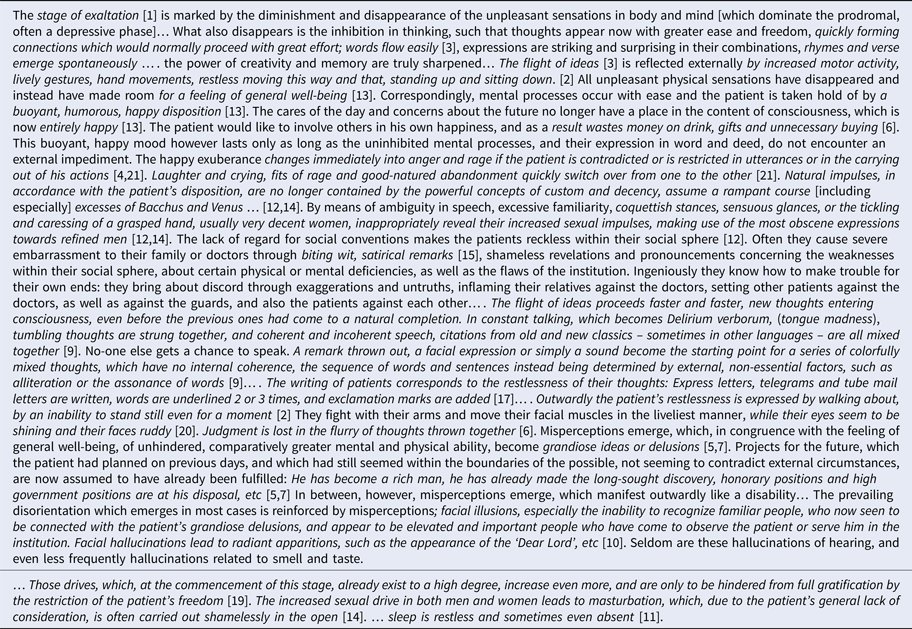
The 196-page monograph ‘Die Manie’ was published in 1881 and contained, in its section ‘Die Pathologie der Manie,’ a detailed clinical description of the syndrome as understood by Mendel. Table 2 contains a condensed version of his key section on the ‘Exalted Stage’, in which Mendel makes specific mention of 18 of the 22 characteristic manic symptoms, all but distractibility, chance in appetite and body weight and lack of insight. I have italicized the sections that describe these symptoms and give the numbers for each symptom/sign as listed in Table 1.
Translation of a condensed version of Emanuel Mendel's ‘Die Manie: Eine Monographie 1881’ pp. 15–19. Chapter 2, The Pathology of Mania: Typical Mania. The Exalted Stagea

a Numbers in square brackets reflect the characteristic manic symptoms as enumerated in Table 1 with the relevant text in italics.
His introductory paragraph emphasizes three core features of mania: a speeding up and increased freedom of thought, motoric hyperactivity and mood elevation. His detailed clinical sections contain often rich descriptions of affective instability, pressured and tangential speech, increased libido and associated change in ‘moral standards,’ and grandiose ideation.
Tuke's dictionary
D. Hack Tuke (1827–1895) edited a two volume 1477-page dictionary of Psychological Medicine published in 1892, the first of its kind. It contained a detailed seven-page entry on mania (Tuke, Reference Tuke1892, pp. 761–767) which provided often vivid examples of 18 of the 22 characteristic symptoms and signs of mania (which are detailed in the last entry into Table 1). The entry begins with the introductory quote above and then goes on as follows:
Mania may be defined as being an affection of the mind characterized by an acceleration of the processes connected with the faculty of imagination together with emotional exaltation, psychomotor restlessness, and an unstable and excitable condition of the temper (Tuke, Reference Tuke1892, p. 761).
Only poor judgment, change in moral standards, excess writing and lack of insight are not described.
Kraepelin's first edition
Fortunately, Kraepelin has left us with an excellent record of his clinical views of mania early in his career. He finished his formal psychiatric training with von Gudden in Munich in 1881. In 1882–1883, he was living in Leipzig both studying with the founder of experimental psychology, Wundt, and working as a clinical assistant to the neurologist/neuropathologist, Wilhelm Erb. He was then approached, via a friend, with an offer to write a compendium of psychiatry by a recognized publisher. Wundt encouraged him to undertake this, which he did, completing most of it in the spring of 1883 when he was 27 years old (Kraepelin, Reference Kraepelin1987, pp. 23–25).
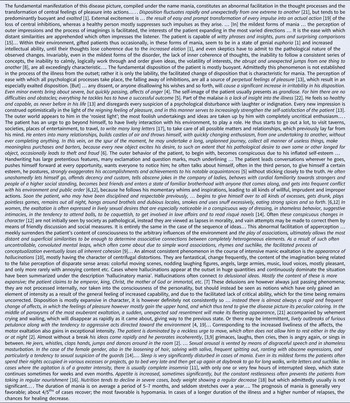
The section on mania takes up 20 of the 384 pages of this ‘compendium’ which were newly translated for this essay (Kraepelin, Reference Kraepelin1883). A complete translation is given in the online Supplementary Appendix and a condensed version – focusing on the symptoms and signs of mania – is provided in Table 3 with the same numbering and italicization as Table 2. Kraepelin provided often vivid descriptions of all the major symptoms and signs of mania except characteristic changes in physical appearance.
Translation of a Condensed Version of Emil Kraepelin's Compendium der Psychiatrie zum Gebrauche für Studirende und Aerzte (1883): Mania (pages 241–261)a (Kraepelin, Reference Kraepelin1883)

a Numbers in square brackets reflect the characteristic manic symptoms as enumerated in Table 1 with the relevant text in italics.
Conceptualizations of mania
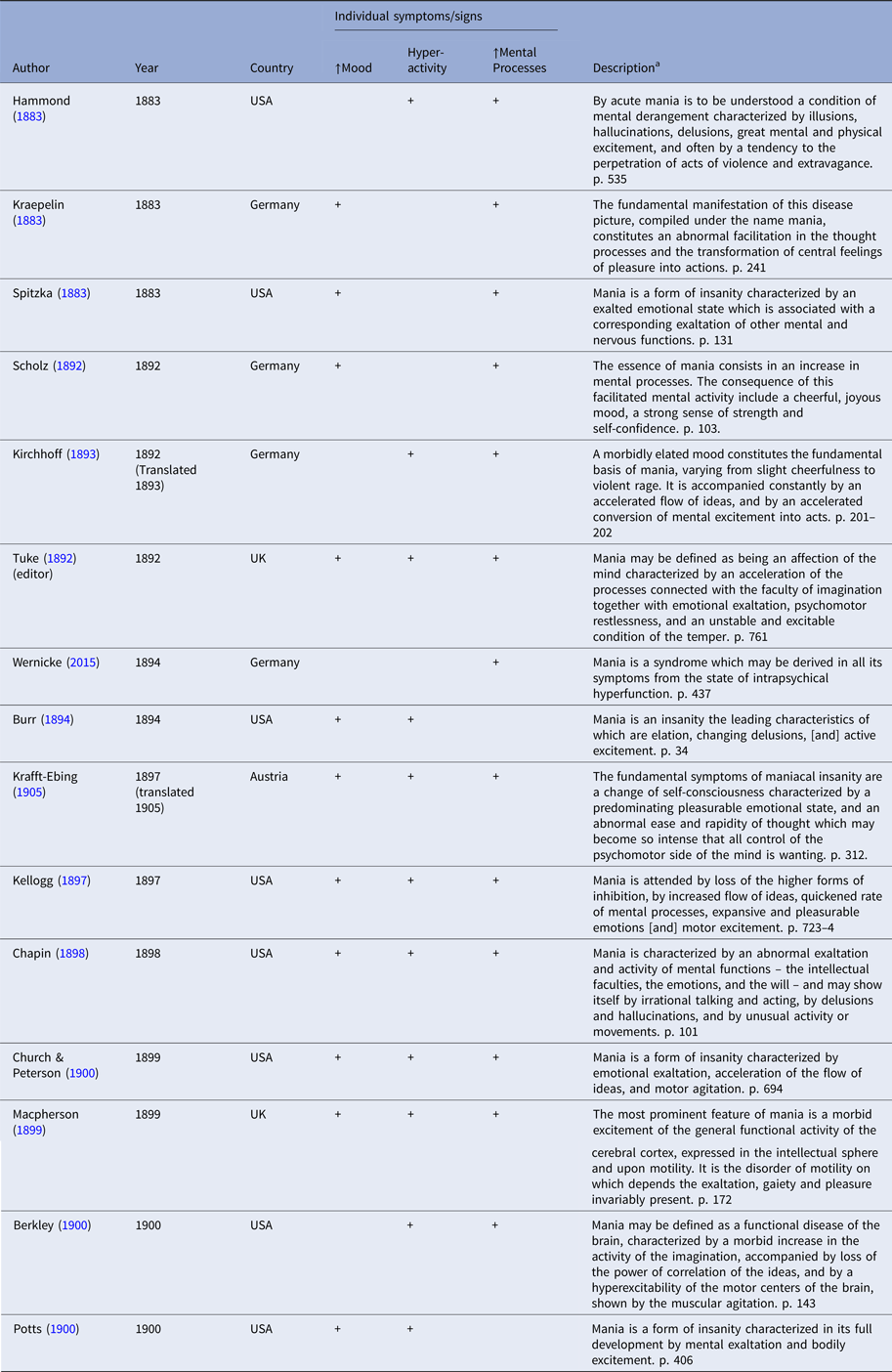
Finally, 15 of our authors provided concise and readily interpretable definitions of mania (Table 4). The three most frequency mentioned fundamental symptoms were: accelerated mental processes – 13, elevated mood – 11, and hyperactivity – 11. Of these authors, six note all three symptoms, eight note two and only one – Wernicke (Reference Wernicke2015) – reports a single key symptom – for him ‘intrapsychical hyperfunction’.
Concise descriptions of the nature of the manic syndrome from 15 Authors 1880–1900

a Sometimes shortened/abbreviated for conciseness.
Discussion
Two bodies of evidence set the stage for this inquiry. First, historical studies have demonstrated that the syndrome of mania at the beginning of the nineteenth century was non-specific, reflecting a generic picture of agitated insanity. Over the nineteenth century, our modern concept of mania – as an affectively-based syndrome with well-characterized symptoms and signs – gradually emerged (Berrios, Reference Berrios and Paykel1982; Healy, Reference Healy2008; Hill & Laugharne, Reference Hill and Laugharne2003). Second, my prior inquiry showed that the depiction of mania in psychiatric textbooks written from 1900 to 1956 (Kendler, Reference Kendler2016a) was congruent with our modern concept of the syndrome as captured by the mania criteria in DSM-III (American Psychiatric Association, 1980), although many of the textbook authors provided a wider range of symptoms and signs.
This study therefore examined the nature of the descriptions of the manic syndrome over the critical years of 1880–1900 during which modern psychiatric nosology was shaped by Emil Kraepelin. I used contemporary documents to attempt to distinguish between two hypotheses: (i) something approaching the modern concept of mania was widely accepted by 1880 and was incorporated with little change into Kraepelin's structure of manic-depressive illness, and (ii) the concept of mania as a psychiatric syndrome was in substantial flux during these years and was only stabilized by Kraepelin with his creation of manic-depressive insanity in 1899.
Two major sources of information were brought to bear on this question. I first examined descriptions of mania in 25 textbooks published from 1880 to 1900 and compared these descriptions with those previously examined from the twentieth century textbooks (Kendler, Reference Kendler2016a). The symptoms and signs used to describe mania were similar in the two sets of texts. The mean number of recorded symptoms – from the 22 characteristic symptoms selected from the twentieth century texts – did not differ. No individual symptom/sign was reported more frequently in one group than the other. The rank order of frequency with which they were reported was highly correlated in the two sets of documents.
There were, however, some differences in the nineteenth century descriptions. First, we found one textbook published in 1886 which stood out qualitatively (Blandford, Reference Blandford1886). In his description of mania, Blandford made no mention of euphoria, grandiosity, pressured speech, poor judgement, unrealistic plans, or increased libido. No changes were noted in well-being. Rather, the picture of mania was of an agitated, disruptive, disinhibited psychosis patient, similar to the non-specific syndrome of mania dominant earlier in the century. Second, for three of our textbook authors, positive mood was noted but not emphasized as much as agitation, irritability or anger (Schüle, Reference Schüle1880; Luys, Reference Luys1881; Clark, Reference Clark1897). Third, a different set of four authors (of the 15 who provided succinct definitions of mania, Table 4) did not include elevated affect as a key symptom (Hammond, Reference Hammond1883; Kirchhoff, Reference Kirchhoff1893; Berkley, Reference Berkley1900; Wernicke, Reference Wernicke2015). The transition in the conceptualization of mania for a non-specific psychotic illness to a defined affective syndrome was, although well on its way by 1880, likely not entirely complete by 1900.
We verified the results from our textbook analysis by an examination of three additional important contemporaneous documents. In his influential monograph on Mania, Mendel in 1881 described in considerable detail a clinical picture of mania very similar to that given by the twentieth century authors. The compact but thorough entry on mania in the first dictionary of Psychological Medicine in 1892 also closely resembled modern textbook descriptions of mania (Tuke, Reference Tuke1892). Both important texts noted the presence of 18 of our 22 characteristic manic symptoms. Most definitively, Kraepelin's first description of mania from 1883 included 21 of the 22 characteristic manic symptoms and closely resembled in both tone and content those provided by the twentieth century psychiatric textbook authors. Importantly, in our prior historical paper on mania (Kendler, Reference Kendler2016a), we noted that Kraepelin's lengthier description of mania in his critical 6th edition (Kraepelin, Reference Kraepelin1899) – which contained the first full proposal for MDI – was very similar in content including descriptions of all 22 of our characteristic manic signs and symptoms.
Fifteen of our authors provided succinct definitions of mania, which were dominated by three underlying psychopathological constructs: accelerated mental processes, elevated mood and physical hyperactivity. Not surprisingly, these results are congruent with our findings that elevated mood, hyperactivity and increased rate and quantity of speech were the three most commonly reported manic symptoms and signs among our 1880–1900 textbook authors. They also suggest that the commonly expressed view of psychiatric historians that mania developed over nineteenth century into a specific disorder of affect (Berrios, Reference Berrios and Paykel1982; Hill & Laugharne, Reference Hill and Laugharne2003; Healy, Reference Healy2008) is slightly oversimplified. While elevated mood was understood to play a central role in manic psychopathology, many authors saw changes in the speed of cognitive processing and level of physical activity to also represent important pathological processes that were not always considered secondary to morbid changes in mood. These findings are supportive of the extension of the primary criterion of the manic syndrome in DSM-5 to include ‘persistently increased activity’ (American Psychiatric Association, 2013; Machado-Vieira et al. Reference Machado-Vieira, Luckenbaugh, Ballard, Henter, Tohen, Suppes and Zarate2017). In our description of the twentieth century texts on mania, we noted nine authors who reported signs and symptoms they considered to be primary (Kendler, Reference Kendler2016a). All of them emphasized the same three features: elevated mood, hyperactivity and increased rate of speech. This list is obviously closely related to those features emphasized by textbook authors from 1880 to 1900.
In aggregate, our results presented suggest a high degree of consilience between the clinical views of mania in the 20 years prior to the publication of Kraepelin's key 6th edition and the 60 years after. Our various sources concur in supporting the hypothesis that the modern concept of mania was largely, although not completely, formed by 1880. Thus, the historical evidence strongly suggests that Kraepelin incorporated into his overarching structure of manic-depressive illness, the concept of mania as a well delineated broadly defined affective syndrome that he learned early in his career. It is important to note that, as documented by Trede et al. (Reference Trede, Salvatore, Baethge, Gerhard, Maggini and Baldessarini2005), it is the syndrome of mania that stayed relatively constant from 1880to 1900. By contrast, the nosologic status of mania changed dramatically across Kraepelin's textbooks from a free-standing independent disorder to a phase of illness within MDI.
What was responsible for the emerging consensus in the diagnostic view of mania in the late nineteenth century? While I lack data that directly address this question, some speculation is warranted. First, the increasing influence of faculty psychology across this time period helped provide a conceptual underpinning for the emergence of a mood-centered definition of mania (Berrios, Reference Berrios, Georgotas and Cancro1988). Second, especially in Germany, the focus of psychiatric research was shifting from asylums to universities and psychiatric journals and textbooks began to proliferate in Europe and the USA after mid-century (Engstrom, Reference Engstrom2003). The improved communication and the rise of widely recognized experts (e.g. Mendel (Reference Mendel1881)) may have helped build a diagnostic consensus about the nature of mania.
Conclusion
This review has produced strong evidence for clinical and phenomenological continuity of the concept of mania described in the mainstream Western psychiatric tradition over the last 135 years. Kraepelin helped to pass on this tradition via his widely-adopted concept of manic-depressive illness, but did not substantially alter the view of nature of the syndrome of mania that he learned as a training psychiatrist. As we saw in our earlier review covering the twentieth century (Kendler, Reference Kendler2016a), the expert clinicians of the late nineteenth century described a broader array of symptoms and signs for mania than is contained in our DSMs. Furthermore, their descriptions of the classical symptoms were often richer than are depicted in most modern texts. Our current clinical concept of mania has demonstrated sustained clinical utility and a substantial degree of stability over time and space.
Supplementary material
The supplementary material for this article can be found at https://doi.org/10.1017/S0033291717002768
Acknowledgements
None.
Declaration of Interest
The author has no conflict of interest to report.