


Full-depthavalanches or ground slab avalanches occur very often on mountain slopes covered with dwarf bamboo bushes in Hokkaido, Japan. Their release process is as follows:
1 The snow cover starts sliding at an upper part of the slope; this causes the formation of cracks, which are called glide cracks or “avalanche mouths”.
2. Gradually the cracks increase in length, width, and number.
3. Growth of the cracks reaches a point at which the snow mass suddenly moves downwards at a fairly high speed, developing as a full-depth avalanche.
Observations and analyses have already been made on the growth of cracks as a gliding mechanism at the snow—ground interface (Reference Endō and AkitayaEndo and Akitaya, 1378). Both the progress of the cracks and deformation of the snow cover are too slow to be observed with the naked eye. It often takes several hours or even days from the time of the formation of cracks to the time of release of the snow mass. The release takes place suddenly and the movement of the snow mass as an avalanche is completed within an extremely short space of time. So it is difficult to observe in detail the initiation of the release of an avalanche without a recorder.
During the past 7 years the author has succeeded eight times in recording the release and down-slope movement of avalanches which occurred naturally on a mountain slope.
The observations were made in a mountainous area of the Teshio District, Hokkaido, where the Avalanche Research Station of Hokkaido University is located. The south slopes in this area have a uniform angle of about 30-35˚ and they are covered only by dwarf bambo stands 80-100 cm in height. Many avalanches occur on these slopes every year but none has been observed on the north slopes where there arc large trees. In mid-winter the mean snow depth on the south slopes ranges from 80 to 120 cm.
A television camera was set up on top of the station on a ridge and directed towards the neighbouring south slope about 400 m away ready for recording an avalanche with a video recorder; this is designed to record three consecutive pictures per second with the time expressed in digits at the bottom left-hand side of each picture; one reel of magnetic tape, 8 in [20 cm] in diameter, will run continuously for a total of 12 h. When cracks were observed on the slope, the television camera was pointed at them and turned on to record the release process of an avalanche in motion from the time the cracks were found.
After the avalanche had finished, the magnetic tape storing a visual record of the avalanche was taken out and a new one put in ready for recording another avalanche. Afterwards the pictures were reproduced on the screen of a TV monitor in a stop motion, so that every picture of the avalanche was taken both by a still and a cine camera.
The process of avalanche release, namely the transitional process from a static state to the beginning of movement of a snow mass, was classified into three types:
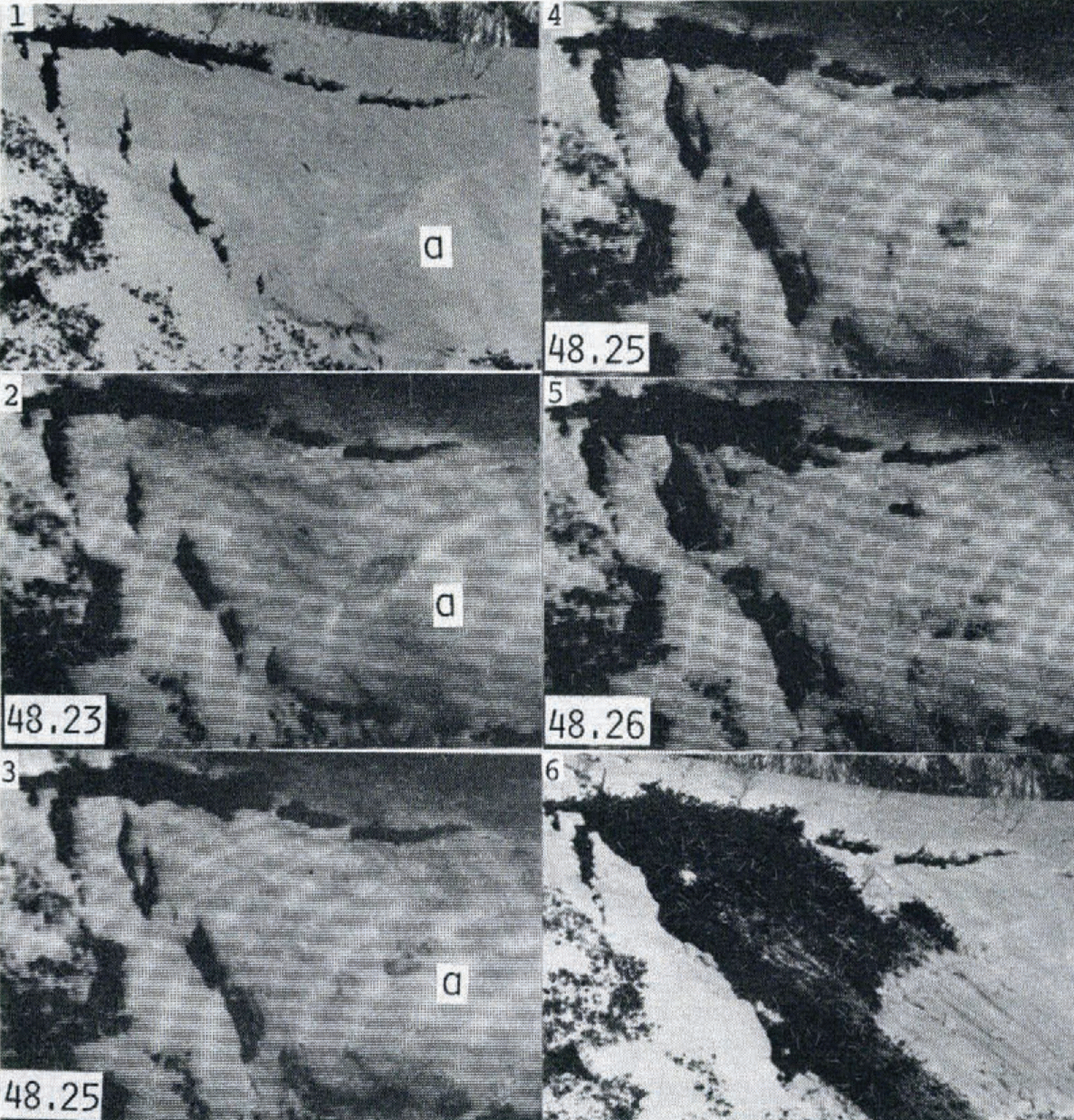
Type A Some undulations and folds caused by gliding of the snow mass are formed on the snow cover below the cracks. A fold which has appeared in a compression zone ruptures suddenly; subsequently, the snow slab between the cracks and the fold descends the slope. The rupture acts as a trigger to the release of the snow slab, developing as a full-depth avalanche (Fig. 1).
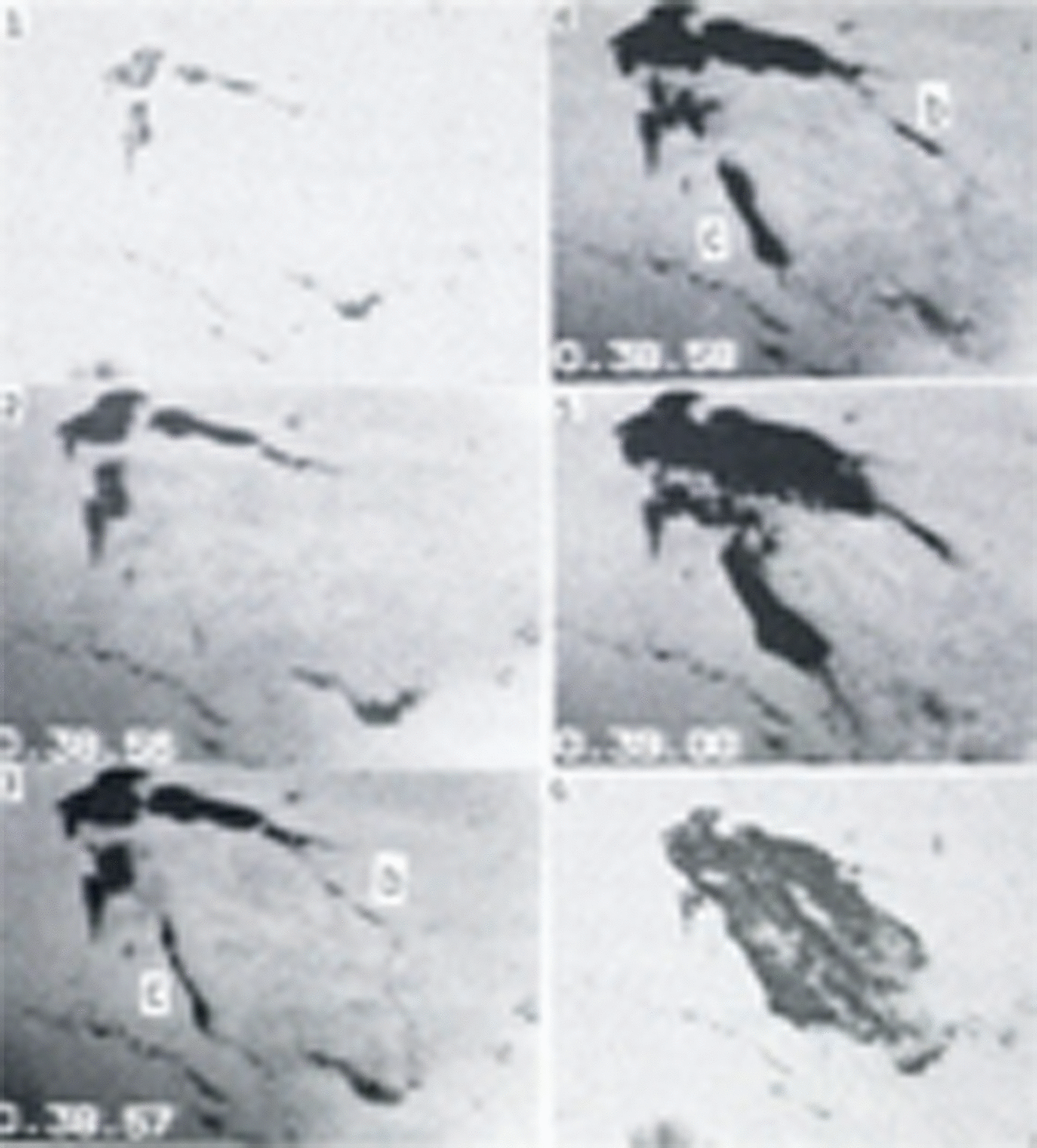
Type B Folds are formed but they do not show a typical rupture pattern. Instead, new downwardtrending longitudinal cracks are formed at both ends of the upper parts of the original cracks. The snow slab is released simultaneously with the formation of the new cracks (Fig. 2).
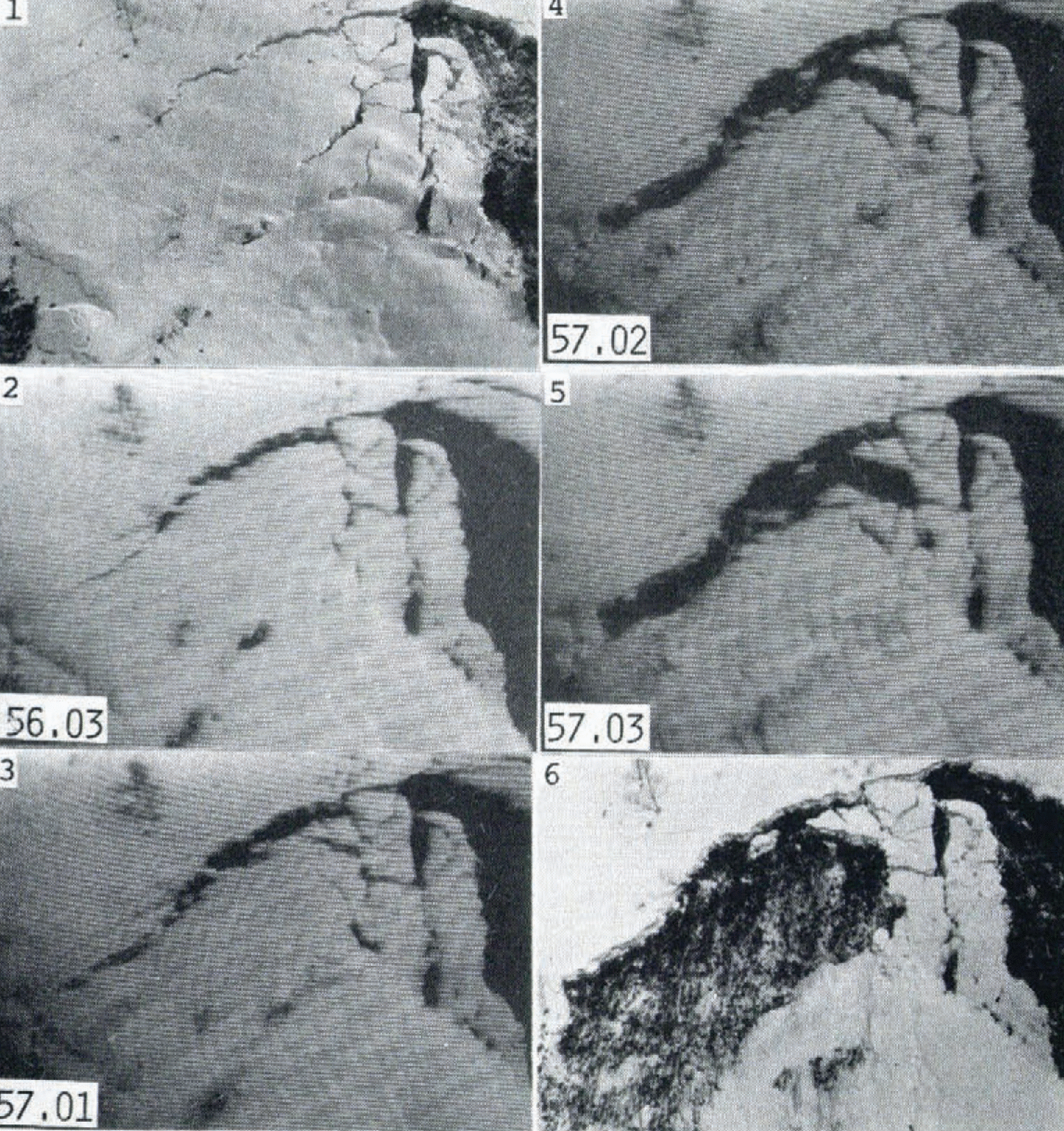
Type C The typical signs mentioned above are not recognized. The snow slab beneath the cracks suddenly descends without any warning (Fig. 3).
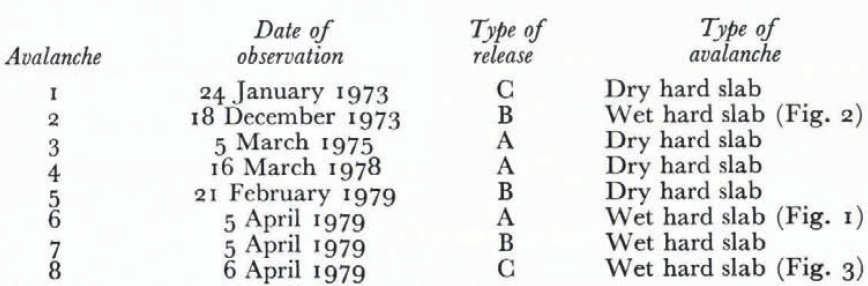
Table 1 gives the date, type of release, and type of avalanche of the eight avalanches which were successfully recorded.
An avalanche of type A release recorded at 11.48 h, 5 April 1979. Photographs 1 and 6 were taken with a still camera about 2 h before and 30 min after the release of the avalanche, respectively. Pictures 2—5 were taken with a VTR, in which numerals on the lower left side represent the time sequence in minutes and seconds. A fold indicated by “a” on the pictures began to collapse at 48 min 25 s. The snow slab then started to release itself as a full-depth avalanche.
An avalanche of type B release recorded at II.38 h, 18 December 1973. Pictures 1 and 6 were taken about 2 h before and about go min after the release of the avalanche, respectively. Two new cracks "b" and “c”, extending from the sides of each of the original cracks, appeared at 38 min 57 s and the release of the snow slab began at the same instant.
An avalanche of type C release recorded at 11.57 h, 6 April 1979. Pictures t and 6 were taken about 3 h before and 30 min after the release of the avalanche, respectively. The snow slab began to release itself at 57 min 01 s without any warning such as the rupture of a fold or the formation of new cracks, as are seen in types A and B.
Types of Release, and Type of Avalanche of the Eight Avalanches
It was discovered from the pictures taken that the mass of a snow slab sliding along the slope was rigid for 3 or 4 s after release began and that thereafter it began to disintegrate into smaller discrete blocks, which rolled over each other in a turbulent motion. But the front face of the turbulent flow could not be followed because it was off the TV screen. The relationship between the time elapsed and distance travelled from initiation of the slide motion was estimated from both the slope profile and the pictures. On the assumption that a constant resisting force was applied to the sliding slab by kinetic friction, as staled by Reference MellorMellor (1968), the frictional resistance may be significant in slow-speed sliding.
The distance S of the sliding snow slab a time t after the start of release is:

where α is the angle of slope, and µ is the coefficient of kinetic friction. Values for the coefficient µ, obtained from the equation using data for the three avalanches 1, 2, and 3 in Table I, are given in Table II.
COEFFICIENTS OF KINETIC FRICTION OBTAINED FROM VTR PICTURES



