






1 Introduction
Piecewise contractions (PCs) are piecewise smooth self-maps of a metric space that act on each of its continuity domains by decreasing the distance between pairs of points. Their importance stems from countless dynamical systems whose dynamics is governed by them: pseudo-billiards and switched server systems [Reference Antunes, Bugeaud and Pires1, Reference Blank and Bunimovich3, Reference Chase, Serrano and Ramadge14, Reference Fernandes and Pires16], outer billiards with contraction [Reference Del Magno, Gaivão and Gutkin15, Reference Gaivão17, Reference Jeong26, Reference Jeong27], polling systems [Reference MacPhee, Menshikov, Popov and Volkov31], best-response dynamics in game theory [Reference Gaivão and Peixe21], election methods [Reference Janson and Öberg25], and neural networks [Reference Catsigeras and Guiraud11, Reference Pires36], just to name a few. PCs also arise in subjects of pure mathematics such as non-trivial recurrence on surfaces [Reference Bowman and Sanderson4, Reference Gutierrez22, Reference Gutierrez and Pires23], uniform distribution of sequences modulo one [Reference Bugeaud7], b-ary expansion of real numbers [Reference Antunes, Bugeaud and Pires1, Reference Pires35], and Hecke–Mahler series [Reference Bugeaud, Kim, Laurent and Nogueira8, Reference Gaivão, Laurent and Nogueira19, Reference Laurent and Nogueira29, Reference Laurent and Nogueira30].
While a contraction acting on a compact or complete metric space always has a unique globally attractive fixed-point, a piecewise contraction with discontinuities may have lots of locally attractive limit cycles and Cantor attractors coexisting side by side.
Thanks to a series of recent works, the dynamics of one-dimensional PCs (that is, PCs of the interval with finitely many discontinuities) is by now well understood. For instance, it is known that the attractor of locally injective PCs of the interval is the union of a finite number of periodic orbits with a finite number of Cantor sets [Reference Calderon, Catsigeras and Guiraud10]. However, the existence of Cantor attractors is rather exceptional. Indeed, in the measure-theoretical sense, a generic PC of the interval is asymptotically periodic, that is, the global attractor is formed by a finite number of periodic orbits [Reference Gaivão and Nogueira20, Reference Nogueira, Pires and Rosales32, Reference Nogueira, Pires and Rosales33]. Moreover, in some cases, the set of exceptional parameters where Cantor attractors exist has zero Hausdorff dimension [Reference Gaivão18]. The following facts are also known: the subword complexity of symbolic orbits of PCs of the interval is either uniformly bounded or a linear function [Reference Catsigeras, Guiraud and Meyroneinc12, Reference Pires34]; PCs of the interval with no periodic orbits and a Cantor attractor can be constructed as suspensions of any minimal interval exchange transformation [Reference Pires34].
A paradigmatic example of a one-dimensional PC is the contracted rotation on
 $[0,1)$
:
 $f_{\unicode{x3bb} ,b}(x)=\unicode{x3bb} x + b \pmod {1}$
with
 $0<\unicode{x3bb} <1$
and
 $1-\unicode{x3bb} <b<1$
. Lifting
 $f_{\unicode{x3bb} ,b}$
to
 $\mathbb {R}$
, one can define a rotation number
 $\rho (f_{\unicode{x3bb} ,b})\in [0,1)$
that describes the asymptotic average rotation of any orbit of
 $f_{\unicode{x3bb} ,b}$
. It is known that
 $f_{\unicode{x3bb} ,b}$
has a Cantor attractor if and only if
 $\rho (f_{\unicode{x3bb} ,b})$
is an irrational number. When
 $\rho (f_{\unicode{x3bb} ,b})$
takes a rational value
 $\frac {p}{q}$
with co-prime positive integers p and q, the contracted rotation
 $f_{\unicode{x3bb} ,b}$
has a single global attracting periodic orbit with period q. Since the rotation number varies continuously and non-decreasingly with the parameter b, every rotation number in the interval
 $(0,1)$
is realizable by some
 $b\in (1-\unicode{x3bb} ,1)$
. Thus, the set of parameters
 $(\unicode{x3bb} ,b)$
, where
 $f_{\unicode{x3bb} ,b}$
has Cantor attractors is uncountable, has Hausdorff dimension
 $\geq 1$
, but has zero Lebesgue measure [Reference Bugeaud6, Reference Laurent and Nogueira29].
In contrast to one-dimensional PCs, less is known about the dynamics of multi- dimensional PCs. In [Reference Catsigeras, Guiraud, Meyroneinc and Ugalde13], it is proved that multi-dimensional PCs are asymptotically periodic whenever the attractor and the set of discontinuities are disjoint. However, such a sufficient condition turns out to be rather difficult to be verified in parameterized families of PCs, which are relevant for many applications. In [Reference Bruin and Deane5], it is proved that asymptotic periodicity is a generic property (in the measure-theoretical sense) of a family of piecewise-affine conformal contractions defined in
 $\mathbb {R}^2$
and sharing the same domains of continuity. The family is obtained by vertical translation of the graph of any PC in the family. Very recently, it was proved in [Reference Jain and Liverani24] that for a generic partition, in a Baire residual sense, the attractor of locally injective PCs on compact subsets of
 $\mathbb {R}^d$
is disjoint from the set of discontinuities, implying that the attractor consists of a finite number of periodic orbits. The authors also prove that PCs are generically topologically stable. However, the results of [Reference Jain and Liverani24] cannot be applied to parameterized families of multi-dimensional PCs.
In this article, we study genericity, from a measure-theoretical point of view, of asymptotic periodicity in parameterized families of multi-dimensional PCs. More precisely, we provide criteria (Theorem 2.9) to show that an arbitrary family
 $\{f_{\mu }\}_{\mu \in U}$
of locally bi-Lipschitz piecewise contractions
 $f_\mu :X\to X$
defined on a compact metric space X is asymptotically periodic for Lebesgue almost every parameter
 $\mu $
running over an open subset U of the M-dimensional Euclidean space
 $\mathbb {R}^M$
. Our criteria consist of two conditions: Hypothesis (E) in Definition 2.7 and Hypothesis (T) in Definition 2.8. We also provide Proposition 3.11, which makes it easier to verify Hypothesis (E).
To show the strength and powerfulness of Theorem 2.9, we give applications of it to prove the almost sure asymptotic periodicity of two families of piecewise contractions
 $\{f_\mu \}_{\mu \in U}$
with varying domains of continuity. More precisely, Theorem 4.1 shows that asymptotic periodicity is a generic property in families of one-dimensional piecewise contractions, while Theorem 2.12 and its corollary are multi-dimensional versions of the same result. Theorem 4.1 appeared previously in [Reference Nogueira, Pires and Rosales33, Theorem 1.4], but the proof presented therein does not generalize to higher dimensions. Such a generalization is one of the main contributions of this article.
The rest of the article is organized as follows. In §3, we consider piecewise contractions defined on arbitrary metric spaces. First, we give a condition, Lemma 3.7, for a piecewise contraction to be asymptotically periodic. In the following, within the same section, we apply Lemma 3.7 to a family of piecewise contractions, yielding a proof of Theorem 2.9. Proposition 3.11, already mentioned in this introduction, is also stated and proved in §3. The results about one-dimensional PCs, including the proof of Theorem 4.1, are given in §4. The proof of Theorem 2.12 is given in §5, while its corollary is proved in §6.
2 Main results
To give the statement of our main results, we first introduce two hypotheses: Hypothesis (E) and Hypothesis (T). To do so, we need the formal definitions of piecewise contraction, regular point, asymptotic periodic self-map, itineraries of a piecewise contraction and a family of piecewise contractions.
Throughout this section, unless otherwise specified,
 $(X,d)$
will denote a compact metric space whose open balls are connected and
 $\unicode{x3bb} \in (0,1)$
.
Definition 2.1. (Piecewise contraction) A map
 $f\colon X\to X$
is called a piecewise
 $\unicode{x3bb} $
-contraction on X if there exist
 $N\in \mathbb {N}$
, open, connected and pairwise disjoint subsets
 $A_1,\ldots , A_N$
of X and bi-Lipschitz maps
 $\varphi _1,\ldots ,\varphi _N\colon X\to X$
such that:
-
(i)
 $X':=\bigcup _{i=1}^N A_i$
is dense in X;
-
(ii)
$f|_{A_i}=\varphi _i|_{A_i}$
for every
$i\in \{1,\ldots ,N\}$
; -
(iii)
$\text {Lip}\,(\varphi _i)\leq \unicode{x3bb} $
for every
$i\in \{1,\ldots ,N\}$
, where
$\text {Lip}\,(\varphi _i)$
denotes the Lipschitz constant of
$\varphi _i$
.




The set
 $\mathcal {A}=\{1,\ldots ,N\}$
is called the label set of f. The collection of sets
 $\{A_i\}_{i\in \mathcal {A}}$
is called the partition of f and the collection of maps
 $\{\varphi _i\}_{i\in \mathcal {A}}$
is called the iterated function system associated to f. The singular set of f is
 $$ \begin{align*}S(f):=X{\setminus} X'.\end{align*} $$
Definition 2.2. (Regular point) Given a piecewise
 $\unicode{x3bb} $
-contraction
 $f:X\to X$
and
 $n\in \mathbb {N}$
, we say that
 $x\in X$
is a regular point of order n if
 $f^j(x)\notin S(f)$
for all
 $0\le j<n$
. We say that
 $x\in X$
is a regular point if x is a regular point of order n for all
 $n\in \mathbb {N}$
. A periodic orbit is called regular if one (and therefore all) of its periodic points is regular. We denote by
 $Z(f)$
the set of regular points of f.
Given a self-map
 $f\colon X\to X$
, we denote by
 $$ \begin{align*} \omega(f,x) := \bigcap_{m\ge 1} \overline{\bigcup_{n\ge m} {\{f^n(x)\}}} \end{align*} $$
the
 $\omega $
-limit set of a point
 $x\in X$
under f.
Given a forward invariant set
 $Y\subset X$
, the union of
 $\omega (f,x)$
over all points
 $x\in Y$
is denoted by
 $\omega (f,Y)$
, that is,
 $$ \begin{align*} \omega(f,Y) := \bigcup_{x\in Y} \omega(f,x). \end{align*} $$
When
 $Y=X$
, we simply write
 $\omega (f):=\omega (f,X)$
.
Definition 2.3. (Asymptotically periodic) Given a self-map
 $f\colon X\to X$
and a forward invariant set Y, we say that f is asymptotically periodic on Y if
 $\omega (f,Y)$
is the union of finitely many periodic orbits. Moreover, f is called asymptotically periodic if
 $Y=X$
.
Remark 2.4. If
 $\omega (f,Y)$
is finite and
 $\omega (f,Y)\cap S(f)=\emptyset $
, then it must be a union of finitely many periodic orbits because, in such a case, f takes
 $\omega (f,Y)$
onto itself. Moreover, f is asymptotically periodic on a closed forward invariant set
 $Y\subset X$
if and only if
 ${f\vert _{Y}:Y\to Y}$
is asymptotically periodic. Finally, if f is asymptotically periodic on Y and
 $X=\bigcup _{n\geq 0}f^{-n}(Y)$
, then f is asymptotically periodic.
Definition 2.5. (Itineraries) Let
 $f:X\to X$
be a piecewise
 $\unicode{x3bb} $
-contraction with label set
 $\mathcal {A}= \{1,\ldots , N\}$
and partition
 $\{A_i\}_{i\in \mathcal {A}}$
. Given any regular point
 $x\in Z(f)$
, we call the itinerary of x the sequence
 $i(x)=(i_0,i_1,\ldots )\in \mathcal {A}^{\mathbb {N}_0}$
,
 $\mathbb {N}_0 =\{0\}\cup \mathbb {N}$
, uniquely defined by the condition
 $f^n(x)\in A_{i_n}$
for every
 $n\geq 0$
. Likewise, if x is a regular point of order n for some
 $n\geq 1$
, then we call the n-tuple
 $(i_0,i_1,\ldots ,i_{n-1})\in \mathcal {A}^{n}$
the itinerary of order n of x if
 $f^j(x)\in A_{i_j}$
for all
 $0\le j<n$
. The set of all itineraries of order n is denoted by
 $\mathcal {I}_n(f)$
.
Given
 $M\ge 1$
, let
 $U\subset \mathbb {R}^M$
be a set of positive Lebesgue measure and
 $\mu ^*\in U$
.
Definition 2.6. (Family of piecewise
 $\unicode{x3bb} $
-contractions) We say that
 $\{f_\mu \}_{\mu \in U}$
is a family of piecewise
 $\unicode{x3bb} $
-contractions on X if there exists
 $N\in \mathbb {N}$
such that the following conditions are satisfied for each
 $\mu \in U$
:
-
(C1)
$f_\mu $
is a piecewise
$\unicode{x3bb} $
-contraction on X; -
(C2) the label set of
$f_\mu $
is equal to
$\mathcal {A}=\{1,\ldots ,N\}$
.


Let
 $\{f_\mu \}_{\mu \in U}$
be a family of piecewise
 $\unicode{x3bb} $
-contractions on X. We denote by
 $S_\mu :=S(f_\mu )$
the singular set of
 $f_\mu $
and by
 $Z_\mu =Z(f_\mu )$
the set of regular points of
 $f_\mu $
.
Given
 $\delta>0$
, set
 $$ \begin{align} U_{\delta}(\mu^*) :=U\cap B_\delta(\mu^*), \quad \mathcal{J}_n^\delta(\mu^*) :=\bigcup_{\mu\in U_{\delta}(\mu^*)} \mathcal{I}_n(f_\mu), \end{align} $$
where
 $B_\delta (\mu ^*)$
denotes the open ball of radius
 $\delta>0$
centered at
 $\mu ^*\in \mathbb {R}^M$
and
 $\mathcal {I}_n(f_\mu )$
is the set of all itineraries of order n of
 $f_\mu $
as in Definition 2.5. By Condition (C2),
 $\mathcal {J}_n^\delta (\mu ^*)$
is a finite set whose cardinality satisfies
 $\#\mathcal {J}_n^\delta (\mu ^*)\le N^n$
.
Definition 2.7. We say
 $\{f_\mu \}_{\mu \in U}$
satisfies Hypothesis (E) at
 $\mu ^*\in U$
if
 $$ \begin{align} \lim_{\delta\to0^+} & \limsup_{n\to\infty}\frac1n\log\#\mathcal{J}_n^\delta(\mu^*) =0. \end{align} $$
In what follows, we denote by
 $\{\varphi _{i,\mu }\}_{i\in \mathcal {A}}$
the iterated function system (IFS) associated to the piecewise
 $\unicode{x3bb} $
-contraction
 $f_{\mu }$
, as in Definition 2.1. Given an n-tuple
 ${\alpha =(i_0,i_1,\ldots ,i_{n-1})\in \mathcal {A}^n}$
, we define the map
 $$ \begin{align} \varphi_\mu^{\alpha}:=\varphi_{i_{n-1},\mu}\circ\varphi_{i_{n-2},\mu}\circ\cdots\circ\varphi_{i_{1},\mu}\circ \varphi_{i_{0},\mu}. \end{align} $$
Denote by
 $\text {Leb}^*$
the Lebesgue outer measure.
Definition 2.8. We say that
 $\{f_\mu \}_{\mu \in U}$
satisfies Hypothesis (T) at
 $\mu ^*\in U$
if there exist
 ${x_0\in X}$
,
 $\varepsilon _0>0$
,
 $\delta _0>0$
,
 $n_0\geq 1$
,
 $a>0$
, and
 $c>0$
such that for every
 $0<\varepsilon <\varepsilon _0$
,
 $n\geq n_0$
, and
 $\alpha \in \mathcal {J}_n^{\delta _0}(\mu ^*)$
,
 $$ \begin{align} \text{Leb}^*(\{\mu\in U_{\delta_0}(\mu^*)\colon & d(\varphi_\mu^{\alpha}(x_0),S_{\mu}) \leq \varepsilon \}) \leq c\, \varepsilon^a. \end{align} $$
We are now ready to state our first result.
Theorem 2.9. Let
 $(X,d)$
be a compact metric space whose open balls are connected and let
 $\unicode{x3bb} \in (0,1)$
. If
 $U\subset \mathbb {R}^M$
is a set of positive Lebesgue measure and
 $\{f_\mu \}_{\mu \in U}$
is a family of piecewise
 $\unicode{x3bb} $
-contractions on X satisfying Hypotheses (E) and (T) at
 $\mu ^*\in U$
, then there is
 $\delta>0$
such that
 $f_\mu $
is asymptotically periodic on
 $Z_\mu =Z(f_{\mu })$
for Lebesgue almost every
 $\mu \in U_\delta (\mu ^*)$
.
The proof of Theorem 2.9 is given in §3.1. Let us briefly explain the strategy of the proof. Hypothesis (E) guarantees that the number of distinct itineraries of
 $f_{\mu ^*}$
grows sub-exponentially with n and that this property is robust. Since, for any
 $\mu $
that is
 $\delta $
-close to
 $\mu ^*$
, the
 $\omega $
-limit set
 $\omega (f_{\mu },Z_\mu )$
can be coded using the itineraries in
 $\mathcal {J}_n^\delta (\mu ^*)$
, which grow sub-exponentially with n, the contraction together with Hypothesis (T) ensures that the measure of parameters where
 $\omega (f_{\mu },Z_\mu )$
gets too close to the singular set of
 $f_\mu $
is arbitrarily small. Hence, for almost every parameter
 $\mu $
sufficiently close to
 $\mu ^*$
, the set
 $\omega (f_{\mu },Z_\mu )$
is disjoint from the singular set, which implies that it is formed by a finite number of periodic points.
In concrete families, it is much more difficult to verify Hypothesis (E) than Hypothesis (T). For this reason, in Proposition 3.11, we provide a sufficient condition that guarantees Hypothesis (E) and that it is easier to check.
Next, we will use Theorem 2.9 to deduce the asymptotic periodicity of generic multi-dimensional piecewise-affine contractions. Let
 $d\ge 1$
be an integer. In what follows, we will now suppose that
 $X\subset \mathbb {R}^d$
is a compact convex polytope, that is, X is a compact set that is the intersection of finitely many closed half-spaces whose bounding hyperplanes is the family
 $$ \begin{align} \mathcal{F}=\{F_1,\ldots, F_{r}\} \quad\textrm{where } F_j = \{x\in\mathbb{R}^d: \langle u^{(j)},x\rangle = c_j\}, \end{align} $$
where
 $u^{(j)}$
is a unit vector in
 $\mathbb {R}^d$
,
 $c_j\in \mathbb {R}$
, and
 $\langle \cdot ,\cdot \rangle $
denotes the Euclidean inner product in
 $\mathbb {R}^d$
. In matrix notation, we represent the polytope as
 $$ \begin{align} X=\{x\in\mathbb{R}^d\colon Mx\leq c\}, \end{align} $$
where M is the
 $r\times d$
matrix whose ith row,
 $1\le i\le r$
, is formed by the entries of the unit vector
 $u^{(i)}$
and
 $c=(c_1,\ldots , c_r)^t$
. The polytope X need not be full-dimensional, that is, it could be contained in a proper affine subspace of
 $\mathbb {R}^d$
. In low dimensions, we can think of X as a convex polygon in
 $\mathbb {R}^2$
, a 2-simplex in
 $\mathbb {R}^3$
, or a compact convex polyhedron in
 $\mathbb {R}^3$
. In the following, a subset A of X is open in X in the subspace topology.
Definition 2.10 (Piecewise-affine contraction).
We say that
 $f\colon X\to X$
is a piecewise-affine contraction on X if there are finitely many disjoint open polytopes
 $A_1,\ldots , A_N$
contained in X with
 $N\in \mathbb {N}$
such that:
-
(1)
$X':=\bigcup _{i=1}^N A_i$
is dense in X; -
(2) there is some norm
$\|\cdot \|$
in
$\mathbb {R}^d$
such that for every
$i\in \{1,\ldots ,N\}$
, the map
$f|_{A_i}$
can be extended to an injective affine contraction on
$\mathbb {R}^d$
.


Clearly, a piecewise-affine contraction f is a piecewise
 $\unicode{x3bb} $
-contraction (Definition 2.1) where
 $\unicode{x3bb} =\max _i\|Df|_{A_i}\|$
.
Now, we introduce a family of piecewise-affine contractions on X. Let
 $\ell \ge 1$
,
 $\mathcal {A}=\{-1,1\}^\ell $
, and
 $\varphi _i: \mathbb {R}^d\to \mathbb {R}^d$
,
 $i\in \mathcal {A}$
, be injective affine contractions that take X into its relative interior, that is, let
 $\Lambda _i\in \textrm {GL}_d$
with
 $\Vert \Lambda _i\Vert < 1$
(
 $\Vert \Lambda _i\Vert = \sup \, \{\Vert \Lambda _i x\Vert : \Vert x \Vert =1 \}$
denotes the operator norm induced by some norm
 $\Vert \cdot \Vert $
in
 $\mathbb {R}^d$
) and
 $b_i\in \mathbb {R}^d$
,
 $i\in \mathcal {A}$
, be such that
 $$ \begin{align} \varphi_i(x) &= \Lambda_i x + b_i \quad\kern1pt \text{for all } x\in \mathbb{R}^d,\text{ for all } i\in\mathcal{A}, \end{align} $$
 $$ \begin{align} \varphi_i(X) &\subset \mathrm{relint}\,(X)\quad \text{for all } i\in\mathcal{A}, \end{align} $$
where
 $\textrm {relint}\,(X)=\{x\in \mathbb {R}^d\colon \text { there exists }\,\epsilon>0,\, B_\epsilon (x)\cap \text {aff}(X)\subset X\}$
,
 $B_\epsilon (x)$
denotes the open ball centered at x of radius
 $\epsilon $
and
 $\text {aff}(X)$
is the affine hull of X. We will use the IFS
 $\Phi =\{\varphi _i\}_{i\in \mathcal {A}}$
to define piecewise-affine contractions whose singular set is determined by the boundary of X and
 $\ell $
hyperplanes in
 $\mathbb {R}^d$
. More precisely, let
 $$ \begin{align} H_j(\mu) := \{ {x}\in \mathbb{R}^d:\langle {v}^{(j)}, {x}\rangle = \mu_j\},\quad 1\le j\le \ell, \end{align} $$
where
 $\mu =(\mu _1,\ldots ,\mu _{\ell })\in \mathbb {R}^\ell $
,
 $v^{(1)},\ldots , v^{(\ell )}\in \mathbb {R}^d$
are unit vectors in
 $\mathbb {R}^d$
. Let
 $$ \begin{align} \mathscr{H}_\mu :=\{H_j(\mu)\colon 1\leq j\leq \ell\},\quad \mu\in \mathbb{R}^\ell. \end{align} $$
Definition 2.11 (Label map).
Given
 $\mu \in \mathbb {R}^\ell $
, the label map with respect to the family
 $\mathscr {H}_\mu $
of hyperplanes is the map
 $\sigma _\mu \colon \mathbb {R}^d\to \mathcal {A}$
defined by
 $$ \begin{align*}\sigma_\mu(x)=(s_1(x),\ldots,s_\ell(x)),\end{align*} $$
where
 $$ \begin{align*} s_j(x) = \begin{cases} -1 & \textrm{if } {\langle {v}^{(j)}, {x}\rangle} \le \mu_j,\\ \phantom{-}1 & \textrm{if } \langle {v}^{(j)}, {x}\rangle> \mu_{j}, \end{cases}\quad 1\le j\le \ell. \end{align*} $$
(The choices
 $s_j(x)=-1$
when
 $\langle {v}^{(j)}, {x}\rangle = \mu _{j}$
are arbitrary and not relevant for the proof of the main result in this section.)
Finally, given
 $\mu \in \mathbb {R}^\ell $
, let
 $f_\mu : X\to X$
be defined by
 $$ \begin{align} f_\mu(x)=\varphi_{\sigma_\mu(x)}(x) \quad \text{for all } x\in X. \end{align} $$
Clearly, for each
 $\mu \in \mathbb {R}^\ell $
, the map
 $f_\mu $
is a piecewise-affine contraction.
We are now ready to state our second main result.
Theorem 2.12. Let
 $f_\mu $
be the piecewise affine-contraction defined in (2.9). The map
 $f_\mu $
is asymptotically periodic on
 $Z_\mu $
for Lebesgue almost every
 $\mu \in \mathbb {R}^\ell $
.
We prove Theorem 2.12 in §5. From this result, we deduce the following corollary whose proof can be found in §6.
Corollary 2.13. Suppose that, for each
 $i\in \mathcal {A}$
, the affine contraction
 $\varphi _i$
in (2.5) is a homothety of
 $\mathbb {R}^d$
. For Lebesgue almost every
 $\mu \in \mathbb {R}^\ell $
, the map
 $f_\mu $
is asymptotically periodic and its periodic points are regular.
3 Piecewise contractions on metric spaces
Let
 $(X,d)$
be a compact metric space whose open balls are connected. Denote by
 $\mathrm {diam}(A) = \sup \{d(x,y)\colon x,y\in A\}$
the diameter of a set
 $A\subset X$
. We also suppose that
 $\mathrm {diam}(X)>0$
. Throughout this section,
 $f:X\to X$
is a piecewise
 $\unicode{x3bb} $
-contraction on X with label set
 $\mathcal {A}= \{1,\ldots , N\}$
, partition
 $\{A_i\}_{i\in \mathcal {A}}$
and
 $\{\varphi _i\}_{i\in \mathcal {A}}$
denotes the iterated function system associated to f.
Recall that
 $Z(f)$
denotes the set of regular points of f (Definition 2.2). The set of regular points of f equals
 $$ \begin{align} Z(f):= X'\cap f^{-1}(X')\cap f^{-2}(X')\cap \cdots\!\;. \end{align} $$
Moreover,
 $Z(f) = \bigcap _{n\geq 1} Z_n(f)$
, where
 $Z_n(f)=X'\cap f^{-1}(X')\cap \cdots f^{-n+1}(X')$
,
 $n\geq 1$
, and
 $Z(f)$
is a forward invariant residual subset of X.
Lemma 3.1 (Cf. [Reference Catsigeras, Guiraud, Meyroneinc and Ugalde13, Lemma 6.1]).
 $Z(f)$
is a residual subset of X.
Proof. To simplify the notation, let
 $Z=Z(f)$
and
 $Z_n=Z_n(f)$
. Clearly,
 $Z_{n+1}=X'\cap f^{-1}(Z_{n})$
. By definition,
 $Z_1 = X'$
is open and dense. Using induction in n, we can show that
 $Z_n$
is open and dense for every
 $n\geq 1$
. Indeed, suppose that
 $Z_{n}$
is open and dense. Then,
 $\varphi _i^{-1}(Z_{n})$
is open and dense because
 $\varphi _i$
is bi-Lipschitz. Thus,
 $Z_{n+1}= X'\cap f^{-1}(Z_{n}) = \bigcup _i A_i\cap f^{-1}(Z_{n}) = \bigcup _i (f|_{A_i})^{-1}(Z_{n})=\bigcup _i (\varphi _i|_{A_i})^{-1}(Z_{n})=\bigcup _i A_i\cap \varphi _i^{-1}(Z_{n})$
is also open and dense. Since
 $Z=\bigcap _{n\geq 0} Z_n$
, we conclude that Z is a countable intersection of open and dense subsets of X.
As in (2.2), given an n-tuple
 $\alpha =(i_0, i_1,\ldots , i_{n-1})$
in
 $\mathcal {A}^n$
, we define the map
 $$ \begin{align} \varphi^\alpha = \varphi_{i_{n-1}} \circ\varphi_{i_{n-2}}\circ \cdots \circ \varphi_{i_1}\circ\varphi_{i_0}. \end{align} $$
Fix
 $x_0\in X$
and set
 $$ \begin{align} \Omega(f) :=\bigcap_{m\geq1}\overline{\bigcup_{n\geq m}\{\varphi^\alpha(x_0)\colon \alpha\in\mathcal{I}_n(f)\}}. \end{align} $$
The following couple of lemmas are elementary. For the convenience of the reader, we include a proof.
Lemma 3.2.
 $\omega (f,x)\subseteq \Omega (f)$
for every
 $x\in Z(f)$
.
Proof. Let
 $x\in Z(f)$
and
 $y\in \omega (f,x)$
, then there exists a sequence
 $n_j\nearrow \infty $
such that
 $f^{n_j}(x)\to y$
as
 $j\to \infty $
. Let
 $\alpha ^{(j)}\in \mathcal {I}_{n_j}(f)$
denote the itinerary of order
 $n_j$
of x. Then,
 $f^{n_j}(x)=\varphi ^{\alpha ^{(j)}}(x)$
. Define
 $y_j:=\varphi ^{\alpha ^{(j)}}(x_0)$
. Then,
 $$ \begin{align*}d(f^{n_j}(x),y_j)=d(\varphi^{\alpha^{(j)}}(x),\varphi^{\alpha^{(j)}}(x_0))\leq \unicode{x3bb}^{n_j} d(x,x_0)\leq \unicode{x3bb}^{n_j}\text{diam}(X). \end{align*} $$
Thus,
 $y_j\to y$
as
 $j\to \infty $
, that is,
 $y\in \Omega (f)$
.
Recall that
 $\mathcal {I}_n(f)$
is the set of itineraries of order n of f (Definition 2.5).
Lemma 3.3. Given
 $n\ge 1$
, the set
 $\Omega (f)$
can be covered by a finite union of closed balls of radius
 $2\mathrm {diam}(X)\unicode{x3bb} ^n$
centered at the points
 $\varphi ^\alpha (x_0)$
with
 $\alpha \in \mathcal {I}_n(f)$
.
Proof. Given
 $y{\kern-1pt}\in{\kern-1pt} \Omega (f)$
, there are
 $n_j{\kern-1.5pt}\nearrow{\kern-1.5pt} \infty $
and
 $ \alpha ^{(j)}{\kern-1pt}\in{\kern-1pt} \mathcal {I}_{n_j}(f)$
such that
 ${y_j{\kern-1pt}:={\kern-1pt}\varphi ^{\alpha ^{(j)}}(x_0){\kern-1pt}\to{\kern-1pt} y}$
as
 $j\to \infty $
. Take j sufficiently large such that
 $n_j\geq n$
and
 $d(y,y_j)\leq \text {diam}(X) \unicode{x3bb} ^{n}$
. Denote by
 $[\alpha ^{(j)}]$
the last n entries of
 $\alpha ^{(j)}$
, then
 $[\alpha ^{(j)}]\in \mathcal {I}_n(f)$
. Moreover,
 $$ \begin{align*} d(y_j, \varphi^{[\alpha^{(j)}]}(x_0) )=d(\varphi^{\alpha^{(j)}}(x_0),\varphi^{[\alpha^{(j)}]}(x_0) )\leq \text{diam}(X) \unicode{x3bb}^n,\end{align*} $$
which gives
 $d(y,\varphi ^{[\alpha ^{(j)}]}(x_0))\leq 2\text {diam}(X)\unicode{x3bb} ^n$
by the triangle inequality.
Definition 3.4. We say that a collection
 $\mathscr {C} = \{C_j\}_{j\in \Lambda }$
of finitely many pairwise disjoint subsets of X is strongly invariant if there exists
 $n_0\ge 1$
such that the following hypotheses are satisfied:
-
(i) for each
$A\in \mathscr {C}$
, there is
$A'\in \mathscr {C}$
such that
${f(A)}\subset A'$
; -
(ii) for each
$B\in \mathscr {C}$
and
$n\ge n_0$
, there is
$B'\in \mathscr {C}$
such that
$\overline {f^n(B)}\subset B'$
; -
(iii) for each
$C\in \mathscr {C}$
, there is
$A\in \{A_1,\ldots , A_N\}$
such that
$C\subset A$
.


Lemma 3.5. If
 $\mathscr {C}=\{C_j\}_{j\in \Lambda }$
is a strongly invariant collection of pairwise disjoint open subsets of X, then there exist periodic orbits
 $\gamma _1,\ldots , \gamma _r$
of f in
 $\bigcup _{j\in \Lambda } C_j$
such that
 $\omega (f,y)\in \{\gamma _1,\ldots ,\gamma _r\}$
for each
 $y\in \bigcup _{j\in \Lambda } C_j$
.
Proof. Since
 $\Lambda $
is finite in Definition 3.4, we may assume that
 $\Lambda =\{1,\ldots , q\}$
. Let
 ${j_0\in \Lambda }$
. Since
 $\mathscr {C}=\{C_j\}_{j\in \Lambda }$
is a strongly invariant collection, by item (i) of Definition 3.4, there exists
 $\alpha =(j_0, j_1\cdots )\in \{1,\ldots ,q\}^{\mathbb {N}}$
such that
 ${f(C_{j_n})} \subset C_{j_{n+1}}$
for all
 $n\ge 0$
. Moreover, there exist
 $m\ge 0$
and
 $p\ge 1$
such that
 $j_m = j_{m+p}$
. Then,
 $$ \begin{align} {f^p(C_{j_m})} \subset C_{j_{m+p}} = C_{j_m}. \end{align} $$
Let
 $n_0\ge 1$
be as in Definition 3.4. By induction, (3.4) implies
 $ {f^n(C_{j_m})} \subset C_{j_m} $
for
 ${n:=n_0p}$
. In this way, by item (ii) of Definition 3.4, since the sets in
 $\{C_j\}_{j\in \Lambda }$
are pairwise disjoint, we conclude that
 $$ \begin{align} \overline{f^n(C_{j_m})}\subset C_{j_m}. \end{align} $$
By item (iii) of Definition 3.4, for each
 $j\in \Lambda $
, there exists a unique
 $\tau (j) \in \mathcal {A}$
such that
 $C_{j}\subset A_{\tau (j)}$
, where
 $\mathcal {A}=\{1,\ldots ,N\}$
and
 $\{A_i\}_{i\in \mathcal {A}}$
denote respectively the label set and the partition of f. Hence, if we set
 $i_m= \tau (j_m), \ldots , i_{m+n-1} = \tau (i_{m+n-1})$
,
 $$ \begin{align} f^n (C_{j_m}) = (\varphi_{i_{m+n-1}} \circ \cdots\circ \varphi_{i_{m+1}}\circ\varphi_{i_m})(C_{j_m}). \end{align} $$
Combining (3.5), (3.6) and the continuity of
 $g=\varphi _{i_{m+n -1}} \circ \cdots \circ \varphi _{i_{m+1}}\circ \varphi _{i_m}$
leads to
 $$ \begin{align*} g(\overline{C_{j_m}}) \subset \overline{f^n(C_{j_m})}\subset C_{j_m}. \end{align*} $$
Since
 $\overline {C_{j_m}}\subset X$
and X is compact, we have that
 $\overline {C_{j_m}}$
is complete. Hence, by applying the Banach fixed-point theorem to the contraction g on
 $\overline {C_{j_m}}$
, we conclude that there exists a unique fixed point of g in
 $C_{j_m}$
. In terms of f, this means that there exists a unique periodic orbit
 $\gamma $
in
 $\bigcup _{\ell =m}^{m+n-1} C_{j_\ell }$
such that
 $\omega (f,y)=\gamma $
for all
 $y\in \bigcup _{\ell =0}^{m+n-1} C_{j_\ell }$
. The proof is concluded by repeating this procedure finitely many times until exhausting all the sets in
 $\mathscr {C}$
.
Denote by
 $\mathscr {C}^{(1)}=\{A_i\}_{i\in \mathcal {A}}$
the partition of f and let
 $\mathscr {C}^{(n)}$
with
 $n\geq 2$
be the collection of non-empty open sets
 $$ \begin{align} A^{\alpha} =A_{i_0}\cap\varphi_{i_0}^{-1}(A_{i_1})\cap\cdots\cap (\varphi_{i_{n-2}}\circ\cdots\circ\varphi_{i_0})^{-1}(A_{i_{n-1}}) \end{align} $$
with
 $\alpha =(i_0,i_1,\ldots ,i_{n-1}) \in \mathcal {I}_n(f)$
. Each set
 $A^{\alpha }\in \mathscr {C}^{(n)}$
with
 $\alpha \in \mathcal {I}_n(f)$
consists of all regular points of order n with itinerary of order n equal to
 $\alpha $
. Let
 $\ell \colon X\to \mathbb {N}\cup \{+\infty \}$
be defined by
 $$ \begin{align*} \ell(x)=\inf\{n\geq1\colon x \text{ is not a regular point of order } n \}. \end{align*} $$
Using the convention
 $\inf \emptyset =+\infty $
, we have
 $\ell (x)=+\infty $
if and only if x is a regular point. Moreover,
 $\ell (x)=1$
if and only if
 $x\in S(f)$
. Otherwise,
 $1<\ell (x)<+\infty $
if and only if
 $f^{\ell (x)-1}(x)\in S(f)$
, and there is
 $\alpha =(i_0,i_1,\ldots ,i_{\ell (x)-2})\in \mathcal {I}_{\ell (x)-1}(f)$
such that
 $f^n(x)\in A_{i_n}$
for every
 $0\leq n<\ell (x)-1$
.
Lemma 3.6. If
 $\Omega (f)\cap S(f)=\emptyset $
, then there is
 $n\in \mathbb {N}$
such that all regular points of order n are regular points and
 $\mathscr {C}^{(n)}$
is strongly invariant.
Proof. Since both sets
 $\Omega (f)$
and
 $S(f)$
are compact, by hypothesis, there exist
 $n_0>0$
and
 $\varepsilon>0$
such that
 $$ \begin{align} d( \varphi^\alpha(x_0),z)\geq \varepsilon\quad \text{for all }n\geq n_0, \text{ for all } \alpha\in \mathcal{I}_n(f), \text{ for all } z\in S(f). \end{align} $$
Let
 $n_1\ge \max \, \{n_0, 2\}$
be such that
 $$ \begin{align*}\text{diam}(X)\unicode{x3bb}^n< \frac{\varepsilon}{2}\quad \textrm{for all } n\ge n_1.\end{align*} $$
Now, we show that all regular points of order
 $n_1$
are in fact regular points, that is,
 $$ \begin{align} Z(f) = \bigcup_{ \alpha \in \mathcal{I}_{n_1}(f)} A^{\alpha}. \end{align} $$
Indeed, suppose by contradiction that there is a regular point y of order
 $n_1$
that is not a regular point of order
 $n_2$
for some
 $n_2>n_1$
. Then,
 $n_1<\ell (y)<+\infty $
and there is
 ${\alpha \in \mathcal {I}_{\ell (y)-1}(f)}$
such that
 $z:=f^{\ell (y)-1}(y)=\varphi ^\alpha (y)\in S(f)$
and
 $$ \begin{align*} d(\varphi^\alpha(x_0),z) = d(\varphi^\alpha(x_0),\varphi^\alpha(y))\leq \text{diam}(X)\unicode{x3bb}^{\ell(y)-1}<\frac{\varepsilon}{2}, \end{align*} $$
which contradicts (3.8).
It remains to show that
 $\mathscr {C}^{(n_1)}$
is a strongly invariant collection (see Definition 3.4). We claim that
 $$ \begin{align} d(f^n(y), z)> \frac{\varepsilon}{2} \quad \text{for all } y\in Z(f),\text{ for all } z\in S(f), \text{ for all } n\ge n_1. \end{align} $$
In fact, given
 $y\in Z(f)$
and
 $n\ge n_1$
, there exists
 $\alpha =(i_0, i_1,\ldots , i_{n-1})\in \mathcal {I}_n(f)$
such that
 $f^n(y) = \varphi ^\alpha (y)$
. Then,
 $$ \begin{align*} d(f^n(y), \varphi^\alpha (x_0) ) = d(\varphi^\alpha(y), \varphi^\alpha(x_0) ) \le \textrm{diam}(X)\unicode{x3bb}^n< \dfrac{\varepsilon}{2} \quad \text{for all } n\ge n_1. \end{align*} $$
The claim now follows by using the triangle inequality in (3.8).
We start by verifying that
 $\mathscr {C}^{(n_1)}$
satisfies item (i) of Definition 3.4. Let
 $\alpha =(i_0, i_1, \ldots , i_{n_1-1})\in \mathcal {I}_{n_1}(f)$
and
 $A^{\alpha }\in \mathscr {C}^{(n_1)}$
. By (3.9),
 $$ \begin{align*} f(A^{\alpha})\subset \bigcup_{ j:(i_1, \ldots, i_{n_1-1}, j)\in \mathcal{I}_{n_1}(f)} A^{(i_1, \ldots, i_{n_1-1}, j)}. \end{align*} $$
We claim that there is
 $i_{n_1}\in \mathcal {A}$
such that
 $$ \begin{align} f(A^{\alpha})\subset A^{\alpha'}, \end{align} $$
where
 $\alpha '=(i_1, \ldots , i_{n_1-1}, i_{n_1})\in \mathcal {I}_{n_1}(f)$
.
To prove the claim, we argue by contradiction: let
 $\alpha =(i_0,i_1,\ldots ,i_{n_1-1})\in \mathcal {I}_{n_1}(f)$
and suppose that there are
 $x,y \in A^{\alpha }$
and
 $j, j' \in \mathcal {A}$
with
 $j\neq j'$
such that
 $f(x)\in A^{(i_1,\ldots ,i_{n_1-1}, j)}$
and
 $f(y)\in A^{(i_1,\ldots , i_{n_1-1}, j')}$
. In particular,
 $f^{n_1}(x)\in A_{j}$
and
 $f^{n_1}(y)\in A_{j'}$
. Then,
 $$ \begin{align*} d(f^{n_1}(x),f^{n_1}(y))=d(\varphi^\alpha(x),\varphi^\alpha(y))\leq \text{diam}(X)\unicode{x3bb}^{n_1}< \frac{\varepsilon}{2}, \end{align*} $$
which means that both
 $f^{n_1}(x)$
and
 $f^{n_1}(y)$
belong to an open ball
 $B_{{\varepsilon }/{2}}$
of radius
 $\varepsilon /2$
. Because in the metric space
 $(X,d)$
open balls are connected, we have that
 $B_{{\varepsilon }/{2}}$
is a connected set that intersects the pairwise disjoint connected sets
 $A_j$
and
 $A_{j'}$
. In this way,
 $B_{{\epsilon }/{2}}$
must contain a point of
 $S(f)$
. However, this shows that
 $f^{n_1}(x)$
is
 $\varepsilon /2$
-close to
 $S(f)$
, which contradicts (3.10). Hence, the claim is true. Therefore, item (i) of Definition 3.4 holds.
We will now verify item (ii) of Definition 3.4. Let
 $\alpha \in \mathcal {I}_{n_1}(f)$
and
 $n\ge n_1$
. By applying (3.11) finitely many times, we have
 $f^{n}(A^{\alpha })\subset A^{\beta }$
for some
 $\beta \in \mathcal {I}_{n_1}(f)$
. Moreover, by (3.10), we conclude that
 $\overline {f^{n}(A^{\alpha })}\subset A^{\beta }$
. This shows that item (ii) of Definition 3.4 holds for every
 $n\geq n_1$
.
Finally, item (iii) of Definition 3.4 is automatic from the definition of
 $\mathscr {C}^{(n)}$
given in (3.7).
Thus, we obtain a sufficient condition for f to be asymptotically periodic on
 $Z(f)$
.
Lemma 3.7. If
 $\Omega (f)\cap S(f)=\emptyset $
, then f is asymptotically periodic on
 $Z(f)$
.
3.1 Proof of Theorem 2.9
In what follows, assume that
 $(X,d)$
is a compact metric space whose open balls are connected and
 $\unicode{x3bb} \in (0,1)$
. Suppose that
 $U\subset \mathbb {R}^M$
is a set of positive Lebesgue measure and
 $\{f_{\mu }\}_{\mu \in U}$
is a family of
 $\unicode{x3bb} $
-piecewise contractions on X satisfying the Hypotheses (E) and (T) at
 $\mu ^*\in U$
. Recall that
 $S_\mu =S(f_\mu )$
is the singular set of
 $f_\mu $
and
 $Z_\mu =Z(f_\mu )$
is the set of regular points of
 $f_\mu $
(see (3.1)). Let
 $x_0\in X$
,
 $\varepsilon _0>0$
,
 $\delta _0>0$
,
 $n_0\ge 1$
,
 $a>0$
, and
 $c>0$
be as in Definition 2.8. Let
 $$ \begin{align*} V:=\{\mu\in U \colon f_\mu\text{ is not asymptotically periodic on }Z_\mu\}. \end{align*} $$
We denote by
 $\{\varphi _{i,\mu }\}$
the iterated function system associated to each piecewise
 $\unicode{x3bb} $
-contraction
 $f_{\mu }$
, as in Definition 2.1. Given an n-tuple
 $\alpha =(i_0,i_1,\ldots ,i_{n-1})\in \mathcal {A}^n$
, we let
 $\varphi ^{\alpha }_\mu $
denote the map defined in (2.2). Replacing f by
 $f_{\mu }$
and
 $\varphi ^{\alpha }$
by
 $\varphi ^{\alpha }_\mu $
in (3.3), we obtain the definition of
 $\Omega _\mu :=\Omega (f_{\mu })$
.
The claim of Theorem 2.9 is trivially true if X consists of a single point. Hence, we may assume that X has at least two points. In this way,
 $\mathrm {diam}(X)>0$
and all the lemmas proved in this section hold.
Let
 $\delta>0$
be arbitrary. By Lemma 3.7 and by the definition of
 $U_{\delta }(\mu ^*)$
given in (2.1),
 $$ \begin{align} V\cap U_{\delta}(\mu^*)\subset \{\mu\in U_{\delta}(\mu^*)\colon \Omega_\mu \cap S_\mu\neq\emptyset\}. \end{align} $$
By Lemma 3.3, for each
 $n\ge 1$
and for each
 $\mu \in U_{\delta }(\mu ^*)$
, we can cover
 $\Omega _\mu $
using at most
 $\# \mathcal {J}_n^\delta (\mu ^*)$
closed balls of radius
 $\varepsilon _n:=2\text {diam}(X) \unicode{x3bb} ^n$
centered at the points
 $\varphi ^{\alpha }_\mu (x_0)$
with
 ${\alpha \in \mathcal {I}_n(f_\mu )\subset \mathcal {J}_{n}^\delta (\mu ^*)}$
. Hence, by (3.12),
 $$ \begin{align} \text{Leb}^*(V\cap U_{\delta}(\mu^*))\leq \sum_{\alpha\in \mathcal{J}_n^\delta(\mu^*)}\text{Leb}^*(\{\mu\in U_{\delta}(\mu^*)\colon d(\varphi_\mu^\alpha(x_0),S_{\mu})\leq \varepsilon_n\}). \end{align} $$
Let
 $n_1$
be the least positive integer such that
 $\varepsilon _n<\varepsilon _0$
for all
 $n\ge n_1$
. By Hypothesis (T), for each
 $n\ge \max \, \{n_0 ,n_1\}$
,
 $$ \begin{align} \text{Leb}^*(\{\mu\in U_{\delta_0}(\mu^*)\colon d(\varphi_\mu^\alpha(x_0),S_{\mu})\leq \varepsilon_n\})\leq c\, \varepsilon_n^a\quad \text{for all } \alpha\in\mathcal{J}_n^{\delta_0}(\mu^*). \end{align} $$
Moreover,
 $0<\delta \le \delta _0$
implies
 $U_{\delta }(\mu ^*)\subset U_{\delta _0}(\mu ^*)$
and
 $\mathcal {J}_n^{\delta }(\mu ^*)\subset \mathcal {J}_n^{\delta _0}(\mu ^*)$
so that (3.14) reads
 $$ \begin{align} \text{Leb}^*(\{\mu\in U_{\delta}(\mu^*)\colon d(\varphi_\mu^\alpha(x_0),S_{\mu})\leq \varepsilon_n\})\leq c\, \varepsilon_n^a\quad \text{for all } \alpha\in \mathcal{J}_n^{\delta}(\mu^*). \end{align} $$
By (3.13) and (3.15), for all
 $0<\delta \le \delta _0$
,
 $n\ge \max \,\{n_0, n_1\}$
, and
 $\alpha \in \mathcal {J}_n^{\delta }(\mu ^*)$
,
 $$ \begin{align*} \text{Leb}^*(V\cap U_{\delta}(\mu^*))\leq c\,\varepsilon_n^a\#\mathcal{J}_n^\delta(\mu^*).\end{align*} $$
Therefore, making
 $n\to \infty $
and using the definition of
 $\varepsilon _n$
yields
 $$ \begin{align} \text{Leb}^*(V\cap U_{\delta}(\mu^*))\leq c\,(2\text{diam}(X))^a\limsup_{n\to\infty}\unicode{x3bb}^{an}\#\mathcal{J}_n^\delta(\mu^*) \end{align} $$
for all
 $0<\delta \le \delta _0$
.
Since
 $0< \unicode{x3bb} <1$
, there exists
 $b>0$
so small that
 $\unicode{x3bb} ^a e^{a b}<1$
. By Hypothesis (E), there exist
 $0<\delta <\delta _0$
and
 $n_2\in \mathbb {N}$
such that
 $$ \begin{align} \unicode{x3bb}^{an} \#\mathcal{J}_n^{\delta}(\mu^*) < \unicode{x3bb}^{an} e^{ab n}=(\unicode{x3bb}^a e^{ab})^n\quad \text{for all } n\ge n_2. \end{align} $$
By (3.16) and (3.17), we obtain
 $\textrm {Leb}^* (V\cap U_{\delta }(\mu ^*))=0$
for some
 $0<\delta <\delta _0$
. This concludes the proof of Theorem 2.9.
3.2 Sufficient condition for Hypothesis (E)
Let
 $\{f_\mu \}_{\mu \in U}$
denote a family of piecewise
 $\unicode{x3bb} $
-contractions on X. In what follows, we establish a sufficient condition that guarantees that
 $\{f_\mu \}_{\mu \in U}$
satisfies Hypothesis (E) at
 $\mu ^*\in U$
.
First, we introduce the notion of multiplicity following [Reference Buzzi9]. Given a finite collection
 $\mathscr {C}$
of subsets of X, the multiplicity of
 $\mathscr {C}$
is the number
 $$ \begin{align*} \text{mult}(\mathscr{C}) :=\max_{x\in X }\#\{A\in\mathscr{C}\colon x\in \overline{A}\}. \end{align*} $$
Given
 $m\in \mathbb {N}$
, a real number
 $r>0$
is m-compatible with
 $\mathscr {C}$
if every open ball with radius r meets at most m elements of
 $\mathscr {C}$
. If r is
 $\text {mult}(\mathscr {C})$
-compatible with
 $\mathscr {C}$
, then we simply say that r is compatible with
 $\mathscr {C}$
. Denote by
 $B_r(x)$
the open ball of radius
 $r>0$
centered at
 $x\in X$
.
Lemma 3.8. There exists
 $r>0$
such that r is compatible with
 $\mathscr {C}$
.
Proof. Suppose, by contradiction, that for every
 $n\geq 1$
, there is
 $x_n\in X$
such that the open ball
 $B_{1/n}(x_n)$
intersects at least
 $m:=\text {mult}(\mathscr {C})+1$
elements of
 $\mathscr {C}$
, say
 ${A_1^{(n)},\ldots ,A_m^{(n)}\in \mathscr {C}}$
. Since
 $\mathscr {C}$
is a finite collection, by the pigeonhole principle, there exist
 $A_1,\ldots , A_m\in \mathscr {C}$
and
 $n_k\to \infty $
as
 $k\to \infty $
such that
 $A_1^{(n_k)}=A_1,\ldots ,A_m^{(n_k)} =A_m$
for all
 $k\ge 1$
. Since X is compact, by taking a subsequence of
 $\{n_k\}$
if necessary, we may assume that there exists
 $x\in X$
such that
 $x_{n_k}\to x$
as
 $k\to \infty $
. For
 $ i=1,\ldots , m$
and
 $k\ge 1$
, let
 $y_i^{(n_k)} \in A_{i}\cap B_{{1}/{n_k}}(x_{n_k})$
. By the triangle inequality, we have that
 $y_i^{(n_k)}\to x$
as
 $k\to \infty $
for
 $i=1,\ldots ,m$
. Thus,
 $x\in \overline {A_i}$
for
 $i=1,\ldots ,m$
, which contradicts the fact that
 $\#\{A\in \mathscr {C}\colon x\in \overline {A}\}\leq \text {mult}(\mathscr {C})$
.
Given
 $m\in \mathbb {N}$
, define
 $$ \begin{align*} \tau_m(\mathscr{C}) :=\sup\{r>0\colon r \text{ is } m\text{-compatible with }\mathscr{C}\} \end{align*} $$
and
 $\tau (\mathscr {C})=\tau _{\text {mult}(\mathscr {C})}(\mathscr {C})$
. Notice that
 $\tau _m(\mathscr {C})=+\infty $
if
 $m\geq \# \mathscr {C}$
. By Lemma 3.8, we have
 $\tau _m(\mathscr {C})>0$
whenever
 $m\geq \text {mult}(\mathscr {C})$
.
Denote by
 $\mathcal {A}=\{1,\ldots , N\}$
the label set of
 $\{f_\mu \}_{\mu \in U}$
and by
 $\mathscr {C}_\mu ^{(1)}=\{A_{i,\mu }\}_{i\in \mathcal {A}}$
,
 $\mu \in U$
, the partition of
 $f_\mu $
as in Definition 2.6. Let
 $\mathscr {C}^{(n)}_\mu $
with
 $n\geq 2$
be the collection of non-empty open sets
 $$ \begin{align} A_\mu^{\alpha}:=A_{i_0, \mu}\cap\varphi_{i_0,\mu}^{-1}(A_{i_1,\mu})\cap\cdots\cap (\varphi_{i_{n-2},\mu}\circ\cdots\circ\varphi_{i_0,\mu})^{-1}(A_{i_{n-1}, \mu} ), \end{align} $$
where
 $\alpha =(i_0,i_1,\ldots ,i_{n-1})$
runs over the set
 $\mathcal {A}^n$
.
In what follows, given two subsets
 $A,B$
of the metric space
 $(X,d)$
, we denote by
 $d_H(A,B)$
the Hausdorff distance of A and B defined as
 $$ \begin{align*} d_H(A,B) = \max \Big\{\kern-2pt\sup_{a\in A} d(a,B), \sup_{b\in B} d(b, A) \Big\}, \end{align*} $$
where
 $d(x,A) = \inf _{a\in A} d(x,a)$
,
 $x\in X$
.
Definition 3.9. Given
 $n\geq 1$
, we say that
 $\{\mathscr {C}^{(n)}_\mu \}_{\mu \in U}$
is stable at
 $\mu ^*\in U$
if there is
 $\delta>0$
such that the following conditions are satisfied:
-
(i)
$\mathcal {I}_n(f_\mu )=\mathcal {I}_n(f_{\mu ^*})$
for every
$\mu \in U_\delta (\mu ^*)$
; -
(ii)
$d_H( A^{\alpha }_{\mu }, A^{\alpha }_{\mu ^*} )\to 0$
as
$\mu \to \mu ^*$
for every
$\alpha \in \mathcal {I}_n(f_{\mu ^*})$
.


As in [Reference Buzzi9], we introduce the multiplicity entropy.
Definition 3.10. The multiplicity entropy of
 $f_\mu $
is
 $$ \begin{align*} H_{\mathrm{mult}}(f_\mu)=\limsup_{n\to\infty}\frac1n\log \mathrm{mult}(\mathscr{C}^{(n)}_{\mu}). \end{align*} $$
Informally, the multiplicity entropy measures the exponential growth rate of the number of itineraries sharing a common prefix.
The following result establishes a sufficient condition for Hypothesis (E) that is easier to check.
Proposition 3.11. If
 $\{\mathscr {C}^{(n)}_\mu \}_{\mu \in U}$
is stable at
 $\mu ^*\in U$
for every
 $n\geq 1$
and
 $H_{\mathrm {mult}}(f_{\mu ^*})=0$
, then
 $\{f_\mu \}_{\mu \in U}$
satisfies Hypothesis (E) at
 $\mu ^*$
.
Proof. Given
 $\varepsilon>0$
, choose
 $p\in \mathbb {N}$
sufficiently large so that
 $ m:=\mathrm {mult}(\mathscr {C}^{(p)}_{\mu ^*}) <e^{\varepsilon p}$
. We start by proving two claims.
Claim A. There is
 $\delta _0=\delta _0(p)>0$
such that
 $\mathrm {mult}(\mathscr {C}^{(p)}_{\mu })\leq m$
for every
 $\mu \in U_{\delta _0}(\mu ^*)$
.
Suppose by contradiction that there is a sequence
 $(\mu _k)_{k\geq 1}$
converging to
 $\mu ^*$
such that
 $\mathrm {mult}(\mathscr {C}^{(p)}_{\mu _k})>m$
. Hence, for each
 $k\ge 1$
, there is
 $x_k\in X$
such that
 ${\#\{A\in \mathscr {C}^{(p)}_{\mu _k}\colon x_k\in \overline {A}\}>m}$
. This implies that there are
 $\alpha _{k,1},\ldots ,\alpha _{k,m+1}\in \mathcal {I}_p(f_{\mu _k})$
such that
 $x_k\in \bigcap _{i=1}^{m+1}\overline {A_{\mu _k}^{\alpha _{k,i}}}$
. Since
 $\{\mathscr {C}_{\mu }^{(p)}\}_{\mu \in U}$
is stable at
 $\mu ^*$
, by item (i) of Definition 3.9,
 $\mathcal {I}_p(f_{\mu _k})= \mathcal {I}_p(f_{\mu ^*})$
for all
 $k\in \mathbb {N}$
big enough. Therefore, by the compactness of X and the pigeonhole principle, there exist an infinite subset
 $\mathbb {N}'\subset \mathbb {N}$
,
 $x\in X$
and
 $\alpha _{1},\ldots ,\alpha _{m+1}\in \mathcal {I}_p(f_{\mu ^*})$
such that
 $x_k\to x$
as
 $k\to \infty $
in
 $\mathbb {N}'$
and
 $x_{k}\in \bigcap _{i=1}^{m+1}\overline {A_{\mu _{k}}^{\alpha _{i}}}$
for every
 $k\in \mathbb {N}'$
. We affirm that
 $x\in \bigcap _{i=1}^{m+1}\overline {A_{\mu ^*}^{\alpha _{i}}}$
. In fact,
 $$ \begin{align} d(x, A_{\mu^*}^{\alpha_i}) &\le d(x, x_k) + d(x_k, {A_{\mu_k}^{\alpha_i}})\nonumber\\ &\quad+ d_H( {A_{\mu_k}^{\alpha_i}}, A_{\mu^*}^{\alpha_i})\quad \text{for all } k\in\mathbb{N}, \text{ for all } i\in \{1,\ldots, m+1\}. \end{align} $$
Since
 $x_{k}\in \overline {A_{\mu _{k}}^{\alpha _{i}}}$
, we have that
 $d(x_k, {A_{\mu _k}^{\alpha _i}}) =0$
. By (3.19), by item (ii) of Definition 3.9 and by the fact that
 $d(x,x_k)\to 0$
as
 $k\to \infty $
in
 $\mathbb {N}'$
, we conclude that
 $d(x,A_{\mu ^*}^{\alpha _i})=0$
, that is,
 $x\in \overline {A_{\mu ^*}^{\alpha _i} }$
. Because i is arbitrary, we have that
 $x\in \bigcap _{i=1}^{m+1}\overline {A_{\mu ^*}^{\alpha _{i}}}$
, which implies that
 $\mathrm {mult}(\mathscr {C}^{(p)}_{\mu ^*})\geq \#\{A\in \mathscr {C}^{(p)}_{\mu ^*}\colon x\in \overline {A}\}>m$
, yielding a contradiction and proving Claim A.
Claim B. Let
 $\delta _0$
be as in Claim A, then
 $ \displaystyle r:=\inf _{\mu \in U_{\delta _0}(\mu ^*)}\tau _m(\mathscr {C}^{(p)}_{\mu })>0.$
By Lemma 3.8 and Claim A, we have
 $\tau _m(\mathscr {C}^{(p)}_{\mu })>0$
for every
 $\mu \in U_{\delta _0}(\mu ^*)$
. Now, suppose by contradiction that there is a sequence
 $(\mu _k)_{k\geq 1}$
converging to
 $\mu ^*$
such that
 $\tau _m(\mathscr {C}^{(p)}_{\mu _k})\to 0$
as
 $k\to \infty $
. So, for some
 $k_0\ge 1$
and for each
 $k\geq k_0$
, there exist
 $x_k\in X$
and
 $r_k>\tau _m(\mathscr {C}^{(p)}_{\mu _k})$
such that
 $r_k\to 0$
as
 $k\to \infty $
and
 $\#\{A\in \mathscr {C}^{(p)}_{\mu _k}\colon B_{r_k}(x_k)\cap A\neq \emptyset \}>m$
. Proceeding as in the proof of Claim A, we can show that there exist an infinite subset
 $\mathbb {N}'\subset \mathbb {N}$
,
 $x\in X$
and
 $\alpha _{1},\ldots ,\alpha _{m+1}\in \mathcal {I}_p(f_{\mu ^*})$
such that
 $x_k\to x$
as
 $k\to \infty $
in
 $\mathbb {N}'$
, and
 $d(x_k, A_{\mu _k}^{\alpha _i})<r_k$
for every
 $k\in \mathbb {N}'$
and
 $i\in \{1,\ldots ,m+1\}$
. By (3.19), we conclude that
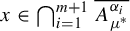 $x\in \bigcap _{i=1}^{m+1}\overline {A_{\mu ^*}^{\alpha _{i}}}$
, which implies that
 $\mathrm {mult}(\mathscr {C}^{(p)}_{\mu ^*})\geq \#\{A\in \mathscr {C}^{(p)}_{\mu ^*}\colon x\in \overline {A}\}>m$
, yielding a contradiction and proving Claim B.
Now, we conclude the proof of the proposition using Claim B. For each
 $n\ge 1$
,
 $\mu \in U$
, and
 $\alpha \in \mathcal {I}_n(f_\mu )$
, since
 $f_{\mu }^n$
is a Lipschitz
 $\unicode{x3bb} ^n$
-contraction on
 $A_\mu ^{\alpha }\in \mathscr {C}^{(n)}_\mu $
,
 $$ \begin{align*} \textrm{diam}(f_\mu^n(A_\mu^{\alpha} ) )\le \unicode{x3bb}^n \textrm{diam}(A_\mu^{\alpha})\le \unicode{x3bb}^n \textrm{diam}(X). \end{align*} $$
By Claim B, choosing
 $n_0\geq 1$
so that
 $\rho :=\unicode{x3bb} ^{n_0} \textrm {diam}(X)< r$
,
 $$ \begin{align*}\textrm{diam}(f_\mu^n(A_\mu^{\alpha} ) )\leq \rho< r\leq \tau_{m}(\mathscr{C}_\mu^{(p)}) \quad \text{for all } n\geq n_0, \text{ for all } \mu\in U_{\delta_0}(\mu^*). \end{align*} $$
Hence, for all
 $n\ge n_0$
,
 $$ \begin{align*} \# \{\beta\in \mathcal{I}_{p}(f_\mu): f_\mu^n (A_\mu^{\alpha})\cap A_\mu^{\beta}\neq\emptyset \}\le m\quad \text{for all } n\geq n_0, \text{ for all }\mu\in U_{\delta_0}(\mu^*). \end{align*} $$
In this way, for each
 $n\ge n_0$
and
 $\mu \in U_{\delta _0}(\mu ^*)$
,
 $$ \begin{align*} \#\mathcal{I}_{n+p}(f_\mu) \le m \#\mathcal{I}_n(f_{\mu}). \end{align*} $$
Therefore,
 $$ \begin{align*} \#\mathcal{J}_{n+p}^{\delta}(\mu^*) \le m\# \mathcal{J}_n^{\delta}(\mu^*)\quad \text{for all } \delta\in [0,\delta_0), \text{ for all } n\ge n_0. \end{align*} $$
In particular,
 $$ \begin{align*} \#{\mathcal{J}}_{n_0+ip}^\delta(\mu^*) \le m^i \#{\mathcal{J}}_{n_0}^\delta(\mu^*) \quad \text{for all } \delta\in [0,\delta_0), \text{ for all } i\ge 0. \end{align*} $$
Hence,
 $$ \begin{align*} \#\mathcal{J}_{n}^{\delta}(\mu^*) \le m^{(({n-n_0})/{p})+1}\# \mathcal{J}_{n_0}^{\delta}(\mu^*) \quad \text{for all } \delta\in [0,\delta_0), \text{ for all } n\ge n_0. \end{align*} $$
By our choice of p, for
 $C:=\log (m^{(p-n_0)/p}\# \mathcal {J}_{n_0}^{\delta _0}(\mu ^*))$
,
 $$ \begin{align*}\log \#\mathcal{J}_{n}^{\delta}(\mu^*) \le n\varepsilon+C \quad \text{for all } \delta\in [0,\delta_0), \text{ for all } n\ge n_0. \end{align*} $$
Thus,
 $$ \begin{align*} \limsup_{n\to\infty} \frac1n \log\#\mathcal{J}_n^\delta(\mu^*) \le \varepsilon \quad \text{for all } \delta\in [0,\delta_0). \end{align*} $$
Since
 $\varepsilon>0$
is arbitrary, we conclude that Hypothesis (E) holds true at
 $\mu ^*$
.
4 One-dimensional piecewise contractions
To illustrate the applicability of Theorem 2.9, we will use it to give an alternative proof of the almost surely asymptotic periodicity of one-dimensional piecewise contractions with varying partition originally proved in [Reference Nogueira, Pires and Rosales33, Theorem 1.4].
Throughout this section, let
 $N\geq 2, \,\, 0<\unicode{x3bb} <1$
, and
 $\varphi _1,\ldots ,\varphi _N:X\to X$
be bi-Lipschitz
 $\unicode{x3bb} $
-contractions on
 $X=[0,1]$
. Consider the open set
 $$ \begin{align*}U=\{(\mu_1,\ldots,\mu_{N-1})\in\mathbb{R}^{N-1}: 0< \mu_1<\cdots<\mu_{N-1}<1\}. \end{align*} $$
For each
 $\mu =(\mu _1,\ldots ,\mu _{N-1})\in U$
, let
 $A_{i,\mu }=(\mu _{i-1},\mu _i)$
for
 $i=1,\ldots ,N$
, where we set
 $\mu _0=0$
and
 $\mu _N=1$
, and let
 $f_\mu :[0,1]\to [0,1]$
be a piecewise
 $\unicode{x3bb} $
-contraction with label set
 $\mathcal {A}=\{1,\ldots , N\}$
, partition set
 $\{A_{i,\mu }\}_{i\in \mathcal {A}}$
, and iterated function system
 $\{\varphi _i\}_{i\in \mathcal {A}}$
. We denote by
 $S_ \mu =S(f_\mu )$
the singular set of
 $f_\mu $
.
We make two assumptions:
-
(A1) for each
$\mu \in U$
,
$f_{\mu }$
is either left or right continuous at each point of the singular set
$S_{\mu }$
; -
(A2)
$\varphi _i([0,1])\subset (0,1)$
for every
$i\in \mathcal {A}$
.


Assumption (A2) is convenient and not restrictive, since we can always extend the domain of the bi-Lipschitz contractions
 $\varphi _i$
to a larger interval, having the same dynamics of
 $f_\mu $
in X and satisfying the desired assumption for the iterated function system.
Based on Theorem 2.9, we will prove the following result.
Theorem 4.1. (Nogueira, Pires and Rosales [Reference Nogueira, Pires and Rosales33])
Let
 $\{f_\mu \}_{\mu \in U}$
be a family of piecewise
 $\unicode{x3bb} $
-contractions on
 $[0,1]$
satisfying assumptions (A1) and (A2). For Lebesgue almost every
 $\mu \in U$
, the map
 $f_{\mu }$
is asymptotically periodic and the periodic orbits are regular.
We now proceed to prove Theorem 4.1.
4.1 Proof of Theorem 4.1
Denote by
 $\Phi =\{\varphi _i\}_{i\in \mathcal {A}}$
the iterated function system of
 $f_{\mu }$
and by
 $\varphi ^{\alpha }$
, the map defined in (3.2). Notice that the maps in the iterate function system do not depend on
 $\mu $
. According to Definition 2.6,
 $\{f_\mu \}_{\mu \in U}$
is a family of piecewise
 $\unicode{x3bb} $
-contractions of the interval
 $[0,1]$
sharing the same label set
 $\mathcal {A}$
and the same iterated function system
 $\Phi $
. However, the partition
 $\{A_{i,\mu }\}_{i\in \mathcal {A}}$
of
 $f_\mu $
varies with the parameter
 $\mu \in U$
. Notice that the singular set of
 $f_{\mu }$
is
 $$ \begin{align*} S_{\mu}=\{0,\mu_1,\mu_2,\ldots,\mu_{N-1},1\}. \end{align*} $$
Definition 4.2. Given
 $\mu \in U$
, we say that the pair
 $(\Phi ,\mu )$
has a singular connection if there are
 $n\geq 1$
and
 $\alpha \in \mathcal {A}^n$
such that
 $\varphi ^\alpha (\mu _i)=\mu _j$
for some
 $(i,j)\in \{1,\ldots ,N-1\}^2$
.
Lemma 4.3. For Lebesgue almost every
 $\mu \in U$
, the pair
 $(\Phi ,\mu )$
has no singular connection.
Proof. Given
 $n\geq 1$
,
 $\alpha \in \mathcal {A}^n$
and
 $(i,j)\in \{1,\ldots ,N-1\}^2$
, consider the set defined by
 $$ \begin{align*} B^{\alpha}_{ij}=\{(\mu_1,\ldots,\mu_{N-1})\in U\colon \varphi^\alpha(\mu_i)=\mu_j \}. \end{align*} $$
We claim that
 $B^{\alpha }_{ij}$
is a Lebesgue null set. Indeed, taking into account that
 $\varphi ^\alpha $
is a Lipschitz contraction, we have two cases.
-
(1) In the first case,
$i=j$
, the equality
$\varphi ^\alpha (\mu _i)=\mu _i$
implies that
$\mu _i$
equals the unique fixed point of
$\varphi ^\alpha $
. Thus,
$B_{ii}^\alpha $
is a null set. -
(2) In the second case,
$i\neq j$
, being the graph of a Lipschitz function,
$B_{ij}^\alpha $
is a null set.


Therefore,
 $$ \begin{align*} B:=\bigcup_{n\geq1}\bigcup_{\alpha\in \mathcal{A}^n} \bigcup_{i=1}^{N-1} \bigcup_{j=1}^{N-1} B^{\alpha}_{ij} \end{align*} $$
is a null set. This means that for each
 $\mu \in U{\setminus } B$
, the pair
 $(\Phi ,\mu )$
has no singular connection.
Let
 $$ \begin{align*} U^*=\{\mu\in U\colon (\Phi,\mu) \text{ has no singular connection}\}. \end{align*} $$
Lemma 4.4. The periodic points of
 $f_{\mu }$
are regular for every
 $\mu \in U^*$
.
Proof. Suppose by contradiction that
 $x\in [0,1]$
is a non-regular periodic point of
 $f_{\mu }$
with
 $\mu =(\mu _1,\ldots ,\mu _{N-1})\in U^*$
. By assumption (A2), we conclude that the periodic orbit of x does not intersect
 $\{0,1\}$
. Therefore, there must exist
 $n\geq 0$
and
 ${i\in \{1,\ldots ,N-1\}}$
such that
 $f^n_{\mu }(x)=\mu _i$
. However, x is periodic, say with period p, and thus
 ${\mu _i=f^{n}_{\mu }(x)=f^{n+p}_{\mu }(x)=f^p_{\mu }(\mu _i)}$
. By assumption (A1), there is a p-tuple
 $\alpha \in \mathcal {A}^p$
such that
 $\varphi ^\alpha (\mu _i)=f_{\mu }^p(\mu _i)=\mu _i$
, which contradicts the fact that
 $(\Phi ,\mu )$
has no singular connection.
Hereafter, fix
 $\mu ^*\in U^*$
.
Lemma 4.5.
 $\{f_\mu \}_{\mu \in U}$
satisfies Hypothesis (E) at
 $\mu =\mu ^*$
.
Proof. Let
 $n\geq 1$
and recall from (3.2) that
 $ \mathscr {C}_\mu ^{(n)} =\{ A_\mu ^{\alpha }\colon \alpha \in \mathcal {I}_n(f_\mu )\} $
. Because the functions defining the iterative function system are bi-Lipschitz,
 $\mathscr {C}_\mu ^{(n)}$
is a finite collection of open intervals whose union equals
 $[0,1]$
but finitely many points that are not regular points of order n of
 $f_\mu $
. This implies that
 $\textrm {mult}(\mathscr {C}_\mu ^{(n)})\leq 2$
for every
 $\mu \in U$
. By Proposition 3.11, the proof will be finished provided we show that
 $\{\mathscr {C}_\mu ^{(n)}\}_{\mu \in U}$
is stable at
 $\mu =\mu ^*$
, that is, that conditions (i) and (ii) in Definition 3.9 are true. We begin by verifying condition (i) in Definition 3.9. The next results are true for all
 $n\ge 1$
.
Claim A.
 $\mathcal {I}_n(f_{\mu ^*})\subset \mathcal {I}_n(f_\mu )$
for some
 $\delta>0$
and all
 $\mu \in U_{\delta }(\mu ^*)$
.
In fact, let
 $\alpha = (i_0, i_1,\ldots , i_{n-1})\in \mathcal {I}_n(f_{\mu ^*})$
. Then, there is a regular point
 $x\in (0,1)$
of order n such that
 $f_{\mu ^*}^k(x)\in A_{i_k,\mu }$
for all
 $0\le k\le n-1$
. Let
 $\delta _\alpha :=\min _{0\le k\le n-1} d(f_{\mu ^*}^k(x), S_{\mu ^*} )>0$
. We have that
 $f_{\mu }^k(x) = f_{\mu ^*}^k(x)$
for all
 $\mu \in U_{\delta _{\alpha }}(\mu ^*)$
and
 $0\le k\le n-1$
. In particular, x is a regular point of
 $f_\mu $
of order n whose itinerary of order n equals
 $\alpha $
, that is,
 $\alpha \in \mathcal {I}_n(f_\mu )$
for all
 $\mu \in U_{\delta _{\alpha }}(\mu ^*)$
. Since
 $\alpha \in \mathcal {I}_n(f_\mu ^*)$
is arbitrary in a finite set, we have that the claim is true for
 $\delta =\min _{\alpha \in \mathcal {I}_n(f_\mu ^*)}\delta _\alpha>0$
.
Claim B.
 $\mathcal {I}_n(f_\mu ) = \mathcal {I}_n(f{_\mu ^*})$
for some
 $\delta>0$
and all
 $\mu \in U_{\delta }(\mu ^*)$
.
By Claim A, it suffices to show that
 $\#\mathcal {I}_n(f_{\mu ^*})= \#\mathcal {I}_n(f_\mu )$
. Notice that
 $\#\mathcal {I}_n(f_\mu )$
equals the number of members of
 $\mathscr {C}_\mu ^{(n)}$
, or equivalently, the number of connected components of
 $(0,1){\setminus } D_{\mu }^{(n)}$
, where
 $$ \begin{align*}D_\mu^{(1)} = S_\mu\quad\textrm{and}\quad D_{\mu}^{(n)} = \bigcup_{k=0}^{n-1} f_\mu^{-k}(S_\mu).\end{align*} $$
In this way, the proof of the claim will be finished if we show that
 $\# D_{\mu }^{(n)} = \#D_{\mu ^*}^{(n)}$
. By assumption (A2),
 $$ \begin{align} D_\mu^{(n)} = \bigcup_{i=1}^{N-1} \bigcup_{k=0}^{n-1} f_\mu^{-k}(\mu_i). \end{align} $$
Since
 $(\Phi ,\mu ^*)$
has no singular connection, for each
 $1\le i\le N-1$
and
 $1\le k\le n-1$
, there exist a finite set
 $F_{i, k}$
(possibly empty) and
 $\delta _{i,k}>0$
such that
 $$ \begin{align} f_{\mu}^{-k} (\mu_i) = \bigcup_{j\in F_{i,k}} \psi_{j}^{-1}(\mu_i) \quad \text{for all } \mu\in U_{\delta_{i,k}}(\mu^*), \end{align} $$
where
 $\psi _j$
is the composition of finitely many maps of
 $\Phi =\{\varphi _i\}_{i\in \mathcal {A}}$
. Since each
 $\varphi _i$
is bi-Lipschitz, it follows from (4.1) and (4.2) that
 $\#D_{\mu }^{(n)}=\# D_{\mu ^*}^{(n)}$
for all
 $\mu \in U_{\delta }(\mu ^*)$
, where
 $\delta = \min _{i, k} \delta _{i,k}$
, proving Claim B.
Moreover, there exists a positive constant
 $M_{i,k,j}$
depending on
 $i,k,j$
such that for all
 $\mu \in U_{\delta }(\mu ^*)$
,
 $$ \begin{align*} d_H( D_{\mu}^{(n)}, D_{\mu^*}^{(n)} ) =& d_H\bigg(\bigcup_{i=1}^{N-1} \bigcup_{k=0}^{n-1} \bigcup_{j\in F_{i,k}} \psi_{j}^{-1}(\mu_i), \bigcup_{i=1}^{N-1} \bigcup_{k=0}^{n-1} \bigcup_{j\in F_{i,k}} \psi_{j}^{-1}(\mu_i^*), \bigg) \\ \le& \max_{1\le i\le N-1} \max_{0\le k\le n-1} \max_{j\in F_{i,k}} M_{i,k,j} \vert \mu_i -\mu_i^*\vert \\ \le& M \Vert \mu - \mu^*\Vert, \end{align*} $$
where
 $\delta = \min _{i, k} \delta _{i,k}$
and
 $M= \max _{i} \max _{k} \max _{j\in F_{i,k}} M_{i,k,j}$
.
Since the members of
 $\mathscr {C}_\mu ^{(n)}=\{A_\mu ^{\alpha }: \alpha \in \mathcal {I}_n(f_\mu )\}$
are the connected components of
 $(0,1){\setminus } D_\mu ^{(n)}$
, we have proved the following claim.
Claim C.
 $d_H(A_{\mu }^\alpha , A_{\mu ^*}^\alpha )\to 0$
as
 $\mu \to \mu ^*$
in
 $U_{\delta }(\mu ^*)$
for every
 $\alpha \in \mathcal {I}_n(f_{\mu ^*})$
.
In other words, condition (ii) in Definition 3.9 is true.
Lemma 4.6.
 $\{f_\mu \}_{\mu \in U}$
satisfies Hypothesis (T) at
 $\mu =\mu ^*$
.
Proof. It is clear that for every
 $\delta _0>0$
,
 $\varepsilon>0$
, and
 $n\geq 1$
,
 $$ \begin{align*} \text{Leb}^*\,(\{\mu\in U \colon \min_{i}| \varphi^\alpha(0)-\mu_i|\leq \varepsilon\} )\leq 2(N-1)\varepsilon\quad \text{for all } \alpha\in\mathcal{J}_n^{\delta_0}(\mu^*). \end{align*} $$
Hence, Hypothesis (T) holds with
 $x_0=0$
,
 $\varepsilon _0=\min _{1\leq i \leq N} {d}_H(\varphi _i([0,1]),\{0,1\})>0$
,
 $n_0=1$
,
 $a=1$
, and
 $c=2(N-1)$
.
4.1.1 Completing the proof of Theorem 4.1
By Theorem 2.9, there is
 $\delta>0$
such that
 $f_\mu $
is asymptotically periodic on
 $Z_\mu $
for almost every
 $\mu \in U_\delta (\mu ^*)$
. By Lemma 4.3, the set
 $U^*$
has full measure in U. Hence, since
 $\mu ^*$
is an arbitrary point of
 $U^*$
, we conclude, by a Lebesgue density point argument and by Lemma 4.4, that there exists a subset
 $U'\subset U^*$
of full Lebesgue measure in U such that for every
 $\mu \in U'$
,
 $f_\mu $
is asymptotically periodic on
 $Z_\mu $
and its periodic points are regular. Moreover, since
 $(\Phi ,\mu )$
has no singular connection, for every
 $x\in [0,1]$
, there is
 $n\geq 0$
such that
 $f^n_{\mu }(x)$
is a regular point, that is,
 ${f^n_{\mu }(x)\in Z_\mu }$
. Putting it all together, in view of Remark 2.4, we conclude that
 $f_{\mu }$
is asymptotically periodic on
 $[0,1]$
for every
 $\mu \in U'$
. This concludes the proof of Theorem 4.1.
5 Proof of Theorem 2.12
Given
 $\mu \in \mathbb {R}^\ell $
, let
 $f_\mu $
be the piecewise-affine contraction on the compact convex polytope X as defined in (2.9). Notice that
 $\{f_\mu \}_{\mu \in \mathbb {R}^\ell }$
is a family of piecewise
 $\unicode{x3bb} $
-contractions on X (Definition 2.6) with label set
 $\mathcal {A}=\{-1,1\}^\ell $
, iterated function system
 ${\{\varphi _i\colon \mathbb {R}^d\to \mathbb {R}^d\}_{i\in \mathcal {A}}}$
of affine contractions
 $\varphi _i(x)=\Lambda _i x+b_i$
with
 $\unicode{x3bb} :=\max _i\|\Lambda _i\|<1$
. The partition
 $\{A_{i,\mu }\}_{i\in \mathcal {A}}$
of
 $f_\mu $
varies with the parameter
 $\mu \in \mathbb {R}^\ell $
and it is defined by
 $$ \begin{align*} A_{i,\mu} := \textrm{relint}(X)\cap \textrm{relint}(\{x\in X : \sigma_\mu(x) = i \}). \end{align*} $$
Notice that
 $A_{i,\mu }$
can be the empty set. Given
 $\alpha = (i_0,i_1,\ldots ,i_{n-1})\in \mathcal {A}^n$
with
 ${n\in \mathbb {N}}$
, we write
 $\varphi ^\alpha (x):=\varphi _{i_{n-1}}\circ \cdots \circ \varphi _{i_0}(x)=\Lambda ^\alpha x+ b_\alpha $
, where
 $\Lambda ^\alpha =\Lambda _{i_{n-1}}\cdots \Lambda _{i_0}$
and
 ${b_\alpha = \varphi ^\alpha (0)}$
. Let
 $$ \begin{align} A_\mu^{\alpha}:=A_{i_0, \mu}\cap\varphi_{i_0}^{-1}(A_{i_1,\mu})\cap\cdots\cap (\varphi_{i_{n-2}}\circ\cdots\circ\varphi_{i_0})^{-1}(A_{i_{n-1}, \mu} ), \end{align} $$
as defined in (3.18).
Let V be the
 $\ell \times d$
-matrix with rows
 $v^{(1)},\ldots , v^{(\ell )}$
, where each
 $v^{(j)}$
is a unit vector orthogonal to the hyperplane
 $H_j(\mu )$
(see (2.7)) and let
 $C_i$
be the diagonal
 $\ell \times \ell $
-matrix with diagonal equal to
 $i=(s_1,\ldots ,s_\ell )\in \mathcal {A}$
. The following lemma gives a useful description of
 $A_\mu ^\alpha $
in terms of the matrices V and
 $C_i$
.
Lemma 5.1. For any
 $n\ge 1$
,
 $\alpha =(i_0,i_1,\ldots ,i_{n-1})\in \mathcal {A}^n$
and
 $\mu \in \mathbb {R}^\ell $
, the set
 $A_{\mu }^{\alpha }$
is the open convex polytope given by
 $$ \begin{align*} A_\mu^\alpha = \mathrm{relint}(X)\cap\bigg(\bigcap_{k=0}^{n-1} \{x\in \mathbb{R}^d\colon C_{i_k} V \varphi^{\alpha_k}(x)>C_{i_k}\mu\}\bigg), \end{align*} $$
where
 $\alpha _k = (i_0,i_1,\ldots ,i_{k-1})$
for
 $1\le k\le n-1$
and
 $\varphi ^{\alpha _0}=\mathrm {id}$
.
Proof. For any
 $\mu \in \mathbb {R}^\ell $
and
 $i=(s_1,\ldots ,s_\ell )\in \mathcal {A}$
, the set
 $A_{i,\mu }$
is an open convex polytope since it is the intersection of the relative interior of the polytope X with finitely many open half-spaces with bounding hyperplanes
 $H_j(\mu )$
,
 $j=1,\ldots ,\ell $
. Indeed, we can write
 $$ \begin{align*} A_{i,\mu}=\text{relint}(X)\cap \bigg(\bigcap_{j=1}^\ell H^{s_j}_j(\mu)\bigg), \end{align*} $$
where
 $H^{s_j}_j(\mu ):=\{x\in \mathbb {R}^d\colon s_j\langle v^{(j)},x\rangle> s_j\mu _j\}$
for each
 $s_j\in \{-1,1\}$
. Using the matrices introduced just before the statement of the lemma, we can write
 $A_{i,\mu }$
as follows:
 $$ \begin{align*} A_{i,\mu}=\text{relint}(X)\cap\{x\in \mathbb{R}^d\colon C_i V x>C_{i}\mu\}. \end{align*} $$
Now, given
 $n\ge 1$
and
 $0\le k\le n-1$
,
 $$ \begin{align*} (\varphi^{\alpha_k})^{-1}(A_{i_k,\mu}) = (\varphi^{\alpha_k})^{-1}(\text{relint}(X)) \cap \{x\in \mathbb{R}^d\colon C_{i_k} V \varphi^{\alpha_k}(x)>C_{i_k}\mu\}. \end{align*} $$
Putting all together (see (5.1)),
 $$ \begin{align*} A_\mu^\alpha = \bigcap_{k=0}^{n-1} (\varphi^{\alpha_k})^{-1}(\mathrm{relint}(X))\cap \{x\in \mathbb{R}^d\colon C_{i_k} V \varphi^{\alpha_k}(x)>C_{i_k}\mu\}. \end{align*} $$
To finish the proof, just notice that
 $$ \begin{align*} \mathrm{relint}(X)\cap (\varphi^{\alpha_k})^{-1}(\mathrm{relint}(X)) = \mathrm{relint}(X), \quad 0\leq k\leq n-1. \end{align*} $$
Indeed, by assumption, for all j,
 $\varphi _{i_j}(X)\subset \mathrm {relint}(X)$
, which implies that
 $\varphi ^{\alpha _k}(\mathrm {relint}(X))=\varphi _{i_{k-1}}\circ \cdots \circ \varphi _{i_0}(\mathrm {relint}(X))\subset \mathrm {relint}(X)$
. Hence,
 $\mathrm {relint}(X)\subset (\varphi ^{\alpha _k})^{-1}(\mathrm {relint}(X))$
.
Let
 $$ \begin{align*} \mathcal{X}=\bigcup_{n\geq1}\mathcal{A}^n. \end{align*} $$
Given
 $\alpha \in \mathcal {X}$
, define
 $$ \begin{align*} Z_\alpha=\{\mu\in \mathbb{R}^\ell\colon A^\alpha_\mu\neq\emptyset \}. \end{align*} $$
Clearly,
 $\mu \in Z_\alpha $
if and only if
 $\alpha \in \mathcal {I}_n(f_\mu )$
with n being the length of the tuple
 $\alpha $
and
 $\mathcal {I}_n(f_\mu )$
being the set of itineraries of order n of
 $f_\mu $
(Definition 2.5).
Lemma 5.2.
 $Z_\alpha $
is convex for every
 $\alpha \in \mathcal {X}$
.
Proof. Given any
 $\alpha =(i_0,i_1,\ldots ,i_{n-1})\in \mathcal {A}^n$
with
 $n\geq 1$
, define
 $$ \begin{align*} \Pi_\alpha := \{(x,\mu)\in \mathbb{R}^d\times \mathbb{R}^\ell\colon x\in A_\mu^\alpha\}. \end{align*} $$
It follows from Lemma 5.1 that
 $(x,\mu )\in \Pi _\alpha $
if and only if
 $x\in \mathrm {relint}(X)$
and
 $$ \begin{align*} C_{i_j} V \varphi^{\alpha_j}(x)>C_{i_j}\mu\quad \text{for all }j\in\{0,\ldots,n-1\}. \end{align*} $$
Notice that
 $\mathrm {relint}(X)$
is a convex set since the relative interior of a convex set is also convex. Now, we claim that
 $\Pi _{\alpha }$
is convex, that is, the convex combination of any two points
 $(x_0,\mu _0)$
and
 $(x_1,\mu _1)$
of
 $\Pi _\alpha $
also belongs to
 $\Pi _\alpha $
. To show that, let
 $t\in [0,1]$
and
 $$ \begin{align*}(x_t, \mu_t) := ( (1-t)x_0 + t x_1, (1-t) \mu_0 +t \mu_1 ). \end{align*} $$
By the hypotheses on
 $(x_0, \mu _0)$
and
 $(x_1, \mu _1)$
, we have that for all
 $0\le j\le n-1$
,
 $$ \begin{align*} x_0, x_1\in \mathrm{relint}(X), \quad C_{i_j} V \varphi^{\alpha_j}(x_0)>C_{i_j}\mu_0\quad \textrm{and}\quad C_{i_j} V \varphi^{\alpha_j}(x_1)>C_{i_j}\mu_1. \end{align*} $$
Because
 $\mathrm {relint}(X)$
is convex,
 $x_t\in \mathrm {relint}(X)$
for every
 $t\in [0,1]$
. However, for all
 $0\le j\le n-1$
and
 $t\in [0,1]$
,
 $$ \begin{align*} C_{i_j}V \varphi^{\alpha_j}(x_t) &= (1-t) C_{i_j}V\varphi^{\alpha_j}(x_0)+ tC_{i_j} \varphi^{\alpha_j}(x_1)\\ &> (1-t) C_{i_j} \mu_0+ t C_{i_j}\mu_1\\ &= C_{i_j} \mu_t. \end{align*} $$
This proves the claim. Finally, since
 $Z_\alpha $
is the projection of
 $\Pi _\alpha $
onto the second variable, we conclude that
 $Z_\alpha $
is also convex.
Let
 $$ \begin{align*} W_1:= \mathbb{R}^\ell\bigg\backslash \bigg(\bigcup_{\alpha\in\mathcal{X}} \partial Z_\alpha\bigg). \end{align*} $$
During the proof of Theorem 2.12, we will construct a set of ‘good’ parameters as the intersection of two subsets of
 $\mathbb {R}^\ell $
. For parameters in this intersection, we will verify that Hypotheses (E) and (T) are satisfied. The first of these subsets is the set
 $W_1$
.
Lemma 5.3.
 $W_1$
is a full Lebesgue measure set.
Proof. Since the boundary of a convex set has Lebesgue measure zero, we conclude from Lemma 5.2 that
 $\partial Z_\alpha $
is a null set for every
 $\alpha \in \mathcal {X}$
. This shows that
 $W_1$
has full measure.
Hereafter, fix
 $\mu ^*\in W_1$
. Let
 $U=B_1(\mu ^*)$
.
Recall from (3.18) that
 $\mathscr {C}_\mu ^{(1)}=\{A_{i,\mu }\}_{i\in \mathcal {A}}$
and, for
 $n\ge 2$
,
 $\mathscr {C}_\mu ^{(n)}$
is the collection of non-empty open convex sets
 $A_\mu ^\alpha $
, where
 $\alpha =(i_0,i_1,\ldots ,i_{n-1})$
runs over the set
 $\mathcal {I}_{n}(f_{\mu })$
.
The next two lemmas show that
 $\{\mathscr {C}_\mu ^{(n)}\}_{\mu \in U}$
is stable at
 $\mu =\mu ^*$
.
Lemma 5.4. Given
 $n\geq 1$
and
 $\alpha \in \mathcal {I}_{n}(f_{\mu ^*})$
, there exist
 $c=c(\alpha )>0$
and
 $\delta =\delta (\alpha )>0$
such that if
 $\mu \in U_\delta (\mu ^*)$
, then
 $\alpha \in \mathcal {I}_{n}(f_{\mu })$
and
 $$ \begin{align*} d_{{H}}(A_{\mu}^{\alpha},A_{\mu^*}^{\alpha})\leq c \|\mu-\mu^*\|. \end{align*} $$
Proof. Let
 $n\ge 1$
and
 $\alpha =(i_0, i_1,\ldots , i_{n-1}) \in \mathcal {A}^n$
. By Lemma 5.1, for every
 $\mu \in \mathbb {R}^\ell $
,
 $$ \begin{align*} A_\mu^\alpha = \mathrm{relint}(X)\cap\bigg(\bigcap_{k=0}^{n-1} \{x\in \mathbb{R}^d\colon C_{i_k} V \varphi^{\alpha_k}(x)>C_{i_k}\mu\}\bigg). \end{align*} $$
By hypothesis,
 $\alpha \in \mathcal {I}_n(f_\mu ^*)$
and so
 $A_{\mu ^*}^\alpha \neq \emptyset $
. Therefore, by continuity in
 $\mu $
, there is
 $\delta =\delta (\alpha )>0$
such that
 $A_\mu ^{\alpha }\neq \emptyset $
for every
 $\mu \in U_\delta (\mu ^*)$
, and thus
 $\alpha \in \mathcal {I}_{n}(f_{\mu })$
.
Now, for every
 $x\in A_{\mu ^*}^{\alpha }$
,
 $$ \begin{align*} d(x,\overline{A_{\mu}^{\alpha}}) =d\bigg(x,X\cap \bigg( \bigcap_{k=0}^{n-1} \{x\in \mathbb{R}^d\colon C_{i_k} V \varphi^{\alpha_k}(x)\geq C_{i_k}\mu\}\bigg)\bigg) = d(x,G_\mu), \end{align*} $$
where
 $$ \begin{align*} G_\mu = \{x\in \mathbb{R}^d\colon Mx\leq c,\,C_{i_k} V \varphi^{\alpha_k}(x)\geq C_{i_k}\mu,\, k=0,\ldots,n-1 \} \end{align*} $$
and we have used the definition of X in (2.4). By Theorem A.1, there is a constant
 ${c=c(\alpha )>0}$
such that
 $$ \begin{align*} d(x,G_\mu)\leq c\| \mu-\mu^*\|. \end{align*} $$
A similar estimate is valid for
 $d(x,G_{\mu ^*})$
for any
 $x\in A_\mu ^{\alpha }$
. Taking the maximum of these two estimates, the lemma follows.
Using the previous lemma, we show that
 $\{\mathscr {C}_\mu ^{(n)}\}_{\mu \in U}$
is stable at
 $\mu =\mu ^*$
, an important property for verifying Hypothesis (E) (see Proposition 3.11).
Lemma 5.5.
 $\{\mathscr {C}_\mu ^{(n)}\}_{\mu \in U}$
is stable at
 $\mu =\mu ^*$
.
Proof. We claim that there is
 $\delta>0$
such that
 $\mathcal {I}_{n}(f_{\mu })=\mathcal {I}_{n}(f_{\mu ^*})$
for every
 $\mu \in U_\delta (\mu ^*)$
. Indeed, by Lemma 5.4, we have
 $\mathcal {I}_{n}(f_{\mu ^*})\subset \mathcal {I}_{n}(f_{\mu })$
for every
 $\mu \in U_\delta (\mu ^*)$
and some
 $\delta>0$
. Now, suppose by contradiction that there are sequences
 $(\mu _k)_{k\geq 1}$
in
 $\mathbb {R}^{\ell }$
converging to
 $\mu ^*$
and
 $(\alpha ^{(k)})_{k\ge 1}$
in
 $\mathcal {A}^n$
such that
 $\alpha ^{(k)}\in \mathcal {I}_{n}(f_{\mu _k})$
but
 $\alpha ^{(k)}\notin \mathcal {I}_{n}(f_{\mu ^*})$
for every
 $k\geq 1$
. Since
 $\# \mathcal {I}_{n}(f_{\mu _k})\leq (\#\mathcal {A})^n$
, by the pigeonhole principle, we may take a subsequence and assume that
 $\alpha ^{(k)}$
is independent of k, and hence we have
 $\alpha \in \mathcal {I}_{n}(f_{\mu _k})$
for every
 $k\geq 1$
but
 $\alpha \notin \mathcal {I}_{n}(f_{\mu ^*})$
. This implies that
 $\mu _k\in Z_{\alpha }$
for every
 $k\geq 1$
and
 $\mu ^*\notin Z_{\alpha }$
. Thus,
 $\mu ^* \in \partial Z_\alpha $
, yielding a contradiction. Therefore, the claim is true. Now, using Lemma 5.4, we conclude that for
 $\delta>0$
small enough and for every
 $\alpha \in \mathcal {I}_{n}(f_{\mu ^*})$
,
 $A_\mu ^{\alpha }$
converges to
 $A_{\mu ^*}^{\alpha }$
as
 $\mu \to \mu ^*$
in the Hausdorff metric. Hence,
 $\{\mathscr {C}_\mu ^{(n)}\}_{\mu \in U}$
is stable at
 $\mu ^*$
.
Next, we want to show that the multiplicity entropy of
 $f_{\mu ^*}$
is zero. To do so, we need to further restrict
 $\mu ^*$
inside another full Lebesgue measure set. Notice that piecewise-affine contractions may have positive multiplicity entropy [Reference Kruglikov and Rypdal28]. We start with a fairly elementary result.
Lemma 5.6. Let
 $B\subset \mathbb {R}^d$
be a linearly independent set. Then, there is
 $\rho =\rho (B)>0$
such that for every
 $w \in \mathbb {R}^d$
with
 $\|w\|<\rho $
, we have
 $w \notin \mathrm {aff}(B)$
.
Proof. Since B is a set of linearly independent vectors, the affine hull
 $\mathrm {aff}(B)$
does not contain the origin of
 $\mathbb {R}^d$
. Set
 $\rho :=d(0,\mathrm {aff}(B))$
, then the conclusion follows.
In what follows, keep
 $1\leq j \leq \ell $
and
 $1\le k\le d$
unchanged. Let
 $$ \begin{align*} \mathcal{Y}_j^{(k)}=\{(\alpha_1,\ldots,\alpha_k)\in\mathcal{X}^k\colon \{(\Lambda^{\alpha_1})^Tv^{(j)},\ldots, (\Lambda^{\alpha_k})^T v^{(j)} \}\text{ is linearly independent}\}. \end{align*} $$
For every
 $\boldsymbol {\alpha }=(\alpha _1,\ldots ,\alpha _k)\in \mathcal {Y}_j^{(k)}$
and
 $\rho $
as in Lemma 5.6, we set
 $$ \begin{align*}\rho_j(\boldsymbol{\alpha}):= \rho(B_j(\boldsymbol{\alpha}))\quad\textrm{where } B_j(\boldsymbol{\alpha}):=\{(\Lambda^{\alpha_1})^Tv^{(j)},\ldots, (\Lambda^{\alpha_k})^T v^{(j)}\}.\end{align*} $$
Given
 $\boldsymbol {\alpha }=(\alpha _1,\ldots ,\alpha _k)\in \mathcal {Y}_j^{(k)}$
, let
 $$ \begin{align*} \mathcal{Z}_{j}(\boldsymbol{\alpha}) := \{\beta\in \mathcal{X}\colon \|(\Lambda^\beta)^T\|<\rho_j(\boldsymbol{\alpha})\ \mathrm{and}\ (\Lambda^\beta)^Tv^{(j)}\in\mathrm{span}(B_j(\boldsymbol{\alpha})) \}. \end{align*} $$
Given
 $\boldsymbol {\alpha }=(\alpha _1,\ldots ,\alpha _k)\in \mathcal {Y}_j^{(k)}$
and
 $\beta \in \mathcal {Z}_{j}(\boldsymbol {\alpha }) $
, let
 $a^{(1)}_{j,\beta }(\boldsymbol {\alpha }),\ldots , a^{(k)}_{j,\beta }(\boldsymbol {\alpha })$
be the coordinates of the vector
 $(\Lambda ^\beta )^T v^{(j)}$
with respect to
 $B_j(\boldsymbol {\alpha })$
, that is, assume that
 $$ \begin{align} (\Lambda^\beta)^T v^{(j)} = \sum_{q=1}^k a^{(q)}_{j,\beta}(\boldsymbol{\alpha}) (\Lambda^{\alpha_q})^T v^{(j)}. \end{align} $$
The following claim is true.
Claim A.
 $\sum _{q=1}^k a^{(q)}_{j,\beta }(\boldsymbol {\alpha })\neq 1$
.
In fact, by Lemma 5.6, we have
 $ (\Lambda ^\beta )^T v_j\notin \mathrm {aff}(B_j(\boldsymbol {\alpha })), $
which proves the claim.
Given
 $1\leq j \leq \ell $
,
 $1\leq k \leq d$
,
 $\boldsymbol {\alpha }\in \mathcal {Y}_j^{(k)}$
, and
 $\beta \in \mathcal {Z}_{j}(\boldsymbol {\alpha })$
, let
 $$ \begin{align*} \Gamma_{j,\beta}(\boldsymbol{\alpha}):=\bigg\{\mu \in \mathbb{R}^\ell\colon \mu_j = \frac{\langle b_\beta,v^{(j)}\rangle-\sum_{q=1}^k a^{(q)}_{j,\beta}(\boldsymbol{\alpha})\langle b_{\alpha_q},v^{(j)}\rangle}{1-\sum_{q=1}^k a^{(q)}_{j,\beta}(\boldsymbol{\alpha})}\bigg\} \end{align*} $$
and
 $$ \begin{align*} W_2 := R^\ell\bigg\backslash\bigg(\bigcup_{j=1}^\ell\bigcup_{k=1}^d\bigcup_{\boldsymbol{\alpha}\in\mathcal{Y}_j^{(k)}}\bigcup_{\beta\in\mathcal{Z}_{j}(\boldsymbol{\alpha})}\Gamma_{j,\beta}(\boldsymbol{\alpha})\bigg). \end{align*} $$
Notice that, by Claim A,
 $W_2$
is well defined.
Lemma 5.7.
 $ W_2$
is a full Lebesgue measure set.
Proof. Since each set
 $\Gamma _{j,\beta }(\boldsymbol {\alpha })$
is a hyperplane in
 $\mathbb {R}^\ell $
and
 $W_2$
equals the whole
 $ \mathbb {R}^\ell $
but a countable union of such hyperplanes, it follows that
 $W_2$
has full Lebesgue measure.
Given
 $\mu \in \mathbb {R}^\ell $
and
 $n\geq 1$
, define the following collection of hyperplanes:
 $$ \begin{align*} \mathcal{H}^{(n)}_\mu:=\{(\varphi^\alpha)^{-1}(H_j(\mu))\colon \alpha\in \mathcal{A}^k, \, 0\leq k\le n-1,\, 1\leq j\leq \ell\}, \end{align*} $$
where
 $\varphi ^0=\mathrm {id}$
is the identity map and
 $\mathcal {A}^{0}:=\{0\}$
. Denote by
 $\mathcal {D}^{(n)}_\mu $
the collection of connected components of
 $ \mathbb {R}^d\setminus \bigcup _{H\in \mathcal {H}^{(n)}_\mu }H. $
Notice that
 $\text {mult} (\mathcal {D}^{(n)}_\mu )$
is bounded by the number of regions of a central hyperplane arrangement (see [Reference Winder37, Corollary, p. 816]), that is,
 $$ \begin{align} \text{mult} (\mathcal{D}^{(n)}_\mu)\leq 2\sum_{k=0}^{d-1} {m_\mu^{(n)}-1 \choose k}, \end{align} $$
where
 $$ \begin{align*} m_\mu^{(n)}:=\max_{x\in\mathbb{R}^d}\#\{H\in \mathcal{H}^{(n)}_\mu\colon x\in H\}. \end{align*} $$
Lemma 5.8. For every
 $\mu \in W_2$
, the sequence
 $(m_\mu ^{(n)})_{n\geq 1}$
is bounded.
Proof. Suppose, by contradiction, that there is
 $\mu \in W_2$
such that
 $(m_\mu ^{(n)})_{n\ge 1}$
is an unbounded sequence. Thus, there is an increasing integer sequence
 $(n_p)_{p\in \mathbb {N}}$
such that
 $m_\mu ^{(n_p)}\geq p$
for every
 $p\in \mathbb {N}$
. For each
 $p\in \mathbb {N}$
, let
 $x_p\in \mathbb {R}^d$
be such that
 $\#\{H\in \mathcal {H}^{(n_p)}_\mu \colon x_p\in H\}\geq p$
. Using the pigeonhole principle and taking p sufficiently large, there exist
 $1\leq j \leq \ell $
,
 $1\leq k \leq d$
,
 $\boldsymbol {\alpha }=(\alpha _1,\ldots ,\alpha _k)\in \mathcal {Y}_j^{(k)}$
and
 $\beta \in \mathcal {Z}_j(\boldsymbol {\alpha })$
such that
 $$ \begin{align*} \begin{cases} \langle \varphi^{\alpha_q}(x_p),v^{(j)}\rangle = \mu_j,\quad q=1,\ldots,k\\ \langle \varphi^\beta(x_p),v^{(j)} \rangle = \mu_j. \end{cases} \end{align*} $$
The previous system is equivalent to
 $$ \begin{align} \begin{cases} \langle x_p,(\Lambda^{\alpha_q})^Tv^{(j)}\rangle = \mu_j-\langle b_{\alpha_q},v^{(j)}\rangle,\quad q=1,\ldots,k,\\ \langle x_p,(\Lambda^\beta)^Tv^{(j)}\rangle = \mu_j-\langle b_\beta,v^{(j)}\rangle. \end{cases} \end{align} $$
By Claim A,
 $(\Lambda ^\beta )^T v^{(j)} = \sum _{q=1}^k a^{(q)}_{j,\beta }(\boldsymbol {\alpha }) (\Lambda ^{\alpha _q})^Tv^{(j)}$
with
 $\sum _{q=1}^k a^{(q)}_{j,\beta }(\boldsymbol {\alpha })\neq 1$
. Then, by (5.4),
 $$ \begin{align*} \mu_j\bigg(1-\sum_{q=1}^k a^{(q)}_{j,\beta}(\boldsymbol{\alpha})\bigg)=\langle b_\beta,v_j\rangle-\sum_{q=1}^k a^{(q)}_{j,\beta}(\boldsymbol{\alpha})\langle b_{\alpha_q},v_j\rangle, \end{align*} $$
which implies that
 $\mu \in \Gamma _{j,\beta }(\boldsymbol {\alpha })$
, yielding a contradiction.
Using the previous lemma and the fact that
 $\text {mult} (\mathscr {C}_\mu ^{(n)}) \leq \text {mult} (\mathcal {D}^{(n)}_\mu )$
, we get the following result.
Lemma 5.9.
 $H_{\mathrm {mult}}(f_{\mu })=0$
for every
 $\mu \in W_2$
.
Set
 $$ \begin{align*} W=W_1\cap W_2. \end{align*} $$
With the next two lemmas, in light of Theorem 2.9, we conclude the proof of Theorem 2.12.
Lemma 5.10. For every
 $\mu ^*\in W$
,
 $\{f_\mu \}_{\mu \in U}$
satisfies Hypothesis (E) at
 $\mu =\mu ^*$
.
Lemma 5.11. For every
 $\mu ^*\in W$
,
 $\{f_\mu \}_{\mu \in U}$
satisfies Hypothesis (T) at
 $\mu =\mu ^*$
.
Proof. Given
 $\epsilon>0$
and
 $\alpha \in \mathcal {X}$
,
 $$ \begin{align*} \text{Leb}^*(\{\mu\in U\colon d(\varphi^{\alpha}(0),S_{\mu}) \leq \varepsilon \}) & \leq \sum_{j=1}^\ell \text{Leb}^*(\{\mu\in U \colon d(\varphi^\alpha(0),H_j(\mu))\leq \varepsilon\})\\ & = \sum_{j=1}^\ell \text{Leb}^*(\{\mu\in U\colon |\langle \varphi^\alpha(0),v^{(j)}\rangle -\mu_j|\leq \varepsilon\}) \\\ &\leq 2^d\ell\varepsilon. \end{align*} $$
Thus, Hypothesis (T) holds true provided
 $x_0=0$
,
 $\varepsilon _0=1$
,
 $\delta _0=1$
,
 $n_0=1$
,
 $a=1$
, and
 $c=2^d\ell $
.
6 Proof of Corollary 2.13
Assume that
 $\varphi _i$
,
 $i{\kern-1pt}\in{\kern-1pt} \mathcal {A}$
, are contractive homotheties, that is, there exist
 $\unicode{x3bb} _i{\kern-1pt}\in{\kern-1pt} (0,1)$
,
 $b_i{\kern-1pt}\in{\kern-1pt} \mathbb {R}^d$
,
 $i\in \mathcal {A}$
, such that
 $\varphi _i(x) = \unicode{x3bb} _i x + b_i$
for all
 $x\in \mathbb {R}^d.$
Given
 $\alpha = (i_0, i_1,\ldots , i_{n-1})\in \mathcal {A}^n$
,
 ${n\ge 1}$
, the map
 $\varphi ^{\alpha }$
defined by (3.2) satisfies
 $$ \begin{align*} \varphi^{\alpha}(x) = \unicode{x3bb}^\alpha x + b^{\alpha}\quad \text{for all } x\in\mathbb{R}^d, \end{align*} $$
where
 $b^\alpha =\varphi ^\alpha (0)$
and
 $\unicode{x3bb} ^\alpha =\unicode{x3bb} _{i_{n-1}}\cdots \unicode{x3bb} _{i_0}$
. Let
 $$ \begin{align*} N_\alpha = \bigg\{\mu\in \mathbb{R}^\ell \colon \text{there exists } j\in\{1,\ldots,\ell\},\, \mu_j = \frac{\langle v^{(j)}, b^{\alpha}\rangle}{1-\unicode{x3bb}^\alpha}\bigg\}. \end{align*} $$
The set
 $N_\alpha $
is a union of
 $\ell $
hyperplanes. Thus,
 $N_\alpha $
has zero Lebesgue measure. By Theorem 2.12, there exists a full Lebesgue measure set
 $W\subset \mathbb {R}^{\ell }{\setminus }( \bigcup _{n\geq 1}\bigcup _{\alpha \in \mathcal {A}^n}N_\alpha )$
such that
 $f_\mu $
is asymptotically periodic on
 $Z(f_\mu )$
for all
 $\mu \in W$
. Hereafter, let
 $\mu \in W$
be fixed. In light of Remark 2.4, either
 $f_\mu $
is asymptotically periodic on the entire domain X or there exists
 $x\in X$
such that
 $\bigcup _{n\ge 0}\{f^n_\mu (x)\}\cap Z(f_\mu )=\emptyset $
. Assume that this second alternative happens, that is,
 $\bigcup _{n\ge 0}\{f^n_\mu (x)\}\subset X{\setminus } Z(f_\mu )$
. By hypothesis,
 $\varphi _i(X)\subset \mathrm {relint}(X)$
for every
 $i\in \mathcal {A}$
. Hence, by the pigeonhole principle, there exists
 $1\le j\le \ell $
such that the forward
 $f_\mu $
-orbit of x intersects the hyperplane
 $H_j(\mu )$
infinitely many times. In particular, there exist
 $n\ge 1$
and
 $y\in H_j(\mu ) $
such that
 $f^n_\mu (y)\in H_j(\mu )$
. Algebraically,
 $$ \begin{align*} \langle v^{(j)}, y \rangle = \mu_j = \langle v^{(j)}, f_\mu^n(y) \rangle. \end{align*} $$
Since
 $f_\mu ^n(y) = \unicode{x3bb} ^\alpha y + b^{\alpha }$
for some
 $\alpha \in \mathcal {A}^n$
,
 $$ \begin{align*} \mu_j = \langle v^{(j)}, f_\mu^n(y) \rangle = \langle v^{(j)}, \unicode{x3bb}^\alpha y + b^{\alpha} \rangle = \unicode{x3bb}^\alpha \mu_j + \langle v^{(j)}, b^{\alpha} \rangle, \end{align*} $$
that is,
 $\mu _j = \langle v^{(j)}, b^{\alpha }\rangle /(1-\unicode{x3bb} ^\alpha )$
, contradicting the fact that
 $\mu \not \in N_\alpha $
. In this way, only the first alternative happens and
 $f_\mu $
is asymptotically periodic on the entire domain X. A similar argument shows that the orbits of
 $f_\mu $
are regular.
Acknowledgements
J. P. Gaivão was partially supported by the Project CEMAPRE/ REM – UIDB/05069/2020 – financed by FCT/MCTES through national funds. B. Pires was partially supported by grants #2019/10269-3, #2022/14130-2, and #2024/15612-6, São Paulo Research Foundation (FAPESP), Brasil. We appreciate the time and effort of the anonymous reviewers, whose feedback contributed to the improvement of this paper.
A Appendix. Distance to a polyhedron
Let A be an
 $m\times n$
matrix and
 $\beta =\beta (A)$
be the least number such that for each non-singular submatrix B of A, all entries of
 $B^{-1}$
are at most
 $\beta $
in absolute value. Given
 $b\in \mathbb {R}^m$
, let
 $G_b$
be the polyhedron
 $$ \begin{align*} G_b=\{x\in\mathbb{R}^n\colon Ax\leq b\}. \end{align*} $$
Denote by
 $\|\cdot \|_{\infty }$
the
 $\ell ^{\infty }$
-norm.
Theorem A.1. [Reference Bergthaller and Singer2, Theorem 0.1]
Given
 $b_0\in \mathbb {R}^m$
and
 $b\in \mathbb {R}^m$
, suppose that
 $G_{b_0}\neq \emptyset $
and
 $G_{b}\neq \emptyset $
, respectively. For every
 $x_0 \in G_{b_0}$
,
 $$ \begin{align*} \inf_{x\in G_b} \|x-x_0\|_{\infty}\leq n \beta \|b-b_0\|_{\infty}. \end{align*} $$



