
Introduction
Several widespread phenomena, including the Bell Beaker and Corded Ware Cultures, are significant archaeological components of the third millennium BC in Europe. In the early twentieth-century, archaeologists, following a culture-historical tradition, associated the wide distribution of these phenomena with the migration of homogeneous social groups (e.g. Childe Reference Childe1925), whereas the second half of the twentieth century witnessed a general decline in such migrationist and ethnic interpretations due to their previous misuse by nationalistic political regimes. As a reaction, Central European archaeology sank into Theoriefeindlichkeit, or hostility towards theory in general (Gramsch Reference Gramsch, Bintliff and Pearce2011). At that time, most archaeologists were not interested in developing novel alternative explanations, and simply described archaeological evidence without any framework of social interpretation. Nevertheless, simple migration as an explanation for cultural change remained deeply rooted in mainstream Central European archaeology. Renewed scientific and theoretical interest in migration and mobility emerged around 30 years ago, accelerated through stable isotope and, more recently, archaeogenetic analyses (e.g. Price et al. Reference Price, Knipper, Grupe and Smrčka2004; Allentoft et al. Reference Allentoft2015; Haak et al. Reference Haak2015).
Migration and mobility are often discussed in connection with the Corded Ware Culture (2900–2000 BC), an archaeological phenomenon well known for cord-impressed beakers, gender-specific mortuary behaviour and a relative dearth of settlement evidence (e.g. Buchvaldek Reference Buchvaldek1986; Müller et al. Reference Müller, Seregély, Becker, Christensen, Fuchs, Kroll, Mischka and Schüssler2009; Kolář Reference Kolář2018). Some scholars view this supposedly uniform archaeological culture as resulting from “a new social and economic order” (Kristiansen et al. Reference Kristiansen2017: 335) that originated from pastoralist Yamnaya communities inhabiting the Black Sea Steppe regions. Recently, a model has been proposed describing the spread of Yamnaya burial rituals, Indo-European languages and lactose tolerance through male-dominated mass migration across vast areas of Europe (Allentoft et al. Reference Allentoft2015; Haak et al. Reference Haak2015; Kristiansen et al. Reference Kristiansen2017). This model of violent migration has been challenged (Frieman & Hofmann Reference Frieman and Hofmann2019; Furholt Reference Furholt2019). Meanwhile, other studies employing quantitative methods and radiocarbon dating have emphasised the strongly regionalised and diverse nature of the archaeological evidence (Furholt Reference Furholt2004, Reference Furholt2014; Bläuer & Kantanen Reference Bläuer and Kantanen2013).
Critique of archaeogenetic approaches, and a way out?
While oversimplified applications of molecular technologies to address questions of migration without any insight into anthropological theory were criticised by Marks as early as Reference Marks2002, are the current archaeogenetic approaches any better? The model of abrupt social change caused by Yamnaya migrations at the beginning of the third millennium BC, which resulted in the Corded Ware Culture, has been repeatedly criticised in recent years. Vander Linden (Reference Vander Linden2016), for example, emphasises how grand narratives on the continental level are based on only a few samples from a handful of sites, while Heyd (Reference Heyd2017) points out that Europe was already extensively connected by the early fourth millennium, and that these social transformations were not restricted to the Corded Ware cultural sphere, but rather were present across Europe as whole. As such, Heyd (Reference Heyd2017) argues that simplistic interpretations of archaeogenetic data that equate ethnic identity with archaeological groups (cf. Kossinna Reference Kossinna1911) have set back research by a century.
In 2018, Furholt published an elaborate critique of interpretations based on archaeogenetic data. He identifies the crucial shortcoming of such interpretations in their lack of integration with any anthropological and archaeological social theory. This isolation has led to several misconceptions, such as the “use of archaeological culture as indicators of human biological populations”, and ambiguous definitions of ‘migration’ (Furholt Reference Furholt2018: 164 & 166). Subsequently, Furholt (Reference Furholt2019) also demonstrated that Steppe ancestry is not related to any distinct archaeological culture, but rather to a specific burial practice: individual inhumation. To gain a better understanding of human mobility, he suggests that researchers should carry out detailed investigations of local communities and their interaction networks, based on the full range of material culture and bioarchaeological evidence, and informed by social theory.
Booth (Reference Booth2019) has also recently responded to the critique of archaeogenetics. Although he explains the common misunderstandings by archaeologists of this research, such as those related to sample size, he also notes that archaeogenetic research fares badly in the use of wider relevant insights from archaeology, admitting that archaeological nomenclature is used “without much regard for what [it] may be taken to mean” (Booth Reference Booth2019: 591). Booth also accuses the mainstream media of the miscommunication of the political implications related to interpretations of inter-group violence, such as ideas of cultural superiority. In this context, Frieman and Hofmann (Reference Frieman and Hofmann2019) have shown that press releases linked to such research generally reflect the research foci of archaeogeneticists, and that both archaeologists and archaeogeneticists should be more concerned with the political impact of their work. They also argue for a fully integrated research, in which archaeological theory and accurately defined terminology are not merely add-ons but integral to the research process (Frieman & Hofmann Reference Frieman and Hofmann2019: 537; for a detailed discussion of terminology in archaeogenetics and archaeology, see Eisenmann et al. Reference Eisenmann2018).
Although detailed local-scale studies of human mobility during European prehistory were marginalised during much of the twentieth century (Furholt Reference Furholt2017), several important studies concerning the third millennium BC have been published in recent decades. To address enduring questions about the processes behind the spread of the Corded Ware Culture in the Baltic region, Holmqvist et al. (Reference Holmqvist, Larsson, Kriiska, Palonen, Pesonen, Mizohata, Kouki and Räisänen2018) have shown that complex interactions across the Baltic Sea can be traced via the dissemination of ceramic technology, including the transport of the pottery vessels and their secondary use as grog. For Bell Beakers, Všianský et al. (Reference Všianský, Kolář and Petřík2014) have identified strong regional preferences in white inlay decoration, based on the natural occurrence of a variety of raw materials. Beckerman's (Reference Beckerman2015) multi-stranded approach to the study of Dutch Corded Ware has shown that settlement context provides no evidence for migrations of aggressive Corded Ware herders; rather, it reflects local manufacturing and subsistence traditions combined with supra-regional networks. Furholt (Reference Furholt2014) also uses a similar approach, supported by network analysis, in his research on Central European Corded Ware regional groups, identifying regional patterning in material culture and funerary practices, thereby disproving the notion of a homogeneous Corded Ware Culture.
Such research is important in light of the increasing interest in past human migration and mobility. It is clear that detailed quantitative analyses of material culture reveal complex mechanisms of interactions, and that past human societies are best analysed in a ‘polythetic’ manner. This approach, originally proposed by D.L. Clarke (Reference Clarke1978) and successfully applied on several occasions (e.g. Beckerman Reference Beckerman2015; Furholt Reference Furholt2008, Reference Furholt2014), enables us to differentiate and explore social subsystems, their components, variability and interactions in time and space. The current grand narratives of large-scale migration need to be underpinned by the sorts of detailed archaeological insights into human mobility and local interactions facilitated by such an approach. How can we relate evidence of complex local interactions with supposed mass migrations? How can research perspectives apparently devoid of context and seemingly incompatible spatial scales be made to bear fruit? In this article, I hope to demonstrate that a theoretically informed, quantified approach to assessing archaeological evidence for past mobility and migration is essential. I also discuss the role that archaeology should play in researching prehistoric mobility and spatial interactions, particularly in relation to archaeogenetics.
Interactions at the edge of the Corded Ware culture zone
Previously published research discussing migration from the Yamnaya region suggests several directions of possible movement originating in northern Ukraine, Belarus and western Russia, and the Carpathian Basin, heading to the west and north-west. These migrants, of potential Steppe ancestry, settled to the east of the River Tisza and to the north of the Danube between 3300 and 2475 cal BC, and also interacted in the Carpathian Basin with other local Chalcolithic and Early Bronze Age communities (Heyd Reference Heyd, Borgna and Müller-Celka2011; Gerling et al. Reference Gerling, Bánffy, Dani, Köhler, Kulcsár, Pike, Szeverényi and Heyd2012). Nevertheless, Yamnaya cultural features, such as individual inhumations beneath tumuli or distinct finds, are frequently found beyond the original cultural zone.
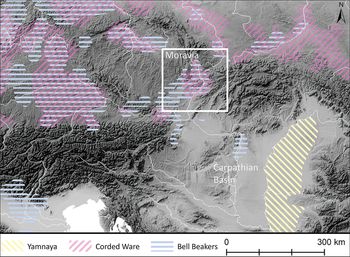
Intensive interaction between the Corded Ware and Yamnaya cultural spheres took place in contact zones located along the southern and eastern borders of the Corded Ware cultural milieu in Central and Eastern Europe (Figure 1). Moravia (the eastern part of the present-day Czech Republic) was one of these contact zones, and Włodarczak (Reference Włodarczak and Kadrow2010) associates the local Corded Ware finds with the Carpathian Yamnaya cultural sphere. The regional Corded Ware group forms a south-eastern periphery of the Corded Ware cultural zone. The southern Moravian lowlands, located on the north-western edge of the Pannonian Plain, were naturally partially open (unforested) throughout the Holocene. The spread of pastures during the third millennium BC, as indicated by pollen of light-demanding and Steppe vegetation in palaeoecological archives, suggests increased dependence on herding c. 2500 BC, likely connected with an increase in human population and the emergence of the Corded Ware (c. 2900–2000 BC) and Bell Beaker complexes (c. 2500–2000 BC) (Kolář et al. Reference Kolář, Kuneš, Szabó, Hajnalová, Svobodová, Macek and Tkáč2018).
Map of Central Europe showing the main archaeological groups of the third millennium BC (figure by J. Kolář, based on Gerling et al. Reference Gerling, Bánffy, Dani, Köhler, Kulcsár, Pike, Szeverényi and Heyd2012; Bilger Reference Bilger2018; Kolář Reference Kolář2018).

The Corded Ware group in Moravia (dated to between 2580 and 2010 cal BC) is characterised by gender-specific individual inhumations, earthen round barrows, beakers decorated with cord impressions and the use of axe-hammers (Kolář Reference Kolář2018). Culture-historical accounts have sought the origins of the Corded Ware in ‘migration waves’ from Bohemia, combined with undefined ‘influences’ from the Carpathian Basin (Šebela Reference Šebela and Podborský1993). The similarity of Corded Ware pottery with Early Bronze Age ceramics in the Carpathian Basin led Bertemes and Heyd (Reference Bertemes, Heyd, Bartelheim, Krause and Pernicka2002) to assign the Moravian Corded Ware graves to the Early Bronze Age Makó Culture of south-western Slovakia and Hungary. While interactions between Moravia and the central Carpathian Basin must have taken place, what were the social processes behind such contacts? Are the observed similarities in material culture and burial practice the result of large-scale migrations, as suggested by the archaeogenetic research? Or were there alternative social relationships that could result in a similar archaeological signature?
Interactions reflected by pottery
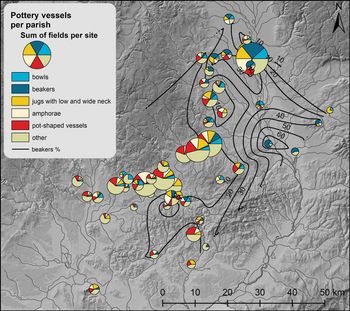
Ceramic vessels are the most frequent Corded Ware artefacts found in Moravia. While vessels of different shapes were deposited in graves according to gendered norms (Kolář Reference Kolář2018), regional patterns can also be observed. A difference between north-eastern and south-western Moravia is evident in the most frequently observed pottery shapes (Figure 2), and corded beakers are recorded much more frequently among the north-eastern communities than among those of the south-west (for details, see Kolář Reference Kolář2018).
The most frequently encountered pottery types and percentages of beakers at Corded Ware Culture sites in Moravia; the sum of pottery vessels is indicated by the size of the pie charts, ranging between 5 and 128 per site (figure by J. Kolář, modified from Kolář Reference Kolář2018: fig. 83).

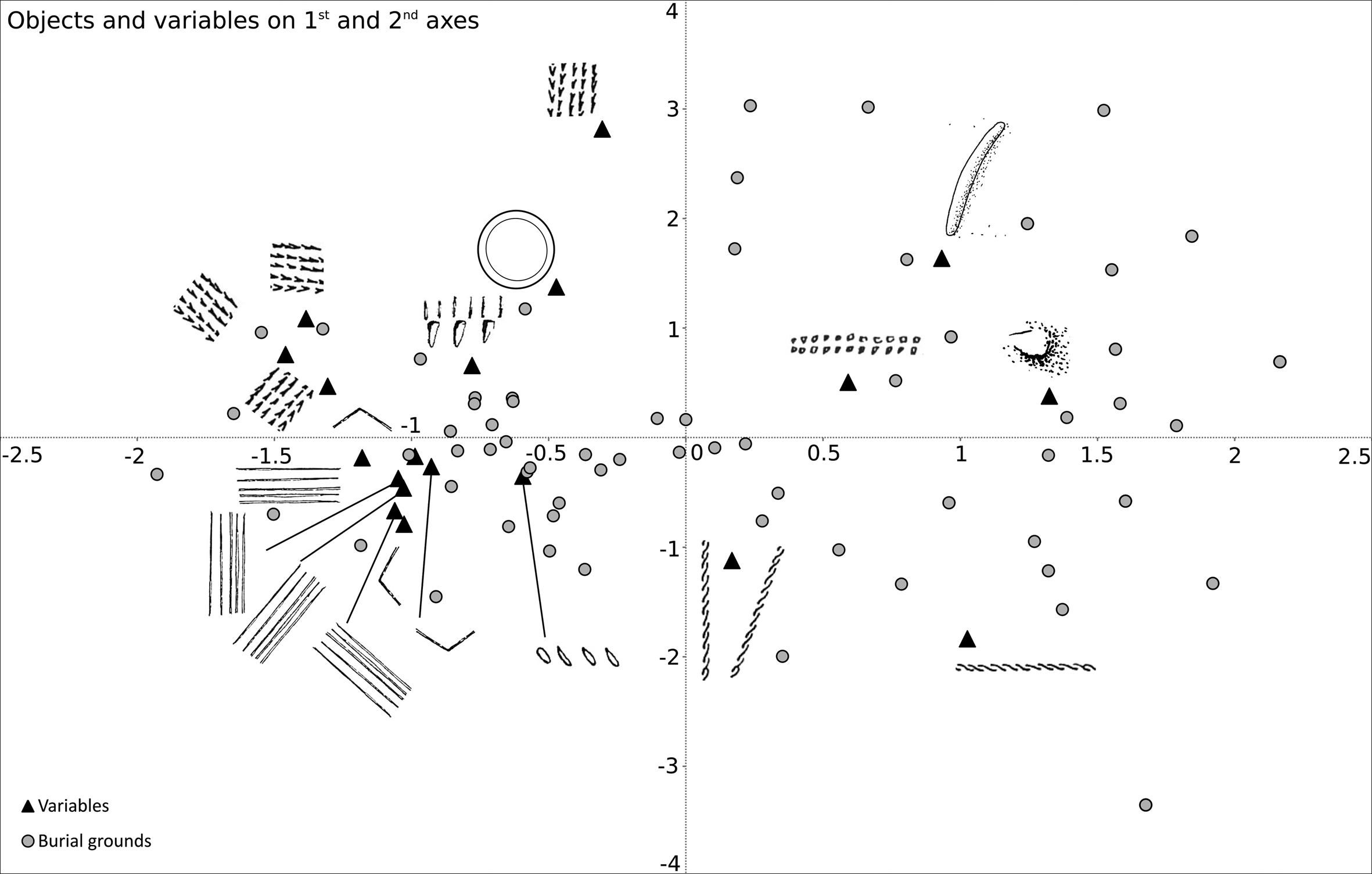
Here, ceramic decoration is differentiated and described on three levels: a decorative ‘ornament’, decorative ‘patterns’ and decorative ‘elements’. A decorative pattern provides information on the spatial arrangement of elements (e.g. a double horizontal line or a row of circular imprints). A set of patterns then forms a decorative ‘ornament’ (e.g. a double horizontal line combined with a horizontal row of circular imprints; for details, see Kolář Reference Kolář2018). Pottery decoration can be analysed on all three levels. Associations of decorative elements and techniques (variables) with sites (objects) are explored through correspondence analysis and interpolation (natural neighbour method) using GIS (Sibson Reference Sibson and Barnett1981). In the analysis of the decorative elements (Figure 3), the first principal axis divides the cemeteries into two groups: the first is characterised by the cord impression technique, relief decoration and punctures and imprints; the second by incised decoration in the form of parallel lines and triangles, and grooved punctures. The second principal axis shows that the cemeteries are divided by the presence of cord imprints and incised decoration on one side, and relief decoration and grooved punctures on the other.
Correspondence analysis of decorative elements and techniques at Corded Ware cemeteries in Moravia (figure by J. Kolář, modified from Kolář Reference Kolář2018: fig. 92).

Spatial analysis shows that the regions of central and south-western Moravia share incision- and grooved-puncture decoration techniques in common (Figure 4). Nevertheless, these areas also have sites with relief decoration and cord impressions.
Correspondence analysis in geographical space; the factor score of burial sites on the first axis is illustrated in Figure 3 (only burial sites with more than two contexts; natural neighbour method of interpolation; figure by J. Kolář, modified from Kolář Reference Kolář2018: fig. 94).

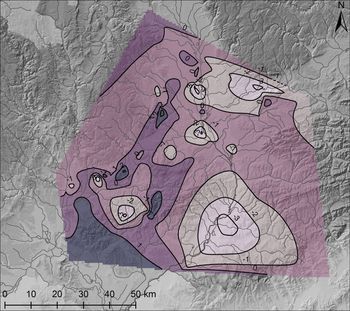
The factor scores (representing similarity) of the second principal axis on Figure 3 divide Moravia into eastern and western halves (Figure 5). Eastern Moravia is characterised by the negative side of the axis, that is, cord impression and incised decoration. The western, and especially the south-western, parts of Moravia are strongly represented on the positive side of the axis, with relief decoration and grooved punctures (for details, see Kolář Reference Kolář2018).
Correspondence analysis in geographical space; the factor score of burial sites on the second axis is illustrated in Figure 3 (only cemeteries with more than two contexts; natural neighbour method of interpolation; figure by J. Kolář, modified from Kolář Reference Kolář2018: fig. 95).

Interactions reflected by lithics
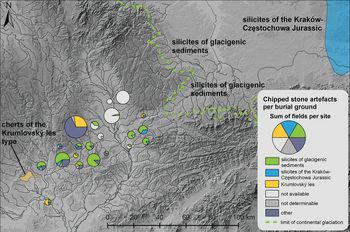
Chipped stone artefacts are among the most common finds recorded in Moravian Corded Ware Culture graves (included in more than 40 per cent of burials). Their origin can be relatively easily traced to the region of extraction (for details, see Kolář Reference Kolář2018). The most frequently used raw material was silicite from glacigenic sediments (more than 50 per cent of all finds) sourced from northern Moravia and farther north (Figure 6).
Spatial patterns of raw materials used for chipped stone artefacts at Corded Ware cemeteries; the sum of artefacts indicated by the size of the pie charts ranges between 3 and 47 per site (figure by J. Kolář, modified from Kolář Reference Kolář2018: fig. 109).

Chert of the Krumlovský les (Krumlov forest) type was the most important locally sourced raw material (Kolář Reference Kolář2018), with the hilly area of the Krumlovský les being exploited from the Mesolithic to the Iron Age. While the greatest volume of chert was exploited from the Early Bronze Age onwards, increased extraction can be dated to as early as the third millennium BC (Oliva Reference Oliva2010). Although this period corresponds to the Corded Ware Culture, there is no evidence for the latter's presence in the Krumlovský les mining area. By contrast, south-western Moravia has many settlements and burial grounds assigned to the Bell Beaker culture. Oliva (Reference Oliva2010) has argued that, although the cherts were used by communities belonging to several archaeological cultures across Moravia, its extraction was controlled by the local Bell Beaker communities. Interactions associated with this raw material were therefore conducted between communities of different archaeological cultures. Such social relationships are crucial for identifying the true extent of a prehistoric society.
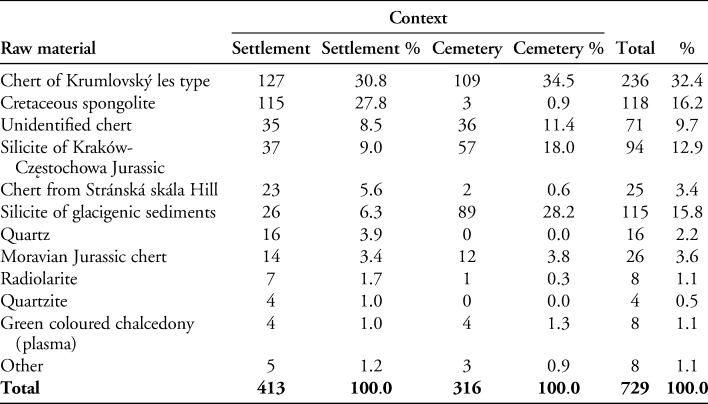
As mortuary practices signal intention, the composition of assemblages from burials and settlements (the latter being more random and unintentional) differs. While this cannot be tested for Corded Ware contexts in Moravia, as virtually no settlement sites are known there, there are numerous settlements and burials assigned to the Bell Beaker Culture (Table 1). Although Bell Beaker burial practices favoured the inclusion of non-local silicites of glacigenic sediments and silicites of the Kraków-Częstochowa Jurassic uplands to the north-east, the settlement evidence, which better reflects everyday life, shows a strong preference for local Moravian materials, particularly Krumlovský les-type cherts.
Raw materials of Bell Beaker Culture chipped stone artefacts in Moravia (after Kolář Reference Kolář2018: tab. 53).

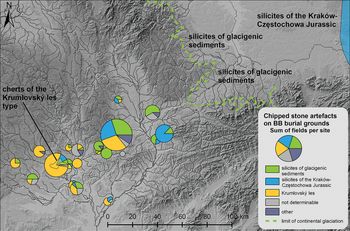
Yet the interactions suggested by the lithics are not that simple, and regional variation existed, even in a territory as small as Moravia (Figure 7). The Bell Beaker burial record in south-western Moravia demonstrates a preference for locally sourced Krumlovský les-type chert. East of the River Svratka, in southern, central and northern Moravia, communities favoured silicites of north-eastern origin for inclusion in graves. The choice of lithic raw material in this region was similar to that of the contemporaneous and spatially overlapping Corded Ware Culture. This suggests that the same exchange networks for lithics existed across these partially contemporaneous archaeological cultures. Nevertheless, these networks were not established during the Final Eneolithic in the third millennium BC, but earlier, as there is clear evidence of the use and social significance of these raw materials from the Early Neolithic Linearbandkeramik period onwards, continuing into the Bronze Age (Šída Reference Šída2006; Mateiciucová Reference Mateiciucová2008; Kaňáková Hladíková Reference Kaňáková Hladíková2013).
Spatial patterns of raw materials used for chipped stone artefacts at Bell Beaker cemeteries; the sum of artefacts indicated by the size of the pie charts ranges between 3 and 63 per site (figure by J. Kolář, modified from Kolář Reference Kolář2018: fig. 112).

Discussion
These examples of the most common categories of Corded Ware Culture finds in Moravia raise a number of important issues. First, they illustrate the shortcomings of the concept of a ‘homogeneous’ archaeological culture. The illusion of material uniformity and clear cultural boundaries can be easily disproved by quantified analyses of detailed datasets, as demonstrated at a European level in previous studies (e.g. Vander Linden Reference Vander Linden and Czebreszuk2004; Furholt Reference Furholt2008, Reference Furholt2014, Reference Furholt2019). Heterogeneity in a regional archaeological record assigned to a single archaeological entity, on the other hand, represents another facet of the argument. The needs of the burying communities were satisfied through the inclusion in graves of locally specific material symbols, but practices regarding the body may have had a supra-regional character, as manifested in gender-specific individual inhumations. Moreover, this practice was new to Moravia in the third millennium BC, and seems to be related to Steppe ancestry. Furholt's (Reference Furholt2019) examination of the Single Grave Burial Rite complex, which appeared in Central Europe and Southern Scandinavia around 2900 BC and later in the British Isles, led to a model that proposes that migration from the Black Sea Steppe region did not result in the emergence of a new and uniform archaeological culture (cf. Kristiansen et al. Reference Kristiansen2017), but in the transformation of extant burial rites across Late Neolithic and Early Bronze Age archaeological cultures. Hence, separately assessing the distinct spheres, or sub-systems in Clark's (Reference Clarke1978) sense, of funerary practices and pottery production allows us to perceive better the precise nature and extent of change, balancing both the large- and small-scale perspectives.
Working within the framework of the polythetic model of culture, it can be argued that some aspects of daily life were shared with a supra-regional group, while other elements were shared with local communities, and yet others pertained to a single household. The ways in which gender groups were differently embedded in both supra-regional entities and local contexts can be cited as an example (Bourgeois & Kroon Reference Bourgeois and Kroon2017). Archaeologists, recently followed by archaeogeneticists, often refrain from studying societies as a whole, confining themselves to interpreting the limited data that are defined as constituting an archaeological culture. This, however, is far from the prehistoric reality, in which communities or societies, not archaeological cultures (descriptive tools of modern archaeologists), were the social actors (cf. Müller Reference Müller2009).
The analysis of chipped stone artefacts and their raw materials demonstrates the continuity of regional and supra-regional interaction networks from the Neolithic to the Bronze Age. The socially significant exploitation of local chert of the Krumlovský les was not interrupted by the putative mass migrations. On the contrary, this area gradually grew into a complex ‘industrial-sacred landscape’ in the Early Bronze Age (Oliva Reference Oliva2010). Moreover, the interactions reflected in the distribution of the raw material clearly did not respect the ‘borders’ of archaeological cultures. This argues against the pervasive notion that archaeological cultures represent the material remains of homogeneous populations or societies.
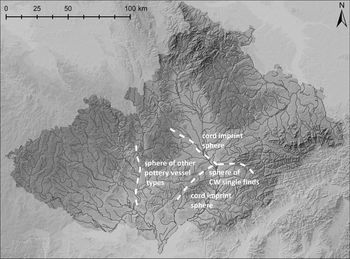
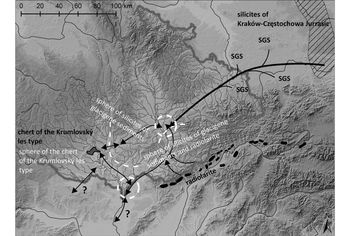
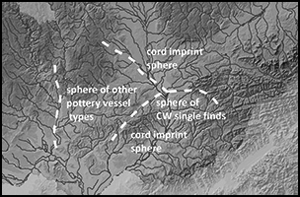
While social relationships are observable as spheres of interactions, whose spatial extent is indicated by similarity in material culture, the polythetic model of culture (Clarke Reference Clarke1978) suggests that a society can have several interaction spheres of different extent. These can overlap fully or partially, according to the relationship between the specific type of material culture and the particular social processes involved. In the case of Corded Ware Culture in Moravia, several spheres of interaction are observable in the pottery and chipped stone artefact assemblages (Figures 8–9). Nevertheless, for an adequate interpretation of a prehistoric society with its relationships, other contemporaneous and spatially related (in our case, Bell Beaker and Yamnaya) interaction spheres must be considered simultaneously.
Interpretative map of pottery groupings (modified from Kolář Reference Kolář2018: fig. 146).

Interpretative map of chipped stone artefact groupings (figure by J. Kolář, modified from Kolář Reference Kolář2018: fig. 147).

A culture-historical interpretation would relate the homogeneity of the material culture with social homogeneity, but the opposite may be much closer to the prehistoric reality. Furholt (Reference Furholt2017: 311) suggests that trans-local relationships would involve ‘frequent intermixing of local settlement communities’, arguing that, if we are to fully understand trans-locality, the archaeological record needs to be interpreted in terms of modes of production. He proposes that during the European Neolithic and Bronze Age, pottery was produced mainly within the household or a settlement (mode 1: ‘local, intra-community self-supplying production’; Furholt Reference Furholt2017: 311), rather than being the result of specialised production and routine exchange (mode 2). As non-specialist potters incorporated ceramic production into their daily practice, any homogeneity in pottery styles observed in a larger region is suggestive of co-socialisation of the potters through long-term and regular mobility between the regional communities. The raw materials used in the chipped stone industry reflect a completely different mode of interaction, especially raw material from distant sources, such as the silicites from the Kraków-Częstochowa Jurassic uplands. Procurement was probably similar to Furholt's (Reference Furholt2017) mode 2, which is characterised by the exchange and high social significance of certain goods.
The model of trans-local societies allows for a new interpretation of the social relationships creating the third-millennium BC societies in Central Europe. Analysis of the interaction spheres of trans-local societies in Moravia suggests that a similar set of spheres functioned in the Carpathian Basin and farther east. Trans-locality, involving a high proportion of mobile individuals within these spheres would result in the regional homogeneity of some components of the material culture and human behaviour, and could facilitate the transfer of knowledge and people. Such a complex social model of human mobility and relations is proposed in opposition to the simple model of rapid migration of homogeneous cultural entities. Moreover, we must recognise that not all cultural changes are related to mobility and vice versa (Raghavan et al. Reference Raghavan2014).
Conclusions
The quantitative analyses and theoretically informed interpretations of datasets relating to aspects of the Corded Ware Culture in Moravia (ceramic decoration and provenance of lithics) prove to be significant for several reasons. First, the results demonstrate that the concept of an archaeological culture as a homogeneous prehistoric entity (a society or population) is unsatisfactory, and should not therefore be used uncritically by other disciplines. Second, these indicate that prehistoric societies were neither static nor uniform. Relationships between trans-local communities involved both local links and those that crossed interaction spheres. Future research must explore how to combine local-, continental- and global-scale perspectives—in our case, how large-scale migrations were manifested in local conditions. Third, a polythetic approach enables archaeologists to not lose sight of the interpretative potential offered by migration and mobility studies. We need to debate honestly the concepts of culture prevailing in archaeology and be open to current discourses in other social sciences (Burmeister Reference Burmeister2016). To that end, cultures need to be understood as “bundles of relationships” (Wolf Reference Wolf2010: 3). Employing complex, socially based interpretations of the archaeological record is preferable to assuming simple connections between mass migrations of homogeneous populations and cultural change, especially today, in a world marked by vastly increased exchange and multiculturalism, as well as a growth in nationalistic movements.
Acknowledgements
This work was supported as a long-term research development project (RV67985939) and is part of the project ‘Land Use, Social Transformations and Woodland in Central European Prehistory: Modelling Approaches to Human-Environment Interactions’, financed by a grant from the Czech Science Foundation (19-20970Y). Valuable feedback on the manuscript was kindly provided by Daniel Sosna, and I am grateful to Péter Szabó for language corrections.