Introduction
The number of goats in Morocco was estimated to 6.5 million heads (FAO, 2014). Goat farming has a major economic role and contributes to the income of more than 70 percent of rural communities in the country (Chentouf et al., Reference Chentouf, Zantar, Doukkali, Farahat, Joumaa and Aden2011). Goats are also important because they exploit marginal and harsh areas. Despite of their importance, information about Moroccan goat resources is scarce and mainly focused on the assessment of production and reproduction performance (Boujenane, Reference Boujenane2008; Boujenane, Lichir and El Hazzab, Reference Boujenane, Lichir and El Hazzab2010; Ibnelbachyr, Boujenane and Chikhi, Reference Ibnelbachyr, Boujenane, Chikhi and Noutfia2015b). In Morocco, the Hamra goat is located in two different regions; Beni Arouss and Rommani that are distant from each other (about 400 km). The Hamra goats in both regions have a red coat colour. The head is strong often carrying twisted horns in both sexes, ears are often dressed in males and dropped in females. The neck is long, very often carrying wattles, and the tail insertion is low (Hilal et al., Reference Hilal, El Otmani, Chentouf and Boujenane2013) (Figure 1). Although animals of both regions have almost the same external appearance, the Ministry of Agriculture still hesitates to consider them as belonging to the same population.
Photograph of Hamra goats.

The phenotypic characterization of local genetic resources depends on the variation of morphological traits, and the selection on them may constitute an effective tool to breed preservation and improvement (Nsoso et al., Reference Nsoso, Podis, Otsogile, Mokhutshwane and Ahmadu2004; Sowande, Oyewale and Iyasere, Reference Sowande, Oyewale and Iyasere2010). Many authors highlighted the importance of using the multivariate analysis of morphological traits to assess phenotypic variation within and between goat populations (Herrera et al., Reference Herrera, Rodero, Gutierrez, Peña and Rodero1996; Dekhili, Bounechada and Mannalah, Reference Dekhili, Bounechada and Mannalah2013).
Therefore, the objective of this study was to characterize the Hamra goat population and to identify the relationship between Beni Arouss and Rommani populations through a multivariate analysis of morphological characteristics.
Materials and methods
Data collection
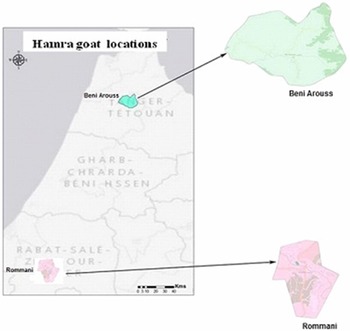
This study was carried out on Hamra goats raised in two regions of Morocco; Beni Arouss, located in the north (between latitudes 35°30′N and 35°33′N and longitudes 5°52′E and 5°63′E), and Rommani, located in the centre (between latitudes 33°35′N and 33°66′N and longitudes 6°31′E and 6°89′E) (Figure 2). Moreover, the Beni Arouss region is characterized by its mountains and high annual rainfall, whereas the Rommani region is characterized by its hills and low annual rainfall. From May to December 2012, 157 adult goats (2–5 years old); 94 in Beni Arouss (85 females and nine males) and 63 in Rommani (58 females and five males) regions were measured. These goats originated from 19 herds in Beni Arouss and nine herds in Rommani regions that were managed under an extensive system. In each herd, 4–12 adult goats were randomly selected and measured.
Map of Beni Arouss and Rommani locations.

Studied variables
The studied variables were heart girth (HG), body length (BL), height at withers (HaW), height at rump (HS), chest depth (ChD), pelvis width (PW), chest width (CW), cannon circumference (CC), head width (HeW), head length (HeL) and horn length (HL). Measurements were taken to the nearest centimetre on animals placed on a flat ground using a tape measure and a calliper. Measurements were taken in the morning before the animals were released for grazing. All measurements were carried out by the same person in order to avoid between-individual variations.
Statistical analyses
Statistical analyses were carried out using the SAS/STAT package (SAS, 1999). Descriptive statistics for body measurements were obtained using the PROC MEANS. Environmental effects on body measurements were assessed using the PROC GLM. The mixed model used included the fixed effect of sex (female and male) and region (Beni Arouss and Rommani) and the random effects of herd nested within region to account for the non-independency of sampling in each region. To assess the between and within region variance components of body measurements, the PROC VARCOMP was used by fitting a model that included region as random effect. PROC CORR was also used to compute Pearson correlations among body measurements. Moreover, to extract a minimum number of uncorrelated components that account for most of the variance in the 11 traits, the factor analysis was realized using the PROC FACTOR. Moreover, the stepwise discriminant analysis was applied using PROC STEPDISC to determine the most discriminant traits. The significance level used for adding or excluding a variable was 0.15. Variables in the final model were then submitted to a canonical discriminant analysis, using PROC CANDISC, in order to derive canonical functions that are linear combinations of the morphological variables and compute the between regions Mahalanobis distance. The ability of the canonical functions to assign each individual to its populations was calculated as the percentage of correct assignment to each population using PROC DISCRIM.
Results
Arithmetic means and region effect
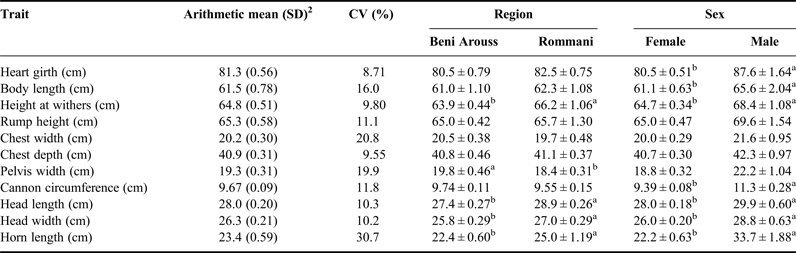
Arithmetic and least-squares means for body measurements are given in Table 1. Overall, HG, BL, HaW, HS, ChD, PW, CW, CC, HeL, HeW and HL of Hamra goats averaged 81.3, 61.5, 64.8, 65.3, 40.9, 19.3, 20.2, 9.67, 28.0, 26.3 and 23.4 cm, respectively. The coefficients of variation for different measurements ranged from 8.71 percent for ChD to 30.7 percent for HL.
Arithmetic means, coefficients of variation (CV), least-squares means ± SE for the 11 body measurements of Hamra goats according to region and sex 1 .

1 Least-squares means within a line for each factor that do not have a common superscript (a,b) are significantly different (P < 0.05).
2 SD, standard deviation.
The region did not have a significant effect (P > 0.05) on HS, CW, ChD, HG, BL and CC, but had a significant effect (P < 0.05) on HeL, HeW, HL, HaW and PW showing a certain homogeneity among the Hamra goats of the two regions. Rommani goat population had the highest values for HeL, HeW, HL and HaW. Differences were 1.5 cm for HeL, 1.2 cm for HeW, 2.6 cm for HL and 2.3 cm for HaW.
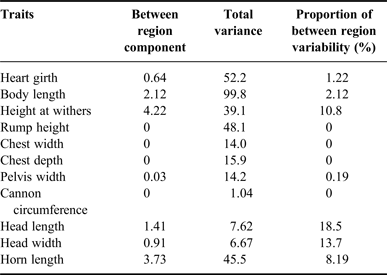
Table 2 shows the proportion of between region variability of Hamra population. It ranged from 0 percent (absence of variability between regions) for HS, CW, ChD and CC to 18.5 percent for HeL. Therefore, there was a low variability between goat populations of Beni Arouss and Rommani regions indicating a close relationship between them.
Between region variance component, total variance and percentage of the between region variability.

Correlations among measurements
Correlation coefficients among morphological traits of Beni Arouss and Rommani goats are shown in Table 3. High and significant correlations were found between HS and HeL in Beni Arouss (0.812) and between HS and HaW in Rommani populations (0.830). HeW in Beni Arouss and HG in Rommani regions were highly correlated with the other morphological traits. Also, the correlation coefficient between the ChD and HG was higher for Rommani goats (0.703) than for Beni Arouss goats (0.351). The lowest and significant correlation coefficient was recorded between HeW and BL in Beni Arouss region (−0.231) and between PW and CW in Rommani region (0.281).
Pearson's correlation coefficients among measurements of Beni Arouss (above the diagonal) and Rommani (below the diagonal) goat populations 1 .

1 BL, body length; HaW, height at withers; HL, horn length; ChD, chest depth; CW, chest width; HG, heart girth; HeL, head length; HeW, head width; HS, rump height; PW, pelvis width; CC, cannon circumference.
ns, Not significant: P > 0.05.
*P < 0.05.
**P < 0.01.
***P < 0.001.
Multivariate analyses
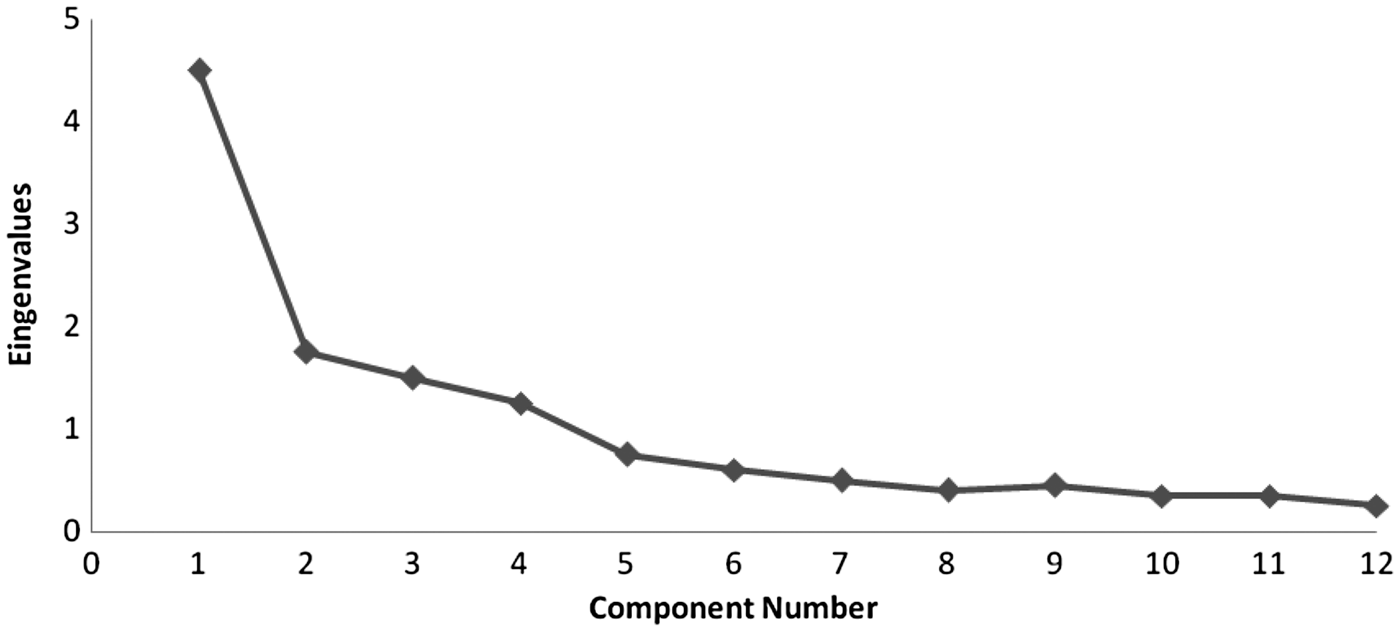
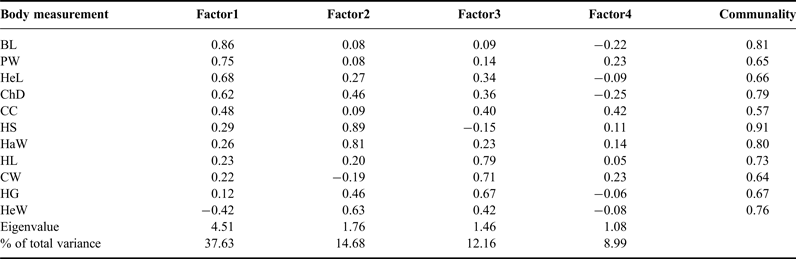
Results of the factor pattern and communality of the body measurements of Hamra goat population are reported in Table 4. The Kaiser–Meyer Measure of Sampling Adequacy, which determines the proportion of the variance in difference measurements caused by the underlying factors, was equal to 0.75. Four factors with eigenvalues >1 were extracted (Figure 3). They accounted for 73.5 percent of the total variance. The first factor explained 37.6 percent of variability, and loadings were highest for BL, PW, HeL and ChD. The second factor described 14.7 percent of the total variability. It was represented by significant positive high loading for HS, HaW and HeW. Factor three (HL, CW and HG) explained 12.2 percent of the total variance. CC was more associated with the fourth factor accounted for 9.0 percent of the variation. Likewise, variables’ communalities, which represent the proportion of variance of each of the 11 variables shared by all remaining body measurements, were medium to high. They varied from 0.57 to 0.91 (Table 4).
Scree plot of factor analysis for body measurements of Hamra goats.

Eigenvalues and % of total variance along with factor loadings and communalities of the body measurements of the two goat populations 1 .

1 BL, body length; HaW, height at withers; HL, horn length; ChD, chest depth; CW, chest width; HG, heart girth; HeL, head length; HeW, head width; HS, rump height; PW, pelvis width; CC, cannon circumference.
The stepwise discriminant analysis showed that among the 11 measurements, HeL, CW, HeW and PW had the most discriminant power as indicated by their partial R 2, suggesting that only few measurements are needed to separate between the two populations.
The canonical discriminant analysis generated only one discriminant function (CAN1) that may be used to differentiate between the populations. The canonical function, which is the linear combination of the four most discriminant traits, is as follows:
 $$\eqalign{{\rm CAN1} & = 0.475 + 0.490\ {\rm HeW} + 0.635\;{\rm HeL} \cr & \quad - 0.375\;{\rm PW} - 0.214\ {\rm CW}.} $$
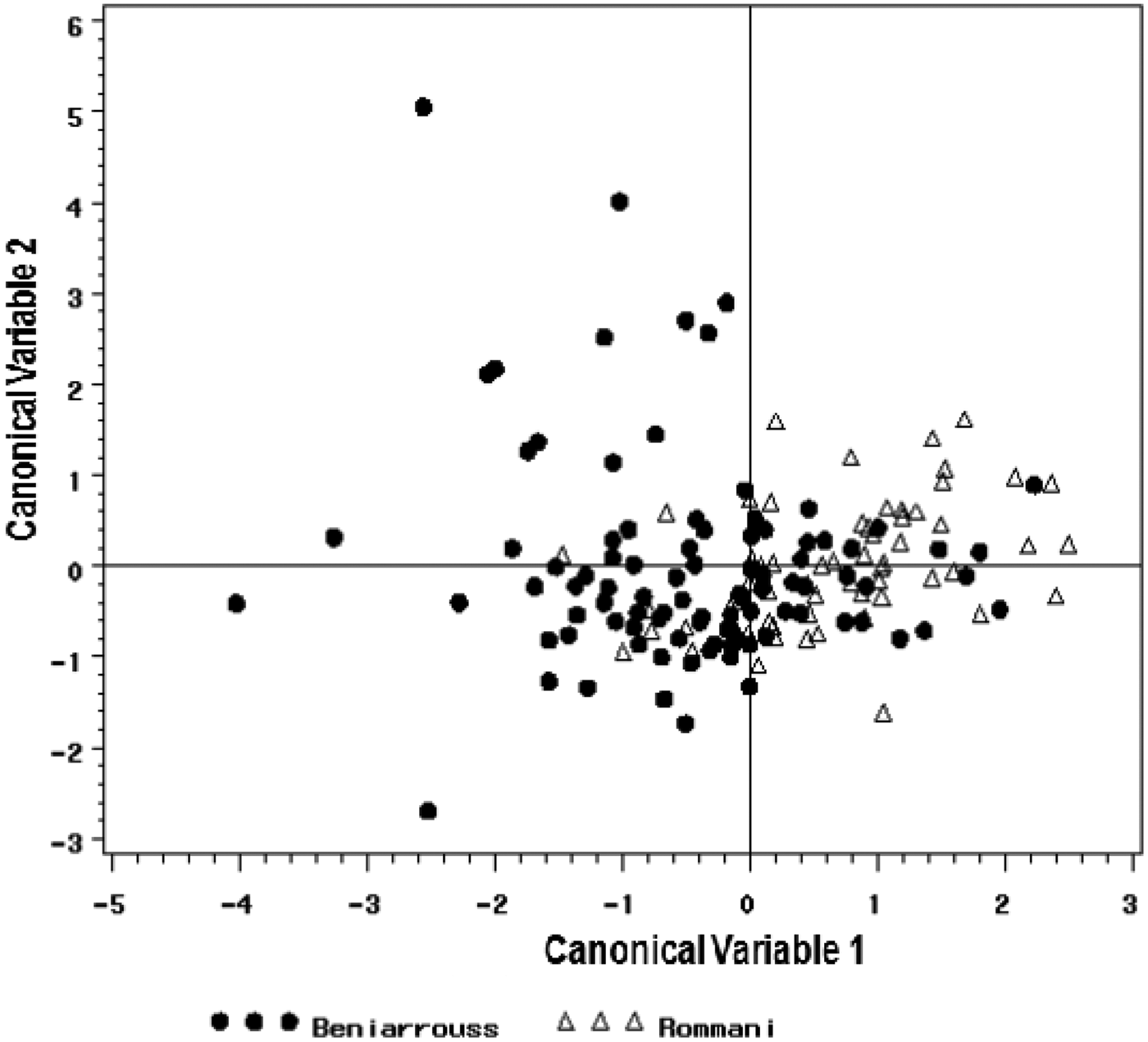
Figure 4 shows an association among the individuals of Beni Arouss and Rommani populations. The first axis, which separated the two populations, indicated homogeneity among individuals of the two populations of Hamra breed. Moreover, the Mahalanobis pairwise distance between the two goat populations was equal to 1.197.
Canonical discriminant analysis for individual body measurements of Beni Arouss and Rommani goat populations.

The percentage of classified individuals into their source population obtained from discriminant analysis was 80.9 percent in Rommani and 50.0 percent in Beni Arouss. Overall, 34.5 percent of individuals were misclassified.
Discussion
The results on body measurements showed that Hamra goats have a medium size. These measurements were higher than those reported by Okpeku et al. (Reference Okpeku, Yakubu, Peters, Ozoje, Ikeobi, Adebambo and Imumorin2011) on Red Sokoto goats (62.3 cm for HaW, 31.4 cm for ChD, 12.1 cm for HeW and 69.8 cm for HG) and Ibnelbachyr, Boujenane and Chikhi (Reference Ibnelbachyr, Boujenane and Chikhi2015a) on Draa breed in South of Morocco (61.5 cm for Haw, 74.4 cm for HG and 23.1 cm for HL). However, these measurements were lower than those found by Rodero et al. (Reference Rodero, Herrera, Peña, Molina, Valera and Sepúlveda2003) on Payoya Spanish dairy goats (77.7 cm for HaW and 87.7 cm for HG). Higher values for body measurements were also reported by Martinez et al. (Reference Martinez, Herrera, Luque and Rodero2014) for Blanca Andaluza, Blanca Celtibérica, Negra Serrana, Pirenaica, Payoya, Murciano-Granadina and Malagueña Spanish goat populations. Further, the Hamra goats had a HaW similar to the value reported by Pires et al. (Reference Pires, Machado, Araújo, Silva, Euclydes, Costa and Oslon2013) for Rhâali goats (64.04 cm), but lower than those reported for Zagora (65.74 cm) and Drâa (71.21 cm) goats. Moreover, it had a ChD greater than those found by Pires et al. (Reference Pires, Machado, Araújo, Silva, Euclydes, Costa and Oslon2013) for Rhâali, Zagora and Drâa (30.85, 30.53 and 29.73 cm, respectively) goats. The morphological measurements of Hamra goats may be due to the varied raising environment.
The effect of region was not significant on HS, CW, ChD, HG, BL and CC, but significant on the other traits, suggesting that morphological measurements of Beni Arouss and Rommani goat populations are closely similar to each other. This result is not in agreement with that of Hagan et al. (Reference Hagan, Apori, Bosompem, Ankobea and Mawuli2012) who reported that BL and HaW of the indigenous Ghana goats significantly differ in various locations and with that of Dekhili, Bounechada and Mannalah (Reference Dekhili, Bounechada and Mannalah2013) who confirmed that the raising area had a great impact on the morphological measurements of Algerian goat populations.
The percentage of the variability between regions ranged from 0 percent for HS, CW, ChD and CC to 18.5 percent for HeL. This result is lower than that reported by Aziz and Al-Hur (Reference Aziz and Al-Hur2013) for the proportion of variability between three Saudi goat types Ardi, Line1 and Line2 (0.01 percent for CC to 45.7 percent for HG).
As expected, correlations among morphological measurements of these goat populations were in general high, indicating a good association between these measurements. These results are in the range of those reported by Yakubu (Reference Yakubu2009), Okpeku et al. (Reference Okpeku, Yakubu, Peters, Ozoje, Ikeobi, Adebambo and Imumorin2011) and Hassen et al. (Reference Hassen, Baum, Rischkowsky and Tibbo2012).
Also, the high correlations among traits found in the current study highlighted the appropriateness of multivariate analyses.
The factor analysis showed that four factor explained 73.5 percent of total variance in Hamra goat breed. These proportions are lower than those reported by Rodero et al. (Reference Rodero, Herrera, Peña, Molina, Valera and Sepúlveda2003) (82.95 and 80.88 percent in Florida and Payoya Spanish dairy goats, respectively). Salako (Reference Salako2006) reduced the linear body measurements of immature Uda sheep in Nigeria to two factors that accounted for 75 percent of total variance. The communalities found in the present study indicated that all the traits had high loadings on factor 1, which is a good descriptor of general body size, while factors 2, 3 and 4 seemed to reflect the body shape and head size for the Hamra goat population.
The most discriminant variables selected through the stepwise discriminant analysis were HeL, HeW, PW and CW. These four measurements can be useful to differentiate between Beni Arouss and Rommani goat populations. As a result, the seven other body measurements had limited differentiation effects and hence might not be trusted in studying morphological studies to define the racial characterization of these two populations. Some of the discriminating variables obtained in the present study were similar to those reported by Herrera et al. (Reference Herrera, Rodero, Gutierrez, Peña and Rodero1996) in Andalusian breeds and Rodero et al. (Reference Rodero, Herrera, Peña, Molina, Valera and Sepúlveda2003) in Florida and Payoya Spanish dairy goats. Dekhili, Bounechada and Mannalah (Reference Dekhili, Bounechada and Mannalah2013) reported that BL, CW, ear length, rump height, HeL, rump width, tail length, BL and side depth would be more important in differentiating the Algerian goats. Herrera et al. (Reference Herrera, Rodero, Gutierrez, Peña and Rodero1996) concluded that two cephalic variables (length and width of the head) had the largest discriminant value.
Only one canonical variable was generated (P < 0.001) from the canonical discriminant analysis. A similar result was also reported by Yadav et al. (Reference Yadav, Jain, Kulkarni, Govindaiah, Aswathnarayan and Sadana2013) for India sheep. The Mahalanobis distance between the two populations was very low (1.197), indicating a morphological similarity between the two goat populations. This similarity may be due to two distinct factors: the genetic exchange that might took place between the two populations in the past or the presence of a common or close origin. Yadav et al. (Reference Yadav, Jain, Kulkarni, Govindaiah, Aswathnarayan and Sadana2013) reported that differences in Mahalanobis distances between four sheep breeds of southern peninsular zone of India were associated with differences in management practices, agro-climatic conditions and biophysical resources. Likewise, Dekhili, Bounechada and Mannalah (Reference Dekhili, Bounechada and Mannalah2013) reported a large Mahalanobis distance (8.6) between southern and northern goat populations in Algeria. Additionally, Pires et al. (Reference Pires, Machado, Araújo, Silva, Euclydes, Costa and Oslon2013) reported, in a Cluster evaluation of Brazilian and Moroccan goat populations, that the Euclidean distances between Drâa and Zagora, Drâa and Rhâali and between Zagora and Rhâali Moroccan populations were 1.12, 1.46 and 0.50, respectively.
The discriminant analysis showed a high misclassification error of individuals belonging to Rommani and Beni Arouss goat populations (34.5 percent). This indicates that on the basis of morphological measurements, there was similarity between the two goat populations. Rodero et al. (Reference Rodero, Herrera, Peña, Molina, Valera and Sepúlveda2003) reported that the misclassification error of Payoya and Florida breeds in Spain was almost nil. Dossa, Wollny and Gauly (Reference Dossa, Wollny and Gauly2007) and Martinez et al. (Reference Martinez, Herrera, Luque and Rodero2014) concluded that the degree of correct classification of goats in their zones depended on the high discriminating power of morphological measurements.
Conclusions
The results of this study showed that although Beni Arouss and Rommani goat populations are located far from each other, they are not morphologically so different, and may be considered as belonging to the same Hamra population. This information will help in developing improvement and preservation strategies for the Hamra goat population. Nevertheless, this morphological characterization should be confirmed by the molecular characterization.
Acknowledgements
We sincerely thank all the field officers and extension staff who assisted us in the survey work. We are also grateful to all the Beni Arouss and Rommani goat farmers who willingly provided unrestricted access to their farms and animals.
Conflict of interest
The authors have no conflict of interest regarding the research reported in this manuscript.