INTRODUCTION
The harvesting of wild animal protein to supplement household diets and livelihoods is widely documented throughout sub-Saharan Africa, with the bulk of research hailing from the humid zones of west and central Africa (Bennett & Robinson Reference Bennett and Robinson2000; Robinson & Bennett Reference Robinson and Bennett2000; Manika & Trivedi Reference Manika and Trivedi2002; Milner-Gulland & Bennett Reference Milner-Gulland and Bennett2003; Lowassa. et al. Reference Lowassa, Magimbi and Kaltenborn2004; De Merode et al. Reference De Merode, Homewood and Cowlishaw2004; Fa et al. Reference Fa, Ryan and Bell2005). In contrast, data on the biomass and species composition of animals harvested at specific sites across the rainfall gradient are less common, especially in the xeric grassland and savannah biomes in eastern and southern Africa (Robinson & Bennett Reference Robinson and Bennett2004). Moreover, studies from these regions have typically focused on describing illegal poaching activities from conservancies and their fringes (Hofer et al. Reference Hofer, Campbell, East, Huish, Taylor and Dunstone1996; Teylingen & Kerley Reference van Teylingen and Kerley1995; Lloyd Reference Lloyd1999; Carpaneto & Fusari Reference Carpaneto and Fusari2000; Loibooki et al. Reference Loibooki, Holfer, Campbell and East2002; Lowassa et al. Reference Lowassa, Magimbi and Kaltenborn2004; Holmern et al. Reference Holmern, Muya and Skaft2007), with the emphasis being on highlighting threats to key species or biomes of high conservation importance.
These studies do little to enhance general understanding of the importance of wildlife to rural livelihoods, given that the majority of rural peoples live outside of protected areas and are thus not likely to be hunting high-priority conservation species. Historically, the wild meat harvesting phenomenon has primarily been framed in terms of a conservation crisis (Brown & Williams Reference Brown and Williams2003), and the importance of wild meat to local livelihoods generally does not feature as a study in its own right, but rather as a means through which to emphasize how local trade and demand is fuelling the conservation crisis (see Ling et al. Reference Ling, Kumpel and Albrechtsen2002; De Merode et al. Reference De Merode, Homewood and Cowlishaw2004; Cowlishaw et al. Reference Cowlishaw, Mendelson and Rowcliffe2005; East et al. Reference East, Kumel, Milner-Gulland and Rowcliff2005; Fa et al. Reference Fa, Ryan and Bell2005; Edderai & Dame Reference Edderai and Dame2006).
This paper specifically examines the use of wildlife by rural communities located outside high-priority conservation areas within xeric savannah and grassland regions. Even though these communities may not be harvesting high-profile conservation species, or have access to larger-bodied animal types, there is reason to suggest that the biomass of wildlife off-take from these regions may still be noteworthy. Wildlife biomass supply and possibly demand in disturbed dry forests and savannah grasslands may be higher than in protected areas, probably owing to the abundance of ungulates and rodents in these localities with rapid intrinsic population growth rates (Robinson & Bennett Reference Robinson and Bennett2004). Even in disturbed savannah and grassland regions in South Africa, there are indications that rural communities may make regular use of wildlife, particularly smaller-bodied rodents and ungulates. In communally-accessed rural lands in South Africa, 29% of households in a Limpopo Province site (Twine et al. Reference Twine, Moshe, Netshiluvhi and Siphugu2003), 33% in an Eastern Cape site (Shackleton & Shackleton Reference Shackleton and Shackleton2006) and 56% in a KwaZulu-Natal site (Shackleton et al. Reference Shackleton, Shackleton, Netshiluvhi, Geach, Balance and Fairbanks2002a) used bushmeat, with a mean incidence of 52% across 14 villages and three provinces (Shackleton & Shackleton Reference Shackleton and Shackleton2004). Small-bodied rodents, birds and ungulates are the most commonly cited quarry.
Although the above examples suggest that wildlife is quite extensively used in a number of rural areas, there is currently poor understanding as to the magnitude of off-take. A few studies conducted in South African communal lands have asked informants to estimate the weight (in kg) of wild meat they consume on an annual basis (Twine et al. Reference Twine, Moshe, Netshiluvhi and Siphugu2003; Shackleton et al. Reference Shackleton, Shackleton, Ntshudu and Ntzebeza2002b, Reference Shackleton, Timmermans, Nongwe, Hamer and Palmer2007), but these subjective recall methods are limited by their reliance on indirect measures, coupled with the fact that the household-survey method used may be prone to underestimation, as wild meat is quite frequently consumed outside of the homestead (White Reference White2001; McGarry & Shackleton Reference McGarry and Shackleton2009a, Reference McGarry and Shackletonb).
This study seeks to quantify the magnitude of wildlife off-take per km2 in a rural area in South Africa, in order to assess its significance to both conservation and local livelihoods. Elsewhere on the continent, quantification of off-take has employed a market economy approach that examines wild meat commodity chains (Ling et al. Reference Ling, Kumpel and Albrechtsen2002; De Merode et al. Reference De Merode, Homewood and Cowlishaw2004; Cowlishaw et al. Reference Cowlishaw, Mendelson and Rowcliffe2005; East et al. Reference East, Kumel, Milner-Gulland and Rowcliff2005; Fa et al. Reference Fa, Ryan and Bell2005; Edderai & Dame Reference Edderai and Dame2006). In South Africa, wild meat has limited commercial potential in local and national markets and is not widely traded (White Reference White2001; Shackleton et al. Reference Shackleton, Shackleton, Ntshudu and Ntzebeza2002b; Shackleton & Shackleton Reference Shackleton and Shackleton2004), which suggests that an alternate method for quantifying off-take is needed. The study thus quantified off-take through surveying hunters directly, profiling typical hunt off-takes, which were then scaled to the household and landscape level.
METHODS
Sites
Research was conducted within the four neighbouring village clusters of Moloweni, Mbodweni, Lubhacweni and Mvusi Green in the Eastern Cape province (South Africa). All villages are located within a 15 km radius of the town of Mount Frere (30° 55′ 0″ S, 28° 58′ 60″ E). The combined settlement area of the villages was approximately 19 km2, with village commonages covering an additional 80 km2. The estimated population of the entire region was 6555 people, or 936 households (Statistics South Africa 2008).
The region is located on a plateau, 1200–1400 m above sea level, and the vegetation is classified as East Griqualand grassland (Mucina & Rutherford Reference Mucina and Rutherford2006). Summer temperatures range between 10 °C and 35 °C and, in winter, mean temperatures range between −1 °C and 18 °C. The area experiences summer rainfall, with average annual precipitation of 650 mm. Land use is divided between small-scale subsistence agriculture and livestock grazing on communal rangelands.
Socioeconomics
The Mount Frere district falls within the former Apartheid ‘homeland’ of the Transkei, and as such is an intensively used and deeply impoverished rural area. A survey of 746 households in 2002 showed that 97% of households reported private consumption expenditure below a monetary poverty line of R 560 (US$ 53) per adult equivalent per month (De Swardt Reference De Swardt2004). A random survey of 126 households in the region showed an average earned income of R 894 ±1788 (US$ 112 ± 225) per month, and a total combined income of just R 1580 ± 1825 (US$ 197 ± 228), or R 337 ± 469 (US$ 42 ± 59) per person per month.
Hunting activities in the region
The local communities are understood to have hunted for centuries (Soga Reference Soga1931). Harvesting of wildlife from these regions is not considered an illegal activity and there appeared to be no efforts to monitor or control hunting activities locally. Historically, both the extent of the phenomenon, and the impact of hunting on local biodiversity has been difficult to assess, as researchers have neglected the former homeland regions of South Africa and very few historical descriptions of local flora and fauna exist (Hayward et al. Reference Hayward, White, Mabandla and Bukeye2005). There are some indications that a high diversity of indigenous mammals exists in these former tribal homelands (Hayward et al. Reference Hayward, White, Mabandla and Bukeye2005), but it is not clear the extent to which these animals are currently being hunted by local communities (White & Nyengane Reference White and Nyengane1998; White Reference White, Seydack, Vermeulen and Vermeulen2000, Reference White, Lawes, Eeley, Shackleton and Geach2004). Commentators consider hunting activities in the study area have accelerated over the past few decades (Kepe Reference Kepe1997; White Reference White, Seydack, Vermeulen and Vermeulen2000; Lawes et al. Reference Lawes, Eeley, Shackleton, Geach, Lawes, Eeley, Shackleton and Geach2004); there is a recognized need for more information on the extent and nature of wild meat hunting to assist with conservation planning (Hayward et al. Reference Hayward, White, Mabandla and Bukeye2005; White Reference White, Seydack, Vermeulen and Vermeulen2000).
Research techniques
The research followed a three-stage methodology conducted over three years, namely (1) focus groups, (2) random household surveys and (3) hunter interviews.
Focus groups
In the first year, we held two initial exploratory focus group discussions, each comprising between 9 and 12 adult males. Focus groups participants were individuals engaging in at least annual wild meat collection activities. Participants were identified with the aid of a key informant, who was himself a prominent village hunter. Focus groups were used in order to probe hunting motivation and procedures, and we also aimed to establish a local network and compile an interviewee list of local hunters. A species list was compiled using the Xhosa-English reference provided in Quickelberge (Reference Quickelberge1989), and illustrated bird and mammalian guides (Sinclair et al. Reference Sinclair, Hockey, Tarboton, Hayman and Arlott2003; Kingdon Reference Kingdon2003).
Random household surveys
During late summer in the second year, we conducted a random household survey of 42 households from each village (total n = 126). The names, gender and ages of each household member were recorded, as was information on household socioeconomics. In each household the person responsible for preparing the household meals was asked to cite the number of hunters in the household, and to rate the frequency of hunting in the household given seven potential frequency response categories; ‘never’, ‘yearly’, ‘2–3 times a year’, ‘monthly’, ‘2–3 times a month’, ‘weekly’ or ‘2–3 times a week’.
The data from these surveys were used to develop methodology for the final stage of hunter surveys (below). Given a population density in the study region of 61 people per km2 or 13 households per km2 (Statistics South Africa 2008), we estimated the number of households per km2 of the study region within each hunting frequency category.
Hunter interviews
During late summer in the third year we interviewed a total of 50 regular (at least monthly) hunters from the villages of Mbodleni (n = 13), Lubhacwe (n = 9), Mvusi Green (n = 15) and Ncuteni (n = 13). We identified hunters using the list of key informants compiled during the focus groups, later corroborated by the household surveys. We individually administered structured interviews; each interview took c. 40 minutes. We interviewed most hunters in their homes, the locations of which we had noted on previous visits. During the interviews, we recorded detailed information on hunters’ demographic and economic particulars. Hunters were asked a series of structured questions probing their motivations for hunting, as well as hunting procedures. This included ranking 1–12 the most commonly sighted and captured species. Finally, we asked the hunter to recall their ‘last catch’, i.e. their last successful hunting expedition. As hunters were defined as people engaging in at least monthly hunting activities, this would have been within the last 30 days. The following information on the last catch was recorded: number of hunters in the party, method of hunting, number of dogs (if present), duration of the hunt, distance travelled, number of animals acquired, taxa acquired, and where possible the species and gender. For the last catch records, we ensured that the same last catch was not recorded for two interviewees from the same hunting group. We did this by staggering the interviews over a period of a few weeks, thereby asking hunters from the same hunting group to recall separate last catch incidents.
Data processing
We acquired mean weights for male and female specimens from the literature and applied them to the last-catch data. From this we derived an estimate of the total weight and dressed weight of wild meat extracted per hunting event. A carcass yield estimate of 52% was used to calculate dressed weight for the common duiker, Sylviacarpa grimmia (Ferriera & Hoffman Reference Ferreira and Hoffman2001). For other hunted taxa, a conservative estimate of 45% carcass yield was used, given that sheep and goats generally yield in the region of 53% and 49%, respectively (Sen et al. Reference Sen, Santra and Karim2004). Mean numbers of taxa acquired per hunt as well as mean species rankings were not significantly different for hunters with at least weekly (n = 27) and less than weekly (n = 23) hunting frequencies, and thus we assumed a uniform mean biomass off-take for all hunters with at least a monthly hunting frequency. We extrapolated biomass off-take to the population scale by overlaying the mean per-hunt biomass for at least monthly hunters with the estimated number of households harvesting on an at least monthly basis; that is, the 2–3 times a week (0.8%), once a week (3.2%), 2–3 times a month (2.4%) and once a month (4.0%) frequency categories (Table 1). Assuming a density of 13 households km−2, we calculated the number of households within each frequency category. The frequency response categories were then allocated monthly conversion factors, thus multiplying ‘every few months’ by four, ‘once a month’ by one, and so on. An estimate of the weight of wild meat (in kg) attained per frequency category per km2 was then calculated by multiplying the monthly off-take per frequency category by the number of households harvesting in each frequency category.
Frequency of household engagement in hunting activities reported by random household survey (n = 126).

RESULTS
Household hunting frequencies
The random household survey indicated that 31.8% of household surveyed reported at least annual hunting activities, with 10.4% reporting hunting on at least a monthly basis (Table 1). If 10% of households were presumed to be engaging in at least monthly hunting activities, with a mean number of 1.3 hunters per hunting household, we anticipated 121 regular (at least monthly) hunters in the 930 households. The sample of 50 hunters interviewed would represent just under half of these hunters and 4.5% of all adult males in the study population within the 18–72 year age category (the maximum and minimum ages recorded for hunters).
Hunting practices
Hunting was a social and recreational activity for the majority of hunters; 76% of hunters had engaged in their last hunt accompanied by other hunters. Group hunts would commonly occur on weekends, usually very early on a Sunday morning. Hunters from the local village and surrounds would assemble at an arranged meeting place before dawn with the village hunting dogs (mean 10.8 ± 12.9 dogs used on a hunt). Once assembled, the party would set out in search of game. Hunt locations could be several kilometres away from the village, and usually comprised fragments of indigenous and plantation forest located in the valleys between the open grassland. Hunters would usually return to the village later in the afternoon, where they would usually drink traditional beer, and clean, share and sometimes cook and consume their kills. There were few cultural taboos regarding consumption of wild meat, and all animals recorded in the last catches were reportedly consumed.
Pursuit hunting with the aid of dogs and metal-topped sticks (knobkerries) was the most common form of hunting, practised by 81% of hunters on their last hunt. The remaining 16% used traps (wire snares). For pursuit hunts the average time spent hunting was 6.5 hours (± 2.7), with a maximum of 11 hours. The most commonly reported period between laying and collecting traps was 24 hours, but one hunter reported 48 hours.
Hunting activities were not primarily motivated by financial need or the economic status of hunters. Meat was mostly not sold, and 98% consumed the meat themselves or with their families. There was also no evidence that hunters were worse-off than the rest of the community. The sociodemographic profile of hunters was very similar to the overall population profile for adult men, with a mean age of 33 years (± 15) for hunters compared to a mean age of 36 (± 24) for the general adult population. Moreover, 66% of the hunters interviewed reported no source of formal cash income, which is a similar level of unemployment for the study population (Statistics South Africa 2008).
Off-take per hunt
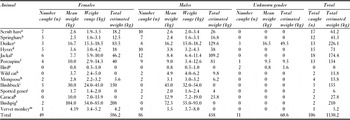
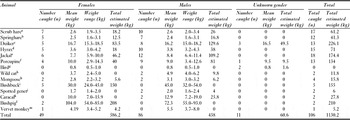
An estimated 1130 kg of wild meat was collected in pursuit hunting (Table 2); a mean of 5.5 (± 3.9) hunters participated in each pursuit hunting event, and the mean off-take for pursuit hunting was 4.7 kg hunter−1 hunt−1. With a mean hunting time for pursuit hunting of 6.4 (± 2.7) hours, the mean efficiency of pursuit hunting was thus 4 kg hr−1 group−1, or 0.7 kg hr−1 hunter−1. Pursuit and trap hunting yielded similar numbers of species per hunting expedition (2.7 ± 1.4 versus 2.6 ± 2), but larger-bodied animal types were more common with pursuit hunting, yielding 26.3 kg off-take per hunt compared to a mean off-take of 3.8 kg per trap, or 10.2 kg per trapping event (where several traps were usually laid). As trap hunting was both less common and less productive than pursuit hunting, trap hunting only accounted for 6.7% (or 80.2 kg) of the total estimated biomass of off-take. For pursuit and trap hunting combined, the total mean off-take was 4.9 kg hunter−1 hunt−1.
Estimated total mean catch weight (in kg) of animal species caught during pursuit hunts. Species documented and source of weight estimates are aLepus Saxatilis (Taylor Reference Taylor1998), bPedetes capensis (Anderson Reference Anderson1996), cSylvicapra grimmia (Schmidt Reference Schmidt1984; Taylor Reference Taylor1998), dProcavia capensis (Skinner & Chimimba Reference Skinner and Chimimba2005), eCanis mesomelas (Rowe-Rowe Reference Rowe-Rowe1978), fHystrix africaeaustralis (Van Aarde Reference van Aarde1985), gspecies vary. Estimate given here, hFelis lybica and Herpestes ichneumon (Stuart Reference Stuart1981), iTragelaphus scriptus (Stuart & Stuart Reference Stuart and Stuart1992), jGenetta tigrina (Rowe-Rowe Reference Rowe-Rowe1978), kCaracal caracal, also known as Felix caracal (Stuart & Stuart Reference Stuart and Stuart1992), lPotamochoerus larvatus, also known as Potamochoerus porcus (Seydack Reference Seydack1983), mCercopithecus aethiops (Skinner & Chimimba Reference Skinner and Chimimba2005).
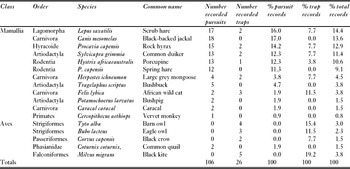
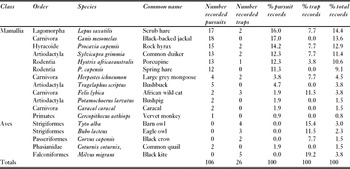
A total of 193 individual animals representing thirteen species from six mammal orders and four bird orders were caught during the last 50 hunting events surveyed (Table 3).
Breakdown of taxa cited in the last-catch records.
Off-take at broader spatial and temporal scales
Given an average hunting off-take of 4.9 kg hunter−1 hunt−1, combining average off-takes with monthly household hunting frequencies for ‘at-least monthly’ hunting households yields a total off-take estimate for the study period of 22.4 kg km−2. If less-regular hunters are assumed to be hunting with the same efficiency as ‘at least monthly’ hunters and off-take is presumed to be constant throughout the year, the estimated off-take from all households over a year would be 268.6 kg km−2 yr−1 or 3 kg person−1 yr−1. Gross weight off-take for the most commonly harvested animal species would be S. grimma 50 kg km−2 yr−1, Canis mesomelas 38 kg km−2 yr−1, Lepus saxatilis 13 kg km−2 yr−1 and Hystrix africaeaustralis 15 kg km−2 yr−1.
Value of off-take
Using our yield conversions, carcass yield of the pursuit and trap last-catch estimates was 538.4 kg. At the time of the research, the average carcass price for small domestic ungulates (goats, sheep) was R 26 kg−1 (US$ 3.3; Department of Agriculture 2007). Presuming similar values for domestic and wild meat, the total monetary value of the carcass yield given the last-catch records would be approximately R 57 hunter−1 hunt−1 (US$ 7.2 hunter−1 hunt−1). This is similar to the amount estimated by the hunters themselves, which was R 51 ± 48 hunt−1 (US$ 6.4 ± 6 hunt−1).
At a landscape level, an average wild meat off-take of 268 kg km−2 yr−1 would have a monetary value of R 3419 km−2 yr−1 (US$ 427 km−2 yr−1). If distributed equitably among households in the population this would provide 1.3 kg person−1yr−1 with a monetary value of R 263 household−1 yr−1 (US$ 32 household−1 yr−1). However, given that only an estimated 32% of households in the region make use of wild meat, we would anticipate mean cash equivalent value of R 822 household−1 yr−1 (US$ 103 household−1 yr−1).
DISCUSSION
Significance of off-take to local nutrition and livelihoods
There was no local wild meat trade in the study regions, which suggests that wild meat harvesting does not play an important role in local rural economies. This is not to say, however, that wild meat is not important to local livelihoods. Given that the annual combined household income in the study region was less than R 21 000 (US$ 2550), the annual cash-equivalent value of wild meat for each using household is 4% of total household income, which would amount to a considerable cash-saving for such households. With respect to the nutritional importance of wild meat, wild meat provides a useful, but not comprehensive protein source for the rural population. The estimated daily off-take of 8 g wild meat per person in the study region comprises c. 30% of the estimated 27.9 g a day animal protein eaten by South Africans (Kruger et al. Reference Kruger, Sayed, Langenhoven and Holing2005), but only 13% of the recommended daily protein intake for active adults. However, as the wild meat harvest is not distributed equitably amongst the population, but is rather consumed by a small subset of hunters and their immediate families, the contribution of wild meat to the nutrition of hunters and their close associates would be more considerable. Thus, while wild meat may not be critical to local nutrition at a population level, it can be deemed very important, if not critical, to individual users. From this study, there was no evidence that these individual users were motivated by economic need, but there were suggestions that hunting holds great sociocultural value. These peer benefits may be particularly relevant to those who occupy marginal positions in the community. Recent research from the Eastern Cape has shown hunting to have social and nutritional importance, for young people orphaned, alienated or otherwise made vulnerable by HIV and AIDS (McGarry & Shackleton Reference McGarry and Shackleton2009a, Reference McGarry and Shackletonb).
Relative magnitude of off-take: South Africa
The dressed weight off-take of 268 kg km−2 yr−1 suggested by this study is considerably larger than previous estimates. Prior to this study, estimates of wild meat off-take from South African rural areas have used household interviews based on recall, where respondents were asked to provide the number of each species eaten per unit period. Using this method, two studies from the Eastern Cape Province have estimated annual household off-takes ranging from 151 kg mean dressed weight in the Kat River Valley (Shackleton et al. Reference Shackleton, Shackleton, Ntshudu and Ntzebeza2002b) to 210 kg mean fresh mass in coastal regions (Shackleton et al. Reference Shackleton, Timmermans, Nongwe, Hamer and Palmer2007). In contrast, household interviews based on recall recorded only 2.9 kg edible wild meat per household per year in Limpopo Province (Twine et al. Reference Twine, Moshe, Netshiluvhi and Siphugu2003).
To some extent, the high levels of off-take recorded in this study could be attributable to the use of hunter-recall rather than household-recall to derive estimates. As a significant proportion of the wild meat hunted from communal lands is not shared within the household unit, but rather consumed directly by the hunters, it is possible that household recalls could underestimate actual off-take. Yet even granting this, caution should be exercised in scaling the estimated off-take to broader temporal and spatial scales. With respect to temporal scalability, this study was limited by its short (1 month) assessment period and corresponding inability to both assess and control for seasonal variation in wild meat off-take. This lack of temporal perspective is a common shortcoming of other wild meat off-take studies in South Africa, which have also inferred annual off-take through multiplying monthly estimates by a factor of twelve (Shackleton et al. Reference Shackleton, Shackleton, Ntshudu and Ntzebeza2002b; Twine et al. Reference Twine, Moshe, Netshiluvhi and Siphugu2003). With respect to spatial scalability, it should not be assumed that the relatively high off-take in the study region typifies hunting practices in South African communal lands. Shackleton et al. (Reference Shackleton, Timmermans, Nongwe, Hamer and Palmer2007) have found that off-take can vary widely even between villages within the same locality, and that high off-takes in one village may not necessarily be matched in neighbouring sites. Moreover, there are indications that wild meat reserves are still quite good in the Eastern Cape, where this study was located (Hayward et al. Reference Hayward, White, Mabandla and Bukeye2005). In contrast, Dovie et al. (Reference Dovie, Shackleton and Witkowski2002) found near negligible use of wild meat in Limpopo province.
Relative magnitude of off-take: African tropical forests
If off-take were distributed equitably among the study population, each person would consume 8 g wild meat per day. This is less than quantities reported elsewhere in Africa. In the northern province of Cote d'Ivoire, both Asibey (Reference Asibey1974) and Feer (Reference Feer, Hladick, Hladik, Pagezy and Linares1993) recorded daily wild meat consumption rates of 30 g person−1. Similarly, in Liberia, Steel (Reference Steel1994) recorded daily wild meat consumption rates of 29 g person−1. Daily wild meat consumption figures are even higher in Central African studies, where estimates can range from between 60 g person−1 to 180 g person−1 (Noss Reference Noss1998; Fa et al. Reference Fa, Currie and Meeuwig2003).
However, these relatively low per person figures should be interpreted cautiously, as they in part reflect the high human population density in South Africa's communal lands. In tropical forest zones, mean human populations in cities and small settlements are c. 18 people km−2. Gabon has population densities as low as 3 people km−2, and both Cameroon and the Democratic Republic of Congo have population densities <20 people km−2 (Fa et al. Reference Fa, Currie and Meeuwig2003). When city and village densities are averaged over the entire hunting range, effective population densities are likely to be even lower than this. In comparison, the population density in the Mount Frere region was 62 people km−2, and likely higher in villages. The study region may indeed yield off-takes per km2 comparable to those in tropical zones, at least for some key species. For example, the Duiker off-take rate in this study is comparable to the 50 kg blue duiker km−2 yr−1 reported for the Ituri Forest region, Congo-Zaire (Hart Reference Hart, Robinson and Bennett2000).
Sustainability of off-take
Given current levels of understanding, it is not possible to assess whether extraction rates for species hunted in the study sites are sustainable or not. Although it is true that in humid zones, more detailed studies assessing ecosystem productivity versus extraction rates have generally found off-take levels to be unsustainable (Wilkie & Carpenter Reference Wilkie and Carpenter1999), as the ecosystem productivity of the study zone is unlikely to be the same as in humid zones, general statements as to the sustainability of off-take in the study site cannot be made. There are, however, a number of historical and allometric sources that suggest that the species hunted from the study regions may be particularly resilient to hunting pressure (Child & Wilson Reference Child and Wilson1964; Ferreira & Hoffman Reference Ferreira and Hoffman2001; Skinner & Chimimba Reference Skinner and Chimimba2005). It is noteworthy that none of the animals recorded in this study have been listed as high priority conservation species on the IUCN (World Conservation Union) red data list (IUCN 2008). Large-bodied animal types were mainly absent, and most of the animals recorded were small-bodied rodents, carnivores and ungulates with high intrinsic population growth rates. Historically, many studies have reported much lower large vertebrate population densities in hunted versus non-hunted sites (Bodmer Reference Bodmer1995; Alvard et al. Reference Alvard, Robinson, Redford and Kaplan1997; Mena et al. Reference Mena, Stallings, Regalado, Cueva, Robinson and Bennett2000; Peres & Dolman Reference Peres and Dolman2000), which have a higher population growth-rate relative to large vertebrate species (Jerozolimski & Peres Reference Jerozolimski and Peres2003). An abundance of high growth-rate ungulates and rodents in these disturbed dry forests and savannah grasslands may actually ensure higher wildlife biomass supply relative to protected areas (Robinson & Bennett Reference Robinson and Bennett2004). In additional to allometric advantages, there is also some historical evidence to suggest that fecundity rates for some smaller-bodied species such as duiker may greatly accelerate under increased hunting pressure, and that these types of animals are particularly suited to high-pressure harvesting (Child & Wilson Reference Child and Wilson1964; Ferreira & Hoffman Reference Ferreira and Hoffman2001; Skinner & Chimimba Reference Skinner and Chimimba2005). These observations provide some means by which to account for the high levels of wild meat off-take seen in the study region, despite consistently high harvesting pressure and an absence of hunting management policies in the region.
CONCLUSIONS
This is the first study of its kind to show a demonstrably important use of wildlife in a South African communal area. Previous studies used a household-recall method and estimated lower off-takes. These studies may, however, have been prone to underestimation, as they excluded wild meat not eaten in the home from estimations. In contrast, annual off-take rates for certain species were similar to those reported from some humid zones, although here high human population densities translate to less-significant off-takes in terms of contribution to human nutrition at the population level. Although we cannot yet explain the apparent high biomass off-take from the study region, it is likely that off-take rates may be attributable to the hypothesis that small-bodied, high growth rate rodents and ungulates dominate heavily harvested and otherwise disturbed dry forests and savannah grasslands. Descriptive studies and allometric profiling suggest that the most common species recorded might be particularly resilient to hunting.
ACKNOWLEDGEMENTS
This research was partly funded by a grant from the Rockefeller Brothers Foundation. We gratefully acknowledge this support.