A transformational development agenda was adopted on the 70th anniversary of the founding of the United Nations in September 2015,Footnote 1 titled “Transforming our World: The 2030 Agenda for Sustainable Development” (hereafter, the 2030 Agenda), the agenda includes 17 SDGs and 169 targets.Footnote 2 The 2030 Agenda and the SDGs are based on the evolutionary but contested concept of sustainable development.
To begin with, this article briefly outlines the historical development of the concept.Footnote 3 While the concept was not explicitly referred to, the Stockholm Declaration on the Human Environment in 1972Footnote 4 first “planted the seeds of sustainable development”.Footnote 5 Several principles under the declaration suggested that debates on sustainable development revolve around the relationship between environmental protection and economic growth.Footnote 6 Then, the World Commission on Environment and Development (WCED) established by the UN General Assembly in 1983, was asked to find new approaches for managing environmental resources and sustaining human development.Footnote 7 In 1987, The WCED issued the Brundtland Report, “Our Common Future” which presented the famous definition of sustainable development: “to ensure that it meets the needs of the present without compromising the ability of future generations to meet their own needs”.Footnote 8
While this definition with an inter-generational perspective was later debated,Footnote 9 it was recognized by the 2030 Agenda.Footnote 10 With the momentum of the 1992 UN Declaration on Environment and Development (Rio Declaration),Footnote 11 a reconciliation of environmental protection and economic growth and a focus on intergenerational equity were articulated in the principles which “set out” the substantive elements of sustainable development.Footnote 12 Furthermore, sustainable development debates concerning the two elements of environmental protection and economic growth gradually expanded to include a third element: the social development component. The social development component was first discussed in 1995 by the Copenhagen Declaration on Social Development and the Declaration of the Right to Development in 1996.Footnote 13 Later, at the 2002 World Summit on Sustainable Development, the Johannesburg Declaration integrated three elements of sustainable development: economic growth, social inclusion, and environmental protection.Footnote 14 The 2030 Agenda recognized “three dimensions – economic, social and environmental – in a balanced and integrated manner”.Footnote 15
The concept of sustainable development has evolved “substantially and procedurally into the creation of a new branch of international law called ‘international sustainable development law”’.Footnote 16 International sustainable development law has attracted the attention of international environmental law researchers because it provides an overarching framework for international environmental law.Footnote 17 Sustainable development scholarship has explored the relationship between the SDGs and law in various ways.Footnote 18 One question often addressed is the SDGs’ legal status and normative impact. To date, no major international instrument for sustainable development, including the 2030 Agenda and the SDGs, exists in a binding form. In other words, they exist as “soft law” in contrast to “hard law” with binding force.
While the definition of hard and soft law has been much debated in the international law scholarship,Footnote 19 this article follows a binary definition of hard and soft law: hard law is binding law (i.e. international treaties), whereas the scope of “soft law [involves] all instruments that do not fall within the realm of binding law”.Footnote 20 The concept of soft law varies among authors in the international legal literature. One recent trend in international legal scholarship is to move away from the hard–soft law dichotomy and instead view the hard–soft law phenomenon as a continuum.Footnote 21 On the one hand, some treaty texts, although categorized as hard laws, are frequently soft and vague. On the other hand, even a soft law instrument has strong normative impacts. In other words, such soft norms are international commitments despite being legally non-binding. The 1992 Rio Declaration is an example.Footnote 22
Similarly, while the SDGs are often embraced as “aspirational goals”,Footnote 23 international law scholars identified the SDGs as rooted in international legal frameworks: “[t]he 2030 Agenda for Sustainable Development in many ways reflects and reinforces international law”,Footnote 24 such as that embodied in treaties and international court decisions. Likewise, in Asia Pacific, the 2030 Agenda has a range of uneven impacts on environmental law.Footnote 25 Also, the UN General Assembly encourages Member States to implement SDGs consistent with international law.Footnote 26 Thus, “the SDGs do not operate outside of the legal sphere and cannot, therefore, be expected to remain ‘solely aspirational”’.Footnote 27 While this article understands that there exists a blurred distinction between hard and soft law, it follows a definition based on a simple dichotomy between binding (hard law) and non-binding (soft law) instruments thus treating the 2030 Agenda and SDGs as “soft law”.
This article addresses the legal and institutional impacts of the 2030 Agenda and the SDGs on the domestic system since laws and institutions implementing the SDGs at the domestic level have attracted little attention thus far. Legal and institutional mechanisms for sustainable development are discussed when considering the implementation of such within the domestic system. National implementation usually considers the implementation of international legal instruments but also includes the case of soft law instruments, thereby referring to the myriad acts and efforts of governments to transform international commitments to the national level.Footnote 28 A vast literature exists on the implementation of international commitments. The national implementation process is “extraordinarily complex [and] there is no single pattern by which international commitments are put into practice within countries”.Footnote 29
Currently, UN member States have followed different legal strategies to implement the SDGs.Footnote 30 Many countries have utilized institutional mechanisms under existing national laws through high-level political leadership such as inter-ministerial committees.Footnote 31 This is an understandable consequence because the implementation of the SDGs is voluntary; in other words, UN Member States are not required to enact new laws or amend existing laws to implement the SDGs.Footnote 32 By contrast, States usually enact or amend laws in the implementation of international treaties.Footnote 33 The national implementation of numerous international environmental agreements, such as the Paris Agreement, Convention on Biodiversity, and Ramsar Convention, can be regarded as one of the legal ways to implement elements of sustainable development at the domestic level.Footnote 34
However, this article argues that the absence of specific legislation on sustainable development is concerning because the implementation of sustainable development necessitates legislative enactments and the establishment of institutions designed to effect substantive policy changes.Footnote 35 This point relates to the advantages and disadvantages of the SDGs in the context of implementation, which will be discussed in more detail in the next section. A question arises as to whether existing institutional mechanisms are sufficient to effect substantive policy changes to the point where “the lives of all will be profoundly improved and our world will be transformed for the better”.Footnote 36 This issue is not unique to the implementation of the SDGs and scholars have pointed out its flaws along with the historical development of the concept of sustainable development, as will be discussed in the next section.
Very few nations have enacted sustainable development laws to implement the SDGs; Sri Lanka is one such nation. The enactment of a new law, the Sustainable Development Act (SDA),Footnote 37 is a significant step in the SDG implementation within a new institutional framework. Interestingly, the structure of Sri Lanka’s SDA is based on Canada’s sustainable development legal framework: the Federal Sustainable Development Act (FSDA).Footnote 38 Therefore, this study examines the Sri Lankan process of creating institutional mechanisms for SDG implementation, including strategies and policy actions with a comparative insight into Canadian FSDA. The analysis attests to the reality of the difficulties in rearranging the existing institutional infrastructure enforcing the SDA to implement SDGs. Thus, as for a research method, this article adopts a qualitative study, based on the legislative history, related laws, relevant case decisions, and media reports. The case setting and analysis are guided by the literature review, including UN reports and scholarly articles.
The remainder of this article is organized as follows. Section I discusses the importance of institutional infrastructure and legal frameworks for SDG implementation based on a review of scholarship on sustainable development. Section II illustrates how the Sri Lankan SDA emulates the structure of Canada by comparing it with the FSDA. A comparative study of Canadian legislation provides analytical insights into the shortcomings of the Sri Lankan SDA. This section also examines the reality of the formulation of national policy and strategy after the enactment of the SDA in Sri Lanka, investigates critical issues in the implementation process, and briefly touches upon the impact of the COVID-19 pandemic on the 2030 Agenda. Section III discusses the promises and limitations of the SDA in Sri Lanka. Although the enactment of the SDA has merits, this section identifies several obstacles and weaknesses. Finally, Section IV concludes.
I. Importance of laws and institutions for SDG implementation
A. The pros and cons of the SDGs in the implementation context: literature review
As this article focuses on the domestic implementation of SDGs, this section discusses different scholarly debates on the advantages and disadvantages of SDGs in the implementation context. Long before the emergence of the SDGs, the sustainable development concept had already been criticized in its implementation context; the vagueness and ambiguity of the concept prevented states from being held accountable for achieving sustainable development.Footnote 39 However, the adoption of the SDGs was celebrated because it was expected to change the dynamics of implementation. Global governance literature has articulated SDGs as a governance strategy for “goal setting”Footnote 40 and has noted three positive features of the goal-setting approach: (1) selecting priorities, (2) mobilizing resources, and (3) setting measurable criteria and timeframes.Footnote 41 The third feature, setting measurable criteria and timeframes, has been recognized as one of the promises of the SDGs.Footnote 42 Therefore, the goal-setting approach was expected to make it possible to hold States accountable for achieving sustainable development.
However, the goal-setting approach also requires establishing organizational arrangements to oversee efforts to attain goals.Footnote 43 The lack of such arrangements is one of the causes of the limited impact of SDGs in generating a transformation. “[T]he domestic political impact of the SDGs has remained mostly discursive”.Footnote 44 This is mainly due to ad hoc institutional changes and deficiencies in national finance: “[O]bservable institutional change often merely replicates existing priorities, trajectories, and government agendas, and governments tend to selectively implement those SDGs that support policies they have already prioritized”.Footnote 45 Such a critique points out a negative aspect of the goal-setting approach which promotes setting “priorities” as one of its positive features. The problem of “selective implementation” has already been recognized because the selectivity misses a complex picture of how the 17 SDGs interact with each other.Footnote 46 Such critical insights suggest the need for specific legislation and new institutional mechanisms to implement the transformative elements of the SDGs at the domestic level.
Even before the SDGs, the literature on sustainable development has pointed out the importance of creating institutional mechanisms. Tarlock observed, “[L]aw can give the concept of ‘sustainable development’ legitimacy, but only an institutional infrastructure can actually implement the idea by applying it to specific resource choices”.Footnote 47 Tarlock further emphasized that implementing sustainable development needs “governance institutions, representative bodies, laws that assign the rights and conditions for resource use, and institutions designed to produce substantive policy changes”.Footnote 48
Scholars have generally echoed Tarlock’s concern about sustainable development.Footnote 49 Ross argued that legislation would enhance the process of developing, implementing, and evaluating sustainable development strategies.Footnote 50 Sustainable development is referred to in various national and subnational laws: while it may just have a symbolic meaning in legislation, it appears “as duties, objectives, and procedural requirements” in some statutes.Footnote 51 Ross suggested that “if a provision is to be more than simply symbolic, then ideally there should be some statutory (often formal) means to monitor and review compliance”.Footnote 52 Building on Ross’s view of the necessity of specific legislation for sustainable development, this article argues that national legal frameworks are the foundation for institutional infrastructure and implementation mechanisms. Legislation frames every institution in a State. Sustainable development is a long-term goal that a State needs to achieve through institutional mechanisms.
The 2030 Agenda requires that “institutional and legal frameworks embody the integrated, cross-cutting nature of the 2030 Agenda at all levels of government”.Footnote 53 Similarly, SDG review reports issued by the UN, noted that institutional infrastructure plays a decisive role in its implementation. For example, the 2018 UN World Public Sector Report highlights that a national-level institutional framework is essential for achieving the SDGs.Footnote 54 The 2019 UN report states that government policies and strategies drive the implementation of the SDGs.Footnote 55 This report highlights that “[A]ll governments should incorporate targets and indicators into their national plans and budgets, formulate policies and programs to achieve them and create an institutional framework that deals with uncertainties and risks, as well as systems for monitoring and evaluation”.Footnote 56
Outside the UN, organizations and experts have issued analytical reports on the implementation of the SDGs. For example, the 2021 Sustainable Development Network (SDSN) report describes four components of “national coordination and implementation mechanisms at the central/federal level of the government”; Voluntary National Review (VNR), high-level statements, SDG strategy, and the national budget.Footnote 57 The VNR submitted to the High-Level Political Forum (HLPF) is a process for UN member countries to assess the present progress made in achieving sustainability goals, signals high-level political commitment.Footnote 58 The 2030 Agenda also encourages voluntary reviews that are conducted at sub-national levels (Voluntary Local Reviews).Footnote 59 Scholars argue that such voluntary reviews should also take place at both the company and household levels.Footnote 60 This resonates with the UN encouraging voluntary reviews with multi-stakeholder engagement.Footnote 61 Moreover, the 2020 SDSN report emphasizes the importance of government strategies and policy actions. The report notes that analyzes of strategies and policy actions “are complex and costly to undertake [and] international organizations do not have the mandate to assess their member’s policies”.Footnote 62 Therefore, high-level political commitment to strategies and policies supported by institutional mechanisms is needed to achieve long-term goals.
As for the national budget, the 2021 SDSN report further highlights the interdependence of high-level political statements and provisions in the national budget.Footnote 63 The discrepancy between the expressed high-level political statements and the integration and allocation of SDGs into the national budget, as well as the implementation of public policy processes, will cause the implementation process to lag.Footnote 64
In addition, several scholars have highlighted that developing countries face social and political challenges that hinder their achievement of SDGs. In developing countries, focusing on national capacities, policies, and priorities to set practical targets for institutions and inter-agency coordination plays an important role in SDG implementation.Footnote 65 Likewise, each country may face different challenges based on its national context, political instability, public policy framework, legal system, institutional infrastructure, and community participation.Footnote 66 The integration of monitoring and evaluation mechanisms into policy-making is a key requirement for institutional infrastructure in developing countries.Footnote 67
By early 2020, all countries faced the COVID-19 pandemic as the greatest challenge in their achieving the SDGs by 2030. The 2021 SDSN report highlights the SDGs in the national pandemic recovery plan have become crucial factors in institutional infrastructure since 2020.Footnote 68 The report shows COVID-19 has increased the financing gap in developing countries, resulting in severe economic setbacks caused by the pandemic and a two-year delay in allocating the national budget for the SDGs.Footnote 69 This reinforces the fact that increasing the financial capacity of developing countries has become a prime requirement for achieving the SDGs.Footnote 70 Identifying the situation, the UN noted that “VNR[’s] main messages this year are primarily focused on national plans and strategies for a sustainable and resilient recovery”.Footnote 71
B. National laws and institutions for the implementation of SDGs
The previous subsection reviewed how scholarship has discussed the importance of laws and institutions in the context of SDG implementation. How, then, is national practice? UN Member States have followed different legal strategies to implement SDGs.Footnote 72 The most popular approach is to use institutional mechanisms with the necessary redesigns under existing national legal frameworks.Footnote 73 At the 1992 Earth Summit in Rio de Janeiro, countries adopted sustainable development as an overarching goal and agreed to formulate their own “National Sustainable Development Strategies” integrating the economic, social, and environmental aspects.Footnote 74 Countries promoted the use of one central unit, the “National Councils on Sustainable Development”, with the coordination of stakeholders to create, implement, and monitor sustainable development strategies that ensure a common consensus and ownership of the implementation plans.Footnote 75
These countries follow the strategy of having no specific laws on sustainable development (even though they probably have environmental laws referring to sustainable development in various forms, such as symbolic meanings or legal requirements): Germany, Indonesia, and Nigeria have adapted existing institutional mechanisms used for the Millennium Development Goals.Footnote 76 Brazil, Botswana, China, Colombia, Costa Rica, Ghana, Mexico, Pakistan, the Philippines, and Sierra Leone established new institutional mechanisms to implement their SDGs.Footnote 77 These countries constitute only a portion of the UN Member States but demonstrate some institutional mechanisms that operate within their existing legal frameworks.
In contrast, few countries have enacted specific legislation for sustainable development. The Republic of Korea and Malta amended their Sustainable Development Acts to implement the SDGs.Footnote 78 In 2019, the Government of Canada amended the Federal Sustainable Development Act.Footnote 79 The enactment of new legislation to exclusively implement the 2030 Agenda can be observed in Sri Lanka, particularly in the establishment of an SDA in October 2017.Footnote 80
A question arises: Why have so few UN Member States enacted specific legislation for sustainable development? We can imagine that using existing institutional frameworks to implement an SDG agenda gears a nation for fast achievement and that legislative actions through parliamentary procedures are time-consuming in any legal system. Another explanation is that for the 2030 Agenda and SDGs, States need to submit VNR to the HLPF complying with the UN overseeing mechanism.Footnote 81 While the VNR process is a voluntary mechanism, UN follow-up and review mechanisms are “robust, effective, participatory, transparent and integrated” – therefore States may not feel the necessity to enact national sustainable development legislation.Footnote 82 Since the 2030 Agenda and the SDGs are soft law, “there is no further ratification process and governments are under no legal obligation to transfer the goals into their national legal system formally”.Footnote 83 Thus, it is not surprising that only a few UN members have amended or enacted specific legislation for the 2030 Agenda. At the same time, international soft law norms may remain soft at the international level but become hard law through compliance with domestic State practice.Footnote 84 This article emphasizes the importance of institutional mechanisms for SDG implementation since the enactment of such legislation (such as the SDA) will provide an important basis for implementation. This finding is supported by Ross’s argument.Footnote 85 Furthermore, we can recall Tarlock’s observation that “Law can give the concept of SD legitimacy”.Footnote 86 Similarly, Allott emphasizes the importance of law for enhancing a society’s sustainability by making laws in the past, applying them in the present, and shaping the future.Footnote 87
Therefore, this article will now turn to the SDG implementation processes in Sri Lanka as a prominent example of enacting a new law to implement SDGs with a specific unit for monitoring. Since there is little research on how sustainable development is embedded into the domestic legal system, this study can contribute to filling this research gap and will offer a fuller view of legal and institutional implementation at the national level. However, as will be seen below, the complex processes of creating institutional mechanisms have become a barrier to timely implementation for Sri Lanka.
II. The Sri Lankan SDA: A disorganized emulation of Canada’s FSDA
In this section, first, the structure and features of the new Sri Lankan SDA are explained, with a brief outline of the Sri Lankan sustainable development jurisprudence in the past. Second, the reality of the SDA is described based on how the policy-making and implementation processes took place. In particular, the analysis of the first part is drawn from a comparative insight into Canada’s sustainable development legal framework. This comparative insight into the Canadian Act is essential because the structure of Sri Lanka’s SDA is based on Canada’s FSDA, which was enacted in 2008 (amended in 2019 in response to the 2030 Agenda).Footnote 88 While there are similarities between the two laws, there are also some differences. The comparative perspective provides critical insights into the complexities of the Sri Lankan SDA, helping to identify its limitations (as will be discussed in more detail in Section IV).
A. Comparison of Sri Lankan and Canadian sustainable development legal framework
1. The Sri Lankan SDA
First, Sri Lanka’s legal and institutional mechanisms are described. The constitution forms three pillars of government: the legislature, the judiciary, and the executive.Footnote 89 The sources of law in the country are the Constitution, laws passed by the Parliament, and Supreme Court case laws. Provincial Councils (PCs) established in 1987, amending the Constitution and creating a subnational governance structure with delegated roles and functions.Footnote 90 Under the authority delegated by the Constitution and other laws, subnational governments enact statutes and bylaws.
Several articles in the Constitution explain the constitutional underpinnings of sustainable development. Article 27 (14) explains the State’s responsibility to preserve and improve the environment. This responsibility was partially delegated to PCs by the Constitution and National Environmental Act (NEA) No. 47 of 1980.Footnote 91 The NEA is administered both centrally and provincially by the Ministry of the Environment and the Central Environmental Authority. The State is required to foster respect for international law and treaty obligations under Articles 27 (15) and 157, as highlighted by the Supreme Court in several cases.Footnote 92 The Parliament Act is required for the domestic implementation of international treaties in Sri Lanka’s dualist legal system.Footnote 93
It has been noted that, even without legislation on sustainable development, the Sri Lankan judiciary has long taken a progressive role in applying soft law principles of sustainable development in domestic environmental jurisprudence. Environmental scholarship has explored the innovative contributions of the judiciary in this area.Footnote 94 Although the space in this article does not allow a comprehensive discussion of Sri Lankan jurisprudence, it is crucial to highlight the landmark Eppawala case, in which the Supreme Court first introduced the concept of sustainable development.Footnote 95 In this case, the judiciary innovatively gave legal recognition to sustainable development by referencing several principles from the Stockholm and Rio Declarations, despite the absence of specific legislation.Footnote 96
Another notable point in this landmark case is that the Supreme Court referred to the separate opinion of the Vice President of the International Court of Justice (ICJ) Hon Judge C.G. Weeramantry (Sri Lankan), in an ICJ case in which the recorded sustainable development principle is rooted in Sri Lankan Buddhist culture.Footnote 97 This was further elaborated in his scholarship:
Buddhism is entirely averse to the notion that nature and all created things exist for the benefit of humankind. Mankind is part of the entire cosmic order but not in the apposition of dominance. Humans are subject to the universe’s natural order as much as any other form of sentient existence. Buddhism is eco-centric rather than anthropocentric since it views humans as an integral part of nature.Footnote 98
Against this nurturing background, the government enacted the SDA, which included the same definition of sustainable development as in the Brundtland Report. After the 2030 Agenda and the SDA, sustainable development has continued to evolve through innovative judicial decisions in Sri Lanka.Footnote 99
The Parliament’s intention to enact the SDA to implement the SDGs is particularly salient. The legislature has stressed these historical substances, emphasizing the roots of the doctrines of public trust and sustainable development in Sri Lankan Buddhist history.Footnote 100 Furthermore, the government demonstrated the highest commitment by being the first country to establish a parliamentary committee on SDGs.Footnote 101 With the SDA, the Parliament intended to establish a resolute SDG strategy to continue until 2023. It will also mean establishing an integrated institutional mechanism and implementing the SDG strategy by 2030.Footnote 102
The SDA calls for the National Policy and Strategy on Sustainable Development (NPSSD) and institutional strategies for the 2030 Agenda. A key objective of the SDA is to establish a legal framework for NPSSD, ensuring ecological efficiency of natural, social, and economic resources, and integrating environmental, economic, and social factors into government decisions.Footnote 103 The nodal government unit, the Sustainable Development Council (SDC), was established by the SDA, to draft, implement, and monitor the NPSSD.Footnote 104 For this task, the twelve-member SDC including the Chairman, appointed by the President, consists of four ex-officio members.Footnote 105 The SDC is a legal entity, funded by the national budget, and has fifteen powers, functions, and duties.Footnote 106
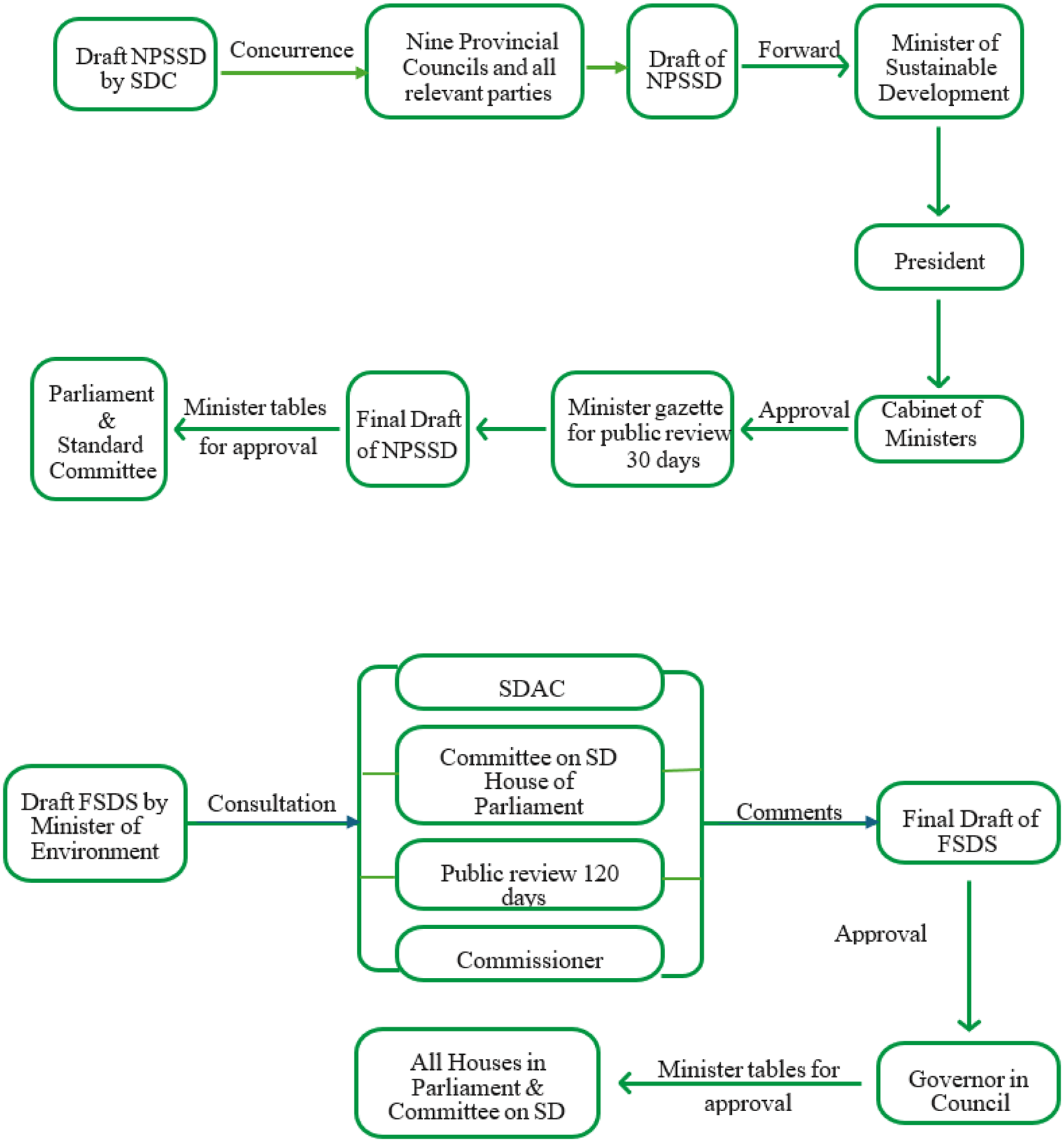
The SDA stipulates the procedure for obtaining parliamentary approval for the NPSSD. The SDC is mandated to submit the draft of the NPSSD to the Minister of Sustainable Development, securing the “concurrence” of nine PCs and all relevant parties.Footnote 107 Then, the Minister upon obtaining approval from the President and Cabinet, publishes the draft for public review for thirty days and submits it to Parliament for approval.Footnote 108 Within one year of the Parliament’s approval, every national government and subnational institution must formulate an institutional strategy in compliance with the NPSSD.Footnote 109 These institutions should submit a report on their progress to the SDC. Section 13 of the SDA is a new legal provision that empowers the Auditor General (AG) to conduct an “environmental and social audit” for development projects of all national and subnational institutions to ensure alignment with the SDGs. Until then, as per the constitution, the AG’s audits of development projects were limited to the projects’ financial and physical aspects.Footnote 110
2. The Canadian FSDAFootnote 111
Long before the SDGs, Canada enacted the 2008 FSDA “to provide the legal framework for developing and implementing a Federal Sustainable Development Strategy that will make environmental decision-making more transparent and accountable to Parliament”.Footnote 112 The FSDA calls for the Federal Sustainable Development Strategy (FSDS) and departmental sustainable development strategies.Footnote 113 The 2019 FSDA amendment, which aligns with SDGS includes sustainable development decision-making, which was not the focus of the 2008 FSDA.Footnote 114
While the FSDA defines sustainable development by reiterating the definition in the Brundtland Report,Footnote 115 it also states that “sustainable development is based on an efficient use of natural, social and economic resources and the need for the Government of Canada to integrate environmental, economic and social factors in the making of all of its decisions”.Footnote 116 This provision appears to be a copy of the preamble of Canada’s 1999 Environmental Protection Act.Footnote 117
The Minister of the Environment is responsible for the FSDS. The Minister presents the first draft simultaneously to four parties for consultation.Footnote 118 The first is the Sustainable Development Advisory Council (SDAC) which comprises twenty-nine members appointed by the Minister, who holds the chair position.Footnote 119 The SDAC is a multi-stakeholder composite that represents provinces/territories, Aboriginal peoples, environmental NGOs, businesses, and labour organizations. The second consultation is obtained from the Commissioner of Environment and Sustainable Development appointed by the Auditor General under the Auditor General’s Act.Footnote 120 (The Commissioner’s main duty is to submit an annual report to Parliament on sustainable development since 1995.) Within 120 days, the Commissioner submits reviews and comments on the draft FSDS to the Minister on whether each target in the draft is measurable and includes a timeframe. The third consultation is from the Committee on Sustainable Development of the House of Parliament.Footnote 121 Fourth, the draft FSDS is published for public review and comments for 120 days. Following the consultation process, the Minister shall obtain first approval for the FSDS from the Governor of the Council,Footnote 122 and then table at the each House of Parliament for final approval.Footnote 123 The Minister monitors the implementation progress of the FSDS and presents a report to Parliament once every three years.Footnote 124 The Queen’s Committee on Sustainable Development oversees the FSDS.Footnote 125
3. Comparison between the SDA and FSDA
This section provides a brief comparative analysis. The structure of the Sri Lankan SDA is similar to that of the Canadian FSDA (2008). There are, however, significant differences between the two laws. The comparison provides insight into the reasons for the slow progress of the SDA. Canada’s government is both a constitutional monarchy and a federal parliamentary democracy.Footnote 126 It comprises federal, provincial, and territorial governments. Federal and provincial governments have constitutional jurisdiction regarding environmental issues.Footnote 127 Laws enacted by the central government apply in their entirety. In contrast, Sri Lanka is a unitary country with a central judiciary and a two-tier government.Footnote 128 The constitution delegates environmental matters and some State functions to PCs and the subnational government.Footnote 129
Sri Lanka’s SDA is structurally similar to Canada’s FSDA in three ways: initially, both acts followed the definition of sustainable development in the Brundtland Report.Footnote 130 Second, the objectives of both Acts are similar, promoting the integration of environmental, economic, and social factors as well as calling for a national strategy for achieving SDGs.Footnote 131 Third, the SDA rolled out the position of Auditor General, similar to that of the Commissioner in the FSDA. Both positions are held by public officers who are directly accountable to the Parliament.
Despite these three structural similarities, the SDA follows a complex process for drafting, approving, and reviewing the NPSSD. This complexity is observed at three points. The differences between these two processes are illustrated in Figure 1 in the Appendix. These differences affected the Sri Lankan SDG implementation (as discussed in Section IV).
SDG policy process: Canada and Sri Lanka

First, the composition and role of the councils are notably different. Sri Lankan law established the SDC, similar to the SDAC in Canada. However, the composition and function of the Council are distinctly different. The multi-stakeholder composition in the SDAC, chaired by the Minister, ensures an overarching sustainable strategy for Canada, whereas the SDC is predominantly comprised of bureaucrats, leading to unbalanced representation. The responsibility for national implementation and monitoring of the NPSSD is also conferred on the SDC, whereas the Ministry is accountable in Canada. The SDA Article 4(3) states that subject experts should be appointed to the council, which contradicts Section 4(1) which appoints four ex-officio members, and two other members based on the choice of the President, therefore the provision to appoint subject experts is impractical.Footnote 132
Second, the Sri Lankan law follows a time-consuming linear process to lay down the NPSSD, whereas the Canadian law simultaneously follows the process. In Canada, the Minister is accountable for drafting, implementing, and monitoring the FSDS while in Sri Lanka, the process is overly bureaucratic.Footnote 133 Unlike Canada, Sri Lanka undergoes a complex process that takes a longer timeframe to finalise the NPSSD. As noted, in Canada the Minister undergoes a simultaneous “consultation” process with four parties, receiving the draft of the strategy. In Sri Lanka, the SDC obtains “concurrence” from all relevant parties and nine PCs before sending the draft to the Minister.Footnote 134 The FSDS, following the “consultation” process, first receives approval from the Governor and subsequently from the Parliament. The SDA results in a longer time to complete the draft of the NPSSD. First, the Minister obtains the “concurrence” of the President and the Cabinet of Ministers. With their comments and suggestions, the draft is returned to the SDC for revisions. Subsequently, the draft is published in the government gazette for public review. Finally, the Minister tables the NPSSD in the Parliament for approval.Footnote 135
Third, the position and role of the Auditor General differs from the Commissioner in Canada. The President appoints the Auditor General under the Constitution of Sri Lanka,Footnote 136 while the Auditor General appoints the Commissioner and has a role in drafting the NPSSD under the FDSA in Canada. The SDA introduced the expanded role of the Auditor General which is similar to that of the Commissioner.Footnote 137 However, a significant difference is that the Minister consults the Commissioner for the draft strategy in Canada, while the Auditor General in Sri Lanka has no role in the draft stage. Instead, the SDA identifies the role of the Auditor General in the four stages after Parliament approves the NPSSD.Footnote 138 First, there is an audit of the performance and budget of the SDC. Second, the SDA audits national and subnational institutional strategies and submits progress to the SDC. Third, it audits the institutional annual reports of the NPSSD, and submits reports to the Parliament. Fourth, environmental and social audits of the development projects must be conducted, which is the new role empowered under the SDA.
Next, we examine whether and how Sri Lanka formulates the NPSSD in reality. Although the SDA was enacted nearly seven years ago, the NPSSD remains pending.
B. The reality of the SDA: distinct processes for creating policy and strategy for sustainable development
After the SDA, two distinct policy implementation mechanisms were implemented under the two government regimes. This subsection reviews the processes during the first (2015–20) and second periods (after the year 2020).
1. The previous policy implementation mechanisms (2015–20)
Between 2015 and 2020, the government implemented several policy initiatives. In 2016, a new Ministry of Sustainable Development was formed with the SDC under its purview. Adopting SDGs into national programmes, SDC published a public service delivery strategy in February 2018.Footnote 139 In the same year, the government presented VNR at the UN High-Level Political Forum.Footnote 140 At this same forum, the stakeholder-led Sri Lanka Voluntary Peoples Review 2018 (VPR-2018) was also presented.Footnote 141 In 2019, the Cabinet established a high-level committee (comprising the Parliament Select Committee, the Department of Census and Statistics, and the UN-Sri Lanka) to assist SDC in drafting the NPSSD with public institutions.Footnote 142 At the same time, the expert committee previously appointed by the President submitted the strategic plan to the SDC for guidance.Footnote 143
One principal deficiency in the above policy-implementation mechanism was the lack of an inter-ministerial steering committee. Instead, the Secretary to the President instructed public institutions to align their projects with the SDGs.Footnote 144 The VPR-2018 criticizes that the fragmentation of institutional infrastructure is one of the barriers to achieving SDGs.Footnote 145 The SDC published the draft NPSSD in August 2020 after three years of enactment of the SDA.Footnote 146 However, the draft was not followed, because of the formation of a new government, as will be seen below.
2. The current policy implementation mechanisms (post-2020)
In November 2019, the elected President announced the new national policy, stating his political commitment to achieving the SDGs.Footnote 147 Then, a new government formed in April 2020 made two policy decisions: a new high-level Inter-ministerial Steering Committee and Technical Committee appointed to support the SDC to prepare and implement the NPSSD.Footnote 148 These policy decisions were based on a working group report highlighting reasons for slow progress toward the SDGs: the absence of high-level political leadership and fragmented policy planning approaches.Footnote 149
The report emphasized the requirement of multi-stakeholder collaboration (including relevant public institutions, non-state stakeholders including business, civil society academia, and the research community) and recommended establishing a high-level inter-ministerial steering committee to support SDC, citing examples from several countries.Footnote 150 Furthermore, it is essential that vertical coordination between local governments be established. The SDG planning and implementation responsibility is now transferred to the Steering Committee, instead of the SDC’s statutory role. While contrary to the SDA, the cabinet seems to have decided the SDC alone cannot prepare the national strategy. In the first steering committee, the Prime Minister appointed two technical committees to draft the NPSSD, formulate strategies, and review the appointment of SDC members.Footnote 151
However, the SDC has not yet drafted the NPSSD. The Director General of the SDC implied in a newspaper interview that the national policy is being implemented by the SDC in place of the NPSSD.Footnote 152 The interview also stated that financing is the biggest challenge to Sri Lanka reaching the SDGs.
In July 2022, Sri Lanka presented its second VNR to the UN–HLPF.Footnote 153 Government and academic institutions with the UN resident office guided the VNR process. The VNR highlighted the need to exaggerate the implementation process by involving multi-stakeholders in policy planning and implementation processes.Footnote 154
Unexpectedly, in July 2022, the elected president resigned due to widespread protests, and then the Parliament appointed a new president.Footnote 155 Under the new presidency, a new policy for SDG implementation was announced in August 2022, establishing a “Joint National High-Level Steering Committee” comprising government institutions and UN-Sri Lanka.Footnote 156 The Steering Committee, co-chaired by the Secretary of Treasury and the UN Resident Coordinator, formed the Working Committee.Footnote 157 The SDC currently works under the purview of the committee.
C. Summary
Despite enacting the SDA in 2017, the long-term SDG policy (the NPSSD) is still not submitted to the Parliament. The first draft of NPSSD (2020)Footnote 158 was not followed by the subsequent government, instead forming a policy that deviated from the SDA.
In summary, the problem slowing SDA progress is distinct implementation processes in previous and current government regimes. The animosity between regimes over the last seven years has resulted in distinct short-term SDG policy frameworks without a long-term vision for 2030. Strong political commitment and sustainable policy and institutional mechanisms are necessary to achieve the 2030 Agenda. A recent study revealed that SDG progress in Sri Lanka typically depends on matters controlled by the government and institutional coordination.Footnote 159 The study recommends that the government is obliged to prioritize national policy-making in planning and budgeting for the SDGs.Footnote 160 Moreover, the COVID-19 pandemic in 2020, the current economic downturn, and the debt crisis have further slowed the progress of the SDGs.Footnote 161
This section has presented the practical reasons for the long delay in the implementation of the SDA. However, this article argues that the real cause of the slow progress is the SDA’s legal weaknesses and shortcomings. Thus, implementation under the SDA will likely not improve even after the pandemic and economic crisis subside. This article next discusses the limitations of the SDA.
III. Assessments: positive and negative lessons from the SDA
As noted, Sri Lanka chose to enact a new law, the SDA, even though many countries have used inter-ministerial committees within the existing national legal frameworks. This study aims to provide insights for countries interested in legal reforms to achieve SDGs. Against this backdrop, this section examines the positive and negative aspects of the SDA as a legislative implementation of the 2030 Agenda. First, it explains the three positive impacts and then presents five limitations of SDA.
The foremost positive aspect of SDA is its statutory responsibility for sustainable development. For effective enforcement, precise provisions are also critical. The precision of sustainability law is more important for enforcement and judicial interpretation than political manifestoes.Footnote 162 Until the enactment of the SDA, the State’s responsibility for sustainability did not have a constitutional/legislative guarantee: as noted above, it was judicial invocation and interpretations of sustainable development that established the State’s duty to sustainability in the development and protection of constitutional environmental rights and duties. Although the concept of sustainable development is based on soft law principles, Supreme Court decisions have accepted it as State policy, giving it legal recognition (Eppawala case).
Ross emphasized that “[I]n order for sustainable development to actually become the central organizing principle of government, a substantive duty would need to be imposed on all public bodies”.Footnote 163 Because sustainable development is a continuous process and considered a duty imposed on all government institutions, it creates an obligation for them to actively support its achievement. The SDA established a specific statutory and institutional framework for SDGs imposing a mandate on the government to achieve its goals. In this regard, the SDA provides a benchmark for other UN member countries interested in developing legislation to implement the SDGs. Moreover, it may lead to significant development in future jurisprudence.
The second positive provision of the SDA is the expanded role of the Attorney General in empowering environmental and social audits of development projects that support the transparency of public funds. Since the SDA mandated that all public institutions submit an annual progress report on the NPSSD implementation to Parliament, it empowers the AG to summon central, provincial, and local government institutions, including the SDC, to address slow progress and inefficiencies in their implementation of the NPSSD. This expansion establishes a monitoring mechanism and enhances transparency in the utilization of public funds for SDGs. Ross’s view also highlighted the importance of such monitoring mechanisms “where possible, the substantive objectives must be accompanied by a meaningful toolkit of procedural duties. These include obligations to produce an annual report, require notice, audit or publicity”.Footnote 164
Third, the solitary duties of the central and local government institutions are centrally integrated by the SDC. Formal policies and duties of sustainable development strategies without a legislative backdrop and weak institutional mechanisms often result in inconsistencies and temporary implementation by institutions rather than principal statutory duty.Footnote 165 The SDA ensures that a directionless political culture and government have a legally binding strategy regarding the development agenda. The SDG strategy (NPSSD) provides a legally binding strategy for perennial development issues in the country.
In summary, the SDA shows three positive lessons: the Act statutes government responsibility, broadens the role of the AG in screening development projects, and strengthens the joint duties of central and local governments. However, the SDA has certain deficiencies and weaknesses. The five complex legal issues observed are discussed below. The following discussion shows how cumbersome legal and administrative procedures stand in contrast to the prime objectives of the SDA. Necessary amendments must be made for the SDA to become practical and workable for the NPSSD in Sri Lanka.
The first and greatest detriment is related to PCs.Footnote 166 The requirement for “concurrence” despite the inadequate representation of PCs points to a legal void.Footnote 167 Of the nine PCs, only three, with a rotation, are appointed in the SDC.Footnote 168 Moreover, the SDC meets four times a year. The rotation of PC representation limits one council to attending the SDC every two years. Furthermore, the proviso states that attendees may attend SDC meetings when council matters are discussed. Participation without being a statutory member of the SDC also raises legal questions, where the SDA itself requires the “concurrence” of the nine PCs yet there may be issues of the lack of reasonable engagement of all PCs, because of the absence of equal representation in the SDC anyway. Notably, PCs have not been functional since 2018, due to an unresolved legal issue in the Parliament.Footnote 169
In contrast, Canada’s FSDA receives “comments” from the SDAC and Commissioner; a relatively simple procedure is discussed ahead. The NPSSD remains impossible until certain amendments are made to the SDA and the function of PCs. The SDC shall compose a multi-stakeholder composition representing the nine provincial councils equally. The lengthy, time-consuming approval process (as shown in Figure 1) should be simplified.
The second limitation of the SDA is its lengthy approval process. The first draft should submit to the Minister and the President after the concurrence of the PCs and “all relevant parties”. It is vague and does not define which parties are in the Act. The Minister should obtain approval (concurrence) from the Cabinet of Ministers. If there are any changes, the draft would be returned to the SDC. Before tabling the draft in Parliament for approval, the Minister must publish it for public notice. In contrast, in Canada, the Minister simultaneously receives comments from the SDAC, the Commissioner, the parliamentary committee, and the public before submitting the final draft to the Governor, making its procedure effective. Canada completed the entire procedure for implementing the FSDS in 2016 and 2019. In Sri Lanka, the SDA still did not achieve its primary objective of developing the NPSSD due to its complex process and the lack of political commitment from successive governments to implement the Act.
The third deficiency is the unequal composition of high-level bureaucrats in the SDC, which hinders multi-stakeholder contributions to the NPSSD. Rather than institutional integration between the public service and accountability mechanisms, the SDC assigned implementation responsibilities, effectively creating a bureaucratic monopoly.Footnote 170 In contrast, Canada’s FSDA provides an example of clear legal provisions for a common podium for all voices in SDG decision-making. This point is highlighted in the second VNR of Sri Lanka, recently presented at the UN.Footnote 171 The representation of interested community groups, non-state actors, business people, and experts is necessary for Sri Lanka to draft and implement the NPSSD. Scholars highlighted the importance of stakeholder participation in the implementation of international environmental laws.Footnote 172 The SDGs inherently require a participatory approach across society.
The fourth deficiency is that the AG has no role in the drafting stage of the NPSSD, unlike Canada’s Commissioner, who reviews the draft FSDS. Under the SDA, the AG takes over its role only after Parliament approves the NPSSD.Footnote 173 While the SDA has expanded the AG’s role into environmental and social audits, this provision would be more impactful if the AG had the opportunity to provide feedback during the draft stage.
Finally, the review process of the NPSSD is flawed. As noted, the NPSSD is rescinded upon Parliament’s approval and shall remain in force until 2030. The SDA mentioned periodic reviews of the NPSSD as a function of the SDC.Footnote 174 However, the law categorically states that such reviews are decided by the Cabinet, not the SDC. The review period is also undefined. In Canada, the Minister mandates to review the FSDS once every three years and submit it to the Parliament. Sri Lanka seems uninterested in a defined time for review because it needs to go through a complex process in the nine PCs, “all relevant parties”, the Minister, the President, the Cabinet, a thirty-day public review, and finally the Parliament for approval.
In summary, this section identifies the reasons for the long-delayed NPSSD, as well as obstacles to the SDA functioning more effectively. Sri Lanka can amend the SDA to mitigate the complex procedures for the approval and review of the NPSSD. An important general lesson for countries considering new laws on sustainable development: a multi-stakeholder composition is necessary to create and review national policies and strategies. It is observed that fair representation of PCs at the SDC is necessary to ensure equal participation and avoid a tedious “concurrence” process.
These observations can be used by the UN member countries. Some general lessons are helpful for countries that are considering new laws on sustainable development.Footnote 175 A multi-stakeholder composition is necessary to create and review national policies and strategies. However, it is equally important to consider who should become a stakeholder and provide concurrence to avoid a time-consuming approval process that causes long-delayed policies and strategies.
IV. Conclusion
This study analyzed the approach to SDG implementation in Sri Lanka’s SDA from a comparative perspective with Canadian legislation. Through comparison with the Canadian FSDA, the study revealed procedural flaws of the SDA which impede the objectives of the law enacted for the 2030 Agenda. One may question the continued viability of such a legislative approach for States to implement the SDGs as this study has identified five negative lessons from the SDA and suggested ways to amend it to overcome the cumbersome process of approval and implementation of the NPSSD.
The article argues that the SDA has positive aspects in providing a specific statutory and institutional framework for SDGs, mandating the government’s involvement, expanding the role of the Attorney General in screening development projects, and strengthening the joint duties of central and local governments. With these positive aspects and the improvement of the identified shortcomings, the SDA can enhance SDG progress. Sri Lanka could have benefitted from more detailed insights into Canadian sustainable development legislation when crafting the SDA.
Consequently, the article concludes that enacting specific legislation on the SDGs must be approached with a systematic legal study to identify efficient procedures. This includes engaging multiple stakeholders, as outlined by the 2030 Agenda (SDG 17.16 and 17.7), to utilize existing mechanisms and develop effective procedural frameworks that facilitate successful implementation. Unfortunately, Sri Lanka has yet to address the reasons for the faltering implementation of the SDA or the legal voids within it. Despite experiencing enforcement failures since its enactment in 2017, the government has not prioritized revising and improving the SDA. This lack of focus may be attributed to unprecedented disruptions during the COVID pandemic, exacerbated by the foreign debt crisis, and economic downturn.
The UN has also noted that until Sri Lanka resolves its economic crisis, it will not be able to meet its 2030 Agenda commitments.Footnote 176 According to the Sustainable Development Reports, the SDG Index ranks Sri Lanka 94th in 2020, 87th in 2021, and 93rd in 2024 out of 167 countries.Footnote 177 This underscores the challenges of SDG policy implementation in small, developing countries. Nonetheless, this study aims to provide insights for other nations contemplating new laws on sustainable development, enabling them to learn from Sri Lanka’s experiences and craft more effective legislation for SDG implementation.
Acknowledgements
The author would like to thank the reviewers and the editors of the Asian Journal of International Law for their valuable and constructive comments.
Funding statement
This work was supported by the Japan International Cooperation Agency (JICA) under the SDGs Global Leader Program, which provided funding for this research.
Competing interests
The author declares none.

DISSANAYAKE Champika Thushari Roshanie (Attorney-at-Law/ LLM/LLB/MPM/PGD IR/BSc) is a Doctor of Laws candidate at the Graduate School of Environmental Studies, Nagoya University of Japan. The author is a Special Grade officer in the Sri Lanka Administrative Service, currently serving as the Additional Secretary at the Ministry of Agriculture, Livestock, Land and Irrigation, Colombo, Sri Lanka.