Although a commonplace of music discourse, for keyboardists, the term ‘touch’ is something of a paradox. On the one hand, ‘touch’ connotes the physical act of depressing keys within a mechanistic paradigm of keyboard fingering. On the other hand, the term can refer to a performer's manual agility – more complicatedly, to his or her artistic interpretation, nuance or finesse. To speak of touch thereby conflates the corporeal with the aesthetic, the material with the ideal.
In an 1899 piano pedagogy manual titled Touch: Piano Instruction on the Basis of Physiology, the Alsatian composer and virtuoso pianist Marie Jaëll (1846–1925) sets out to unravel the complexities of touch.Footnote 1 That Jaëll should turn to touch as the connective tissue between literal and metaphorical feeling is not surprising. Jaëll's treatise invites association with a longstanding tradition of keyboard pedagogy manuals, perhaps even François Couperin's 1716 The Art of Playing the Harpsichord – L'Art de toucher le clavecin.Footnote 2 By the end of the nineteenth century, there was an established history of manuals designed to habituate the pianist to the experience of performing routine physical gestures. Many of us will be familiar with the incrementally challenging technical demands of ‘Gradus ad Parnassum’ (or ‘Steps to Parnassus’), such as those by Muzio Clementi and Carl Czerny, and the now ubiquitous Virtuoso Pianist, published by Jaëll's contemporary Charles-Louis Hanon in 1873.Footnote 3
Unlike some pedagogical systems, Jaëll's Touch does not build endurance through the repeated work of fingers dissociated from mental impulse. Instead, Jaëll culls from a diverse repertoire of musical examples – among these several works by Frédéric Chopin, short pieces by Robert Schumann, and Jaëll's original compositions – prefacing these examples with short prose excursuses that interweave musical analysis, descriptions of the mechanics of performance, and aesthetic inquiry. Designed as such, the premise of Jaëll's manual is to study touch as a point of convergence between physiological and psychological phenomena. In so doing, Jaëll marshals an unprecedented and unconventional type of visual evidence: fingerprints.
Jaëll's theory of touch indicates that fingerprints demand interpretation by thinking and feeling pupils in order to convey rehabilitative insights. Stated differently, in Jaëll's manual, fingerprints depict the intertwined haptic and sonic qualities of pianistic technique as images for examination, diagnosis and correction in the performer. Capitalizing on a feedback loop between touch and sound, Jaëll's method positions consciousness of oneself in the act of performance – in modern terms, as a mode of proprioception – as the most efficient means of piano instruction. In what follows, I contextualize Jaëll's fingerprint methodology within nineteenth-century laboratory culture, specifically experimental psychology. I examine some of Jaëll's earliest experiments with fingerprints and pianistic touch, highlighting the difficulties the pedagogue encountered in articulating music pedagogy as experimental science. Finally, I return to Jaëll's 1899 manual, theorizing the definition of touch therein as a kind of embodied cognition. In the vein of piano instruction as physiology, Jaëll's emphasis on attention – to the connection between body and mind – rendered the performer receptive to virtuosic piano music's unique blend of magic and exigence.
Biography
Marie Jaëll was born Marie Trautmann in 1846 in the Alsatian town of Steinseltz. She demonstrated a keen interest in music from a young age: Marie's father, Georges Trautmann, sold his horse to buy his young daughter a piano after she encountered the instrument for the first time at age six.Footnote 4 By age nine, Marie was concertizing internationally, eliciting the praise of Ignaz Moscheles and Henri Herz, who became her teacher at the Paris Conservatoire. In 1866, Marie married a fellow concert pianist, Alfred Jaëll; the two moved to Paris shortly thereafter, where Marie would remain for the rest of her life. Together, Alfred and Marie embarked on several European and Russian tours during their marriage.
By the late 1860s, the Jaëlls were quite famous. Over the course of their careers, the couple nurtured the friendship of some of the nineteenth century's musical giants: the Jaëlls premiered several original pieces for piano and transcriptions of orchestral works by Camille Saint-Saëns; Marie became the dedicatee of Saint-Saëns’ first piano concerto when it was published in 1875.Footnote 5 Liszt and Brahms lavished praise on her, with the former famously remarking that she had ‘an artist's fingers and a philosopher's brain’.Footnote 6
When Alfred died in 1882, Jaëll's outlook on composition, performing and pedagogy changed significantly. Upon Liszt's invitation, between 1883 and 1885 Jaëll undertook three extended trips to Weimar. These long sojourns, during which Jaëll was often called upon to essay several of Liszt's compositions, were foundational for her creative and technical ideas.Footnote 7 Jaëll ultimately became Liszt's confidante and erstwhile editor; the two nurtured a warm friendship until Liszt's death in 1886.
In 1890, in a series of final public performances, Jaëll became the first pianist to perform all of Beethoven's piano sonatas in Paris.Footnote 8 Not long thereafter, she turned to pedagogy and the study of natural philosophy, physiology and psychology, embarking on the significant, jointly scientific and artistic endeavour of theorizing a programme for teaching touch. The earliest iteration of Jaëll's pedagogical reform was Music and Psychophysiology, published in 1896, in which the author poignantly declares that the secret to effectively conveying musical feeling resides with learning to ‘think the notes’.Footnote 9 Jaëll's foray into scientific discourse did not proceed without attention – positive and negative. A particularly harsh review of Music and Psychophysiology admitted Jaëll's ‘erudition and experience’, but nevertheless criticized her for treading into psychophysiological waters as a mere pianist.Footnote 10 Saint-Saëns, by contrast, praised Jaëll for her ability to ‘express most clearly the most instructive and wise things, most beautiful and most true’.Footnote 11
After her death in 1925, Jaëll's pedagogy continued to be influential. One student, Jeanne Bosch van's Gravemoer, employed Jaëll's method in the Netherlands into the 1930s. More surprisingly, Albert Schweitzer – who studied with Jaëll in the late 1890s – translated an early edition of Touch into German.Footnote 12 In his 1931 autobiography, Out of My Life and Thought, Schweitzer writes of his deep appreciation for his teacher.Footnote 13 Jaëll's pedagogy is still in use today: the Marie Jaëll Association retains an outpost in Paris, though its mission has changed to encompass other educational paradigms, namely that of Maria Montessori.Footnote 14
Laboratory Culture and Experimental Psychology
Although Jaëll has received limited critical attention outside France in recent years, scholars such as Myles Jackson, Florence Launay and Jann Pasler, Julia Kursell, James Davies and Roger Moseley have considered Jaëll in light of the nineteenth century's shifting technological and philosophical terrain.Footnote 15 Kursell argues that for Jaëll the goal of a rigorous examination of a pianist's touch was to conjure a ‘continually perfectible’ beautiful sound from the instrument. ‘Because beautiful sonority itself remained open to redefinition’, Kursell writes, ‘the fingerprints made no sense as a proof of any claim beyond their comparison with the next set of fingerprints’.Footnote 16 Additionally, unlike the clavichord, the piano produced a sound that could not be modified after the moment of contact between the hammer and the string – its sound production was occluded by its design. As Moseley notes, the piano thus invited ‘occult’ speculation into the relationship between physiology and performance.Footnote 17 By today's standards, as Kursell and Moseley have shown, in attempting to capture the interval between touch and sound with fingerprints, Jaëll could not postulate any truly objective insights about music or the body. Moreover, the nineteenth century's knowledge of physiology was substantially revised throughout the twentieth century. Based on the available theoretical foundations of the day, any understanding of physiology to which Jaëll made claims is now outmoded. However, what a finger or fingerprint could or could not do in 1899 or today is ancillary to the epistemology of Jaëll's self-proclaimed scientific practice. Such a practice evinces a particular and peculiar ‘experimentalization’ of musical knowledge in the nineteenth century.
Experimental psychology – which, broadly speaking, encompassed the interrelated fields of psychophysics and psychophysiology – had since the 1830s sought to quantify sensation and reaction as facts of mechanistic causes.Footnote 18 Such a mechanistic outlook amplified an underlying dualist logic. By dualist, I mean the idea that physical phenomena in the body could be understood ‘objectively’ apart from cognitive and, moreover, conscious operations. In their 2007 monograph Objectivity, Lorraine Daston and Peter Galison expertly illustrate how, across a variety of disciplines, nineteenth-century experimenters strove to create and analyse scientific images ‘untouched by human hands’.Footnote 19 That is to say: within laboratories, inscription tools such as the myograph, the kymograph, the sphygmograph and the dynamograph were employed to transform bodily motion, such as pulse or muscle contraction, into curvilinear waveforms. These instruments produced a lexicon of visual signification believed to be impervious to the rhetoric of natural philosophy.Footnote 20
Robert Brain summarizes the knowledge produced by such instruments as ‘graphical epistemology’.Footnote 21 The expansive Graphical Method of physiologist Étienne-Jules Marey, published in 1878, illustrates such an epistemology well. Demonstrating how data points obtained in various experimental set-ups could be plotted on a plane of x–y coordinates, Marey posits pithily that ‘everything that the mind can conceive and measure with exactitude expresses itself graphically in a clear and precise manner’.Footnote 22 Marey's volume illustrates how otherwise indiscernible motion – the flight of a bird or the rate of an organism's respiration or blood circulation – might be rendered visible and quantifiable. Casting such phenomena into relief, physiologists in the nineteenth century ‘sought to inscribe in a documentary record the facts provoked and demonstrated in the laboratory, to represent those facts not as created by scientific practices but as testifying to natural truths’.Footnote 23 In collating the variegated approaches made possible by graphic inscription, the innovation of the Graphical Method was in concretizing the link between representation and empirical objectivity. Prompting analysis by knowledgeable interpreters, scientific diagrams thus proposed a gateway to privileged anatomical information. More crucially, diagrams suggested that the body could somehow autonomously narrate its own materiality.
The asserted omniscience of inscription devices underscores a tension between trenchant scientific documentation and a reconfiguration of attention. Although a genealogy of the shifting modes of attention invited by nineteenth-century laboratory culture exceeds the scope of the present article, it is worth noting how reforms within observation problematized the universal laws believed to subtend both the mechanics of biological function – what Anson Rabinbach describes as the epoch's ‘transcendental materialism’ – and the workings of the experiment's measuring devices.Footnote 24 Reaction time experiments in particular, designed to calculate the speed at which sensation could be propagated through the nerves, made it possible (with the aid of increasingly refined timekeeping machines and dynamography) to diagram and measure the speed of a subject's responsiveness with greater precision, and to construe a subject's perception of sensation in mechanistic terms. In a lecture from 1850, the scientific polymath Hermann von Helmholtz described how he used a severed frog's leg, an ultrasensitive chronometer, and an electric current to obtain this exact duration – he measured it at around one-tenth of a second.Footnote 25 In living humans with nervous systems that were intact, however, Helmholtz ultimately verified that this value could fluctuate on the basis of a subject's attention to the experiment and to the conditions of the laboratory itself.Footnote 26 (Worth noting are the critical differences between a neuromuscular response that involves a brain, as in human subjects, and those responses conveyed through a severed limb, as in the frog.) A precursor to experimental psychology, as Benjamin Steege writes, Helmholtz's frog experiment illustrated how attention ‘emerges at nearly every moment both as indispensable to productive observation and yet also as incapable of guaranteeing perceptual accuracy or subjective stability’.Footnote 27
This meant, in essence, that the subject's intellection jeopardized the omniscience of graphical epistemology, which visually depicted and collated perception and reaction within a mechanistic framework.Footnote 28 The influence of attention on the scientific object thus suggested that the value of representation might not consist in its ostensible objectivity. A kind of subjectivity, a variable sensitivity to sensation dependent on focus and habituation, could also be captured for experimentation. As Jonathan Crary observes, ‘the problem of attention was not a question of a neutral timeless activity like breathing or sleeping but of the emergence of a specific model of behaviour with a historical structure – behaviour that was articulated in terms of socially determined norms and was part of the formation of a modern technological milieu’.Footnote 29 In other words, the nineteenth-century laboratory produced knowledge not merely through its objects of graphic inscription or through a revised mode of attending to these objects, but as a constellation of practices that exceeded the experimental apparatus. In this sense, pedagogues such as Marie Jaëll set out to scrutinize the phenomenon of learning and performing music in a no less ‘scientific’ approach.
Charles Féré's Fingerprints
Charles Féré (1852–1907) was an anatomist and criminologist affiliated with Paris's Salpêtrière asylum and the Hospice Bicêtre.Footnote 30 A protégé of Jean-Martin Charcot – whose pioneering and controversial work with hysterics and neurasthenics paved the way for nineteenth-century neurology and psychology – Féré was keenly interested in motor activity, reflexes and hypnosis.Footnote 31 In his early research, Féré collated an array of psychological and sociological phenomena under the rubric of ‘degeneracy and criminality’, for which the physician sought substantiating physiological data.Footnote 32 Féré located such data in fingerprints, devoting much of his career to the study of the extremities, particularly what they might signal about a person's mental state and physical capabilities.Footnote 33
Although both the history of French criminology and the significance of the hand as a marker of identity and autonomy have been amply theorized,Footnote 34 in Féré's lifetime especially, fingerprints were newly ordained as conveyers of anatomical information. The system of criminal measurement-taking, including height, build, eye and hair colour that emerged out of phrenological discourse – known as ‘Bertillonage’, after the police officer Alphonse Bertillon – was only standardized in Paris in the 1880s.Footnote 35 Contemporaneous with Bertillon's profiling system were efforts on the part of Francis Galton to expand the early taxonomic efforts of the Czech anatomist Jan Evangelista Purkyně – who in 1823 classified fingerprints into nine broad categories on the basis of their configuration of loops and whorls – into a procedure for identifying individuals.Footnote 36
In his 1887 monograph Sensation and Movement, Féré asserts that in reaction time experiments conducted with the aid of dynamography, physical preparation has little effect on exertion, particularly in instances where such exertion is instigated as an unconscious reflex response.Footnote 37 Contrastively, regarding voluntary motion of the hands and fingers, Féré asserts that mental labour proportionally increases or decreases the physical response in the extremities. Féré concludes that ‘the energy of a movement is in relationship with the intensity of the mental representation of this same movement’. More provocatively perhaps, Féré contends that the converse of his conclusion similarly holds true: ‘the idea of movement is already movement in the act of beginning’, he writes, ‘in all instances when the idea is sufficiently intense, the action follows necessarily’.Footnote 38 In other words, a build-up of psychic impulses, should they reach a certain threshold, necessarily results in a physical response in the body. Likewise, sensation and movement are always matched with mental representations. Féré labels this relativity of mental and physical activity ‘psychomechanics’.
Within an epistemology of nineteenth-century laboratory culture, discernible in Féré's psychomechanics is the notion that bodies might produce knowledge irrespective of volition, and that such knowledge can be transcribed without conscious intervention on the part of the subject.Footnote 39 In a section on Lapsus calami, or a slip of the pen, Féré writes, ‘When we hear an articulated sound, when we see a written word or when we obtain its mental representation, produced in the entire organism is a movement of a particular form, the sensation of which manifests particularly in the muscles in relation with the production of these signs’.Footnote 40 Important in Féré's theory of ‘automatic’ writing is the imbrication of biological mechanics – such as the movement of the hands or mouth – with psychical representation. As a diagnostic sign not unlike a waveform, Féré asserts, writing may point up potential disconnects within a circuitry of oral and visual comprehension.
In a series of experiments conducted at Bicêtre in 1896, Féré synthesized his analysis of the general psychomechanics of the fingers, hands and arms, with his study of fingerprints.Footnote 41 Across these studies, Féré asserts that fingerprints are linked to ‘functional aptitude’ in human subjects, which in turn governs movements of the extremities. Although Féré does not specify the exact nature of his experimental apparatus, the physician availed himself of a state-of-the-art dynamograph, which depicted the amount of pressure that could be exerted by a subject's hand as a waveform so that it could be measured.Footnote 42 ‘The energy, rapidity and precision’ of these movements, Féré observes, are related to the ‘intensity of mental representations and intellectual development’; these are in turn linked to a person's sensations, emotions and overall psychophysiological potential.Footnote 43 There were thus insidious implications to the scientific objectivity Féré bestowed on fingerprints: configured as an anatomical sign, the technological apparatus and epistemology of Marey's graphical method might dangerously suture philosophical positivism to biological determinism.
Féré also suggests that in addition to diagnosing pathology, fingerprints could index a subject's adaptation to its environment. ‘Those cultivated individuals from the point of view of a delicate manual technique’, Féré writes, ‘have a tendency to apply their five fingers to an object, evenly spaced, applying the central region of the fingertips to it’.Footnote 44 In theorizing a cultivated individual with hands capable of intricate manoeuvres, the physician unexpectedly and unintentionally renders his psychomechanical outlook legible within the tradition of piano performance. More importantly, in linking a subject's psychophysiological disposition with the quality of his or her fingerprints, Féré also suggests that the sense of touch might be refined if one's attention were drawn to the kinds of sensation elicited by the contact between fingertip and surface.Footnote 45 For Féré, as a visual representation of touch, a fingerprint not only indicates a person's mental faculties in relation to his or her movements; its diagnostic function could invite practice and correction over time.
Marie Jaëll's Fingerprints
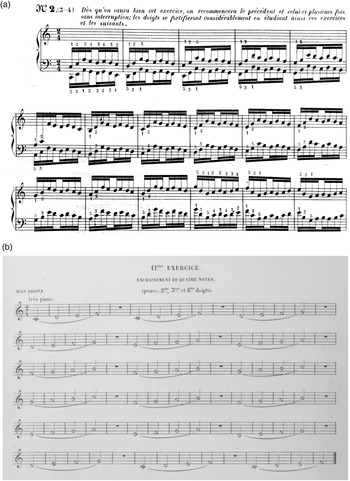
Jaëll's pedagogy is redolent of some aspects of innervated attention cultivated by the nineteenth century laboratory's instruments of measurement and observation. I hypothesize that Jaëll was drawn to the laboratory's objects and the kinds of knowledge they produced because they were, at least in part, adumbrated by similar designs in contemporaneous keyboard pedagogy. Keyboard pedagogy had in fact been associated with physiology decades before the piano became a tool for experiments in acoustics. As early as 1716, François Couperin writes of the advantages of using a wooden dowel to reduce extraneous hand movements.Footnote 46 Devices like Johann Bernhard Logier's Chiroplast, a sometimes pain-inducing device designed to prevent certain fingers on the pianist's hand from moving while others were left mobile, were marketed as late as the 1880s, although it is unlikely that Jaëll herself encountered the apparatus.Footnote 47 It is more likely, however, that Jaëll witnessed a flowering of disciplinary devices of a similar ilk: Friedrich Kalkbrenner's Guide-mains, used in the instruction of Jaëll's friend, Saint-Saëns, the Dactylion finger exerciser of Henri Herz, Jaëll's teacher at the Conservatoire, among others.Footnote 48 In an earlier edition of Touch published in 1894, Jaëll replaces the bluntness of the nineteenth-century piano method and its attendant objects with many highly focused exercises. In one such exercise, Jaëll aims to train the thumb, index, middle and ring fingers in a series of ascending tetrachords, written in simple minims (see Ex. 1b). In exchanging the gradual progression toward spellbinding finger mechanics for exercises that honed evenness of articulation, however, Jaëll's own method pivots away from an inherited tradition of virtuosic display, nevertheless perpetuating the disciplinary ethos of piano pedagogy writ large.
Comparison of (a) Exercise 2 from Hanon's Virtuoso Pianist (1873), and (b) Exercise 11 from Jaëll's Le Toucher (1894)

Influenced by the disciplining objects and programmes of nineteenth-century music education, Jaëll's method is also reflective of shifts in modes of nineteenth-century scientific inquiry. Published in 1896, Marie Jaëll's earliest endeavour in this vein, Music and Psychophysiology, demonstrates familiarity with Féré's research and contemporaneous studies in anatomy, physiology, psychology and natural philosophy.Footnote 49 Jaëll theorizes a link between the physical action of the fingers and the psychical impulses that both engender and react to bodily motion. ‘Every performer acting in a visible fashion on the movements of his fingers’, Jaëll writes, ‘will act in an invisible, though no less real fashion, on his mental activity. There will thus be established a logical correlation between the progressive development of the improvement of the finger's movements and the musical feeling of the performer’.Footnote 50
On the topic of musical ‘feeling’, in developing an aesthetics of musical performance, Jaëll conceives of the mysterious interrelated forces among pianist, piano and listener, as a kind of psychomechanics. ‘Why not admit’, Jaëll writes,
that in principle the true knowledge of ideal beauty entails the deep, precise, meticulous knowledge of the material functions that serve to express it, above all, as in the study of piano, the double function of the mechanism of the instrumentalist and of the instrument, attributed broadly to the analysis of the relationship between causes and effects.Footnote 51
Clarifying what she means by material, Jaëll suggests that physical vibration underlies musical harmony and rhythm; the ear is remarkably capable of deciphering fundamentally ‘precise’ mathematical iterations of either type of vibration.Footnote 52 Within Jaëll's paradigm of musical performance, the ‘material functions’ of both instrument and instrumentalist, transmitted to the listener, cause the perception of beauty.
Later in the same volume, Jaëll posits a conformity among auditory, tactile and visual sensations. In an extended passage only briefly summarized here, Jaëll develops a three-pronged programme for music's aesthetics, construed through the technology of the piano, and subsumed under the rubric of ‘interpretation’. Through his or her interpretation, a sensitive pianist conjures a beautiful timbre configured on the basis of the harmonic series, is cognizant of harmonic relationships between notes played successively and simultaneously, and possesses unwavering acumen in rhythmic articulation, such that the ‘smallest perceptible differences’ between notes are rendered discernible.Footnote 53 Even before consciously perceiving these aspects of interpretation, Jaëll writes, the pianist ‘will express this thought despite himself, thanks to his highly improved motor functions, thanks to his art of movements adapted to musical expression’.Footnote 54 Jaëll's aesthetics of music thereby consists in the innate perfectibility of the mechanics of performance; critically, the framework for achieving such perfection is implicit in the overlapping physical structures of sound and living things.Footnote 55
In 1897, Féré opened his laboratory to Jaëll, where she could continue to test her theory of touch on human subjects. In her laboratory notebooks, Jaëll uses fingerprints to encapsulate finger position and motion. In so doing, she posits that such images can cultivate correlative mental representations, which can be harnessed for improving the quality of a pianist's touch. The artefacts from these experiments, including her earliest work with fingerprints, which she began in 1896, are preserved in Jaëll's archive, housed at the National and University Library in Strasbourg, France (Bibliothèque nationale et universitaire de Strasbourg).Footnote 56
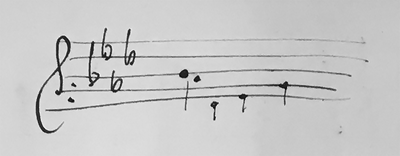
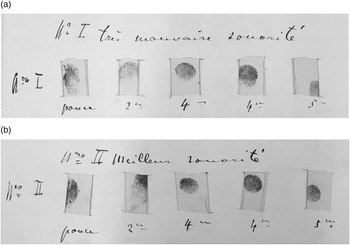
In an early series of fingerprints, Jaëll frames an experiment around an unnamed musical example (Ex. 2). Jaëll fingerprinted a pupil during the execution of this musical fragment; the fingerprints appear on small cardboard cut-outs, affixed to a piano keyboard during the experiment, and later lifted and glued into Jaëll's notebook.Footnote 57 In this particular experiment to be performed by the pianist's right hand, Jaëll compares two sets of prints, one labelled ‘very poor sonority’, and another ‘better sonority’ (Exx. 3a and 3b).
Generic Musical Example from Marie Jaëll, Untitled Working Notebook, 1896–97. Bibliothèque nationale et universitaire de Strasbourg, MRS.JAELL 357,1

(a) ‘Very Poor Sonority’ and (b) ‘Better Sonority’, from Marie Jaëll, Untitled Working Notebook, 1896–97. Bibliothèque nationale et universitaire de Strasbourg, MRS.JAELL 357,1

In her commentary, Jaëll singles out the importance of the contact between thumb and piano key, in this case on the note D@, signalling how the knowledge acquired from examining fingerprints might be used to dictate piano performance. She writes, ‘The improvement of the sound caused by this disposition of papillae results from the proportional diversification of the papillary lines’ (‘L'amelioration de la sonorité causée par cette disposition des papilles résulte de la diversification proportionnelle des lignes papillaires’).Footnote 58 By ‘proportionally diverse’, I take Jaëll to be describing the visual clarity and legibility of the lines that characterize every fingerprint. Jaëll thus asserts that the distinctive ridges of all fingerprints, if arranged in a proportionally diverse manner, would suggest an especially ‘good’ musical touch. After contemporaneous physiology, in these papillary ‘lines’, ‘ridges’ or ‘folds’, Jaëll theorizes an ‘organized map’ of coalesced nerve endings especially receptive to the most refined species of touch. The most vibrant sonorities are the result of contact between piano key and the most sensitive part of the fingertip.Footnote 59 Jaëll continues,
Whereas the second, fourth, and fifth fingers of the first group produce contacts by similar lines, the lines are neatly diversified in the second group. … The modification of the position of the thumb is in close correlation with this diversification. When it comes to the defective character of those papillae, it consists particularly in the disproportion of the area of contact.
Tandis que le 2me, 4me et 5me doigts du premier groupement produisent les contacts par des lignes similaires, les lignes sont nettement diversifiées dans le second groupement … Le changement de position du pouce est en corrélation étroite avec cette diversification. Quant au caractère défectueux de ces papilles, il consiste surtout dans la disproportion de l’étendue des contacts.Footnote 60
In other words, across multiple prints, Jaëll asserts that the similar direction of the papillary lines indicates subtle motion within the hand that increases the surface area of this ‘good’ contact.Footnote 61 In the first set of prints, Jaëll observes the congruence of the ridges of the fingerprints of the second, fourth and fifth fingers, whereas the lines of the thumbprint veer off in a different direction. In the second set, the thumbprint conforms to the other fingerprints, and the sound of the D@ has improved.
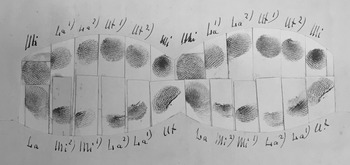
In a subsequent experiment based on Chopin's Étude in A-flat major, op. 25, no. 1 – the ‘Aeolian Harp’ – Jaëll intensifies the connection among fingerprints, touch and sonority (Ex. 4). In this diagram, Jaëll again imbues the clarity and uniform direction of the fingerprint's lines with aesthetic value. The gentle curvature of Jaëll's layout accentuates the linear design of the papillary ridges; Jaëll positions the fingerprint cards such that these lines can be easily connected across prints of adjacent fingers, thereby producing a marker of physiological and musical quality. The resultant portrait of piano performance also captures the circular motion of the left and right wrists engendered by the execution of Chopin's étude, thereby affording characteristics of visual order to sound. Crucially in this instance, Jaëll does not indicate which finger generates which fingerprint; the resultant illustration conforms her haptic ‘data’ to a limiting, two-dimensional representational field.
Fingerprints Taken During the Execution of F. Chopin, Étude in A-flat major, op. 25, no. 1, ‘Aeolian Harp’, from Marie Jaëll, Untitled Working Notebook, 1896–97. Bibliothèque nationale et universitaire de Strasbourg, MRS.JAELL 357,1

As a dynamic interplay of senses and physical phenomena – including the motion of the fingers, wrists and arms, as well as the heaviness or lightness of the contact between fingertip and key – piano performance defies the kind of scientific objectivity conveyed by Jaëll's representational logic. The prints themselves say nothing about the type or duration of contact between fingertip and piano key, nor do they accommodate the material differences among piano strings within the same instrument, which changes according to register.Footnote 62 Also, and perhaps more critically, Jaëll deliberately arranges the order of the fingerprints when she displays them in her scientific notebooks. In the ‘very poor’ and ‘better’ examples above, for instance, both the defective primary set of prints and the reformed second set are displayed out of musical order; executed in time, the fingering would be 5|4–1–2–4. Jaëll shuffles the fingerprint cards to reflect the idiomatic positioning of the right hand, 1–2–4–4–5, resulting in a temporal distortion of the musical notation. An uneasy relationship between static anatomical sign and music's ephemerality is thus latent within Jaëll's methodological apparatus.
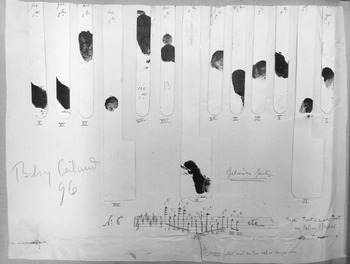
Jaëll addressed the matter of music's dynamism in a series of fingerprints taken of her student Elizabeth Caland.Footnote 63 For one experiment with Caland, Jaëll selected Brahms's Waltz, op. 39, no. 6 in C-sharp major. Based on the prints and her annotations, Jaëll sought to represent and analyse Caland's performance of the waltz's characteristic staccato articulation as compared with a more legato interpretation (Ex. 5). Unlike previous experiments, however, Jaëll has Caland perform the waltz on narrow slivers of white cardboard, which approximate the shape of piano keys, instead of small, fingertip-sized squares. Jaëll labels each print with a Roman numeral to indicate the order in which the keys are to be depressed. Jaëll also includes Arabic numerals and note names above each key-shaped cut-out. These digital coordinates – inscribed in red ink – in connection with the notated musical example (with which Jaëll also specifies Arabic fingering numerals), aspire to impart some indication of the order in which the fingers would be activated. Using Arabic numerals to convey such information is, of course, a practice that spans centuries and geographical locations, across a wide array of composers, courtiers, critics, editors and theorists. Similar to fingerings, fingerprints provided insight into music as a temporal, aesthetic and corporeal phenomenon. However, unique to Jaëll's use of fingerprints is the notion that, inherent in the coordinates were the haptic and sonic data of performance.
Fingerprints Taken During the Execution of J. Brahms, Waltz, op. 39, no. 6 in C-sharp major, from Marie Jaëll, Untitled Working Notebook, 1896–97. Bibliothèque nationale et universitaire de Strasbourg, MRS.JAELL 560,1

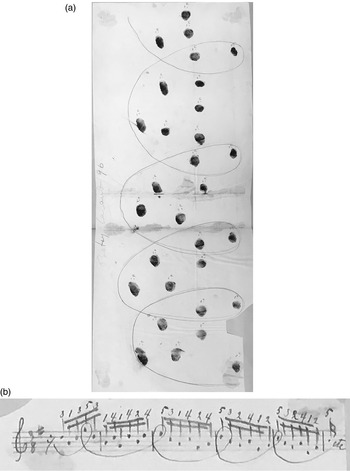
A second experiment from the same 1896 collection of Caland's fingerprints depicts the subject of the G major fugue from the second book of J.S. Bach's Well-Tempered Clavier. In this instance, Jaëll dispenses with cardboard cut-outs, opting instead for a free-form diagram of Caland's fingerprints, displayed in landscape orientation across the gutter of a large working notebook. Jaëll lines up the fingerprints in columns according to pitch: the first note of the excerpt (D5) is depressed by the third finger of the right hand three times in the first bar, three times by the fourth finger in the second bar, and so on. Again, using a thread of red ink to quite literally inscribe motion into a schematic of Caland's fingerprints, Jaëll links the notated musical example with her diagram, indicating how some notes should cohere as an aspect of Caland's practice. In this sense, Jaëll attempts to weave an aspect of temporality back into the fabric of her flattened visual diagram (Ex. 6).
Fingerprints (Elizabeth Caland) Taken During the Execution of J.S. Bach, G major fugue from Well-Tempered Clavier, Book 2, from Marie Jaëll, Untitled Working Notebook, 1896–97. Bibliothèque nationale et universitaire de Strasbourg, MRS.JAELL 560,1

Conceptualized within the epistemology of the nineteenth century's graphical method, such parochial studies bear little resemblance to a rigorous experimental methodology. Jaëll does not control for any particular set of circumstances or proffer any truly measurable data. Additionally, although Jaëll's examination of Caland's fingerprints correct in some ways the temporal distortions of her first experiments in musical touch, none of the foregoing experiments shed light on the nuance of Caland's execution – whether the chosen musical excerpts were, at least according to Jaëll, executed with the proper tactile sensitivity. Most importantly, the assessments Jaëll makes about such execution (that is, ‘very poor’ and ‘better’) are legible only within a visual framework. Unmoored from the moment sound is conjured from the piano – and without audio recordings – fingerprints gesture toward sound and motion but make for regrettably imprecise data.
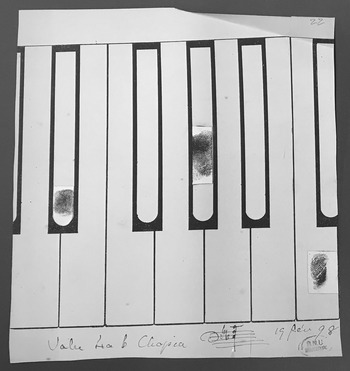
Undaunted by the difficulties of articulating her pedagogy within scientific discourse, Jaëll undertook a wealth of additional experiments. These experiments flesh out her developing methodology during the earliest stages of her collaboration with Charles Féré. As illustrated in Example 7, Jaëll had by February 1898 adopted an improved schematic for fingerprinting: an unnamed subject's prints are captured on small, roughly one-inch by one-inch cards, arranged in a freshly designed visual field. In her notebook, Jaëll does not specify the provenance of this new apparatus – ‘piano paper’. In the margins of a slip of piano paper dated February 1898, Jaëll inscribes the date of the experiment, the title of the musical work from which she culls the moment to be examined (‘Valse La Bémol Chopin’), and a musical example – an A-flat major triad in second inversion, notated in bass clef (to be executed by the left hand).
Fingerprints (anonymous), 19 February 1898, ‘Waltz La Flat Chopin’, from Marie Jaëll, Untitled Working Notebook, 1898–99. Bibliothèque nationale et universitaire de Strasbourg, MRS.JAELL 358,3

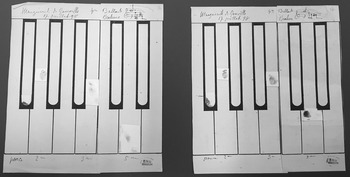
By early 1898, Jaëll's experimental methodology was comparative: two sets of fingerprints, generated by the same executant, were studied side-by-side. A set from 17 July 1898, for example, features the prints of Jaëll's student, Marguerite de Rouville (Ex. 8).Footnote 64 Jaëll compares two iterations of the same musical gesture – a descending B minor arpeggio – performed by Rouville's right hand. Like the prints generated by her student Elizabeth Caland, this example illuminates Jaëll's ongoing efforts to inscribe music's execution in time into the visual field: she indicates the finger to be used in the space below the printed piano key.
Fingerprints (Marguerite de Rouville), 17 July 1898, ‘Ballade Brahms’, from Marie Jaëll, Untitled Working Notebook, 1898–99. Bibliothèque nationale et universitaire de Strasbourg, MRS.JAELL 358,3

Problematically, Jaëll's methodology in many ways prioritizes the representation of the experiments over the experiments themselves. Along with several complete piano-fingerprint ‘graphs’ are loose and unlabelled fingerprint cards. Jaëll asked her pupils to perform a given excerpt multiple times, each time collecting new visual data, and arranging the cards to visualize what she observed about touch and sonority. In selecting from among a succession of captured fingerprints a pair of especially illustrative ones – denoting improvement within the same student – Jaëll subverts the proclaimed objectivity of her apparatus. Therefore, the standardization of the representational field as piano paper problematizes the epistemology of laboratory science. Not unlike the graphs and waveforms depicted in Marey's capacious Graphical Method, Jaëll's representations are in essence coordinates plotted within a visual field. Decidedly unlike the graphical method of nineteenth-century experimental science, however, Jaëll's easily manipulated fingerprint cards demand double interpretation by Jaëll herself, once in generating the diagrams and again in conveying meaning with them.
Touch and Embodied Cognition
Across Touch, Jaëll attempts to remediate several methodological difficulties, expanding her early experiments with fingerprints to include a performer's ability to attend and react to sensation. I consider the paradigm for the transmission of musical knowledge Jaëll develops in her treatise as a species of embodied cognition – that is, a deliberate estrangement from and gradual reconciliation with one's own body as a mode of knowledge acquisition.
Jaëll insists on the intimate connection between physical sensation and music's aesthetics, asserting that perception and attention are crucial factors in modifying touch and transmitting an effective musical performance. Significantly, Féré's psychomechanics also belies the influence of attention on the experimental apparatus. The physician suggests, for example, that a pleasant or painful physical sensation can modify its associated mental impression, thereby changing any subsequent physical iterations of the same sensation. ‘If under the influence of pleasure or pain certain muscles seem to contract in a more obvious manner’, the physician writes in Sensation and Movement, ‘it is perhaps due to their functional predominance within certain acquired habits’.Footnote 65 For the acquisition of rote physical skills or the development of habitual behaviour, Féré posits attention to one's physical and mental wellbeing as a significant ameliorating factor. As an outgrowth of his work at Bicêtre, Féré extends this aspect of muscular and mental exertion within his theory of psychomechanics to the role of sensation and movement in understanding psychophysiological pathology. Hysterics, he observes, were susceptible to permanent states of mental fatigue, which dulled their sensation and ability to move at will.Footnote 66 To improve such conditions, along with hygiene, Féré emphasizes the critical link between thought and physical activity as a conduit to diagnosis and treatment. ‘When one says that the mind thinks’, Féré asserts strikingly, ‘it is the whole being that enters into activity’.Footnote 67
The pedagogical programme Jaëll develops in Touch is unprecedentedly holistic, imbuing the rigid discipline of musical preparation manifest in the first edition with new scientific insights, first essayed in Music and Psychophysiology. The manual begins with an inventory of fingerprints and their role in sensation. Jaëll argues that, in the same way one discerns an object's shape by feeling, a pianist can learn to associate touch and hearing. To illustrate how a particular mode of haptic experience can be false – or skewed, we might say – Jaëll relays an instance in which Aristotle described the sensation of crossing one's index and medial fingers and placing a small metal ball at the point of contact between them. Aristotle argued that when crossed, the fingers would feel two spherical forms, thereby perceiving falsely. Using fingerprints of the second and third fingers in their ordinary position and a second set of prints of the fingers when crossed, Jaëll argues that the orientation of the fingerprints’ papillary grooves – whether or not they conform to the overall shape of the ball – is what transmits a correct or incorrect perception.Footnote 68
Jaëll reasons that if one were to somehow observe the relationship between the papillary ridges of the fingertips and their contact with piano keys, one might also learn to capitalize on the inherent relationship between sound and feeling.Footnote 69 Becoming a great artist, Jaëll ventures, necessitates more than mere practice (perhaps the same kind of practice invited by the copious musical drills featured in other piano pedagogy manuals); it demands a ‘concordance’ of ‘tactile and auditory sensations’, coordinated by the most refined physical touch. ‘Under the influence of this coordination’, Jaëll writes, ‘the impressions transmitted at the keyboard awaken a veritable concert of tactile sensations, the harmony of which is as perceptible to the artist as the harmony of sounds’.Footnote 70
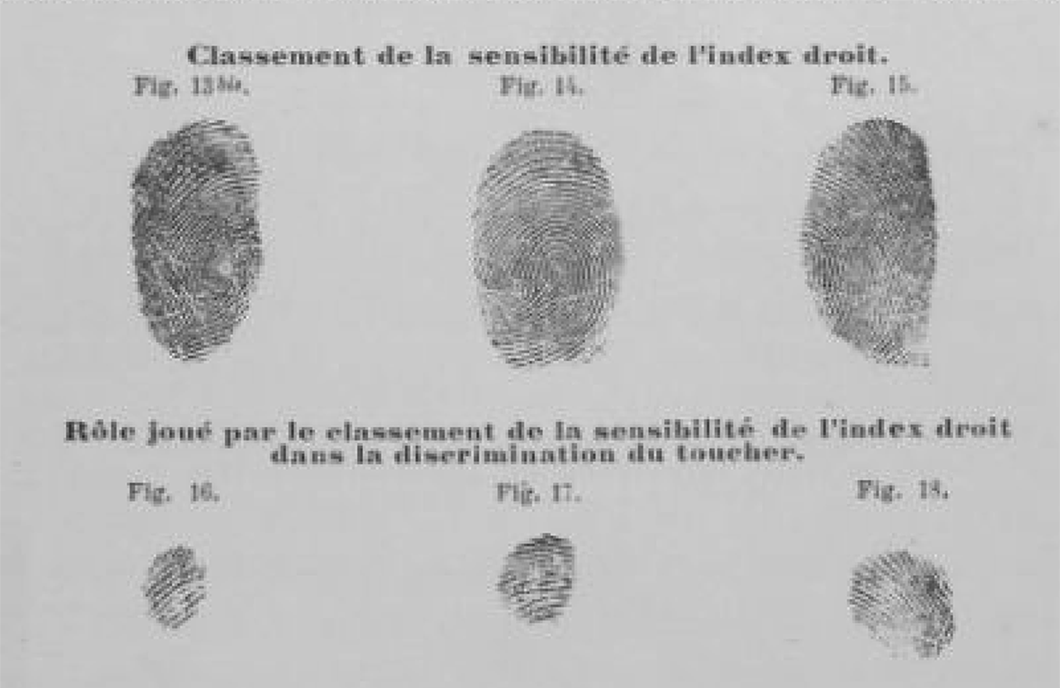
Jaëll locates the pianist's ability to ‘feel’ his or her performance in the variable sensitivity of the fingertips, which is related to a ‘triple manifestation’ of musical sensibility – rhythm, timbre and nuance – through which pianists communicate their artistry.Footnote 71 Jaëll measures the relationship between haptic and musical sensitivity by comparing fingerprints, asserting that ‘slight differences in the sensation of the fingertips, classified here in three principle groups, come from the fact that there is in each papillary line a multitude of nerve material, for which each has a function and wherein the transmission occurs at a different speed’.Footnote 72 On the basis of this speed of transmission, Jaëll denotes three principle species of touch, illustrating each with a fingerprint: most sensitive, average sensitivity and least sensitive (Jaëll's figures 13bis, 14 and 15 respectively). Jaëll theorizes that imperceptible motions of the fingers result from attending to minute variations in tactile sensitivity, associated with the three principle classes of touch: the first with movement from right to left, the second crosswise and the third with movement from left to right (Jaëll's figures 16, 17 and 18 respectively).Footnote 73 Jaëll concludes that a fingerprint's size and shape, and the configuration of papillary lines, can register haptic and potentially musical sensitivity (Ex. 9).
Figures 13bis–18 from Marie Jaëll, Touch (rev. 1899)

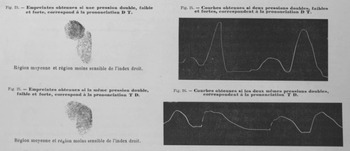
Jaëll subsequently describes another experiment in which she asked pianists to roll their right index finger from side to side while enunciating different consonants. The goal of the experiment, she notes, was to compare the strength of the articulated consonant with the speed of the finger's motion from right to left and left to right, and how the variably sensitive regions of the fingertips might impact this rate of motion and print clarity. Example 10 reproduces Jaëll's figures 19 through 22. Figures 19 and 21 are both composites of two fingerprints – one made while enunciating the stronger consonant ‘T’ and a second while enunciating the weaker ‘D’ – and their corresponding waveforms. With these images and dynamographs of the variances in pressure and speed, Jaëll posits a connection among speech, fingertip sensitivity, finger dexterity and the nuance of pianistic attack.Footnote 74
Figures 19–22 from Marie Jaëll, Touch (rev. 1899)

In the final section of Touch, Jaëll extends her insights on attention to learning several pieces from well-known piano literature, synthesizing aspects of her experimental methodology with piano pedagogy. The crucial step for any student learning to play a piano piece, Jaëll remarks, is finger position, which he or she learns by grouping fingers in accordance with the work's harmonic content.Footnote 75 Aspiring to the most perfect visual impression through will and muscular strength moulds the student's hands into the right position, thereby improving the effectiveness of his or her touch. Jaëll solidifies the reciprocity between position and movement with descriptive prose and several sets of fingerprints, explaining her pedagogical method thus:
As long as the placement of the fingers remains incomplete, the orientation of the movements plays an educating role that ameliorates the fingers’ position. The study of movement retains, despite the defective placement, all of its educational value. However, the spontaneous effort of the pupil, with the goal of establishing, through the tension of all his musculature, the relationships between the most correct fingers, can considerably shorten the duration of this education.
Aussi longtemps que la localisation des doigts reste incomplète l'orientation des mouvements joue un rôle éducateur qui améliore la position des doigts. L'étude du mouvement garde donc, malgré la localisation défectueuse, toute sa valeur éducatrice. Mais l'effort spontané de l'élève, fait en vue d'établir, par la tension de toute sa musculature, les rapports de position des doigts les plus corrects, peut considérablement abréger la durée de cette éducation.Footnote 76
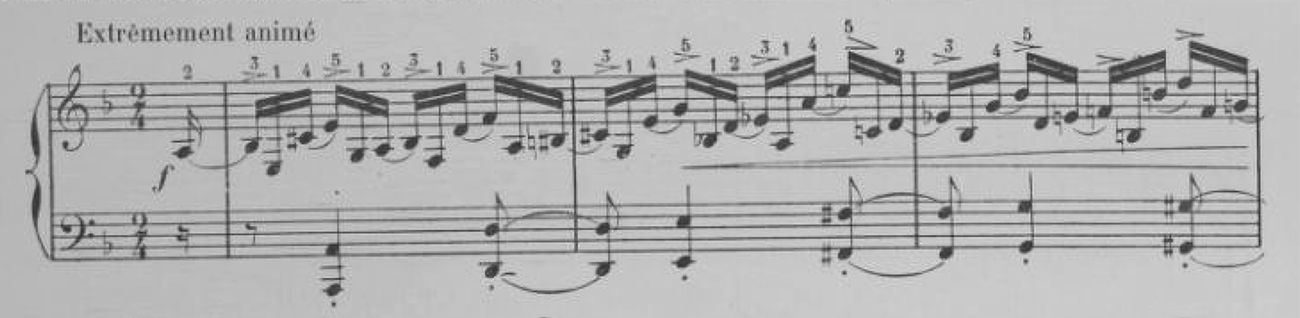
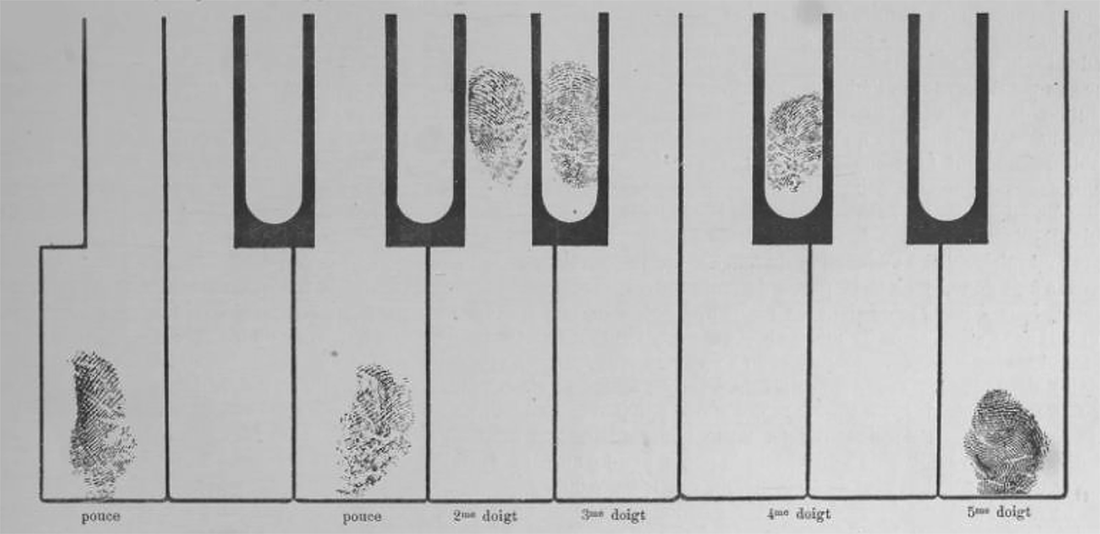
Of the many études Jaëll marshals to structure her method, one excerpted from Schumann's Kreisleriana, op. 16, serves as a case study. Jaëll reproduces the entirety of the first section of Kreisleriana and includes detailed fingering for the first three measures, illustrating the originating finger position with a fingerprint diagram. It is worth underscoring Jaëll's own distinction between ‘exercise’ and ‘étude’, both of which are found in her manual. Unlike Hanon's exercises – or concert études that bear the imprimatur of disciplined hands packaged into polished moments of transcendence – Jaëll's études single out psychophysiological problems more than they prepare for or provide opportunities for virtuosic display.
R. Schumann, Kreisleriana, bars 1–3, with Jaëll's Fingering, from Touch (rev. 1899)

Initial Finger Positioning for Kreisleriana from Marie Jaëll, Touch (rev. 1899)

The challenge here, Jaëll contends, is learning the right-hand arpeggios while developing the ability to roll the fingers slightly to preserve contact between the fingertip and its assigned key. Preserving contact conveys the harmonic structure underlying the work's striking dissonances.Footnote 77 Invited by the innovation of Jaëll's fingerprint-centred methodology, attention to the nuance of contact between fingertip and key could isolate imperceptible ameliorating and ‘harmonious’ movements. Likewise, in seeking to reconcile the chasm between acoustics and music with fingerprints, Jaëll braids the physical properties of sound (which she summarizes with the word ‘harmony’) with those of haptic and visual sensation. ‘As there is an obvious relationship between the written musical work and the spacing of the keys on which the fingers will be placed to execute it’, Jaëll writes, ‘there is also an obvious relationship between the way in which the fingers will work to execute it and the associated calculations by which the mind stores the aesthetic value of the executed work’.Footnote 78 With this, Jaëll expands the notion of harmony to include visual order – as in the disposition of the keyboard, notated music and, by extension, the papillary ridges of fingerprints – and acoustic data, processed in the minds of the performer and listener.
Jaëll's experimental methodology thus charts a link between the spatial exigencies of finger mechanics and music's intellection. She found inspiration for her aesthetic theory in Féré, who in 1895 signalled a connection among visual order, space and beauty. In a cartographic metaphor, Féré describes fingerprints – visual manifestations of the location of sensitivity – as a distinctive ‘geography’ in which one might become better oriented with experience.Footnote 79 Such ability, he theorized, would hinge on a person's intellectual and psychomechanical development. Féré asserts a connection, predicated as such, between intellectual development and aesthetic sensitivity.Footnote 80
Unlike Féré, however, imbued with knowledge from her experience as a virtuoso pianist, Jaëll's theories on music's aesthetics also accommodated the corporeal aspects of musical training. Jaëll opens Touch with a noteworthy philosophical excursus on sensation – tactile and auditory. ‘As the complex relationships of harmony unfold in thought’, Jaëll writes,
equally complex relationships of tactile sensations suggest [to the pianist] uninterrupted calculations, since if the duration of sounds comes from consecutive vibrations, the duration of the touch of each finger comes from consecutive sensations.Footnote 81
Pendant que les rapports complexes de l'harmonie des sons se déroulent dans la pensée, les rapports non moins complexes des sensations tactiles lui suggèrent des calculs ininterrompus; car si la durée des sons provient de vibrations consécutives, la durée du toucher de chaque doigt provient de sensations consécutives.Footnote 82
In incorporating the physicality of learning to play the piano into the experience of musical beauty, with beauty ostensibly open to matters of individual taste, Jaëll again posits a mechanistic, seemingly objective view of the interrelationship between touch and sound. For Jaëll, the perception of music's harmonic content is analogous to the way in which the mind processes tactile sensation: as vibration.
However, despite her usage of the term ‘consecutive’ in the foregoing passage, Jaëll does not ultimately define the pianist's synthetic response to vibration as teleological. She continues:
The art of touch does not reside more in the duration of sensations than musical art [resides] in the duration of sounds, for only when the simultaneous and successive evolutions of tactile sensations are combined – their incessant variations – might [they] give rise to the feeling of a polyphony of sensations, the harmony of which is equivalent to musical harmony.
L'art du toucher ne réside pas plus dans la durée des sensations que l'art musicale dans la durée des sons, car ce n'est que lorsque les évolutions simultanées et successives des sensations tactiles se combinent, que, leurs incessante variations, peut naître le sentiment d'une polyphonie de sensations dont l'harmonie équivaut à l'harmonie musicale.Footnote 83
Stated differently, in her perplexing and quite beautiful characterization of performing as a ‘polyphony of sensations’, Jaëll theorizes that haptic data is brought to the pianist's consciousness through his or her fingers in a manner that is both ‘simultaneous’ – that is, in coordination with musical harmonies that are expressed as chords – and ‘successive’ – those that unfold or are arpeggiated over time.
More than a mere collapsing of auditory and tactile mechanics, the definition of touch Jaëll develops hinges on a pianist's attention, impressed upon by visible and invisible phenomena. She doubles down on this with a striking metaphor. ‘The musician notably will understand’, she observes, ‘that his mind is in his hand inasmuch as in his head, and that the surest and most individual musical educator to which he is disposed is his hand.’Footnote 84 Inverting the notion that the hand and fingers determine the identity of the criminal subject, or diagnose the psychophysiological pathology of the hysteric, Jaëll instead theorizes the musician's hand as the sentient educator of the musical subject. Attuning to the data conveyed with his or her own body reimagined as another hypersensitive laboratory instrument,Footnote 85 Jaëll's pianist generates a composite ‘polyphony’ of auditory, haptic and visual vibration.
Such a polyphony accommodated the temporality of piano music's literally successive and simultaneous sensations. On the Kreisleriana, for instance, Jaëll asks the following:
How else to make the mind conceive of notes played successively as if they were played simultaneously without beginning this education of thought by holding the correlative keys, at a given moment, actually simultaneously pressed together? It is true, in execution, that these held collections might progress so rapidly that they themselves produce combinations of only fleeting tactile sensations; but as fleeting as they are, these combinations are inherent to the education of touch and, consequently, in the education of the pupil's musical consciousness.
Comment faire concevoir au cerveau des notes jouées successivement comme si elles étaient jouées simultanément, sans commencer cette éducation de la pensée en tenant les touches corrélatives, à un moment donné, vraiment simultanément enfoncées? Il est vrai, dans l'exécution, ces tenues collectives peuvent se succéder si rapidement qu'elles ne produisent elles-mêmes que des combinaisons de sensations tactiles fugitives; mais aussi fugitives qu'elles soient, ces combinaisons sont inhérentes à l'éducation du toucher et, par conséquent, à l'éducation de la conscience musicale de l'élève.Footnote 86
In other words, guided by the self-reflexive mode of Jaëll's method, the pianist generates aesthetic meaning as a function of producing and reacting to vibration, construed as the essence of physical and psychical phenomena. Jaëll conceives of this process as a kind of proprioceptive sleight-of-hand. The pianist first sustains sonorities that unfold in time successively, generating a mental impression of aural and tactile harmony, and gradually synthesizes the two ‘images’ into a polyphony. In the preliminary stages of deploying Jaëll's piano method, fingerprints would be needed for the diagnosis of tactile imperfections. Crucially, the perfectibility of performance would consist in drawing the pianist's attention to the unique – we might say intangible – qualities of each masterwork. Attention would counteract the faulty effects of ‘unthinking’ mechanics.Footnote 87
Whereas in experimental psychology the conundrum of attention dislodged the objective diagnostic sign as the narrated temporality of the body, in Jaëll's method, the pianist exploits this disconnect between space and time. He or she ultimately learns to react to a near instantaneous ‘polyphony of sensations’ by phasing in and out with sound and the embodied knowledge produced by it. In imbricating the piano's technology with its performer, the anatomical sign of the fingerprint in Jaëll's pedagogy could yield no objective truth. It functioned instead to visualize the inscrutable, but more revelatory psychological phenomena of teaching oneself how to touch. In this sense, in approaching touch scientifically, Jaëll's recourse to experimentation is also an expression of her lifelong pursuit – to spark in pianists a total artistic awakening. ‘In reality’, Jaëll writes, ‘art and science seem to have a common goal: to combat unconsciousness’.Footnote 88 Jaëll's definition of touch thus depends on a subject that continuously attends to the piano's sonic, visual and haptic sensations as a jointly psychological and aesthetic phenomenon.Footnote 89 The ‘Parnassus’ of Jaëll's piano pedagogy was not, therefore, a body habituated to the blunt mechanics of scales and arpeggios, but a mind that resonated harmoniously with music. With its emphasis on proprioception and shot through with memories cultivated by practice, Jaëll's method endeavours to print the link between touch and sound, even as it insists upon music's ineffability.