Introduction
The first cyst of Echinococcus shiquicus (E. shiquicus) is believed to have been documented by Guo and colleagues in 1993 where they described a unilocular hydatid cyst similar to that of E. granulosus (see Xiao et al., Reference Xiao, Qiu, Nakao, Li, Yang, Chen, Schantz, Craig and Ito2006). Later on, Qiu et al. found adult tapeworms designated as atypical Echinococcus tapeworms in the Tibetan fox (Vulpes ferrilata) in 1995 (Qiu et al., Reference Qiu, Chen, Ren, Luo, Liu, Liu and He1995). During this time, the controversy surrounding the identification and species delineation of Echinococcus and possibly the absence of molecular evidence masked the scientific community from appreciating the differences, thus identifying it as a variant of E. multilocularis; a sympatric species in the Qinghai–Tibet Plateau. In 2005, another study reported similar findings but was able to differentiate it from existing species and sub-species based on sequences from mitochondrial (mt) and nuclear DNA (Xiao et al., Reference Xiao, Qiu, Nakao, Li, Yang, Chen, Schantz, Craig and Ito2005).
Morphologically, E. shiquicus resembles E. multilocularis, but it is usually differentiated by its smaller rostellar hooks, fewer segments, the position of the genital pore in the mature segment, number of eggs in the gravid segment and nature of cysts which are often unilocular (Xiao et al., Reference Xiao, Qiu, Nakao, Li, Yang, Chen, Schantz, Craig and Ito2005). Adults are believed to exist in two forms, one form having a short strobila consisting of a single immature and single gravid segment, which forms the majority of commonly encountered specimens and a second form composed of immature, mature and gravid segments. Detailed morphological features and the differences with other Echinococcus species have been fully described elsewhere (Xiao et al., Reference Xiao, Qiu, Nakao, Li, Yang, Chen, Schantz, Craig and Ito2005, Reference Xiao, Qiu, Nakao, Li, Yang, Chen, Schantz, Craig and Ito2006).
So far, adult worms have been found only in Tibetan foxes, which are the known suitable definitive host (Xiao et al., Reference Xiao, Qiu, Nakao, Li, Yang, Chen, Schantz, Craig and Ito2005). Cysts containing protoscoleces have been identified in plateau pikas (Ochotona curzoniae) and plateau voles (Lasiopodomys fuscus) while the parasite DNA has been detected in the lacustrine vole (Microtus limnophilus), long-tailed dwarf hamster (Cricetulus longicaudatus) and Blyth's mountain vole (Phaiomys leucurus) (Xiao et al., Reference Xiao, Qiu, Nakao, Li, Yang, Chen, Schantz, Craig and Ito2006; Wang et al., Reference Wang, Liu, Zuo, Mu, Weng, Sun, Wang, Boufana, Craig, Giraudoux, Raoul and Wang2018). The life cycle pattern exhibited by E. shiquicus suggests some correlation with the feeding relationship between wild rodents and foxes in the Tibetan Plateau (Xiao et al., Reference Xiao, Qiu, Nakao, Li, Yang, Chen, Schantz, Craig and Ito2006; Jiang et al., Reference Jiang, Liu, Zhang, Renqing, Xie, Li, Wang and Wang2012). Although dogs have not been proven to be suitable definitive hosts for E. shiquicus, mtDNA specific to E. shiquicus had been detected by coproPCR in the feces of dogs from Shiqu County, Tibet Autonomous Prefecture of Sichuan Province (Boufana et al., Reference Boufana, Qiu, Chen, Budke, Campos-Ponce and Craig2013) and more recently in a Rizha Village in the same county (Weng et al., Reference Weng, Mu, Wei, Wang, Zuo, Ma, Ding, Wang, Wu, Craig and Wang2020) indicating exposure. In the meantime, the zoonotic potential of this species is still unclear. Possible reasons for this were highlighted by Xiao et al. (Reference Xiao, Qiu, Nakao, Li, Yang, Chen, Schantz, Craig and Ito2006) including the unconfirmed presence of the adult stage in dogs (companion animals) considering their crucial role in the transmission of zoonotic diseases through environmental contamination.
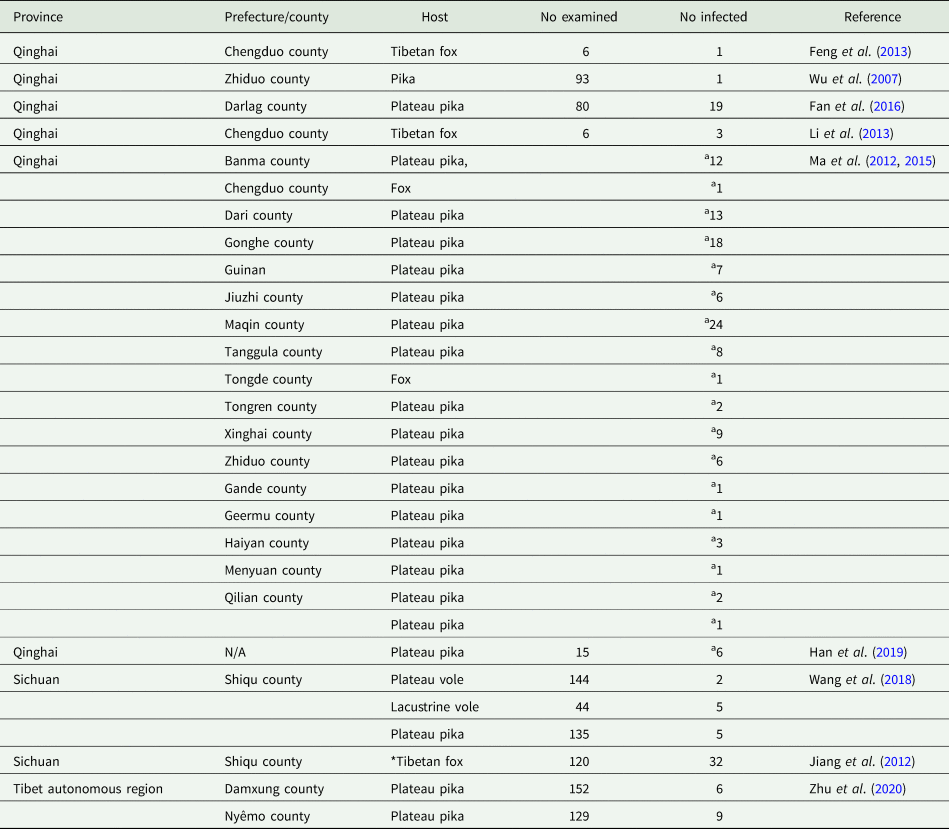
Until now, E. shiquicus has been commonly found and reported in the central areas of the Qinghai–Tibet plateau (Table 1); a large mountainous region that spans different provinces and autonomous regions (Tibet and Xinjiang Autonomous regions, Qinghai, Sichuan, Gansu, and Yunnan provinces) of China with an average elevation of 4000 m. The Qinghai–Tibet plateau is an isolated geographical area with harsh topographical and meteorological characteristics, with peculiar biodiversity, making it a suitable place to find genetically distinct species of various organisms.
Distribution of E. shiquicus in the Qinghai–Tibet Plateau from previous studies

*Faecal samples, anumber of isolates only.
Since the discovery of E. shiquicus, progress has been made in understanding the genetic diversity and population structure, howbeit by short mitochondrial gene sequences of the cytochrome c oxidase subunit 1 (cox1) and the NADH dehydrogenase subunit 1 (nad1) (Ma et al., Reference Ma, Wang, Lin, Craig, Ito, Cai, Zhang, Han, Ma, Zhang, Liu, Zhao and Wang2012, Reference Ma, Wang, Lin, Zhao, Li, Zhang, Ma, Zhang, Hou, Cai, Liu and Wang2015; Wang et al., Reference Wang, Liu, Zuo, Mu, Weng, Sun, Wang, Boufana, Craig, Giraudoux, Raoul and Wang2018; Han et al., Reference Han, Jian, Zhang, Ma, Zhu, Cai, Wu, Wang and Shi2019), with only a few studies employing longer mtDNA sequences (2505 bp) (Fan et al., Reference Fan, Lou, Li, Yan, Liu, Zhan, Li, Liu, Cai, Lei, Shi, Yang, McManus and Jia2016; Zhu et al., Reference Zhu, Yan, Li, Ohiolei, Wu, Li, Zhang, Fu and Jia2020). Meanwhile, a better insight into the population structure will require an extensive investigation across the plateau as conflicting population demographics/indices have so far been observed, which is either a consequence of short DNA sequences or sample size limitations.
Here, to further understand the distribution and population structure of E. shiquicus on the plateau, we described isolates of this species in regions of Gansu and Qinghai provinces other than the central areas (the southeast and northeast edges of the plateau) and also their genetic relationship with previous isolates collected from the plateau using longer mtDNA sequences.
Materials and methods
Sample collection
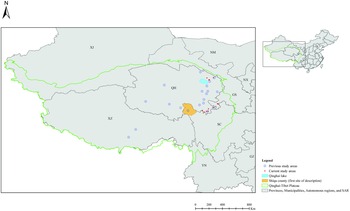
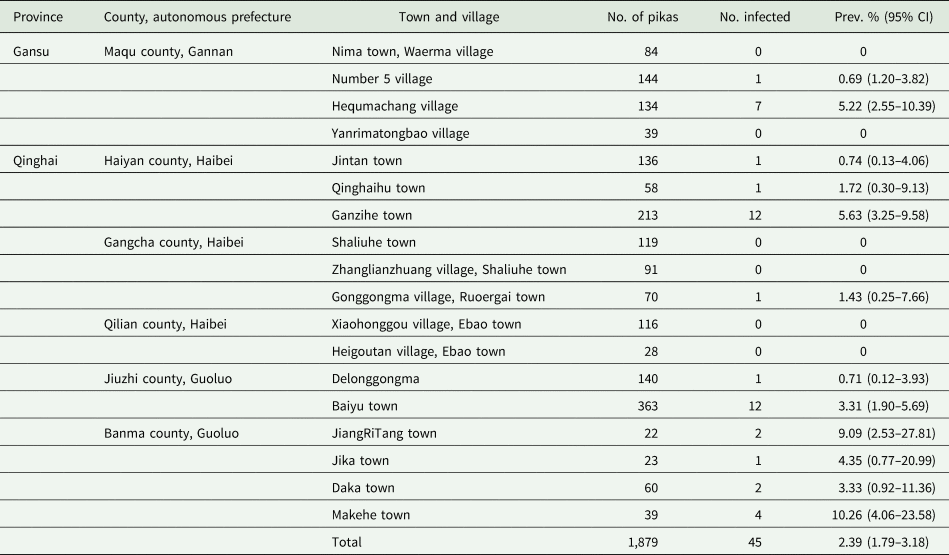
Plateau pikas were trapped and examined for infection with E. shiquicus during the months of April–October 2018 in Gansu and Qinghai provinces, Peoples' Republic of China (Fig. 1). All pikas were trapped in different towns and villages across three prefectures and six counties (Table 2). Trapped animals were dissected and their internal organs (lungs and livers mainly) examined for cysts.
The geographical distribution of E. shiquicus in China from previously investigated and the current study areas. GS, Gansu; GZ, Guizhou; NM, Inner Mongolia; NX, Ningxia; QH, Qinghai; SC, Sichuan; XJ, Xinjiang; XZ, Tibet; YN, Yunnan.

Echinococcus shiquicus prevalence and distribution in Gansu and Qinghai provinces, China

DNA extraction, PCR amplification and sequencing
Genomic DNA was extracted by Qiagen Blood and Tissue Kit (Qiagen, Hilden, Germany) from the germinal layer of each cyst (retrieved from trapped pikas) and stored at −80 °C before use. Using the following primer pairs, universal primers for nad1 (nad1-F: 5′-TAAGWTRAGTGTGTGTGTTGGT-3′ and nad1-R: 5′-TAARCAAACCTCTCAACGAGAC-3′) (W = A/T; R = A/G) (Fan et al., Reference Fan, Lou, Li, Yan, Liu, Zhan, Li, Liu, Cai, Lei, Shi, Yang, McManus and Jia2016) and cox1 (cox1-F: 5′-AGTTACTGCTAATAATTTTGTGTCAT-3′ and cox1-R: 5′-TGATGTAAAAGGCAAATAAACC-3′) (Zhu et al., Reference Zhu, Yan, Li, Ohiolei, Wu, Li, Zhang, Fu and Jia2020). PCR was carried out in a 25 μL reaction mixture containing 12.5 μL Premix Ex Taq™ version 2.0 (Takara Bio, Kusatsu, Japan), 0.5 μL (10 pmol) of each primer, 0.5 μL of genomic DNA extract, and RNAse free water was used to complete the final volume to 25 μL. PCR product (about 5 μL) were visualized by electrophoresis in 1.5% (w/v) agarose gel made from 1 × TAE (40 mm Tris-acetate, 2 mm EDTA, pH 8.5) and stained with GelRed® (Biotium, Fremont, USA). After electrophoresis, the gel was viewed under UV transilluminator (Bio-Rad, Inc). The remaining PCR products were sequenced using the same primer sets (Beijing Tsingke Biotechnology Co., Ltd., Xi'an, China).
Molecular analysis
The number of haplotypes and diversity indices (haplotype diversity and nucleotide diversity) were calculated by DnaSP v6 (Rozas et al., Reference Rozas, Ferrer-Mata, Sanchez-DelBarrio, Guirao Librado, Ramos-Onsins and Sanchez-Gracia2017) while the neutrality indices, Tajima's D (Tajima, Reference Tajima1989) and Fu's Fs, (Fu, Reference Fu1997) were estimated in Arlequin v.3.5.2.2 (Excoffier et al., Reference Excoffier, Laval and Schneider2005). The median-joining networks were constructed using the cox1 and nad1 gene sequences as well as cox1–nad1 concatenated gene sequences by PopART (http://popart.otago.ac.nz).
Results
Echinococcus shiquicus prevalence
Out of 1879 plateau pikas examined, 2.39% (95% CI 1.79–3.18) were infected with E. shiquicus. The highest prevalence was recorded in Makehe town in Qinghai province (10.26%, 95% CI 4.06–23.58) (Table 2). Overall the prevalence was higher in Qinghai at 2.5% (95% CI 1.82–3.43) than in Gansu 2% (95% CI 1.02–3.89). Cox1 gene was successfully amplified for 30 isolates, while amplification of the nad1 gene was successful for 25 isolates. All isolates, using their nucleotide sequences were identified as E. shiquicus with >99% similarity to the reference E. shiquicus sequences (GenBank accession no. AB208064) in a BLASTn search. The distribution of E. shiquicus survey areas (this study and previous studies) across the QTP is shown in Fig. 1.
Population indices and median-joining network
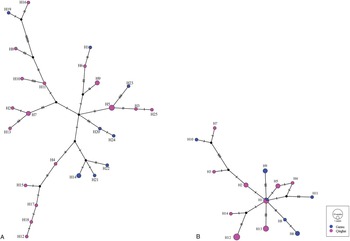
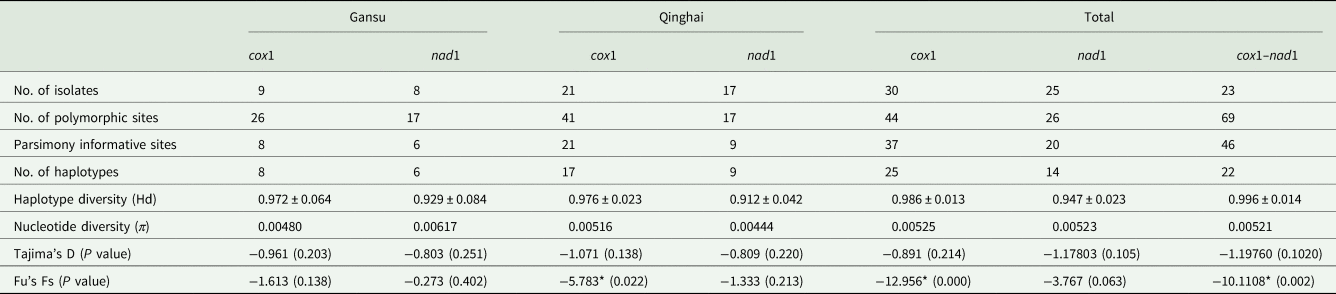
Overall, of the 30 successful cox1 amplified isolates, 25 haplotypes were found with 44 polymorphic sites, of which 37 were parsimony informative. For the 25 isolates with successful nad1 amplification, 14 haplotypes were observed with 26 polymorphic sites out of which 20 were parsimony informative (Table 3). High and low haplotype and nucleotide diversities were observed, respectively in both provinces. Negative Tajima's D and Fu's Fs values were observed across all populations with significant (P < 0.05) Fu's Fs for cox1 gene in isolates from Qinghai and the overall population (Gansu and Qinghai) as well as for cox1–nad1 concatenated gene (Table 3). The median-joining network constructed by the cox1 gene showed a star-like configuration with no central haplotype (Fig. 2a). In contrast, the nad1 gene network, which also presented a star-like configuration had a central haplotype that was found in both provinces (Fig. 2b). Overall, no peculiar distinction was observed in the mitochondrial makeups of the isolates collected from the different provinces.
Median-joining networks (a) nad1 and (b) cox1 gene sequences.

Genetic diversity and population indices of E. shiquicus populations from Gansu and Qinghai provinces

*Significant P-value (<0.05).
Echinococcus shiquicus population structure in the Qinghai–Tibet plateau: analysis of the cox1–nad1 (2505 bp) vs partial cox1 (762 bp) mitochondrial genes
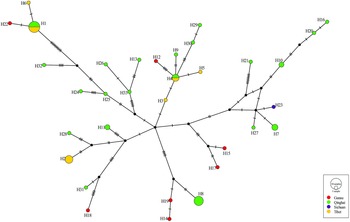
A dataset consisting of 59 concatenated sequences of the complete cox1 and nad1 (2505 bp) mitochondrial genes, including sequences from Gansu (7), Qinghai (36), Sichuan (1) and Tibet (15) was used to estimate the population diversity indices and infer the population structure. A total of 80 polymorphic sites, including 64 parsimony informative sites resulted in 33 haplotypes with a haplotype diversity of 0.949 ± 0.016 and a nucleotide diversity of 0.00568. The outcome of the neutrality indices; Fu's F −5.138 (P = 0.110) and Tajima's D −0.6007 (P = 0.279) was not significant. The median-joining network based on 2505 bp (cox1–nad1 sequences), depicted a star-like structure with several hypothetical vectors (possibly unsampled haplotypes) one of which occupied the centre of the network (Fig. 3). In the network, no distinction according to the different provinces was observed.
Median-joining network of 59 concatenated cox1–nad1 sequences of E. shiquicus from the Tibetan Plateau.

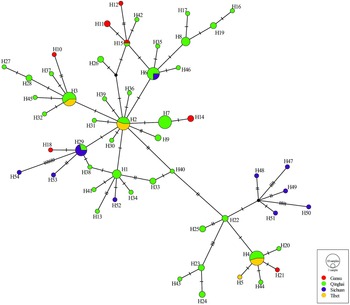
To accommodate more sequences originating from the plateau and to compare the outcome of the population indices with short gene sequences, we trimmed the complete cox1 sequences from this study to 762 bp. A final dataset comprising 120 sequences from the Qinghai–Tibet plateau, including sequences from Gansu (9), Qinghai (81), Sichuan (15) and Tibet (15) was realized from this study, GenBank database and Fan et al. (2016). From the datasets, 54 haplotypes with 65 polymorphic sites were observed, of which 26 were parsimony informative. Haplotype and nucleotide diversities of 0.966 ± 0.006 and 0.00588, respectively, were found for the entire population with negative and highly significant values of Fu's F −25.614 (P = 0.000) and Tajima's D −1.999 (P = 0.001). The median-joining network presented a complex and expanding star-like configuration with haplotype H2 occupying the middle of the network (Fig. 4), unlike the 2505 bp network and was founded in Qinghai province and Tibet Autonomous Region. Again, no haplotype was common to all provinces, however, haplotype H2, H3 and H4 were found in Qinghai and Tibet, H6 and H29 were found in Qinghai and Sichuan, while H15 was common to Qinghai and Gansu (Fig. 4). Meanwhile, nucleotide variation was higher in the set of sequences from Sichuan than those from other provinces (Fig. 4). Nonetheless, no clear distinction regarding location (province) was also observed.
Median-joining network of 120 partial cox1 sequences of E. shiquicus from the Tibetan Plateau.

Discussion
Echinococcus shiquicus described in 2005 is currently found only in the Qinghai–Tibet plateau (Xiao et al., Reference Xiao, Qiu, Nakao, Li, Yang, Chen, Schantz, Craig and Ito2005). While the host range and distribution are not fully understood, studies so far have reported more infection in the eastern-central part of the plateau. Also, the zoonotic potential remains unknown as the tapeworm species is reportedly maintained in the plateau via a sylvatic cycle that is largely supported by the feeding relationship between Tibetan foxes (the known definitive hosts) and certain small mammal populations (voles and pikas) (Xiao et al., Reference Xiao, Qiu, Nakao, Li, Yang, Chen, Schantz, Craig and Ito2005; Wang et al., Reference Wang, Liu, Zuo, Mu, Weng, Sun, Wang, Boufana, Craig, Giraudoux, Raoul and Wang2018). Prevalence of E. shiquicus has been reported to reach as high as 23.75% in plateau pikas especially in Qinghai province (Fan et al., Reference Fan, Lou, Li, Yan, Liu, Zhan, Li, Liu, Cai, Lei, Shi, Yang, McManus and Jia2016) where most surveys have been conducted since it was described in Shiqu County, Sichuan province. Similarly, in this study, we found a higher prevalence in the central areas of Qinghai-Tibet plateau compared to other regions. More so, the detection in Hequmachang Village of Maqu County in Gansu represents the first detection of E. shiquicus in the province. It was also, detected around Qinghai Lake in Ganzihe town of Haiyan County and Gonggongma village of Gangcha County towards the northeastern edge of the plateau.
Until now, the diversity and population structure of E. shiquicus has been largely investigated by partial mitochondrial gene sequences of cox1 and/or nad1 (Ma et al., Reference Ma, Wang, Lin, Craig, Ito, Cai, Zhang, Han, Ma, Zhang, Liu, Zhao and Wang2012, Reference Ma, Wang, Lin, Zhao, Li, Zhang, Ma, Zhang, Hou, Cai, Liu and Wang2015; Wang et al., Reference Wang, Liu, Zuo, Mu, Weng, Sun, Wang, Boufana, Craig, Giraudoux, Raoul and Wang2018; Han et al., Reference Han, Jian, Zhang, Ma, Zhu, Cai, Wu, Wang and Shi2019), and recently by mtDNA sequences of up to 2505 bp (Fan et al., Reference Fan, Lou, Li, Yan, Liu, Zhan, Li, Liu, Cai, Lei, Shi, Yang, McManus and Jia2016; Zhu et al., Reference Zhu, Yan, Li, Ohiolei, Wu, Li, Zhang, Fu and Jia2020). Moreover, studies have shown that by analysing longer DNA sequences or certain genes with higher resolution power, a better understanding of the intraspecies variation and phylogenetic resolution of Echinococcus species is realised (Laurimäe et al., Reference Laurimäe, Kinkar, Romig, Omer, Casulli, Umhang, Gasser, Jabbar, Sharbatkhori, Mirhendi, Ponce-Gordo, Lazzarini, Soriano, Varcasia, Rostami Nejad, Andresiuk, Maravilla, González, Dybicz, Gawor, Šarkūnas, Šnábel, Kuzmina and Saarma2018, Reference Laurimäe, Kinkar, Romig, Umhang, Casulli, Omer, Sharbatkhori, Mirhendi, Ponce-Gordo, Lazzarini, Soriano, Varcasia, Rostami-Nejad, Andresiuk, Maravilla, González, Dybicz, Gawor, Šarkūnas, Šnábel, Kuzmina, Kia and Saarma2019; Ohiolei et al., Reference Ohiolei, Li, Yan, Fu and Jia2020). In this report, analyses of the concatenated mitochondrial cox1 and nad1 gene sequences were used to infer the population structure of E. shiquicus collected from the plateau in contrast to most previous studies that utilized partial gene sequences. The E. shiquicus population, as seen in the neutrality indices demonstrated by the cox1 and concatenated cox1–nad1 genes, suggested population expansion with significant negative values of Fu's F. This observation is in contrast to the population indices observed in some previous studies in Qinghai and Sichuan provinces where the neutrality test demonstrated positive non-significant values based on partial cox1 gene as well as a recent investigation of E. shiquicus populations from the Tibet Autonomous Region and Qinghai Province although with a longer DNA fragment, 2505 bp (Nakao et al., Reference Nakao, Li, Han, Ma, Xiao, Qiu, Wang, Yanagida, Mamuti, Wen, Moro, Giraudoux, Craig and Ito2010; Zhu et al., Reference Zhu, Yan, Li, Ohiolei, Wu, Li, Zhang, Fu and Jia2020). With the geographically isolated and harsh climatic conditions of the plateau, one would expect that E. shiquicus population in the plateau would have experienced a population bottleneck event considering the geological events that led to the formation of the plateau millions of years ago (Harrison et al., Reference Harrison, Copeland, Kidd and Yin1992), but with the contrasting available reports mainly based on short gene sequences, the population structure and demographic history of E. shiquicus across the plateau remain to be further explored and it would be interesting to understand the population structure vis-à-vis the timeline of events during the plateau formation. Moreover, Knapp et al. (Reference Knapp, Nakao, Yanagida, Okamoto, Saarma, Lavikainen and Ito2011) suggested that E. shiquicus were presumably present in the last 1.5–3.0 million years. Compared to other species of Echinococcus present on the Tibetan Plateau, for example, E. multilocularis, a sister species to E. shiquicus which also shares similar host characteristics, demonstrates a relatively lower mitochondrial polymorphism (Nakao et al., Reference Nakao, Li, Han, Ma, Xiao, Qiu, Wang, Yanagida, Mamuti, Wen, Moro, Giraudoux, Craig and Ito2010; Li et al., Reference Li, Li, Fan, Fu, Zhu, Yan and Jia2018), although this species has a more generalistic host requirement with zoonotic potentials. Similarly, on the plateau low mitochondrial polymorphism is also true for E. granulosus sensu stricto, a widespread and geographically expanding species (Nakao et al., Reference Nakao, Li, Han, Ma, Xiao, Qiu, Wang, Yanagida, Mamuti, Wen, Moro, Giraudoux, Craig and Ito2010; Ohiolei et al., Reference Ohiolei, Xia, Li, Liu, Tang, Wu, Danqulamu, Zhu, Shi, Fu, Yin, Yan and Jia2019).
Comparatively, 59 concatenated cox1–nad1 gene sequences (2505 bp) and 120 partial cox1 gene sequences (762 bp) were analysed. The partial cox1 outcome indicated population expansion, while the longer mtDNA dataset (2505 bp) showed no significant deviation from neutrality although Tajima's D and Fu's Fs values were negative. Meanwhile, the discrepancies could not be fully resolved in this study due to few and uneven sequence representations for some locations besides other factors that considerably influence the outcome of such indices (Brown et al., Reference Brown, George and Wilson1979; Laurimäe et al., Reference Laurimäe, Kinkar, Romig, Omer, Casulli, Umhang, Gasser, Jabbar, Sharbatkhori, Mirhendi, Ponce-Gordo, Lazzarini, Soriano, Varcasia, Rostami Nejad, Andresiuk, Maravilla, González, Dybicz, Gawor, Šarkūnas, Šnábel, Kuzmina and Saarma2018). Whatever may be the case, these observations thus underscores the need for far more studies and robust investigations into the genetic population structure of E. shiquicus across the plateau.
Furthermore, the absence of genetic distinction between isolates from different provinces across the plateau as depicted by the network structure was as expected, with very high nucleotide polymorphism as previously reported (Nakao et al., Reference Nakao, Li, Han, Ma, Xiao, Qiu, Wang, Yanagida, Mamuti, Wen, Moro, Giraudoux, Craig and Ito2010). According to the network structure, the central haplotype or the most stable ancestors may have originated from Qinghai and then spread to other regions of the Tibetan Plateau. Moreover, higher nucleotide polymorphisms were observed in the partial cox1 gene sequences of isolates from Sichuan, where the species was first described than the cox1 gene sequences from Gansu, Qinghai and Tibet.
In this study, we report the presence of E. shiquicus in regions of Gansu Province located within the Qinghai–Tibet plateau even though they did not show any peculiar distinction with isolates from other locations on the plateau. More so, no common haplotype was found in all locations which further buttress high intraspecies variation within E. shiquicus. The results also call for more investigation to determine the prevalence and distribution of E. shiquicus in other regions of the plateau and its surrounding axis, confirm the most abundant haplotype in the plateau and explore the genetic polymorphism using other informative regions of the mtDNA to provide more detail on the population structure.
Data availability
All sequences used in this study can be found under the following accession number: cox1 MW684294-MW684318, nad1 MW684319-MW684332 in GenBank database https://www.ncbi.nlm.nih.gov/nucleotide/
Financial support
This study was funded by the National Key Research and Development Plan (2017YFD0501301; 2018YFC1602504), Central Public-Interest Scientific Institution Basal Research Fund (1610312017001; 1610312020016), and Cultivation of Achievements of State Key Laboratory of Veterinary Etiological Biology (SKLVEB2020CGPY01).
Conflicts of interest
The authors declare there are no conflicts of interest.
Ethical standards
All animals were handled following good animal practice according to the Animal Ethics Procedures and Guidelines of the People's Republic of China. The study was approved by the Animal Ethics Committee of Lanzhou Veterinary Research Institute, Chinese Academy of Agricultural Sciences (no. LVRIAEC2017-002). All pikas were strictly handled according to the animal protection laws of the People's Republic of China (A Draft of an Animal Protection Law in China released on September 18, 2009).