Antibiotic-resistant bacteria (ARB) are one of today’s most urgent public health problems.Reference Spellberg, Bartlett and Gilbert 1 Experts agree that promoting judicious antibiotic use is one of several important strategies to prevent the spread of ARB. 2
Approximately 30% of inpatient antibiotic use is unjustified or unnecessary.Reference Hecker, Aron, Patel, Lehmann and Donskey 3 – Reference Arnold, McDonald, Smith, Newman and Ramirez 5 To improve the use of antibiotics in the inpatient setting, healthcare institutions have developed antibiotic stewardship programs. Though stewardship efforts can be effective, inappropriate use of antibiotics persists even where robust programs are in place.Reference Camins, King and Wells 6 – Reference Dellit, Owens and McGowan 8
The most common approach to antibiotic stewardship involves prospectively auditing inpatients receiving antibiotics and providing feedback to patient providers.Reference Pope, Dellit, Owens and Hooton 9 This strategy is based on the premise that physicians are rational actors and that a physician will make optimal choices if provided with the appropriate information. Increasing evidence, however, indicates that physicians do not make purely rational decisions.Reference Meeker, Knight and Friedberg 10 Decisions to prescribe antibiotics are influenced by a multitude of factors, including social norms and the physician’s underlying beliefs and emotions.Reference Charani, Castro-Sanchez and Sevdalis 11 , Reference Charani, Edwards and Sevdalis 12
To achieve larger and more sustainable improvements in antibiotic use, the array of factors influencing prescribing habits must be identified and addressed.Reference Charani, Edwards and Sevdalis 12 In this study, we investigated the context in which physicians practice and the professional and psychosocial factors that influence physicians’ antibiotic prescribing decisions.
METHODS
Interviews were conducted at 2 acute care hospitals in Indianapolis, Indiana: Sidney and Lois Eskenazi Hospital and the Richard Roudebush Veterans Affairs Medical Center (VAMC). Eskenazi Hospital is a 316-bed safety-net hospital for Marion County, Indiana. The Roudebush VAMC is a 209-bed tertiary-care facility that provides complete medical care for 85,000 adults. Both hospitals are affiliated with Indiana University’s School of Medicine.
During this study, a formal antimicrobial stewardship program was in place at only 1 of these hospitals. At this facility, an infectious disease physician reviewed charts of inpatients on antibiotics twice per week and provided feedback to the primary prescribers.
Electronic invitations to participate in the study were sent to inpatient providers who prescribe antibiotics at either facility. Invitees were asked to participate in a 30-minute confidential interview about their antibiotic-prescribing habits. The target enrollment was 30 physicians, including at least 15 attending, or staff, physicians. The protocol and conduct of this study were reviewed and approved by the Indiana University Institutional Review Board. Participants read and signed an informed consent form. No compensation was provided to physician participants.
A research assistant (A.C.) trained in qualitative interviewing conducted all interviews. We used semi-structured interview questions consisting of open-ended questions and flexible probes based on participant response. Only 1 question was asked at a time. Questions addressed social norms, perceptions of risk, self-efficacy, and knowledge (Online Appendix 1).
All interviews were audio recorded, transcribed, and deidentified. All transcripts were reviewed by the research assistant for accuracy and completeness. Transcripts were analyzed using emergent thematic analysis, an inductive process in which data are categorized into meaningful units that represent the experiences and beliefs of participants.Reference Miller and Crabtree 13 – Reference Bernard 15
First, 2 members of the research team (D.L., A.C.) read all interview transcripts and discussed general impressions. Next, the analytic team reread one-fifth of the transcripts and assigned labels to the data line by line. These labels were compared and discussed among team members. Once the team had agreed on this initial set of codes, analysts continued to apply them to the remaining transcripts, meeting at designated intervals to discuss interpretations of the data. Codes were added, modified, and removed as the team’s familiarity with the data improved.Reference Charmaz 16 The next phase of analysis was focused coding. Analysts applied the final codes derived from the first phase to each transcript. The analysts met after every 10 transcripts to ensure that their coding was consistent. Discrepancies between analysts were resolved by discussion and consensus. NVivo, version 9, software (QSR International, Cambridge, MA, USA) facilitated coding and analysis.
RESULTS
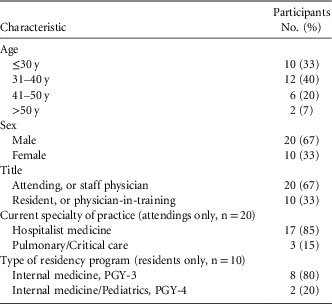
Of the 46 physicians invited to participate, 30 (65%) accepted. All 30 participants were physicians who practiced inpatient medicine. They had spent a median of 7 years (IQR, 3–15) in clinical practice. Additional characteristics are shown in Table 1.
Characteristics of 30 Physician Participants

NOTE. PGY-3, post-graduate year 3; PGY-4, postgraduate year 4.
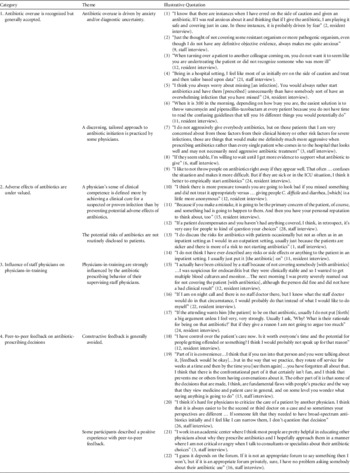
The interviews revealed 4 themes related to the culture of antibiotic prescribing: (1) antibiotic overuse is recognized but generally accepted; (2) the potential adverse effects of antibiotics have a limited influence on physician decision making; (3) physicians-in-training are strongly influenced by the antibiotic prescribing behavior of their supervising staff physicians; and (4) prescribing decisions of other physicians are questioned, but there is reluctance to provide critique, feedback, or advice.
Theme 1. Antibiotic Overuse Is Recognized but Generally Accepted
Physicians recognized the benefits of goal-directed therapy for sepsis, which includes the early use of antibiotics.
However, many participants described a low threshold to initiate antibiotics even in stable patients without a definitive infection. These uncertain situations produced anxiety for the treating physician. Antibiotics were prescribed “just in case” there was a bacterial infection. In addition, broad-spectrum antibiotics were prescribed to avoid missing an unlikely or unidentified resistant pathogen (Table 2, quotations 1–5). In situations in which a resident physician was covering unfamiliar patients overnight, prescribing antibiotics was preferred when a patient’s clinical status declined; the expectation was that the primary team would de-escalate antibiotics at a later time if a bacterial infection was not present (Table 2, quotation 6).
Themes and Illustrative Quotations Identified from Semi-structured Interviews of 30 Inpatient Physicians

NOTE. Each quotation ends with a label, indicating the subject’s study number (1–30) and his or her title (staff or resident).
A few participants thought this low threshold was driven by a fear of lawsuits: “I have seen lawsuits for delays in therapy… [In my prior job], sometimes I would ask my partners their advice on doing things, and they seemed to be hedging on the side of just treating a lot of times because they were experienced with litigation” (26, staff).
Some physicians described a more discerning, tailored approach to starting antibiotics in the patient who lacked conclusive evidence of infection, making a distinction between a stable patient and an unstable patient who is in the ICU (Table 2, quotations 7–9).
Participants universally agreed that they try to de-escalate antibiotics. Factors that informed their decisions to de-escalate included microbiologic cultures, imaging results, white blood-cell count, vital signs, and overall clinical course. Participants were most comfortable with de-escalation when the decision was based on culture data. Inpatient team pharmacists often prompted physicians to consider de-escalation.
Theme 2. The Potential Adverse Effects of Antibiotics Have a Limited Influence on Physician Decision Making
Participants wanted to provide appropriate care and to see their patients recover from their illness. Prescribing antibiotics for a suspected infection was seen as consistent with this overarching goal.
Though physicians were aware of the global problem of antibiotic resistance, they had difficulty applying this awareness to the care of a specific patient: “It [the problem of antibiotic resistance] is always there at the back of your mind, but then sometimes when you are faced with a particular situation, you’re stuck between trying to think on the global way of trying to reduce broad-spectrum antibiotic use and all that versus trying to make sure you don’t miss a bug by going too narrow” (15, resident).
A physician’s sense of clinical competence was defined more by achieving a clinical cure for a suspected or proven infection than by preventing potential adverse effects of antibiotics. Missing an infection could make a physician “look bad” in the eyes of colleagues or prompt colleagues to “question” his or her choices (Table 2, quotations 10–12). Similar concerns were not expressed about a patient’s risk for developing Clostridium difficile or an infection with an ARB: “I think there is more pressure towards you are going to look bad if you missed something and did not treat it appropriately versus … giving people C. difficile and diarrhea, [which] is a little more anonymous” (12, resident).
The potential adverse effects of antibiotics not only failed to influence physician decision making, but they were also not routinely discussed with patients (Table 2, quotations 13 and 14). In general, the benefits of antibiotics were thought to outweigh the risks to hospitalized patients: “The hospital is a different setting … Patients are there because they are sick and they understand that, for the most part, the treatments you give them are necessary” (13, staff).
There were exceptions to this practice. Participants acknowledged that they would disclose the risk of an antibiotic that was unusually toxic (eg, amphotericin). Participants also acknowledged that they tended to discuss the risks of antibiotics with the patient when they had decided not to prescribe antibiotics.
I think that most physicians will discuss risks and benefits to suit their needs. I think that if you think the patient should be on antibiotics, your discussion will lead them in that direction and you won’t highlight side effects and those kinds of things (13, staff).
I think it’s more driven in the opposite fashion of talking about the risks when maybe I don’t want to do an antibiotic and the patient is pushing or if I’m going to withhold antibiotics in a patient who clearly has an infection and there are good reasons to do it (28, staff).
Theme 3. Physicians In Training Are Strongly Influenced by the Antibiotic Prescribing Behavior of Their Supervising Staff Physicians
Physicians in training, or residents, universally recognized that their prescribing behavior was strongly influenced by their staff physicians. One resident acknowledged that he was guided by “staffing patients with the staff and kind of trusting what they thought was best to give the patient” (2, resident). He noticed that his staff physician’s recommendations were not always in line with standard guidelines. Other residents reiterated that their comfort level with prescribing reflected the prescribing behavior of their staff physician:
When we see broad-spectrum antibiotics being thrown on patients with relative ease, it gives us the confidence to do so as well (15, resident).
Whatever attending [physician] you are with is the attending who you learn from, and if I see them continuously not prescribe antibiotics over and over again, then I feel comfortable not prescribing antibiotics. But if they always do it, then I feel the need to do it (11, resident).
Residents described situations in which they disagreed with the staff physician about the need to start antibiotics or the need to give broad-spectrum therapy. One resident was strongly criticized for not starting a stable patient on antibiotics overnight (Table 2, quotation 18). Others acknowledged prescribing in a manner that would meet the staff physician’s approval or silently deferring to the attending physician’s antibiotic recommendations (Table 2, quotations 15–17).
Theme 4. Although Other Physicians’ Prescribing Decisions Are Questioned, There Is Reluctance to Provide Critique, Feedback, or Advice
Participants acknowledged that antibiotics were generally overused, and they recognized situations when their colleagues prescribed antibiotics unnecessarily.
Some staff physicians were willing to give feedback to their colleagues about antibiotic choices, but the forum had to be “appropriate.” For example, changeovers were cited as a situation in which this feedback could be given. One staff physician thought the “academic” environment was conducive to educating colleagues (Table 2, quotations 21–22).
However, many residents and staff physicians admitted that they would not provide direct critique of their colleagues’ antibiotic prescribing habits. One commonly cited obstacle to feedback was a respect for hierarchy: “If it is another resident in my equal level of training or somebody higher, I would be less inclined to question their antibiotic view” (14, resident). In addition, it is often not convenient to provide this type of feedback. For example, after a physician signs out to the oncoming physician replacing him or her, the 2 individuals may not see each other in person for several weeks (Table 2, quotation 19).
Participants found it inherently difficult to criticize another physician’s care (Table 2, quotations 18–20). They did not want to “offend” a colleague or harm a “good collegial relationship.” While a physician’s decision to prescribe an antibiotic may seem questionable in hindsight, participants recognized that the clinical circumstances may have been less clear-cut at the time the decision was made to initiate antibiotics. In addition, critiquing one’s colleagues can be awkward: “You’re not going to teach someone who is senior faculty about MICs [minimum inhibitory concentrations] and sensitivities and specificities … or tell them to go back and read a book… It’s just not going to happen” (13, staff).
DISCUSSION
Improving antibiotic prescribing practices is a complex, challenging task with multiple barriers.Reference Schouten, Hulscher, Natsch, Kullberg, van der Meer and Grol 17 , Reference Cortoos, De Witte, Peetermans, Simoens and Laekeman 18 Efforts to improve antibiotic use within hospitals have largely focused on education and implementing formal antibiotic stewardship programs.Reference Dellit, Owens and McGowan 19 However, this study’s findings suggest that antibiotic use is also influenced by physicians’ shared attitudes and beliefs.
Social norms strongly influence human behavior, and physicians are not immune to this phenomenon.Reference Smith and Korenstein 20 Prior studies have described the influence of cultural norms on antibiotic prescribing decisions.Reference Charani, Castro-Sanchez and Sevdalis 11 , Reference Charani, Edwards and Sevdalis 12 , Reference Borg 21 – Reference De Souza, MacFarlane, Murphy, Hanahoe, Barber and Cormican 24
Our study identified several shared values that define the local antibiotic prescribing culture: (1) antibiotic overuse is recognized but generally accepted; (2) the potential adverse effects of antibiotics have a limited influence on physician decision making; (3) physicians-in-training are strongly influenced by the antibiotic prescribing behavior of their supervising staff physicians; and (4) other physicians’ prescribing decisions are sometimes questioned, but there is limited peer-to-peer feedback or critique.
When faced with diagnostic uncertainty, participants valued the reassurance of prescribing antibiotics. Although such an approach is warranted for a patient with suspected sepsis, physicians also admitted to prescribing antibiotics in a stable patient “just in case” an infection was present. The effect of uncertainty avoidance on antibiotic prescription has been described in other qualitative studiesReference Schouten, Hulscher, Natsch, Kullberg, van der Meer and Grol 17 , Reference Bjorkman, Berg, Roing, Erntell and Lundborg 25 and may explain some of the variability in antibiotic use that is seen among different countries.Reference Borg 26 , Reference Borg 27
A second shared value identified in our interviews is that physicians are far more concerned about the immediate risk presented by an infection—whether proven or suspected—than the downstream risks of prescribing antibiotics. In general, studies have found that physicians perceive ARB as more of a theoretical or public health problem and, therefore, not relevant to the care of their individual patients.Reference Pulcini, Williams, Molinari, Davey and Nathwani 28 – Reference Giblin, Sinkowitz-Cochran and Harris 30
While these participants’ sense of clinical competence was influenced by not missing an infection, they expressed less concern about their antibiotic prescribing decisions fostering C. difficile or an infection with ARB. There may be several reasons why participants undervalued these adverse events. For example, these antibiotic-related adverse effects tend to be multifactorial; they may have a delayed manifestation; they may be difficult to attribute to a single physician’s decision, thereby providing a degree of anonymity for the prescribing physician. Furthermore, overlooking these adverse effects could reflect the limited time frame hospitalists and residents care for their patients. Physicians rotate on and off the inpatient service and typically do not follow patients after discharge, so they would not be aware of their patient being readmitted for C. difficile or an antibiotic-resistant infection.
A third theme in our interviews was the strong influence senior staff had on resident physicians’ antibiotic prescribing decisions. Studies from the United Kingdom, Ireland, and Belgium also identified senior opinion leaders as important determinants of antibiotic prescribing practices, superseding the influence of local policy.Reference Charani, Castro-Sanchez and Sevdalis 11 , Reference Cortoos, De Witte, Peetermans, Simoens and Laekeman 18 , Reference De Souza, MacFarlane, Murphy, Hanahoe, Barber and Cormican 31 Based on these findings, efforts to improve inpatient antibiotic use must recognize the hierarchy of decision making. Residents will have difficulty following guidelines if recommendations are not endorsed by their staff physicians.
A fourth cultural value identified in our interviews was the participants’ reluctance to provide feedback, critique, or advice to another physician regarding his or her prescribing habits. A qualitative study of 4 hospitals in the United Kingdom found that participants were also reluctant to question their colleagues who deviated from local prescribing guidelines.Reference Charani, Castro-Sanchez and Sevdalis 11 This disinclination was an unwritten but widely accepted cultural rule, which was part of the system’s “prescribing etiquette.” In our study, the reluctance to provide direct feedback reflects a lack of collaboration among physicians to address the complicated problem of ARB. Avoiding confrontations and preserving strong working relationships were seen as higher priorities.
By describing the influence of local practice and hospital culture, our findings highlight potential avenues for improving antibiotic use in the inpatient setting. To heighten awareness of antibiotic-related adverse events, a hospital’s quality management team could provide direct feedback to physicians when these events occur. Encouraging physicians to discuss potential antibiotic-related adverse events with their patients may also raise awareness of these concerns. Because many participants acknowledged a desire to maintain a sense of competence among their peers, there may be opportunities to compare physicians to their peers on defined metrics, eg, the frequency of appropriate antibiotic use and the incidence of antibiotic-related adverse events. Barriers to peer-to-peer feedback could be addressed by creating nonputative forums where providers openly discuss their antibiotic prescribing decisions. In addition, an antimicrobial stewardship team could promote a collaborative culture by developing strong working relationships with prescribers and providing real-time feedback. Though this approach is resource-intensive, it can reduce anxieties and gradually change prescriber behaviors.Reference Davey, Brown and Charani 32 Finally, the greater availability of accurate diagnostic tests will help physicians feel more confident in not starting or de-escalating antibiotics.Reference Harbarth and Samore 33
This study is one of the few to explore antibiotic prescribing attitudes among inpatient physicians in the United States. We found that shared attitudes and beliefs are influential in decision making about antibiotics. The 4 themes we identified agree with several European reportsReference Charani, Castro-Sanchez and Sevdalis 11 , Reference Cortoos, De Witte, Peetermans, Simoens and Laekeman 18 , Reference De Souza, MacFarlane, Murphy, Hanahoe, Barber and Cormican 31 suggesting that antibiotic prescribing across different Western countries may be influenced by a similar set of cultural factors. Understanding these factors on a local level and their role in prescriber decision making could facilitate more effective stewardship interventions.
Our study has some limitations. First, because physicians self-reported their attitudes and behavior, their responses may not reflect their actual practice. All interviews were conducted by a nonphysician and kept confidential, but participants may nonetheless have been inclined to give socially desirable responses. Second, our findings reflect 30 inpatient medical physicians at 2 teaching hospitals and may not be generalizable to other settings. Although thematic saturation was observed at the end of 30 interviews, we cannot rule out the possibility that minority perspectives may have been missed.
This study is an important albeit early step in understanding how physicians make antibiotic decisions. Current efforts at antibiotic stewardship within hospitals have focused heavily on educating providers and providing them real-time feedback about their prescribing decisions. We have shown that antibiotic decisions are not entirely based on reason. To achieve sustainable improvements in antibiotic use, a stewardship program should also address the local cultural factors and social networks that influence prescribing practice.
Acknowledgments
Financial support: This project was supported by a Project Development Team within the Indiana Clinical and Translational Sciences Institute and the National Institutes of Health National Center for Research Resources (Grant No. UL1TR001108).
Potential conflicts of interest: All authors report no conflicts of interest relevant to this article.
Supplementary Material
To view Supplementary Materials for this article, please visit http://dx.doi.org/10.1017/ice.2015.136