Introduction
Between 2007 and 2011, youth unemployment in Ireland trebled to ~30% (Eurofound. NEETs: Young People not in Employment, 2012). This represents the rate of young people between 15 and 24 years not in education, employment or training (NEETs). The potential mental health effects of such a dramatic rise in economic inactivity among young people remains largely unknown. Several recent studies have suggested that increases in unemployment and general economic hardship have led to an increase in suicide rates and mental disorder among the general adult population in the United States and Europe (Kentikelenis et al. Reference Kentikelenis, Karanikolos, Papanicolas, Basu, McKee and Stuckler2011; Stuckler et al. Reference Stuckler, Basu, Suhrcke, Coutts and McKee2011; Barr et al. Reference Barr, Taylor-Robinson, Scott-Samuel, McKee and Stuckler2012; Reeves et al. Reference Reeves, Stuckler, McKee, Gunnell, Chang and Basu2012; De Vogli et al. Reference De vogli, Marmot and Stuckler2013; Gili et al. Reference Gili, Roca, Basu, McKee and Stuckler2013).
Much research exists on the association between psychological distress and economic inactivity among adults. However, few population-level studies have examined rates of mental disorder among economically inactive young people (Paul & Moser, Reference Paul and Moser2009). Although economic inactivity is undoubtedly a cause of distress in adult populations, it is not known whether it has similar effects in young adults who have very limited experiences of employment and for whom periods of economic inactivity and frequent changes in employment and education status may have become the norm (Arnett, Reference Arnett2000). Analyses of the Christchurch Health and Development Study have revealed small independent risks of suicidality and anxiety and substance use disorders associated with exposure to economic inactivity (Fergusson et al. Reference Fergusson, Horwood and Lynskey1997, Reference Fergusson, Horwood and Woodward2001, Reference Fergusson, Boden and Horwood2007). However, these analyses were carried out before dramatic rises in youth economic inactivity associated with the global economic recession in the developed world. Arnett (2000) also raised the idea of shifting values among emerging adults in relation to what we traditionally measure as economic activity and how this might not fit in with many young people’s activities. Young people at present assign greater value to activities that give them happiness and meaning compared with young people in the past. Happiness and meaning for them may be found outside the traditional domains of employment, education and training in other pursuits such as travelling, unpaid entrepreneurship and volunteering, particularly at a time when opportunities in traditional pursuits are limited. Arnett also identified that while emerging adulthood is becoming an increasingly unstable period in terms of traditionally valued pursuits (employment, education and training), it is also a period of resilience, hopefulness and self-focus (Arnett, Reference Arnett2000, Reference Arnett2007).
The directionality of any associations between NEET young people and mental health problems is a current focus of interest (Scott et al. Reference Scott, Fowler, McGorry, Birchwood, Killackey, Christensen, Glozier, Yung, Power, Nordentoft, Singh, Brietzke, Davidson, Conus, Bellivier, Delorme, Macmillan, Buchanan, Colom, Vieta, Bauer, McGuire, Merikangas and Hickie2013). There is increasing evidence of a profound effect of child and adolescent psychopathology on later psychosocial and economic outcomes (Goodman et al. Reference Goodman, Joyce and Smith2011). A recent analysis of a British longitudinal study found that the longitudinal impact of childhood psychological ill health far outweighed the longitudinal impact of childhood physical ill health on earnings and employment up to age 50 (Goodman et al. Reference Goodman, Joyce and Smith2011). Similarly, a series of papers from the Christchurch Health and Development Study has identified the adverse effects of mental health disorder in adolescence and young adulthood on later psychosocial and economic outcomes (Fergusson & Woodward, Reference Fergusson and Woodward2002; Gibb et al. Reference Gibb, Fergusson and Horwood2010; Fergusson et al. Reference Fergusson, McLeod and Horwood2014).
We aimed to carry out an investigation of the associations between economic inactivity and mental disorder (including suicidal behaviour) in a community sample of young people in Ireland. Owing to the longitudinal design of the study, we were also able to investigate adolescent mental health predictors of economic inactivity in young adulthood.
Methods
The Challenging Times (CT) Study is a longitudinal cohort study based in North Dublin City (Lynch et al. Reference Lynch, Mills, Daly and Fitzpatrick2004). The original sample was obtained using a random sampling technique, stratified by school. A total of 743 pupils, aged 12–15 years (mean 13.3 years), in eight mainstream schools were screened using surveys in the classroom, and 140 screened positive for being ‘at-risk’ of psychiatric illness. In all, 104 (74%) of the ‘at-risk’ group agreed to attend for diagnostic interview and a control group of 94 young people was randomly selected from the remainder of the sample. The interview schedule comprised the ‘Schedule for Affective Disorders and Schizophrenia for School-aged Children Present and Lifetime version (K-SADS-PL)’ (Kaufman et al. Reference Kaufman, Birmaher, Brent, Rao, Flynn, Moreci, Williamson and Ryan1997). Challenging Times Two (CT2) is a follow-up study of the original CT cohort. The follow-up was carried out between December 2007 and December 2009 and 80% follow-up was achieved (n=168). See Harley et al. (2015) for more details on tracing and methodology (Harley et al. Reference Harley, Clarke, Kelleher, Coughlan, Lynch, Fitzpatrick and Cannon2015). Participants were aged between 19 and 24 years (mean 20.8 years). The diagnostic interview schedule was ‘The Structured Clinical Interview for DSM-IV Disorders Axis One (SCID-1)’ (First et al. Reference First, Spitzer, Gibbon and Williams2002). Psychiatric disorder outcomes were divided into five diagnostic groupings [affective disorder, anxiety disorder (not including specific phobia), drug use disorder (excluding alcohol), alcohol disorder and any other SCID-I disorder outcome].
Statistical analysis
The prevalence of NEET status at follow-up was weighted in order to adjust for the inclusion of a higher proportion of those found to be ‘at-risk’ of mental health difficulties in the original CT study in comparison with the ‘not-at-risk’ group. This gave an estimate of prevalence in the population from which the sample was drawn. Weighting of prevalence figures to adjust for oversampling of ‘at-risk’ group was carried out as follows: of the 168 individuals followed up, 91 were from the original CT1 ‘at-risk’ group and 77 were from the original CT1 comparison group. Therefore, every individual from the original ‘at-risk’ group that was followed up represented 1.7 individuals in the entire ‘at-risk’ group (157/92), and every individual followed up from the control group represented 7.4 individuals in the original comparison group (566/77). The crude prevalence figure from the follow-up study was multiplied by these weights. Statistical analyses were conducted using Stata version 11.
We examine the association between lifetime and current (i.e. past month) Axis I disorders within each category, suicidal ideation and attempts, and non-suicidal deliberate self-harm, and NEET status. Logistic regression models with 95% confidence intervals (CI) were used and models were run adjusted and unadjusted for confounders. One person with a diagnosis of schizophrenia known to mental health services was followed up but not interviewed. We omitted this individual from our analysis, as we did not have information regarding current economical activity. Ethical approval for the study was granted by the ethics committees of the Mater Miscordiae University Hospital and the Royal College of Surgeons in Ireland.
Results
The weighted prevalence of NEET status at age 19–24 years follow-up was 17.8%. We found that NEET status was not significantly related to age (χ 2=10.5, df=5, p=0.06) or gender (χ 2=0.21, df=1, p=0.6), but was significantly associated with lower educational level (χ 2=12.0971, df=1, p=0.001) and lower social class (χ 2=9.9, df=1, p=0.002). Individuals with NEET status at follow-up were not more likely to have been drawn from the baseline ‘at-risk’ category versus the control group. A total of 23.1% of the ‘at-risk’ group versus 16.9% of the control group were classified as NEET at follow-up. This difference in proportions was not significant (χ 2=0.99, df=1, p=0.31).
Associations between lifetime and current mental disorder and suicidal behaviour and NEET status in young adulthood
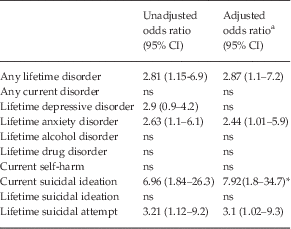
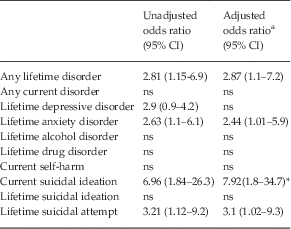
NEET, not in education, employment or training; ns, not significant; CI, confidence interval and Current, past month.
a Adjusted for gender and socioeconomic status.
* Remains significant after additional adjustment for adolescent mental disorder.
Current and lifetime mental health disorders
The associations between NEET status and mental disorders are outlined in Table 1. We found that NEET status was associated with a twofold increased risk of fulfilling criteria for any mental disorder over the course of the young person’s lifetime (OR=2.81, CI=1.15–6.92, p=0.025). This result remained significant when adjusted for gender and social class (OR=2.87, CI=1.114–7.21, p=0.025). We found that NEET status was significantly associated with a twofold increased risk of anxiety disorders (lifetime risk) [odds ratios (OR)=2.63, CI=1.13–6.06, p=0.023]. This result remained significant when adjusted for gender and social class (OR=2.44, CI=1.01–5.9, p=0.046). We also found a twofold increased risk of lifetime depressive disorders associated with NEET status that approached statistical significance (OR=2.9, CI=0.9–4.2, p=0.051).
The association between prior childhood and adolescent mental disorder and NEET status in young adulthood
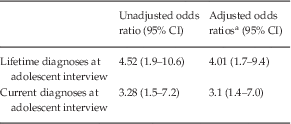
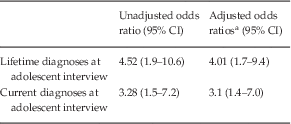
NEET, not in education, employment or training; CI, confidence interval and Current, past month.
a Odds ratios for NEET status adjusted for gender and socioeconomic status.
Suicidal behaviours
The associations between NEET status and suicidal behaviours are shown in Table 1. We found that young people who were NEET had a sevenfold increased risk of current (past month) suicidal ideation than their economically active peers: (OR=6.96, CI=1.84–26.32, p=0.004). This result remained significant after adjustment for social class and gender, (OR=7.92, CI=1.8–34.78, p=0.006). We found that NEET status was associated with threefold increased odds of suicide attempts over the lifetime (OR=3.21, CI=1.12–9.2, p=0.03). This result remained significant after adjusting for social class and gender (OR=3.09, CI=1.02–9.33, p=0.045).
Adolescent mental disorder
Examination of the interview data from the baseline interview showed that 64% of the NEET group had fulfilled diagnostic criteria for a mental disorder during childhood or adolescence. We found that those young people who were classified as NEET in young adulthood were three times more likely to have received a psychiatric diagnoses at the time of the CT1 interview (1-month prevalence) (OR=3.28, CI=1.48–7.24, p=0.003) than their peers and this persisted when adjusted for gender and social class (OR=3.1, CI=1.4–7, p=0.007; see Table 2). Furthermore, NEET young adults were four times more likely than their economically active peers to have fulfilled criteria for a psychiatric diagnosis over the course of their childhood and early adolescence up to the time of the baseline interview (OR=4.52, CI=1.98–10.36, p=>0.001). This association also survived adjustment for gender and social class (OR=4.01, CI=1.71–9.43, p=0.001).
In order to determine which of the significant associations between NEET status and mental disorder were independent of pre-existing psychopathology, we additionally adjusted the associations between NEET status and mental disorder in young adulthood for psychopathology in adolescence. The only association that remained statistically significant was the association between NEET status and current suicidal ideation (OR=7.32, CI=1.57–34.04, p=0.011), indicating that increased risk of suicidal ideation in association with NEET young adults occurred even in those NEET young people who did not have a prior history of mental disorder.
Discussion
In this Irish sample, we found that NEET status in young adulthood was associated with more than threefold increased odds of any lifetime mental disorder and two and a half-fold increased odds of any lifetime anxiety disorder. We also found a strong association with prior childhood and adolescent disorder; young people who had NEET status in young adulthood were three times more likely than their economically active peers to have fulfilled criteria for a mental disorder at the time of their adolescent interview at age 12–15 years (mean age 13 years). They also had a fourfold increase in the odds of fulfilling criteria for a mental disorder at any point in childhood or adolescence up to the baseline interview. We found that the prior association with pre-existing risk for psychopathology was driving the effects we noticed with mental disorders at young adulthood with one important exception: we found that NEET status conveyed a sevenfold increased risk of suicidal ideation that was independent of prior adolescent psychopathology. In other words, the strong and significant association with suicidal ideation among NEET young people occurred irrespective of whether the individual had ever had a mental disorder diagnosis in the past. This supports the hypothesis that economic inactivity in young people is a causal factor for suicidal ideation. Suicide prevention is increasingly being recognized as a major concern for this age group (Malone et al. Reference Malone, Quinlivan, Grant and Kelleher2013). This body of work should encourage further exploration of NEETs in the area of suicide prevention.
Our finding that adolescent psychopathology was a risk factor for later economic inactivity is important in highlighting the need for early comprehensive interventions for young people’s mental health problems not only to relieve mental distress but also to improve young people’s chances of good economic and social outcomes (Fergusson & Woodward, Reference Fergusson and Woodward2002; McGorry et al. Reference McGorry, Bates and Birchwood2013).
Current evidence suggests that the majority of mental disorders in childhood and adolescence go untreated (Bijl et al. Reference Bijl, de graaf, Hiripi, Kessler, Kohn, Offord, Ustun, Vicente, Vollebergh and Walters2003; Merikangas et al. Reference Merikangas, He, Brody, Fisher, Bourdon and Koretz2010). Although most common mental health disorders in adolescence are in remission by the late 20s, the economic effects of early poor youth mental health, in terms of impact on work, education and training, may continue into adulthood (Goodman et al. Reference Goodman, Joyce and Smith2011; Patton et al. Reference Patton, Coffey, Romaniuk, Mackinnon, Carlin, Degenhardt, Olsson and Moran2014). The poorer educational and occupational outcomes of adolescents with mental disorder seen in this study highlight the need for continuing supports for these young people. At present, services in Ireland are not configured to support a model of continuing integrated care through adolescence into young adulthood. The development of youth mental health services bridging the gap between adolescence and adulthood (e.g. Headspace in Australia and Youthspace in England) are examples of interventions that are effective and fit for purpose (McGorry et al. Reference McGorry, Bates and Birchwood2013). More work is needed on the development of vocational interventions to prevent adolescents with common mental disorders heading towards economic inactivity in emerging adulthood (Twamley et al. Reference Twamley, Jeste and Lehman2003; Killackey et al. Reference Killackey, Jackson and McGorry2008). Not only are interventions needed for young people, but for all of society. Mental health stigma has been shown to be a mediating factor in the rates of unemployment of people with mental disorder (Evans-Lacko et al. Reference Evans-Lacko, Knapp, McCrone, Thornicroft and Mojtabai2013).
This paper has both strengths and limitations. Key strengths of this paper include the longitudinal design, the high follow-up rate and the use of in-depth interviews completed by trained mental health professionals (psychiatrists and psychologists) with both participants and their parents. In addition to this, information pertaining to suicidality was coded, blinded and subject to independent appraisal by senior team members. Limitations of this study are the modest sample size with limited power to find effects, and in particular differential effects for different diagnostic categories. Nevertheless, our effects were relatively large. Another limitation is the point prevalence measure of NEET status. We did not have information on length of time the young person had been economically inactive. Previous research has noted a dose–response relationship between length of time in NEET status and poor outcomes (Fergusson et al. Reference Fergusson, Horwood and Lynskey1997, Reference Fergusson, Horwood and Woodward2001, Reference Fergusson, Boden and Horwood2007; Gibb et al. Reference Gibb, Fergusson and Horwood2010).
This paper reinforces the importance of the early intervention model in psychiatry to maximize functional outcomes for adolescents with mental disorder (Scott et al. Reference Scott, Fowler, McGorry, Birchwood, Killackey, Christensen, Glozier, Yung, Power, Nordentoft, Singh, Brietzke, Davidson, Conus, Bellivier, Delorme, Macmillan, Buchanan, Colom, Vieta, Bauer, McGuire, Merikangas and Hickie2013). Future research needs to identify potential mediating factors between adolescent mental health disorder and economic inactivity, as well as resilience factors mediating entry to further education and labour force participation in emerging adulthood in order to deliver the most effective intervention at the most appropriate time. Finally, the concerning link between current NEET status and newly emerging suicidal ideation in Irish young people requires further investigation.
Acknowledgement
The Challenging Times Two follow-up study was funded by the Health Research Board of Ireland (HRA_PHS/2010/4). This research was supported by an Interdisciplinary Capacity Enhancement Award from the Health Research Board Ireland to M Cannon and M Clarke (ICE/2012/11). E Power was supported by a HRB Summer Research Studentship. The authors wish to acknowledge Carla Mills and Irene Daly for their work in the first wave of data collection. The Challenging Times study was funded by The Friends of the Children’s University Hospital, Temple Street, Dublin; The American Foundation for Suicide Prevention; The Northern Area Health Board, Dublin. The authors thank RCSI Clinical Research Centre, Beaumont Hospital for use of their interview facilities. Finally, the authors wish to thank all the young people who took part in this study.
Conflicts of Interest
The authors report no conflicts of interest.