INTRODUCTION
Cognitive rehabilitation developed alongside medicine and in particular neurosurgery. Higher patient survival rates following neurological trauma are often accompanied by cognitive impairments, which require long-term solutions. Memory impairment is one of the most common consequences of neuropathological damage, impacting virtually all aspects of everyday life. Individuals with severe memory impairment or amnesia are unable to spontaneously acquire or retain new information, making it difficult or impossible to meet social, family, and work-related obligations.
Electronic memory aids are ubiquitously used and are accessible to most people in developed countries. Although they were designed for the average consumer with occasional memory slips and scheduling conflicts, they have immense potential for individuals with memory impairment. Most PDAs and smartphones come equipped with some combination of a calendar, camera, camcorder, voice recorder, memos, Web browser, and navigation software, potentially providing memory-impaired individuals with a plethora of means to create and retrieve rich and textured memories as well as stay connected within continually changing social and societal milieus. A number of studies suggest that mobile phones (Stapleton et al., Reference Stapleton, Adams and Atterton2007; Wade & Troy, Reference Wade and Troy2001), digital voice recorders (Hart et al., Reference Hart, Hawkey and Whyte2002; Van den Broek et al., Reference Van den Broek, Downes, Johnson, Dayus and Hilton2000; Yasuda et al., Reference Yasuda, Misu, Beckman, Watanabe, Ozawa and Nakamura2002), and PDAs with customized patient-friendly software (Kim et al., Reference Kim, Burke, Dowds and George1999, Reference Kim, Burke, Dowds, Boone and Park2000) can support mnemonic functioning in individuals with relatively mild memory impairment, particularly when healthcare workers or family members program the device. These individuals have further been able to attain independent use of commercially available PDAs and electronic organizers with structured training sessions (Fleming et al., Reference Fleming, Shum, Strong and Lightbody2005; Gentry et al., Reference Gentry, Wallace, Kvarfordt and Lynch2008). In contrast, individuals with more severe memory impairment have not benefited from these electronic memory aids (Kim et al., Reference Kim, Burke, Dowds, Boone and Park2000; Stapleton et al., Reference Stapleton, Adams and Atterton2007; Wilson et al., Reference Wilson, Baddeley and Cockburn1989); however, they have responded well to a customized paging system where for a monthly fee, text reminders can be sent to a patient’s pager via a paging company. This latter system minimizes memory demands by only requiring individuals to press a large button in response to an audible alarm in order to view an incoming message (Wilson et al., Reference Wilson, Evans, Emslie and Malinek1997, Reference Wilson, Emslie, Quirk and Evans2001). To date, these technologies have predominantly improved patient autonomy by acting as an extension of the primary caregiver in off-site environments, though a few findings suggest that providing patients with structured training on device use may enhance independence in cases of milder memory impairment.
Accumulating evidence suggests that memory is supported by multiple systems such that if one system is damaged (most frequently, episodic memory or memory for events specific to time and place), other systems can provide avenues for acquiring new skills and knowledge (Schacter & Tulving, Reference Schacter, Tulving, Schacter and Tulving1994; Tulving & Schacter, Reference Tulving and Schacter1990). Practical applications of this research include aligning training methods of memory aid use with intact memory systems in individuals with amnesia. For instance, Sohlberg and Mateer (Reference Sohlberg and Mateer1989) developed a successful memory aid training program for individuals with severe memory impairment that engaged intact procedural memory, the acquisition of motor skills or routines without conscious awareness. By participating in repetitive practice of memory aid use across novel situations, ensuring skills were overlearned and mastered, amnesic individuals were able to acquire the skill set necessary to reliably use paper-based aids (see also Donaghy & Williams, Reference Donaghy and Williams1998). Other learning techniques, including vanishing cues and errorless learning, have also enabled amnesic individuals to acquire computing skills (Glisky et al., Reference Glisky, Schacter and Tulving1986), general everyday information (Wilson et al., Reference Wilson, Baddeley, Evans and Shiel1994), and notebook checking behavior (Squires et al., Reference Squires, Hunkin and Parkin1996). The vanishing cues technique builds on the priming effect whereby individuals with amnesia are able to correctly respond to gradually reduced visual cues without conscious awareness of learning (Glisky, Reference Glisky1995). Errorless learning or learning without making mistakes, adapted from research with pigeons (Terrace, Reference Terrace1963) and developmentally challenged children (Cullen, Reference Cullen1976; Sidman & Stoddard, Reference Sidman and Stoddard1967), also enhances learning via implicit or unconscious memory avenues that are ill equipped for error discrimination (Baddeley & Wilson, Reference Baddeley and Wilson1994). Unfortunately, these potent learning techniques have not been exploited to their full potential to train individuals with severe memory impairment in the independent use of commercial technology (e.g., smartphones) to support their memory functioning.
The present case study is the first of a series of systematic program evaluation studies that aims to introduce an established and successful theory-driven training method of electronic memory aid use for individuals with severe memory impairment. Here, we describe its application to enabling an individual with moderate-to-severe memory impairment postcolloid cyst removal to independently support her memory using commercial smartphone technology.
METHOD
Case RR
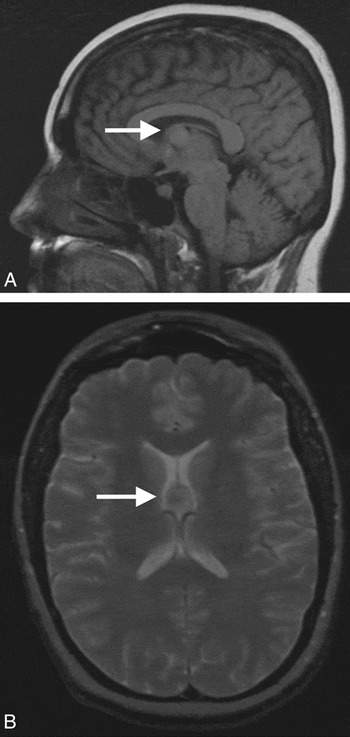
RR provided written informed consent for the study, which was approved by the hospital research ethics board. RR is a 55-year-old right-handed woman with 14 years of education and an occupational history in office management. In early 1998, she began experiencing memory difficulties including leaving the stove on, forgetting entire conversations from the previous day, and getting disoriented or lost while driving. By the summer of that year, she had bitemporal constant pressure headaches two to three times per week. In November 1999, she was diagnosed with a colloid cyst (Figure 1). The cyst was excised in December 2000 using the anterior transcallosal approach. Following surgery, RR developed complications including ventriculitis, a grand mal seizure, and communicating hydrocephalus for which she underwent a right lateral ventriculostomy and subsequent insertion of a left ventriculoperitoneal shunt, followed by a shunt revision. RR underwent prolonged inpatient then outpatient rehabilitation. Upon discharge home, she required 24-hr supervision due to severe memory impairment. She subsequently divorced and began living with her mother. By late 2007, RR was able to live alone with extensive support from family and friends. Medical history includes diagnosis of depression in late adolescence requiring hospitalization and electroconvulsive therapy, fibromyalgia, hypothyroidism, and type A diabetes.
RR’s colloid cyst appears as an isointense rounded lesion (1.5 cm) in the third ventricle at the midline adjacent to the foramen of Munro seen here on a T1-weighted clinical magnetic resonance image. The cyst is depicted in two planes and marked by a white arrow. (A) Sagittal slice. (B) Axial slice.

Cognitive Profile and Functioning
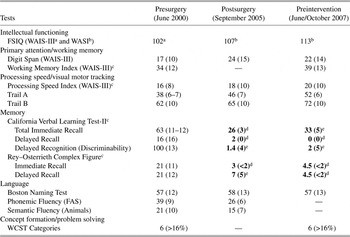
Neuropsychological evaluation was obtained 6 months prior to surgery and at 5 and 7 years postsurgery (Table 1). Prior to surgery, RR’s memory ability was average to very superior. Her cognitive profile also indicated slowed visual motor tracking pre- and postoperatively and reduced phonemic and semantic fluency postoperatively. Memory ability showed the largest drop postsurgery from previously high levels of ability to the impaired range.
Neuropsychological test results from assessments completed presurgery, postsurgery, and prior to memory intervention

Note
Raw scores are shown here with age-corrected scaled scores or percentiles (WCST) included in brackets. Clinically significant reduction in memory test scores is shown in bold font. FSIQ, Full Scale Intelligence Quotient; WAIS-III, Wechsler Adult Intelligence Scale (Third Edition); WASI, Wechsler Abbreviated Scale of Intelligence; WCST, Wisconsin Card Sorting Test; %, percentile.
a WAIS-III.
b WASI.
c Tests administered in October 2007 when RR began our memory intervention program.
d Impaired.
e Borderline impaired.
On beginning our training program, RR reported having ongoing problems with retaining new information and with topographical disorientation. She was attempting to use a range of memory strategies acquired during her postoperative rehabilitation including setting alarms, calendaring, following routines, making lists, placing items in prominent places, mental elaboration, and spaced repetition, but with limited success (Memory Strategies Questionnaire; Troyer & Rich, Reference Troyer and Rich2002). Although RR relied heavily on a paper-based day planner, she reported that her success rate for attending appointments and completing tasks was only 50%. RR also had numerous notebooks in which she recorded ongoing information, but transporting her “external memory” became impractical and unwieldy as the number of books increased. For example, when she first arrived for her consultation appointment at our clinic, she brought a knapsack containing approximately 20 paper books in which she had written notes.
Memory Intervention
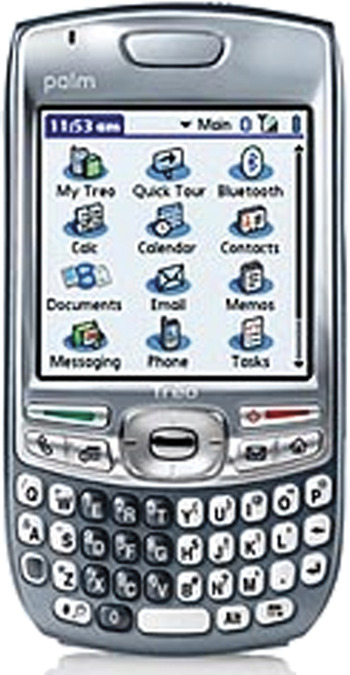
Training on the smartphone (Figure 2) was administered individually and comprised two phases: basic skill acquisition (Phase I) and real-life generalization (Phase II). Phase I skill acquisition was couched in the principles of errorless learning and vanishing cues. The vanishing cues technique was significantly modified here, only loosely resembling its original form. Instead of providing the traditional medium of word fragments to teach content knowledge and then procedural skills to patients (Glisky et al., Reference Glisky, Schacter and Tulving1986), cues or environmental support took the form of physical and verbal prompts provided by the trainer, which were gradually reduced as RR demonstrated increasing skill. Guessing was minimized, and cues were successively faded while ensuring that there was enough cue information to guide the correct response and prevent the commission of errors (Wilson et al., Reference Wilson, Baddeley, Evans and Shiel1994). Software applications were covered individually and sequentially as each application was mastered. Each application was broken down into its component steps comprising one trial. An individual training session was composed of 10 trials. Each component step received its own score (range: 0–4; 0 = no environmental support and 4 = maximum environmental support). The cuing hierarchy was as follows: 4 = full explanation and demonstration provided by the trainer; 3 = trainer provided the same verbal explanation as above but pointed to the next step prior to RR executing it; 2 = trainer gave no verbal guidance, only pointing to the correct response prior to RR executing it; 1 = reserved for instances when RR correctly confirmed a step, “Do I tap ‘details’?”; and 0 = no environmental support provided.
The Treo 680 smartphone [111.8 mm (l) × 58.4 mm (w) × 20.3 mm (d); 157 g] runs on the Treo OS 5.4.9 platform. It has an Intel PXA270 312 MHz processor, a 320 × 320–pixel TFT touch screen, 64 MB of nonvolatile flash memory (with more storage capacity available via external expansion card), GSM/GPRS/EDGE class 10 radio quad band, a 1.3-megapixel VGA camera with 2× digital zoom and video capture, removable rechargeable battery, and built-in infrared technology.

Criterion for moving to the next stage of training was 98% correct responding (0 s) within a single training session (10 trials). Given the various levels of the calendar application, training was further divided into three stages. Stage I comprised entering events on the present day. Stage II introduced future planning and future events, and Stage III focused on attaching notes with additional information about events. Progressively richer and nuanced examples of day-to-day functioning were introduced via role play (Sohlberg & Mateer, Reference Sohlberg and Mateer1989).
Phase II generalization training extended the practical utility of the smartphone. RR was introduced to additional software applications using the same errorless learning/vanishing cues approach, and her use of the smartphone was monitored and tested for real-life tasks. For instance, training on the camera function included taking photos of landmarks on the way to our clinic to assist wayfinding. RR entered text on each photo or attached an audio recording. RR typically came to her sessions with many questions (which she read from an attached note to her appointment entry) and completed homework assignments requiring her to make entries and respond to her smartphone. Homework assignments were introduced over two stages, with the second stage introducing more complexity. Stage I focused on entering and responding to single event entries (e.g., bring address book to session for instruction on entering contacts), whereas Stage II comprised multistep tasks (e.g., install smartphone software on desktop computer, synchronize smartphone with computer, call trainer to confirm success).
Design
A within-subject A1-B1-A2-B2 single-case experimental design was used to evaluate the impact of smartphone use on day-to-day prospective remembering. A phone call schedule was used to quantify prospective memory before and at various points after intervention. Prospective memory was measured at baseline prior to initiating the training program (A1), following training with the use of the smartphone (B1), without the use of the smartphone in a return to baseline condition (A2), and finally, with the use of the smartphone during a 4-month postintervention follow-up (B2). Although RR was instructed not to use her smartphone for the phone call task comprising the return to baseline condition, she was able to continue using it for all other day-to-day activities. Several outcome questionnaires were also administered across baseline and postintervention conditions.
The baseline phone call schedule and questionnaires were completed during the 2 weeks preceding commencement of the intervention program. Intervention sessions lasted 1 hr and were administered twice weekly, with at least one intervening day between training sessions. Phase I skill acquisition for the calendar function occurred over eight 1-hr training sessions. Phase II generalization, including acquisition of further software functions and completion of applied homework tasks, also occurred over eight sessions. In total, the intervention program lasted 8 weeks. The program was self-paced. Postintervention measures were administered immediately following intervention and at 4-month follow-up.
Outcome Measures
Phone calls
RR was given a schedule of 10 phone calls to complete over a 2-week period (5 per week). Each call was allocated a 2-hr window to provide some flexibility regarding possible conflicting activities. All calls were equally represented across morning and late-day slots (between 9 a.m. and 9 p.m.) on the hour and half hour and whether one or two calls were required on a given day. On 3 days, two calls were scheduled, one in the morning and one in the afternoon or evening, to more closely approximate real-life commitments. In line with real-life requirements, RR was instructed to call in advance if she could not complete a phone call during the allotted window. She was instructed that she could use any mnemonic strategies to remember the calls except for relying on someone to remind her, allowing us to measure outcome relative to her true preexisting baseline. A different phone call schedule was used for each condition of the study to reduce practice effects. Days and times were randomized across the four schedules. When RR completed her last call per condition, she was asked what mnemonic strategies she had used and to provide an effort rating in regard to how much effort was needed to remember to complete the phone calls (range: 1–5; 1 = no effort at all and 5 = very effortful).
Questionnaires
The Memory Mistakes Questionnaire (Troyer & Rich, Reference Troyer and Rich2002) involved rating a list of common memory mistakes on a frequency-of-occurrence scale (range: “never” to “all the time”). Components of the Memory Awareness and Strategies Scale (MASS; a questionnaire currently undergoing standardization in individuals with severe memory impairment; content not overlapping with that of other administered measures is reported here), including ratings regarding distress over memory impairment and confidence in handling everyday memory demands. Strategies of Smartphone Use (a questionnaire designed for the present study to measure smartphone use before and after intervention), including confidence and frequency-based ratings in regard to accessing retrospective information, prospective information, and technical ease of use.
RESULTS
Memory Intervention
Phase I skill acquisition
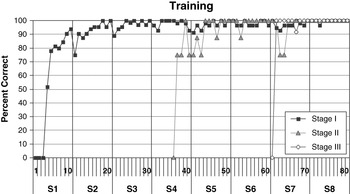
RR successfully acquired all three stages of the calendar function within eight 1-hr training sessions or 80 trails (Figure 3).
Skill acquisition training on the smartphone over Stages I–III. Number of trials are depicted on the first row of the x-axis (1–80) and number of training sessions on the second row of the x-axis (S1–S8). Each point on the figure represents percentage correct for one trial comprising multiple component steps (Stage I = 14 steps, Stage II = 2 steps, and Stage III = 3 steps).

Phase II skill generalization
RR further generalized use of her smartphone calendar to everyday activities. At this phase, RR also successfully and rapidly acquired the skill sets for additional software applications (e.g., mobile phone, address book, camera, camcorder, voice recorder, MP3 player, video games, memos, to-do lists). In line with our clinical observations of other clients who have completed the same intervention program, RR acquired additional software functions more quickly relative to the initial calendar function due to their general similarity.
Outcome
Phone calls
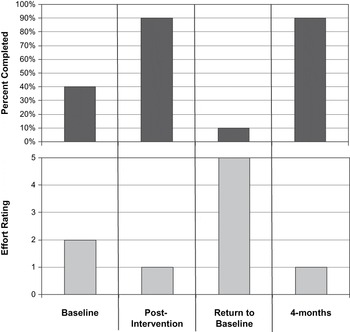
As seen in Figure 4A, RR’s rate of phone call completion was 40% at baseline, consistent with her self-reported reliability rate of about 50%. After memory intervention, phone call completion improved to 90%, and this improvement was maintained 4 months postintervention. When asked not to use her smartphone to complete phone calls in the return to baseline condition, her success rate dropped below initial baseline performance. This likely occurred because RR was able to continue using her smartphone for all other day-to-day memory needs and she reported not writing the phone calls into her paper organizer, which she had stopped using. As seen in Figure 4B, phone calls were rated as least effortful when using the smartphone than when relying on other methods, in part due to disruption of baseline strategies (e.g., paper organizer) in the return to baseline condition.
(A) Percentage of calls completed at baseline, immediately following memory intervention (postintervention), at return to baseline, and at 4-month follow-up. (B) Effort rating (0 = no effort at all and 5 = very effortful) provided by RR after each phone call condition at baseline, immediately following memory intervention (postintervention), at return to baseline, and at 4-month follow-up.

RR routinely wrote “completed” at the end of event entries in her smartphone calendar that she had attended to (e.g., “call mom—completed”), whereas forgotten events were left unflagged, providing opportune information for comparing her performance on the prospective phone call task with real-life memory functioning. The 2-week period immediately following memory intervention (phase B1) was selected for analysis. First, we examined whether RR’s completed notation was an accurate log of her actual memory functioning by comparing her phone call entries in her smartphone with our own records. When the calendar of her smartphone was reviewed relative to her call success rate, we found that she had written completed at the end of all phone call entries (e.g., “call Dr. Svoboda—completed”) except for the one call she missed that was left unflagged (e.g., “call Dr. Svoboda”), demonstrating 100% accuracy in her ability to document whether or not she completed a task entered in her smartphone calendar. Second, we summed all other event entries in her smartphone calendar and calculated a completed-to-total events ratio. Over this 2-week period, RR had made 144 event entries. Of these, she had a completion ratio of .96, very close to her ratio of .90 for the phone call task, suggesting good agreement between the real-life memory functioning and the prospective phone call measure. Due to a higher number of observations, the real-life measure is likely a more accurate depiction of her everyday memory functioning than the phone call measure (144 vs. 10 observations). The most commonly “forgotten” real-life event was checking e-mail, something RR reported not enjoying but for which she wanted a reminder.
Questionnaires
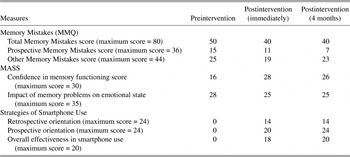
As seen in Table 2, RR reported making fewer memory mistakes postintervention and at follow-up. When prospective memory mistakes were examined separately from nonprospective memory mistakes, they showed a steady decline over immediate and follow-up assessments, whereas other memory mistakes (e.g., retelling a joke or story), not expected to change with intervention, remained relatively stable over time. On the MASS, RR reported greater confidence in dealing with all types of everyday memory demands postintervention, whereas the impact of memory problems on her emotional state was minimally reduced. In regard to Strategies of Smartphone Use, RR relied more on her smartphone for prospective than for retrospective information, although use for the latter was still substantial. For instance, for a weekly outing with her friend, she attached a note documenting that they went clothes shopping, what they bought, what item was not in stock, and what size was ordered by the clerk. Overall, RR reported being maximally effective both in the technical aspects of smartphone use and in reliably responding to its alarm. Together, questionnaire responses were consistent with quantitative phone call performance.
Responses on outcome questionnaires: Before and after memory intervention

Note
MMQ, Multifactorial Memory Questionnaire.
Qualitative observations
At 4-month follow-up, RR was making full use of the smartphone to support her individual memory needs. She attached notes to appointments or social events to remind herself of items to bring, questions to ask, messages to convey, or instructions to follow. For instance, as part of her granddaughter’s birthday party, she attached a note to the event outlining that she would be expected to babysit, including details regarding the kids’ routines and their sleeping arrangements. These notes kept her on track prospectively. She also attached notes to describe what happened at an appointment or event. This strategy created an autobiographical or retrospective memory log for each event. For instance, in response to an appointment to have cable TV installed at her home, she documented the package she signed up for when the technician arrived. RR also made good use of a number of other functions on her smartphone. She took numerous photos and videos of her grandchildren to share with friends and family. She used the memos function to create and access a large store of information akin to an artificial long-term memory, including her current medications and information for each, a list of Christmas gifts for her family and where each was hidden, an exercise log of distances she walked each day as well as directions to places she had trouble finding, and Web sites she enjoyed. In sum, RR reported using her smartphone extensively, and we witnessed her use of it in novel untrained ways.
DISCUSSION
The present case study is the first of several ongoing evaluative studies aimed to demonstrate the effectiveness of an established theory-driven memory intervention program for individuals with moderate-to-severe memory impairment (Richards et al., Reference Richards, Leach and Proulx1990; Wu et al., Reference Wu, Richards, Baeker and Lazar2007). Though our initial memory aids were paper based with an electronic multialarm device incorporated to support prospective memory functioning, technology has evolved to the extent that current PDAs and smartphones supersede what could be accomplished by paper-based systems in terms of storage capacity, flexibility, and user acceptance. Here, we show the effectiveness of this approach in enabling an individual with relatively severe memory impairment to autonomously support her memory functioning using a commercial smartphone.
The goal of intervention was for RR to ubiquitously and independently apply her smartphone to support a broad range of daily prospective memory challenges. In order to ensure that we had an objective measure of memory functioning at baseline and postintervention, we assigned her a schedule of phone calls. Phone calls are a sensitive estimate of real-life prospective memory ability, mimicking day-to-day time-limited commitments such as appointments, meetings, and social gatherings (Maylor, Reference Maylor1990; Moscovitch, Reference Moscovitch, Craik and Treehub1982). RR’s training was not specifically geared toward making these phone calls; it was aimed toward the generalization of specific skill sets to real-life circumstances. In line with this training goal, RR’s performance on the phone call task was closely associated with her actual day-to-day memory functioning as demonstrated by comparison of her phone call performance with that of self-documented daily task completion in her smartphone. Moreover, RR’s questionnaire-based responses as well as our own qualitative observations of her smartphone use in many and novel ways support the conclusion that full and successful generalization of technical skills to everyday memory problems was accomplished in this case study.
RR possessed several characteristics that likely contributed to her successful outcome in combination with structured training. She had focal memory impairment within the context of relatively preserved intellectual and cognitive functioning, enabling her to flexibly and creatively solve memory challenges. Although premorbidly she relied on only a few memory strategies (often writing in a calendar or making lists and occasionally writing a reminder note or mentally retracing her steps to remember something), during inpatient rehabilitation, she acquired several more compensatory memory strategies and in less than 7 years was able to live on her own, albeit with extensive support from family and friends. She had good self-awareness in regard to her memory functioning and was highly motivated to use the smartphone. RR’s history, personal characteristics, the nature of her injury, and her cognitive profile are in many respects consistent with existing observations in the literature regarding factors that increase the likelihood of using compensatory memory strategies following brain injury (Evans et al., Reference Evans, Wilson, Needham and Brentnall2003; Oddy & Cogan, Reference Oddy and Cogan2004). RR’s age (>30 years) is the only factor that has not been predictive of good outcome.
Successful application of technology in supporting individuals with severe memory impairment has also been reported by Wilson et al. (Reference Wilson, Evans, Emslie and Malinek1997, Reference Wilson, Emslie, Quirk and Evans2001) using Neuropage, a paging system that places minimal demands on learning. The case of RR suggests that independent and flexible use of commercial technology is another viable option for some individuals with severe memory impairment when accompanied by numerous weeks of theory-driven structured training. In fact, 2 years prior to joining our program, RR had already purchased a PDA with the same operating system as her current smartphone; however, following a short period of ineffective use, she gave up on the technology. Our findings build on Sohlberg and Mateer’s (Reference Sohlberg and Mateer1989) work using paper-based methods and studies in individuals with milder memory impairment who require significant training to independently use commercial technology (Fleming et al., Reference Fleming, Shum, Strong and Lightbody2005; Gentry et al., Reference Gentry, Wallace, Kvarfordt and Lynch2008). Moreover, most individuals with memory impairment do not spontaneously use electronic memory aids (Evans et al., Reference Evans, Wilson, Needham and Brentnall2003). Taken together, these findings suggest that health professionals need to close the gap between patients with memory needs and widely available assistive technology. Due to RR’s unsuccessful history with PDA use, she is a particularly good example of how providing structured theory-based training can enable an individual with significant memory impairment to independently operate and greatly benefit from commercial technology.
A significant number of behavioral studies have shown that patients with impaired episodic memory due to damage to related brain structures have relatively preserved implicit or unconscious forms of memory (Brooks & Baddeley, Reference Brooks and Baddeley1976; Milner et al., Reference Milner, Corkin and Teuber1968; Schacter & Tulving, Reference Schacter, Tulving, Schacter and Tulving1994). The case study of RR contributes to a small yet important literature further showing that tapping into preserved implicit memory systems enables individuals with severe memory impairment to acquire practical skill sets to manage real-life problems including effective management and use of paper-based organizers (Donaghy & Williams, Reference Donaghy and Williams1998; Sohlberg & Mateer, Reference Sohlberg and Mateer1989), accessing a customized digital device for rehabilitation-related information (Goldstein et al., Reference Goldstein, Beers, Shemansky and Longmore1998), and acquisition of computer data entry procedures (Glisky et al., Reference Glisky, Schacter and Tulving1986) and their application to a vocational setting (Glisky & Schacter, Reference Glisky and Schacter1987).
Although the exact learning mechanisms are still under investigation, functional imaging studies of priming, an exemplar of implicit memory such that a response is unconsciously altered by a prior experience, has been associated with a reduction in neural or hemodynamic response in task-related brain regions (for reviews, see Henson, Reference Henson2003; Schacter et al., Reference Schacter, Dobbins and Schnyer2004). Moreover, the acquisition and retrieval of motor sequences or skills activate a combination of the motor cortex, striatum, and/or the cerebellum irrespective of whether learning is implicit or explicit, suggesting that a separate network of regions, typically undamaged in the amnestic syndrome, underlies procedural learning. This system appears to undergo plastic changes irrespective of conscious awareness (for reviews, see Doyon et al., Reference Doyon, Penhune and Ungerleider2003). In RR’s case, implicit procedural learning and aspects of a significantly malfunctioning declarative memory system may have supported her acquisition of smartphone skills.
In conclusion, the training approach described here is not aligned with one particular technology but rather can be applied to linking individuals who have severe memory impairment with any of a number of emerging technologies to expand functional autonomy. Our training approach is well operationalized and easily grasped by professionals with some understanding of memory functioning, including occupational therapists, behavior therapists, and social workers. This approach has been successful with the majority of clients referred to our clinic who continued to struggle with memory functioning following discharge from standard inpatient rehabilitation programs. Replication of our case study in a larger group of patients is presently underway to demonstrate the effectiveness of this theoretically driven method across individuals with various etiologies underlying severe memory impairment.
ACKNOWLEDGMENTS
We would like to thank Prathiba Shammi for providing neuropsychological test scores, Ashwini Persaud for assistance with training, and Anisa Nixon for technical assistance. We would also like to thank the anonymous reviewers for helpful comments and Larry Leach, Kelly Murphy, and Guy Proulx for helpful discussion. The information in this manuscript and the manuscript itself have never been published either electronically or in print. This case study is part of a larger effort to empirically evaluate our clinical program for the purpose of knowledge dissemination and seeking permanent government funding for our services.