Patients on hemodialysis are at increased risk for infection and thus at increased need for antimicrobial administration.Reference Nguyen, Shugart and Christi 1 Previous studies have measured the appropriateness of antimicrobial use in this setting. In 2014, 93% of all dialysis events reported to the National Healthcare Safety Network (NHSN) Dialysis Event Surveillance reporting system included an intravenous antimicrobial start (IVAS).Reference Nguyen, Shugart and Christi 1 Snyder et alReference Snyder, Patel, Kallen, Strom, Tucker and D’Agata 2 examined all parenteral antimicrobial use in 2 outpatient hemodialysis units and classified 29.8% as inappropriate; approximately half of these did not meet criteria for infection. A recent study describing appropriateness of intravenous antibiotics in hemodialysis facilities (HDFs) showed that 20.5% were inappropriate, specifically due to incorrect dosing.Reference Hui, Nalder and Buising 3
Implementation of an antimicrobial stewardship program in outpatient HDFs has been associated with reduced antimicrobial use with no negative effects.Reference D’Agata, Lindberg and Lindberg 4 Therefore, novel performance metrics are needed to assess and improve antimicrobial prescribing in this setting.
We measured the prevalence of IVASs in Philadelphia HDFs and estimated the proportion of these IVASs that were inappropriate using a novel metric constructed with only NHSN data.
Methods
Study setting and design
We conducted a period prevalence survey of IVASs reported to the NHSN by HDFs in Philadelphia County during 2018.Virtually all outpatient dialysis facilities are required by the Centers for Medicare and Medicaid Services to report dialysis events to the NHSN. The Philadelphia Department of Public Health can access these data for public health efforts.
Definitions
Dialysis events reported to the NHSN include IVAS, positive blood culture, and/or suspect infection (ie, pus, redness, or increased swelling at vascular access site). 5 An IVAS is defined as any outpatient initiation of an intravenous antibiotic or antifungal drug in a patient who has not received other antimicrobials in the past 21 days. 5 This includes outpatient starts that were either newly initiated in the HDF or continued from an inpatient antimicrobial course. A patient month is defined as 1 patient receiving hemodialysis at a facility during the first 2 working days of the month, at which time individual facilities report monthly denominator data. 5 We defined an inappropriate IVAS as an IVAS that was reported without co-occurrence of a positive blood culture, a blood sample being collected for culture, or a suspected infection. To specifically target IVASs that were initiated in the HDF, we excluded IVASs that were a continuation of antibiotics initially prescribed in an inpatient setting.
Data analysis
Descriptive analyses were performed. Aggregate rates (across all facilities) were calculated by totaling events and dividing by the sum of all patient months, expressed per 100 patient months. Rates were stratified by access type (eg, fistula, graft, central line). Differences between proportions of events, by access type, were assessed. Analyses were performed in SAS version 9.4 software (SAS Institute, Cary, NC) and Excel (Microsoft, Redmond, WA). P values < .05 were considered statistically significant.
Results
During the study period, 54 of 55 HDFs (98.2%) in Philadelphia County were required to report to the NHSN and were included in this analysis. Based on the 2018 NHSN Outpatient Dialysis Center Practices Survey, most HDFs (n = 52, 96.3%) were for-profit entities, part of a group or chain of dialysis centers, and freestanding. The median number of dialysis stations per HDF was 20.5 (interquartile range [IQR], 16–24) and the median number of patients treated was 71.5 (IQR, 49–88).
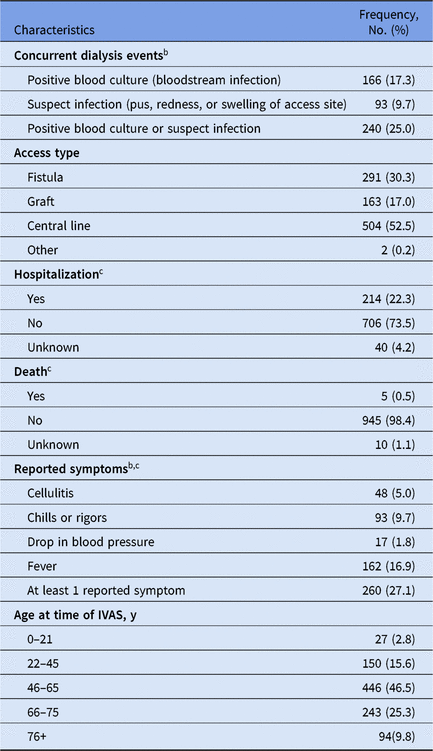
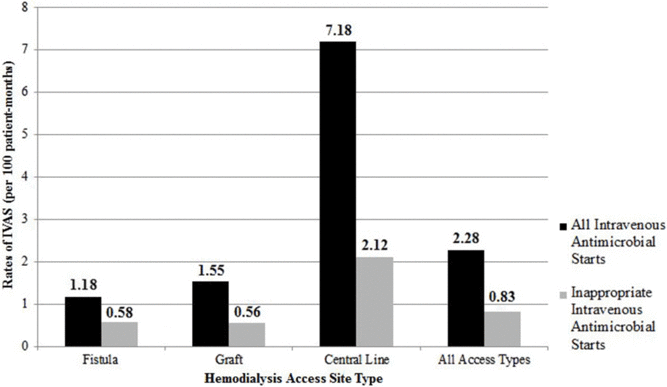
In 2018, 960 IVASs and 42,175 patient months were documented: fistula, 24,612; graft, 10,517; central line, 7,015; other, 31. Characteristics of patients with an IVAS are listed in Table 1. The aggregate IVAS rate was 2.28 per 100 patient months. Most IVAS regimens (n = 658, 65.6%) included vancomycin. Aggregate IVAS rates, among patients with a fistula or graft, were lower than in patients with a central line (P < .001) (Fig. 1). Additionally, the aggregate rate among patients with a fistula was significantly lower than those with a graft (p = .006). Most of the IVASs (n = 610, 63.5%) were reported as new outpatient initiations, not continuations from inpatient antimicrobial treatments.
Characteristics of Hemodialysis Patients a With a Documented Intravenous Antimicrobial Start (IVAS), 2018 (n = 960)

a A patient may have had >1 IVAS over the study period.
b Not mutually exclusive.
c Definitely or possibly related to the reported dialysis event.Reference Fleming-Dutra, Hersh and Shapiro 6
Aggregate rates of intravenous antimicrobial starts (IVAS) by hemodialysis access type and appropriateness, 2018.

More than half of these new outpatient IVASs (n = 351, 57.5%) were classified as inappropriate. Aggregate rates of inappropriate IVASs, among patients with a fistula or graft, were lower than in patients with a central line (P < .0001). No significant difference was found between aggregate rates of inappropriate IVASs in patients with a fistula compared to those with a graft (P = .86) (Fig. 1). Symptoms were inconsistently reported among patients with a new outpatient IVAS and for whom a blood culture was obtained (Table 1). Most patients with a pathogen isolated (61 of 90, 67.8%), compared to less than half of patients with coagulase negative Staphylococcus isolated (21 of 47, 44.7%), had symptoms reported.
Discussion
Applying a novel metric we constructed using only NHSN data, we identified a large proportion of IVASs in HDFs that were likely inappropriate. These findings suggest a need for antimicrobial stewardship among HDFs.
Based on the findings of this analysis, we estimated that over half of the intravenous antimicrobials initiated in Philadelphia HDFs may have been inappropriate, based on the lack of a suspected or documented clinical infection. This finding suggests a significant opportunity for antimicrobial stewardship. Our estimate of inappropriate IVASs is similar to studies reporting the national rate of inappropriate prescribing in other outpatient settings.Reference Fleming-Dutra, Hersh and Shapiro 6 , Reference Shapiro, Hicks, Pavia and Hersh 7 Given the unique infection risks present in HDFs, identifying setting-specific determinants of inappropriate prescribing practices may enable targeted antimicrobial stewardship activities that could be applied at the level of the individual facility, throughout a dialysis network, and/or regionally.
Using only data available from the NHSN, this metric provides public health agencies, hemodialysis quality improvement organizations, and HDFs with a standardized and practical method to identify and track the prevalence of inappropriate IVASs and devise antimicrobial stewardship interventions.
In this analysis, patients receiving hemodialysis through a central line had significantly higher rates of both IVASs and inappropriate IVASs than those receiving hemodialysis through a fistula or a graft. Similar differences between access types in national IVAS rates have been noted.Reference Nguyen, Shugart and Christi 1 The impact of reducing central-line use on IVAS and inappropriate IVAS rates should be further explored and quantified.
Several limitations of our study should be considered. This analysis and the resulting metric relied solely on surveillance data, which may suffer from inconsistent reporting and underreporting. No validation or review of patients without a documented indication for an IVAS has been conducted to date. Additionally, when an IVAS was reported without a positive blood culture or suspect infection, it was not possible to determine whether a separately reported dialysis event for that patient was somehow linked to the IVAS. Thus, we were not able to assess whether previously reported positive blood cultures or suspect infections may have triggered the IVAS; instead, we relied on the facility reporting all related events together. Lastly, our metric only classifies the appropriateness of IVASs based on a lack of clinical infection or blood culture. Due to presumed underreporting in our data, clinical symptoms were not factored into the determination of appropriateness of IVASs. A large portion of inappropriate antimicrobial doses identified in 2 hemodialysis units in a prior study were attributed to a failure in choosing a more narrow-spectrum antimicrobial and not meeting the criteria for surgical prophylaxis.Reference Snyder, Patel, Kallen, Strom, Tucker and D’Agata 2 Therefore, our metric is likely an underrepresentation of the true prevalence of inappropriate prescribing occurring in HDFs in this regard.
Nonetheless, this striking estimate of inappropriate intravenous antimicrobial prescribing that is occurring in hemodialysis facilities warrants further investigation into the determinants of inappropriate prescribing practices in this setting and prompts validation of this metric.
Acknowledgments
Financial support
This study was supported in part by an appointment to the Applied Epidemiology Fellowship Program administered by the Council of State and Territorial Epidemiologists and funded by the Centers for Disease Control and Prevention (CDC) (Cooperative Agreement no. 1U38OT000143-05) and was also supported in part by the Epidemiology and Laboratory Capacity grant provided by the CDC (Notice of Funding Opportunity no. CK14-140105PPHF18).
Conflicts of interest
All authors report no conflicts of interest relevant to this article.