Fluid overload is a common post-operative problem in children recovering from surgery for congenital heart disease.Reference Maehara, Novak, Wyse and Elliot 1 Pre-operative congestive heart failure and aggressive intra-operative fluid resuscitation can create a state of excessive positive fluid balance. Post-operative cardiac dysfunction, acute kidney injury,Reference Bennett, Dent and Ma 2 and capillary leakage resulting from the systemic inflammatory response to cardiopulmonary bypass can further exacerbate this problem.Reference Khabar, El Barbary, Khouqeer, Devol, Al-Gain and Al-Halees 3 – Reference Seghaye 5 This fluid overload, much of which occurs in the extravascular space, can impair gas exchange, increase duration of mechanical ventilation, and result in other post-operative morbidities.Reference Mahmoud, Burhani, Hannef, Jamjoom, Al-Githmi and Baslaim 6 Therefore, rapid attainment of negative fluid balance is a common post-operative goal.
Traditionally, negative fluid balance has been achieved using intra-operative ultrafiltration,Reference Mahmoud, Burhani, Hannef, Jamjoom, Al-Githmi and Baslaim 6 post-operative diuretic therapy, and in some centres peritoneal dialysis.Reference Stromberg, Fraser, Sorof, Drescher and Feltes 7 – Reference Chin, Hwang and Weng 11 These modalities, however, can be limited by the delicate balance between mitigating post-operative fluid overload and maintaining adequate intravascular volume for appropriate haemodynamic stability and end-organ perfusion. Some institutions place passive peritoneal drainage catheters as a less aggressive means of promoting negative fluid balance in these patients.Reference Stromberg, Fraser, Sorof, Drescher and Feltes 7 , Reference Malm, Pawade, Karl and Mee 14 – Reference Shikata, Yagihara and Kagisaki 21 Recently, passive peritoneal drainage has been shown to be a safe and effective means of eliminating unwanted extravascular fluid and promoting negative fluid balance without adversely affecting haemodynamic stability following repair of complete atrioventricular septal defect.Reference Saini, Delius, Seshadri, Walters and Mastropietro 13
Passive peritoneal drainage has also been implemented in many centres in children recovering from Fontan palliation for single-ventricle anatomy,Reference Stromberg, Fraser, Sorof, Drescher and Feltes 7 , Reference Malm, Pawade, Karl and Mee 14 – Reference Lacour-Gayet, Clarke and Jacobs 23 although it has not been formally studied in this population. These patients are unique physiologically in that they rely on passive blood return from the systemic venous system for pulmonary blood flow and adequate haemodynamic stability, which is dependent on a pressure gradient between the systemic venous system and the Fontan circuit.Reference Mastropietro, Clark, Grimaldi, Killinger and Ricmond 22 These patients are therefore very sensitive to hypovolaemia and a cautious approach to negative fluid balance is often required. For this reason, we hypothesised that passive peritoneal drainage would be a practical means to this end. We therefore aimed to show that passive peritoneal drainage is a safe and helpful adjunct to the attainment of negative fluid balance in patients recovering from Fontan palliation for single-ventricle anatomy.
Materials and methods
We performed a retrospective review of children who underwent Fontan palliation for single-ventricle physiology at Children's Hospital of Michigan between 1 January, 2007 and 31 December, 2011. This review was approved by the Institutional Review Boards at Wayne State University and the Detroit Medical Center. At our centre, patients undergoing Fontan palliation have peritoneal drainage catheters placed frequently by one surgeon and infrequently by the other. Our surgeon who favours peritoneal drainage catheters in these patients does so because he hopes that it promote more favourable fluid balance in the immediate post-operative period. This difference in practice allowed us to retrospectively study the impact of passive peritoneal drainage on post-operative fluid balance. We chose post-operative fluid balance as our primary outcome variable because we believe the confounding effect of the difference in surgeon on this outcome should be small. Post-operative fluid balance is determined much more so by the post-operative care provided to the patient than the intra-operative surgical technique. The post-operative care for these patients was dictated by a multidisciplinary team consisting of a cardiovascular surgeon; paediatric intensive care attending physician and fellow; physician assistants, nurse practitioners, and paediatric residents; a hospital pharmacist; and the bedside nurses. On most days, only one of the two cardiovascular surgeons would attend morning rounds as part of the multidisciplinary team and contribute to the plan of care, regardless of which surgeon performed the initial surgical procedure. Following rounds, management decisions continued to be made by the intensive care physicians while the cardiac surgeons are in the operating suites. Therefore, the decisions that would have the greatest effect on post-operative fluid balance such as those regarding fluid resuscitation, fluid replacement, vasoactive medication dosing, diuretic use, and weaning of mechanical ventilation were made by similar multidisciplinary teams as opposed to each patient's primary cardiac surgeon alone.
Operative protocol
Our operative protocol has been described previously.Reference Saini, Delius, Seshadri, Walters and Mastropietro 13 Briefly, all patients received methylprednisolone 30 mg/kg before surgical incision. Cardiopulmonary bypass was instituted with target flow rate of 2.5–3.0 L/minute/m2. After cross-clamp removal, zero-balanced ultrafiltration was started. After terminating cardiopulmonary bypass, 20 minutes of modified ultrafiltration was initiated.
Peritoneal drainage catheter insertion, when implemented, occurred before chest closure. A stab incision was made in the right subxiphoid area through which the peritoneal catheter (Kendall Quinton, 37 cm; Tyco Healthcare Group, Mansfield, Massachusetts, United States of America) was passed, leaving the cuff outside the skin to facilitate removal. A purse-string suture was then put in the peritoneum just inferior to the insertion of the diaphragm fibres. An opening was made in the peritoneum within that purse-string suture and the catheter was introduced into the left upper quadrant of the peritoneal cavity. The catheter therefore entered the peritoneal cavity above the level of the umbilicus, generally resting in the left upper part of the peritoneal cavity where it drained freely by gravity without interference by the omentum.
All patients also underwent intra-operative placement of mediastinal tubes and bilateral pleural tubes. Post-operatively, peritoneal drainage catheters continued to drain to gravity only; no suction was applied. Laboratory analysis of peritoneal drainage was not performed in any patient. Peritoneal catheters were left in place until drainage was <1 ml/kg per 8-hour shift. All patients met this criterion and had their peritoneal drainage catheters removed before transfer from the intensive care unit.
We recorded the following pre-operative and intra-operative data: age, weight, gender, lesion, comprehensive Aristotle complexity score,Reference Lacour-Gayet, Clarke and Jacobs 23 dominant ventricle, pre-operative cardiac catheterisation measurements, surgical approach, that is, extracardiac or lateral tunnel, presence of fenestration in the Fontan circuit, and duration of cardiopulmonary bypass.
Post-operative management
During the first 24 post-operative hours, all patients received 750–1000 ml/m2/day of 5% dextrose solution with 0.2% sodium chloride to maintain fluid and electrolyte requirements; packed red blood cells to maintain haematocrit >30%; fresh frozen plasma and platelets as needed to reverse post-surgical coagulopathy; and 5% albumin administration for additional fluid resuscitation to maintain haemodynamic stability as deemed necessary by the intensive care unit team. In addition, 5% albumin or fresh frozen plasma, depending on coagulation studies, was used to replace chest tube and passive peritoneal drainage, if present, each hour at a ratio of 1:1 ml during the first post-operative night. The rationale behind this practice is to prevent excessive negative fluid balance in the immediate post-operative period, which is usually the period of greatest haemodynamic lability. Furosemide therapy was initiated in all patients on the morning of post-operative day 1, and some patients received additional intermittent boluses of intravenous furosemide (1 mg/kg) and chlorothiazide (2 mg/kg) during the study period, with a goal of establishing even to negative fluid balance as efficiently as haemodynamically tolerated.
All patients arrived to the paediatric intensive care unit intubated and receiving positive pressure ventilation, which is standard practice at our institution for patients undergoing cardiopulmonary bypass. All patients were managed using synchronised intermittent mandatory ventilation. Patients were extubated from ventilator support, regardless of the time of day, when they were breathing comfortably with good gas exchange on the following settings: respiratory rate ≤5 breaths/minute, pressure support ≤10 cmH2O, positive end-expiratory pressure ≤5 cmH2O, and fraction of inspired oxygen concentration ≤0.4.
Post-operative data recorded included: total fluid input, urine output, chest tube output, and peritoneal drainage output in the first 48 hours; central venous pressure at 0, 24, and 48 hours post-operatively; peak lactate in the first 48 hours; estimated creatinine clearance at days 1 and 2 (Schwartz formula)Reference Schwartz, Haycock, Edelmann and Spitzer 24 ; serum electrolytes on the day of admission and on the morning of days 1 and 2; vasoactive medication and diuretic use; and duration of passive peritoneal drainage. The following outcome measures were also recorded: duration of vasopressor use, duration of mechanical ventilation, post-operative arrhythmia, intensive care unit length of stay, and death.
Vasoactive-inotropic score was calculated according to the following formula: vasoactive inotrope score = dopamine (μg/kg/minute) + dobutamine (μg/kg/minute) + [100 × epinephrine (μg/kg/minute)]+ [10 × milrinone (μg/kg/minute)] + [10,000 ×vasopressin (units/kg/minute)] + [100 × norepinephrine (μg/kg/minute)].Reference Gaies, Gurney and Yen 25 Ventilation index was calculated according to the following formula: ventilation index = [RR × (PIP-PEEP) × PaCO2]/1000, where RR is the respiratory rate, PIP is the peak inspiratory pressure, and PEEP is the positive end-expiratory pressure.Reference Mahmoud, Burhani, Hannef, Jamjoom, Al-Githmi and Baslaim 6
Statistical analyses
Anthropometric data, peri-operative data, and data from the first 48 post-operative hours in patients with passive peritoneal drainage were compared with those without using t-tests, Mann–Whitney U-tests, or χ 2-tests as appropriate for individual variables. Variables with repeated measures, for example central venous pressure, vasoactive inotrope score, and ventilation index, were compared using mixed within-between subjects analysis of variance.
Results
Of the 44 patients who underwent Fontan palliation during the study period, 43 had medical records available for review, 21 with peritoneal drainage catheters placed intra-operatively and 22 without peritoneal drainage catheters placed. Of the 21 patients with peritoneal drainage, 20 were placed in patients palliated by one of our two surgeons and 19 out of 22 patients without peritoneal drainage were palliated by the other surgeon. Post-operative management for all patients, as described above, was directed by similar multidisciplinary teams of physicians, nurses, and pharmacists.
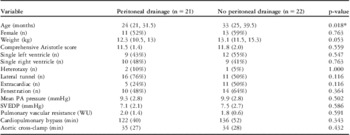
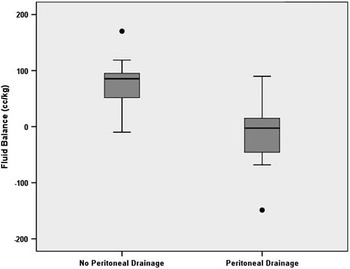
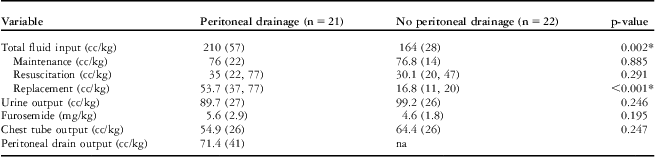
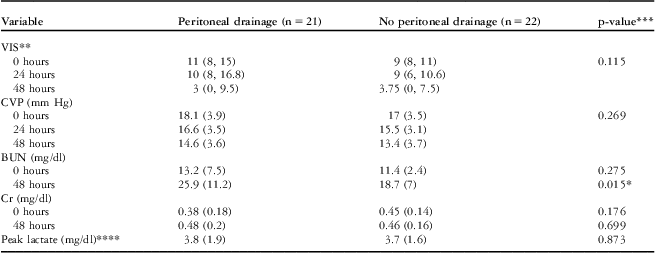
No mechanical complications occurred as a result of peritoneal drainage catheter placement. Peritoneal drainage catheters were in place for a median duration of 4 days (range: 2–14 days). Anthropometric and peri-operative data are provided in Table 1. The median age in patients with peritoneal drainage catheters was ∼9 months younger than patients without peritoneal drainage (p = 0.018), and accordingly there was a trend towards lower weight in the former patients (p = 0.053). All other characteristics recorded were not statistically different between groups. Patients with peritoneal drainage received significantly more fluid in the first 48 post-operative hours compared with those without peritoneal drainage, yet the median fluid balance was negative in those patients with peritoneal drainage but positive in those without, p < 0.001 (Fig 1). Urine output and chest tube output were not statistically different between groups; peritoneal drainage output therefore predominantly accounted for the observed difference in fluid balance (Table 2). Further, the greater degree of fluid provided to those with peritoneal drainage was not due to greater resuscitation needs but rather due to replacement of fluid losses from mediastinal, pleural, and peritoneal drainage tubes (Table 2). Haemodynamics as represented by vasoactive-inotrope score and central venous pressure were not statistically different, whereas mean blood urea nitrogen on post-operative day 2 was significantly higher in those with peritoneal drainage (Table 3).
Anthropometric and peri-operative data.

PA = pulmonary artery; SVEDP = single-ventricle end-diastolic pressure; WU = Woods units
Data represented as mean (standard deviation) for normally distributed continuous variables, median (intraquartile range) for skewed continuous variables, or n (%) for categorical variables
*Statistical significance: p-value < 0.05
Fluid balance during the first 48 post-operative hours. The median fluid balance in those with peritoneal drainage was negative, −9 ml/kg (interquartile range : −50, +22), but positive in those without peritoneal drainage, +77 ml/kg (interquartile range : +52, +96), p < 0.001.

Fluid input and output during the first 48 post-operative hours.

Data represented as mean (standard deviation) for normally distributed variables or median (intraquartile range) for skewed variables
*Statistical significance: p-value < 0.05
Post-operative haemodynamic/end-organ data.

*Statistical significance set at p-value < 0.05
**VIS = vasoactive inotropic score, represented as median (intraquartile range) owing to skewness; all other data represented as mean (standard deviation); CVP = central venous pressure; BUN = blood urea nitrogen; Cr = creatinine
***For repeated measures, represents between-subjects p-value
****Peak lactate during the first 48 post-operative hours
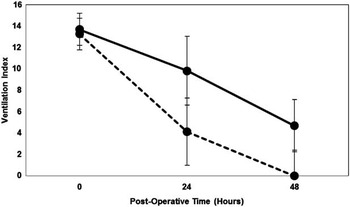
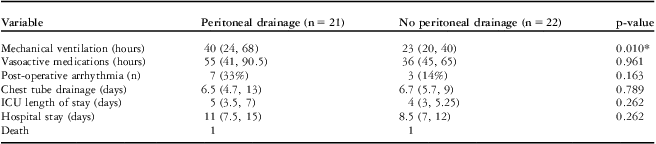
Ventilator support as reflected by the ventilation index upon arrival to the intensive care unit was not statistically different between groups – peritoneal drainage 13.7 ± 4.3, no peritoneal drainage 13.3 ± 2.2, p = 0.67 – but was weaned more slowly in patients with peritoneal drainage (Fig 2). Post-operative outcomes are provided on Table 4. More patients with peritoneal drainage remained intubated at 48 hours (n = 8, 38%) as compared with those without peritoneal drainage (n = 1, 4.5%), p = 0.009, and the median duration of mechanical ventilation was significantly longer in patients with peritoneal drainage. Other post-operative outcomes such as the incidence of post-operative arrhythmias, duration of vasoactive medication use, intensive care unit stay, hospital stay, duration of chest tube drainage, and mortality were not statistically different between groups.
Mean ventilation index over time. Ventilation index decreased more slowly in patients with peritoneal drainage, solid line, as compared with those without, dashed line, between-subjects p = 0.011. Error bars represent 95% confidence intervals.

Post-operative outcomes.

Data represented as median (intraquartile range) or n (%)
*Statistical significance p-value <0.05
Discussion
This is the first study to compare the effects of passive peritoneal drainage on fluid balance and other outcomes in patients recovering from Fontan palliation. As hypothesised, patients with passive peritoneal drainage were more likely to achieve negative fluid balance as compared with controls. We will again acknowledge that the difference in surgeon between groups likely has a confounding effect on the results reported in this study, although its effect on our primary outcome variable, post-operative fluid balance, should be small. Durations of cardiopulmonary bypass and aortic cross-clamping were very similar between groups, intra-operative anaesthesia and perfusion management were conducted by similar personnel, and post-operative management was under the control of similar multidisciplinary teams. Therefore, although we cannot fully dismiss a confounding effect by immeasurable differences in surgical technique, we are confident that the marked difference of 86 ml/kg in fluid balance observed in this study is clinically meaningful. In addition, no mechanical complications occurred as a result of catheter placement and the difference in fluid balance did not adversely affect haemodynamic stability, as vasoactive inotrope requirements were weaned in a temporally similar manner in both groups. Patients with peritoneal drainage did receive significantly more fluid, but this difference resulted not from greater resuscitation needs but from our practice of replacing chest tube and peritoneal drainage output intravenously with albumin or fresh frozen plasma during the first post-operative night (Table 2). Thus, from a haemodynamic and technical standpoint, peritoneal drainage did not appear to have any adverse effects. These findings were similar to those reported in a retrospective review of our patients recovering from atrioventricular septal defects.Reference Saini, Delius, Seshadri, Walters and Mastropietro 13
Conventional thinking associates negative fluid balance after cardiac surgery with less lung and chest wall fluid, improved respiratory system compliance and gas exchange, and ultimately shorter durations of mechanical ventilation. Surprisingly, ventilator support was weaned more slowly in Fontan patients with peritoneal drainage. This finding was not observed in our review of patients with atrioventricular canal defects, who had similar durations of mechanical ventilation.Reference Azakie, McCrindle and Van Arsdell 16 In Fontan patients heavily dependent on systemic venous pressures, benefit from negative fluid balance may be negated by ventilation–perfusion mismatch that can result from diminished pulmonary blood flow. Indeed, the higher blood urea nitrogen values observed in patients with peritoneal drainage suggest that these patients had less intravascular volume at 48 hours post-operatively. Although fluid balance is not the only determinant of duration of mechanical ventilation, our data support the physiologic notion that positive fluid balance is likely more advantageous to Fontan patients in the early post-operative period.
On the other hand, we cannot conclude from our findings that peritoneal drainage after Fontan palliation is clinically detrimental. Rather, we can simply conclude that peritoneal drainage promotes fluid excretion more so than pleural drainage alone. We hypothesise that in a prospective study comparing peritoneal drainage with conventional pleural drainage in Fontan patients, if carefully controlled for fluid balance and randomised for surgeon, these differences in mechanical ventilation would not be observed and patients with peritoneal drainage would exhibit less dependence on post-operative diuretic therapy.
Our data do have some limitations. As previously discussed, there are likely some immeasurable differences in surgical technique that confound the results of our study. A prospective study controlled for surgeon is needed to confirm these results. Moreover, our study is limited by its retrospective, single-centre design. The effects of peritoneal drainage could be different at other centres, as post-operative respiratory and fluid management vary considerably across institutions. For example, extubation in the operative suite after Fontan palliation is practised at some centres in hopes of improving post-operative cardiopulmonary interactions as early as possible.Reference Morales, Carberry, Heinle, McKenzie, Fraser and Diaz 26 Despite these limitations, peritoneal drainage appears to be an effective means of facilitating post-operative fluid excretion. Further research is required to determine whether this practice ultimately provides benefit or detriment to this unique patient population.
Conflicts of Interest
None.
Financial Support
This research received no specific grant from any funding agency, commercial or not-for-profit sectors.
Ethical Standards
The authors assert that all procedures contributing to this work comply with the ethical standards of the United States of America guidelines on human experimentation set forth by the National Commission for the Protection of Human Subjects of Biomedical and Behavioral Research, and with the Helsinki Declaration of 1975, as revised in 2008, and has been approved by the institutional review boards of the Detroit Medical Center and Wayne State University.