Acute severe asthma is one of the main reasons for acute hospital admission in children and is a significant predictor of morbidity, anxiety, stress, and time off school and work for children with asthma and their families (Reference Sennhauser, Braun-Fahrlander and Wildhaber1). Recent guidelines outline criteria for the diagnosis of severe asthma in children, and recommend that initial management involves inhaled beta two (ß2) agonists and ipratropium with systemic corticosteroids. For children unresponsive to initial inhaled treatment, intravenous bronchodilator therapy is recommended.
Magnesium sulphate (MgSO4) has bronchodilator effects in acute severe asthma in adults (Reference Mohammed and Goodacre2). Nebulized MgSO4, administered in combination with ß2 agonists during adulthood, is associated with reduced hospital admissions and improved lung function (Reference Mohammed and Goodacre2). In contrast, the effects of nebulized MgSO4 during childhood are inconclusive (Reference Powell, Dwan and Milan3). The Magnesium Nebuliser Trial in Children (MAGNETIC) examined the role of MgSO4 as an adjuvant to standard treatment in children (Reference Powell, Kolamunnage-Dona and Lowe4). This study summarizes an economic evaluation conducted on the basis of the MAGNETIC study.
METHODS
Trial Background
MAGNETIC (ISRCTN81456894) was a prospective randomized controlled trial of 508 children aged 2–16 years with severe acute asthma (Reference Powell, Kolamunnage-Dona and Lowe4). Participating children were recruited from emergency departments (EDs) or children's assessment units (CAUs) in 30 hospitals in the United Kingdom between January 2009 and April 2011. They received local hospital defined conventional therapy. They were randomly allocated to either nebulized salbutamol 2.5 mg (aged 2–5 years) or 5 mg (aged 6 years and over) and ipratropium bromide 0.25 mg mixed with either 2.5 ml of isotonic MgSO4 (n = 252) or 2.5 ml of isotonic saline (n = 256) on three occasions at approximately 20-min intervals. The primary clinical outcome was the Yung Asthma Severity Score (ASS) (Reference Yung, South and Byrt5) at 60 min postrandomization (with MAGNETIC sized to detect a 0.5 point difference on the ASS at a 5 percent significance level with 80 percent power). Further details are reported elsewhere (Reference Powell, Kolamunnage-Dona and Lowe4;Reference Powell, Kolamunnage-Dona and Lowe6).
Type of Economic Evaluation, Study Perspective and Time Horizon
The economic evaluation was designed as a cost-effectiveness analysis (CEA) calculating the incremental cost per unit change in ASS, and a cost–utility analysis (CUA) calculating the incremental cost per quality-adjusted life-year (QALY) gained. The baseline economic evaluation was conducted from the perspective of the UK National Health Service (NHS) and personal social services (7). The time horizon extended to discharge from the ED/CUA or the hospital where the child was admitted to an inpatient ward immediately following ED/CUA attendance, for the purposes of the CEA, and to 1 month postrandomization for the purposes of the CUA.
Measurement of Resource Use
Data were collected about all significant resource inputs through two means. First, the MAGNETIC study captured the type, volume and duration of all resource use related to the primary ED/CAU attendance, admissions to inpatient wards, intubation, mechanical ventilation, surgical procedures, tests or investigations, additional bronchodilator medication, concomitant medications, and associated adverse events. Second, postal questionnaires completed by parents’ approximately 1 month postrandomization recorded the children's resource use between completion of ED/CUA attendance or hospital discharge and one month postrandomization. These recorded use of prescribed inhalers, other prescribed medicines, privately purchased medications, community health and social services, as well as hospital outpatient attendances and hospital readmissions. These questionnaires also recorded direct nonmedical costs borne by parents and carers, and their self-reported lost earnings, as a result of attending hospital during the child's primary ED/CAU attendance and/or hospital admission(s), and as a result of the child's asthma during the follow-up period. No attempt was made to quantify, in economic terms, unpaid activities foregone by parents and carers.
Valuation of Resource Use
Unit costs for resources were obtained from a variety of sources. Unit costs for hospital and community care were largely derived from national sources and encompassed the cost of health professionals’ qualifications (Reference Curtis8). Some costs were valued using NHS Reference Costs (2009–10), a catalogue compiled by the Department of Health in England (9). Drug costs were obtained from the British National Formulary (10). Costs for individual preparations were used as well as costs for chemical entities (11). The values attached to direct nonmedical costs borne by parents and carers and their lost earnings were those provided by the parents completing the economic questionnaires. All costs were expressed in GBP (£) and valued at 2009–10 prices, and also expressed in terms of EUR (€) with currency conversions conducted through mid-year purchasing power parities. No discounting was required.
Calculation of Utilities and Quality-adjusted Life Years
Parents of children aged ≥5 years described their children's health-related quality of life at one month postrandomization using the proxy version of the EQ-5D (Reference Brooks12). The York A1 tariff was applied to each set of responses to generate EQ-5D utility scores (Reference Dolan, Gudex and Kind13). Given methodological constraints surrounding application of the EQ-5D in young children (Reference Petrou14), analyses were also conducted to “map” parental responses to the Asthma Module of the Pediatric Quality of Life Inventory™ (PedsQL) (Reference Chan, Mangione-Smith and Burwinkle15) onto EQ-5D utility scores. Mapping models were developed using data collected for 5- to 16-year-old children for whom both EQ-5D and PedsQL responses were available. These included (Reference Brazier, Yang and Tsuchiya16): (i) an Ordinary Least Squares (OLS) model using the PedsQL total score, age, and gender as independent variables; (ii) an OLS model using the PedsQL sub-scale (asthma symptoms, treatment problems, worry, and communication) scores, age, and gender as independent variables; and (iii) an OLS model using the PedsQL sub-scale scores, squared sub-scale scores, interaction terms derived using the product of sub-scale scores, age, and gender as covariates. Further details are available elsewhere (Reference Powell, Kolamunnage-Dona and Lowe6). The best fitting model (model (iii) (Reference Powell, Kolamunnage-Dona and Lowe6)) was identified on the basis of its Akaike Information Criterion (AIC). This model was subsequently used to predict EQ-5D health utilities for the 2- to 4-year-old children for whom the toddler PedsQL module had been completed.
Baseline utility data was not collected within MAGNETIC because of concerns surrounding family intrusions at a sensitive time. To estimate QALYs, baseline utility data was estimated based on secondary evidence. A physician panel comprised of two respiratory nurses and a consultant mapped ASS scores onto EQ-5D health states from which baseline utility scores were estimated. ASS scores of 1–3 were mapped onto an EQ-5D health state of 11111; ASS scores of 4–6 were mapped onto an EQ-5D health state of 22222; and ASS scores of 7–9 were mapped onto an EQ-5D health state of 33333.
The number of QALYs accrued was calculated as the area under the baseline-adjusted (Reference Manca, Hawkins and Sculpher17) utility curve, assuming linear interpolation between baseline and follow-up utility scores. Given the likelihood that children return to the EQ-5D health state reported at 1 month earlier than that time, the base-case analysis assumed that the EQ-5D health state reported at 1 month was achieved immediately following hospital discharge.
Methods for Dealing with Missing Data
Multiple imputation was used to impute missing data (Reference Briggs, Clark and Wolstenholme18). The MICE algorithm within R Version 2.13 was used to impute values for the following variables: total health and social service costs; total societal costs; QALYs based on linear interpolation assuming that the health gain was achieved immediately following hospital discharge; and QALYs based on linear interpolation assuming that the health gain was achieved linearly over the follow-up period. Age, sex, and treatment allocation were included as explanatory variables. Health service costs up to completion of ED/CUA attendance or hospital discharge was included as an additional explanatory variable in the models that imputed values for total health and social service costs and total societal costs over the 1-month time horizon. Five imputed datasets were generated.
Cost-effectiveness Analytic Methods
Datasets generated through multiple imputation were bootstrapped separately in Microsoft Excel 2003 and the results were subsequently combined (Reference Briggs, Clark and Wolstenholme18) to calculate standard errors around mean costs and effects that incorporate uncertainty around imputed values as well as sampling variation. Standard errors were used to calculate 95 percent confidence intervals (CIs) around estimates of costs, effects and QALYs based on Student's t-distribution. Cost-effectiveness acceptability curves (CEACs) showing the probability that MgSO4 is cost-effective at a range of cost-effectiveness thresholds were generated based on the proportion of bootstrap replicates (across all five imputed datasets) with positive incremental net monetary benefits (Reference Stinnett and Mullahy19). For the CEA, incremental net benefit was defined as the unit reduction in ASS multiplied by its respective cost-effectiveness threshold, minus the incremental cost, where the cost-effectiveness threshold represents the maximum society is willing to pay for each unit reduction in ASS. For the CUA, incremental net benefit was defined as the incremental QALY gain multiplied by its cost-effectiveness threshold, minus the incremental cost, where the cost-effectiveness threshold represents the maximum society is willing to pay for each additional QALY. Baseline statements about cost-effectiveness assume a GBP 20,000 (EUR 22,957) per QALY gained threshold (7). The probability that MgSO4 is less costly or more effective than placebo was based on the proportion of bootstrap replicates that had negative incremental costs or positive incremental health benefits.
The following sensitivity analyses were undertaken for the CEA: (i) performing a complete case analysis; (ii) varying the per diem costs for inpatient stays in pediatric wards; (iii) assuming that part of a day spent on an inpatient ward equated to a proportional period for costing purposes; (iv) assuming that part of a day spent on an inpatient ward equated to a full day for costing purposes; and (v) varying the average cost of an ED/CUA attendance. The following sensitivity analyses were undertaken for the CUA: (i) performing a complete case analysis; (ii) assuming linear interpolation of health utilities over the 1-month follow-up period; (iii) assuming baseline ASS scores mapped onto EQ-5D health states with lower utility scores than in the baseline analysis (1–3 mapped onto health state 11222; 4–6 mapped onto health state 22333; 7–9 mapped onto health state 33333); (iv) assuming baseline ASS mapped onto EQ-5D health states with higher utility scores (1–3 mapped onto health state 11111; 4–6 mapped onto health state 22111; 7–9 mapped onto health state 33222); and (v) adopting a societal perspective.
RESULTS
The main clinical outcomes are presented elsewhere (Reference Powell, Kolamunnage-Dona and Lowe4). In brief, children receiving MgSO4 had significantly lower ASS values after 60 min treatment (−0.25 [95 percent CI: −0.48 to −0.02]; p = .034) than those receiving placebo, although this did not meet the predefined clinically relevant difference of 0.5.
Resource Use and Costs
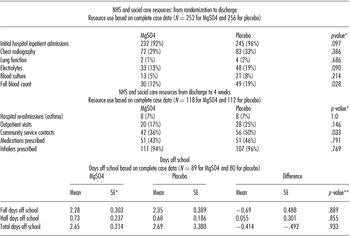
Table 1 provides a summary of resource use values. There were no statistically significant differences between the trial arms in any category of resource use with the exception of number of children who had contact with community care services (42 versus 56; p = .033) or who had a full blood count (30 versus 49; p = .028). The sources and values of relevant unit costs are summarized in Supplementary Table 1, which can be viewed online at http://dx.doi.org/10.1017/S0266462314000440. There were no statistically significant cost differences between the trial arms in any cost category with the exception of the cost of the experimental intervention. Over the 1-month follow-up time horizon, mean total health and social service (societal) costs were GBP 1,067 or EUR 1,225 (GBP 1,157 or EUR 1,328) in the MgSO4 group, compared with GBP 1,119 or EUR 1,284 (GBP 1,202 or EUR 1,380) in the placebo group, in children with complete cost data (Supplementary Table 2, which can be viewed online at http://dx.doi.org/10.1017/S0266462314000440).
Resource Use Values by Resource Item and Allocation Group

*The p-values were calculated in SPSS using chi-square.
**Standard errors and p-values were calculated in Microsoft Excel/SPSS using two-tailed Student's t-tests assuming unequal variance.
Cost-Effectiveness and Cost-Utility Outcomes
In the base-case CEA, the incremental cost-effectiveness of MgSO4 was estimated at GBP 189 (EUR 217) per unit decrement in ASS (Supplementary Table 3, which can be viewed online at http://dx.doi.org/10.1017/S0266462314000440). MgSO4 had a 75.1 percent probability of being cost-effective at a GBP 1,000 (EUR 1,148) per unit decrement in ASS threshold, an 88.0 percent probability of being more effective and a 36.6 percent probability of being less costly. The cost-effectiveness outcomes remained robust to sensitivity analyses with the exception of valuing higher-level inpatient care using per diem NHS reference cost for pediatric intensive care (probability of cost-effectiveness declined to 68.3 percent). The cost-effectiveness outcomes, following multiple imputation of missing data, are summarized in Supplementary Table 4, which can be viewed online at http://dx.doi.org/10.1017/S0266462314000440.
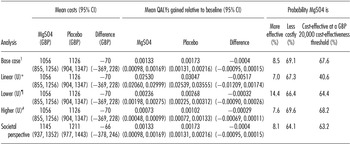
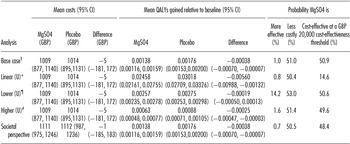
The results of the base-case CUA are summarized in Table 2. MgSO4 had a 67.6 percent probability of being cost-effective at a GBP 20,000 (EUR 22,957) per QALY gained threshold, an 8.5 percent probability of being more effective and a 69.1 percent probability of being less costly. The CEACs (Supplementary Figure 1, which can be viewed online at http://dx.doi.org/10.1017/S0266462314000440) indicate that the probability that MgSO4 is cost-effective varies between 60 percent and 70 percent depending on the value of the cost-effectiveness threshold. Mean net monetary benefits associated with MgSO4 are shown in Supplementary Table 5, which can be viewed online at http://dx.doi.org/10.1017/S0266462314000440 (GBP 63, 95 percent CI: (-219, 334), at a GBP 20,000 threshold; EUR 72, 95 percent CI: (-251, 383), at a EUR 22,957 threshold). The cost-utility outcomes remained robust to sensitivity analyses (Table 2 and Supplementary Table 5; Supplementary Figure 1) with the exception of a reduction in the probability of cost-effectiveness to 40.6 percent at a GBP 20,000 (EUR 22,957) threshold that followed linear interpolation of health utilities over the entire follow-up period. Multiple imputation reduced the probability that MgSO4 is cost effective at a GBP 20,000 (EUR 22,957) threshold to 50.9 percent (Table 3; Supplementary Figure 2, which can be viewed online at http://dx.doi.org/10.1017/S0266462314000440). At this threshold, MgSO4 generated a mean net loss of GBP 2 (95 percent CI: -171, 168) (EUR 2; 95 percent CI: -196, 193) (Supplementary Table 6, which can be viewed online at http://dx.doi.org/10.1017/S0266462314000440). As in the complete case analysis, assuming linear interpolation of health utilities over the entire follow-up period had the largest effect on cost-utility outcomes (Table 3 and Supplementary Table 6; Supplementary Figure 2).
Cost-Utility Outcomes for the Base-Case CUA Analysis and Sensitivity Analyses – Complete Case Analyses

1Complete case analysis included MgSO4 (n = 111) and placebo (n = 107).
*Linear interpolation of health utilities over the entire follow-up period, rather than assuming that the health gain was achieved immediately following hospital discharge.
¶‘Lower (U)’ denotes an assumption that baseline ASS scores mapped onto EQ-5D health states with lower utility scores than in the baseline analysis.
#‘Higher (U)’ denotes an assumption that baseline ASS scores mapped onto EQ-5D health states with higher utility scores than in the baseline analysis.
Cost-Utility Outcomes for the Base-Case CUA Analysis and Sensitivity Analyses – Analyses Following Multiple Imputation

1Complete case analysis included MgSO4 (n = 111) and placebo (n = 107).
*Linear interpolation of health utilities over the entire follow-up period, rather than assuming that the health gain was achieved immediately following hospital discharge.
¶‘Lower (U)’ denotes an assumption that baseline ASS scores mapped onto EQ-5D health states with lower utility scores than in the baseline analysis.
#‘Higher (U)’ denotes an assumption that baseline ASS scores mapped onto EQ-5D health states with higher utility scores than in the baseline analysis.
DISCUSSION
This study represents the first economic evaluation of nebulized MgSO4 used with standard inhaled bronchodilator therapy in acute pediatric asthma. The economic evaluation was conducted according to national methodological standards (7). The study developed novel methods for utility estimation in young children for whom validated preference-based approaches to outcomes measurement are currently lacking (Reference Petrou14;Reference Eiser and Morse20). It also addressed a range of methodological challenges faced by analysts conducting trial-based economic evaluations of pediatric interventions (Reference Ungar and Santos21).
MAGNETIC demonstrated a statistically significant difference in ASS at 60 min post-treatment in favor of MgSO4, although this did not meet the predefined criterion for clinical relevance (Reference Powell, Kolamunnage-Dona and Lowe4). Our economic evaluation found that the probability of cost-effectiveness of supplementing standard treatment of severe acute asthma in children with MgSO4 is less than 70 percent across accepted cost-effectiveness thresholds for an additional QALY. Several caveats should be noted. First, there was considerable stochastic uncertainty surrounding our cost-effectiveness estimates, which we addressed through the use of CEACs, and sensitivity analyses to handle uncertainty surrounding individual components of the economic evaluation. Second, a complete profile of resource usage, cost, and health utility data over the study time horizon was only available for 218 of 508 (42.9 percent) children, despite postal reminders to parents. In response, we applied multiple imputation techniques for handling missing values (Reference Sterne, White and Carlin22). Third, baseline health states were not valued using the same utility measures applied at 1-month postrandomization. Nevertheless, our sensitivity analyses revealed that our cost-utility results remained robust to alternative mapping algorithms for baseline utility estimation. Fourth, the absence of a health utility measure validated across the childhood spectrum led us to develop separate mapping algorithms between PedsQL responses and EQ-5D utility scores on the basis of data collected for 5- to 16-year-old children; the results were used to estimate EQ-5D utility scores for 2- to 4-year-old children. Potential alternative approaches for health utility measurement, such as parent-completed time trade-off or standard gamble exercises for all children, would have required more expensive and time-consuming data collection and were not considered practical or ethical given the acute care context. Finally, the results of our economic evaluation were particularly sensitive to the time trajectory of health gain associated with nebulized MgSO4. Future studies should pay particular attention to utility measurement during and immediately following the hospital visit or stay when the child presents with an acute episode of severe asthma.
CONCLUSION
Our study suggests that the probability of cost-effectiveness of nebulized MgSO4, given as an adjuvant to standard treatment of severe acute asthma in children, is less than 70 percent across accepted cost-effectiveness thresholds for an additional QALY. Data from our study can be used to inform future health economic studies in this area.
SUPPLEMENTARY MATERIAL
Supplementary Table 1: http://dx.doi.org/10.1017/S0266462314000440
Supplementary Table 2: http://dx.doi.org/10.1017/S0266462314000440
Supplementary Table 3: http://dx.doi.org/10.1017/S0266462314000440
Supplementary Table 4: http://dx.doi.org/10.1017/S0266462314000440
Supplementary Table 5: http://dx.doi.org/10.1017/S0266462314000440
Supplementary Figure 2: http://dx.doi.org/10.1017/S0266462314000440
Supplementary Table 6: http://dx.doi.org/10.1017/S0266462314000440
CONTACT INFORMATION
Stavros Petrou, PhD (s.petrou@warwick.ac.uk), Professor of Health Economics, Warwick Clinical Trials Unit, Division of Health Sciences, University of Warwick, Coventry, UK
Angela Boland, PhD, Health Technology Assessment Analyst, Liverpool Reviews and Implementation Group, University of Liverpool, Liverpool, UK
Kamran Khan, MSc, Research Associate in Health Economics, Warwick Clinical Trials Unit, Division of Health Sciences, University of Warwick, Coventry, UK
Colin Powell, MD, Senior Lecturer in Child Health, School of Medicine, Cardiff University, Cardiff, UK
Ruwanthi Kolamunnage-Dona, PhD, Senior Lecturer in Biostatistics, Department of Biostatistics, University of Liverpool, Liverpool, UK
John Lowe, BSc, Research Manager, School of Medicine, Cardiff University, Cardiff, UK; Department of Biostatistics, University of Liverpool, Liverpool, UK
Iolo Doull, MD, Consultant in Paediatric Respiratory Medicine, Department of Respiratory Paediatrics, Children.s Hospital for Wales, Cardiff, UK
Kerry Hood, PhD, Director of South East Wales Trials Unit, School of Medicine, Cardiff University, Cardiff, UK
Paula Williamson, PhD, Professor of Medical Statistics, Department of Biostatistics, University of Liverpool, Liverpool, UK
CONFLICTS OF INTEREST
The authors have no conflicts of interest to disclose.