INTRODUCTION
Although many factors have been reported to influence outcome after brain injury, the majority of studies do not have a theoretical basis. Therefore, hypotheses cannot be made about the nature of relationships between influential variables and outcome. One theory, proposed by Kendall and Terry (1996), uses a cognitive–phenomenological theory of stress and adjustment (Lazarus & Folkman, 1984) as a theoretical framework to explain individual differences in psychosocial adjustment after head trauma. The theory proposes that adjustment following any life event depends on how it is subjectively evaluated, rather than its factual circumstances and characteristics. Two appraisals of the event take place. The primary appraisal assesses whether the event is threatening or harmful, whereas the secondary appraisal assesses whether the demands placed on the individual's coping resources are too great, resulting in an inability to cope with (and, therefore, control) the event. The appraisal process will influence the coping strategy chosen to combat stress caused by the event (Lazarus, 1993). If the event is perceived as being controllable, a problem-focused strategy is likely to be effective, whereas an uncontrollable event is better addressed with an emotion-focused approach. A reduction in psychosocial well-being occurs when the chosen coping strategy is incompatible with the appraisal made.
Antecedents that influence appraisal of, and coping with, events include personal and environmental resources. Self-concept is one factor cited by Kendall and Terry as a personal resource, whereas social support is an example of an environmental resource. Another antecedent is represented by situation factors, which include objective variables, such as physical injury. The model suggests that these antecedents only affect psychosocial adjustment through the mediation of appraisal and coping, which might explain the inconsistent findings in the literature relating to predictors of outcome. Appraisal and coping might vary between individuals; therefore, the impact of predictors on outcome would also vary.
Several variables that could be included as antecedents in Kendall and Terry's model have been identified in the brain injury population. One psychological variable is personality type. Schretlen (2000) investigated the potential influence that personality type has on psychosocial outcome at 8 years post-injury, and found that those with a better behavioral adjustment had a lower trait of neuroticism. Kurtz et al. (1998) and Tate (2003) reported increased neuroticism and decreased extraversion at 1 year post-injury. Malec et al. (2004) also found that neuroticism significantly influenced outcome measures of participation and independence at the much earlier time of 3 months post-injury. Self-concept has also been found to change after brain injury. Tyerman & Humphrey (1984) found 72% of their cohort reported some negative changes in their self-concept at just 7 months post-injury, in comparison to preinjury ratings. McMillan et al. (2003) suggest that self-perceptions are associated with coping style, with reduced self-efficacy being a result of an avoidant coping style.
A further psychological variable relating to coping style that might influence outcome, is attribution style. Moore and Stambrook (1992) determined that the combination of a problem solving coping style, plus an external attribution for the brain injury, combined with an internal attribution for day to day events, improved the chance of returning to employment up to 10 years after injury. They also found that a “self-controlling” coping style and a “positive reappraisal” coping strategy was associated with fewer disturbances of mood and reduced the impact of physical disability, especially when combined with lower external locus of control. However, Moore and Stambrook (1994) also report that coping strategies of repression, escape, and denial were associated with poor outcome. This finding is supported by Williams et al. (1998) who report that those who externally attribute the cause of their injury, suffered greater anxiety and depression up to 5 years post-injury, whereas Finset and Andersson (2000) found that avoidant coping was associated with depression, and a lack of active-approach coping was associated with apathy.
Lack of self-awareness (insight) acts as a significant barrier to social reintegration, regarded by some as one of the most significant predictors of poor late psychosocial outcome and employment (Brooks & McKinlay, 1983; Prigatano & Schachter, 1991; Sherer et al., 1998; Thomsen, 1984, 1989). Awareness of disability influences outcome by allowing individuals to evaluate their ability to perform functional tasks (Doig et al., 2001; Greenspan et al., 1996; Heinemann & Whiteneck, 1995). The presence of a good social network has also been identified as central to good psychosocial outcome (Oddy et al., 1985; Webb et al., 1995), yet how an individual perceives their social support can influence life satisfaction and psychosocial adjustment (Holosko & Huege, 1989; Smith et al., 1998). However, the importance of social awareness is tempered by studies showing that recovery of insight can also increase the risk of depression, possibly due to a realization that expectations about recovery are not being met (Fleminger et al., 2003).
Many variables, therefore, can have an influence on outcome after brain injury. The cognitive–phenomenological theory of stress and adjustment outlined earlier, provides a conceptual base from which the best variables that explain long-term outcome after head trauma can be identified. Furthermore, the proposed nature of the relationship between variables and outcome is theoretically based. However, in many of the studies cited, only a few dimensions of outcome are assessed, yet the type and number of variables selected can influence different outcome dimensions by varying degrees. Employing Kendall and Terry's model as an explanation of multidimensional outcome, it was hypothesized that psychosocial variables representing personal and environmental resources, and situation factors, would influence multidimensional outcome by means of the mediation of appraisal and coping variables.
METHODS
The participants, procedure, outcome measures, appraisal, and coping measures used in this study were identical to those described in a tandem study (Wood & Rutterford, JINS, 2006, this issue).
Psychosocial Measures
The Head Injury Semantic Differential Scale (HISDS; Tyerman & Humphrey, 1984) was used as a measure of self-concept. Total scores ranged from 20 to 140, with a higher score reflecting more-positive characteristics. Personality was profiled using the Eysenck Personality Questionnaire–Revised (EPQ-R; Eysenck & Eysenck, 1991), which has subscales of Psychoticism, Neuroticism and Extraversion. Internal consistency has been reported by Eysenck and Eysenck (1991), with a mean Cronbach's α of .77 for Psychoticism, .88 for Extraversion, and .87 for Neuroticism.
The Recent Life Changes Questionnaire (RLCQ; Miller & Rahe, 1997) provided a measure of stressful life events during a 2-year period before assessment. Events are coded using life change units suggested by Miller and Rahe (1997).
The Significant Others Scale–Short Form (SOS-SF; Milne, 1992) provided information on perceived type of social support and its function within a person's social network. The scale is derived from The Significant Others Scale (SOS; Power et al., 1988), and assesses actual and ideal levels of emotional and practical support, for several significant relations.
Awareness was assessed by comparing responses of participants and relative/significant others on appropriately worded versions of the Patient Competency Rating Scale (PCRS; Prigatano & Altman, 1990). The scale was originally devised for measuring awareness; however, good face validity suggests it is also a comprehensive measure of functional competency. Hall et al. (2001) found it was associated with several other outcome measures and also showed greater sensitivity across subjects than most measures. Internal consistency of the scale has been reported by Fleming et al. (1998), with a Cronbach's alpha reported of .91 for patient ratings and .93 for relative ratings.
Data Screening and Analysis
Missing value analysis
The number of completed questionnaires ranged from a minimum of 87 (66.4%) for the Causal Dimensions Scale II, up to 104 (79.4%), for the Hospital Anxiety and Depression Scale. Measures not completed varied between participants, so missing value analysis was performed to identify any patterns within the missing data. Little's Missing Completely at Random Test (Little, 1988) calculated for the complete set of variables showed no significant deviation from a pattern of values that are missing completely at random (χ2 = 468.154; df = 439; p = .162). This finding was also true when the variables were divided into groups as per the analyses, that is, the appraisal and coping variables (χ2 = 20.508; df = 21; p = .489) and the psychosocial predictor variables (χ2 = 75.876; df = 66; p = .190). The Expectation-Maximization method of imputation was used to substitute values for missing data for all variables (Little & Rubin, 1987). This strategy involves forming a missing data correlation matrix for partially missing data, finding the conditional expectation of missing data, then substituting these expectations for missing values. The maximization step performs maximum likelihood estimation to generate imputed values (Schafer & Graham, 2002; Tabachnick & Fidell, 2001).
Principal components analysis
A principal components analysis was carried out to reduce the nine psychosocial variables included in the study. When assessing the suitability of data for analysis, the correlation matrix revealed several coefficients of 0.3 and above. Bartlett's Test of Sphericity (Bartlett, 1954) reached statistical significance and the Kaiser-Meyer-Oklin value was .624, exceeding the recommended value of .6 (Kaiser, 1970, 1974), thereby supporting the factorability of the correlation matrix. Principal component analysis revealed the presence of four components with eigenvalues exceeding 1, explaining 29.02%, 17.77%, 16.72%, 12.48% of the variance, respectively. An inspection of the screeplot revealed a clear break after the fourth component. It was decided to retain four components for further investigation. To aid interpretation of these four components, varimax rotation was performed. On the first component, labeled personality, measures of self-concept and extraversion loaded positively, whereas neuroticism loaded negatively. The second component, labeled social support, included having a good level of actual social support combined with high levels of ideal social support. The third component, labeled competency, consisted of the total score of PCRS and awareness levels. Psychoticism and recent life events loaded on the fourth component, labeled life stress.
Testing for mediation effects
The process described in a tandem study (Wood and Rutterford, 2006, this issue) was used to assess the hypotheses that appraisal and coping will mediate the influence of psychosocial predictor variables on six outcome dimensions. The significance of psychosocial components in the final step of the final regression determines whether evidence of mediation exists. This finding differs from the usual approach when interpreting hierarchical regression analyses, where the extent to which variables contribute to the explained variance is of importance. Only those predictor variables that significantly contributed to the predictive models are presented in the tables that show results of regression analyses.
RESULTS
Psychosocial Variable Regressions
See Table 1 for psychosocial variables. The indirect relationship between four psychosocial and outcome variables by means of mediation of appraisal and coping variables was considered. First, the majority of appraisal and coping mediators were significantly predicted by all four psychosocial components. They explained the largest amount of variance (41%) in self-efficacy [F(4,126) = 23.494; p < .01]. Other mediators were: stability–causal attribution [F(4,126) = 4.350; p < .01]; avoidance–coping [F(4,126) = 14.670; p < 0.01]; problem-focused cognitions–coping [F(4,126) = 4.870; p < .01]; problem-focused behavior–coping [F(4,126) = 5.996; p < .01]; and positive interpretation–coping [F(4,126) = 8.092; p < .01].
Raw scores for psychosocial predictors

Second, all four psychosocial components had a significant overall predictive effect on all outcome variables. However, various combinations of independent variables made significant contributions to each outcome. The prediction of community integration [F(4,126) = 12.516; p < .01] was significantly contributed to by personality and competency, with 26% of the variance explained. Personality also made a significant contribution to predicting satisfaction with life [F(4,126) = 18.092; p < .01], accounting for 35% of the variance. Anxiety [F(4,126) = 20.469; p < .01] and depression [F(4,126) = 27.811; p < .01] were significantly predicted by personality and life stress, with 38% and 45% of the variance explained, respectively. Personality was the sole significant contributor to both employment status [χ2(4) = 10.279; p < .05] and Quality of Life (QoL) [χ2(4) = 22.134; p < .01], and the variance explained in these cases, were 10% and 24%, respectively.
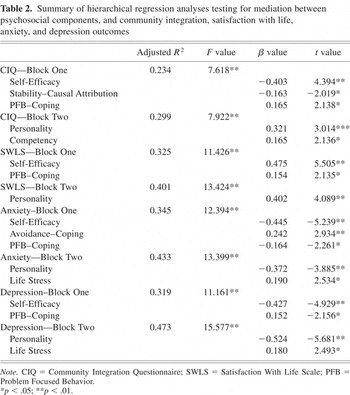
Third, mediators that were predicted by psychosocial components (i.e., self-efficacy, stability–causal attribution, avoidance–coping, problem-focused cognitions–coping, problem-focused behavior–coping, positive interpretation – coping) and those psychosocial components that contributed to the prediction of each outcome variable (see above) were entered into hierarchical regressions. The resultant models are presented in Tables 2 and 3. All outcomes, with the exception of employment status, were significantly predicted by the mediators entered in the first block of the regressions (this relationship has to be present when testing for mediation effects; Baron & Kenny, 1986). Community integration, satisfaction with life, anxiety, depression, and QoL, had 23.4%, 32.5%, 34.5%, 31.9%, and 19.4% of the variance explained, respectively. When psychosocial components were added in the second block of regressions, they all continued to have a significant effect on each outcome. Therefore, associations between psychosocial variables and each outcome were not found to be mediated by appraisal and coping variables.
Summary of hierarchical regression analyses testing for mediation between psychosocial components, and community integration, satisfaction with life, anxiety, and depression outcomes

Summary of hierarchical logistic regression analyses testing for mediation between psychosocial components, and employment status and QoL outcomes

Further Regressions
A total of nine further regressions were conducted; therefore, to allow for the possibility of family-wise error, the Bonferroni correction was applied to all α values. The analyses have shown that appraisal and coping variables were not mediating the relationship between psychosocial variables and outcomes. Therefore we investigated the degree to which appraisal and coping variables when combined with the four psychosocial components, predicted each outcome. Results presented in Table 4 are of each model. Independent variables had a significant overall predictive effect on all outcome variables except employment status. However, various combinations of independent variables made significant contributions to each outcome. The predictive model of community integration was significantly contributed to by personality, competency, self-efficacy, and personal control–causal attribution, with 30.9% of the variance explained. Personality, problem-focused behavior–coping, self-efficacy, and personal control–causal attribution, all made significant contributions to predicting satisfaction with life, accounting for 42.3% of the variance. Personality, life stress, religion–coping, self-efficacy, and locus of causality–causal attribution, explained 45% of the variance in anxiety. Personality, life stress, and self-efficacy showed significant effects with depression, explaining 46.3% of the variance. Personality also had a significant effect, along with problem-focused behavior–coping, when predicting QoL, with 43.5% of the variance explained.
Summary of regression analyses testing the prediction of outcome dimensions by psychosocial components, and appraisal and coping variables

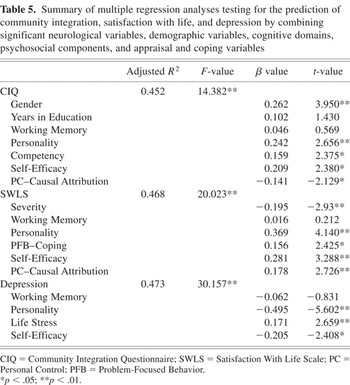
Personality and self-efficacy consistently contributed to the prediction of the majority of outcome dimensions. However, similar to the prediction by demographic and cognitive variables in the tandem paper (Wood & Rutterford, 2006, this issue), there was inconsistency in the additional psychosocial variables that contributed to the reliable prediction of each outcome dimension. Furthermore, data from the two papers would suggest that some outcome dimensions can be reliably predicted by a set of variables that incorporate neurological, demographic, cognitive and psychosocial factors. Therefore, Table 5 presents a summary of regression analyses when predicting community integration, satisfaction with life and depression, outcomes that were reliably predicted by variables of more than one type. The contributions are presented for all the previously significant variables entered into the regression. As would be expected, independent variables reliably predicted all outcomes. 45.2% of the variance in community integration was accounted for, with working memory and years in education no longer contributing. Working memory also no longer contributed to the prediction of satisfaction with life or depression; however, 46.8% and 47.3% of the variance in each outcome respectively, was still explained by the remaining independent variables.
Summary of multiple regression analyses testing for the prediction of community integration, satisfaction with life, and depression by combining significant neurological variables, demographic variables, cognitive domains, psychosocial components, and appraisal and coping variables

DISCUSSION
The cognitive–phenomenological theory of stress and adjustment proposed by Lazarus and Folkman (1984) forms a theoretical basis for the model proposed by Kendall and Terry (1996). In this model, that psychosocial variables, such as personal and environmental resources and situational factors, influence psychosocial adjustment through the mediation of appraisal and coping variables. The results of this study fail to support this theory. There was no evidence to indicate that appraisal and coping variables mediate relationships between psychosocial variables and outcome variables. However, when appraisal and coping were combined with other psychosocial variables as direct predictors of outcome, every outcome except employment status was reliably predicted, accounting for large amounts of the variance. Personality was the only variable to significantly influence all outcomes. Self-efficacy also appears influential, because it contributed to the prediction of all outcomes, except rating QoL as good or better.
It is clear that, when cognitive, demographic, and psychosocial variables are combined to directly predict outcomes, the influence of working memory diminishes. Therefore, it would appear that psychosocial variables, specifically personality and self-efficacy, have the largest impact on long-term outcomes. In addition, specific demographic variables differentially influence outcome dimensions: gender appears important regarding community integration; severity influences life satisfaction; and age at injury helps to determine employment status. Contrary to the literature, coping strategies were not consistently influential across all outcomes (Finset & Andersson, 2000; Moore & Stambrook, 1992, 1994). One reason for the small predictive contribution of coping strategies could be the inclusion in the study of personality, self-concept, and self-efficacy. The findings by Malec et al. (2004) and Schretlen (2000) are supported by the fact that low neuroticism and better self-concept was predictive of better outcome across all dimensions.
The inability of the theory to explain psychosocial adjustment at very late stages after brain injury may be because psychological impact is greatest soon after the event. At a late stage post-injury, the impact will be less; therefore, the same personal resources are not required. However, several issues need to be considered when interpreting the findings of both this study and the tandem study (Wood & Rutterford, 2006, this issue). First, the approach used to gather participants introduces the possibility of responder bias. The individuals that were located had retained the same address for a long period of time, suggesting a stable lifestyle and, therefore, opportunity for good community support. Respondents might also have been those who made the best personal adjustment after injury and, therefore, were more willing to take part in the study. Some of the psychosocial and outcome measures used were less than ideal but were selected on the basis that participants would understand their content, on the assumption that inability to understand could lead to unreliable responding and low completion rates. Furthermore, because participants were asked to complete a high number of measures, each measure had to be reasonably concise. We therefore chose to include the shortened version of several questionnaires. Despite these precautionary measures, the completion rate of between 66 and 80% was disappointing and may reflect the time needed to complete a large number of questionnaires. The internal consistency of some measures, particularly the Brief COPE, was low (Cronbach's α < .8), which may go some way to explaining why evidence of mediation was not found. Many brain-injured participants potentially lack insight, therefore, an additional problem of using self-report questionnaires concerned the accuracy of responses (Prigatano & Altman, 1990; Prigatano & Klonoff, 1998). However, our cohort did not demonstrate a reduced level of awareness, indeed the participants actually overstated their problems in relation to proxy ratings given by significant others. Employment status was judged by the number of hours worked by participants and not the type of employment (paid vs. volunteer work) reported by participants. However, we believe that the measure included shows the level of productive activity in which they were engaged. The authors also acknowledge that the cohort used is not necessarily representative of head-injured people, because most (65%) were either in the category of severe or very severe injury. Other studies that have reported on very late outcome from head trauma have included cohorts with more restricted ranges of injury severity. Higher proportions (90–100%) of the samples had severe or very severe injuries (Colantonio et al., 2004; Hoofien et al., 2001; Thomsen, 1987).
The final limitation concerns the design of both studies. Psychosocial and cognitive variables were assessed at the same time as outcome variables. Therefore, some of the variables used to predict outcome could be construed as being outcome measures themselves. However, the primary focus of this study was to investigate the way variables interact with one another before influencing multidimensional outcome. Kendall and Terry's (1996) model formed the basis for hypothesized relationships between variables. Therefore, this model determined those variables that were deemed predictors and outcomes. Kendall and Terry did not state when predictor variables should be assessed when interpreting their model; therefore, the theoretical basis of the model was deemed to apply when all components of the model were assessed concurrently. However, the design of these studies limits their ability to predict long-term outcome at early stages of recovery from brain injury. The findings, therefore, should be treated as exploratory until they can be confirmed using prospective methodology. However, we believe the data help identify factors that potentially play an important part in determining outcome at late stages after injury that could influence types of intervention and goals of rehabilitation at earlier stages of recovery.
ACKNOWLEDGMENT
The authors thank Dr. Christina Liossi, for her advice regarding the statistical analyses included in this article.