In the early fifteenth century, after the end of the great period of English ecclesiastical embroidery now referred to as opus Anglicanum,Footnote 1 the market for custom-made church vestments appears to have expanded rapidly.Footnote 2 The nobility, the gentry and an increasing number of wealthy merchants and, to a lesser degree, yeomen and husbandmen bequeathed vestments or money for their purchase to the church of their choice.Footnote 3 Between 1437 and 1483, Holy Trinity in Hull was the recipient of £130 in donations towards the liturgical needs of the church. More than £100 of this amount was bequeathed by parishioners specifically for the acquisition of new vestments.Footnote 4 Museums around the world hold a wealth of these late fifteenth- and early sixteenth-century English ecclesiastical embroideries in various states of repair and reuse. Until recently, there has been little published research into how the garments were commissioned and produced; even more elusive are the individuals who created them.Footnote 5
In part this may be due to the commonly held and often-published view that the workmanship in these later embroidered garments is inferior in comparison to the earlier opus.Footnote 6 This perception came under new scrutiny at a symposium on English ecclesiastical embroidery held in 2013 at which historian Kate Heard argued, on the basis of her research into the documentary sources for the purchase and production of English ecclesiastical embroidery, that there is ‘a grave disjunction between the profiles and recorded actions of those buying late medieval English embroidery and our perceived decline in the quality of that work’.Footnote 7 The present paper seeks to supplement this recent scholarship through the examination of a contract for the production and purchase of a single set of vestments. A copy of this indenture (transcribed in the appendix to this paper) was included in ‘The Boke off Certeyn Bargeyns Tempore domine Alianore Touneshend vidue’, now in the British Library.Footnote 8 It offers an opportunity to examine a rare late fifteenth-century formal contract and expand current knowledge regarding the practice of the professional embroiderer at the beginning of a period of great transition in technique, design and demand.
During the later Middle Ages it was the responsibility of the congregation to provide the items needed to secure the successful operation of the parish church. The extensive list included such necessary and varied items as a psalter, a lesson book, church bells, candlesticks, a processional cross and at least one set of vestments. It was also the congregation’s responsibility to maintain and replace these items when required.Footnote 9 Depending on the economic circumstances of the individual parish, and the personal wealth of the parishioners, there was also an opportunity to add to these necessary items when desired. In making a gift to the fabric of the church the donor’s name would be added to the bede-roll, the list of parish benefactors, which was occasionally read aloud by the priest in full or in part during the service.Footnote 10 In the village of Morebath, in Devon, Christina Timewell’s name was added to the list when she left the parish her best gown, which, at her request, was to be sold and the proceeds put towards the purchase of a new image of the Virgin.Footnote 11
At the opposite end of the social spectrum, Henry vii bequeathed a ‘whole suit of vestments and coopes of cloth of gold tissue’ to Westminster Abbey.Footnote 12 He had commissioned these expensive vestments earlier in his reign from Italian merchants who had them made in Florence with the unique Tudor rose and portcullis design woven into the cloth of gold. Probably intended to create a ‘glorious show’ at the coronation of his son Arthur,Footnote 13 they were left to the abbey to form ‘a perpetual memory there to remain while the whole world shall endure’.Footnote 14
As well as bequeathing vestments to a specific church, valuable garments were sometimes offered for reworking into vestments. Sir William Compton, after requesting that his executors provide forty pairs of vestments to be given to forty churches, left ‘to the Abbey Church of Winchcombe … my wedding gown of tinsel satin to make a vestment to the intent that they pray for my soul’.Footnote 15 Alternatively, a sum of money might be left with the intention that it should be used for having vestments made. In his will dated 12 January 1519, Sir John Thurston, an alderman and former Sheriff of London, left money for a total of fourteen vestments to be made for ten different parish churches in London, Norfolk and Suffolk, specifying the colours, materials and cost.Footnote 16 He also left instructions for the inclusion of a Latin dedication on each one to remind the wearer to pray for his soul and those of his three wives and all their parents.Footnote 17 To the parish church in Erlesowne in Suffolk (perhaps St Mary’s, Earl Soham, possibly where his parents were buried) he also bequeathed ‘a sewte of double velvet blue or green with one cope of the value of xx li [£20] and a roll to be set upon every garment viz “pray ye for the souls of Edward Thurston and Mawde his wife and for all their childrens souls”’. Dame Elizabeth Thurston, Sir John’s third wife, died the following year. In her will she specified ‘a vestment of cloth of gold and the armes of the said Sir John Thurston and myn to be embrowdred and sett on the same vestment’.Footnote 18
Occasionally, the preferred iconography was also indicated, and sometimes instructions were left setting out who was to wear the vestments and on what occasions. Such instructions could become quite detailed, as in the will of Sir Walter Hungerford, Baron of Hungerford and Member of Parliament (d. 1449):
one whole suit of vestments, with all things appertaining thereto, for a Priest, Deacon, and Subdeacon, likewise a cope of black and red velvet, embroidered like waves, two copes of damask with gold of the same colour and work, to be used by the said prior and Monks every year on the day of my obit, to the honour of God and in memory of me and my parents, and I desire that in the said vestments for greater notice my arms be wrought.Footnote 19
Vestments could be both made and repaired by skilled parishioners or, as in the case of the parish of Morebath, a neighbouring priest;Footnote 20 but to fulfil such highly specific requirements as those of Sir Walter might require the executor to commission the vestments from an embroiderer, in some cases by means of a formal contract. One such contract was made between Walter Devereux, Lord Ferrers and embroiderer William Acton on 20 October 1468.Footnote 21 The indenture specifies that two images should be embroidered, one of the Virgin and one of St John. They were to be of the same materials and workmanship as an embroidered image of the Crucifixion that Acton had previously provided. Unfortunately, there is no corresponding contract for the latter; consequently, little information can be discovered from the document apart from the cost and time-frame – approximately £7 payable upon delivery a month later.
A contract for a set of vestments might require more specific detail, as in the case of the agreement that is the main subject of this paper between Sir Robert Clere and William Morton, citizen and broderer of London, dated 20 November 1495. The Cleres were a long-established and wealthy Norfolk family. Robert was born in 1453 and was admitted to Lincoln’s Inn in 1467. He was by all accounts a good lawyer, and a friend to many East Anglian gentry. Margaret Paston described him as ‘a man of substaunce and worchyp’.Footnote 22 In his long and distinguished career, he served as a Member of Parliament, Sheriff of Norfolk and Suffolk, and Justice of the Peace in Norfolk; he became a Knight of the Order of the Bath in 1494.Footnote 23 His first wife was Dame Anne Hopton.Footnote 24 He and his second wife, Alice Boleyn, aunt to the ill-fated Queen Anne, attended Queen Catherine at the meeting of Henry viii and Francis i of France at the Field of the Cloth of Gold in June 1520.Footnote 25
One of Sir Robert Clere’s associates was Sir Roger Townshend, who served as Justice of the Peace in Norfolk and Justice of the Court of Common Pleas until his death in 1493.Footnote 26 Sir Roger was a religious man and his will serves to illustrate his piety: the lengthy preamble, worthy of a successful lawyer, is followed by requests for a multitude of masses and cash bequests to children, the poor and to priests and clerks. However, his bequests did not include any specific objects, such as plate or vestments.Footnote 27
His widow, Dame Alianore Townshend, in whose book of business matters the Clere–Morton contract is found, wrote her will in 1499, naming Sir Robert Clere as her executor.Footnote 28 She left instructions for the erection of the extant Easter Sepulchre in the chancel of the parish church of St Mary, East Raynham, Norfolk, in memory of her late husband. An extract from her will in a memorandum-book of her son states:
Also I wyll that the masse boke and chalys and a vestment of black velvet and another of black worsted wth all the apparell that longeth therto to the altar in the chapel remain in the saide place to the behaf of my sonne Townshend after my decease and to the heyrs desendyng of hym lawfully begotyn.Footnote 29
It is clear that, as executor of Dame Alianore’s will, Sir Robert Clere held a position of trust within the Townshend family. It may not have been practical for her to travel to London to arrange for the commissioning of the vestments herself and it would be reasonable to suggest that she trusted Sir Robert to execute the contract on her behalf, and then had copy of the document made to include in her ‘Boke off Certayne Bargeyns’.
William Morton was a member of the Mercers’ Company. He began his apprenticeship with William Myles in 1446 and was later transferred to Thomas Muschamp, who had served as Sheriff of London in 1464.Footnote 30 Thomas Muschamp’s wife, Maude, was an embroiderer and vestment-maker with a shop in Milk Street. As an apprentice in the Muschamp household, Morton may thus have had access to training as an embroiderer,Footnote 31 and as a vestment-maker, specialising in religious garments including the tailoring and embroidery.Footnote 32 Morton was admitted to the Freedom of the City as a Mercer in 1460 and he became embroiderer to Henry vii upon his accession to the throne in 1485.Footnote 33
Sir Robert requested a ‘sute’, of vestments, which included a cope, a chasuble and two tunicles.Footnote 34 All were to have a ground fabric of black velvet with crimson velvet orphreys, a choice similar to that of Sir Walter Hungerford.Footnote 35 Black was traditionally used to celebrate the requiem mass or obit, an annual service marking the anniversary of someone’s death. Very few black vestments survive because the iron used to obtain a rich black colouring results in the premature decay of the fabric.Footnote 36 The mourning vestment of Abbot Robert Thornton of Jervaulx Abbey, dated as early as 1510 and now in the collection of the Victoria and Albert Museum,Footnote 37 is a rare extant example of a chasuble in the same combination of black and crimson velvet, with appliquéd images and angels.
The Clere–Morton contract specifies that these articles were to be ‘complete in lengthe and brede accordyng to the Statuts of London’. Difficulties regulating the quality of the vestments produced in the City had resulted in the need for laws regulating the trade. These specified the quality of the fabrics, the embroidery silks and the metal threads to be used; they also specified the dimensions of each of the three types of embroidered vestment that Sir Robert required. The cope was ‘to holde in leyngth vij quarters of a yerde kepyng his compas rounde about’ (ie the semicircular garment was to have a radius of 63in. / 1600mm). The chasuble was ‘to holde in leingth a yerde and half and in brede a yerde and a quarter’ (54in. / 1370mm in length and 45in. / 1140mm in width). The tunicle was 9 inches shorter in length than a chasuble, so 45in. / 1140mm.Footnote 38
The total cost to Sir Robert Clere would be £23. At the making of the indenture Sir Robert paid £5 to William Morton for the purchase of materials. The contract stipulated that Morton was to provide all the laces, fringes and fabric needed to compete the set of vestments at his own cost. All the embroidery was to be carried out by ‘workmen of the sayd occupacion’ of embroiderer. A very significant detail in the contract is the stipulated delivery date. Having executed the contract on 20 November 1495, Morton agreed to the delivery of the ‘full completely finished’ set of vestments ‘within a month after the date of the making of this indenture’. This time-frame would appear to be challenging in comparison to the Devereux contract, in which the embroiderer was given a whole month to complete just two figures.
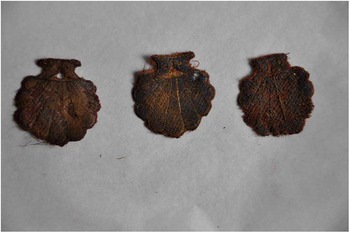
The black velvet was to be embroidered with designs of Sir Robert’s choosing. He provided a pattern for the 140 gold fleur-de-lis and silver scallop shells that were to be ‘powdered’ across the ground and ‘garnyshed abowte with fyne golde of venyss and spangyllys of sylv[er] and gylt’. The fleur-de-lis appears on many of the extant ecclesiastical textiles of the period, symbolising the Holy Trinity and being associated with the lily, a symbol of the Virgin Mary.Footnote 39 The scallop – associated with St James and the Compostela pilgrimage – was much less common as a vestment device. Worcester Cathedral Library has the fragments of a thirteenth-century embroidered scallop border, discovered in the tomb of Bishop William de Blois (fig 1).Footnote 40 The Duke of Bedford also had a set of vestments embroidered with scallops.Footnote 41 It was the device of the Chivalric Order of St Michael, whose members included Edward vi, and a cope with scallops identified as belonging to him is listed in an Elizabethan inventory of 1600.Footnote 42 In terms of the Clere–Morton contract, the silver scallop is the main device on the arms of the Townshend family, supporting the hypothesis that Sir Robert Clere executed the contract on behalf of Dame Alianore Townshend rather than on his own behalf.
Fragments of embroidered scallop shells from a chasuble orphrey in Worcester Cathedral Library, discovered in the tomb of William de Blois, Bishop of Worcester 1218–36. Photograph: Christopher Guy, Worcester Cathedral Archaeologist; reproduced by permission of the Chapter of Worcester Cathedral

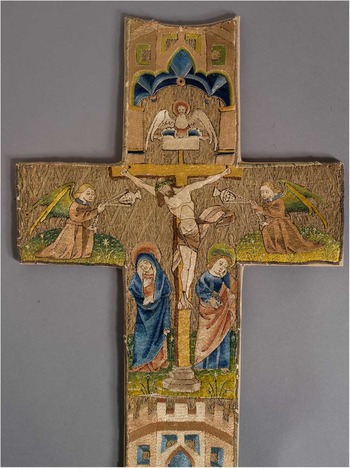
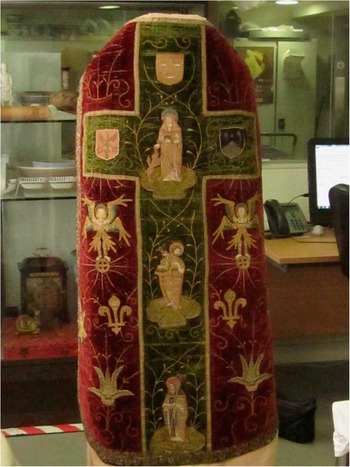
All the orphreys were to have a ground of crimson velvet. They were to be embellished with twenty-nine ‘armes ymages and angels’ in Venice gold and coloured silks. The chasuble orphrey was to depict a crucifix and images of the Virgin Mary and St John the Evangelist. The orphrey on the cope was to be similar to the chasuble, depicting ‘ymages and angels’, and the hood on the back of the cope would depict the Assumption. The orphreys were to be bordered with Venice goldFootnote 43 and spangles ‘lyke unto an howsyng’. Traditionally, the religious figures on finely embroidered orphreys were enclosed within an architectural canopy (fig 2). However, as the contract specifies crimson velvet for the orphreys, the embroidery perhaps included more of the same flourishes that were used around the fleur-de-lis and scallop motifs on the black velvet. An extant example of the use of couched Venice gold to contain or surround the figures with tendrils and sprays is illustrated on the green velvet orphreys of the Huddleston Chasuble in the Fitzwilliam Museum (fig 3).
An orphrey, c 1425, of linen embroidered in coloured silk and silver-gilt thread (ROM, 971.397). The crucifix is surmounted by a dove under an architectural canopy, representing the Holy Ghost, and flanked by angels with censors, with the Virgin Mary on the left and St John on the right. The surface of the linen ground is completely covered by finely embroidered images, mainly in split stitch, and the background is filled using the traditional method of underside couching to fix the metal thread in a diaper pattern. Photograph: reproduced by permission of the Royal Ontario Museum, Toronto; © ROM

The Huddleston Chasuble, c 1500 (FM, T9-1986). Note the decorative treatment of couched Venice gold in the area around the figures on the orphrey and the use of embroidered arms. Photograph: author; © Fitzwilliam Museum, Cambridge

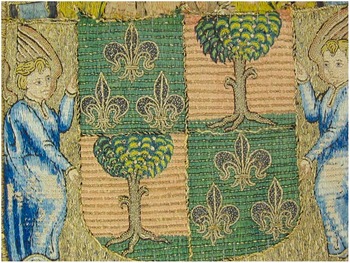
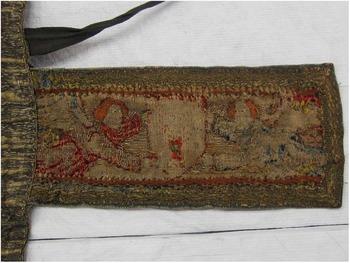
The arms ‘accordyng to a patron wrought in clothe the wiche the sayde sir Robert delyv[ere]d to the sayd Willim for an exampyll’ would have been embroidered on the chasuble under the crucifix and on the morse, the clasp used to draw the two sides of the cope together at the front of the garment (figs 4 and 5). The orphreys of the two tunicles were to include the arms and were also to be further ‘gar[n]yshed wt ymages & angels accordyng to the sayd chesabyll & coope’. Visually acknowledging the donor in this way was an important element in a bequest, as noted by Hungerford in his will. Praying for the soul of the deceased was the customary means to ensure a swift passage through purgatory.Footnote 44 The arms visually identified the donor and reminded the clergy and congregation of the person for whom prayers were being said.Footnote 45
Detail of the bottom panel of an orphrey from a cope of c 1460–90 (V&A, T.46-1914). The panel is 11in. (280mm) wide by 6in. (152mm) tall and is of linen embroidered in coloured silk and silver-gilt thread; the arms are possibly those of John Sante, Abbot of Abingdon (1469–95). They depict trees eradicated and fructed, quartered with silver fleurs-de-lis. Photograph: author; courtesy of the Victoria and Albert Museum, London

Morse of linen measuring 6.5×2in. (165×50mm), on a cope of c 1500 (V&A, 1376–1901), embroidered in coloured silk and silver-gilt thread, heavily worn with unidentifiable arms held aloft by angels. Photograph: author; courtesy of the Victoria and Albert Museum, London

The advance preparation of arms as individual motifs embroidered in coloured silks and gold thread on a plain linen ground was already an established practice in the first quarter of the fifteenth century: Thomas Brydon, an English embroiderer working in Rouen, embroidered 918 badges with the Duke of Bedford’s personal device of gold roots for a total payment of £433.Footnote 46 An inventory of goods from Westminster Abbey taken in 1539 includes a cache of twenty-seven new morses with the arms of Cardinal Thomas Wolsey, presumably made before his death in anticipation of the purchase of new copes.Footnote 47
Sir Robert stipulated ‘that in no wyse [should] the glosse & bryghtnss of the sayde gold & sylkys be defaced’. Some years earlier, William Morton had personally encountered the problem of inferior goods. He had been ‘bound by an indenture to our sovereign lord the king’ to deliver a set of twelve copes and the gold was to be of the highest calibre.Footnote 48 He had ordered a large quantity of gold thread based on the quality of a sample provided by a supplier. Unfortunately, when the goods were delivered they were not of the same quality as the sample provided and Morton found himself without the means to complete the commission for the king in a timely fashion.Footnote 49 As a result of this continuing problem, Parliament passed an act in 1489 against the deceptive weight and working of gold and against:
those who bring the said gold into this realm so deceitfully and falsely pack it so that the thread and colour under the first layer is thicker and coarser than is that which is visible, and not matching its outward appearance, to the complete impoverishment of the said embroiderers, and also to the great costs and disadvantage of the buyers of embroidered work.Footnote 50
Concern over the quality of the materials used in embroidered goods worked and sold in London was not entirely addressed by the act of 1489. Quality continued to be an issue, not only for the gold thread, but also for silk, textiles and workmanship. Sir Robert felt compelled to address this by twice referring to the quality of the embroidery and stipulating that it was to be done by ‘workmen of the sayd occupacon’.Footnote 51
The seemingly impossible time-frame of one month for the completion of the contract may have involved the use of ready-made embroideries, a manufacturing method that was being employed as early as 1400. The traditional orphrey consisted of a long narrow strip constructed by sewing together a series of panels depicting saints set in an architectural framework. Santina Levey suggests that these were produced by a specialist group of craftsmen and that their work, of solidly embroidered figures on a linen ground, was obtained ready for use in completing the vestments.Footnote 52 This is borne out by Lisa Monnas’s investigations into the production of the Stonyhurst vestments, although there is little evidence of where or how the work was carried out and by whom.Footnote 53 Leanne Tonkin has investigated the similarities of the embroidered figures on orphreys dated around 1400.Footnote 54 Her findings suggest that the reuse of similar outlines and repetitive stencilling, employing minor variations in design and colour to indicate different persona, points to mass production and that such techniques were developed to ‘to meet the requirements and expectations of the London mercery trade’.Footnote 55
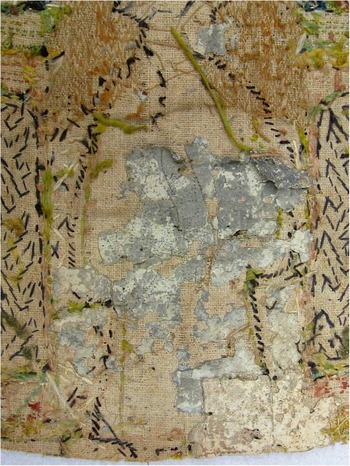
By the middle of the fifteenth century, another time-saving method developed whereby the figures of the saints were worked separately from the architectural canopy. The completed saint was then cut from the linen ground and appliquéd into a void left for the figure under the canopy on the background panel. The figure was outlined using heavier silk thread to conceal the raw edge of the linen (figs 6 and 7).Footnote 56
Panel from an orphrey of c 1500 (OC 558), showing an unidentified figure embroidered on linen in silk and silver-gilt threads, cut from linen ground and appliquéd onto a previously embroidered orphrey, and outlined with heavy black thread using surface couching to conceal the raw edges of the linen. Photograph: author; reproduced by kind permission of St Mary’s College, Oscott

The black stitches used to couch the heavy outline and the window pattern are easily distinguished on the reverse of the orphrey shown in fig 6 (OC 558). This image also clearly indicates that the architectural framework behind the figure was completed prior to the figure being appliquéd in place. Photograph: author; reproduced by kind permission of St Mary’s College, Oscott

By the end of the fifteenth century, such was the demand for embroidered vestments by the nobility, gentry and merchant classes that an even greater change occurred to design and production methods. At the time of the Clere–Morton agreement, ‘powdering’, or scattering images over the surface of the ground fabric, had become an established alternative to the all-over embroidery that had been the trademark of the earlier period of opus Anglicanum.Footnote 57 This also presented clients with a less expensive substitute for the imported figured silk velvets and woven cloth of gold preferred by royalty.Footnote 58
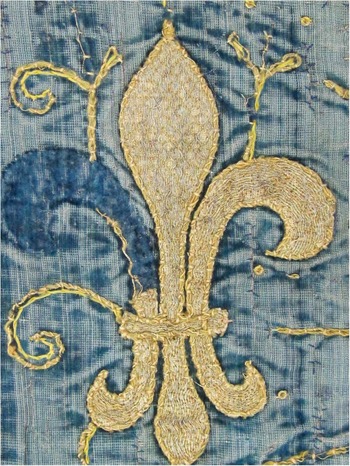
The pile on the velvet made it difficult to stitch images directly onto the fabric. Instead, individual slips or appliqués were stitched onto a linen ground using a variety of techniques and materials, including cutwork cloth of gold,Footnote 59 detail-stitching and shading in coloured silks and couched Venice gold (fig 8). Morton may have provided Sir Robert in the first instance with a selection of drawings, patterns or, more likely, such ready-made slips as he had at his disposal.Footnote 60 Sir Robert could choose from these and they could be sewn down and then quickly outlined and embellished with gold thread and spangles, keeping any necessary embroidery work to a minimum. Sir Robert also wanted specific arms to be placed on each garment ‘accordyng to a patron wrought in clothe … for an exampyll’. He may have had access to a supply of previously embroidered badges similar to the ones Thomas Brydon had made for the Duke of Bedford and provided one ‘wrouthe wt fine gold sylver & sylkys’ as a pattern for Morton to copy.Footnote 61
Detail of a damaged fleur-de-lis on a cope of c 1500–25 (V&A, 617-1898), illustrating the use of cutwork appliqué, surface couching to conceal the raw edges and the use of spangles. Photograph: author; courtesy of the Victoria and Albert Museum, London

The contract is for a fixed price and does not break down the costs for materials or labour. These can be estimated, however, by extrapolating the quantities and costs required for each item in the contract based on data from a variety of other documents. The king’s warrant book of 1498–9, for example, records a number of different prices for black and crimson velvet yardage, indicating there were a variety of qualities available. The cost of black velvet suitable for a jacket for a servant cost 10s a yard whereas velvet fit to make a riding gown for the king cost 18s per yard.Footnote 62 Crimson velvet ranged from 13s 4d to 30s per yard.Footnote 63 The width of the velvet from selvage to selvage was approximately 600mm.Footnote 64 To make Sir Robert’s set of vestments would have required approximately 17 yards based on the sizes given in the statute and the number of seams found in extant vestments. The cost for black and crimson velvet would thus have been approximately £13, even at the low end of the quality scale – in other words, a substantial portion of the contracted amount.
We can estimate the cost of the 140 fleur-de-lis and scallop shell motifs by comparison with an itemised list for the supply of textile furnishings for the king’s chapel at Westminster in a warrant of 4 January 1499.Footnote 65 Forty-eight portcullises at 4s each were provided for three chasubles; separate embroidered images of St Francis, St Edward and Our Lady of Pity cost 40s each. In each case, the motifs and embroideries were probably much larger than those required for the Clere vestments, thus making it difficult to determine a cost for the individual embroidered items in the Clere–Morton contract, but the Westminster warrant does give us a sense of the scale.
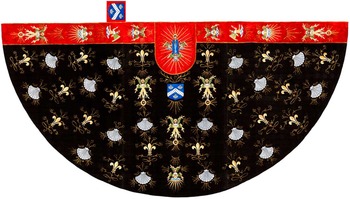
A fairly accurate cost for the remaining items can be determined from a vestment set bequeathed by Agnes Cely in her will of 1483.Footnote 66 Cely was the widow of Richard Cely, a well-established wool merchant in the City of London and a ‘man of substance’.Footnote 67 The costs paid to the suppliers of the vestment materials are given in detail in the family accounts.Footnote 68 Enough buckram to line all four garments in the Clere–Morton contract would have cost 10s; ribbons and fringes 17s 7½d. The vestment-maker charged 10s to make up Agnes’s vestments. Additional Holland cloth for the albs cost 2s plus 12d to make them up. The cost for the velvet plus these items comes to approximately £16 10s, leaving just £6 10s for the embroidery, the Venice gold, the gold and silver spangles and the ‘sylkys of dyv[er]s colours’ required to complete the contract. Figures 9 and 10 show what the finished cope and chasuble might have looked like, based on a detailed examination of several extant embroideries dating from c 1460 to c 1520.
The cope of the Clere–Morton contract reconstructed. Watercolour: author

The chasuble of the Clere–Morton contract reconstructed. Watercolour: author

The close relationship of mercers, vestment-makers and embroiderers at the end of the fifteenth century is illustrated by the use of the terms used to describe William Morton’s occupation. He and William More are described as embroiderers to Henry vii in a grant given under privy seal in November 1485, which says: ‘Grant in survivorship to William More and William Morton the office of embroiderer to the king with wages &c. out of the issues, of the county of Kent, a livery from the wardrobe in the winter.’Footnote 69 Morton has also been identified as a major supplier of goods to Edward iv,Footnote 70 and in a complaint brought against him in that capacity in the early 1480s he is named as a vestment-maker.Footnote 71 Apart from some references early in the reign of Henry vii,Footnote 72 little evidence has been discovered to link him directly with any embroidery done in the Great Wardrobe. On the other hand, his partner, William More,Footnote 73 appears often in connection with payments from the Great Wardrobe for embroidery work.Footnote 74 A ‘William More brotherer’ appears in the Mercers’ Court Books in 1518; the Wardens of the Mercers granted him a lease of premises in Knightrider Street for a term of twenty years.Footnote 75 His specific designation as ‘brotherer’ suggests he may not have been a mercer.
Anne Sutton’s exhaustive study of the extant records of the Mercers’ Company indicates that some smaller guilds, including vestment-makers and embroiderers, came under their control.Footnote 76 According to Sutton, ‘Mercers who were only vestment-makers were regulated as “mere artisans”’ and were not considered to be full members.Footnote 77 Embroiderers also appear to have been supervised to some extent by the Mercers, even though the Arte or Mistery of the Broderers had been recognised as an organised body electing representatives and sitting on the Common Council of the City of London as early as 1376,Footnote 78 and they are known to have admitted apprentices to the Freedom of the City as early as 1509.Footnote 79 However, little is known about its governance prior to the granting of a charter in 1561, and the Broderers’ Hall was destroyed by the Great Fire of London in 1666, resulting in the loss of a majority of the Company’s records prior to that date.Footnote 80
From the Mercers’ records, we know that the Wardens of the Broderers petitioned the Mercers’ Company as early as July 1494 regarding the appointment of two mercers to accompany them in searching the premises of all vestment-makers who ‘do occupie that occupation of browdere’.Footnote 81 The two mercers were to have an ‘understondyng and knowing the feat’ of embroidery and vestment-making; the Broderers specifically requested William Morton or John Thurkleton, the latter having produced the Cely vestments.Footnote 82 At this time the Mercers’ Company was not prepared to act on the petition and requested further information from the Broderers so ‘that no prejudice or hurt therby might growe therby unto oure felishippe’.Footnote 83
The Broderers refined their petition and presented it to the City in September 1495 so that all ‘thynges made in the said Crafte myght be truely wrought’ and to allow the Wardens of the Broderers to work with ‘ij mercers expert in the said Crafte the same mercers to be assigned by the Wardeyns of the Crafte of the mercery’ in order to seek out and fine offenders, with the oversight of a representative of the Mayor.Footnote 84 The petition granted them jurisdiction over craftsmen working not only in London but in the suburbs as well. A fine of 40s could be levied, with half of the funds going to the City and the other half to be divided equally between the Mercers and the Broderers. The offending work was to be either given to poor parishes or burnt. The dimensions of the vestments were also established at this time and the amount of the fine was set at 20s for those found to be in contravention, the proceeds being split in the same manner. The petition also gave the Wardens of the Broderers the right to approve the employment of foreign embroiderers and for ensuring they were sufficiently skilled.Footnote 85
Ordinance 94 of the Mercers, governing apprenticeships and made in 1497,Footnote 86 draws a distinction between those mercers taking apprentices who sell their merchandise, and those who only make vestments, altar cloths, embroidering and setting (the fixing of gemstones to textiles).Footnote 87 The articles for the latter provide for a younger start, at the age of twelve, a longer apprenticeship, of fourteen years, and a lesser fee for enrolment. It also specifies that if the mercer-vestment-maker should begin to trade in merchandise, either wholesale or retail, he must then pay the full fee and possibly a fine as well. There is no mention of the previously acknowledged articles governing the quality of embroidered goods produced and sold by mercer-vestment-makers.
Conclusions
This analysis of the contract between Sir Robert Clere and William Morton has examined many aspects of embroidered vestments and their role in the daily practice of religion in pre-Reformation England, including the spiritual value to the purchaser and economic value to the producer. It has also clarified many aspects specific to the occupation of professional embroiderer in the latter years of the production of English ecclesiastical embroidery. Several factors led to the alleged decline in the quality of the goods produced: the growth in demand for embroidered items had put pressure on the producers to increase the rate of production by engaging new and faster methods of production; the inconsistent supply of high-quality imported materials contributed to finished goods of substandard quality; and, most importantly, the disparate nature of the persons producing embroidered goods, and lack of an overarching body of governance, led to a fractured labour force.
During the latter half of the fifteenth century, in an effort to maintain the integrity of the craft, a number of governing bodies were recruited to devise regulations to ensure the quality of materials and workmanship. Parliament had put in place regulations to control the quality of imported materials with the implementation of an act against the deceptive weight and working of gold. The presence of vestment-makers as artisan-embroiderers of the Mercers’ Company, operating with few guiding principles in place, had compelled the Broderers to initiate measures of quality control through a petition to the Mayor and Aldermen of the City of London and enjoining the assistance of the Mercers. This resulted in the issuing of new statutes to ensure the high-quality production of embroidered goods. To what degree these measures were successful remains unclear. However, as demonstrated by the outstanding documentary and material evidence, those who purchased embroidered vestments and used them for generations certainly considered them to be of great value.Footnote 88
That the Mercers and the Broderers were intricately linked through the production and sale of ecclesiastical embroidery is apparent. Exactly how the relationship worked is difficult to determine given the lack of documentation for the Broderers. Nonetheless, a review of the evidence available with respect to the king’s embroiderers – Morton and More – suggests that they may have worked as a team, Morton’s role being more that of a procurer of embroidered goods, and More’s role mainly that of producer. The contract in question identifies Morton as an embroiderer but it is possible that his role was more that of an administrator, assembling the team and materials and supervising the work. The same may have been true of William More, although the presence of numerous payments to him in the warrants of the King’s Wardrobe for embroidery completed, and his absence from the Mercers’ apprenticeship or membership rolls, would argue that he was first and foremost an embroiderer and therefore very probably a member of the Broderers’ fellowship.
Further targeted research into the records of the Mercers’ Company, in concert with the documents of other guildsFootnote 89 and those in public and private archives, is required to shed light on the elusive embroiderer and his working relationships. It is significant to note that the historical capacity of the embroiderer to develop new production techniques and the ability to adapt to a changing and more demanding environment would prove to be essential skills in the challenging years of the sixteenth-century Reformation, when it became clear their principal source of income would no longer be available.
The Reformation resulted in the loss of a huge amount of ecclesiastical embroidery, though vestments were not completely banned from use in parish churches until 1552 when Edward vi’s reforms included the stipulation that the priest was to celebrate mass at a table rather than an altar and only to wear a surplice.Footnote 90 The inventories from Ormesby St Margaret and St Mary’s, East Raynham (both in Norfolk), are extant. There are no black velvet vestments among the items found in St Margaret’s,Footnote 91 but among the vestments listed in the inventory of St Mary’s on 3 September 1552 there is ‘one cope and one vestment blak worsted’ and ‘one cope and vestment of blak velvet’.Footnote 92 It would appear that the suits of vestments mentioned in Dame Alianore Townshend’s will – perhaps one of which was that made to the specifications in the Clere–Morton contract – remained in use as she had wished until they were eventually confiscated by the king’s commissioners.
Acknowledgements
The author would like to recognise the helpful staff at the National Archives, the British Library and the London Metropolitan Archives. She extends her sincere thanks to David Beasley, Lynsey Darby, Kate Heard, Carol Humphrey, Naomi Johnson, Donna Marshall, Kate Owen and Kim Sloan. The author gratefully acknowledges the assistance of an Embroiderers’ Guild of America Research Fellowship Grant.
APPENDIX
Transcription notes
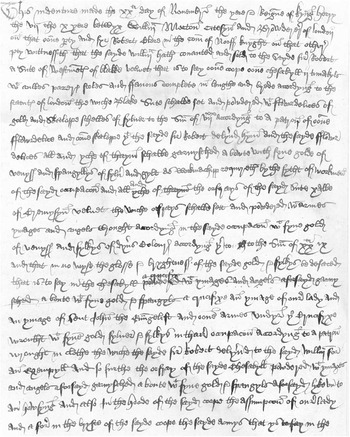
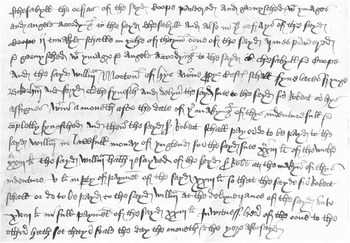
The contract is included in BL, Add ms 41305, fols 35v and 36 (figs 11 and 12), and is a copy of an original indenture that is no longer extant. The copy was made by an unknown person, ostensibly at the request of Dame Alinore Towneshend. The spelling of words is not consistent throughout and there are several words, phrases and lines of script through which lines have been drawn; these have been shown struck through in the following transcription. If the meaning of the word is quite clear from either the context or the spelling, it has been left as written. For more obscure spellings, the meaning has been clarified by the insertion of letters within square brackets. The use of contractions has not been changed (as in the use of ‘w’in’ for ‘within’ and ‘ye’ for ‘the’). The copy was written with no recognisable punctuation and none has been added.
This indenture made the xxth day of Novembr the yere & Reigne of Kyng Henry the vii the x yere betwyx William Morton Citesyn and Browderer of London on that oone p[ar]ty and Syr Robert Clere in the com[ty] of Norff[olk] knyght on that other p[ar]ty wittnessth that the sayde William hath co[ve]nanted and sold to the sayde sir Robert a sute of Vestments of blakke velwet that is to say oone coope oone chesabyll ij tunakyls wt aulbes parers stoles and ffanons complete in lengthe and brede accordyng to the Statuts of London the wiche Blake sute schalbe set and powdered with flowrdelices of gold and skalope schelles of sylver to the s[u]m of vii xx accordyng to a patron of oone fflowrdelice and oone skalope that the sayde sir Robert delyv[ere]d hym and the sayde fflowrdelices all and yche of thaym schalbe garnyshed abowte with fyne golde of venyss and spangyllys of sylv[er] and gylt as workma[n]chipp requireth by the sytht of workmen of the sayd occupacon and all and yche of the orfrays of the sayd sute & albe of cremysyn velwet the wiche orfrays schalbe sett and powdered wt armes ymages and angels wrought according in the sayde occupacon wt fine gold of venyss and sylkys of dyv[er]s colours according[l]y to the s[u]m of xxix and that in no wyse the glosse & bryghtnss of the sayde gold &sylkys be defaced that is to say in the chesabyll garnyshed aboute wt fyne gold & spangyls a crucifix an ymage of our lady and an ymage of sent John the Evangelist and oone armes undyr ye crucifyxe wroutht wt fine gold sylver & sylkys in their occupacon accordyng to a patron wrought in clothe the wiche the sayde sir Robert delyv[ere]d to the sayd William for an exampyll and so furthe[r] the orfray of the sayde chesabyll powdered wt ymages and angels aforsayd garnyshed aboute wt fyne gold & spangyls aforsayd lyke unto an howsyng and also in the hoode of the sayd coope the assumpcon of our lady and a for in the bryste of the sayde coope the sayde armys that ys in the chesabyll the orfra[y]s of the sayd coope powdered and garnyshed wt ymages and angels according to the sayd chesabyll and also in ye orfrays of the sayde tunakyls schalbe in yche of theym oone of the sayd armes powdered & gar[n]yshed wt ymages & angels accordyng to the sayd chesabyll &coope and the sayd William Morton of hys awone p[ro]pyr cost schall fynd laces fringe Bokerham and seryd clothe fynesch and delyv[er] the sayd sute to the sayd sir Robert or hys assignes wtin a moneth after the date of ye making of thys indenture full & Co[m]pletly fynesched and then the sayd S[ir] Robert schall pay or do to be payd to the sayd William in lawfull monay of yngland for the sayd sute xxiij li of the wiche xxiij li the sayd Willim hath resey[r]ved of the sayd S[ir] Robt at the makyn of thys indenture v li in p[ar]ty of payme[n]t of the sayd xxiij li so that the syde sir Robert schall or do to be payd to the sayd Willim at the delyverance of the sayd sute xviij li in full payme[n]t of the sayd xxiij li in witness her[e] of the oone to the other hath set thayr seale the day the moneth & the yere aforsayd
BL, Add ms 41305, fol 35v. Photograph: © The British Library Board

BL, Add ms 41305, fol 36. Photograph: © The British Library Board

Abbreviations And Bibliography
-
Abbreviations
- BL
-
British Library, London
- FM
-
Fitzwilliam Museum, Cambridge
- LH
-
Longleat House, Wiltshire
- LMA
-
London Metropolitan Archives
- MC
-
Mercers’ Company, London
- OC
-
Oscott College, Birmingham
- ROM
-
Royal Ontario Museum, Toronto
- TNA
-
The National Archives, Kew
- V&A
-
Victoria and Albert Museum, London