Successful adaptation in immigrant youth is a high-stakes issue for multiple stakeholders in many countries because of its potential long-term significance for the well-being of migrants and the vitality of receiving societies (Masten, Liebkind, & Hernandez, in press). Immigrant youth are simultaneously confronted with the challenges of development and acculturation (Motti-Stefanidi, Berry, Chryssochoou, Sam, & Phinney, in press), often in a societal context replete with prejudice and discrimination (Garcia-Coll et al., Reference Garcia-Coll, Lamberty, Jenkins, McAdoo, Crnic and Wasik1996). Despite the challenges they face, their adaptation is often positive, and sometimes better than that of their nonimmigrant peers (Berry, Phinney, Sam, & Vedder, Reference Berry, Phinney, Sam and Vedder2006; Garcia-Coll & Marks, Reference Garcia-Coll and Marks2011). Nonetheless, there is also striking variation within immigrant and nonimmigrant groups in the adaptive success of young people (e.g., Fuligni, Reference Fuligni1997).
The present study is a longitudinal investigation of adaptation trajectories of immigrant students enrolled in Greek urban public schools. Students were studied in their school contexts, and the quality of their adaptation was compared to that of their nonimmigrant classmates. The focus is on variations in adaptation, both between and within groups of immigrant and nonimmigrant youth. Adaptation was examined at the individual and classroom levels of analysis through hierarchical linear modeling (HLM) in order to examine intradindividual change, group differences in adaptation and growth, and the role of classroom context.
During the first year of the study, students were young adolescents in transition from primary to secondary school. This is a major period of developmental transition, which involves significant changes and exposes youth to new educational and social challenges (Roeser, Eccles, & Sameroff, Reference Roeser, Eccles and Sameroff1998). These changes are often incongruent with the developmental needs of adolescents, which may explain in part why early adolescence is often marked by significant declines in academic achievement (e.g., Fredricks & Eccles, Reference Fredricks and Eccles2002), worse conduct (e.g., Bongers, Koot, van der Ende, & Verhulst, Reference Bongers, Koot, van der Ende and Verhulst2004), as well as increases in emotional symptoms (e.g., Cole et al., Reference Cole, Tram, Martin, Hoffman, Ruiz and Jacquez2002). Given that immigrant youth are exposed to acculturative challenges, in addition to developmental challenges, it is an interesting period to study adaptation over time, particularly in relation to the adaptation and development of their nonimmigrant classmates (Fuligni, Reference Fuligni2001) who primarily confront normative developmental challenges.
Conceptual Framework
The conceptual framework for this study was based on an integrative new, multilevel approach to research on adaptation in immigrant youth developed by Motti-Stefanidi et al. (in press). This framework was influenced by theory from multiple fields, but especially the following perspectives: the three-level model of immigrant adaptation proposed by Verkuyten (Reference Verkuyten2005), a social psychologist studying issues of ethnicity and migration; Bronfenbrenner's bioecological model of human development (Bronfenbrenner & Morris, Reference Bronfenbrenner, Morris and Lerner2006); Berry's cultural transmission model (Berry, Poortinga, Breugelmans, Chasiotis, & Sam, Reference Berry, Poortinga, Breugelmans, Chasiotis and Sam2011); and the risk and resilience framework, which was initially proposed by Norman Garmezy (Garmezy, Masten, & Tellegen, Reference Garmezy, Masten and Tellegen1984) and other pioneers in this area (e.g., Rutter, Reference Rutter1985; Werner & Smith, Reference Werner and Smith1982) and later elaborated by Garmezy's student Ann Masten (Masten, Reference Masten2007) and other contemporary investigators (e.g., Luthar, Cicchetti, & Becker, Reference Luthar, Cicchetti and Becker2000).
This integrative model offers a conceptual framework for judging positive adaptation in immigrant children. The adaptation of immigrant youth can be judged with respect to success in age-salient developmental tasks and also acculturative tasks, as well as in terms of psychological well-being (Motti-Stefanidi et al., in press). The present study examines the trajectories of immigrant youth with respect to core developmental tasks and to psychological well-being.
Adaptive success in young people can be assessed on the basis of whether they meet the expectations and standards for behavior and achievement related to developmental tasks that parents, teachers, and society set for them, and that they themselves usually come to share (Masten, Burt, & Coatsworth, Reference Masten, Burt, Coatsworth, Cicchetti and Cohen2006; McCormick, Kuo, & Masten, Reference McCormick, Kuo, Masten, Fingerman, Berg, Smith and Antonucci2011). However, for immigrant youth who navigate at least two cultures, a monocultural perspective focused only on one set of developmental tasks, those defined by the dominant culture, is particularly problematic for understanding adaptation (Motti-Stefanidi et al., in press). Furthermore, comparing their behavior and achievement to that of their nonimmigrant peers may lead to the conclusion that immigrant youth are inferior in some way, which could be attributed to genetic, behavioral, or cultural deficiencies. This “deficit” approach to the study of minority group adaptation has been denounced; instead, it has been argued that the adaptation of minority children needs to be examined in its own right, and not always in comparison to the mainstream standard (Garcia Coll, Akerman, & Cicchetti, Reference Garcia Coll, Akerman and Cicchetti2000; McLoyd, Reference McLoyd2006; Motti-Stefanidi et al., in press).
Nevertheless, it could be argued that it is reasonable to judge current behavior and performance in terms of future adaptation in the host society, evaluating developmental task success of immigrant youth in relation to what is expected of nonimmigrant peers (Motti-Stefanidi et al., in press). Three core developmental tasks faced by young people in contemporary Western societies, regardless of their social or immigrant status, are academic achievement, conduct, and peer competence. How well young people are doing in school, whether they exhibit rule-abiding conduct, and whether they are liked by peers and have friends are significant indices of current adaptive success and forerunners of future adaptation in society for all youth (Masten et al., Reference Masten, Burt, Coatsworth, Cicchetti and Cohen2006; McCormick et al., Reference McCormick, Kuo, Masten, Fingerman, Berg, Smith and Antonucci2011).
Internal psychological adaptation, evaluated by indices of perceived well-being versus distress, is also a significant marker of positive adaptation for all youth (Masten et al., Reference Masten, Burt, Coatsworth, Cicchetti and Cohen2006). Psychological well-being is related concurrently and over time with external adaptation in developmental tasks (Masten et al., Reference Masten, Long, Roisman, Burt, Obradović and Roberts2005), although psychological well-being can be incongruent with success in developmental tasks, such as when successful young people living under stressful conditions are depressed or anxious (Luthar, Reference Luthar1991).
Based on this integrative framework, individual and group variations in immigrant youth adaptation are examined in developmental and acculturative contexts, taking into account multiple levels of analysis (Motti-Stefanidi et al., in press). The backbone of the framework consists of three levels. The individual level is focused on individual differences. The level of interaction is focused on interactions that shape the individual life course of immigrants, and that take place in contexts, such as the school. Finally, the societal level is focused on variations in cultural beliefs, social representations, and ideologies, as well as variables that reflect power positions within society (e.g., social class, ethnicity). The three levels of the model are viewed as interconnected and embedded within each other.
The levels of this integrative model refer to system levels of context. However, the concept of levels can also refer to levels of analysis, or scientific explanation. These two conceptions of levels are interrelated, yet distinct. For example, the influence of each of the levels of context on adaptation can be examined at different levels of scientific explanation. At the first level of analysis the unit is the individual, at higher contextual levels, the unit may be the classroom, the school, the city, or the country. The influence of socioeconomic status (SES) adversity, a societal level variable, on adaptation can be examined at the individual level of analysis, by assigning to each study participant a score reflecting the SES standing of the family, or at the level of interaction, by assigning a score on mean SES adversity to schools. In the following study, these distinct meanings of “level” will be clearly delineated for variables that have been defined and analyzed at multiple levels.
Contextual Risks for Immigrant Youth Adaptation
Immigrant youths confront normative developmental challenges at the same time that they contend with significant contextual stressors. Immigrant status and SES adversity are two indicators of contextual adversity that have each been shown to put at risk the adaptation of young people (Garcia-Coll et al., Reference Garcia-Coll, Lamberty, Jenkins, McAdoo, Crnic and Wasik1996; McLoyd, Reference McLoyd1998). Immigrant families are often overrepresented in the low SES strata of host societies (e.g., Beck & Tienda, in press). Nonetheless, an “immigrant paradox” has been described, whereby first-generation immigrants have better adaptation than either their national peers or second generation immigrants (Berry et al., Reference Berry, Phinney, Sam and Vedder2006; Garcia Coll et al., in press; Garcia Coll & Marks, 2011). However, this phenomenon has not been observed in all receiving societies (e.g., Motti-Stefanidi, Pavlopoulos, Obradović, Dalla, et al., Reference Motti-Stefanidi, Pavlopoulos, Obradović, Dalla, Takis and Papathanasiou2008), in all immigrant groups within a society (e.g., Fuligni, Reference Fuligni1997), or even in all domains of adaptation (e.g., Sam, Vedder, Liebkind, Neto, & Virta, Reference Sam, Vedder, Liebkind, Neto and Virta2008).
In contrast to the immigrant paradox, a number of cross-sectional studies have shown a significant achievement gap between immigrant and nonimmigrant youth (e.g., Cooper, Reference Cooper2003). The immigrant paradox is more consistently found in educational attitudes and behavior than in grades and test scores (Garcia Coll & Marks, 2011). The family's lower SES is also associated with generally worse academic and cognitive achievements (e.g., McLoyd, Reference McLoyd1998), although immigrant status may independently account for additional variance in school achievement difficulties (Portes, Reference Portes1999). Longitudinal patterns of the academic achievement of immigrant (Suárez-Orozco et al., Reference Suárez-Orozco, Gáytan, Bang, Pakes, O'Connor and Rhodes2010) and nonimmigrant (Wigfield, Eccles, Schiefele, Roeser, & Davis-Kean, Reference Wigfield, Eccles, Schiefele, Roeser, Davis-Kean, Damon, Lerner and Eisenberg2006) early adolescents seem to follow similar declining paths. These declines are generally more pronounced among youth from disadvantaged socioeconomic backgrounds (Wigfield et al., Reference Wigfield, Eccles, Schiefele, Roeser, Davis-Kean, Damon, Lerner and Eisenberg2006).
In addition, the socioeconomic and ethnic composition of the school context have also been shown to have an impact on students' grade point average (GPA; see OECD, 2010), although, according to some studies, the former matters significantly more than the latter (e.g., Rumberger & Palardy, Reference Rumberger and Palardy2005). However, a significant negative effect of ethnic composition on school achievement at high levels of segregation (over 40%) has also been reported (Szulkin & Jonsson, Reference Szulkin and Jonsson2007). According to some studies, the school's social and ethnic composition similarly affects all students (e.g., Rumberger & Palardy, Reference Rumberger and Palardy2005), but according to others, they may affect some students more than others (e.g., Hochschild & Scovronick, Reference Hochschild and Scovronick2003). Finally, with respect to the effect of school social and ethnic composition on longitudinal change in immigrant students' academic achievement, Suárez-Orozco and colleagues (2010) found that about one-third of the recently arrived early adolescent immigrant students, who followed positive academic trajectories, were enrolled in the least segregated and higher mean SES schools, compared to those with problematic academic trajectories.
Evidence from cross-sectional studies regarding the effect of immigrant status on adolescent students' conduct (breaking or following the rules of school and society) is also contradictory. Some studies have found evidence, consistent with the immigrant paradox, showing that first-generation students reported significantly fewer behavior problems than their nonimmigrant peers (Berry et al., Reference Berry, Phinney, Sam and Vedder2006), whereas others have found that immigrant status is associated with a higher likelihood of antisocial behavior (e.g., Bengi-Arslan, Verhulst, van der Ende, & Erol, Reference Bengi-Arslan, Verhulst, van der Ende and Erol1997). In still other studies, the findings depend on the ethnic group under study (e.g., Motti-Stefanidi, Pavlopoulos, Obradović, Dalla, et al., Reference Motti-Stefanidi, Pavlopoulos, Obradović, Dalla, Takis and Papathanasiou2008). In contrast, the evidence is clear that there is an inverse relationship between students' SES and conduct problems (Lahey, Miller, Gordon, & Riley, Reference Lahey, Miller, Gordon, Riley, Quay and Hogan1999; McLoyd, Reference McLoyd1998).
Longitudinal studies of externalizing behavior show decreasing developmental trends for some behaviors (e.g., aggression, opposition, and property violations) but rising trajectories for other problems (e.g., status violations, such as alcohol and drug use and truancy; Bongers et al., Reference Bongers, Koot, van der Ende and Verhulst2004). To the best of our knowledge, the conduct of immigrant students has not been examined longitudinally, although ethnic minority and low SES status appear to be associated with delinquent developmental patterns (Moffitt, Reference Moffitt, Cicchetti and Cohen2006). In regard to the possible effects of school characteristics on conduct, students who are enrolled in schools that do not meet their developmental needs, appear to be at higher risk for school behavior problems, independently of immigrant or social status (Roeser et al., Reference Roeser, Eccles and Sameroff1998). These are often the schools with high ethnic and low SES composition (Suárez-Orozco et al., Reference Suárez-Orozco, Gáytan, Bang, Pakes, O'Connor and Rhodes2010).
The criteria for judging positive adaptation with respect to immigrant youth's peer relationships differ depending on whether one takes a developmental or an acculturation perspective. From a developmental perspective, being accepted by peers and classmates is an important index of current, and predictor of future, adaptation, and psychological well-being (Masten et al., Reference Masten, Burt, Coatsworth, Cicchetti and Cohen2006). From an acculturation perspective, based on the assumption that the learning and maintenance of both cultures is conducive to better adaptation and psychological well-being (Berry et al., Reference Berry, Poortinga, Breugelmans, Chasiotis and Sam2011), having friends and being accepted by both intra- and interethnic peers is a sign of positive adaptation (Motti-Stefanidi et al., in press; Spiel & Strohmeier, in press). In sum, immigrant adolescents, like all adolescents, need to be liked and accepted by their peers, independently of the ethnicity of these peers, but they also need to navigate successfully between intra- and interethnic peers.
Immigrant status may be a risk factor, under certain conditions, for peer popularity. Immigrant youth have been described as preferring intraethnic over interethnic peers (e.g., Titzmann & Silbereisen, Reference Titzmann and Silberreisen2009), a phenomenon called friendship homophily (McPherson, Smith-Lovin, & Cook, Reference McPherson, Smith-Lovin and Cook2001). Therefore, whether immigrant status is a risk factor for peer popularity seems to depend to a large extent on the ethnic composition of the student's school. A lower ethnic composition of the school has been shown to put immigrant students at higher risk for low peer acceptance and popularity, because there is a smaller “pool” of immigrant students to choose from (Titzmann & Silbereisen, Reference Titzmann and Silberreisen2009). In contrast, a higher ethnic composition of the school reduces their chance to interact with nonimmigrant peers, and presents a risk for their acculturation.
In any case, the homophily biases, described at first contact between immigrant and nonimmigrant students, have been argued to decrease as opportunities for interactions, particularly positive interactions, increase over time in multicultural schools (e.g., Spiel & Strohmeier, in press). This latter trend can be explained, according to intergroup contact theory, because “familiarity breeds liking,” primarily by reducing prejudice (Pettigrew & Tropp, Reference Pettigrew and Tropp2006). Similar arguments as the ones presented for the effect of immigrant status on peer popularity can explain the finding that students' SES is also not associated with peer popularity (e.g., Motti-Stefanidi, Pavlopoulos, Obradović, Dalla, et al., Reference Motti-Stefanidi, Pavlopoulos, Obradović, Dalla, Takis and Papathanasiou2008).
The literature on immigrant status or SES as risk factors for psychological well-being in adolescence is mixed, although evidence consistently indicates a general increase in distress associated with early adolescence. Some studies find a risk effect (e.g., Oppedal & Roysamb, Reference Oppedal and Roysamb2004), whereas other studies find no difference in well-being between immigrant and nonimmigrant youth (e.g., Berry et al., Reference Berry, Phinney, Sam and Vedder2006; Motti-Stefanidi, Pavlopoulos, Obradović, Dalla, et al., Reference Motti-Stefanidi, Pavlopoulos, Obradović, Dalla, Takis and Papathanasiou2008; Sam et al., Reference Sam, Vedder, Liebkind, Neto and Virta2008). The literature on SES as a risk factor for well-being indicates risk for internalizing problems, although less consistently than the risk for externalizing symptoms (e.g., McLoyd, Reference McLoyd1998). Longitudinal studies indicate an increase in internalizing symptoms associated with early adolescence, independently of the immigrant and/or social status of the individual (Cole et al., Reference Cole, Tram, Martin, Hoffman, Ruiz and Jacquez2002).
The possibility of school-level effects on psychological well-being among immigrant or nonimmigrant youth has been considered theoretically, although research is limited. The degree to which the school context meets early adolescents' developmental needs is viewed as a significant promotive factor of their emotional well-being (Roeser et al., Reference Roeser, Eccles and Sameroff1998). However, as noted above, the schools where immigrant youth are enrolled have often high ethnic and low SES composition and are ill equipped to support their developmental and acculturative needs (Suárez-Orozco, et al., Reference Suárez-Orozco, Gáytan, Bang, Pakes, O'Connor and Rhodes2010), putting at risk their psychological well-being.
Resources for Immigrant Youth Adaptation
As would be expected on the basis of the multifinality principle (e.g., Cicchetti & Toth, Reference Cicchetti and Toth2009), significant individual variation is observed within immigrant and nonimmigrant youth in adaptive trajectories, with some beating the odds and doing well (e.g., Fuligni, Reference Fuligni1997). This diversity in outcomes suggests that certain resources contribute to youth's positive adaptation despite the adversity in their lives (Cicchetti & Rogosh, Reference Cicchetti and Rogosch2002; Masten, Reference Masten2007). These resources may derive from any one of the three levels of the integrative framework presented earlier (individual level, level of interaction, societal level; Motti-Stefanidi et al., in press).
Self-efficacy and parental school involvement are two potential factors that may promote or protect the adaptation and well-being of immigrant and nonimmigrant youth. Self-efficacy, which refers to people's beliefs in their capabilities to regulate their functioning, and to manage environmental demands in order to achieve desired outcomes, plays a crucial role in the way young people manage risks and challenges (Bandura, Reference Bandura1997). Adolescents high in self-efficacy deal more proactively with the demands and pressures of their environment, trusting that they have the capacity to bring about desired goals on their own. Self-efficacy has been shown to promote, both concurrently and over time, the academic achievement (e.g., Bandura, Barbaranelli, Caprara, & Pastorelli, Reference Bandura, Barbaranelli, Caprara and Pastorelli1996), peer popularity (e.g., Caprara, Barbaranelli, Pastorelli, & Cervone, Reference Caprara, Barbaranelli, Pastorelli and Cervone2004), and conduct (e.g., Bandura, Caprara, Barbaranelli, Pastorelli, & Regalia, Reference Bandura, Caprara, Barbaranelli, Pastorelli and Regalia1996) of early adolescents, and to be negatively associated with depression (e.g., Bandura, Pastorelli, Barbaranelli, & Caprara, Reference Bandura, Pastorelli, Barbaranelli and Caprara1999). Furthermore, there is scant evidence that self-efficacy beliefs moderate the relationship between context and different indicators of development (Bradley & Corwyn, Reference Bradley and Corwyn2001).
Both cross-sectional and longitudinal studies show that parental monitoring of early adolescents' school progress and behavior, partly achieved through their involvement in their child's school, promote early adolescents' positive adaptation (Hill & Taylor, Reference Hill and Taylor2004). Parents' involvement in the school signals to both their children and teachers that they value education, increases their skills and information regarding the school's expectations for behavior and homework, and functions as a form of social control, because parents and teachers can work together to build a consensus about behavioral and academic goals. Parental school involvement has also been shown to mediate the relationship between authoritative parenting and academic achievement (Steinberg, Lamborn, Dornbusch, & Darling, Reference Steinberg, Lamborn, Dornbusch and Darling1992).
There is no consensus in the literature on how parental school involvement functions across SES backgrounds and ethnicity. For example, some studies report that even though minority and low SES parents are less likely to be involved in their children's schooling (Hill & Taylor, Reference Hill and Taylor2004), the positive association of parental involvement with school success holds equally across SES and minority status groups (e.g., Gutman, Sameroff, & Eccles, Reference Gutman, Sameroff and Eccles2002). In contrast, for example, Hill and Tyson (Reference Hill and Tyson2009) showed that parental school involvement is more strongly related to the academic achievement of minority than majority adolescents, and that it predicts the academic achievement and conduct of high but not low SES youth. Finally, in a very recent study parental involvement together with racial/ethnic socialization were shown to moderate the relationship between public regard, a contextual risk related to racial/ethnic minority status, and adolescents' academic adjustment (McGill, Hughes, &Way, Reference McGill, Hughes, Alicea and Way2011).
The Present Study
The present study is unique in focusing on longitudinal adaptation for immigrant and nonimmigrant youth, assessed with diverse methods and informants, utilizing HLM to consider change over time across embedded levels of analysis. Furthermore, it compares and contrasts the patterns of adaptation and psychological well-being of immigrant and nonimmigrant youth embedded in the same classrooms.
The sample consisted of early adolescents, aged 12–13 years at Wave 1, enrolled in Greek urban public high schools. The students were assessed three times, once every year of compulsory secondary school education. Because the three assessment points were nested within individuals, and individuals within classrooms, three-level hierarchical linear models were used, first to study initial level and change in adaptation and psychological well-being over time (Level 1 in the HLM model), and, second, to disentangle individual (Level 2) and classroom (Level 3) effects on initial level and change in adaptation and psychological well-being. We focused on the classrooms at Level 3, because they are the immediate educational context of the students. Furthermore, classrooms are embedded in schools, and the regulatory processes characterizing them are interrelated (Eccles, Reference Eccles, Lerner and Steinberg2004). Therefore, we presented in the literature review results that pertain to both schools and classrooms.
Greece used to be a source of immigrants and then transformed into an immigrant receiving country in the early 1990s. Today, more than 10% of the students enrolled in Greek public schools are of immigrant origin. The two largest immigrant groups in the country are economic immigrants from Albania and Pontic-Greek immigrants from the former Soviet Union, who are ethnic immigrants. The former are treated by the state as economic immigrants, even when born in Greece. The latter are considered to be returning natives and are given citizenship. The attitudes of nonimmigrants toward the presence of immigrants in the country are generally negative (Semyonov, Raijman, & Gorodzeisky, Reference Semyonov, Raijman and Gorodzeisky2006). Both immigrant groups experience significant, although not the same degree of, discrimination (Triandafyllidou, Reference Triandafyllidou2000).
Pontic-Greeks are descendants of the ancient Hellenic communities of the southern coast of the Black Sea. During the Stalinist era the Pontic-Greeks were persecuted and deported to different areas of the Soviet Union. These immigrants are of Greek ethnicity and members of the Greek Orthodox Church. They retained their Greek culture, language, religion, and customs for about 20 centuries, but never lived in Greece (Georgas & Papastylianou, Reference Georgas, Papastylianou, Grad, Blanco and Georgas1996). Therefore, their language is incomprehensible to native Greeks, as it is a Greek dialect rooted in Ancient Greek. Most Pontic-Greeks do not speak Modern Greek well (Triandafyllidou, Reference Triandafyllidou2000). In contrast, all immigrants from Albania, a neighboring country to Greece, entered the country as undocumented economic immigrants. After more than 40 years of Communist rule (1945–1989), a large proportion of the Albanian workforce, together with their families, immigrated to neighboring Greece and Italy.
We collected data from schools with a high percentage of immigrant youth from these two ethnic groups. The few immigrant students in these schools who did not belong to these ethnic groups, originated from different European, Asian, and African countries.
Hypotheses
The present study was designed to address three overarching questions formulated in risk and resilience terms. Two research questions focus on risk and one on resilience:
Question 1: Are immigrant status and social adversity risk factors for initial level and change in adaptation and psychological well-being?
Based on our previous cross-sectional studies of immigrant youth in Greece and the literature reviewed above, we expected immigrant status (Motti-Stefanidi, Pavlopoulos, Obradović, Dalla, et al., Reference Motti-Stefanidi, Pavlopoulos, Obradović, Dalla, Takis and Papathanasiou2008; Motti-Stefanidi, Pavlopoulos, & Tantaros, Reference Motti-Stefanidi, Pavlopoulos and Tantaros2011) and SES adversity (McLoyd, Reference McLoyd1998) to be risk factors for students' GPA. These hypotheses are based, first, on the immigrant students having serious language barriers and minimal, if any, educational support in the Greek education system to overcome them and, second, the schools addressing neither immigrant students' nor low SES students' general educational needs. We also expected that immigrant status would continue to explain variance in academic achievement even after controlling for SES adversity (Portes, Reference Portes1999). With regard to changes in adaptation (assessed via repeated measures), school achievement was expected to decline over the course of the study in both immigrant (Suárez-Orozco et al., Reference Suárez-Orozco, Gáytan, Bang, Pakes, O'Connor and Rhodes2010) and nonimmigrant groups, as well as in students of high and low SES adversity (Wigfield et al., Reference Wigfield, Eccles, Schiefele, Roeser, Davis-Kean, Damon, Lerner and Eisenberg2006). Because the academic achievement of immigrant and nonimmigrant youth from the same classrooms has not been directly compared and studied longitudinally in past research, it was not clear what to expect regarding a possible widening or closing of the achievement gap between them. However, because the school performance of immigrant youth is just above the failing point, the achievement gap between immigrant and nonimmigrants groups would not be expected to widen any further.
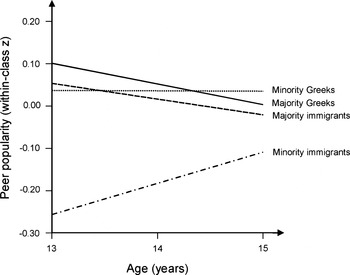
Based on our previous studies (Motti-Stefanidi et al., Reference Motti-Stefanidi, Pavlopoulos and Tantaros2011; Motti-Stefanidi, Pavlopoulos, Obradović, Dalla, et al., Reference Motti-Stefanidi, Pavlopoulos, Obradović, Dalla, Takis and Papathanasiou2008), immigrant status was expected to be a risk factor for the popularity of immigrant students as a whole, mostly because of the negative attitudes of nonimmigrants toward immigrants in the country (Semyonov et al., Reference Semyonov, Raijman and Gorodzeisky2006). For longitudinal change in popularity, we expected that any initial differences between immigrant and nonimmigrant groups would decrease over the course of the study as classmates became more familiar and cross-group friendships more likely (Pettigrew & Tropp, Reference Pettigrew and Tropp2006). SES adversity was not expected to be a risk factors for peer popularity, because of the homophily phenomenon (McPherson et al., Reference McPherson, Smith-Lovin and Cook2001).
The analyses regarding the effect of immigrant status on conduct were exploratory because the findings in the literature are contradictory, and our own previous studies yield different results depending on the ethnic group (Motti-Stefanidi, Pavlopoulos, Obradović, Dalla, et al., Reference Motti-Stefanidi, Pavlopoulos, Obradović, Dalla, Takis and Papathanasiou2008). With regard to longitudinal change, an increase in conduct symptoms would be expected in all youth, and particularly among disadvantaged youth (Bongers et al., Reference Bongers, Koot, van der Ende and Verhulst2004; Moffitt, Reference Moffitt, Cicchetti and Cohen2006). To the best of our knowledge, the conduct of immigrant youth has not been studied longitudinally.
Concerning psychological well-being, even though the literature is contradictory, based on our previous work, we did not expect immigrant students or students of high SES adversity to differ in well-being from their nonimmigrant peers. Both immigrant and nonimmigrant students were expected to show a decrease in their psychological well-being over this time period, in keeping with the general literature on declining well-being in early adolescence (Cole et al., Reference Cole, Tram, Martin, Hoffman, Ruiz and Jacquez2002).
Question 2: Are the socioeconomic and ethnic composition of the classrooms risk factors for initial level, and change in adaptation and psychological well-being?
Based on the literature reviewed above it was expected that both the socioeconomic (Rumberger & Palardy, Reference Rumberger and Palardy2005) and the ethnic (Szulkin & Jonsson, Reference Szulkin and Jonsson2007) composition of classrooms would be risk factors, both concurrently and over time, for students' academic achievement, as well as for students' conduct and psychological well-being. Such classrooms are often ill equipped to deal with the developmental and acculturative needs of their students with deleterious consequences not only for their academic achievement (Suárez-Orozco et al., Reference Suárez-Orozco, Gáytan, Bang, Pakes, O'Connor and Rhodes2010) but also for their behavior and psychological well-being (Roeser et al., Reference Roeser, Eccles and Sameroff1998; see Wigfield et al., Reference Wigfield, Eccles, Schiefele, Roeser, Davis-Kean, Damon, Lerner and Eisenberg2006). In what concerns peer popularity, it was expected that a higher proportion of nonimmigrants in a classroom would be associated with a higher risk for the peer popularity and acceptance of the immigrants, because of the homophily phenomenon (McPherson et al., Reference McPherson, Smith-Lovin and Cook2001).
Question 3: Are self-efficacy and parental school involvement promotive and/or protective factors for initial level, and changes in, adaptation and well-being?
Both self-efficacy and parental school involvement were expected to promote, both concurrently and over time, academic achievement, conduct, and peer popularity. Self-efficacy, but not parental involvement, was expected to promote, both concurrently and over time, students' psychological well-being. However, it was not clear from the literature what to expect with respect to same-level and cross-level moderations of resources by contextual risks on adaptation. Bandura (Reference Bandura1997) has argued that the success with which contextual risks are managed depends to a large extent on the strength of the individual's personal self-efficacy. This argument suggests that self-efficacy may predict differentially the relationship of contextual risk with adaptation, which could hold for any of the outcomes and any of the individual and classroom-level risks examined. Regarding parental school involvement, the evidence is not clear. However, even though parental school involvement would be expected to predict all students' academic achievement, this relationship would be expected to be stronger for nonimmigrant youth because other factors related to immigrant status, such as discrimination, may play an additional role in determining these students' GPA.
Method
Sample
This study included students attending 12 schools in Athens, Greece, which had high proportions of immigrant students. Permission to study the students in these schools was granted by the Greek Ministry of Education. A total of 1,057 students who attended 49 secondary-school Grade 1 classes took part in the study (Wave 1; age M = 12.7 years, SD = 0.65; 53% male). Of these students, 532 were immigrants (316 first generation, 216 second generation); first-generation immigrants had spent 65% (range = 13%–99%) of their lifetime in Greece. Depending on the area of town, the immigrant students were predominantly of Albanian origin (attending 9 schools) or Pontic-Greeks (attending 3 schools); the other immigrants originated from six different countries. Albanians were mainly first-generation immigrants (82%) whereas Pontic-Greeks (35% first generation) and other immigrants (41% first generation) were mainly second-generation immigrants. In addition, the proportion of immigrants in class varied between 20% and 100%, with a higher percentage in schools attended by Pontic-Greek students.
The cohort was assessed annually for three school years. Retention from Wave 1 to Wave 2 was 75% (N = 785) and 80% from Wave 2 to Wave 3 (N = 627), resulting in an overall retention rate of 59% from Wave 1 to Wave 3. The loss of 41% of the original cohort over the course of the study required a systematic evaluation of attrition effects.
Measures
All questionnaires were translated from Greek into Albanian and Russian and were then backtranslated into Greek by four bilingual speakers. Immigrant students could choose the language in which they preferred to respond to the questionnaires. The vast majority (90%) of the immigrant students chose to respond to the questionnaires presented in the Greek language.
Risks
Immigrant status (1 = being immigrant, 0 = being Greek), immigrant generation, and ethnicity (Albanian, Pontic-Greek, other) were all dummy coded.
Socioeconomic adversity was assessed in each wave by the sum of student-reported single-parent household, low professional status (e.g., unskilled worker, farmer, unemployed) of either parent and high residential density (i.e., the quotient of the number of people living in the house to the number of the rooms in the house being higher than one). The sum of risk factors provided a cumulative risk index (range = 0–4).
Resources
Parental involvement
In each wave, Greek language teachers rated the involvement of a student's parents in school issues on five items, each rated on a 5-point scale, ranging from not at all to very much. Sample items were “The student's parents are cooperative with teachers,” “The student's parents are interested in their child's school performance,” and “The student's parents are in contact with the teachers and the school.” Items were scored such that high scores indicate high involvement. The scale had high internal consistencies (in all waves, Cronbach α > 0.94 for all groups).
Self-efficacy
A global measure of an individual's degree of perceived self-efficacy was used to assess adolescents' beliefs in their self-efficacy (Bandura, Reference Bandura1990). The 44 items represent eight domains of functioning, namely, enlisting social resources, self-regulated learning, leisure time skills, self-regulation, meeting others' expectations, social efficacy, self-assertive efficacy as, well as enlisting (parental) social support. Sample items were “How well can you resist peer pressure to drink beer, wine or liquor?” “How well can you study when there are other interesting things to do?” Students rated their beliefs in their level of capability to manage the designated activities on a 7-point scale ranging from not good at all to very good. The scale had high internal consistencies (in all waves, Cronbach α > 0.91 for all groups).
Adaptation and psychological well-being
Four domains of adaptation were studied using multiple methods and informants.
Academic performance
This was assessed in terms of a student's GPA for each school year obtained from school records. Grade points in Greek secondary schools are rated by teachers on a 20-point scale, with higher points indicating better performance. The GPA of each student was based on the judgments of at least four different teachers and five different subjects during the first trimester of each school year of data collection (mathematics, ancient Greek, modern Greek, physics, and history). GPA consisted of the average across all available subjects on the 20-point scale.
Conduct
In each wave, Greek language teachers rated the conduct of each student in the classroom on five items, each rated on a 5-point scale, ranging from not at all to very much. The items assessed the degree to which the student disturbed the class or was aggressive toward peers. Sample items were: “makes fun of other kids in class,” “gets involved in fights.” Thus, they were all related to externalizing problems. Items were scored such that high scores indicate positive adaptation. The scale had high internal consistencies (in all waves, Cronbach α > 0.88 for all groups).
Peer popularity
In each wave, students in each classroom were asked to write down the names of three classmates that they liked most. An individual's popularity among all classmates, among Greek, and among immigrant classmates was measured in each wave by the total number of nominations received from such classmates. These popularity scores ranged from 0 to 11. To control for the number of nominating peers within a class, we standardized all three popularity scores by computing within-class z scores. Thus, all scores had 0 mean and 1 SD for each classroom.
Psychological well-being
This was self-rated by the students on the five items of the emotional symptoms subscale of the Strengths and Difficulties Questionnaire that all refer to internalizing problems (Goodman, Meltzer, & Bailey, Reference Goodman, Meltzer and Bailey1998), each rated on a 3-point scale, ranging from not true to certainly true. The items were reversely coded such that high scores indicate few symptoms. The scale had relatively low internal consistencies (in all waves, Cronbach α > 0.60 for both immigrant and Greek students). Item analyses showed that internal consistency could not be increased by dropping any one of the items.
Multilevel analyses
The three assessments were nested within individuals and individuals within school classes. Frequency of assessments for each individual also varied (range = 1–3, M = 2.3). Therefore we applied multilevel analysis (HLM; Raudenbush & Bryk, Reference Raudenbush and Bryk2002), using HLM 6.0.8 software (Raudenbush, Bryk, & Congdon, Reference Raudenbush, Bryk and Congdon2002). In these models, an outcome (e.g., academic performance) was predicted for each individual at Level 1 by wave in the study. Wave was centered at Wave 1 such that the individual intercepts referred to the initial level of the outcome. Thus, Wave 1 was recoded as 0, Wave 2 as 1, and Wave 3 as 2.
The individual initial level and the individual linear change over the three assessments (slope of the regression line) were predicted at Level 2 by the constant variables sex (to control for sex differences) and immigrant status (risk), and the Wave 1 variables sociodemographic adversity (risk), parental involvement and self-efficacy (resources), and the risk by resource interactions, with no predictors at Level 3 (classrooms). In a last step, the classroom characteristics percentage of immigrants in class and mean sociodemographic adversity in class were added to the models to test both main effects and cross-level interactions of these two classroom characteristics.
Finally, differences among the immigrants were studied by predicting adaptation from immigrant generation and dummy-coded ethnicity (Albanian, Pontic-Greek, other), controlling for sex and adversity, using the same types of three-level models as above.
Results
Sample attrition
We studied systematic sample attrition over the three waves of the study by comparing the drop-outs in Wave 2 with the students with assessments up to Wave 2, and the drop-outs in Wave 3 with the students with assessments up to Wave 3, in terms of the individual predictors and outcomes used in the multilevel models for all students, namely, sex, immigrant status, socioeconomic adversity, parental involvement, self-efficacy, and the four adaptation variables. Of the 2 × 9 = 18 tests, only two reached significance. Students who dropped out in Wave 2 had lower scores in academic performance and in conduct (in each case, .02 < p < .05, Cohen d < 0.25). Thus, the dropouts differed by less than a quarter of a standard deviation from the continuing participants. They were mostly because of teachers or students refusing to participate in the study or families moving to a different location; dropouts from the school system were extremely rare.
Because the data were not completely missing at random (Little, Reference Little1995), we initially included dummy-coded dropout in all multilevel analyses. Because the results for the remaining predictors were highly similar to the results for models without dropout control, we report here only the results for the latter less complex models. Because multilevel longitudinal analysis adequately controls for missing at random effects (Little, Reference Little1995; Hox, Reference Hox2010), we did not attempt to further control for such attrition effects.
Description of the variables
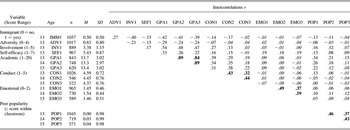
The means, standard deviations, and intercorrelations of the individual risks and resources at age 13 and the measures of adaptation at ages 13–15 are presented in Table 1.
Means, standard deviations, and intercorrelations of the risks and resources at age 13 and the competencies at ages 13 to 15

Note: Correlations in italic are not significant (p > .05). Stability correlations are in bold.
As expected, all significant correlations between risks and competencies were negative, all significant correlations between resources and competencies were positive, all significant correlations between risks and resources were negative, and all significant intercorrelations among risk measures, among resource indicators, and among indicators of adaptation were positive. Cross-age stabilities were very high for GPA and moderate for the other variables.
Multiple imputation at Level 2
Whereas missing values do not present a problem at Level 1 in multilevel models and did not occur in the current study at Level 3 (classrooms), missing values at Level 2 (individuals) presented a problem. Although they were unsystematic (mainly because some teachers did not cooperate in the study), listwise deletion of participants is required for multiple Level 2 predictors, which would have strongly reduced the sample of students. Therefore, we applied multiple imputation (five imputations using SPSS) for estimating missing values at Level 2, using all available Level 2 variables. All multilevel analyses were run using the multiple imputation option of HLM 6.0.8. (Thus, all multilevel analyses were run five times, and the results of the five runs were averaged.)
Decomposition of the variances of competencies
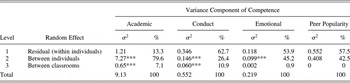
In order to provide information about the extent to which the three levels of analysis (age-related change, individuals, classrooms) contributed to the overall variation in each domain of adaptation, the variance components for each level were computed from the unconditional three-level model for each adaptation variable (see Table 2).
Decomposition of the variances of competencies into components at the levels of analysis
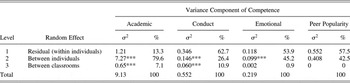
Note: Variance components refer to random coefficient models with no predictors. Missing values at Level 2 were imputed (five imputations). Significances of the Level 2 and Level 3 variance components refer to χ2 tests. Between-classroom variance was zero for peer popularity because popularity was standardized within classrooms.
***p < .001.
As expected, academic achievement (GPA) varied most strongly between individuals but also showed significant variation between classrooms and sufficient variation within individuals in the longitudinal analysis. Conduct showed strong variation within individuals, intermediate variation between individuals, and significant variation between classrooms. Psychological well-being and peer popularity showed a similar amount of variation within and between individuals, with nonsignificant variation between classrooms (the latter was trivial because popularity was standardized within classrooms). Thus, analyses of main effects of classroom characteristics were only useful for academic achievement and conduct.
Prediction of adaptation in developmental task domains by risks and resources
The analyses were designed to examine whether immigrant status and social adversity were risk factors for adaptation and for changes in adaptation, whether parental involvement in school issues and students' self-efficacy were resources promoting adaptation and changes in adaptation, and whether these risks and resources showed statistical interactions in these predictions. To address these questions, we used multilevel modeling to predict students' initial level of adaptation and linear change in adaptation between ages 13 and 15 by students' individual characteristics.
Because we had only three time points, we analyzed within-individual linear change and not more complex change functions. We centered age at age 13 such that the individual intercept always referred to the initial level of adaptation, and change referred to increases or decreases from initial level.
Hierarchical prediction of the effects of risks, resources, and their interaction
In recent research on risks and resources for adaptation, adaptation is often predicted by hierarchical ordinary regressions, entering first control variables such as sex, in a next step risks or resources, in the following step resources or risks (such that the effect of controlling for each other can be evaluated), and in a last step interactions between risks and resources (e.g., Masten et al., Reference Masten, Burt, Roisman, Obradović, Long and Tellegen2004). A similar procedure can be applied in multilevel modeling but faces the problem that adding a predictor may under certain conditions decrease rather than increase the explained variance such that the incremental explained variance is negative (Hox, Reference Hox2010). Therefore, a more cautious approach is in order where explained variances but not incremental explained variances are interpreted, and the significance of a nested model comparison is interpreted as an overall difference between these models rather than the significance of incremental variance explained by the added predictors.
In longitudinal multilevel models an additional complication arises from the fact that the individual initial scores and the individual slopes (change parameters) may be correlated, something that is not possible in ordinary regression approaches where the outcomes are controlled by the initial scores such that the slopes are forced to be statistically independent from the initial scores. Therefore, multilevel longitudinal models study change with models that include both initial (or mean) levels and slopes. Consequently, adding a predictor for the initial levels may not only explain variance of the initial levels but also variance of the slopes if the initial levels and slopes are correlated.
A reasonable approach in this case is comparing two sequences of nested models.Footnote 1 In the first sequence of initial level as outcome models, Level 2 predictors are added blockwise only for the individual initial levels but not for the slopes. This sequence of models is comparable with ordinary hierarchical regressions of initial level on the predictors; in particular, the explained Level 2 variance by each model can be computed, and increases in model fit can be interpreted as due to the added predictors.
In a second step, each model of this sequence can be expanded by predicting not only the initial levels but also the slopes from the predictors, resulting in a second sequence of initial level and slope as outcome models. The increase in model fit of such a model relative to its initial level and slope as outcome model can be interpreted as because of the prediction of slopes. Although the explained variance by such an expanded model can be computed, it should not be compared with the explained variance by the initial level as outcome model with the same predictors because it can be smaller than the explained variance of the simpler initial level as outcome model because of an intercept–slope correlation (“negative incremental explained variance”; see Hox, Reference Hox2010).
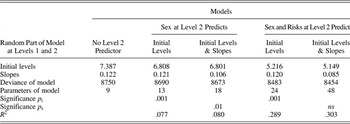
We illustrate the procedure in detail for the comparisons involved in the first steps of the hierarchical predictions of the initial levels and slopes of academic achievement. Table 3 contains the required data. The model without predictors at Level 2 serves as a baseline comparison model. Adding sex as a predictor for the initial levels at Level 2 reduced the Level 2 variance from 7.387 + 0.122 to 6.808 + 0.121; thus, R 2 = (7.509 – 6.929)/7.509 = .077, and model fit increased significantly relative to the baseline model, χ2 (df = 13 – 9 = 4) = 8750 – 8690 = 60, p < .001. Adding sex as a predictor of the slopes (changes between ages 13 and 15) reduced the Level 2 variance to 6.801 + 0.106 = 6.907; thus, R 2 = .080, and model fit increased significantly relative to the initial level as outcome model, χ2 (18 – 13 = 5) = 8690 – 8673 = 17, p < .01. It can be concluded that adding sex as a predictor of the slopes significantly increased the fit of the initial level and slope as outcome model relative to the initial level as outcome model.
Variance components at Level 2 and model deviances of nested multilevel models for academic achievement

Note: All models include age as a Level 1 predictor and no predictor at Level 3 (classrooms); p i refers to the significance of adding Level 2 predictors for the initial level as outcome models; p s refers to the significance of adding these predictors to these models also for the slopes; R 2 refers to the explained variance by each model. Missing values at Level 2 were imputed (five imputations).
Adding the two risks (immigrant status and adversity) to the initial level as outcome model as one block of predictors reduced the Level 2 variance further to 5.216 + 0.120 = 5.336, thus, R 2 = .289, and significantly increased the model fit relative to the model without risks, χ2 (df = 24 – 13 = 11) = 8690 – 8483 = 207, p < .001. For the initial level and slope as outcome model the procedure resulted in R 2 = .303, but the difference in fit relative to the initial level as outcome model was not significant, χ2 (df = 48 – 24 = 24) = 8483 – 8454 = 29, ns. This time, adding predictors for the slopes did not significantly increase the model fit.
Whereas the significance tests are based on straightforward model comparisons, explained variances are not fully incremental because of the complications outlined above, particularly because of correlations between initial levels and slopes. For example, adding predictors for slopes in the last model reduced the variance of the slopes relative to the initial level as outcome model from 0.120 to 0.085 but also the variance of the initial levels from 5.216 to 5.149.
We now report the results for a sequence of multilevel models where we entered four steps:
1. sex in order to control all results for sex differences,
2. risks or resources,
3. resources or risks (such that the effect of controlling for each other can be evaluated), and
4. one interaction between risks and resources.
We entered only one interaction in the last step in order to avoid problems of collinearity and overly complex models (note that each model in Step 4 had 234 parameters). All models did not include a Level 3 (classrooms) predictor.
We illustrate our logic of model construction with the regression equations for Model 2a for GPA (academic achievement) that predicts the initial GPA at age 13 as well as the linear change in GPA between ages 13 and 15 by sex, immigrant status, and adversity. We use the notation provided in the HLM output where P, B, and G denote regression coefficients and E, R, and U error terms:

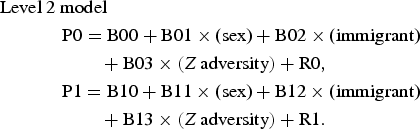
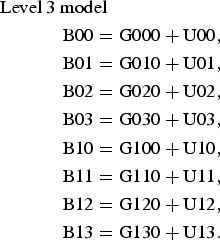
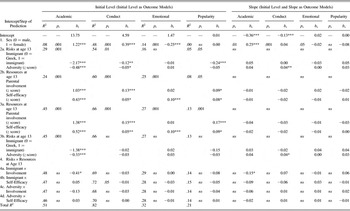
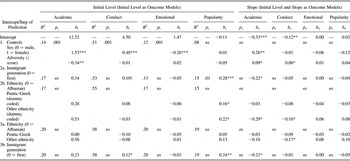
Table 4 contains the results for all models. We describe the results in detail for GPA and then summarize the main findings. The Level 2 intercept for the initial levels 13.75 is the estimated mean GPA at age 13 for a model without predictors at Level 2. The Level 2 intercept for the slopes in this model is the estimated mean 1-year change in GPA; thus, GPA decreased for 0.36 points per year. Note that these estimates may slightly deviate from the means in Table 1 because they are estimates by a multilevel model that takes all data into account. Sex significantly contributed to the prediction of both initial level and change in GPA; on average, females scored initially 1.22 points higher than males, and this sex difference increased by 0.25 GPA points per year. Thus, for age 15 females the GPA was estimated as being 1.22 + 0.25 + 0.25 = 1.72 points higher than male GPA.
Results of hierarchical multilevel regressions predicting initial levels or both initial levels and slopes of adaptation from sex and initial risks and resources

Note: Reported are (a) the explained variances R 2, the significances p i for increased model fit by adding predictors of initial level of adaptation and the unstandardized initial regression coefficients b i for each block of such predictors for a sequence of nested three-level random coefficient models with the Level 1 predictor age centered at age 13, four blocks of predictors for initial level of adaptation at Level 2 (individuals), and no predictor at Level 3 (classrooms); and (b) the significances p s for increased model fit by also predicting slopes in these models as well as the unstandardized initial regression coefficients b s for predicting these slopes for each block of predictors. The intercepts for the initial levels refer to the mean adaptation of male Greeks at age 13, and the intercepts for the slopes refer to the mean 1-year increase of male Greeks' adaptation. Missing values at Level 2 were imputed (five imputations). Significances for b refer to robust standard errors; significances for model comparisons refer to differences between deviance scores.
*p < .05. **p < .01. ***p < .001.
After controlling for sex, risks significantly contributed to initial GPA (Model 2a). At age 13, immigrants scored 2.17 points lower than Greeks, and an increase in students' sociodemographic adversity of 1 SD was associated with a decrease of 0.48 GPA points. Thus, being an immigrant and living in a socially adverse environment were unique risk factors for academic achievement.
Note that the b values can be directly compared in terms of effect sizes only for variables of the same scale. Because the four competencies were measured on different scales, the effect sizes cannot be directly compared between different columns of Table 4, and within columns they can only be directly compared between the dichotomies sex and immigrant status, and between the standardized predictors adversity, parental involvement and self-efficacy. Therefore, it would be misleading to conclude from the larger b for immigrants compared to adversity that the effect of being an immigrant was stronger than the effect of adversity. However, the b values can be easily transformed into standardized beta using the well-known formula

and these betas can be directly compared within and between the columns of Table 4. Because the standard deviations were 0.50 for immigrant status and 3.02 for GPA at age 13 (see Table 1), the effect of immigrant status on GPA was β = −2.17 × 0.50/3.02 = −0.36 and the effect of adversity on GPA was β = −0.48 × 1/3.02 = −0.16. Thus, immigrant status was more risky for GPA than adversity.Footnote 2
Similarly, resources predicted initial GPA when sex was controlled (Model 2b). If students' parents were 1 SD more involved in school issues, the students scored 1.38 GPA points higher, and students 1 SD higher in self-efficacy scored 0.52 GPA points higher. Thus, parents' involvement in school issues and students' self-efficacy were unique promotive factors for academic achievement. Because both resources were standardized, it may be concluded that the effect of parental involvement in school issues was more important for GPA than students' self-efficacy. However, caution has to be exercised here because GPA and parental involvement were rated by the same teacher, whereas self-efficacy was rated by the students themselves such that the stronger effect for parental involvement may be at least partly because of shared method variance.
Even with both risk factors controlled, each resource still predicted GPA. Conversely, risks also continued to predict GPA when resources were controlled. Adding risks or resources to the prediction of change in adaptation did not significantly increase model fit relative to the initial level as outcome model, and the regression coefficients b s in these models were close to zero and nonsignificant.
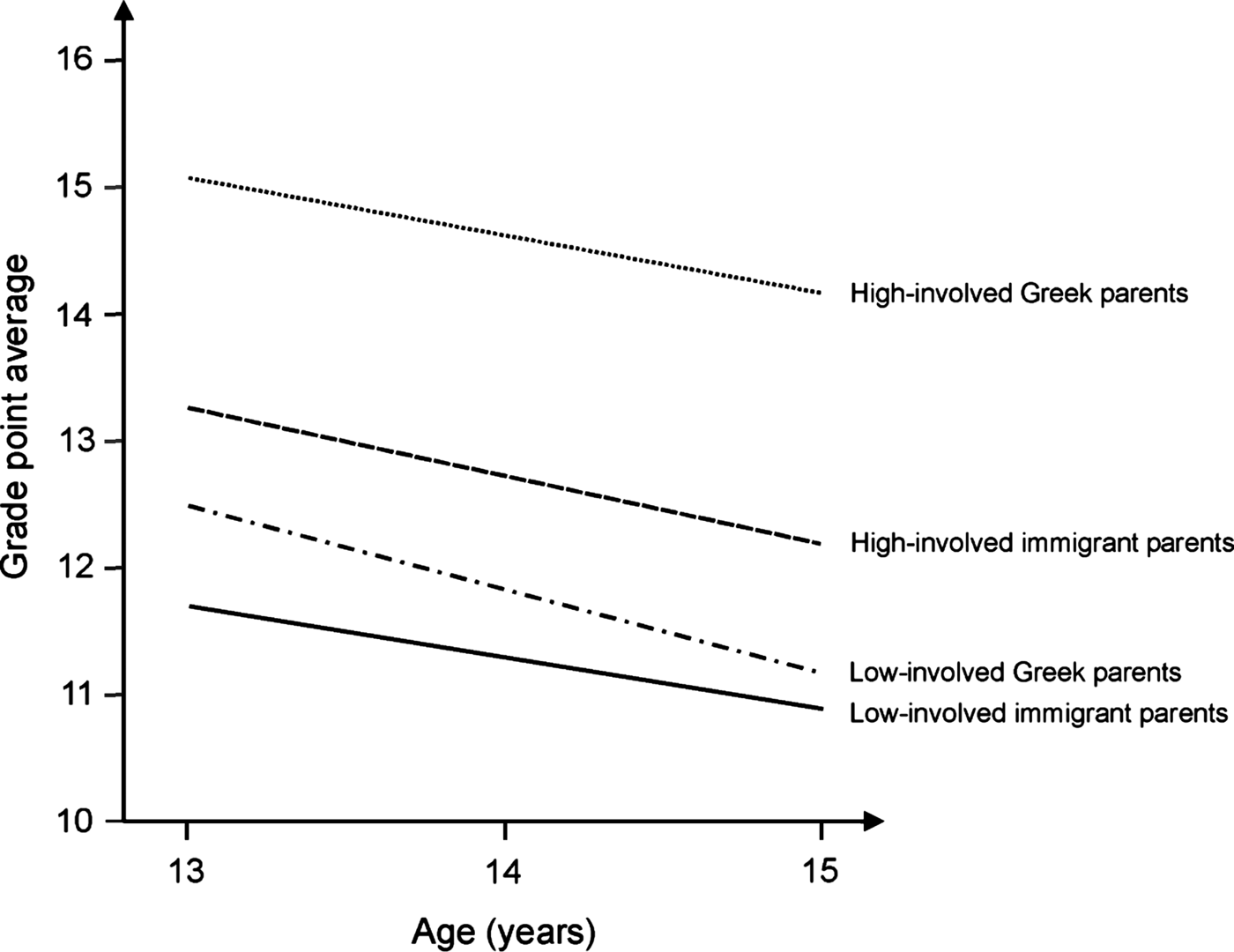
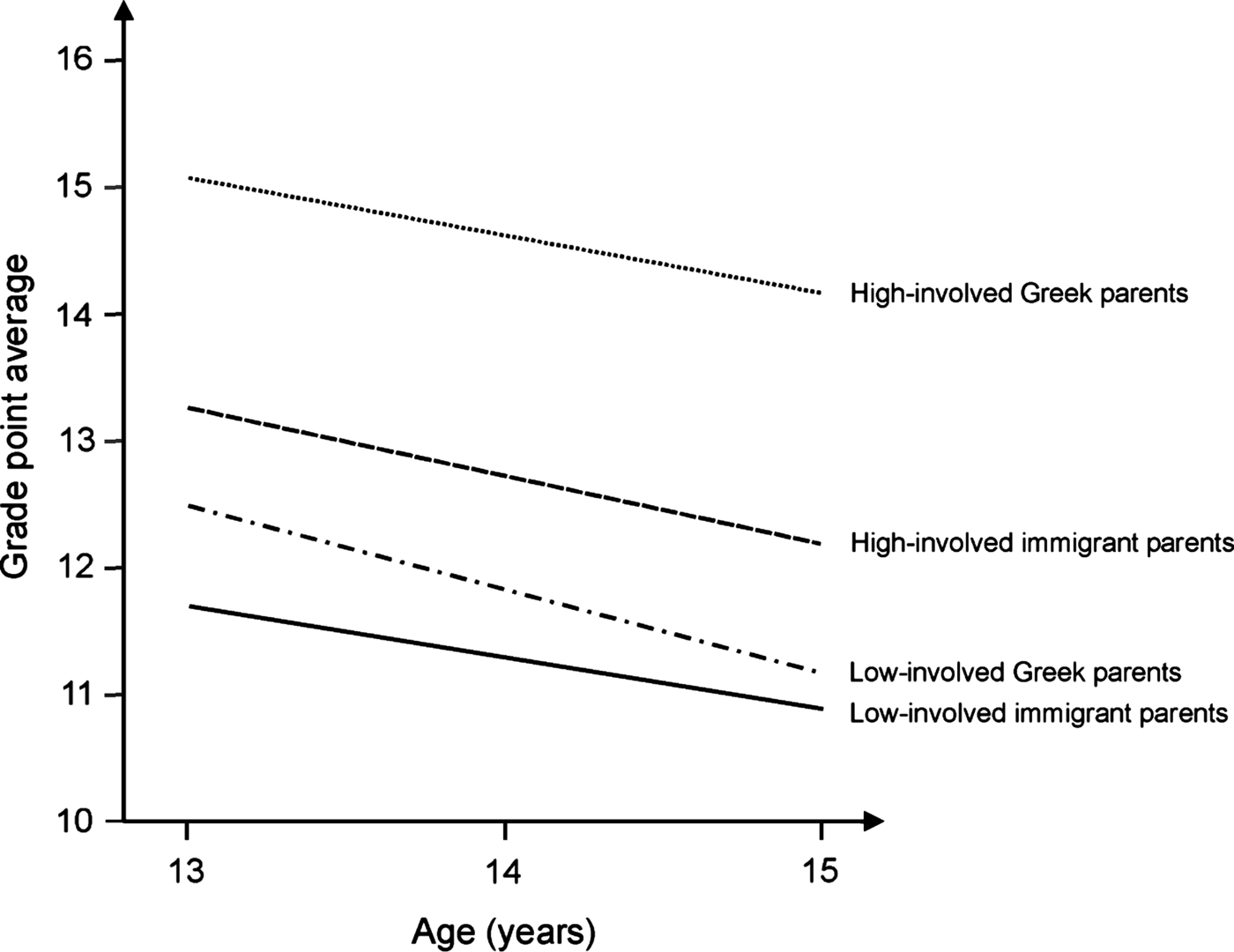
Above these main effects, two significant interactions were found indicating that the effect of parental involvement depended on immigrant status both for initial GPA and for GPA change. Figure 1 indicates that the interactions were small; GPA decreased for all four groups but from different initial levels and with different slopes. Initially, Greek students profited more than immigrant students from the involvement of their parents, but over time Greek students of low-involved parents lost most GPA points, moving close to the lowest GPA group (the immigrant students with low-involved parents).
The change in academic achievement between ages 13 and 15 by parental involvement and immigrant status.
The initial level as outcome model with all Level 2 main effects explained 45% of the initial variance in GPA; the most complex model with all risk by resource interactions explained 51% of the initial variance in GPA. We did not report the R 2 values for the initial level and slope as outcome models in order to prevent inappropriate comparisons with the R 2 values for the initial level as outcome models; in many cases the R 2 values of an initial level and slope as outcome model was slightly lower than the R 2 value of the less complex initial level as outcome model (see the above discussion of negative explained variance).
For the initial level of conduct, the large explained variance of 66% by the initial level as outcome models was largely because of the large sex effect that already explained 48% of the variance. The remaining effects were because of resources and their covariation with risks but not to risks after controlling for resources. The same pattern was found for peer popularity, and risks were unrelated to the level of psychological well-being even when resources were not controlled. Overall, then, initial adaptation was more because of resources than risks. Only for academic achievement risks explained variance when resources were controlled.
Beyond this general picture, there were some notable more specific findings. Self-efficacy predicted the initial level in all four competencies, which cannot be attributed to shared method variance because only psychological well-being was self-rated. In contrast, initial psychological well-being was only predicted by sex and self-efficacy; the latter result may be attributed to shared method variance. Peer popularity was unrelated to sociodemographic adversity but negatively affected by immigrant status although 50% of the students were immigrants. This finding will be considered in more detail in the next section on classroom influences on adaptation.
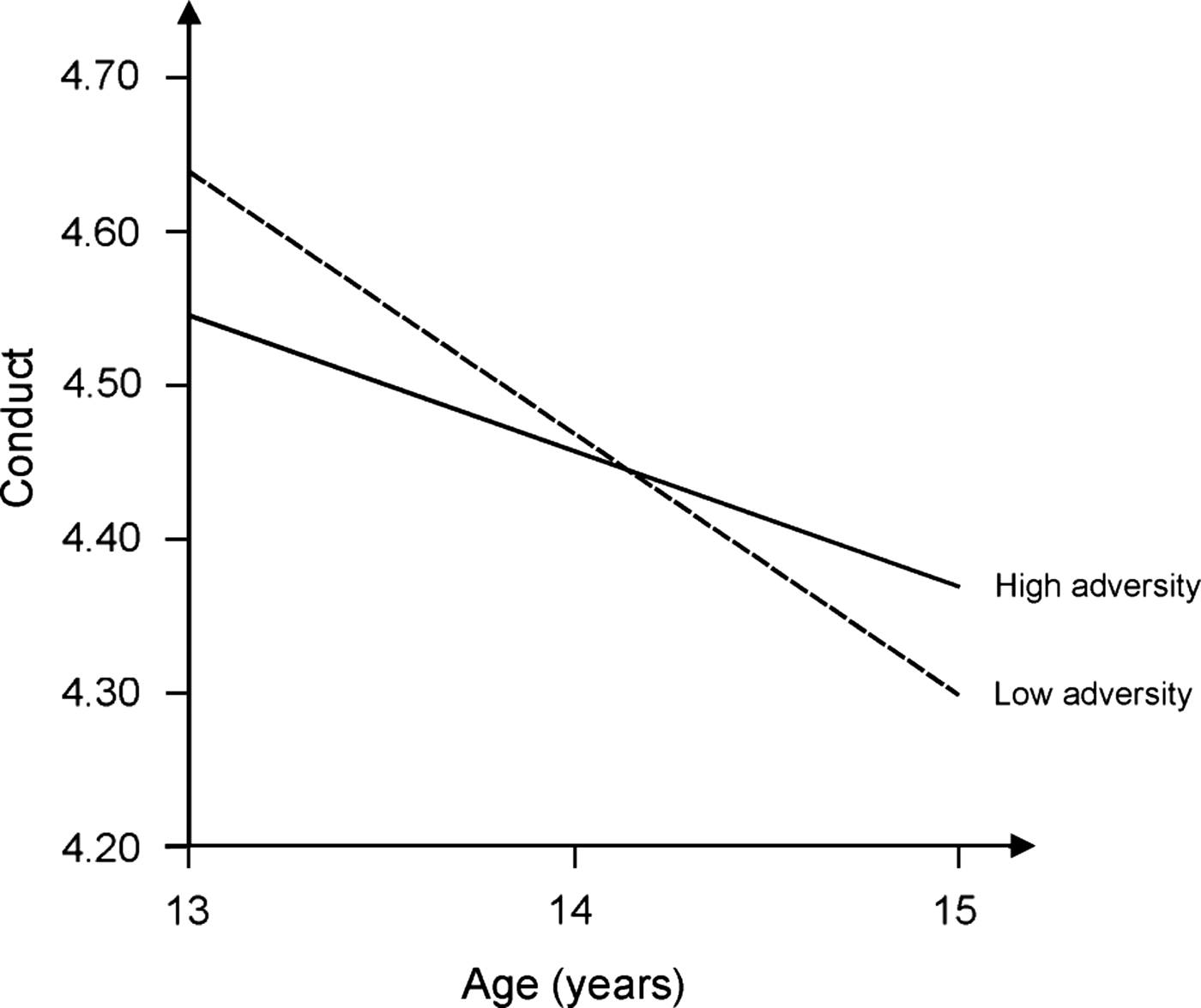
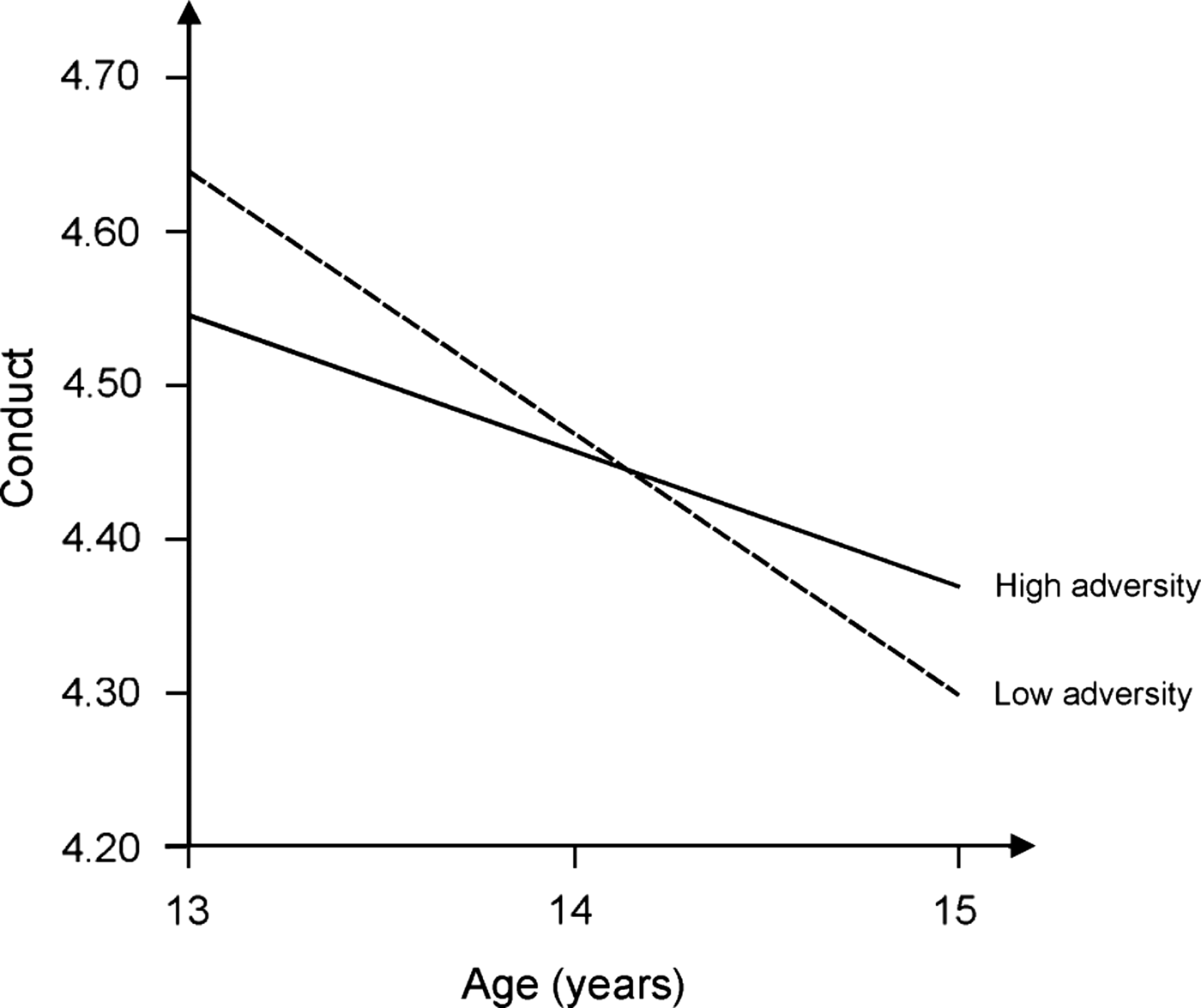
Finally, the only significant effects on changes in adaptation apart from sex differences look somewhat paradoxical: the conduct of students living in more adverse social environments improved when they approached adolescence; that the effect was significant with and without controlling for risks suggests that it was not a chance finding because of the many statistical tests. However, this relative increase started from a lower initial level, and it was a lower decrease rather than an increase (see Figure 2). Still, it is noteworthy that high-adversity students tended to behave better at age 15 than low-adversity students when sex and immigrant status were controlled.
The decrease of conduct for students high and low in adversity.
Contextual influences of classrooms
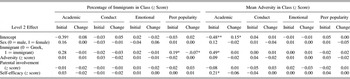
Classroom effects were evaluated by adding either the percentage of immigrants in a classroom or the mean sociodemographic adversity of the students in a classroom as a Level 3 predictor to the Model 3 in Table 4. The two contextual predictors were not simultaneously entered because they correlated r = .60 across the 49 classrooms (collinearity problem). The results for the main effects of the Level 3 predictors and their cross-level interactions with Level 2 effects are presented in Table 5. Main effects on popularity were not possible because of the within-class standardization of the popularity scores, and main effects on psychological well-being were highly unlikely because of their low between-classroom variation (see Table 1).
Results of hierarchical multilevel regressions for main effects and cross-level interactions regarding classroom characteristics

Note: Reported are unstandardized regression coefficients in three-level random coefficient initial level and slopes as outcome models with the Level 1 predictor age centered at age 13, five predictors at Level 2 (individuals), and one predictor at Level 3 (classrooms). The intercepts for the initial levels refer to the mean adaptation of male Greeks at age 13, and the intercepts for the slopes refer to the mean 1-year increase of male Greeks' adaptation. Missing values at Level 2 were imputed (five imputations). Significances refer to robust standard errors.
†p < .10. *p < .05. **p < .01.
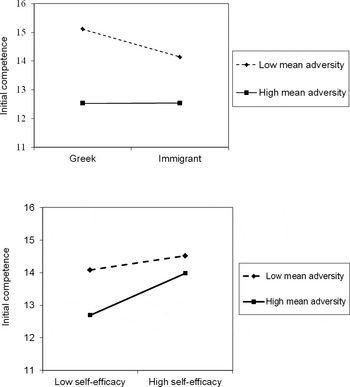
Three at least marginally significant main effects were found that all concerned academic achievement. GPA tended to be lower in classrooms with many immigrants and in classrooms with many students living in socially adverse environments; the latter negative contextual effect, however, became weaker because of a positive effect of such classrooms on GPA change. In addition, mean adversity in class significantly moderated the effects of immigrant status and self-efficacy on GPA (see Figure 3).
Cross-level interactions of mean adversity in class with the effects of immigrant status and self-efficacy on academic achievement.

The top panel shows that the overall negative effect of immigrant status on initial GPA (see Table 4) concerned only classrooms with few students high in sociodemographic adversity; in classrooms with many students high in adversity, the immigrant effect disappeared (GPA was identical for Greeks and immigrants in these classes). Furthermore, in the high-adversity classrooms, the overall effect of students' self-efficacy on their GPA was stronger than in low-adverse classrooms; in fact, highly self-efficacious students could nearly compensate for the overall disadvantage of attending high-adverse classrooms.
A last finding concerned both level and change in peer popularity. Recall that immigrants were less popular among their classmates than Greek students overall (see Table 4, Model 2a). As Figure 4 shows, this concerned mainly immigrants in secondary-school Grade 1 classrooms with many Greek classmates. Later they became more popular in these classrooms, and 2 years later they were nearly as popular as Greek students. A more detailed analysis in terms of nominations received only from Greeks or only from immigrants indicated that immigrants in predominantly Greek classes tended to be increasingly nominated by both Greek and immigrant classmates.
The change of peer popularity by immigrant status and the percentage of immigrants in class.

Differences among the immigrants
Attending classes with few versus many immigrants was not the only variable that differentiated immigrants from one another. In order to better understand the immigrant effects on adaptation, we studied differences between the immigrants at Level 2 in terms of immigrant generation and ethnicity, controlling for differences in sex and socioeconomic adversity. In addition, we explored cross-level interactions with the Level 3 variable mean adversity in class. Percentage of immigrants in class was not studied because it was strongly related to being Albanian (46% immigrants in class) and being Pontic-Greek (70% immigrants in class). The analyses were strictly parallel to those reported in Table 4 and Table 5 except that we studied only immigrant students and used different Level 2 predictors.
Immigrant generation was coded as 0 for first generation (59% of the sample) and 1 for second generation (41% of the sample). Ethnicity was coded by two dummy variables, one for Pontic-Greek students (31% of the immigrants) and another one for the highly heterogeneous group of other immigrants (18%); thus, the 51% Albanian students were coded as 0 in both dummy variables.
As Table 6 indicates, the results for the two control variables sex and sociodemographic adversity were very similar to the overall effects reported in Table 4 such that no immigrant by sex or immigrant by adversity interactions are expected. Indeed, these interactions were not even marginally significant if they were added to the three-level models of Step 2a in Table 4.
Results of hierarchical multilevel regressions predicting initial levels or both initial levels and slopes of adaptation among immigrants from sex, adversity, immigrant generation, and ethnicity

Note: Reported are (a) the explained variances R 2, the significances p i for increased model fit by adding predictors of initial level of adaptation and the unstandardized initial regression coefficients b i for each block of such predictors for a sequence of nested three-level random coefficient models with the Level 1 predictor age centered at age 13, four blocks of predictors for initial level of adaptation at Level 2 (individuals), and no predictor at Level 3 (classrooms); and (b) the significances p s for increased model fit by also predicting slopes in these models as well as the unstandardized initial regression coefficients b s for predicting these slopes for each block of predictors. The intercepts for the initial levels refer to the mean adaptation of males (of the first immigrant generation and/or Albanian origin) and the intercepts for the slopes refer to the mean 1-year increase of these immigrants' adaptation. Missing values at Level 2 were imputed (five imputations). Significances for b refer to robust standard errors; significances for model comparisons refer to differences between deviance scores.
†p < .10. *p < .05. **p < .01. ***p < .001.
After controlling for sex and adversity, second-generation immigrants were more popular than first-generation immigrants, even if ethnicity was controlled. In addition, their (initially nonsignificantly higher) academic achievement decreased more strongly than the adaptation of the first-generation immigrants, even if ethnicity was controlled. Thus, in the third year of secondary school, they tended to have lower grades than first-generation immigrants. No other significant effects of immigrant generation on adaptation were found except for a slightly better initial teacher-judged conduct of the second-generation students.
Concerning ethnicity, Albanian students were less popular than the other immigrants but only if immigrant generation was not controlled. Controlling for immigrant generation makes a difference because being of Albanian origin was closely related to first-generation immigrant status (81% of the Albanian students were first-generation immigrants but only 35% of the Pontic-Greeks and only 40% of the other immigrants). Because first-generation students were less popular than second-generation students, even after controlling for ethnicity (see Table 6), the bottom line is that the ethnicity effect on popularity was explained by immigrant generation. The same argument applies to the significantly more strongly decreasing academic achievement of the other immigrants that was not even marginally significant if immigrant generation was controlled (see Table 6). Thus, no specific explanation in terms of ethnicity is needed for explaining these effects.
The only significant effect surviving control of immigrant generation was the particularly marked worsening of the other immigrants' conduct compared to the Albanian students', but it is impossible to interpret this finding any further in terms of ethnicity because the other immigrant group was highly diverse in terms of country of origin.
When mean sociodemographic adversity in class was added as a Level 3 predictor of the effects reported in Table 6, not a single significant cross-level effect was found. Thus, the effects in Table 6 were independent of class-level sociodemographic adversity.
Together, these analyses of differences among the immigrants showed mainly a differentiation concerning immigrant generation. Second-generation immigrants were more popular than first-generation immigrants and were judged by their teachers as behaving somewhat better in class but showed a particularly marked decrease in their academic achievement over the 3 school years. The ethnicity effects could be attributed to differences in immigrant generation or were not further interpretable.
Discussion
This study examined the longitudinal patterns of adaptation of immigrant and nonimmigrant students enrolled in Greek urban public schools. We used three-level hierarchical linear models to address two risk questions and one resilience question from the perspective of a new conceptual framework integrating developmental, acculturation, and intergroup processes (Motti-Stefanidi et al., in press). First, we examined whether immigrant status and social adversity are risk factors for initial level and changes over 3 school years in adaptation and well-being. Second, we examined whether the socioeconomic and ethnic composition of the classroom are risk factors for initial level and changes in adaptation and well-being. Third, we examined how self-efficacy and parental school involvement are related to immigrant status, social adversity, and adaptation. The results support a developmental, differentiated, and contextualized approach to explaining individual differences in the adaptation of immigrant youth, and in addition point to the significance of immigrant generation.
Group differences in adaptation and growth
The results reveal the need to take a differentiated approach to explaining group differences in youth's adaptation, depending on the domain of adaptation. Controlling for SES adversity, immigrant status was a risk factor for students' initial GPA, conduct and peer popularity, but was not for their psychological well-being. When immigrant status was controlled, SES adversity was a risk factor for initial GPA and conduct, but not for peer popularity and psychological well-being. Thus, immigrant status and SES adversity were unique risk factors for initial academic achievement and conduct, and neither was a risk factor for psychological well-being. Results also indicated that immigrant status constituted a greater risk to GPA than SES adversity. These results are not consistent with an immigrant paradox.
These differences in the adaptation of immigrant and low SES youth, compared to their counterparts, are argued to reflect their social disadvantage. The lower academic achievement of immigrant youth may be related to their lower competence in the “academic” language of the host country, essential for success in school (Suárez-Orozco et al., Reference Suárez-Orozco, Gáytan, Bang, Pakes, O'Connor and Rhodes2010), in combination with a lack of the necessary support in overcoming these language barriers. Moreover, Greek schools do not provide institutional support addressing the general educational needs of immigrant or low SES students. Discrimination may also play a role in explaining why immigrant status presented additional risk for GPA, over and above low SES, as well as in the lower popularity of immigrant students. Immigrant, and low SES, students' worse conduct could be explained by concurrent, or possibly cascading, linkages between academic achievement and externalizing behavior (Masten et al., Reference Masten, Long, Roisman, Burt, Obradović and Roberts2005). Finally, the finding that, despite the worse academic achievement of both immigrant, and low SES, students, they did not differ from their counterparts in psychological well-being, may signal a detachment from school-related experiences, and reflect self-protection (Eccles, Reference Eccles, Lerner and Steinberg2004).
Change in adaptation over the period of the study, was observed in GPA, conduct, and peer popularity. Changes observed in peer popularity will be discussed in the next section. In what concerns change in the first two adaptation domains, both immigrant and nonimmigrant groups showed declining adaptation in their academic achievement and conduct. This was expected for school achievement, because it has been commonly observed, independently in immigrant (Suárez-Orozco et al., Reference Suárez-Orozco, Gáytan, Bang, Pakes, O'Connor and Rhodes2010) and nonimmigrant samples (see Wigfield et al., Reference Wigfield, Eccles, Schiefele, Roeser, Davis-Kean, Damon, Lerner and Eisenberg2006), to decline during early adolescence. Good conduct also tends to decline in early adolescence (e.g., Bongers et al., Reference Bongers, Koot, van der Ende and Verhulst2004). It is not clear whether the decline in immigrant youth's adaptation is the result of acculturation. To elucidate this issue, one would need to study a third group, consisting of youth who remained in the immigrant's home country (Fuligni, Reference Fuligni2001). If their adaptation trajectories were stable, the decreases in immigrant youth's adaptation could be attributed to acculturation on the developmental change. Otherwise, the parallel declining paths of the three groups could reflect purely developmental change.
Classroom context effects on adaptation and growth
The inclusion of the classroom level of analysis further allowed a more nuanced approach to differences in the adaptation of immigrant and nonimmigrant groups. The variance decomposition of the four adaptation outcomes (Table 2) showed that the classrooms were significantly different in terms of GPA and conduct but not in emotional competence. Because our focus in the current study was individual-level adaptation, we did not use these or other classroom-level variables as outcomes but rather used classroom differences as predictors of individual adaptation and cross-level moderators of individual-level predictions of adaptation. Our findings showed that the classroom context matters particularly for students' academic achievement and peer popularity.
Students in classrooms characterized by lower mean SES or higher concentration of immigrants had lower initial achievement, as indexed by GPA. This effect was stronger in the former than in the latter type of classrooms. However, classrooms with a low mean SES seem to have a more negative effect on nonimmigrant, than on immigrant, students' academic achievement. The academic achievement of immigrant students is relatively low in both low and high mean SES classrooms, whereas that of nonimmigrant students is lower in low SES classrooms, approaching that of immigrant students.
An unexpected finding was that, even though lower mean socioeconomic composition of the classroom was a risk factor for students' initial GPA, classroom SES was not a risk factor for change over time in their GPA. Instead, these students' academic achievement appeared to improve over the course of the study. It was also found that, based on teacher ratings, low SES students' good conduct declined less than that of their counterparts. These results could reflect a lowering of standards by teachers over time for low-SES students or low-SES classrooms. Teachers may not be particularly demanding of these students, rewarding modest effort and/or good conduct, possibly with the goal of keeping them in school.
As was already discussed, immigrant students were in general less popular among their classmates than nonimmigrants. However, this finding needs qualification, because this was more likely to be observed in classrooms that had a higher percentage of nonimmigrants than immigrants. At the time of the first assessment, when the students were grouped in the same classrooms for the first time (as they began secondary school), nonimmigrants, which were the majority in these classrooms, received more positive nominations than the immigrants, which were the minority in these classrooms. However, even in these classrooms over the course of the study, immigrant students became as popular as their nonimmigrant classmates, being increasingly nominated by both Greek and other immigrant students. In sum, lower immigrant proportion of students in the classroom may at first pose a risk for peer acceptance, but over time, may facilitate acculturation processes that are advantageous for intergroup peer relations and understanding that could benefit individuals as well as schools and society.
In the classroom context then, “majority” and “minority” did not refer to the societal level, where immigrants are the minority, but to local circumstances within the school, where in some classrooms immigrant groups held a minority position and in other classrooms a majority position. Independently of whether adolescents were immigrants or not, but depending on whether they were the minority or majority in their classrooms, the results showed that initially, as predicted from homophily phenomenon (McPherson et al., Reference McPherson, Smith-Lovin and Cook2001), perceived similarity in terms of ethnicity promoted intraethnic contact and liking. Subsequently, with additional contact across a longer period of time, and under the school's institutional support, homophily effects appeared to decline, which one would expect in the context of interethnic contact (Pettigrew & Tropp, Reference Pettigrew and Tropp2006). These results are congruent with, but also extend, the results from other studies (e.g., Titzmann & Silbereisen, Reference Titzmann and Silberreisen2009). However, this is the first study to directly compare the popularity of immigrant and nonimmigrant youth in the same classrooms over time, taking classroom composition into account.
Individual differences in adaptation and growth
Significant individual differences were found within immigrant and nonimmigrant groups with respect to their adaptation and psychological well-being, reflecting the multifinality principle (Cicchetti & Toth, Reference Cicchetti and Toth2009). Both students' self-efficacy and their parents' involvement in the school were related to initial academic achievement, conduct, and peer popularity, although not to change over time. Emotional symptoms were positively related to self-efficacy but not to parental involvement in the school. Once resources were taken into account, contextual risks had little relation to adaptation, whereas resources continued to matter after risks were considered. Only in the case of academic achievement did risks continue to explain variance after resources were controlled for.
Consistently with a broad literature, normative adaptive resources related to good outcomes across a variety of adaptation domains, even in the context of social adversity (Luthar, Reference Luthar, Cicchetti and Cohen2006; Masten, Reference Masten2007). Although these findings are consistent with a promotive role of these resources in adaptation, the correlational nature of the data precludes conclusions about causal direction. Moreover, these resources were already associated with adaptive criteria at the outset of the study, and did not contribute any further to accounting for variance in changes in these outcomes. Finally, one would expect the relationship between resources and adaptation to be bidirectional.
In certain cases, self-efficacy and parental school involvement were also found to moderate the effects of contextual risk on adaptation. Self-efficacy seemed to play a protective role for the GPA of students enrolled in classrooms with high mean SES adversity. Doing well academically may be the greatest challenge in such classrooms, which were shown to have a deleterious effect on the GPA of both immigrant and nonimmigrant students. Students high in self-efficacy, independently of immigrant or social status, may be better able to act proactively and use effective coping strategies to deal with challenges (Bandura, Reference Bandura1997).
Parental school involvement also was found to be differentially important in the prediction of achievement. Parental school involvement was associated with initial academic achievement of all students, independently of immigrant status, but this effect was significantly greater for nonimmigrant students. Over time, the GPA trajectories of immigrant and nonimmigrant students, both those whose parents were high and those who were low in school involvement, decreased. However, this decrease was greater for nonimmigrant students of low-involved parents, thus moving these nonimmigrant students' GPA close to that of immigrant students of low-involved parents. This finding was not foreseen, but could be explained by the fact that the schools do not offer individualized educational support to those who need it, whether immigrant or nonimmigrant. When the parents have low school involvement, signaling a lack of investment in the education of their children, students are left to their own devices. Whatever advantage nonimmigrant students had over immigrant students at entry to secondary school is then lost as they progress through more demanding school grades.
Immigrant generation and ethnicity effects
To better understand the immigrant effects on adaptation we examined in more detail the role of ethnicity and generation. It was found that second generation immigrant youth were more popular and had better conduct, but also had a more marked decrease in their GPA over time, compared to first-generation immigrant youth. Any differences between ethnic groups ceased to be significant after controlling for immigrant generation.
The higher popularity of second generation youth among classmates can probably be explained by the fact that they know the language well, because they were born in the host country, and that they have adopted more the values, attitudes, and behaviors of the host country than first-generation immigrants (Berry et al., Reference Berry, Phinney, Sam and Vedder2006). For these same reasons, their teachers may be judging more positively their conduct (Motti-Stefanidi, Pavlopoulos, Obradović, & Masten, Reference Motti-Stefanidi, Pavlopoulos, Obradović and Masten2008). However, the decline in their academic achievement may also signal their declining achievement motivation. This finding is reminiscent of the immigrant paradox, whereby second-generation immigrants do worse academically than first-generation immigrants, with a performance comparable to that of their nonimmigrant peers (Sam et al., Reference Sam, Vedder, Liebkind, Neto and Virta2008). These results suggest that it is important to consider the possibility that the immigrant paradox varies by domain of adaptive function.
Limitations and future directions
This study had a number of limitations. One limitation relates to measurement in studies of immigrant and native youth. It is very difficult to ascertain whether the validity of the measures is comparable when assessing, for example, self-efficacy. Every effort was made to choose robust measures for this study and to carefully translate and backtranslate the measures, but the degree to which the findings were affected by culturally based or language-based differences related to the assessment tools available is unknown.
The immigrant youth in this study also varied considerably in terms of time since immigration. Although the analyses controlled to some degree for this variance, it was not feasible to study the possibility that adaptation in the domains examined depends on the timing of immigration.
Longitudinal data on the adaptation of immigrant youth are rare and challenging to obtain. Although three waves of longitudinal data were successfully collected in this study, there was considerable attrition by the third wave. We were able to partially control this attrition effect by dummy variables in our HLM models.
Because of the complexity of the analyses, we chose to control for gender rather than study gender-related effects in depth. Gender may play important roles in the adaptation of immigrant youth at multiple levels of analysis. Gender differences merit a full examination in future studies.
Despite these limitations, the study had several unusual strengths. It was possible to study longitudinal patterns of adaptation and psychological well-being for immigrant youth, and to directly compare them with those of their nonimmigrant classmates. Adaptation indices were assessed with diverse methods and informants, independent of the child. The three-level hierarchical models allowed us to disentangle some key individual and classroom level effects on adaptation, in order to explain variation in trajectories operating for different individuals and groups of individuals. In addition to contextual risk assessed in multiple levels, resources, and in some cases their dynamic interplay, were shown to predict variations in outcomes. In the future, more research is needed to examine the contribution of unique aspects of the immigrant experience to the adaptation of immigrant youth. In particular, the challenges of acculturation and discrimination, both considered independently and in interaction with factors such as social adversity or resources call for further longitudinal and multilevel research.