INTRODUCTION
Anaemia is defined by the World Health Organization (WHO) as a reduction in the concentration of haemoglobin in the blood (measured in grams per litre of blood, or g/L), primarily caused by a disruption of erythrocyte level equilibrium (Hoffbrand et al. Reference Hoffbrand, Moss and Pettit2006; de Benoist et al. Reference de Benoist, McLean, Egli and Cogswell2008). An estimated two billion people worldwide are thought to be affected with this condition, and an increased demand on the body for growth in preschool-aged children (⩽6 years) means anaemia is particularly prevalent in this group (WHO and UNICEF, 2004; McLean et al. Reference McLean, Cogswell, Egli, Wojdyla and de Benoist2009). Among African countries, national prevalence levels in preschool-aged children range from 48·4% in Zimbabwe (Midzi et al. Reference Midzi, Mtapuri-Zinyowera, Mapingure, Sangweme, Chirehwa, Brouwer, Mudzori, Hlerema, Mutapi, Kumar and Mduluza2010) to 61·6% in Nigeria (Tohon et al. Reference Tohon, Mainassara, Garba, Mahamane, Bosque-Oliva, Ibrahim, Duchemin, Chanteau and Boiser2008) and an alarmingly high 73·4% in Zanzibar (Sousa-Figueiredo et al. Reference Sousa-Figueiredo, Basáñez, Mgeni, Khamis, Rollinson and Stothard2008). Uganda appears to be no exception with 64·1% of under five-year olds classified as anaemic in 2001, translating into 3·98 million children (de Benoist et al. Reference de Benoist, McLean, Egli and Cogswell2008). Other studies report even higher prevalence levels, reaching 80% among children less than 10 months old, one third of whom were diagnosed with severe forms of anaemia with haemoglobin levels dropping under 80 g/L of blood, well below the threshold of 110 g/L used to classify anaemia in this particular age group (Crawley, Reference Crawley2004; WHO, 2006a).
The severity of this condition should not be underestimated; it is considered the second most common cause of disability in the world and being chronically anaemic early in life can have far-reaching consequences, impairing both physical and cognitive development (Grantham-McGregor and Ani, Reference Grantham-McGregor and Ani2001; Schneider et al. Reference Schneider, Fujii, Lamp, Lonnerdal, Dewey and Zidenberg-Cherr2008). Although recognised as a global concern for many years, little progress towards amelioration of anaemia has been reported which is in part due to its complex aetiology. Parasitic infections are among its contributory factors. In particular, malaria is responsible in Uganda alone for up to 100,000 deaths per year among preschool-aged children, over half of which are caused by severe malaria anaemia (Korenromp et al. Reference Korenromp, Armstrong-Schellenberg, Williams, Nahlen and Snow2004; Uganda Ministry of Health, 2010). Studies have also shown a direct negative impact of malarial infection on haemoglobin levels, for example in children in Kenya and Ethiopia (Koukounari et al. Reference Koukounari, Estambale, Kiambo Njagi, Cundill, Ajanga, Crudder, Otido, Jukes, Clarke and Brooker2008; Deribew et al. Reference Deribew, Alemseged, Tessema, Sena, Birhanu, Zeynudin, Sudhakar, Abdo, Deribe and Biadgilign2010). Also various antimalarial interventions, including residual spraying and chemoprophylaxis, have been shown to reduce the local prevalence of anaemia (Crawley, Reference Crawley2004; Brooker et al. Reference Brooker, Akhwale, Pullan, Estambale, Clarke, Snow and Hotez2007a).
Intestinal parasites have also been shown to impact potentially on haemoglobin levels, particularly in school-aged children. One example is intestinal schistosomiasis; several studies have addressed the relationship between schistosomiasis and anaemia, but the conflicting results that have arisen make the presence and magnitude of the relationship unclear (Koukounari et al. Reference Koukounari, Fenwick, Whawell, Kabatereine, Kazibwe, Tukahebwa, Stothard, Donnelly and Webster2006, Reference Koukounari, Estambale, Kiambo Njagi, Cundill, Ajanga, Crudder, Otido, Jukes, Clarke and Brooker2008; Kabatereine et al. Reference Kabatereine, Brooker, Koukounari, Kazibwe, Tukahebwa, Fleming, Zhang, Webster, Stothard and Fenwick2007; Kung'u et al. Reference Kung'u, Goodman, Haji, Ramsan, Wright, Bickle, Tielsch, Raynes and Stoltzfus2009). However, in a laboratory setting, there is strong evidence to suggest that schistosomiasis causes anaemia in animals (Friedman et al. Reference Friedman, Kanzaria and McGarvey2005). Also important to consider are the soil-transmitted helminths (STHs). In fact, many studies in school-aged children have found that infection with hookworm contributes more to anaemia than malaria or schistosomiasis, even in areas with a low overall prevalence of anaemia (Brooker et al. Reference Brooker, Jardim-Botelho, Quinnell, Geiger, Caldas, Fleming, Hotez, Correa-Oliveira, Rodrigues and Bethony2007b; Koukounari et al. Reference Koukounari, Estambale, Kiambo Njagi, Cundill, Ajanga, Crudder, Otido, Jukes, Clarke and Brooker2008; for a full review see Smith and Brooker, Reference Smith and Brooker2010).
In order to aid the elucidation of the relative role of parasitic infections in the aetiology of anaemia, this study will determine the distribution of anaemia in preschool-aged children living along the shores of Lake Albert and Lake Victoria in Uganda and investigate how various parasitic infections contribute to the observed distribution through a combination of questionnaire and parasitological data. Whilst Plasmodium species and Schistosoma mansoni are present in communities resident at both lakes, hookworm and other STHs are found predominantly in Lake Victoria with negligible levels in Lake Albert and so the two different parasitological situations may reveal the true impact of hypothesised aetiological factors. Determining the situation in this particular age group and identifying potential risk factors will help to target public health programmes and maximise their cost-effectiveness.
MATERIALS AND METHODS
Study areas and populations
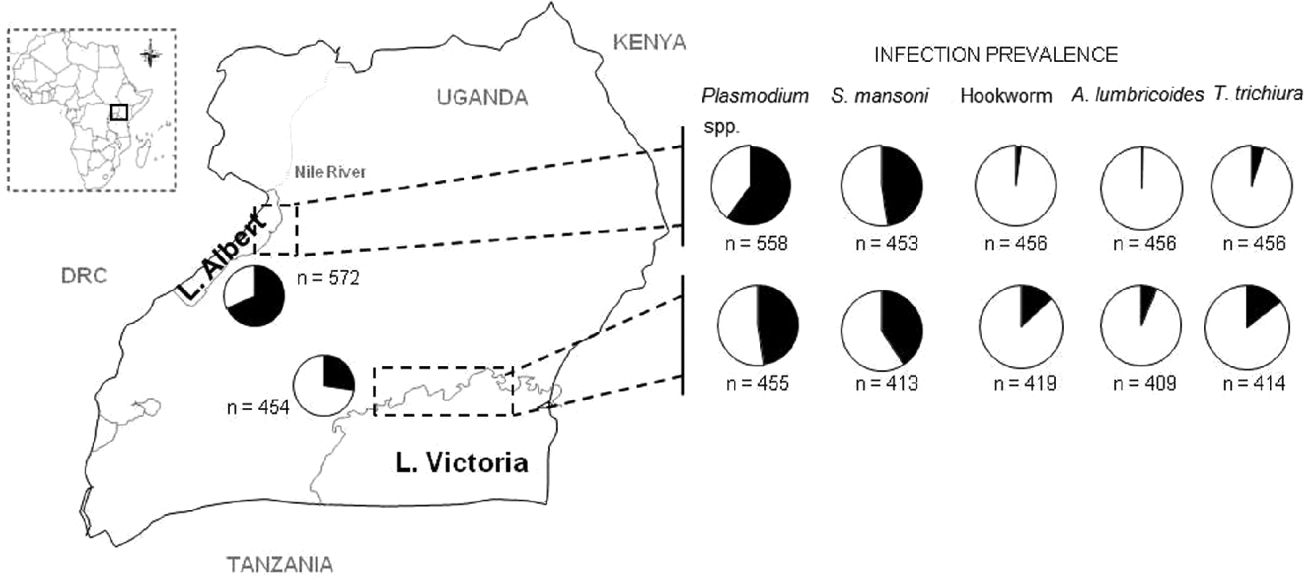
Two independent cross-sectional studies were undertaken in communities along the shore of Lake Albert (Buliisa district) and on islands in Lake Victoria, in Uganda (Fig. 1). The survey conducted in Lake Albert was the baseline survey of a large-scale longitudinal closed-cohort study aimed at investigating maternal and child health in rural Uganda (the Schistosomiasis in Mothers and Infants, SIMI, project) with data collected in June 2009. The Lake Victoria survey was conducted throughout 2009 and aimed at mapping intestinal parasites, malaria and anaemia in communities living on the islands of Lake Victoria; only data from preschool-aged children (⩽6 years) were analysed and reported in this article.
A map of Uganda illustrating the two lakes alongside which live the communities whose preschool-aged children were sampled in this study (adapted from Sousa-Figueiredo et al. Reference Sousa-Figueiredo, Oguttu, Adriko, Besigye, Nankasi, Arinaitwe, Namukuta, Betson, Kabatereine and Stothard2010a). Pie charts located adjacent to the lake represent the prevalence of anaemia where black=proportion with anaemia and white=proportion without anaemia. In the pie charts corresponding to the infection prevalence levels, black=proportion infected and white=proportion not infected by each corresponding type of infection; n=the number of children analysed to obtain each prevalence.

Questionnaire
Due to the young age of the children, their mothers were involved and interviewed with a series of questions relating to the health and general daily life of the family. The age and sex of the child were recorded along with information regarding the education of the mother, living conditions, their main source of water, mosquito bed-net usage and prior history of deworming to aid comparison between the two sites (copies of the questionnaire are available from the corresponding author).
Parasitological and anaemia survey
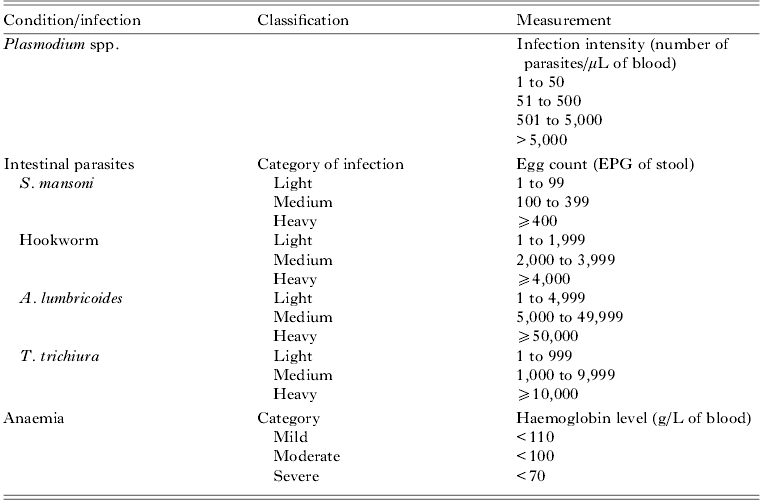
Stool, urine and finger-prick blood samples were taken from each child to measure Plasmodium parasitaemia, intestinal parasite burden and indicate individual anaemia status. Finger-prick blood samples were used to prepare thick and thin Giemsa-stained blood films, considered the ‘gold’ standard for malaria detection in the field, to determine Plasmodium species levels with categories of parasitaemia taken from previous literature (Raso et al. Reference Raso, Luginbühl, Adjoua, Tian-Bi, Silue, Matthys, Vounatsou, Wang, Dumas, Holmes, Singer, Tanner, N'Goran and Utzinger2004) (see Appendix Table A). The Giemsa-stained slides were read in the field approximately one hour after blood collection and re-read by the same technicians a few weeks later for quality assurance of field reads. Plasmodium falciparum was the major species found at the study sites, which is in accordance with previous observations (Jonkman et al. Reference Jonkman, Chibwe, Khoromana, Liabunya, Chaponda, Kandiero, Molyneux and Taylor1995; Sousa Figueiredo et al. Reference Sousa-Figueiredo, Oguttu, Adriko, Besigye, Nankasi, Arinaitwe, Namukuta, Betson, Kabatereine and Stothard2010a; Uganda Ministry of Health, 2010; Oguike et al. Reference Oguike, Betson, Burke, Nolder, Stothard, Kleinschmidt, Proietti, Bousema, Ndounga, Tanabe, Ntege, Culleton and Sutherland2011).
The infection burden of the intestinal parasites investigated in this study, namely, schistosomiasis due to S. mansoni (WHO, 1987), and infection due to the three common STHs, namely hookworm, Ascaris lumbricoides and Trichuris trichiura, was determined by the Kato-Katz method (Katz et al. Reference Katz, Chavez and Pellegrino1972). Duplicate smear preparations were produced from two consecutive-day stool samples at Lake Albert and one day sample from Lake Victoria which were then analysed with light microscopy to determine egg count by senior technicians no more than four hours after stool collection. The results were expressed as number of eggs per gram of faeces (EPG). Results were recorded as presence/absence of infection and categorised by intensity according to guidelines established by WHO (2002) (Appendix Table A).
Haemoglobin levels were recorded with a HemoCue spectrophotometer (HemoCue AB; Angelholm, Sweden) and recorded in g/L. The cut-off values used to define anaemia followed WHO guidelines, with further categorisation according to the severity of anaemia (Gabrielli et al. Reference Gabrielli, Ramsan, Naumann, Tsogzolmaa, Bojang, Khoshal, Connolly, Stothard, Montresor and Savioli2005) (Appendix Table A).
Statistical analyses
Data retrieved were entered electronically using EpiData™ 3.1 software (The EpiData Association, Odense, Denmark) and analysis was then performed with Excel® (Microsoft Excel; Redmond, Washington) and the R 2.10.1 statistical package® (Ihaka and Gentleman, Reference Ihaka and Gentleman1996). Any individuals missing specific data relevant for a given analysis were censored, for example if they failed to provide a stool sample.
Due to the expected overdispersion of parasite distribution among hosts, in particular for intestinal parasites, the geometric mean of Williams was calculated (Kirkwood and Sterne, Reference Kirkwood and Sterne2003). Mean parasite infection intensity and haemoglobin levels were compared with unpaired Wilcoxon and unpaired t-tests respectively, specifying if the variance was equal or not, while prevalence values were compared using the (one-tailed) Fisher's exact modification of the 2×2 χ 2 test (Kirkwood and Sterne, Reference Kirkwood and Sterne2003; Ruxton, Reference Ruxton2006). For all statistical analyses conducted in this manuscript, a probability (P) value ⩽0·05 was considered to be significant. Ninety-five percent confidence intervals (95% CI) for prevalence values were estimated using the exact method (Miettinen, Reference Miettinen1970) and for geometric means, the values were estimated according to Kirkwood and Sterne (Reference Kirkwood and Sterne2003).
Univariate linear and logistic regression analyses were performed to ascertain the impact of demographic data and the results of the parasitological survey of presence/absence of infection, on haemoglobin levels and the odds of anaemia, respectively. Stepwise regression was then calculated, using backwards and forwards stepwise selection and the Akaike information criterion to indicate the most parsimonious model (Kirkwood and Sterne, Reference Kirkwood and Sterne2003). Final models controlled for the age and sex of the child irrespective of significance at univariate level because of prior evidence identifying their impact on anaemia (Hall et al. Reference Hall, Bobrow, Brooker, Jukes, Nokes, Lambo, Guyatt, Bundy, Adjei, Wen, Subagio, Rafiluddin, Miguel, Moulin, de Graft Johnson, Mukaka, Roschnik, Sacko, Zacher, Mahumane, Kihamia, Mwanri, Tatala, Lwambo, Siza, Nguyen Bao Khanh, Huy Khoi and Duy Toan2001; Koukounari et al. Reference Koukounari, Estambale, Kiambo Njagi, Cundill, Ajanga, Crudder, Otido, Jukes, Clarke and Brooker2008; Tohon et al. Reference Tohon, Mainassara, Garba, Mahamane, Bosque-Oliva, Ibrahim, Duchemin, Chanteau and Boiser2008; Mupfasoni et al. Reference Mupfasoni, Karibushi, Koukounari, Ruberanziza, Kaberuka, Kramer, Mukabayire, Kabera, Nizeyimana, Deville, Ruxin, Webster and Fenwick2009).
Ethical approval and treatment
The Ugandan National Council of Science and Technology and the London School of Hygiene and Tropical Medicine (LSHTM), UK granted ethical approvals for these studies (application nos. LSHTM 06.45 and LSHTM 5538.09). All mothers were informed by community leaders (Local Chairman, level 1), community drug distributors or a district Vector Control Division officer about the nature of the survey prior to the study. On the day of the study, mothers gave informed consent by signing (or fingerprinting) a consent sheet. A blanket treatment of praziquantel (CIPLA; Mumbai, India) and albendazole (GlaxoSmithKline; Uxbridge, UK) was given to all participants as indicated by Sousa-Figueiredo et al. (Reference Sousa-Figueiredo, Pleasant, Day, Betson, Rollinson, Montresor, Kazibwe, Kabatereine and Stothard2010b). Malaria treatment using artemisinin-based combination therapy (ACT; LONART – 20 mg artemether/120 mg lumefantrine) for all except pregnant women (oral quinine) was offered on the basis of a positive Giemsa blood film in an outpatient setting.
RESULTS
Characteristics of the study population
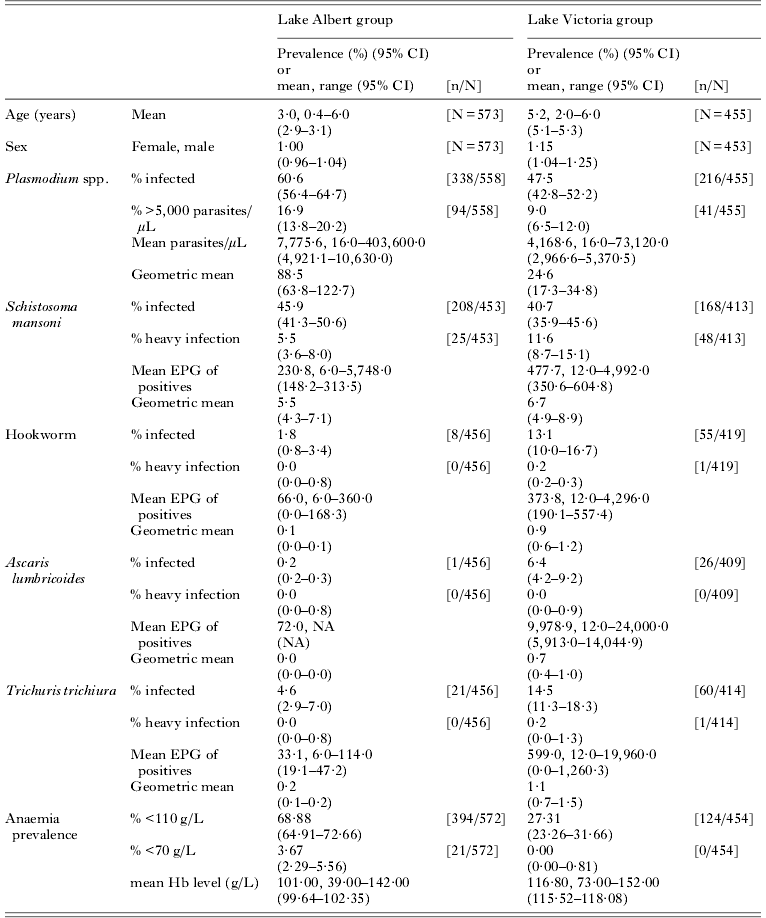
A total of 573 preschool-aged children constituted the Lake Albert study population, while 455 children were recruited at the Lake Victoria sites. With a median age of 3·0 years (range: 0·4–6·0 years), the children in the group at Lake Albert were significantly younger than those in the Lake Victoria group who had a median age of 5·0 years (range: 2·0–6·0 years, P<0·001) (Table 1). The proportion of girls relative to boys did not significantly differ between the two sites (P=0·316). Almost all the children in the Lake Albert study population obtained their water from the lake (99%), whereas a higher proportion at Lake Victoria had access to taps or wells (68% obtained their water from the lake).
A summary of demographic, parasitic infection and anaemia characteristics of the Lake Albert and Lake Victoria study populations in Uganda

95% CI=95% confidence intervals for the corresponding values.
[n/N]=the number of children (n) analysed out of the total dataset (N) for each particular result.
NA corresponds to A. lumbricoides in the Lake Albert study population as there was only one child recorded as being infected.
Malaria and intestinal parasites in preschool-aged children
Plasmodium spp. infection
Although the proportion of mothers from Lake Albert reporting that their children slept under bed-nets was statistically significantly higher than the proportion reported by mothers from Lake Victoria (83·0% vs. 45·5% for children ⩽3 years, P<0·001; 90·5% vs. 30·8% for children >3 years, P<0·001), the prevalence of children infected with Plasmodium spp. was still significantly higher in Lake Albert (60·6%, 95% CI: 56·4–64·7%) than in Lake Victoria (47·5%, 95% CI: 42·8–52·2%) (P<0·001) (Table 1). Additionally, there was also a larger proportion of children infected with higher parasite counts (>5000 parasites/μL of blood) at Lake Albert (16·9%, 95% CI: 13·8–20·2%) than at Lake Victoria (9·0%, 95% CI: 6·5–12·0%) (P<0·001).
Schistosomiasis
The prevalence of S. mansoni was 45·9% (95% CI: 41·3–50·6%) in the Lake Albert group and 40·7% (95% CI: 35·9–45·5%) in the Lake Victoria group (Table 1). While the overall prevalence did not significantly differ (P=0·131), the proportion of children severely infected (with ⩾400 EPG) was statistically significantly higher at Lake Victoria (48 out of 413 children compared to 25 out of 453 children at Lake Albert, P=0·001).
Hookworm infection
Only eight children were infected with hookworm at Lake Albert compared to 55 at Lake Victoria, resulting in significantly different prevalence values of 1·8% (95% CI: 0·8–3·4%) and 13·1% (95% CI: 10·0–16·7%), respectively (P<0·001). Only one child (from Lake Victoria) had a heavy hookworm infection (⩾4,000 EPG).
Ascariasis
Only one child at Lake Albert was infected with A. lumbricoides (0·2%, 95% CI: 0·2–0·3%) compared to 26 at Lake Victoria (6·4%, 95% CI: 4·2–9·2%) (P<0·001). None of the children had heavy infections.
Trichuriasis
Trichuris trichiura was the STH with the highest prevalence at Lake Albert, 4·6% (95% CI: 2·9–7·0%), though it was still statistically significantly lower than the 14·5% (95% CI: 11·3–18·3%) recorded in the children in the Lake Victoria study population (P<0·001). Only one child (from Lake Victoria) had a heavy T. trichiura infection (⩾10,000 EPG).
Prevalence and distribution of anaemia among the study population
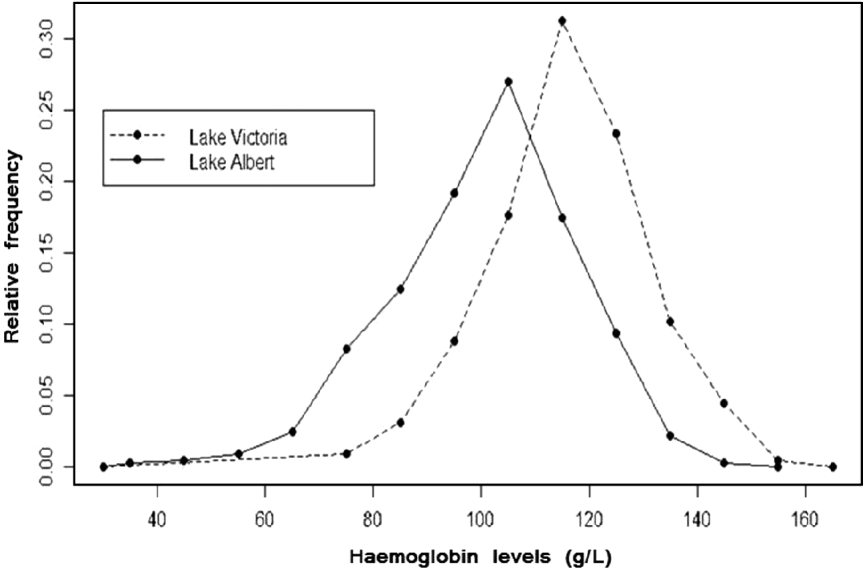
The mean haemoglobin level in children resident along the shores of Lake Albert – 101·0 g/L (95% CI: 99·6–102·4 g/L) – is below the anaemia threshold of 110 g/L and statistically significantly lower than the mean value in the study population of children from Lake Victoria, 116·8 g/L (95% CI: 115·5–118·1 g/L; P<0·001) (Table 1). This significant difference between the distributions of haemoglobin in the two groups is clearly illustrated in Fig. 2.
Frequency distributions of haemoglobin levels (g/L) in the Lake Albert (solid line) and Lake Victoria (dotted line) study populations.

Prevalence of anaemia of 68·9% (95% CI: 64·9–72·7%) was recorded in Lake Albert, rendering the public health problem severe, while a statistically significantly lower value of 27·3% (95% CI: 23·3–31·7%) was recorded in Lake Victoria (P<0·001) (Fig. 1 and Table 1); the latter is classified as a moderate public health problem according to WHO specifications. Additionally, 3·7% of the anaemia cases in Lake Albert were classified as severe (<70 g/L) compared to no severe cases on the islands of Lake Victoria.
Aetiological factors associated with anaemia
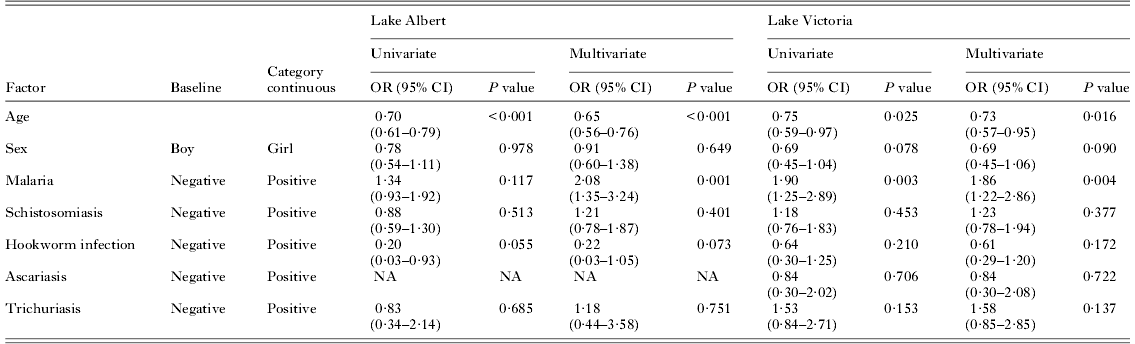
Older children were found to have significantly decreased odds of anaemia (a 35% decrease in odds for every year older in the Lake Albert group and 27% in the Lake Victoria group) after multivariate analysis (Table 2; linear regression tables not shown). Importantly, the Lake Victoria study population was older overall than the one based at Lake Albert. Sex was not significantly associated with a change in the odds of anaemia at either study sites.
Odds ratio (OR) for anaemia in the Lake Albert and Lake Victoria study populations in Uganda with corresponding 95% confidence intervals (95% CI) and P values resulting from logistic univariate and multivariate stepwise regression

NA is used when the standard error is too large to assess significance where only one child was infected with A. lumbricoides.
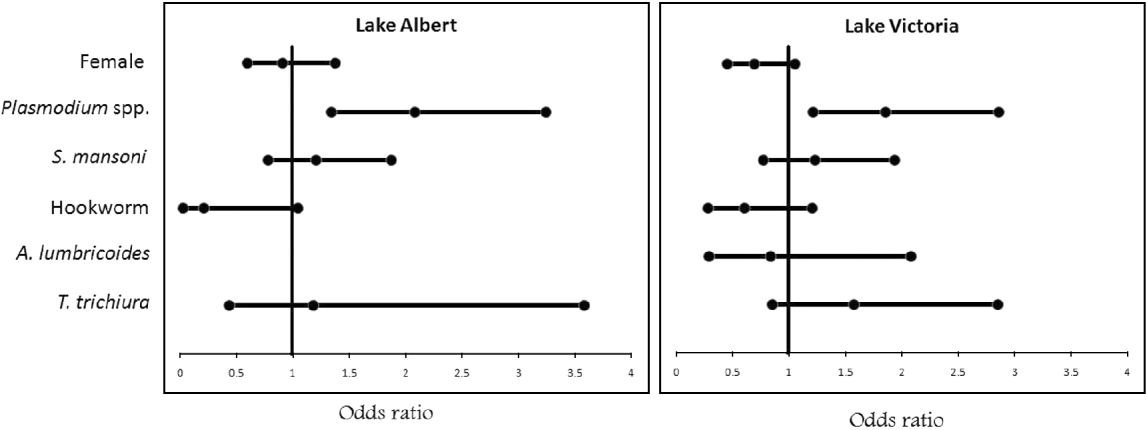
Out of all the infections, only infection with Plasmodium spp. was significantly associated with the odds of anaemia; infection resulted in an odds ratio (OR) of 2·1 at Lake Albert (P=0·001) and an OR of 1·9 at Lake Victoria (P=0·004) (Fig. 3). Infection with S. mansoni, hookworm, A. lumbricoides and T. trichiura did not significantly impact on the odds of anaemia at the two study sites when considered both as presence of infection and categorised by intensity of infection.
Multivariate odds ratios and their corresponding lower and upper 95% confidence intervals for each factor in the two study populations. Ascaris lumbricoides was not included in the Lake Albert figure because at this location only one child was recorded as being infected. Note that the overall trend pattern for each variable is broadly similar between lake systems.

When multiparasitism was considered, 28·7% (95% CI: 24·5–33·1%) of children in the Lake Albert study population were infected with both Plasmodium spp. and S. mansoni, compared to 20·1% (95% CI: 16·3–24·3%) at Lake Victoria (P=0·003). When also taking into account additional infection with at least one STH, eight children (1·8%, 95% CI: 0·8–3·6%) at Lake Albert and 25 (6·3%, 95% CI: 4·1–9·1%) at Lake Victoria were polyparasitised (P=0·001). Relative to children just infected with Plasmodium spp., there was no significant difference in prevalence of anaemia and haemoglobin levels in those additionally infected either with S. mansoni, with at least one STH, and with both S. mansoni and at least one STH at both study sites.
DISCUSSION
Anaemia was found to be of public health importance in preschool-aged children in the communities investigated, particularly among those living along the shores of Lake Albert, where prevalence of anaemia reached 68·9%, very similar to previous reports from the same area (WHO, 2006a). The Lake Victoria study population had a significantly lower prevalence (27·3%), resulting in a public health classification of ‘moderate’ and a mean haemoglobin level greater than the anaemia threshold of 110 g/L.
Aetiological factors
In terms of demographic variables, an increase in age was found to decrease significantly the odds of anaemia. Therefore any long-term evaluation of the improvement of anaemia in longitudinal cohorts should correct for age. This result further highlights the importance of targeting very young children (<3 years of age) in anaemia public health campaigns. As for gender, there are varying reports in the literature regarding prevalence of anaemia in boys and girls (Stoltzfus et al. Reference Stoltzfus, Chwaya, Montresor, Albonico, Savioli and Tielsch2000; Siegel et al. Reference Siegel, Stoltzfus, Khatry, Leclerq and Tielsch2006). In our study no significant difference was found.
At both study sites, infection with Plasmodium spp. appeared to be the predominant infection, significantly decreasing haemoglobin levels and subsequently increasing the odds of anaemia irrespective of other infections, sex and age. Additionally, further regression analysis revealed a significant association when the child was infected with >5,000 parasites/μL of blood, implying that heavier infections have a greater depressing effect on haemoglobin levels. As part of their life cycle, Plasmodium parasites increase the rate of haemolysis of red blood cells directly or in part due to inflammatory cytokines, and the infected individual may then be unable to produce enough new red blood cells to compensate for this loss (Schofield and Grau, Reference Schofield and Grau2005). Our analysis was conducted under the assumption that malaria is being caused predominantly by P. falciparum; however polymerase chain reaction (PCR)-mediated species identification on a different cohort of children from the shoreline of Lake Victoria has subsequently revealed the presence of P. ovale (Oguike et al. Reference Oguike, Betson, Burke, Nolder, Stothard, Kleinschmidt, Proietti, Bousema, Ndounga, Tanabe, Ntege, Culleton and Sutherland2011) and P. malariae at levels approaching 15%, being largely masked by concurrent P. falciparum infection (data not shown).
Previous studies have shown anaemia to be common in children infected with STHs and Schistosoma species, but their relative role as a causative agent has remained controversial (Friedman et al. Reference Friedman, Kanzaria and McGarvey2005; Koukounari et al. Reference Koukounari, Fenwick, Whawell, Kabatereine, Kazibwe, Tukahebwa, Stothard, Donnelly and Webster2006; Tohon et al. Reference Tohon, Mainassara, Garba, Mahamane, Bosque-Oliva, Ibrahim, Duchemin, Chanteau and Boiser2008). In this study S. mansoni, A. lumbricoides and T. trichiura did not influence significantly haemoglobin levels or odds of anaemia. However, it must be taken into consideration that only one to two stool samples were used for microscopy-mediated diagnosis, which limits the accuracy of the measurement of the parasite counts (de Vlas and Gryseels, Reference de Vlas and Gryseels1992). Although schistosomiasis did not have a significant effect on anaemia here, only one species was present, S. mansoni. Therefore the observations made in this study cannot be generalised to areas with S. haematobium, which is known to cause urinary blood loss and thus an association with anaemia is expected (Rollinson et al. Reference Rollinson, Klinger, Mgeni, Khamis and Stothard2005; Tohon et al. Reference Tohon, Mainassara, Garba, Mahamane, Bosque-Oliva, Ibrahim, Duchemin, Chanteau and Boiser2008). Moreover the intensity of infection estimated in children this young may not be sufficient to impact on anaemia.
More surprising perhaps, considering previous evidence demonstrating hookworm infection to be an aetiological cause of anaemia, there was no significant association between anaemia and infection at either of the study sites, even when, relative to the Lake Albert study population, a significantly higher prevalence of hookworm infection was recorded in the Lake Victoria group (with the lower prevalence of anaemia). This could be due to a low prevalence of hookworm infections among the preschool-aged children, who mainly had a low infection intensity, with only one heavy infection case identified at Lake Victoria. Some studies have indicated no association with anaemia when this is the case (Koukounari et al. Reference Koukounari, Estambale, Kiambo Njagi, Cundill, Ajanga, Crudder, Otido, Jukes, Clarke and Brooker2008; Smith and Brooker Reference Smith and Brooker2010). A higher average age of the children and a lower prevalence of malaria in the Lake Victoria group may help explain the considerable difference of from the Lake Albert area.
Multiparasitism
There were cases of polyparasitism recorded at both study sites with over a quarter of children in the Lake Albert study population infected with both S. mansoni and Plasmodium spp.. Whilst there was no evidence of an additional effect on the prevalence of anaemia at these two study sites, the numbers of children infected with more than one species of parasite, including at least one STH, was low and there is conflicting evidence in the literature regarding the impact of polyparasitism on haemoglobin levels. For example, a study in Brazil found the risk of anaemia among school-aged children to be significantly higher in those infected with S. mansoni and two or three STHs than in children infected with just one STH, though there was no difference when S. mansoni was not present (Brito et al. Reference Brito, Barreto, de Cassia, Silva, Assis, Reis, Parraga and Blanton2006). However, the odds of anaemia were found not to differ significantly in Rwanda between children and adolescents with different polyparasite S. mansoni and STH profiles (Mupfasoni et al. Reference Mupfasoni, Karibushi, Koukounari, Ruberanziza, Kaberuka, Kramer, Mukabayire, Kabera, Nizeyimana, Deville, Ruxin, Webster and Fenwick2009).
Some studies suggest a prominent impact of co-infection on anaemia when the child is infected with Plasmodium species. Co-infection with P. falciparum and heavy hookworm intensity in school-aged children in Kenya was associated with a significantly lower haemoglobin concentration than that in children with single infections, while primary school-aged children in Zimbabwe infected with schistosomes and P. falciparum had a prevalence of anaemia almost twice as high as that in children with a single schistosome infection and an even higher prevalence when additionally infected with STHs (Brooker et al. Reference Brooker, Akhwale, Pullan, Estambale, Clarke, Snow and Hotez2007a; Midzi et al. Reference Midzi, Mtapuri-Zinyowera, Mapingure, Sangweme, Chirehwa, Brouwer, Mudzori, Hlerema, Mutapi, Kumar and Mduluza2010). However, a study in Brazil found intestinal STHs protected against a decline in haemoglobin when co-infected with P. vivax (Melo et al. Reference Melo, Reyes-Lecca, Vitor-Silva, Monteiro, Martins, Benzecry, Alecrim and Lacerda2010).
Analysis of available evidence suggests that interaction of malaria and helminth infections can alter immune responses (Mazigo et al. Reference Mazigo, Waihenya, Lwambo, Mnyone, Mahande, Seni, Zinga, Kapesa, Kweka, Mshana, Heukelbach and Mkoji2010). Conflicting evidence has resulted in two contrasting hypotheses: either cytokines produced in response to helminth infection makes individuals more susceptible to advanced stages of malaria, or the body's Th2 immune response may be activated and protect against severe malaria (Mwangi, Bethony and Brooker, Reference Mwangi, Bethony and Brooker2006), though there is currently insufficient evidence to support a firm conclusion (Hartgers and Yazdanbakhsh, Reference Hartgers and Yazdanbakhsh2006).
Factors not investigated
Whilst iron deficiency anaemia (IDA) can result from blood loss from parasitic infection, this multifactorial condition can also result from dietary insufficiencies (Hoffbrand et al. Reference Hoffbrand, Moss and Pettit2006). After six months, an infant requires a source of iron in addition to the supply from breast milk to prevent deficiency (WHO and UNICEF, 1998); this is particularly the case in developing countries where there is a life-long poor diet consisting mainly of cereals, from which iron absorption can be as low as 5% (Crawley, Reference Crawley2004). It takes approximately eight years for a normal adult male to develop IDA solely as a result of poor diet or malabsorption (Hoffbrand et al. Reference Hoffbrand, Moss and Pettit2006), implying less of an impact in preschool-aged children unless there was an interaction with another risk factor, accelerating the severity of anaemia. Concurrent nutritional investigation through observation of diet and questionnaires with measurement of micronutrients would help put our parasitological findings into context. However, these factors are expected to be present in both populations in equal proportions as they are from the same country, belong to the Bantu tribes and have similar dietary constitutions, dominated by fish.
Human immunodeficiency virus (HIV) is highly prevalent throughout Africa and the infection in itself is an increasingly recognised cause of anaemia (Crawley, Reference Crawley2004). Prevalence of HIV in Uganda is reported to be between 5·7% in rural areas and 10·1% in urban areas (15–49 year olds) (Ministry of Health Uganda and ORC Macro, 2006; UNAIDS and WHO, 2008), with estimates of prevalence of anaemia among HIV-infected individuals ranging from 70 to 90% in sub-Saharan Africa (Subbaraman et al. Reference Subbaraman, Devaleenal, Selvamuthu, Yepthomi, Solomon, Mayer and Kumarasamy2009). More importantly, given our study population and co-endemicity with malaria, additional adverse interactions between HIV and malaria have been reported, including increasing severity of anaemia resulting in a crippling mortality rate (Crawley, Reference Crawley2004). Coupled with a prevalence of anaemia of 91·7% reported in HIV-infected infants less than three years old in Uganda (Clark et al. Reference Clark, Mmiro, Ndugwa, Perry, Jackson, Melikian and Semba2002), this suggests an association at our study sites.
Other potential confounding factors not considered in our study include household socioeconomic status (Siegel et al. Reference Siegel, Stoltzfus, Khatry, Leclerq and Tielsch2006), hereditary factors (Beutler, Reference Beutler1994), and different types of immune-mediated anaemia (Hoffbrand et al. Reference Hoffbrand, Moss and Pettit2006). Future insights into this multifactorial condition would greatly benefit from studies combining the investigation of these factors.
Policy recommendations
Various studies have demonstrated that iron supplementation or fortification significantly improve haemoglobin concentration in African children in the field (Menendez et al. Reference Menendez, Todd, Alonso, Francis, Lulat, Ceesay, M'Boge and Greenwood1994,Reference Menendez, Kahigwa, Hirt, Vounatsou, Aponte, Font, Acosta, Schellenberg, Galindo, Kimario, Urassa, Brabin, Smith, Kitua, Tanner and Alonso1997; Iannotti et al. Reference Iannotti, Tielsch, Black and Black2006; Gera et al. Reference Gera, Sachdev, Nestel and Sachdev2007). Whereas other studies found no effect (Stoltzfus et al. Reference Stoltzfus, Chway, Montresor, Tielsch, Jape, Albonico and Savioli2004; Rohner et al. Reference Rohner, Zimmermann, Amon, Vounatsou, Tschannen, N'Goran, Nindjin, Cacou, Té-Bonlé, Aka, Sess, Utzinger and Hurrell2010), the most salient controversy concerns the possibility of an increased susceptibility to malaria infection following iron supplementation. Most studies have found no effect (Menendez et al. Reference Menendez, Todd, Alonso, Francis, Lulat, Ceesay, M'Boge and Greenwood1994, Reference Menendez, Kahigwa, Hirt, Vounatsou, Aponte, Font, Acosta, Schellenberg, Galindo, Kimario, Urassa, Brabin, Smith, Kitua, Tanner and Alonso1997; Gera et al. Reference Gera, Sachdev, Nestel and Sachdev2007), but a trial in Zanzibar had to be stopped early due to increased deaths and adverse events in children receiving supplements, although there is some question as to whether this resulted specifically from iron or folic acid supplementation (Iannotti et al. Reference Iannotti, Tielsch, Black and Black2006; Sazawal et al. Reference Sazawal, Black, Ramsan, Chwaya, Stoltzfus, Dutta, Dhingra, Kabole, Deb, Othman and Kabole2006; Zimmermann and Hurrell, Reference Zimmermann and Hurrell2007). The WHO generally supports specifically targeting children who are anaemic and at risk of iron deficiency with this intervention, but caution needs to be taken when supplementing children not afflicted with iron deficiency in tropical countries in areas of high malarial transmission (WHO, 2006b; Zimmermann and Hurrell, Reference Zimmermann and Hurrell2007). At any rate, due to the chronic and insidious nature of anaemia, iron supplementation needs to be delivered over a long period of time for effects to be apparent and so there may be compliance issues and a lack of feasibility in the field (Hall et al. Reference Hall, Bobrow, Brooker, Jukes, Nokes, Lambo, Guyatt, Bundy, Adjei, Wen, Subagio, Rafiluddin, Miguel, Moulin, de Graft Johnson, Mukaka, Roschnik, Sacko, Zacher, Mahumane, Kihamia, Mwanri, Tatala, Lwambo, Siza, Nguyen Bao Khanh, Huy Khoi and Duy Toan2001; Mwanakasale et al. Reference Mwanakasale, Siziya, Mwansa, Koukounari and Fenwick2009). Therefore prevention of anaemia rather than its treatment would be preferable.
Intermittent preventive therapy of malaria in infants (IPTi) administered alongside childhood immunisation has been shown to have protective efficacy observed against anaemia; however, evidence suggests that the effect is only short-lived (Cairns et al. Reference Cairns, Carneiro, Milligan, Owusu-Agyei, Awine, Gosling, Greenwood and Chandramohan2008). High re-infection rates and distribution issues concerning sustainability and emerging drug resistance prompt other anti-malarial interventions to be considered (Brooker et al. Reference Brooker, Akhwale, Pullan, Estambale, Clarke, Snow and Hotez2007a). In this study, in both Lake shores, mothers reported children regularly sleeping under insecticide-treated nets (ITNs), though the Lake Victoria study population had a lower prevalence of usage. However, there is concern, based on observations in the field, that donated nets are being used for fishing rather than for their correct purpose. Therefore the challenge remains to instil a better understanding about the use and misuse of ITNs for malaria prevention in the community to enable their health impact to be fully realised, perhaps accompanied by concomitant distribution of fishing nets; otherwise the cost spent on increasing ITN coverage may lead to ineffective outcomes. Provision of long-lasting insecticidal nets (LLINs) is required to prevent the need to retreat nets every year, but redistribution of new nets is also important given their life-span of four to five years, mainly due to wear and tear even when correctly used (Griffin et al. Reference Griffin, Hollingsworth, Okell, Churcher, White, Hinsley, Bousema, Drakeley, Ferguson, Basáñez and Ghani2010). A national scale-up programme in rural Zambia of a malaria control package including nets decreased prevalence of severe anaemia by 68% (Chizema-Kawesha et al. Reference Chizema-Kawesha, Miller, Steketee, Mukonka, Mukuka, Mohamed, Miti and Campbell2010).
As shown in this study, it is particularly important to target children for prevention of anaemia soon after birth. National Child Health DaysPLUS in Uganda already operate from static and mobile health units and distribute vitamins, vaccines, albendazole and health education to preschool-aged children in endemic areas (Kolaczinski et al. Reference Kolaczinski, Kabatereine, Onapa, Ndyomugyenyi, Kakembo and Brooker2007). Therefore interventions could piggyback onto this scheme, promoting an integrated approach by incorporating on-site malaria spot testing. This could be achieved by providing ACT when required and supplying ITNs to the mothers in areas of high transmission, as well as imparting education about anaemia. In areas of high malaria transmission very high coverage may be needed to achieve sizeable reductions in malaria and it will be a challenge to ensure that large-scale delivery is sustained (Griffin et al. Reference Griffin, Hollingsworth, Okell, Churcher, White, Hinsley, Bousema, Drakeley, Ferguson, Basáñez and Ghani2010). Firm political commitment, involving local communities and collaboration between different health programmes and their funding will increase the likelihood of success of this intervention (Crawley, Reference Crawley2004; WHO and UNICEF, 2004; President's Malaria Initiative, 2009).
From a public health perspective, avoiding the negative effects of anaemia on the child's physical and cognitive development in these lakeshore zones is clearly needed. An appropriate use of the limited human and economic resources currently available would be to target this high risk group with an intervention focussing on appropriate community prevention and management of malaria.
ACKNOWLEDGEMENTS
We thank Professor Geoff Garnett for financial help towards travelling expenses of HKG for completion of her final dissertation for an MSc in Modern Epidemiology at Imperial College London. We wish to thank the Vector Control Division (Ministry of Health, Uganda) for their time and support during the surveys and in particular we thank the families who participated in the study. We also thank Dr Simon Brooker for supplying data from Lake Victoria and for providing advice regarding an earlier version of this manuscript. This work was supported by the Wellcome Trust (NBK and JRS) and the Bill & Melinda Gates Foundation (AF). Additionally, HKG was supported by a Medical Research Council Advanced Studentship for the MSc in Modern Epidemiology at Imperial College London. M-GB acknowledges support from the European Commission FP7 collaborative project HEALTH-F3-2008-223736 (TransMalariaBloc). We are also grateful to the British Society of Parasitology for supporting this forum on paediatric parasitology.
APPENDIX
Categorisation of infection intensity for Plasmodium spp. (Raso et al. Reference Raso, Luginbühl, Adjoua, Tian-Bi, Silue, Matthys, Vounatsou, Wang, Dumas, Holmes, Singer, Tanner, N'Goran and Utzinger2004), intestinal parasite infections (WHO, 2002) and anaemia (Gabrielli et al. Reference Gabrielli, Ramsan, Naumann, Tsogzolmaa, Bojang, Khoshal, Connolly, Stothard, Montresor and Savioli2005)