

Introduction
Indigenous goat populations in tropical countries are a valuable genetic resource, because of their adaptation to harsh climatic conditions, their ability to better utilize the limited and poor quality feed resources and their tolerance to a range of diseases (Kosgey and Okeyo, Reference Kosgey and Okeyo2007). Under these prevailing conditions, goat production is an important activity for smallholders. This also holds true for Ethiopia, where 21.9 million goats are kept by resource poor farmers across the country (CSA, 2010b). They provide owners with multipurpose functions such as source of income, meat, milk, manure, insurance and cultural values (Legesse et al., Reference Legesse, Abebe, Siegmud-Schultze and Valle-Zárate2008; Assen and Aklilu, Reference Assen and Aklilu2012). Despite their importance and potential, goats are the most neglected in livestock research and development activities of the country (Tsegahun et al., Reference Tsegahun, Lemma, Ameha, Abebe, Zinash, Merkel, Abebe and Goetsch2000).
Designing and implementation of appropriate management and breed improvement programmes based on indigenous breeds, which are appropriate to the existing conditions can contribute substantially to improving the livelihood of farmers. Description of production system and environment, knowledge of management of the breed, characterizing morphological characters and productivity level of the breeds in their habitat are the first step to develop sustainable improvement and conservation programme of farm animal genetic resources (Sölkner, Nakimbugwe and Valle-Zárate, Reference Sölkner, Nakimbugwe and Valle-Zárate1998; Duguma et al., Reference Duguma, Mirkena, Haile, Iñiguez, Okeyo, Tibbo, Rischkowsky, Sölkner and Wurzinger2010; FAO, 2010; Gizaw et al., Reference Gizaw, Komen, Hanotte, van Arendonk, Kemp, Haile, Okeyo and Dessie2011). The objectives of this study were to describe the production systems and the morphological characteristics of Western lowland and Abergelle goats in Ethiopia for designing possible breeding strategies.
Materials and methods
Description of the study areas
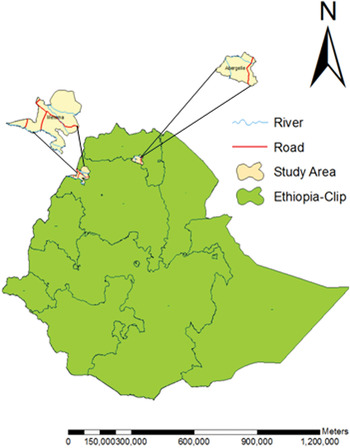
The study was conducted during July 2011 to September 2011 in Metema and Abergelle districts of the Amhara National Regional State of Ethiopia (Figure 1). Metema and Abergelle districts were purposively selected for this study to address goat production in two different agro-ecological zones, farming systems and goat breeds. Metema district is located in a wet-lowland agro-ecological zone and in the North Western part of the country, 860 km from the capital Addis Ababa. The altitude ranges from 550 to 1 608 m and the latitude from 12°40′N to 13°14′N. The rainfall pattern is unimodal with a mean annual range from 850 to 1 100 mm, occurring from June to September (IPMS, 2005). Temperature ranges from a minimum of 22 °C to a maximum of 43 °C (IPMS, 2005). The production system is a mixed crop–livestock system with dominance of crop production as there is a high potential for biomass production. The dominant goat breed is Western lowland. The second study area, Abergelle district is in the dry/submoist highland agro-ecological zone of the northern part of the country, 780 km from Addis Ababa. The altitude ranges from 1 150 to 2 500 m with the latitude of 12°18′N to 13°06′N. The mean annual rainfall ranges from 250 to 750 mm, falling mainly from July to September (DOARD, 2010). The rainfall pattern is very erratic and uneven. Owing to this erratic nature of rainfall, frequent crop failure and drought are common phenomena in the area. The production system is a mixed crop–livestock system with a focus on livestock, mainly Abergelle goat production.
Map of the study areas.

Data collection
Description of production systems
Two villages, one from each district, were selected as the study sites based on goat production potential and willingness of the farmers to participate in a community-based goat improvement programme. A total of 120 goat keepers (60 from each district) were randomly selected and interviewed. For the interviews structured questionnaires were used that covered the following topics: general household characteristics, purpose of keeping goats, livestock ownership, flock structure, performance of goats, management and breeding practices and goat production constraints. Before the survey was conducted, enumerators were trained and the questionnaire was pretested. General information and environmental conditions of the study areas were obtained through secondary data, field observation, informal interviews with farmers and the reports of District Office of Agriculture and Rural Development.
Morphological characterization
A total of 476 Western lowland and 534 Abergelle goats with different dentition classes were used for the morphological characterization. They were classified into six age groups based on their dentition; kids (<6 months), young (between 6 and 12 months), 1 pair of permanent incisors (1PPI) (1 year), 2PPI (2 years), 3PPI (3 years) and 4PPI (≥4 years) (FAO, 1994). The kids and the young were differentiated by asking the age of animals from the owners. Qualitative characteristics (coat colour and pattern, presence or absence of wattles and ruff and hair type) and linear measurements (body weight, body length, chest girth and height at withers) were recorded and measured by using the standard format adapted from the FAO (1986) breed descriptor list. Body weight (kg) was determined using suspended spring scales and other body measurements were taken using a flexible metal tape after restraining and holding the animals in natural position. A total of 726 female animals were available for body weight and other body measurements. Pregnant animals were excluded from the measurement to avoid overestimation.
Data analysis
Both the survey and morphological characterization data were analysed using the Statistical Analysis System (SAS, 2009). The survey data were analysed using descriptive statistics. Chi-square or t-test was employed when required to test the independence of categories or to assess the statistical significance. Indices were calculated for ranked variables (reasons of goat keeping, selection criteria and production constraints). Indices were computed as: sum of (3x for rank 1 + 2x for rank 2 + 1x for rank 3) given for a given reason divided by the sum of (3x for rank 1 + 2x for rank 2 + 1x for rank 3) for overall reasons. Qualitative characteristics of the breeds from morphological characterization data were analysed by frequency procedures. A general linear < B> </B > model (GLM) procedure was used to analyse body weight and other linear body measurements. The male animals were excluded in the model in analysis of body weight and other body measurements because only a few male animals were available at older age/dentition classes. Homogeneity of variance test for body weight in natural scale and log transfer scale at different age classes were also done to see within breed variability.
The statistical model used was
 $$Y_{ijk } = \mu + A_i + B_j + \lpar A \times B\rpar _{ij} + e_{ijk{\rm }} \comma \;$$
where Y ijk is the observation on body weight, chest girth, body length and height at withers; μ is the Overall mean; A i is the fixed effect of age (i ≤ 6 months, 6–12 months, 1PPI, 2PPI, 3PPI, 4PPI); B j is the fixed effect of breed (j = Western lowland, Abergelle); (A × B) ij is the interaction effect of age with breed; and e ijk is the effect of random error.
Results and discussion
General household characteristics
The majority (91.7 percent) of the respondents in both study areas were male. The mean (SD) age of the respondents was 42.50 (12.01) and 42.00 (12.29) years for Western lowland and Abergelle goat keepers, respectively. The mean family size was 5.40 ± 1.85 and 6.30 ± 2.34 for Western lowland and Abergelle, respectively. This was higher than the national average of 4.80 (CSA, 2010a). In Western lowland goat keepers, the majority of respondents (56.6 percent) were able to read and write, whereas in Abergelle only 18 out of 60 farmers were literate. The relatively higher proportion of literate household heads for Western lowland goat owners would be a good opportunity to implement a goat improvement programme as it might be easier for them to record performance and pedigree information. The average land holding (5.03 ± 2.78 ha) of Western lowland goat owners was significantly higher (P < 0.05) than land holding of Abergelle goat owners (1.00 ± 1.47 ha). These figures include only privately owned land for crop production. For grazing, communal grazing areas are used.
Purpose of keeping goats
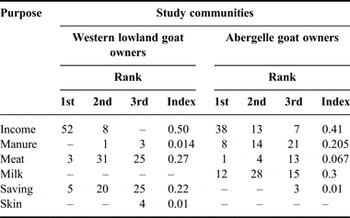
Table 1 shows the purpose of keeping goats and their respective rank by study areas. Better understanding of the purposes of keeping goats is a prerequisite for defining breeding goals (Jaitner et al., Reference Jaitner, Sowe, Secka-Njie and Dempfle2001). The purpose of goat keeping identified in this study is in line with previous studies from Ethiopia and other African countries (Kosgey et al., Reference Kosgey, Rowlands, van Arendonk and Baker2008; Legesse et al., Reference Legesse, Abebe, Siegmud-Schultze and Valle-Zárate2008; Assen and Aklilu, Reference Assen and Aklilu2012). The role of goat as a source of cash income was found to be the primary reason of keeping goat in both study areas with index values of 0.5 and 0.4 for Western lowland goat keepers and Abergelle, respectively. Milk production was ranked as the second most important role in Abergelle, while consumption of goat milk was considered as a cultural taboo in Western lowland goat breeders. The value of manure was ranked third in Abergelle, whereas for Western lowland goat breeders it was ranked fourth.
Ranks of purpose for keeping goats.

The highest index value means the highest importance.
Western lowland goat breeders gave higher priority to meat production (Rank 2) and savings (Rank 3) compared with Abergelle goat keepers. These results clearly show that goat rearing is seen as an option not only to generate income through sale of slaughter animals but also contribute to the household consumption through meat and milk production. Based on the above, we conclude that the main breeding goal of Western lowland goat breeders is to increase meat production for marketing and consumption, whereas Abergelle goat breeders wish to increase meat as well as milk production.
Livestock holding and flock structure
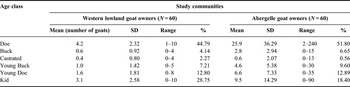
This study revealed that farmers keep mixed livestock species. The average ± SD ownership per household of cattle, goats, sheep and donkeys for Western lowland goat owners were 10.1 ± 7.8, 10.8 ± 7.2, 0.3 ± 1.5 and 1.0 ± 0.3, respectively. The corresponding values for Abergelle were 7.6 ± 6.8, 48.5 ± 52.2, 6.4 ± 11.6 and 1.3 ± 1.4, respectively (Table 2). Goats were found to be an important species owned by respondents in both study areas, particularly in Abergelle. The average flock size of goats in Metema was significantly (P < 0.05) lower than the average flock size in Abergelle. FARM Africa (1996) reported 11 goats per household for Western lowland flocks and 20 goats per household for Abergelle flocks. The relatively higher flock size of Abergelle goats indicates the importance of goat production and a strong scope for breeding activities in the community.
Age structure of goats in flocks of the different study communities.

N, number of households; SD, standard deviation.
The proportion of goats at different sex and age classes in both study areas follow similar trends, where breeding does represent the largest class, followed by kids (Table 2). These findings are in line with the results of Deribe (Reference Deribe2008) and Tsegaye (Reference Tsegaye2009) who reported 48.1 percent breeding does for Metema and 56.6 percent breeding does for Abergelle region, respectively. In Western lowland goat, breeding does make up to 44.8 percent of the flock followed by kids (28.75 percent), young does (did not give birth) (12.8 percent), young bucks (not sexually active) (7.21 percent), bucks (4.14 percent) and castrates (2.27 percent). A similar pattern was also observed in Abergelle with 51.8 percent breeding does, 18.4 percent kids, 12.89 percent young does, 9.60 young bucks, 6.65 percent bucks and 0.56 percent of castrates. The lower the proportions of the kids in the Abergelle area were because of seasonal kidding. As the area is drought prone area, most of the kidding happened between November and December following the active mating at the wet season (June and July).
The ratio of breeding buck to breeding does was 1:7 for Western lowland goat and 1:12 for Abergelle, which was higher than the recommended ratio of 1:25 for tropical traditional production system (Wilson and Durkin, Reference Wilson and Durkin1988).
Selection criteria and breeding practice
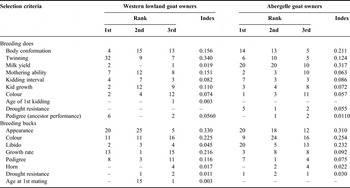
Selection criteria for breeding does and bucks are summarized in Table 3. For Western lowland goat owners, the most important selection criteria for breeding does were multiple births, body conformation, mothering ability and kid growth with index values of 0.34, 0.16, 0.15 and 0.11, respectively. Coat colour, fertility traits (kidding interval and age at 1st kidding) were also mentioned as selection criteria but with lower ranking. The probable reason for high emphasis on multiple births as the preferred trait by Western lowland goat keeper could be because of the high availability of the feed throughout the year and the breed potential. Around 1.6 litres per kidding were reported by Western lowland goat breeders. For Abergelle goat owners, milk yield, body conformation and multiple births were ranked as first, second and third important selection criteria with index values of 0.32, 0.21 and 0.12, respectively. Drought resistance, coat colour, kidding interval, kid growth, mothering ability and pedigree information were also described as selection criteria. Body conformation followed by coat colour were found as the most important selection criteria of breeding bucks in both study communities with the index values of 0.33 and 0.22 for Western lowland goat keepers and 0.31 and 0.25 for Abergelle, respectively. The preferred colours in Western lowland goat breeders were white, red and patchy of those colours. The preferred colours for Abergelle goat breeders were red brown and red. Plain black was the less preferred colour in both communities. Owing to the relatively large flock sizes per household in Abergelle goat, farmers paid high emphasis on sexual activity of breeding bucks. In general, goat owners in both study sites preferred size and other performance traits. The improvement of traits related with growth performance can be achieved easily through village-level selection as the traits are easy to measure and have high heritability.
Selection criteria for breeding does and bucks.

In both study areas, mating was uncontrolled and random, since bucks were mixed with the does throughout the year. Most of the goat keeper respondents (91.67 percent) in Western lowland practiced mixing of their flock during the grazing period on an average with five other flocks. However, in Abergelle only 15 percent of the respondents allowed their flocks to mix with other flocks during grazing. As explained by Kosgey et al. (Reference Kosgey, Baker, Udo and van Arendonk2006), uncontrolled mating together with a small flock size would increase the level of inbreeding. On the other hand, practice of mixing flocks would minimize the problem of inbreeding by increasing the chance of mating of unrelated animals (Jaitner et al., Reference Jaitner, Sowe, Secka-Njie and Dempfle2001). The implication of these results is that a cooperative village-level breeding scheme would be appropriate for Western lowland goat breeders, while selection within individual flocks could be possible in Abergelle goat given the individual flock grazing practice and the large flock size. There is a significant (χ 2, P < 0.05) difference in buck ownership between the two communities. Only 40 percent of the respondents of Western lowland goat keepers had their own buck; however, higher proportions of (86.67 percent) Abergelle goat keepers had their own buck. The farmers, who had no buck, used bucks from their neighbours and grazing lands. Regardless of the communities, farmers kept bucks mainly for mating and later fattening and slaughter.
Castration of bucks after mating/service was a common practice in both the study areas. Fattening was the most important reason of castration (77.5 percent for Western lowland goat keepers and 82.32 percent in Abergelle). Castration to control mating and temperament were reported by a few respondents. The average age (2.10 ± 0.68 years) of castration for Western lowland goat was significantly (P < 0.001) lower than that of Abergelle (4.40 ± 1.05 years). Keeping of intact male in the flock for a prolonged period would increase the hazard of inbreeding through increasing the chance of mating of bucks with their daughters. The practice of castration reported in both communities would be good for implementing village-level selection through avoiding of mating of unwanted bucks and it would also increase the value of culled bucks.
Reproductive performance
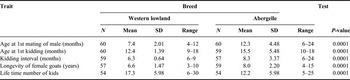
The average reproductive performances of goats as reported by the respondents are given in Table 4. There was a significant (P < 0.001) difference between the two breeds for all aspects of reproductive performance considered. The better performance of Western lowland goats may be because of the genetic superiority of the breed and/or better feed situation of the area. Age at first kidding reported in female Western lowland goat (12.4 months) and Abergelle (15.5 months) goat were comparable to the report of 13.6 months for Metema area (Tsegaye, Reference Tsegaye2009) and 14.9 months for Abergelle (Deribe, Reference Deribe2008). The kidding interval, 6.29 months for Western lowland and 8.28 months in Abergelle, observed in this survey was lower than that given in the earlier reports of 8.4 months for Western lowland goat (Tsegaye, Reference Tsegaye2009) and 11.31 months for Abergelle goat (Deribe, Reference Deribe2008).
Reproductive performance of goats as reported by respondents in the surveyed area.

N, number of respondents; SD, standard deviation.
Production constraints
A good understanding of the existing production constraints in the study regions is essential for planning appropriate interventions. In both the study areas, high prevalence of disease and parasites were mentioned by the goat owners as the most limiting factor for goat production. All respondents complained about the low efficiency of veterinary service provided by the government. Feed shortage and recurrent droughts were also identified as important constraints for Abergelle goat owners. Goat keepers moved their goats to other areas where enough feed was available as a possible mitigation strategy. Feed shortage was mentioned by only a few goat owners of Western lowland. This is because the area receives good rain and there is a relatively large area of communal grazing land. Predators, input (mostly veterinary service), lack of improved genotypes, labour and capital, theft, lack of market and lacking extension service were also reported as limiting factors of goat production in both study areas. This result is in line with goat production constraints reported for Southern Ethiopia (Tibbo, Reference Tibbo, Merkel, Abebe and Goetsch2000; Legesse et al., Reference Legesse, Abebe, Siegmud-Schultze and Valle-Zárate2008) and Northern Ethiopia (Tsegaye, Reference Tsegaye2009; Assen and Aklilu, Reference Assen and Aklilu2012).
Morphological characteristics
Qualitative characteristics
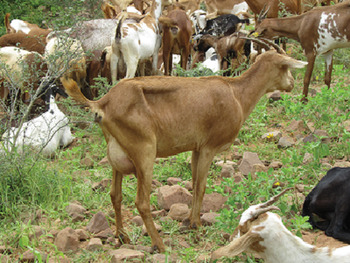
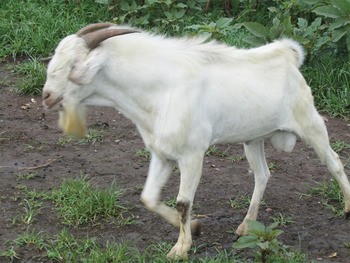
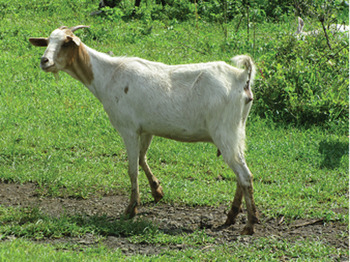
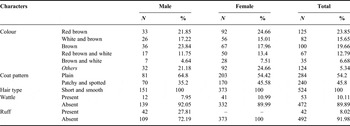
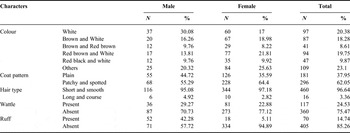
Qualitative characters observed for female and male goats of the two breeds are presented in Tables 5 and 6. The study revealed that the two breeds have a wide range of coat colours. Most of (54 percent) Abergelle goats have a plain coat pattern, while most (60 percent) of Western lowland goats show a mixture of different colours with patchy and spotted patterns. Red brown, brown and the combination of these colours with other colours are the predominant coat colours observed in Abergelle goat (Figures 2 and 3). White and the combination of white with other colours were the major coat colours of Western lowland goat (Figures 4 and 5). Irrespective of breeds and sex groups, all observed goats had short and smooth hair. There is a very small number (3.36 percent) of animals of the Western lowland goat breed, which have a long and coarse hair type. Wattles were found in Western lowland goats (24.53 percent) and Abergelle goats (10.11 percent). A variation in the existence of ruff was observed between breeds and sex groups. Only 8.0 percent of males of Abergelle goats have a ruff and 42.28 and 5.11 percent of males and females of Western lowland goats have a ruff, respectively. Almost all males and females of Abergelle goats had horns and around 5 percent of Western lowland goats were polled. Most of the qualitative characters of both breeds obtained in this study were in agreement with the results of FARM-Africa (1996).
Adult male of Abergelle goat.

Adult female of Abergelle goat.

Young buck of Western lowland goat.

Adult female of Western lowland goat.

Qualitative characteristics of Abergelle goat.

N, number of goats observed.
Qualitative characteristics of Western lowland goat.

N, number of goats observed.
Quantitative characteristics
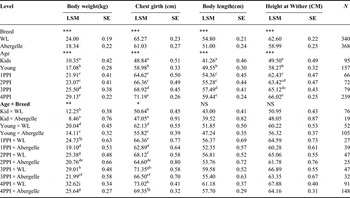
The male animals were excluded from the model owing to only a small number available at older age. However, the sexual dimorphism was observed at lower age groups (data not shown). Male goats showed higher values for all measurements than their female counterparts. The least square means and standard error of body weight, chest girth, body length and height at withers of female Abergelle goats were 24.00 ± 0.19 kg, 65.27 ± 0.23 cm, 54.8 ± 0.21 cm and 62.60 ± 0.22 cm, respectively. The corresponding value for Abergelle goats were 18.34 ± 0.22 kg, 61.03 ± 0.27 cm, 51.00 ± 0.24 cm and 58.99 ± 0.25 cm, respectively (Table 7).
Least square means and standard error of body weight, body length and height at withers at different breed and age groups.

Column means within each sub-class with different superscript letter are statistically different. NS, non-significant, *P ≤ 0.05, **P ≤ 0.01, ***P ≤ 0.001. PPI, pair of permanent incisors; SE, standard error; WL, Western lowland.
Breed had significant effect on all body measurements. The Western lowland goat had the highest values for all measurements. Age strongly influenced (P < 0.001) body weight and other linear body measurements. Except for age classes 1PPI and 2PPI, there was a significant increase in weight from the lower dentition class to the higher. A similar trend was observed for chest girth, body length and height at withers. This situation is expected since the size and the shape of animals change as the age increases.
The interaction effect of breed with age affected body weight (P < 0.01) and chest girth (P < 0.05). But, there was no significant (P > 0.05) age by breed interaction effect on body length and height at withers. Western lowland goats at dentition group 3PPI and 4PPI were significantly heavier than other categories. Western lowland and Abergelle goats at older age (3PPI and 3PPI) had the highest chest girth compared with other age breed interaction groups. The weight of 32.62 kg for Western lowland and 25.64 kg for Abergelle goat obtained for mature females were slightly lower than the mature weight of 33.9 kg of Western lowland and 28.4 kg of Abergelle goat reported by FARM Africa (1996). The average weight at young age of 14.11 kg of Abergelle goat was similar to the report of Deribe (Reference Deribe2008) for the same breed, who reported 13.5 kg of weight at yearling age.
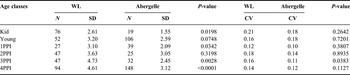
There was a significantly higher within-breed variation of body weight of Western lowland goats compared with the Abergelle goats in natural scale for most of the age categories. However, there was no significant difference for many of the age categories except for the age group 3PPI after transformation to the log scale (Table 8). The relatively higher variation observed in Western lowland goat could be a larger scope for genetic improvement of Western lowland goats through selection compared with the Abergelle goats.
Variability of the body weight at different age groups.

WL, Western lowland goat; N, number of animals; SD, standard deviation; CV, coefficient of variation.
Conclusions
This study provided insight into production systems and physical characteristics of Western lowland and Abergelle breeds of goat in Ethiopia. Goat farming was found to be an important component for livelihoods of both communities, with higher importance for Abergelle goat breeders. The goat keepers in both communities keep goats for multiple purposes. Keeping goat for cash income was important for both communities, while milk production was important only for Abergelle goat breeders. Selection criteria are similar, but with different emphases on specific traits. Farmers give emphasis to growth (body conformation) and other performance (such as milk yield and litter size) traits. Individual flock mating is a major practice for Abergelle goat keepers, whereas group flock mating is the dominant practice for Western lowland goat keepers. Furthermore, morphological characterization revealed that there is a variation between and within the studied breeds. Western lowland goats are on an average not only bigger than Abergelle goats but also show considerably higher variation in body size. This indicates a large scope of genetic improvement by selecting best young males. Community-based breeding programmes considering the multifunctional roles of goats and the breeding objectives of farmers should be implemented.
Acknowledgements
The study was financed by Austrian Agency for International Cooperation in Education and Research and Sustainable Natural Resource Management Programme in North Gondar. The authors are very grateful to the Amhara Regional Agricultural Research Institute, the Gondar and Sekota Agricultural Research Centers for technical and logistic assistance. They are also grateful to farmers participating in this study.