In the last forty years, from 1979 to 2019, the Chinese economy has grown 33-fold, adjusted for inflation, from 367 billion yuan in 1978 to 82 trillion yuan in 2017. However, while China's economic transformation from an agrarian to an industrial economy, and increasingly to a post-industrial knowledge economy is lauded and well-studied, especially during the last forty years,Footnote 1 the transformation of the Chinese academe from a civil service-based gentry society to a university-trained, professionally oriented society and increasingly to a high-tech STEM society, is less studied and less appreciated.Footnote 2 This is particularly true of the forty years from 1912 to 1952, when China's university-educated population increased 600-fold, from 500 in 1912, to 25,000 in 1927, 100,000 in 1941, 200,00 in 1948, and 300,000 in 1952.Footnote 3
Yet, it is debatable that the so-called Chinese economic miracle could have occurred without such prior human capital investment and input.Footnote 4 This preliminary study on the making of the Chinese academe from 1912 to 1952 is motivated by our desire then to gain a better understanding of the historical origins of the distinctive patterns of tertiary education in modern China, including the social origins of China's university students and faculty members, and their links to China's socio-economic transformation, from an agrarian society and economy to a global manufacturing powerhouse and innovative centre of the world's knowledge economy.
In a 2013 Chinese-language monograph, the Lee-Campbell Group entered and analysed the matriculation cards of 150,000 Peking University (PKU) and Suzhou University (SZU) undergraduate students in a dataset entitled the China University Student Dataset – People's Republic of China (CUSD-PRC hereafter) to document how the increasing numbers of working-class students and female students matriculating and being educated in China's elite universities from 1949 to 2002 transformed Chinese society and the Chinese academe in the second half of the 20th century.Footnote 5 Our findings, that almost half of all PKU and SZU students during the second half of the 20th century came from working class families with no prior tertiary education, creating a veritable “silent revolution” in Chinese society, have had a significant impact not just on the Chinese academe but also on the contemporary general understanding of Chinese social stratification and social mobility during the second half of the 20th century.Footnote 6
In preparation for a similar Chinese-language book-length study on Chinese university education during the first half of the 20th century, we have also created three other related big historical databases: the China University Student Database – Republic of China (CUSD-ROC hereafter), which currently includes 160,253 records of 131,105 domestic undergraduate students and 117,928 unique individuals from many of the largest and strongest 130 universities recognized by the ROC Ministry of Education (MOE) in 1947;Footnote 7 the China University Student Database – Overseas (CUSD-OS hereafter), which currently includes 78,199 records for 50,000 of the 60,000 Chinese students to graduate from foreign universities during this period; and the China University Employee Database (CUED-ROC hereafter), which currently includes 7,576 records, roughly three-quarters of the university faculty members of an estimated 1950 national faculty population of 10,000.Footnote 8
We divide this preliminary, article-length study based on these three datasets into six parts. First, we very briefly outline the meritocratic principles and multiple testing criteria to select domestic and foreign university students as well as university faculty members during the first half of the 20th century. Second, we describe the CUSD-ROC, the CUSD-OS and the CUED-ROC, the processes by which we compiled these data over the last ten years, and the insights they provide into the transformation of the Chinese academe. We then follow this with three sections in which we analyse these data, both separately and linked together by common individuals, in order to arrive at four distinctive features of the Chinese academe during this time: there was a high proportion of students and faculty members who studied abroad, who were female, who majored and worked in science, technology, engineering and mathematics (STEM subjects), and who came from changing social and spatial backgrounds. Finally, we conclude with a short reflection on why what in many societies are often considered to be durable inequalities – gender, nationality and socio-economic status – were mutable in Republican China, and why what in other societies are considered to be mutable inequalities – location and residence – remain surprisingly durable in China today.Footnote 9
Meritocratic Principles of Student Selection and Faculty Employment
The Republican Chinese academe was created according to one inherited foundational belief and one overpowering ambition. The ambition, which dates back to the late Qing,Footnote 10 was to select, educate and employ China's best and brightest and, by doing so, to provide the best leadership possible to ensure China's continued survival.Footnote 11 The foundational belief was that to achieve such a goal required a meritocratic state and society of educated people selected by an objective measure of their cognitive ability, knowledge and values (xuanxian juneng 选贤举能) and drawn from the most capable in China regardless of their ethnicity, nationality, gender and social background (youjiao wulei 有教无类).Footnote 12 The purpose of the university was primarily to teach, not to do research.Footnote 13 A university faculty position was a calling, not a career.
However, despite the common assertion that this new meritocracy had two banners, democracy (de 德) and science (sai 赛), the new university curriculum rarely focused on political theory,Footnote 14 but instead concentrated on English and STEM subjects (which in China meant applied rather than pure science),Footnote 15 producing an enthusiasm among Chinese students studying abroad to declare such majors as agriculture (Hu Shi 胡适), engineering (Dai Yi 戴逸), medicine (Guo Moruo 郭沫若, Lu Xun 鲁迅) and even history of science (Yuen Ren Chao 赵元任).
Although the civil service examination (keju 科举) was officially abolished in 1905, testing remained a common procedure to select students for university admission, for study abroad and for employment after graduation. Moreover, as college education became more important in Republican society and in the labour market, university admission based on objective tests became increasingly strict. In 1917, the Ministry of Education announced that in principle university admission was only for qualified students with a valid high school diploma and chosen according to an objective test performance. In 1924, the Ministry of Education reiterated these admission criteria to the then 21 national universities.Footnote 16 In 1933, the Ministry of Education extended competitive objective university admission tests as a precondition of government recognition and registration to all private and missionary universities in the 76 officially recognized universities.Footnote 17 And, in 1938, the ministry mandated, for the first time since 1905, the resumption of set national examinations (tongyi zhaosheng kaoshi 统一招生考试), only to relax such requirements after 1942 owing to the intensified Japanese invasion.
The recruitment of university faculty members, unlike student admissions, was not test based, but in the best Chinese universities employment was largely restricted to students who had graduated from prestigious Western universities. According to Hu Shi, “At present, most of the university professors in China and most of those who hold important positions in government and in industry were partly educated in foreign countries, especially in the United States.”Footnote 18 Chen Liang's 2015 study on university faculty and staff at Tsinghua University documents the influence of foreign education on position, income and social status.Footnote 19 Of 65 full-time professors at Tsinghua University in 1930, all except three professors in the department of Chinese literature had studied overseas. Of the remaining 62 professors, 48 had foreign degrees – 24 held a master's degree and 24 a PhD degree.Footnote 20 Of the 23 instructional faculty members at Tsinghua University in 1932, the teaching associates, 18 eventually also moved abroad to enrol in a degree programme.Footnote 21
New Data Sources
The CUSD-ROC, CUSD-OS and CUED-ROC databases document the tremendous changes in Chinese social stratification and social mobility that derived from these new “meritocratic” examination and employment criteria.
In 2010, Chen Liang first proposed that we extend our study of proprietary undergraduate student registration cards in the CUSD-PRC to create a CUSD-ROC that would include similar Republican university student records stored in publicly accessible local and provincial archives, rather than proprietary university archives. Liang initially organized the preliminary coding of half of the current CUSD-ROC entries from such sources,Footnote 22 supplemented by James Lee and Mingyu Zhang, who added one-quarter of the current CUSD-ROC records from university proprietary records.Footnote 23 Most recently, Bamboo Ren has added another quarter of the current CUSD-ROC entries, including 29,420 publicly accessible student records from eight other tertiary educational institutions,Footnote 24 17,587 from published student records or alumni lists, and 11,833 from publicly accessible archival records. In addition, Ren is completing the recoding of over 30,000 previously incompletely coded archival records.Footnote 25 As of October 2019, we have data for 115,731 students from 19 of 55 Ministry of Education recognized universities (daxue 大学), 14,482 students from nine of 75 institutes (xueyuan 学院), and 892 students from the one specialized tertiary school (zhuanke xuexiao 专科学校) in the CUSD-ROC.Footnote 26
Overall, while the CUSD-ROC only includes one-third to one-half of all Republican tertiary graduates and does not yet include one of the largest early universities (Beiyang), most of the missing data are from a myriad of smaller tertiary institutions and not the larger, better-known and higher-standing universities. The dataset already includes student records for five of the largest and most prestigious public universities (Tsinghua, Peking, Shanghai Jiaotong, Zhejiang and Sun Yat-sen); five of the largest and most prestigious missionary universities (St John's, Soochow, Lingnan, Nanking and Ginling); and the largest and most prestigious private universities (Utopia and Xiamen). Together, these 12 elite universities account for 122,547 out of the 160,235 (around 75 per cent) student records in the CUSD-ROC.
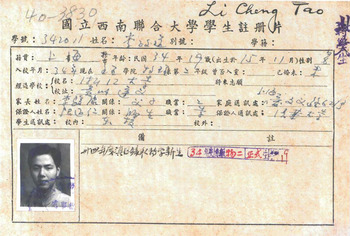
Almost 80 per cent of CUSD-ROC data, like the data for our 2013 book on elite higher education in the PRC, come from student matriculation cards similar to that shown in Figure 1.Footnote 27 These cards record information on the student's personal characteristics (name, sex and religion, previous and current education); prior schooling, including university and current major; and family and social background (names, occupations, places of origins and residential addresses of the student's parents and guarantors).
National South-West Associated University 1945 Student Matriculation Card

As the CUSD-ROC includes the names of students, parents and guarantors, it allows us to extend our study of individual characteristics to include a variety of information not in the original records. We can accordingly link CUSD-ROC students by name and university to their other records in the CUSD-OS and the CUED-ROC, and thus link undergraduates to post-tertiary study and/or academic employment, and we can do so intra-generationally to link other students in the CUSD-ROC with the same parents or guarantors, as well as intergenerationally if the parents and/or guarantors themselves are also in the CUSD-ROC, CUSD-OS and/or CUED-ROC.
The CUSD-OS is particularly important in terms of understanding the development of tertiary and post-tertiary education in China because of the unusually high proportions of Chinese students who formally studied abroad and who were subsequently employed by Chinese tertiary institutions. In addition to the 300,000 first-degree graduates from Chinese tertiary institutions, more than 131,000 of whom are already in the CUSD-ROC, another 60,000-plus Chinese students graduated from universities abroad during this time, about half at the undergraduate (UG) level and half at the post-graduate (PG) level, five-sixths of whom are already in the CUSD-OS.Footnote 28 These include over 35,000 Chinese students who graduated from Japan, about 10 per cent of whom were female, and more than 25,000 Chinese students who graduated from North American and European universities, about 20 per cent of whom were female. In Japan, the majority of overseas Chinese students were UG students, reflecting the late development of Japanese post-tertiary education. In the US and Europe, the proportions were approximately one-third UG and two-thirds PG.Footnote 29
Meanwhile, the CUED data created by Ren allow us to link students’ family social and spatial origins, personal characteristics and educational experience to the world of work, focusing in this paper on 7,576 unique university faculty recorded in the CUED-ROC, 2,009 of whom can be traced to their CUSD-ROC records. These include 4,475 faculty members surveyed nationally by the ROC Ministry of Education in 1941 and 1944, and 3,814 additional faculty registered by the PRC Ministry of Education in 1950 for the East China Region, comprising Shandong, Jiangsu, Shanghai, Zhejiang, Fujian and Anhui.Footnote 30 Together, the CUED-ROC faculty account for as many as three-quarters of the MOE-estimated 10,000 university faculty national population in 1950.Footnote 31
We intend to make all the information derived from publicly accessible records (about half the CUSD-ROC), as well as the majority of the CUSD-OS and CUED, publicly available following the protocol of such other large data public releases as the China Multi-Generation Panel Datasets, CMGDP-LN and CMGDP-SC, which we have already made available through the Inter-university Consortium for Political and Social Research, University of Michigan, at https://www.icpsr.umich.edu/icpsrweb/ICPSR/series/265, in 2010 and 2014,Footnote 32 and the China Government Employee Dataset – Qing (CGED-Q hereafter), which we began to release in 2019 through the Hong Kong University of Science and Technology and the Renmin University Institute of Qing History.Footnote 33
These sources, together with other large publicly accessible historical databases,Footnote 34 record information on 2.5 million unique historical Chinese individuals.Footnote 35 As we show below, they are already sufficient to complicate, enhance and qualify many of our previous understandings of past Chinese society, including the Republican academe, and even our appreciation of contemporary Chinese society, with its one million plus university-educated Chinese and 600,000 Chinese pursuing tertiary and post-tertiary education abroad, especially in the US.
International Education, Standards and Leadership
A good example of such new information is the well-studied large number of Chinese tertiary and post-tertiary students who chose to study abroad, in particular in Japan in the first quarter of the 20th century, and in Europe and especially the United States in the second quarter of the 20th century.Footnote 36 Today, their contemporary counterparts, the 600,000 Chinese students studying abroad, while just 3 per cent of the 20 million Chinese enrolled in Chinese universities, are the largest national contingent of overseas students worldwide. In comparison, we now know – thanks to the CUSD-OS – that the more than 60,000 Chinese students who studied abroad between 1912 and 1952 represent one-sixth of all Chinese university students during this period, both domestic and international. Not only did 10 per cent of all Chinese undergraduates during the first half of the 20th century graduate from foreign universities in Japan, Europe and the United States instead of Chinese universities, over 5 per cent of Chinese university undergraduates, largely from the most prestigious universities, continued formal post-tertiary education abroad. Of these, 4–5,000 earned a PhD and more than 10,000 earned a terminal master's or post-tertiary professional degree. Many other Chinese students who went abroad are not counted here since they did not graduate with a formal degree from a recognized university and do not therefore fall within the parameters of our current study.Footnote 37
The CUED allows us now to appreciate the huge impact these foreign graduates had on the development of ROC Chinese academe. Nationally, the higher the faculty member's academic rank, the more likely he or she was to have studied abroad. Altogether, Chinese graduates with foreign university degrees account for almost half of all CUED university faculty and over three-quarters of full professors. According to Figure 2, almost 80 per cent of full professors in the CUED reported their highest degree to be from abroad, compared to 40 per cent of associate professors and 13 per cent of lecturers. Overall, 40 per cent of all full professors in the CUED received their education in the United States, compared to 20 per cent who studied in China and 10 per cent who studied respectively each in Japan, France, the UK and Germany.
International Education of Professorial and Non-professorial Faculty in the CUED

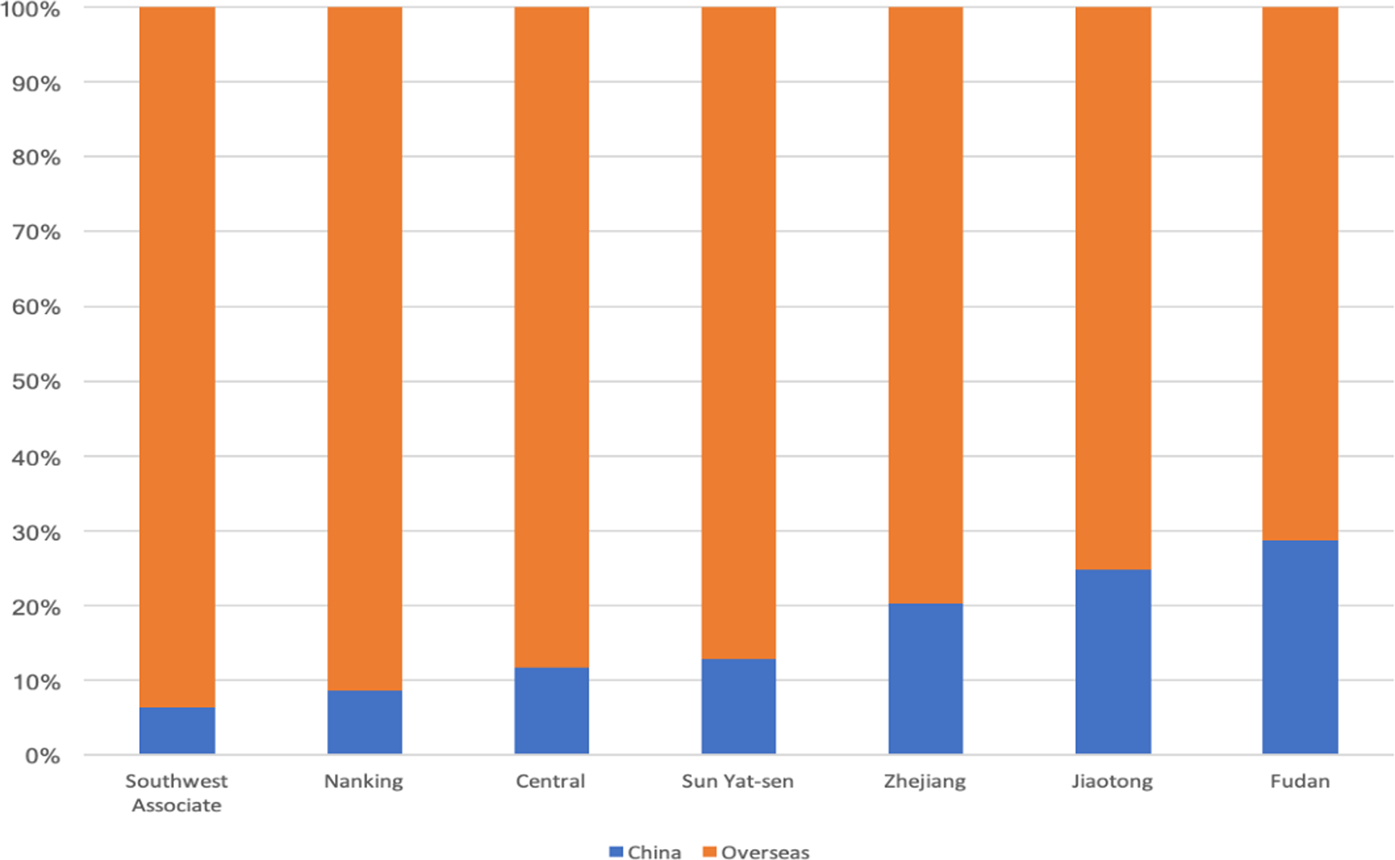
Generally, the better the university, the higher the proportion of foreign-trained Chinese faculty members. Figure 3 differentiates the proportion of foreign-educated faculty at seven of the top national universities in 1941, 1944 and 1950. Five universities had significantly higher proportions of foreign-trained faculty: South-West Associate (93 per cent), Jinling (91 per cent), Central (89 per cent), Sun Yat-sen (88 per cent) and Zhejiang (80 per cent). Only two universities – Jiaotong (75 per cent) and Fudan (71 per cent) – had close to national average proportions, but their data are solely from 1950 and reflects the emigration of many foreign-trained faculty in the late 1940s.
International Training of CUED-ROC Full Professors at Top National Universities
Note:
South-West Associate and Sun Yat-sen are based on MOE 1941 and 1944 surveys; Central includes data from Nanjing in 1950.

Many of these foreign-trained faculty were themselves also graduates of top Chinese universities. The higher the degree, the higher the concentration of alumni from top Chinese universities. In the United States, for example, almost 40 per cent of Chinese students who had previously studied in China came from just 14 of the 130 Ministry of Education recognized Chinese universities in 1947.Footnote 38 Moreover, matching 1,554 of 2,775 Chinese US PhDs to their records in the CUSD-ROC, we find that over 80 per cent of such matched Chinese PhD graduates came from just seven universities: Tsinghua, Zhejiang, Shanghai Jiaotong, Nanking, Peking, Sun Yat-sen and St John's.Footnote 39 Were we able to include Central and Yenching students, the two most conspicuously “top” universities missing from the CUSD-ROC, these meritocratic proportions would only increase.Footnote 40
This concentration of students from China's top universities in the best global universities in Japan, Europe and, especially, the United States is partly because, in contrast to today with the vast majority of current Chinese students overseas being self-funded, one-third to one-half of the formally enrolled Chinese students overseas, especially in the first quarter of the 20th century, were selected largely according to their performance in competitive examinations and supported by Chinese central and provincial authorities or by foreign governments – the US beginning in 1909, France beginning in 1916, and the UK from 1926 onwards – and by foreign non-government organizations afterwards.Footnote 41
In other words, domestic and international tertiary admissions combined with tests for post-tertiary international placement and international funding support to create a Republican examination hierarchy which produced successive generations of China's academic and professional elite. Furthermore, it was the interaction of their individual and collective leadership and central state policy which not only produced China's universities during this period but also defined the complicated history of Chinese universities throughout this formative century.Footnote 42
Female Tertiary Education in the Republic of China and the CUSD-ROC
Further analyses of the CUSD-ROC, CUSD-OS and CUED have already produced several new discoveries regarding female tertiary education in China, schooling abroad and subsequent academic employment during this period. The first finding is simply the rapid increase in co-education not just in general but in many of China's most elite universities. The second is the unusual high proportions of female students who majored in STEM subjects, with the exception of engineering. The third is the unexpected opportunities for female academic employment, which, while far from being equal to those for men, were nevertheless far greater than in many developing and developed countries at that time.
The early spread of co-education in China is already well known. In 1920, two prominent Chinese universities, Peking University and Nanjing Higher Normal School, were the first to formally admit female students. Two years later, there were already 31 Chinese non-missionary tertiary educational institutions open to women, and most were co-educational.Footnote 43 By 1931, almost all of the 41 registered universities were fully co-educational, except for one relatively remote provincial engineering university (Northeastern China Jiaotong) and two Catholic male universities (Aurora and Fu Jen Catholic).Footnote 44 In addition, there were three female-only colleges – Ginling College in Nanjing, Hackett Medical College in Guangzhou and Hwa Nan College in Fuzhou.
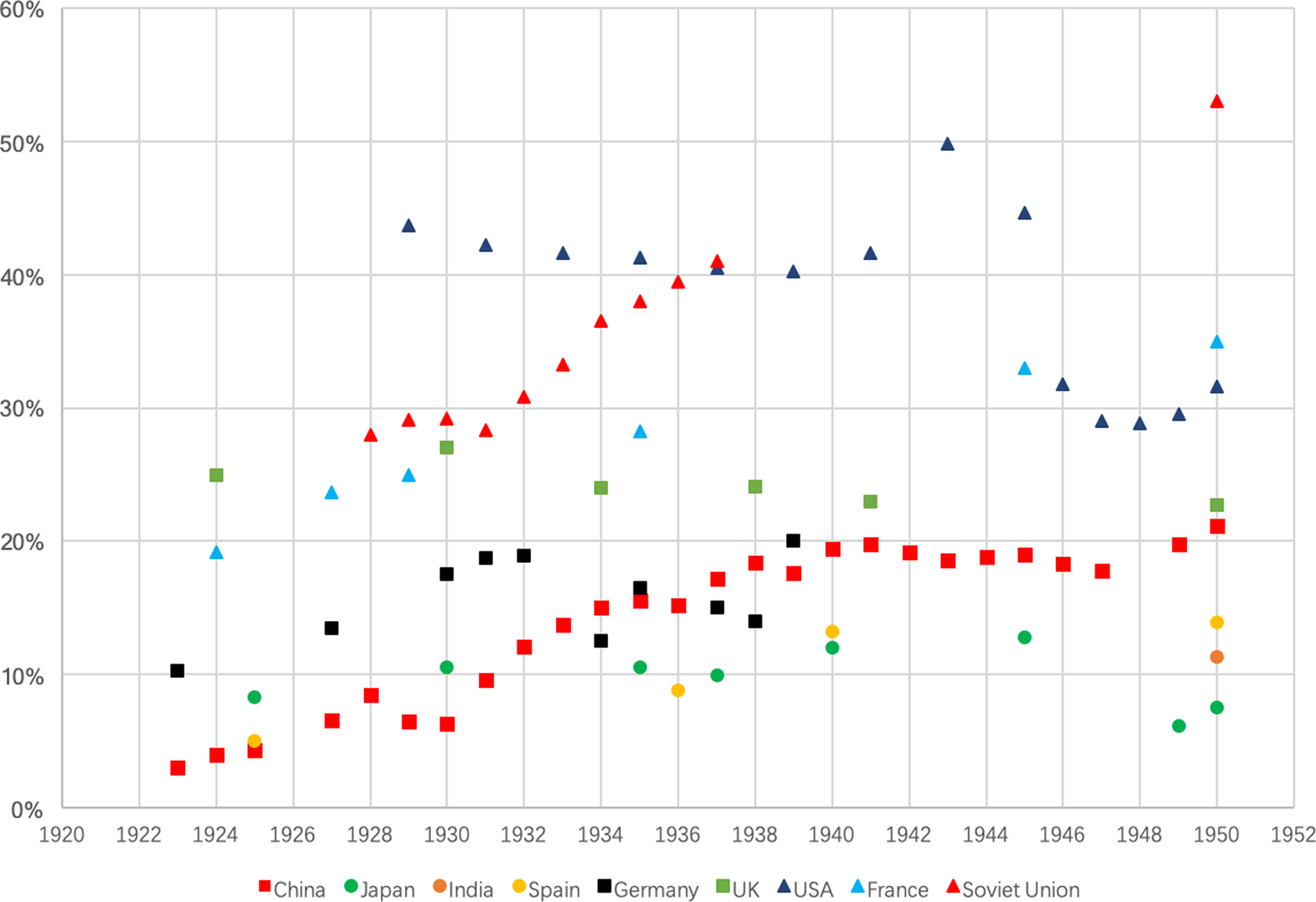
Female tertiary enrolments in China, in other words, began considerably later than was the case in North America and Western Europe, but by the standards of the first half of the 20th century, they were already high by the late 1930s. According to Figure 4, among large populations in the second quarter of the 20th century, only the Soviet Union, USA and France, denoted by triangles, had consistently higher female tertiary enrolment. And only in the Soviet Union were female tertiary proportions increasing even faster and higher than was the case in China.Footnote 45 The proportion of domestic female tertiary graduates in China was well ahead of those in Spain, Japan and India, denoted by circles in Figure 4, and more or less equal at different times to such advanced European countries, denoted by squares, as Germany and, in 1950, even the UK. According to Yiqi Mei, over 20 per cent of the Chinese students who studied in the US were female,Footnote 46 as were, according to the CUSD-OS, 10 per cent of the Chinese students who studied in Japan. These proportions suggest that Chinese females, given the more open context of US education, were as successful in pursuing educational opportunities abroad as they were in China, but when confronted with the closed opportunities offered by Japanese universities, they were only as successful as their Japanese counterparts, of whom only 10 per cent went to university.
International Comparison of Percentage of Female Tertiary Students
Sources:
The data for China are taken from Ministry of Education 1948 and CUSD-ROC; for Japan, Ministry of Education, Culture, Sports, Science and Technology–Japan, http://www.mext.go.jp/b_menu/hakusho/html/others/detail/1318190.htm, which may include two-year as well as four-year institutions; for India, from Kelly and Slaughter Reference Kelly and Slaughter2012; for Spain, Davies Reference Davies2000 and Flecha García Reference Flecha García2011; for Germany, Stephenson Reference Stephenson1975; Reference Stephenson, Cocks and Jarausch1990; for the UK, from Anderson Reference Anderson1995 and Bolton Reference Bolton2012; for the USA, Snyder Reference Snyder1993; for France, Tournier Reference Tournier1973 and Klineberg Reference Klineberg2015; and for the Soviet Union, data come from Fitzpatrick Reference Fitzpatrick1978 and De Witt Reference De Witt1955; 1961. With thanks to You Zuo.

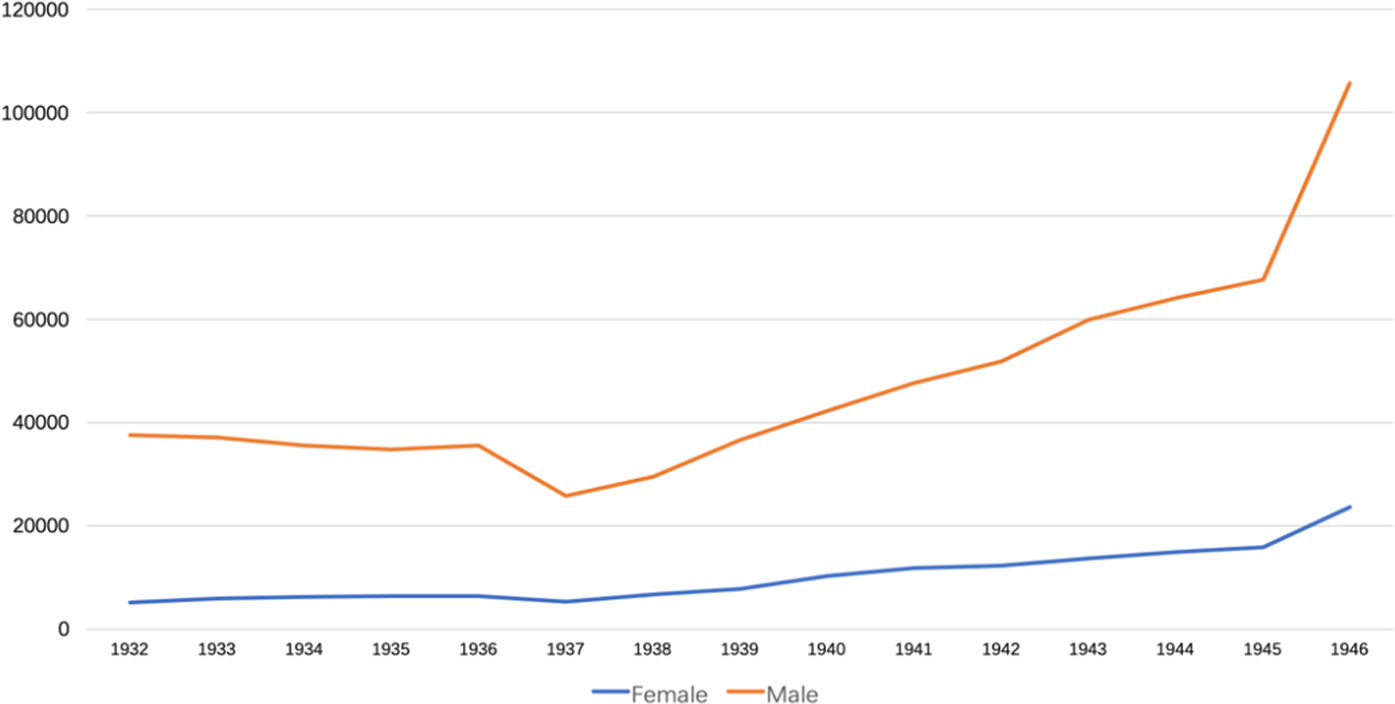
In fact, although the proportion of female tertiary students hardly changed from 1938 to 1948, the number of female students reported by the Republican Ministry of Education quadrupled during this decade, from 6,000 to 24,000, while the number of male students tripled from 29,000 to 100,000. This increase, which reflects the establishment of 100 new universities and specialized schools (from 106 in 1932 to 207 in 1947), is singular considering that by 1945 the Japanese controlled much of China, including large parts of ten Republican provinces (Jiangxi, Henan, Shanxi, Anhui, Zhejiang, Suiyuan, Guangdong, Hubei, Guangxi and Hunan), and nine provinces in their entirety (Heilongjiang, Jilin, Liaoning, Hebei, Shandong, Jiangsu, Rehe, Chahar and Taiwan).Footnote 47
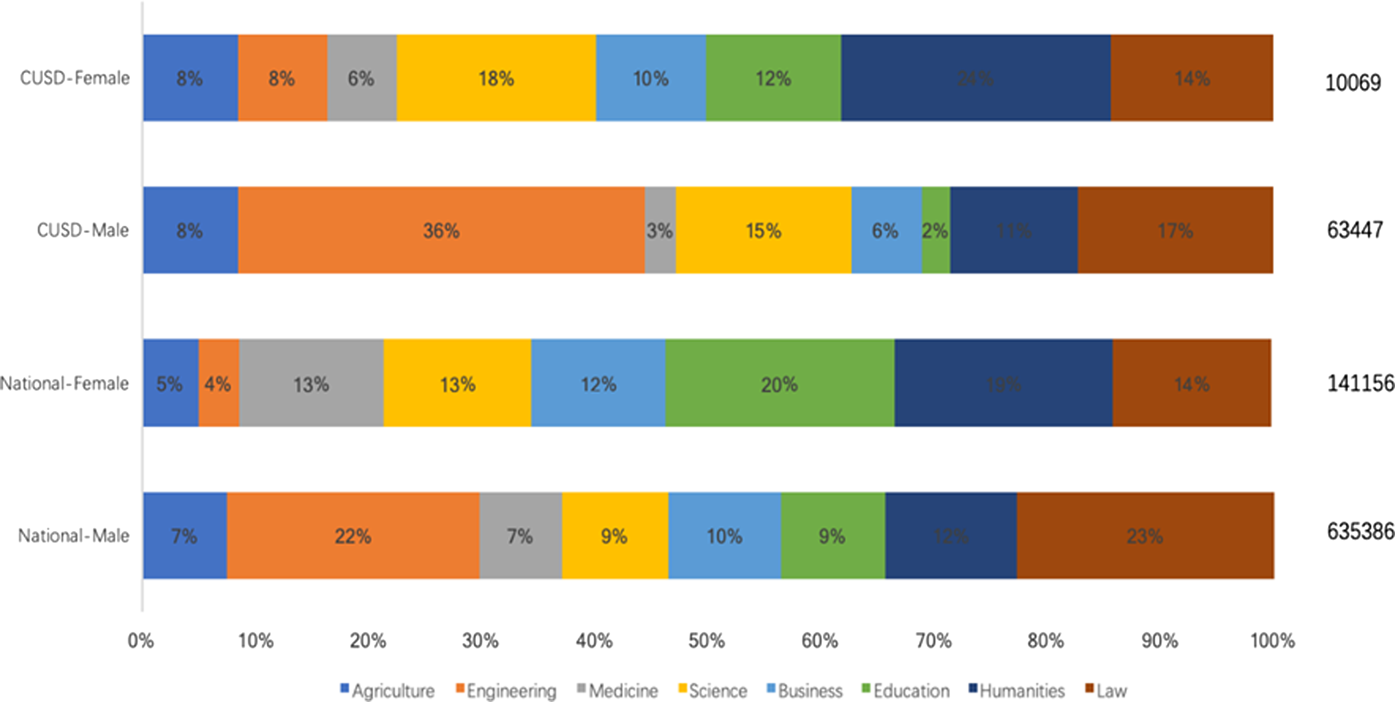
Data on student majors from the CUSD-ROC furthermore suggest that the proportion of female students would have been even higher in Republican China were it not for government quotas favouring engineering, which was overwhelmingly male, especially at many of the best national universities. Figure 6 contrasts the 16,146 female and 75,170 male students, who together constitute the CUSD-ROC, by student major.Footnote 48 Engineering students accounted for one-quarter of all undergraduate students nationally, in contrast with the US, the UK and France at this time (where they accounted for only 5 per cent), and were particularly predominant in CUSD-ROC universities, especially government universities where they accounted for over one-third of all public university students. As a result, while 29 per cent of CUSD-ROC missionary university students and 21 per cent of CUSD-ROC private university students were female, only 13 per cent of CUSD-ROC public university students were female.Footnote 49

National and CUSD-ROC University Student Enrolment by Major and Sex
Notes:
See Ministry of Education 1948 for national data.

The predominance of males in engineering is hardly surprising given that most engineers majored in three fields – civil, electrical or mechanical engineering – in preparation for employment either in construction or in manufacturing. Engineers in these fields were expected to work and direct a work force that was largely male and often of rural origins with little or no formal prior education. Female preferences to major in education, the humanities and medicine, also shown in Figure 6, may reflect a similarly gendered employment market.
What is surprising in Figure 6 is that the proportions of tertiary student majors by gender nationally and in the CUSD-ROC were roughly the same in almost every field of knowledge excluding engineering, education, the humanities and health. For example, in agriculture it was 5 versus 7 per cent nationally, and 8 versus 8 per cent in the CUSD-ROC; 10 versus 6 per cent in the CUSD-ROC for business; 14 versus 17 per cent in the CUSD-ROC for law; and even in science it was 18 versus 15 per cent in the CUSD-ROC. Unlike today, knowledge and academic careers in Republican China were only partially gendered.
Perhaps as a result, while the proportion of female faculty in China in the 1940s was well below the proportion of female faculty in the US in the late 1970s, below 8 versus over 20 per cent,Footnote 50 the proportions of female faculty in China's best universities in the 1940s were comparable to the proportions of tenured female faculty in the best US universities in the late 1970s: 6.8 per cent in Nanking (excluding Ginling College) and 3 per cent in most other elite Chinese universities, compared to 3 per cent at Harvard, 1.6 per cent at Yale, 1 per cent at Princeton and 5 per cent at Stanford, Berkeley, Chicago and Columbia.Footnote 51 The proportions were also considerably higher than in other advanced European countries as well as the developing world in general.
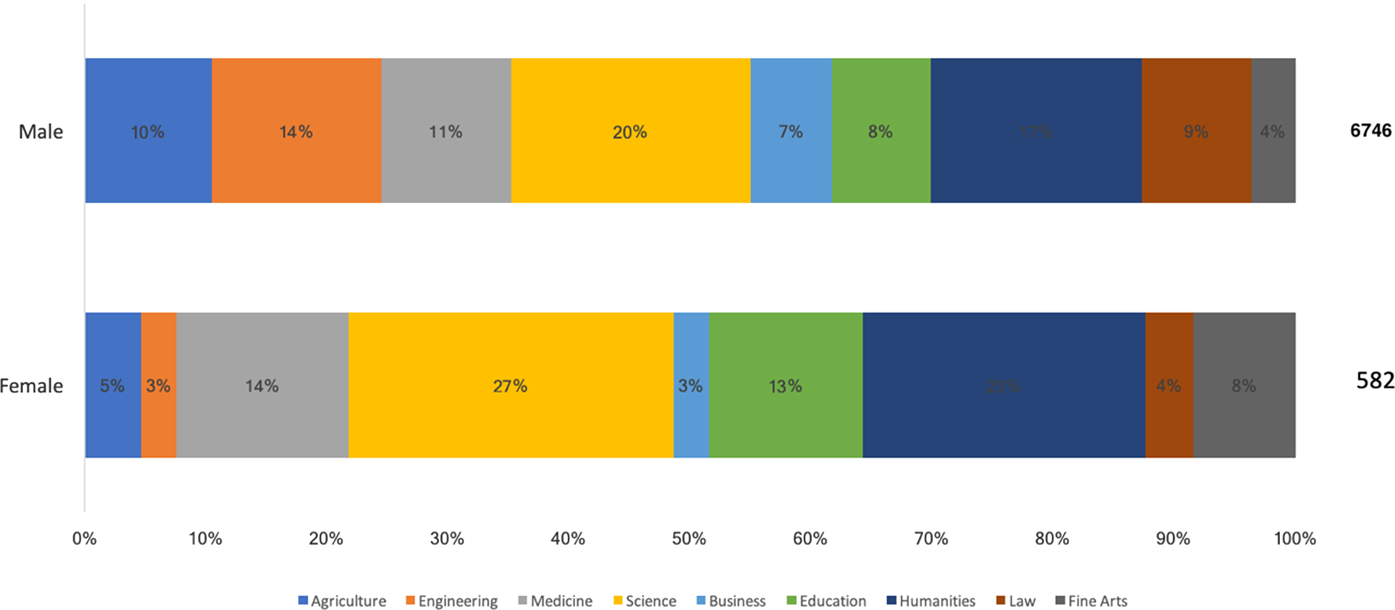
Moreover, while most tenured female faculty in the US were in the humanities and education, nearly half of the Chinese female faculty staff (49 per cent) were in STEM subjects – compared to 55 per cent of the male faculty members. Only the distribution depicted in Figure 7 was different: 27 per cent of female faculty were in the sciences, 14 per cent in medicine, 5 per cent in agriculture and 3 per cent in engineering. This is in comparison to 20 per cent of male faculty in the school of science, 11 per cent in medicine, 10 per cent in agriculture and 14 per cent in engineering. Female positions in science and engineering faculties elsewhere in the developed world during the first half of the 20th century remained comparatively rare.Footnote 52
CUED-ROC University Faculty in STEM and Other Fields by Gender

ROC Emphasis on Science, Agriculture, Engineering and Medicine
The surprisingly high proportion of Chinese female professors in STEM was in keeping with ROC government policy encouraging academicians to pursue agriculture, engineering, medicine and science. In 1931, the ROC Ministry of Education formally differentiated between three levels of tertiary education – university, institute and specialized school – and eight faculties: the humanities, science, law, education, agriculture, engineering, business and medicine. All universities had to include at least three faculties, at least one of which had to be science, agriculture, medicine or engineering. In 1933, the MOE mandated that no tertiary institution could admit more humanities students than STEM students. In 1935, the ROC Ministry of Education further restricted annual new student recruitment in humanities, law, business and education to no more than 30 students.Footnote 53
In fact, the proportions of STEM students in the largest and best-known national universities were very high from the beginning of the second quarter of the 20th century, if not earlier. Figure 8 summarizes the student majors recorded in the CUSD-ROC for six of the best-known national universities (Jiaotong, Nanking, Peking, Sun Yat-sen, Tsinghua and Zhejiang) from 1927 to 1948.Footnote 54 STEM student enrolments in these universities, in spite of some stochasticity owing to the incomplete survivorship of student records especially in the 1920s, were always over 60 per cent, and in some years grew to as much as 75 per cent.
The Predominance of Engineering and Science in China's Top Universities
Sources:
Based on 40,989 CUSD-ROC records for Jiaotong, Nanking, Peking, Sun Yat-sen, Tsinghua, and Zhejiang Universities. (Another 8,963 records are undated.)

Nevertheless, according to Hu Shi, even in the early 1940s the government believed that nationally “there is already a great shortage of trained personnel in various fields, especially in science and technology.”Footnote 55 Hu Shih's suggested solution, that “the training of scientific and technical personnel for cultural and economic reconstruction in China will depend more than ever before upon sending students to study in the United States,” effectively tied the distinctive emphasis of Republican higher education policy on STEM subjects and the overwhelming presence of STEM students in many of China's best universities to another equally distinctive feature of the Chinese academe: the high proportion of Chinese students and faculty who studied or continued to study internationally, particularly in the United States.
New Social and Spatial Inequalities
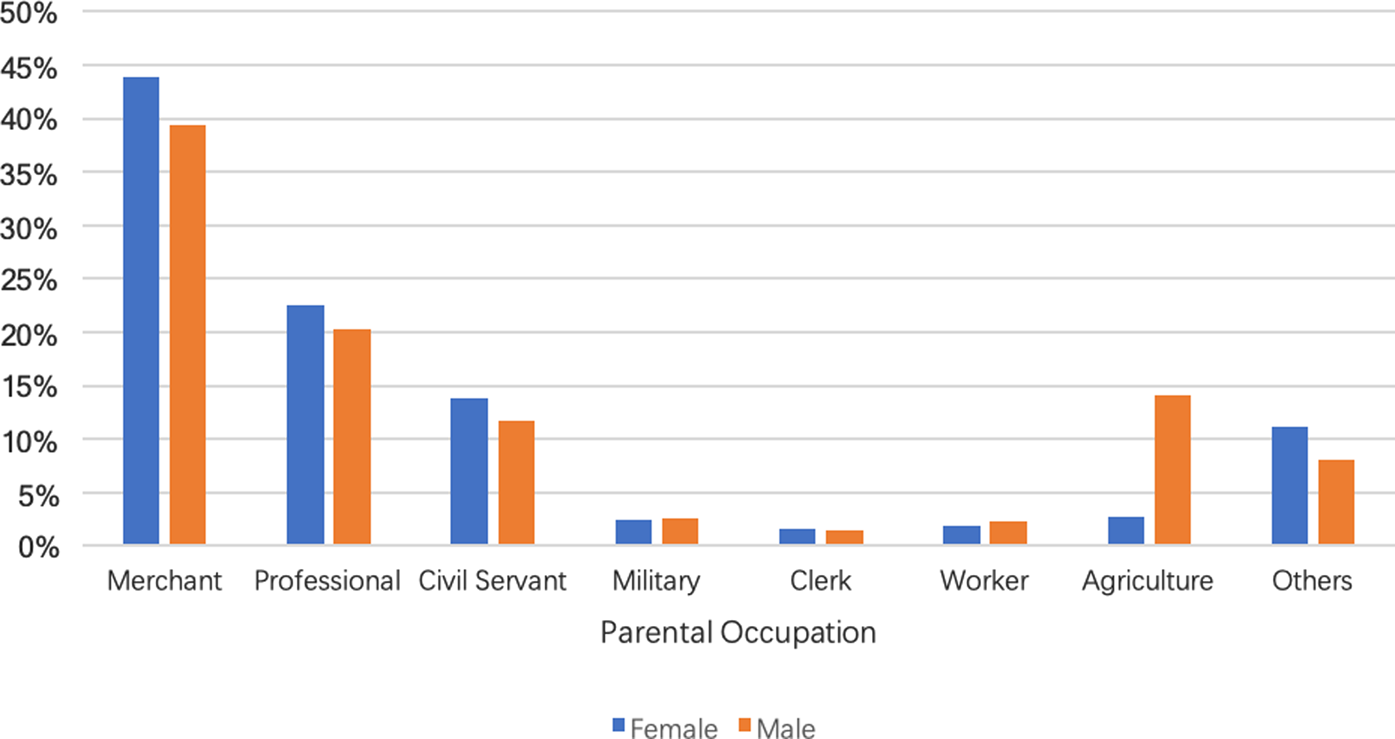
In fact, as we discuss in detail elsewhere, the consequent changes in university curricula and admission criteria contributed to a major transformation in the social origins of ROC university students. In the late 19th century, almost 70 per cent of the successful civil service test candidates were children of high officials and degree holders.Footnote 56 In contrast, according to student-reported parental occupations in the CUSD-ROC, summarized in Figure 9, the proportion of students from civil servant families dropped abruptly from almost 70 to no more than 14 per cent. Instead, 60 per cent of CUSD-ROC students, persisting into the early 1950s, recorded that they came from merchant or professional families. Footnote 57
Parental Occupation in the CUSD-ROC by Gender

According to Figure 9, there was little difference by gender. The only major exceptions were students from farm families, who were predominantly male, suggesting that the distinctive rise in the proportion of female tertiary students in the 1920s and 1930s was overwhelmingly an urban phenomenon.
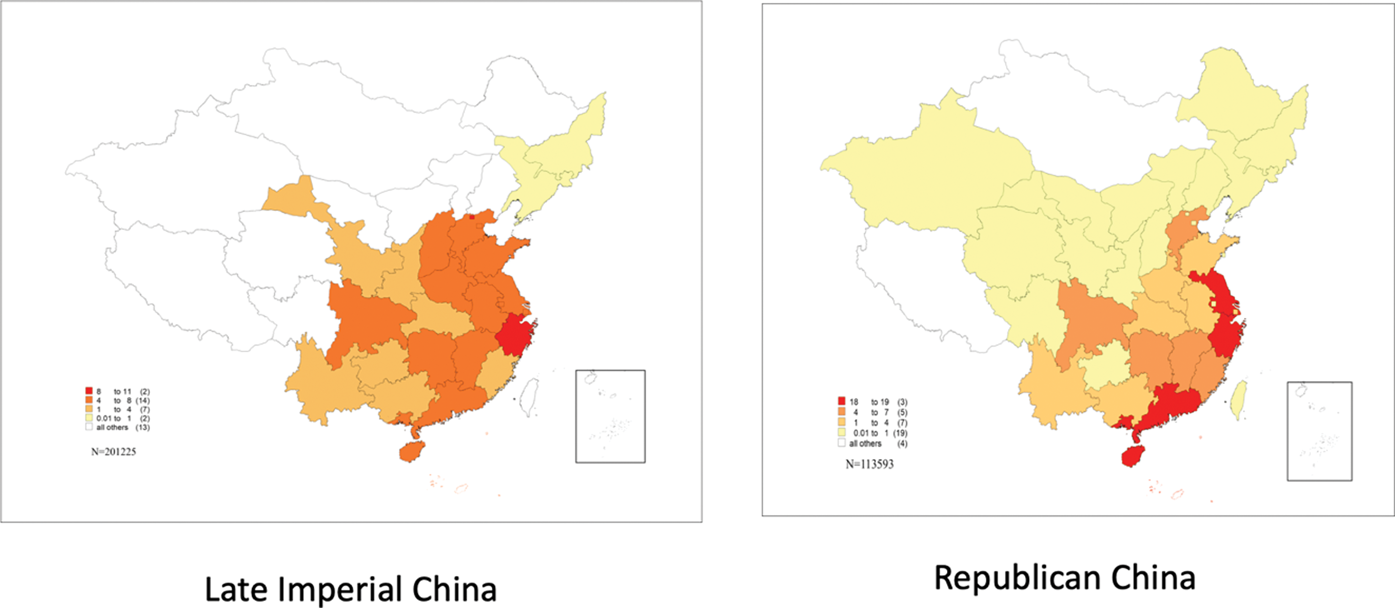
Moreover, the different social composition and academic preferences of tertiary students during the first half of the 20th century reflects equally profound changes in students' place of origin (jiguan 籍贯).Footnote 58 According to Maps 1 and 2, while 30 per cent of the civil officials who were appointed owing to their performance in the civil service examination (according to data from the CGED-Q) came from north China – that is Beijing, Tianjin, Hebei, Henan, Shandong and Shanxi – these proportions declined in the CUSD-ROC by two-thirds to just 10 per cent. Instead, students from Jiangnan and the Pearl River Delta, who had accounted for just 24.4 per cent of successful test candidates in late Imperial China, grew in Republican China to 58.4 per cent. According to data from the CUSD-ROC, the proportion of students from Zhejiang increased from 10 per cent in late Imperial China to 18 per cent in Republican China, the proportion of students from Jiangsu, including Nanjing and Shanghai, increased from 7.8 per cent in late Imperial China to 21 per cent in Republican China, and the proportion of students from Guangdong, including Guangzhou, increased from 5.9 per cent in late Imperial China to 18.5 per cent in Republican China. Such profound changes in student spatial origins suggest that most ROC University students were not related to previous imperial examination lineages (keju jiazu 科舉家族) but rather came from fundamentally different families.
Place of Origin of Late Imperial Degree Holders vs CUSD-ROC Students

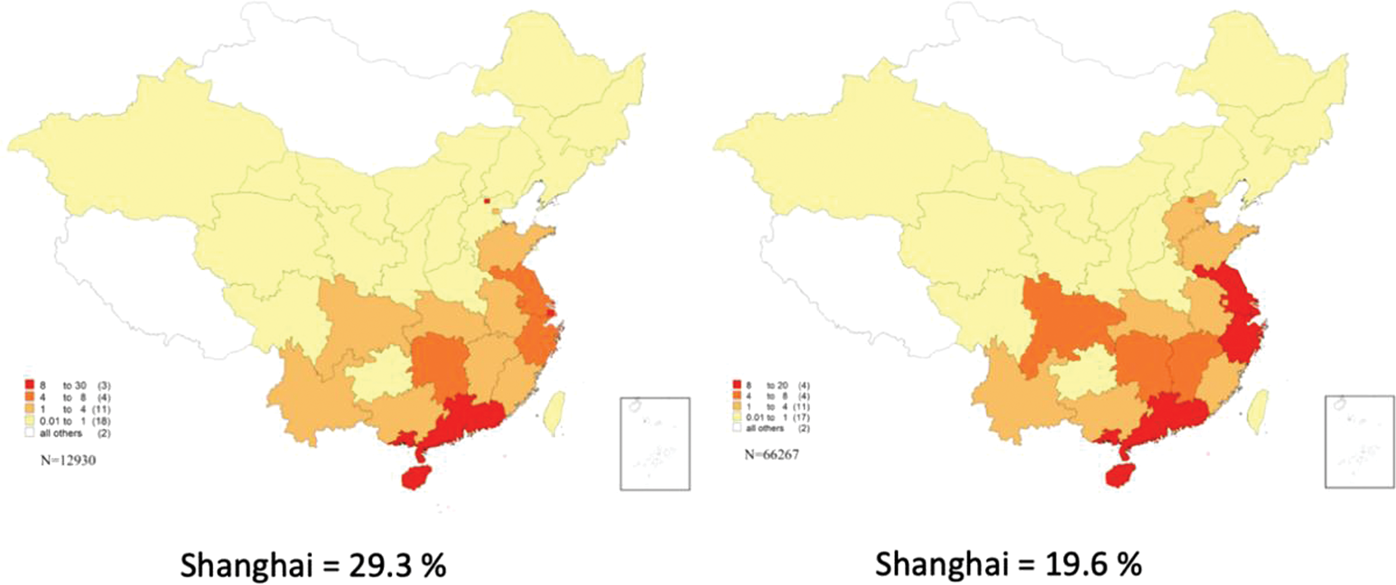
In fact, many ROC university students came from just a handful of cities. While only 4 per cent of students in the CUSD-ROC reported that their place of origin was either Beijing, Guangzhou, Nanjing, Shanghai or Tianjin, 36 per cent listed a residential address in one of these five cities as their regular mailing address (yongjiu tongxin chu 永久通信处) or current home address (jiating dizhi 家庭地址). Meanwhile, Maps 3 and 4 show that female students’ families were far more likely than male students’ families to live in Shanghai, 29.3 per cent versus 19.6 per cent. Female tertiary students were also far more likely than male tertiary students to have gone to high school in Shanghai, 45.2 per cent compared to 31.5 per cent, even if their mailing address or home address was not in Shanghai.
30 per cent Female CUSD-ROC Students Homes Are in Shanghai Compared to 20 per cent of Male Students

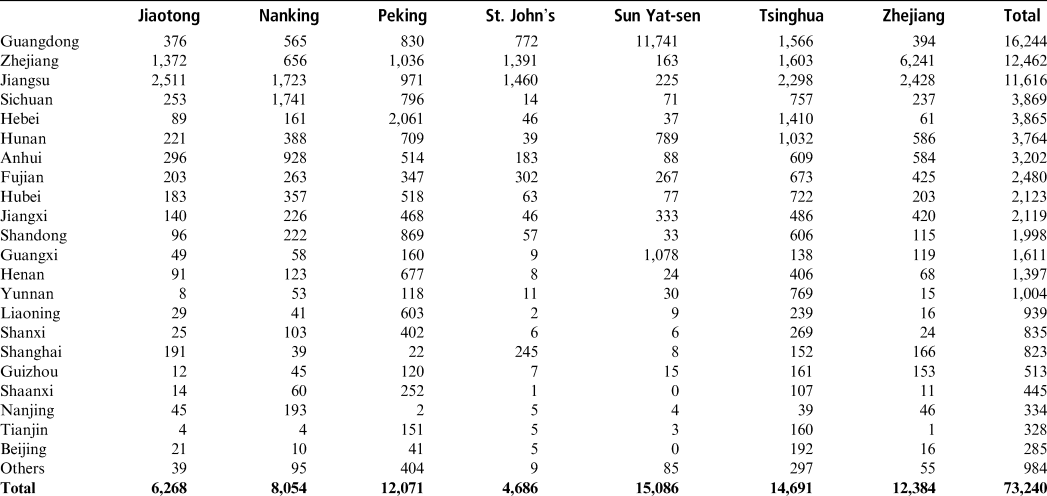
University students and female students especially came predominantly from two regions: first and foremost the Yangtze River Delta (YRD hereafter) and, to a lesser extent, the Pearl River Delta (PRD hereafter), plus Beijing and Tianjin. Students from the YRD and PRD in fact predominated not just in the best domestic universities, including Peking, but also in the best international universities. Table 1 summarizes the provincial origins of 73,240 CUSD-ROC students at the top universities included in this dataset. Over half, 56 per cent, came from the YRD and PRD, including 16,244 (22 per cent) from Guangdong; 12,462 (17 per cent) from Zhejiang, and another 12,773 (17 per cent) from Jiangsu including Shanghai and Nanjing. Moreover, were we to consider family address instead of provincial origin, the proportion of students from the YRD would increase from 34 to 40 per cent, while the PRD proportions would remain more or less the same. According to Mei Yiqi's study of the provincial origins of 13,770 Chinese overseas students who studied in the US before 1954, this was also true.Footnote 59 Over half came from the YRD and PRD: 4,473 (37 per cent) came from Jiangsu including Shanghai and Nanjing; 757 (5 per cent) came from Zhejiang; and 2,334 (17 per cent) came from Guangdong – half from Guangzhou and the other half province wide.
Provincial Origins of Students at Top CUSD-ROC Chinese Universities

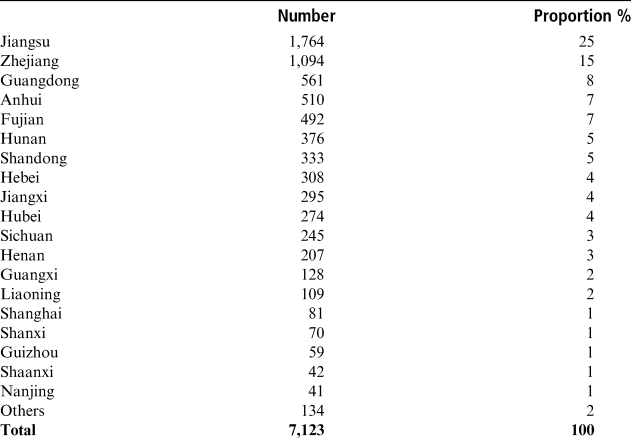
Three provinces, Jiangsu, Zhejiang and Guangdong, which accounted for less than one-fifth of China's total population in the first half of the 20th century, provided more than half of all Chinese tertiary students both domestically and abroad. Moreover, while these students accounted for the majority of China's future professionals – accountants, doctors, engineers, lawyers and officials – they also accounted for the majority of China's university faculty. Table 2 contrasts the provincial origins of CUED professors and other faculty staff. Half of them came from the YRD and PRD: 27 per cent of all CUED university faculty came from Jiangsu, including Nanjing and Shanghai; 15 per cent came from Zhejiang; and 8 per cent came from Guangdong. These proportions increase to 57 per cent if we look only at those who earned a PhD degree, 25 per cent of whom came from Jiangsu, 18 per cent of whom came from Zhejiang, and 14 per cent of whom came from Guangdong.Footnote 60 However, while 20 per cent of the students at China's top universities and abroad were female, the female proportions of future faculty and PhD graduates were far less: 8 per cent of all faculty and 3 per cent of all PhDs.
Provincial Origins of CUED Professors and Other Faculty

Conclusion
New big historical data sources show that while the educated elite in the late Imperial (1368–1911) and Republican (1912–1949) periods were chosen by objective examination, their social and spatial origins differed greatly. The imperial examination elite were the sons and grandsons of civil officials, who came from a national rural population of landed gentry. The Republican university elite were the sons and daughters of urban businessmen and professionals, concentrated largely in China's most developed regions: the YRD and PRD. While these social inequalities have since experienced a “silent revolution,” the spatial inequalities – region and rural/urban registration – continue to persist to today.Footnote 61
The overlap between human capital production and economic production, however, draws this narrative full circle. Today, half a century later, two of the most conspicuously successful regional Chinese economies, including the 20 or more Special Economic Zones throughout China, are the Yangtze Delta, including Shanghai and Pudong, and the Pearl River Delta, including Shenzhen and Guangzhou. While the link between human capital, domestic and foreign investment, and economic growth has already attracted scholarly attention,Footnote 62 the detailed historical and analytic narrative of secondary, tertiary and post-tertiary education and employment, both regionally and internationally, needs more development. We need to gain a better understanding of how the creation and location of so many of China's secondary and tertiary institutions of learning during the first half of the 20th century contributed to China's spatial inequality during the second half of the 20th century. We also need to explore how these and other distinctive features of the early Chinese academe – international training, regionally based student recruitment, with high female and STEM proportions – contributed to China's subsequent political and economic development. But these topics are outside the parameter of this preliminary exploratory article.
Today, as we transform from an industrial to a knowledge economy, human capital based on knowledge and skills has become more and more important in the job market. Worldwide, we can observe the rise of a meritocratic educated elite, drawn from an increasingly global population, defined by abilities and skills, who are to a greater or lesser degree independent from earlier political and property-based elite populations. Elite university admission and elite firm employment have accordingly become increasingly competitive since such elite university/company graduation and employment are a necessary precondition for global elite social status and economic standing.Footnote 63
China stands out as a precursor of this global trend since it has a long history of meritocratic selection for elite employment, based on individual performance in “objective” standardized tests, which were restricted at first to specific social and spatial population categories but then increasingly open to society as a whole. This paper on meritocracy and opportunity in Republican China demonstrates that the historic evolution of China's meritocratic elite in the first half of the 20th century contributes to our understanding both of an ongoing second great transformation, from political and property elites to meritocratic examination elites in general, and of the historic origins of contemporary social and spatial inequalities in China today specifically.Footnote 64
Many of the distinctive features of contemporary Chinese tertiary education –international, female, STEM, urban, and even region – date back to the Republican period. Only the focus on meritocratic selection through testing predates the bourgeois 1911 Xinghai Revolution, and only the diverse proletarian origins of many of China's university students today, and the recent transformation of China's universities from teaching to research, came after the proletarian Communist Chinese Revolution.
The mutability of ascriptive categories in the Chinese academe – nationality, gender, wealth, location, work – has major implications for our understanding of China's current patterns of social mobility and social stratification. This mutability is a tribute to the ability of meritocratic selection by objective tests during much of the 20th century to “trump” the privileges of nationality, politics and property, producing the diversity of today's elite global society. At the same time, such meritocratic selection is also a major contributor outside of China to the recent backlash of previously privileged populations left behind.
This study also exemplifies how a data analytic approach using new Chinese historical microdata can transform our understanding of historical and contemporary China.Footnote 65 By linking individuals, their ancestors and descendants, as well as their different contexts across datasets and across time, we can understand better the intergenerational dynamics and long-term consequences of changing political values, public policies, population processes and socio-economic contexts associated with Who Survives, Who Gets Married, Who Gets Children, on one hand, and Who Gets Education, Who Gets Work, Who Gets Property, and, using the CGED-Q, Who Gets Authority, on the other. In so doing, we will be able to measure with far more accuracy the historical continuity and revolutionary change of who we were in the past and who we are today.
Acknowledgements
This study was supported by Hong Kong Research Grant Council Projects No. 16602117 and No. 640613, and by National Social Science Fund of China 15BZS073. We would like to thank Terry Bodenhorn, Cameron Campbell, Hao Dong and Michael Palmer for their editorial comments, as well as Chengcheng Liang, Yibei Wu, Li Yang, Mingyu Zhang, Zixin Zhang and You Zuo for specific contributions.
Conflicts of interest
None.
Biographical notes
Bamboo Yunzhu REN is a PhD candidate in social science at the Hong Kong University of Science and Technology and a 2018–2022 Hong Kong PhD Fellowship Scheme Fellow.
Chen LIANG is associate dean of the College of History and professor of history at Nanjing University as well as a 2019 “Outstanding Young Talent.”
James Z. LEE is Yan Ai Foundation chair professor of social science and chair professor in humanities at the Hong Kong University of Science and Technology.